 by Tom Gurney
Tom Gurney BSc (Hons) is an art history expert with over 20 years experience
Published on June 19, 2020 / Updated on October 17, 2026
Email: tomgurney1@gmail.com / Phone: +44 7429 011000
Looking at Birds
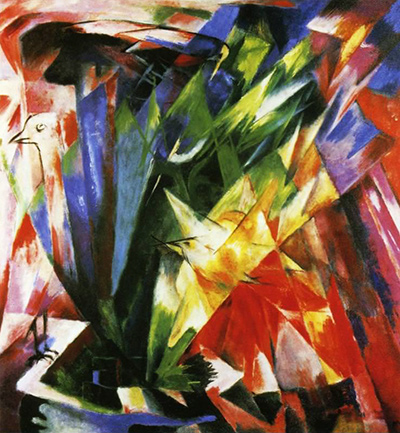
Three birds flicker through Franz Marc’s Birds. One pale creature stands at the left, its thin beak and round eye drawn with a few dark marks. A second appears high among blue and green shapes. A third emerges lower down, its light body caught in crossing bands of colour. Wings, leaves and rays are hard to separate. Marc painted the work in 1914, near the end of his short career. The painting lets an identifiable subject hover at the edge of abstraction: the birds are present, yet the surrounding movement almost carries them away. [1]
The Lenbachhaus in Munich records Vögel as oil on canvas, 109 × 100 cm. It is a nearly square picture rather than a horizontal landscape. An early sale catalogue described three bird forms within prismatic, spectrum-like colour; the current museum essay also identifies three. Counting them is a useful first task for a viewer, but the picture becomes more rewarding when the birds’ shapes are followed into the larger fan of blue, green, red, violet and white. [1] [2]
Watch: Franz Marc
Explore Marc’s blue horses, the Blue Rider circle and the move towards abstraction in English-language videos.
Franz Marc, Blue Horses and Der Blaue Reiter
An English-language introduction to Marc’s blue horses, animals, spirituality and the Blue Rider.
Watch on YouTubeFinding the three birds
The bird at left has the clearest face. Its pale neck rises beside a blue vertical passage, and a small eye and pointed beak make it immediately legible. The body below becomes less certain as white and pink areas join the surrounding forms. It seems to stand or watch while the picture moves around it. That relatively quiet presence gives the eye a place to begin before the rest of the painting opens up. [1]
Higher and nearer the middle, a dark head and narrow beak emerge among green and blue blades. This bird is harder to trace as a complete body. The lower bird is made from pale angular passages crossed by warm yellow and red; its head and beak are suggested with minimal dark strokes. Marc has reduced the signs needed to recognize each creature. A curved line or pointed mark may be enough for an eye or beak, while the body participates in the same colour geometry as everything around it. [1]
The larger composition moves diagonally. Green forms sweep upward across the centre; blue and violet regions press from the sides. Pale wedge shapes and red-orange accents break the field into a fan. The Lenbachhaus relates this spreading structure to a wingbeat. That analogy is a way to feel the painting’s movement, even where there is no single wing to outline. The birds’ flutter and the canvas’s shifting planes become almost one event. [1]
Yet the painting is not all motion. The pale left bird pauses in profile; the central forms meet at points that briefly hold still; the colour fan is balanced within the nearly square format. The museum essay describes a simultaneous sense of flutter and quiet. That tension lets the image avoid becoming a mere diagram of speed. We can watch for the instant before movement, the instant within it, or the stillness that remains when the eye settles on one bird. [1]
Colour, shape and late work
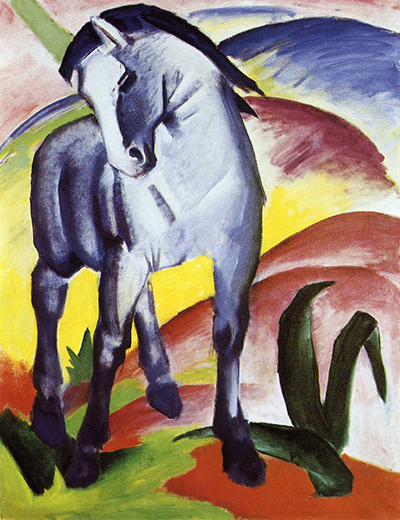
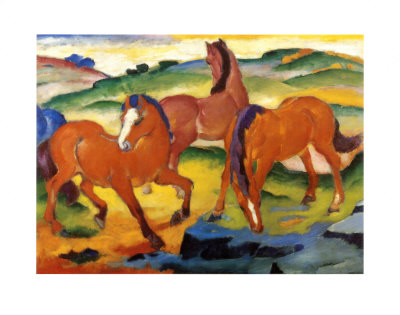
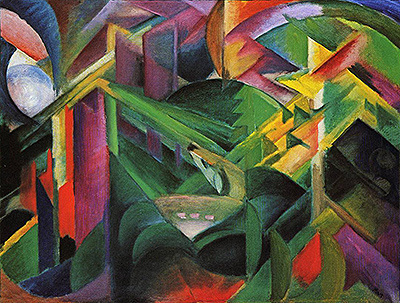
Marc had long joined animals to their surroundings through colour. In The Large Blue Horses, the curves of three bodies echo hills. In Deer in a Monastery Garden, an animal stands within fractured moonlit vegetation. Birds goes further: the creatures are indicated with only a few graphic signs and almost vanish into the field of colour. The change is one of degree and purpose, not a sudden rejection of living subjects. [3] [4] [1]
The Lenbachhaus essay connects the broken planes and bright colours with Marc’s engagement with Italian Futurism and Robert Delaunay’s painting. It cites art historian Armin Zweite on the way angled pieces allow both flight and watchful pause. Those comparisons help locate the formal language of 1914, but the image itself remains the test. The green fan across the middle, the sharply crossing pale shapes and the briefly visible birds show Marc adapting modern techniques to a particular sensation of animal life. [1]
The museum also quotes a letter Marc wrote to Maria in 1915 from military service. Looking back on his art, he described finding even animals and nature less pure than he had once hoped, and feeling driven towards more schematic, abstract forms. This later reflection can illuminate the direction visible in Birds, but it was written after the 1914 painting and in the altered circumstances of war. It should not be treated as a diary entry recording exactly what he intended at the easel when he painted these three birds. [1]
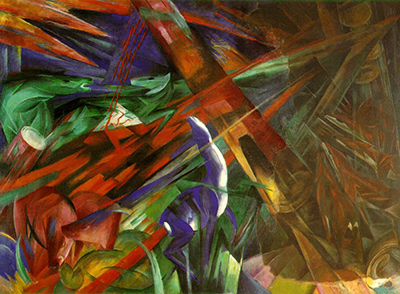
The birds are especially useful for thinking about abstraction because they have not disappeared entirely. Fighting Forms, also dated 1914, asks us to follow a contest of red and blue-black masses without a secure depicted animal. In Birds, a beak and eye remain enough to identify a creature. The artist could shift how much of the natural subject he retained rather than move along a single, irreversible ladder from depiction to pure form. [5] [1]
Confiscation and the Lucerne sale
The painting later passed through a coercive history. A Lenbachhaus exhibition label states that it was in Dresden’s Galerie Neue Meister until the Nazi authorities confiscated it on 12 August 1937. The original Galerie Fischer catalogue lists Vögel as lot 90 in the Lucerne auction of modern works removed from German museums on 30 June 1939, identifying Dresden as the source. This original catalogue settles the auction year: a later Lenbachhaus label inadvertently prints 1938. The painting did not enter that market as an ordinary voluntary sale by the Dresden museum. [6] [2]
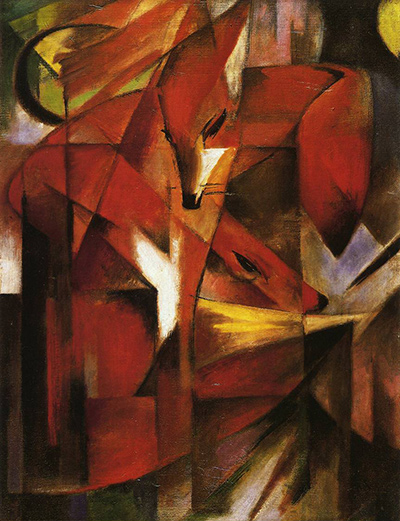
A Düsseldorf provenance report names the American collector Ray W. Berdeau as buyer at that sale and gives the price in dollars. The painting later reached the Lenbachhaus, with public acquisition support reflected in its current credit line. Its earlier route ran from Dresden through Nazi confiscation and the 1939 Lucerne sale; the Munich museum is its present home. [7] [1] [6]
That material history belongs beside the visual experience, not over it. The painting still asks us to look patiently. Find the pale bird at left, then the darker upper figure and the light form below. Follow the crossing colours that make wings and setting meet. Marc held recognisable creatures within a restless surface, so that an eye can both locate them and lose them again. Birds gives that movement a vivid, delicate shape. [1]
Artwork Directory
This source-checked selection contains 192 identified works and print designs from the current Franz Marc research set. It is a curated selection, not a complete catalogue raisonné. Some works link to their article here; others link to a collection record. Unresolved identifications are omitted.
Discussion
Three birds emerge from an increasingly broken field of colour.
Reader Insights
Observation
Which bird can you find first, and which is hardest to separate from the background?
Comparison
How does this late work differ from Marc’s more legible animal groups?
Interpretation
How does the painting’s later collecting history shape your encounter with it?
Join the Conversation
Which detail changed the way you saw this work? Share a close observation or a comparison with another Marc picture.
References
- Lenbachhaus, Vögel, G 17489 and Friedel/Hoberg essay. View source.
- Galerie Fischer, Lucerne sale catalogue, 30 June 1939, lot 90. View source.
- Walker Art Center, The Large Blue Horses. View source.
- Lenbachhaus, Deer in a Monastery Garden. View source.
- Bavarian State Painting Collections, Fighting Forms. View source.
- Lenbachhaus, expanded object label, 2024. View source.
- Düsseldorf, provenance research report on Marc’s Foxes, comparison with Birds. View source.
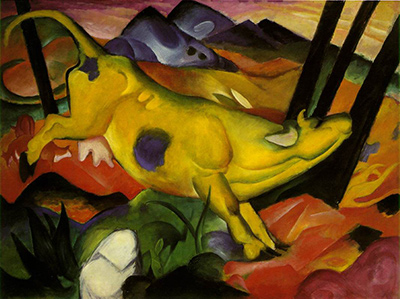
- Related artwork image, Yellow Cow: Photograph by Dr. Alexey Yakovlev; resized without crop or colour change, CC BY-SA 2.0.
- Franz Marc’s Birds, three birds among coloured forms. Legacy site reproduction of the artwork discussed on this page.