


 by Tom Gurney
Tom Gurney BSc (Hons) is an art history expert with over 20 years experience
Published on June 19, 2020 / Updated on October 17, 2026
Email: tomgurney1@gmail.com / Phone: +44 7429 011000
Explore Franz Marc’s paintings
Franz Marc’s paintings ask us to look at animals, land and colour in changing ways. An early horse may stand close to the edge of a field; a blue foal may fill a scene with calm; a deer may become hard to separate from a crystalline forest. In Marc’s last works, the animals can almost disappear as colour and form take the lead. This guide follows those shifts through particular paintings, with links to their full pages and an alphabetical catalogue for browsing. It is a way into the works rather than a single rule for interpreting them. [1] [2] [3]
Start with a painting
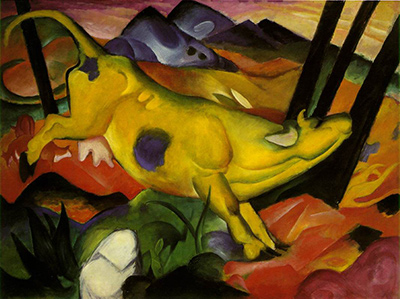
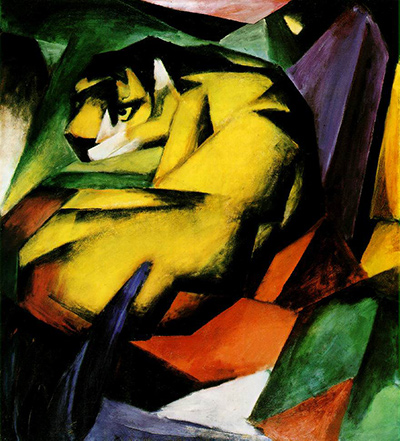
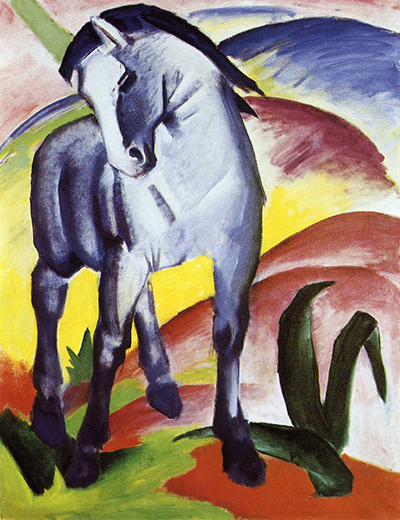
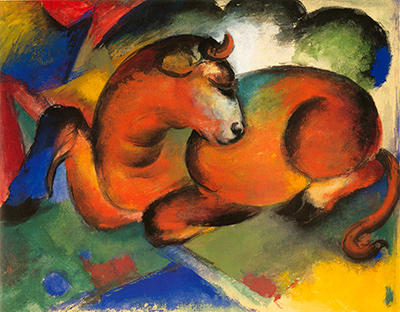
For a first encounter, Blue Horse I is a clear place to begin. The single blue foal stands against bands of warm and cool colour, its body and the land around it built from echoing curves. Yellow Cow gives a very different experience: one yellow animal leaps outward. Tiger uses angular shapes to hold a crouched body in a state of alertness. These three pictures show Marc varying pose, scale and colour to change how we meet an animal. [2] [4] [5]
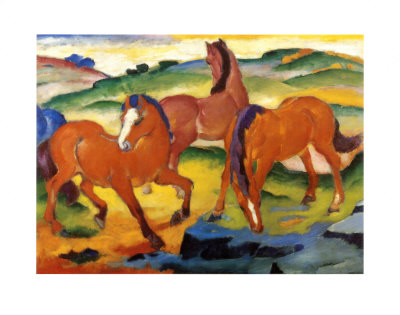
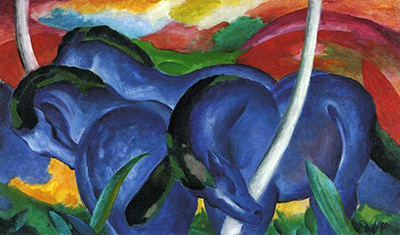
The horse paintings form a larger path through his work. Horse in a Landscape of 1910 puts a reddish horse between us and a field. In 1911, Blue Horse II gives a rear view of a blue horse, while The Large Blue Horses groups three animals into a wide, connected shape. Large Red Horses, also known as Grazing Horses IV, is another specific 1911 canvas, now at Harvard. The titles sound related, but each refers to an identified object with its own date, owner and composition. [1] [6] [7] [8]
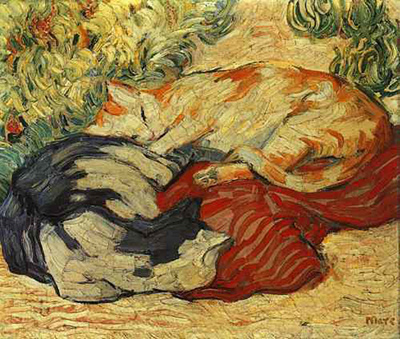
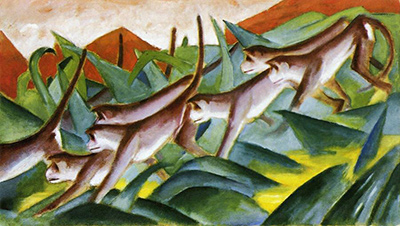
Other animals open different visual problems. The five donkeys of Donkey Frieze make a long rhythm of repeated heads and ears. In Three Cats, red, yellow and black-and-white bodies cross a busy 1913 field. The white cat of Cat on a Yellow Pillow sleeps in a quiet curl. Marc did not assign every animal one expression or use every colour in one way. The figure’s posture and its relationship with the space around it matter just as much. [9] [10] [11]
Watch: Franz Marc
Explore Marc’s blue horses, the Blue Rider circle and the move towards abstraction in English-language videos.
Franz Marc, Blue Horses and Der Blaue Reiter
An English-language introduction to Marc’s blue horses, animals, spirituality and the Blue Rider.
Watch on YouTubeLandscapes, people and animals
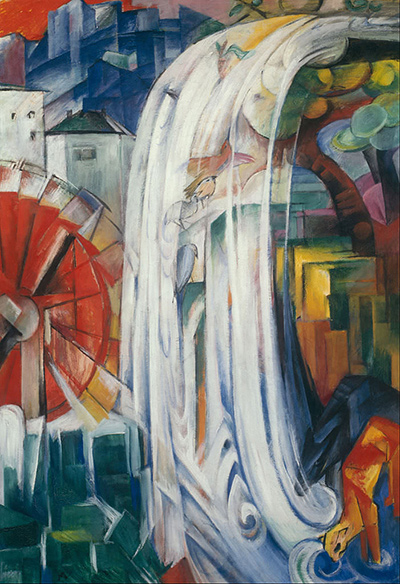
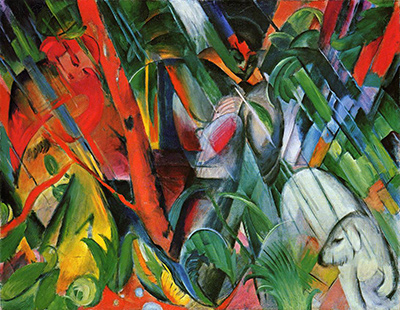
Marc’s painting was never only a catalogue of separate creatures. The Bewitched Mill of 1913 brings buildings, animals, trees and water into a tall scene. In the Rain depicts Franz and Maria Marc with their dog Russi in a shower, making a human subject unusually prominent. The Dream places a sleeping woman among animals in an imagined world. These works show how he could bring people into animal-centred art without treating the natural setting as mere background. [12] [13] [14]
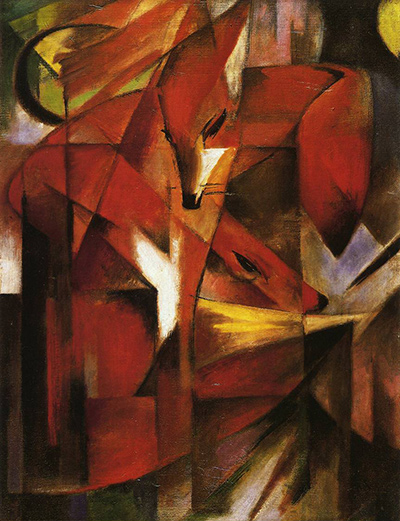
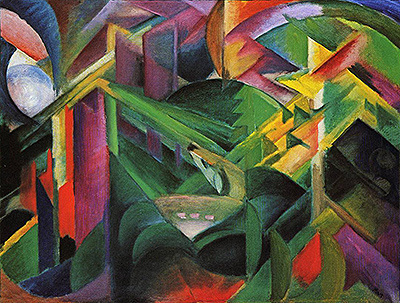
His deer paintings are especially easy to confuse by title. Deer in a Monastery Garden is a 1912 moonlit Lenbachhaus work with one small animal. Deer in the Forest II is a 1914 Karlsruhe canvas with three resting deer. The Phillips Collection has the separate 1913 Deer in the Forest I. Exact titles, dates and collections help us compare the pictures without collapsing them into a generic “Marc deer.” [15] [3] [16]
Toward abstraction
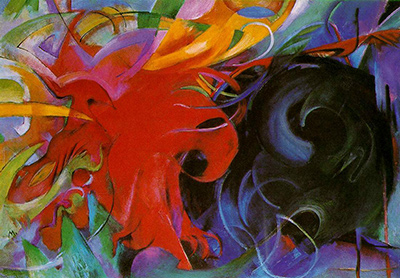
In 1913 and 1914, Marc increasingly allowed colour and form to carry a painting beyond a clearly outlined animal. Mandrill still has a face, though its body nearly merges with green and yellow arcs. Birds offers three creatures within a near-abstract fan of colour. Fighting Forms, Broken Forms and Small Composition III make the painted shapes themselves the main encounter. These are distinct late canvases, not variations of one lost image. [17] [18] [19] [20] [21]
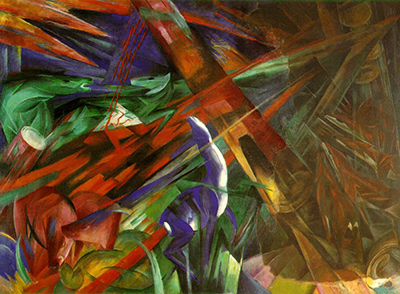
Fate of the Animals is a particularly intense 1913 bridge between those approaches. Animals remain visible while violent diagonals fracture the forest around them. Its documented conservation and later history are part of the story of the physical painting. The lost Tower of Blue Horses of 1913 offers a different limit: we know it from records and reproductions, but the original canvas has not been securely located. Looking carefully includes knowing when a work’s image and history are incomplete. [22] [23]
Browse the paintings
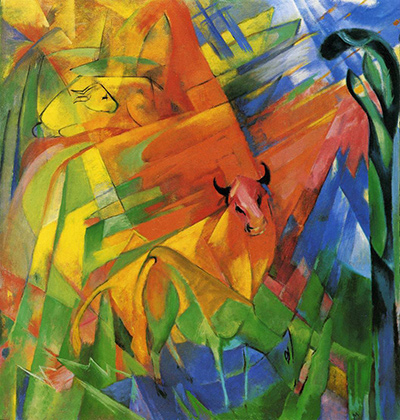
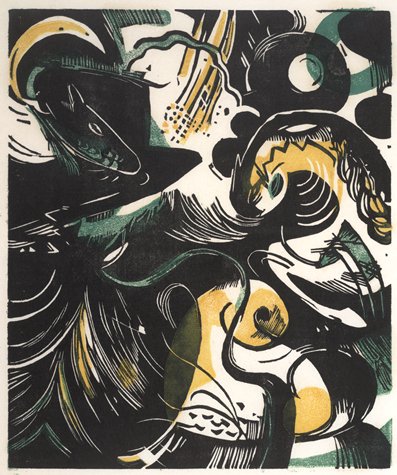
The alphabetical catalogue continues across A–G, H–S and T–Z. The image grid on this page offers a shorter selection. A painting can have several English titles, and two related names may identify either one canvas or entirely different works. The individual pages use collection records, dates and images to make those distinctions. Use the catalogue to explore, then follow the full page for the work that catches your eye.
Artwork Directory
This source-checked selection contains 192 identified works and print designs from the current Franz Marc research set. It is a curated selection, not a complete catalogue raisonné. Some works link to their article here; others link to a collection record. Unresolved identifications are omitted.
Discussion
Marc’s painting subjects changed across landscapes, people, animals and near abstraction.
Reader Insights
Observation
Which work in the catalogue shows a change in his use of colour most clearly?
Comparison
What differences appear when two similarly titled horse or deer works sit side by side?
Interpretation
How does following the works by date change the story of his career?
Join the Conversation
Which detail changed the way you saw this work? Share a close observation or a comparison with another Marc picture.
References
- Museum Folkwang, Horse in a Landscape. View source.
- Lenbachhaus, Blue Horse I. View source.
- Kunsthalle Karlsruhe, Deer in the Forest II. View source.
- Guggenheim, Yellow Cow. View source.
- Lenbachhaus, Tiger. View source.
- Albertina record crediting Kunstmuseum Bern, Blue Horse II. View source.
- Walker Art Center, The Large Blue Horses. View source.
- Harvard Art Museums, Grazing Horses IV. View source.
- Franz Marc Museum, Donkey Frieze. View source.
- Kunstsammlung Nordrhein-Westfalen, Three Cats. View source.
- Kunstmuseum Moritzburg and ZDF, White Cat. View source.
- Art Institute of Chicago, The Bewitched Mill. View source.
- Lenbachhaus, In the Rain. View source.
- Museo Thyssen-Bornemisza, The Dream. View source.
- Lenbachhaus, Reh im Klostergarten. View source.
- Phillips Collection, Deer in the Forest I. View source.
- Pinakothek, Mandrill. View source.
- Lenbachhaus, Birds. View source.
- Pinakothek, Fighting Forms. View source.
- Guggenheim, Broken Forms. View source.
- Leopold Museum, Small Composition III exhibition caption. View source.
- Kunstmuseum Basel, exhibition booklet on Fate of the Animals. View source.
- Staatliche Museen zu Berlin, Tower of Blue Horses history. View source.
- Catalogue image credits — Yellow Cow: Photograph by Dr. Alexey Yakovlev; resized without crop or colour change, CC BY-SA 2.0. Fighting Forms: Image: Bayerische Staatsgemäldesammlungen; resized without crop or colour change, CC BY-SA 4.0. This derivative is shared under the same licence.
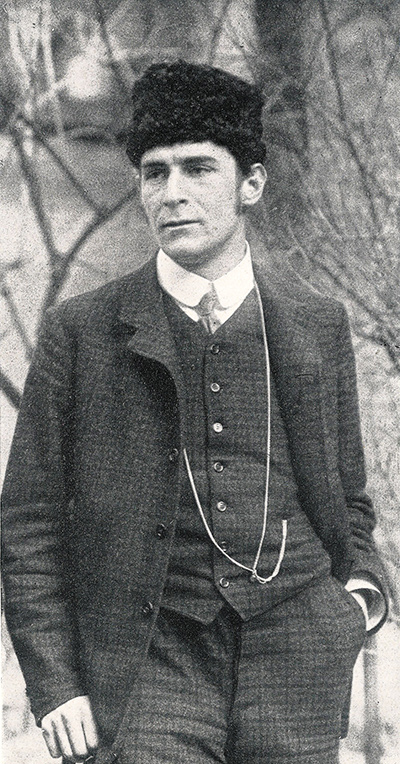
- Splash image: Historical photograph of Franz Marc. Public-domain image via Wikimedia Commons; resized without crop or colour adjustment.
