 by Tom Gurney
Tom Gurney BSc (Hons) is an art history expert with over 20 years experience
Published on June 19, 2020 / Updated on October 17, 2026
Email: tomgurney1@gmail.com / Phone: +44 7429 011000
Looking at The Large Blue Horses
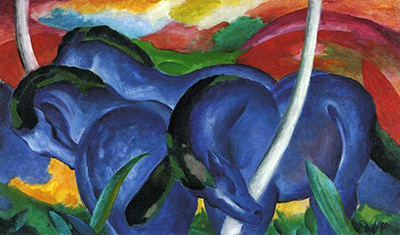
Three blue horses bend together across Franz Marc’s The Large Blue Horses. Their broad backs and lowered heads form a rolling shape that seems to continue into the red hills behind them. Green plants rise at the front, while two pale, curved trunks or stems cut through the scene. The animals are close enough to appear as one group, but each has its own turn of neck and weight of body. Marc painted this wide canvas in 1911, the year in which colour became a central means of shaping his animal world. It has been in the Walker Art Center’s collection in Minneapolis since 1942. [1] [2]
The Walker records the title as Die grossen blauen Pferde, an oil painting on canvas measuring 41⅝ × 71⁵⁄₁₆ inches unframed, roughly 106 × 181 cm. Its long format helps make the three horses a single rhythmic presence. It is a different work from the upright Blue Horse I at the Lenbachhaus and the missing four-horse Tower of Blue Horses. Their shared blue and horse subjects invite comparison, but the number, arrangement, scale and histories are distinct. [1] [3] [4]
Three horses, one continuous shape
Begin on the left, where a horse’s neck curves down and its head presses towards the lower edge. A second body rises behind it, its rounded back creating a high blue arc. On the right, another horse bends into the foreground, its neck and head turning inward. Marc lets their shoulders and flanks overlap. The blue shifts from dark to pale and into violet, making the bodies legible even where their outlines meet. The group has weight without seeming fixed to one spot. [1]
The animals’ curves echo the hills. A red rise behind the right-hand horse repeats the shape of its back. Green wedges between the horses and the distant colour help hold the group within the land. The thin pale stems frame and interrupt the blue bodies, drawing the eye upward before it returns to the lowered heads. It is easy to call this a picture of three blue animals against a red landscape, but that shorthand misses how carefully Marc connected their shapes. The setting seems to carry the same slow movement as the horses. [1]
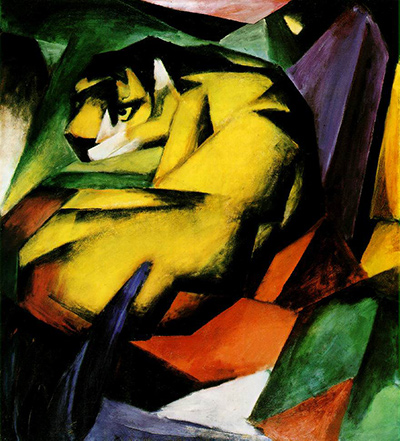
The heads all turn down or sideways, so the painting lacks the direct gaze of Marc’s Tiger. The horses do not perform an obvious event. Their togetherness and posture create a quieter encounter. The Fondation Beyeler has described them as calm and self-contained; that is one considered reading of the visible group. A viewer may also feel pressure in their crowded closeness and the intense red field behind them. The picture’s mood is made from both the bodies and the surrounding contrasts, not from blue alone. [5] [1]
Watch: Franz Marc
Explore Marc’s blue horses, the Blue Rider circle and the move towards abstraction in English-language videos.
Franz Marc, Blue Horses and Der Blaue Reiter
An English-language introduction to Marc’s blue horses, animals, spirituality and the Blue Rider.
Watch on YouTubeWhy blue holds the group together
In a letter to August Macke of 12 December 1910, Marc described blue through his own spiritual and gendered associations. The letter is evidence of what the painter was thinking as he moved towards these 1911 works, but it is not a formula that automatically explains every blue surface. Here blue joins three animals into a shared body of colour. It also makes their curves stand out against red hills, yellow ground and green plants. The painting’s emotional effect grows from those relations as much as from Marc’s stated associations. [6] [1]
The repeated colour also lets differences emerge. A single blue horse might stand apart as a symbolic figure. Three grouped horses create changing patches of darker blue at overlaps and lighter blue on exposed backs and necks. Their combined mass is strong, but their individual forms still have to be followed. Marc solved a pictorial problem of unity without simply drawing one animal three times. [1]
His notes from around 1911–12 ask how the world might appear to an animal and challenge the habit of placing animals in landscapes composed only for human eyes. The Large Blue Horses cannot be claimed as a literal horse’s view of nature. Its joined bodies and hills do suggest a desire to make animal and environment feel part of one order. The landscape does not sit behind the horses as a separate stage; its coloured rises participate in the same rhythm. [7] [1]
Among the horse paintings of 1911
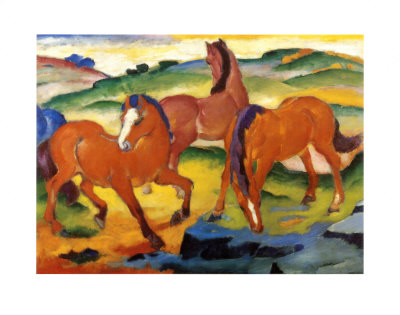
Marc worked through many horse groups before and during 1911. Large Red Horses arranges three animals in a triangle across a pasture; the left horse turns its head toward us and the right one grazes. The Walker painting compresses three blue bodies into a closer, lower group against a strongly coloured hillside. The two works share scale, vivid colour and a concern with animal-landscape rhythm, but their bodies move differently. One sets three red animals across a broad view; the other makes a dense blue gathering. [8] [1]
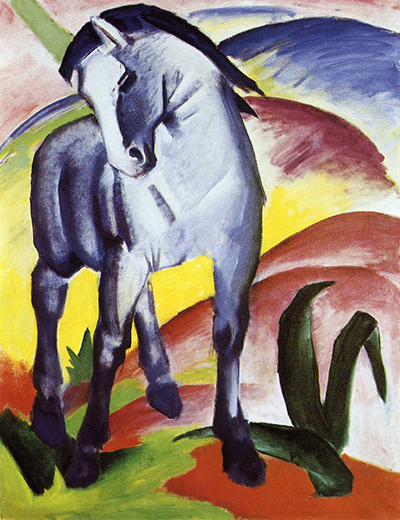
The single Blue Horse I offers another contrast. Its upright foal bends its head into an inward pose, and the vertical canvas gives it almost all the attention. In the Walker painting, no horse is the sole centre. The eye passes from one body to another through curves that join the group. Both images show Marc leaving natural coat colour behind, but they make different kinds of presence from that decision. [3] [1]
The painting’s journey to America
The painting’s path through the 1930s was different from that of many Marc works seized from German public collections. A Jewish Museum exhibition label records that The Large Blue Horses was in private hands when the Nazi campaign against modern art targeted his pictures. It was shown in a London anti-Hitler exhibition in 1938 and then travelled to the United States, where it appeared in Twentieth Century Banned German Art. Those exhibitions gave the painting a public role in opposition to Nazi cultural policy before it came to Minneapolis. [9]
The Walker records its accession in 1942 as a gift from the T. B. Walker Foundation and Gilbert M. Walker Fund, number 1942.1. Soon after its arrival it was placed above the grand staircase of the museum’s first building. A 1942 photograph in the Walker’s history shows a teacher and students sketching the painting there. Its public life was not limited to scholars examining a famous European work; it entered the museum’s teaching and everyday visitor experience. [1] [2]
The Walker’s account follows the painting through changing buildings and displays. It appeared in the new Walker building when that opened in 1971. A 2000 exhibition organized with the Busch-Reisinger Museum and Stuttgart’s Staatsgalerie reunited works from the Blue Rider circle, including Marc’s Small Yellow Horses. Later, after a Minneapolis display ended in 2016, the blue horses travelled to New York and Switzerland before returning in 2023. These movements are exhibition history, not changes of ownership. The Walker remains the collection that holds the canvas. [2]
Reproductions helped make the work familiar long before and after its arrival in Minnesota. The Walker traces printed versions back to 1919 and illustrates a 1942 newspaper interior whose colours were described as inspired by Marc’s painting. That circulation made the horses recognizable outside a museum. It also underscores the value of returning to the original composition: three differently placed bodies, pale framing stems, red hills and small green forms make a more involved visual experience than the simple phrase “blue horses” suggests. [2] [1]
The horses’ colour may be the first thing we remember, but their joined posture is what sustains the painting. Follow the left bowed head through the high central back to the right-hand animal, then watch how the hills repeat those curves. Marc made the creatures and the land seem to move together. The Walker’s photographs show generations of viewers meeting that image in a public space; the painting itself keeps offering new relationships to find among three animals that are at once separate and closely bound. [1] [2]
Artwork Directory
This source-checked selection contains 192 identified works and print designs from the current Franz Marc research set. It is a curated selection, not a complete catalogue raisonné. Some works link to their article here; others link to a collection record. Unresolved identifications are omitted.
Discussion
The three horses seem to form one broad, connected blue shape.
Reader Insights
Observation
Where does one horse’s outline become the next horse’s?
Comparison
How does this close group differ from the more open Large Red Horses?
Interpretation
What does blue accomplish when it runs across all three bodies?
Join the Conversation
Which detail changed the way you saw this work? Share a close observation or a comparison with another Marc picture.
References
- Walker Art Center, Die grossen blauen Pferde, 1942.1. View source.
- Walker, collection history. View source.
- Lenbachhaus, Blue Horse I. View source.
- Berlin State Museums, tower history. View source.
- Fondation Beyeler, archived Blue Rider exhibition text. View source.
- Marc to Macke, 12 December 1910, German correspondence. View source.
- Franz Marc, notes on animal perception. View source.
- Harvard Art Museums, Grazing Horses IV. View source.
- Jewish Museum, Afterlives exhibition labels, 2021, p. 101. View source.
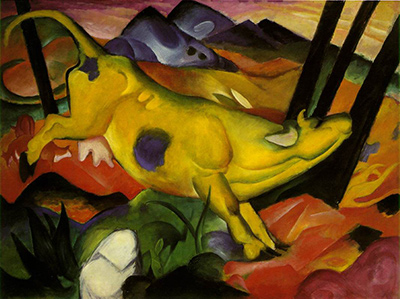
- Related artwork image, Yellow Cow: Photograph by Dr. Alexey Yakovlev; resized without crop or colour change, CC BY-SA 2.0.
- Splash image: Franz Marc, The Large Blue Horses, 1911. Walker Art Center, Minneapolis, 1942.1. Public-domain faithful reproduction from the Yorck Project via Wikimedia Commons; resized without cropping or colour adjustment.