* As an Amazon Associate, and partner with Google Adsense and Ezoic, I earn from qualifying purchases.
by Tom Gurney Tom Gurney BSc (Hons) is an art history expert with over 20 years experience
Published on June 19, 2020 / Updated on September 28, 2026
Email: tomgurney1@gmail.com / Phone: +44 7429 011000
Degas Star Dancer On Pointe: Introduction
A dancer balances on one pointed foot. Her other leg extends behind her to the left, while her torso and outstretched arm reach toward an almost empty expanse of stage. Pale blue-green tulle catches small red accents, and a band of blue with billowing light forms runs along the top. Edgar Degas's The Star: Dancer on Pointe seems to hold a step just before it changes. The performer needs the open space ahead of her: the picture's right half lets the movement continue in the viewer's mind. [1][3]
This is the gouache-and-pastel work in the Norton Simon Museum, Pasadena, accession F.1969.40.P. That identification matters because another Degas image commonly called The Star belongs to the Musée d'Orsay. The Orsay piece is tall, looks down on a white-costumed dancer, and was made with pastel over a monotype. The Norton Simon work is wide and follows a dancer reaching across a stage. The similar English names cannot make these two pictures one object. [1][2]
At a glance
ArtistEdgar Degas
TitleThe Star: Dancer on Pointe
DateAbout 1878–80
MediumGouache and pastel on paper, mounted on board
These facts follow the Norton Simon object record and audio transcript. The museum describes the dancer's position as a piqué en attitude. In plain terms, she rises onto a supporting pointe with the other leg lifted behind. The owner notes how fleeting the balance would be in performance. That physical difficulty helps explain the picture's energy; it does not prove that this particular image records one instant of an actual, named ballet. [1]
Melina Darde and the made image
The Norton Simon Museum identifies the model as Melina Darde, a teenaged member of the Paris Opéra's corps de ballet. That is a more precise starting point than calling the figure simply an anonymous ballerina. It connects Degas's study to a young professional whose training made such a pose possible. The museum is also clear that he transformed the model into a stage “star” through artistic imagination. We can name Darde while distinguishing the person who modelled from the fictionalized performance setting around her. [1]
The title may tempt a biography that the picture does not offer. It does not tell us that Darde was a principal dancer, performed this step in a particular production, or felt triumph at this moment. “Star” describes the figure's pictorial role and the work's established title. The museum's account locates the model within the corps de ballet. A corps dancer could have technique and presence without having the status implied by a modern celebrity label. Keeping those meanings separate gives the young performer her documented place instead of inventing a career event. [1]
Degas could bring dancers into his studio, according to the Norton Simon audio. A held pose gives an artist time to study how a body turns and bears weight; it is not the same thing as reproducing a live step mechanically. The museum notes that Degas used wax sculpture to explore difficult positions, though no bronze of a dancer in precisely this pose survives. That background explains one way he could work through movement outside the theatre. It does not identify a particular wax as the direct model for this sheet, and the page should not create one by resemblance. [1]
Darde's name should also discipline our language about the pose. It is easy to say the dancer is carefree or exhausted because her face is partly turned and her limbs extend. Those feelings are readings that viewers may have, not statements in a model's own words. The work can show the tension of balance and the artifice of a brightly lit stage without offering private access to the young woman who helped Degas construct it. The named model matters even where the record is limited: it reminds us that a body used for artistic experiment belonged to a working person. [1]
A pose that cannot last
The supporting foot carries the figure while the raised leg points left and back. The torso leans forward, and the extended arm reaches into the unoccupied right-hand space. These directions do not cancel one another; they make the body seem about to turn or travel. The Norton Simon audio suggests that the leg might lead into a turn, while acknowledging this as a possible next movement, not a known sequence. The balance is brief, the museum says, so a viewer sees a position that would change almost at once on stage. [1]
The tutu makes the body harder to parse. Its puffed layers sit between torso and legs, blurring exactly how the upper and lower halves connect. The Norton Simon interpretation describes this joining as awkward and relates it to the difficulty of representing such a fleeting position. That awkwardness is worth noticing. It prevents the dancer from becoming a weightless symbol of grace. We are aware of the technical problem Degas faced: a body in motion must be made legible in an unmoving picture, even when no resting pose can fully stand in for the living step. [1]
One might call the raised rear leg an arabesque at first glance. The museum's more exact piqué en attitude wording is preferable because the bent and turning relationship of the limbs matters here. For a reader unfamiliar with ballet terms, the visible facts are enough: one shoe meets the floor on pointe; the other leg is lifted behind; the reaching arm seems to pull the movement forward. A specialist name can sharpen looking, but it should not hide the step behind jargon. [1]
The dancer's near profile and the close scale let us follow the movement without a crowd of other performers. Still, she is not isolated against a blank studio wall. The band of blue and pale billows above resemble a stage set, and a partial form enters at the lower left. Such fragments suggest a larger performance world beyond the crop. They also keep the space unsettled: the stage is not mapped like an architect's plan. It serves the direction of the dance. [1]
Six joined sheets and an open stage
The Norton Simon audio explains that the pastel consists of six pieces of paper joined together. Their seams can be seen on close inspection. Degas enlarged the surface and left much of the right half nearly empty. This is a material decision with a visual consequence. If the edge of the paper stopped close to the dancer's reaching hand, the movement would feel blocked. The added space gives her somewhere to go, even though she remains fixed in pigment and paper. [1]
The openness is not absolute emptiness. Low, soft grey-green tones establish the stage, and billowing pink or light forms run along the top. The upper shapes pull the eye in the same general direction as the outstretched arm. Meanwhile the lifted leg points back. Degas sets these directions against one another, making the figure appear poised between advance and turn. The broad right field gives the viewer time to sense that counterforce; it is not merely an unfilled background waiting for another dancer. [1]
The seams complicate the impression of a spontaneous performance glimpse. A figure may look caught in an instant, but the support was physically assembled. Degas planned and extended the pictorial field. The museum's brief transcript does not specify the order of each piece, so we should not narrate an exact sequence of first sheet, second sheet and final addition. What is secure is the six-piece construction and the deliberate breadth of the stage as the finished work now presents it. [1]
The visible joins are especially revealing because they make the act of composition physical. A dancer's leap or balance is usually discussed in terms of anatomy and timing; here the artist also had to decide where the edge of the image would fall. Extending the paper can change a viewer's sense of speed without changing the dancer's pose. More room in front of the reaching arm makes her seem to travel; a tighter crop would contain her. This is a useful way to understand why the museum's audio stresses the open right side. The apparent movement does not reside only in the figure. It arises from the relation between figure, paper and the space Degas chose to leave around her. That relationship remains clear even when a reproduction makes the seams difficult to see, but the physical object gives the most direct evidence of how the image was built. [1]
The medium combines gouache and pastel. Gouache can lay down more opaque wet color, while pastel makes dry colored marks on the paper surface. The owner record names both; a small web image cannot reveal precisely where one material ends and the other begins. What we can see is a light costume against a muted ground and a figure whose edges sometimes sharpen and sometimes soften. The material mix lets Degas keep parts of the body and stage distinct while allowing tulle and painted billows to feel airy. Claims about exact pigment mixtures or fixative layers would require conservation evidence beyond the short public record. [1]
Watch: Edgar Degas
Explore his paintings, drawings and sculpture in three short videos.
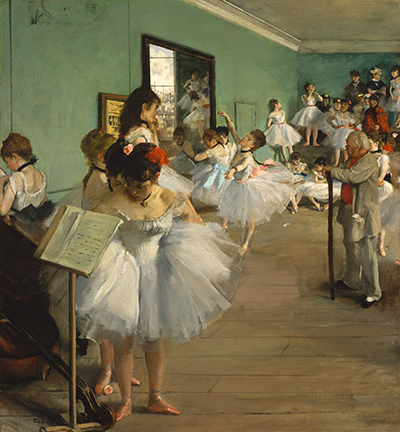
Degas, The Dance Class
Smarthistory
Look closely at Degas’s off-duty dancers and his unusual view into the rehearsal room.
The Norton Simon Museum suggests two ways to imagine the viewpoint: close through opera glasses or from the theatre wings, to which Degas had access as an elite subscriber. These are interpretive possibilities that help explain the dancer's scale and the absence of a visible audience. They are not a diary entry placing him at a particular seat on a particular evening. Both readings make us aware of the act of looking. The viewer is close to a performer who is supposed to be seen, while the point from which we see her remains indistinct. [1]
The stage seems to stretch across the picture instead of receding deeply. The dancer occupies its left half, while the low grey-green surface leads toward the right edge. A front-row spectator might see the figure as an isolated star; someone at the wings might know how much preparation and support surround a brief appearance. Degas's image allows both sensations. It concentrates on the glimmering movement, yet a close look at the body's hard balance and the constructed paper support shows the labor of performer and artist. [1]
The pale costume with small red notes draws attention immediately. It can be easy to describe it only as delicate or decorative. But its billowing tulle also helps disguise the difficult change in direction between the forward torso and raised leg. That visual job makes costume part of the structure of the pose. The performer appears light because Degas has made the cloth and body work together on the page; the real step would still have required strength and training. [1]
A different Star in Paris
The Musée d'Orsay's Ballet, RF 12258, has alternate titles L'Étoile and Danseuse sur scène. It is about 1876–77, a pastel over a monotype, 58.4 × 42 cm. The sheet is tall rather than wide. A white-costumed dancer occupies the stage from a high viewpoint; a darker figure appears in the wings. It belonged to Gustave Caillebotte and was included in the 1877 third Impressionist exhibition, according to Orsay's record. None of these identifiers belongs to the Norton Simon sheet. [2]
The Orsay work is often the one people mean when they say Degas's The Star. The Norton Simon composition is different: a blue strip, pale stage forms, one-foot balance and large open field at the right identify this sheet. Similar titles can obscure that difference, so owner, accession, format and medium matter together. [1][2]
The two works can still be compared usefully. Both make a dancer the focal point of a stage scene; both choose an unusual viewpoint rather than a frontal row of performers. Orsay looks down into a more crowded stage and wing, while Norton Simon brings us close to a lone dancer thrust across a horizontal field. Orsay's monotype underlayer is another difference from Norton Simon's gouache-and-pastel paper construction. These are visual and technical contrasts, not steps in a proven, direct sequence from one picture to the other. [1][2]
Provenance and present identity
The Norton Simon provenance begins with Alexis Rouart in Paris and traces the sheet through dealers and collectors, including Sir William Eden, Jakob Goldschmidt and the Magnin collection, before the Foundation acquired it at a 1969 sale. That route explains why an image of a Paris Opéra dancer came to be in Pasadena. It is a history of ownership, not a record of Darde's later career or proof of where Degas worked on every joined piece of paper. [1]
The work's later title history also reinforces the identity problem. The museum's provenance includes sale descriptions such as Premier sujet, The Dancer and Danseuse sur la pointe. Such names can point to the same sheet even when they do not contain the modern English title. Conversely, L'Étoile can name a different picture. The Norton Simon accession F.1969.40.P and the sheet's material description identify this work through changes of language and market label. [1][2]
Looking at the movement again
Start at the supporting shoe, where the dancer's weight meets the stage. Follow the lifted leg leftward, then return along the torso and right arm into the open field. Look at how the tulle interrupts the body between those directions. Finally, trace the pale stage forms across the top and consider how they lead the eye forward. The picture's sense of flight depends on those opposed vectors and on a carefully extended sheet of paper. [1]
Degas's The Star: Dancer on Pointe is a study of a trained, momentary balance made durable through drawing and color. Melina Darde supplied a human model; gouache, pastel and six joined pieces of paper gave Degas a stage for her transformed figure. Knowing the exact Norton Simon object keeps the work distinct from Orsay's other Star and lets its particular invention come into focus. For the larger subject, see Degas's ballet dancers and his pastels. [1][2]
Artworks directory
A selected index of documented works, combining owner records with entries sampled across Michel Schulman’s digital catalogue raisonné. It is not a complete catalogue. View the full catalogue
Share what you notice in Degas’s star dancer on pointe.
Reader Insights
Close Looking
How does the open right half extend the dancer’s movement?
Context
Where do costume and pose make the balance difficult to read?
Open Question
Which details distinguish this Norton Simon work from Orsay’s Star?
Join the Conversation
Share your reading of these works below.
References
Norton Simon Museum, The Star: Dancer on Pointe, F.1969.40.P, collection record, provenance and embedded audio transcript, search-indexed museum text accessed 27 September 2026. View source
Splash image: Edgar Degas, The Star: Dancer on Pointe, c. 1878–80, gouache and pastel on paper mounted on board. Norton Simon Foundation, Pasadena, F.1969.40.P. Collection record. View source
Tom Gurney is an art history expert. He received a BSc (Hons) degree from Salford University, UK, and has also studied famous artists and art movements for over 20 years.
Tom has also published a number of books related to art history and continues to contribute to a number of different art websites. You can read more on Tom Gurney here.



 by Tom Gurney