Blue Dancers

View Danseuses bleues (Blue Dancers) in its artwork record.

* As an Amazon Associate, and partner with Google Adsense and Ezoic, I earn from qualifying purchases.


by
Tom Gurney BSc (Hons) is an art history expert with over 20 years experience
Published on June 19, 2020 / Updated on September 28, 2026
Email: tomgurney1@gmail.com / Phone: +44 7429 011000

Degas Blue Dancers: Introduction

Four blue-costumed dancers crowd together in Edgar Degas's Blue Dancers. Arms curve above and across bodies; pale faces, dark hair and deep blue skirts appear among strokes of warmer color. A reddish vertical at the right checks the swirl of movement. At first glance the women may seem to be turning together, but the picture gives us no clear count or rhythm for a dance. We may be seeing separate performers in a compressed group, or an artist's repeated exploration of related gestures. That ambiguity is part of the picture's appeal. Degas makes us follow forms through overlap and color before we can assign an action to each figure. [1] [5]

This page is about the oil painting in the Musée d'Orsay, Paris, accession RF 1951 10. The title Blue Dancers also belongs to a different, later pastel in the Pushkin Museum's collection. Many online captions confuse these works because the shared English title is easy to remember and the blue costumes are similar. The Orsay canvas has its own material, dimensions, date history and provenance. Starting with those facts allows the close looking to remain tied to the right object. [1][2]

At a glance

  • ArtistEdgar Degas
  • French titleDanseuses bleues
  • DateAround 1890 in the current Orsay catalogue; specialist and exhibition datings vary
  • MediumOil on canvas
  • Dimensions85.3 × 75.3 cm
  • CollectionMusée d'Orsay, Paris, RF 1951 10
  • AcquisitionGift of Dr. and Mrs. Albert Charpentier to the French national museums, 1951

Contents

  1. Introduction
  2. At a Glance
  3. Reading a close group
  4. Color as structure
  5. Movement without a clear stage
  6. Why the date remains broad
  7. Not the Pushkin pastel
  8. From Degas's studio to Orsay
  9. Looking again

The present Orsay object record supplies the principal catalogue facts. It dates the oil to about 1890. Michel Schulman's digital catalogue raisonné dates the same canvas to about 1886, while Orsay's 2019 Degas at the Opéra press file labels it about 1893–96. Their dates cannot all be a single exact year. The museum's present date works for the short label; the wider disagreement should be kept visible in any deeper chronology. [1][3][4]

Reading a close group

The dancers fill the available space instead of standing in an open, measured room. Blue fabric runs from one body to the next, so the group looks almost continuous. The eye has to pick out a face, a shoulder and an arm, then test which skirt belongs beneath it. Degas's arrangement slows recognition. It makes the act of seeing the figures part of the viewer's experience. One can enjoy the sweep of blue immediately; finding the distinct bodies takes longer. [1]

The painting's vertical shape reinforces that crowding. The women rise through the field in a column of curving gestures. Their bodies do not form a straight chorus line, and the painting gives only hints of the space beyond them. The right-hand reddish wall or upright edge is particularly useful. It interrupts the blue and gives the group something firm to press against visually. It is also a mark by which the Orsay image can be distinguished from other works called Blue Dancers. [1]

An arm raised overhead may suggest someone fixing a costume or beginning a movement. Another form seems to turn in a different direction. Yet the visible canvas alone does not document a specific rehearsal, dance step or instant backstage. Degas often used dancers as subjects for studies of pose and movement, but this particular painting does not come with an identified performance or named models in the owner record. It is better to describe the gestures and the visual arrangement than to supply a fictional scene around them. [1]

The group also resists a simple account of four simultaneous actions. Similar blue shapes and repeated limbs can make the women appear like stages in one body's movement. That is a possible way of reading Degas's pictorial rhythm, not proof that he used one model four times or intended an early motion study in a literal technical sense. The painting can prompt questions about time precisely because it keeps individual figures and repeated forms in tension. A viewer sees a group and a sequence at once, then moves back and forth between those impressions. [1]

At a distance the blue can seem like one mass. Up close it varies: darker notes pull some folds back, lighter ones bring others forward, and flesh tones interrupt the costume. The eyes move from one small light patch to the next to recover faces and hands. This distribution avoids a single, clearly framed star. Degas gives attention to a cluster of workers within the dance world, although we should not turn a formal choice into evidence of a particular social message he intended. The picture lets several figures share the field. [1]

Color as structure

The blue costumes provide the painting's clearest visual link. Blue repeats across separated bodies, joining them even when a head or arm is partly concealed. Warm passages around the figures, including the red-brown edge at right, set that color into relief. The contrast is more than a decorative opposition. It helps the viewer distinguish an otherwise dense arrangement and gives the eye a path through it: from blue skirt to warm face, back to blue, then outward to the red-brown boundary. [1]

This is an oil painting. That basic fact matters when discussing its surface. The blue is laid in paint on canvas, not rubbed or fixed pastel on paper. Degas used pastel for many dancers, including a separate Blue Dancers in Moscow, but a familiar color effect does not identify a medium. A reader comparing reproductions should look at the owner caption before describing chalk, paper seams or a pastel's powdery texture. Those terms would misidentify the Orsay canvas. [1][2]

Color also complicates the edges of bodies. Where blue areas meet, one dancer can seem to merge with another. In other places a pale arm cuts through the field and restores a figure's direction. These transitions let the painting hover between a legible gathering and a pattern. They are not a failure to finish a set of four portraits. The work's force lies partly in how the eye repeatedly organizes and reorganizes it. With each pass, a gesture previously read as belonging to the whole can become one person's gesture again. [1]

The reddish strip at right can be read as a piece of the venue's architecture, but it also functions as a color stop. Without claiming to reconstruct an exact room from it, we can see how it confines the group. The canvas offers fewer spatial cues than a broad rehearsal room, so color and overlap do more work. The viewer feels close to the dancers, with little room for a conventional distance between spectator and subject. That closeness is a constructed visual effect, not evidence that Degas painted from a seat at this exact position during one recorded event. [1]

Movement without a clear stage

The dancers' raised arms and turned bodies suggest activity before, after or around a performance. None holds a centered pose offered to an audience in the way a solo bow might be presented. The painting is strongest when read through this uncertainty. It lets us watch preparation and movement as a set of bodily choices, while declining to specify which moment of the workday we have entered. The broader ballet dancers page addresses Degas's long engagement with rehearsal and labor; this canvas makes that engagement unusually concentrated through four overlapping figures. [1]

The lack of a fully described stage frees Degas to make the figures answer one another. A bent arm can be read next to a head tilted in a different direction; a blue hem can repeat the curve of another. Such repetitions are difficult to track in a moving performance, where time carries an action away. A painting fixes them so the viewer can compare at leisure. Yet it does not become a diagram. Its gestures keep some of the fleeting character of dance, and the dense paint leaves several possible paths for the eye. [1]

The women can appear graceful because the blue creates a flowing shape. Their raised arms, however, may also call to mind the effort of holding positions or adjusting dress. It is reasonable to let both sensations coexist. The picture does not identify the dancers' feelings or their training status. Nor should an interpretation of labor turn every bent arm into documentary proof of fatigue. What it can show is a subject beyond the perfectly synchronized stage spectacle: bodies near one another, momentarily engaged in gestures that Degas has chosen to combine. [1]

The shared costume color can make the four figures seem interchangeable at first. Look longer and the differences in direction and placement emerge. This is one reason the title, while convenient, is incomplete as a description. “Blue dancers” tells us about garments and a profession; it does not describe the compact design or the red interruption at the edge. The painting asks us to distinguish people through partial glimpses, even while it binds them in a common visual rhythm. [1]

Watch: Edgar Degas

Explore his paintings, drawings and sculpture in three short videos.

Why the date remains broad

Degas did not date every stage of work on a painting, and catalogues can revise an attribution of year as related studies and records are reconsidered. For RF 1951 10, the current Orsay entry gives “vers 1890.” The specialist catalogue by Michel Schulman says circa 1886. Orsay's own press file for its 2019 Opéra exhibition gives approximately 1893–96. All three refer to the same oil canvas through title, dimensions and accession. This is a real dating disagreement, not evidence that there are three Orsay oils of identical size. [1][3][4]

An exact year would imply more certainty than these sources allow. It could also invite an invented development story: one work supposedly leading directly into another solely because of a catalogue label. The safer reader account locates the painting within Degas's mature engagement with dancers and says where the owner catalogue currently places it. If a future technical study or archival record narrows the date, this page can be revised. For now, “around 1890” is a label tied to Orsay's present record, not a claim to know the week or season in which Degas laid down the paint. [1][3][4]

The difference matters when comparing the oil with the Pushkin pastel, dated around 1898 by its project record. If one assumes a firm 1886 date for Orsay and a firm 1898 date for Pushkin, the works can be made into a tidy twelve-year progression. The Orsay evidence itself does not support such precision. We can say the works are different and that the Pushkin object is catalogued later, but we should avoid claiming that one directly evolved from the other without a study chain or documentary link. Similar subject and color alone are not a developmental proof. [1][2][3][4]

Not the Pushkin pastel

The Pushkin State Museum's project record lists a Blue Dancers of about 1898 measuring 65 × 65 cm and made in pastel on paper. Orsay's RF 1951 10 is 85.3 × 75.3 cm, an oil on canvas. Both can be discussed as Degas's responses to blue-costumed dancers, but the differences in owner, medium, size and image are decisive. A search-result thumbnail with the short English title is insufficient to identify which one a page or print reproduces. [1][2]

This distinction prevents the qualities of one work from being attributed to the other. Pastel permits direct, dry strokes of color and raises different support and handling questions from oil. The Orsay canvas should be read as a painting, while the Moscow work is a later pastel; their similar blue costumes do not make their materials or histories interchangeable. [1][2]

Other Degas works can have blue dancers or similar French titles too. That repetition is part of his sustained work with a subject, and it is why a museum accession is useful for readers. It offers a stable identifier even when English titles vary in translation or shorten to the same phrase. On this page, Blue Dancers means RF 1951 10 unless another work is named with its separate collection and medium. [1][2]

From Degas's studio to Orsay

The Orsay catalogue records the painting in the first Degas studio sale in Paris in May 1918, lot 72, after the artist's death. It subsequently passed through the Danthon collection and was owned by Dr. and Mrs. Albert Charpentier. They gave it to the French national museums in 1951, initially for the Jeu de Paume. The painting was assigned to the Musée d'Orsay in 1986. Michel Schulman's catalogue independently crosswalks the studio sale and later ownership to the same accession. [1][3]

The studio sale tells us the work remained in Degas's estate, but it does not establish that he was painting it in 1917 or that he considered it unfinished. Artists can keep works for many reasons. The gallery history after 1951 also should not be confused with the work's creation date. Its presence at the Jeu de Paume and then Orsay is a history of public custody and display, not a sequence of artistic revisions. Keeping those timelines separate prevents a common error in pages about late Degas: treating a posthumous sale as if it dated the marks on the canvas. [1][3]

The 1951 gift brought the painting into a public collection with an identifiable catalogue record. The red edge and four blue-costumed figures match Orsay's reproduction, while the record supplies the medium, dimensions and collection number that an image alone cannot establish. Provenance ties the familiar composition to a particular, documented object. [1]

Looking again

Return to the group and try to follow one dancer at a time. Notice where a blue skirt connects to a torso, where an arm separates from a neighboring shoulder, and where a face briefly interrupts the colored mass. Then look at the group as one shape against the warmer surround. The painting is lively in both modes. It invites the viewer to alternate between people and pattern, between a possible moment of preparation and an arrangement of color on canvas. [1]

The short title cannot settle every question raised by that view. It does not tell us a ballet, a room, a named model or an exact year. The current Orsay catalogue provides a firm identity and medium, while its date remains approximate and other authorities disagree. Those limits leave ample room to look closely without inventing a story. Degas's Orsay Blue Dancers is compelling because four individual figures become a concentrated movement of blue, and then become individuals again under the viewer's patient eye. [1][3][4]

The same patient eye can notice what a reduced web image hides. A small reproduction tends to turn separate painted passages into a smoother field; details of edge and color become harder to judge. That is another reason to use collection records for facts about material and size rather than deducing them from a screen. The Orsay oil is a substantial canvas, taller than it is wide. Its scale helps explain the effect of standing close to an intertwined group instead of surveying small figures at a distance. The record and the image work together: one anchors the object, and the other invites looking. [1]

Artworks directory

A selected index of documented works, combining owner records with entries sampled across Michel Schulman’s digital catalogue raisonné. It is not a complete catalogue. View the full catalogue

406 artworks

NameDateMedium
>Group of dancers (MS 77)1893Pastel
[Self-Portrait with Christine and Yvonne Lerolle]probably 1895–96Photograph
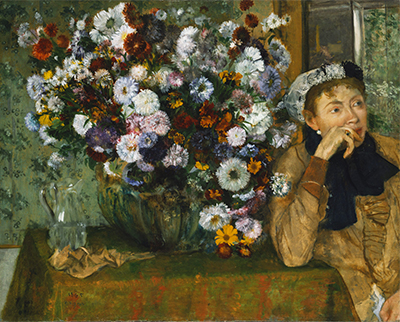
A Woman Seated beside a Vase of Flowers (Madame Paul Valpinçon?)1865Oil painting
Achille de Gas as midshipman (MS 718)1857Painting
Achille Degas (MS 715)1864Painting
After the bath - Woman Drying Herself (MS 1038)1888—1892Pastel
After the bath (MS 1037)1893Pastel
After the bath (MS 1046)1905Pastel
After the bath (MS 1060)1895Pastel
After the bath (MS 1061)1898Pastel
After the bath (MS 1062)1895Pastel
After the bath (MS 1063)1896Painting
After the bath (MS 1064)1896Painting
After the bath (MS 1065)1896Painting
After the bath (MS 1391)1900Pastel
After the bath (MS 1402)1888Pastel
After the bath (MS 1744)1886Pastel
Arlequin et danseuses (MS 2224)1884Pastel
At the café Châteaudun (MS 1913)1869—1871Painting
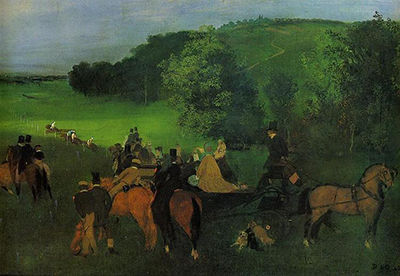
At the horse track (MS 1929)1869—1872Painting
At the Milliner's1881Pastel
At the milliner's (MS 2587)1882—1885Painting
At the milliner's (MS 562)1882Pastel
At the milliner's (MS 565)1882Pastel
At the milliner's (MS 567)1885Painting
At the races (MS 85)1861Painting
At the races - Jockeys (MS 92)1868Painting
At the races - The start. (MS 98)1860Painting
Auguste de Gas (MS 1243)1857Painting
Autumn landscape (MS 1403)1890Pastel
Ballet Dancers in the Wingsc. 1890–1900Pastel
Ballet scene (MS 452)1885Painting
Ballet scene (MS 454)1896Painting
Ballet scene (MS 458)1887—1890Pastel
Bather Drying Herselfc. 1883–84Pastel
Beach at low tide (MS 1730)1869Pastel
Beach at low tide (MS 1742)1869Pastel
Beach at low tide (MS 1907)1869Pastel
Beach at low tide (MS 1915)1869Pastel
Beach at low tide (MS 2070)1869Pastel
Before the race (MS 73)1882Painting
Before the race (MS 74)1882Painting
Before the race (MS 81)1884Pastel
Before the race (MS 82)1885Pastel
Before the race (MS 86)1884Painting
Before the start (MS 78)1885Pastel
Boat at low tide (MS 1407)1869Pastel
Breakfast after the bath (MS 1039)1890Pastel
Breakfast after the bath (MS 1565)1895—1898Pastel
Bust of a woman (MS 869)1887—1890Painting
By the seashore (MS 1917)1869Pastel
Calm sea seen from a cliff (MS 1741)1869Painting
Chatting (MS 2061)1882—1885Pastel
Cliff on the seashore (MS 1230)1869Pastel
Cliff on the seashore (MS 671)1869Pastel
Copy after "The Finding of Moses" by Véronèse (MS 1401)1860Painting
Criminals physiognomies (MS 858)1881Pastel
Crouching nude woman from behind (MS 1235)1876Pastel
Dance exercises (MS 270)1891Pastel
Dancer (MS 282)1899Pastel
Dancer (MS 492)1880—1885Pastel
Dancer adjusting her bodice (MS 1576)1875Painting
Dancer adjusting her bodice (MS 293)1890Painting
Dancer adjusting her shoulder strap (MS 283)1899Pastel
Dancer adjusting her shoulder strap (MS 285)1889—1896Pastel
Dancer adjusting her shoulder straps (MS 275)1896—1899Pastel
Dancer Adjusting Her Slipper1873Graphite and chalk
Dancer adjusting her slipper (MS 1588)1887Pastel
Dancer adjusting her slipppers (MS 1581)1880Pastel
Dancer at the barre (MS 1731)1895—1898Pastel
Dancer at the barre (MS 2073)1874Pastel
Dancer at the barre (MS 2570)1885Pastel
Dancer bending (MS 486)1874—1879Pastel
Dancer bowing on her knee (MS 494)1895Pastel
Dancer combing her hair (MS 1390)1879Painting
Dancer dressing (MS 1745)1889Pastel
Dancer exercising (MS 483)1874Pastel
Dancer fastening her shoe (MS 2077)1887Pastel
Dancer in blue (MS 2349)1902Pastel
Dancer in bust (MS 1726)1897Pastel
Dancer in bust (MS 277)1895—1899Pastel
Dancer in green (MS 2608)1897—1901Pastel
Dancer in green (MS 273)1878Pastel
Dancer in pink bowing (MS 1418)1878Pastel
Dancer in red (MS 280)1893Pastel
Dancer in Ukrainian Dress1899Pastel
Dancer leaning (MS 2585)1874—1879Pastel
Dancer Moving Forward, Arms Raisedc. 1885–90Sculpture
Dancer nude study (MS 2348)1902Pastel
Dancer on stage (MS 1415)1879Painting
Dancer on stage (MS 478)1881—1885Pastel
Dancer Putting on Her Stocking1890s/1911Sculpture
Dancer reading (MS 165)1879Pastel
Dancer seated (MS 121)1872Painting
Dancer seen from behind (MS 2211)1889Pastel
Dancer seen from the back (MS 171)1874Painting
Dancer tilting (MS 423)1883Pastel
Dancer with a fan (MS 2592)1876Pastel
Dancer with arms crossed (MS 274)1872Painting
Dancer with arms raised (MS 1743)1891Pastel
Dancer with green bodice (MS 2345)1902Pastel
Dancer with raised arms (MS 475)1870Painting
Dancer with tambourine (MS 2053)1882Pastel
Dancer with tambourine (MS 450)1883Painting
Dancer with tambourine (MS 465)1897Painting
Dancers (MS 2215)1878Painting
Dancers (MS 2217)1890Pastel
Dancers (MS 2362)1904—1906Pastel
Dancers (MS 294)1890Pastel
Dancers (MS 471)1878Pastel
Dancers adjusting their hair (MS 286)1897Pastel
Dancers at rest (MS 1228)1898Pastel
Dancers at rest (MS 224)1874Painting
Dancers at the barre (MS 266)1877Pastel
Dancers at the barre (MS 267)1880Pastel
Dancers at the barre (MS 268)1900Painting
Dancers at the barre (MS 269)1900Pastel
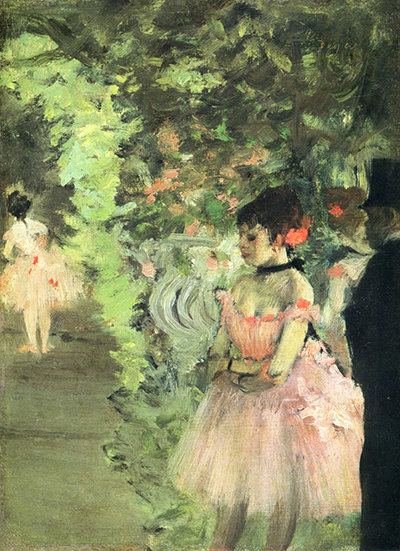
Dancers Backstage1876/1883Oil painting
Dancers backstage (MS 271)1890Painting
Dancers behind the wings (MS 288)1880Pastel
Dancers bowing (MS 453)1885Pastel
Dancers in a landscape setting (MS 466)1895—1898Pastel
Dancers in pink (MS 1738)1900Pastel
Dancers in pink (MS 2364)1904Pastel
Dancers in red skirts (MS 451)1884Painting
Dancers in white (MS 1748)1878Pastel
Dancers in yellow skirts (MS 2359)1903Pastel
Dancers on stage (MS 1417)1881Pastel
Dancers on stage (MS 460)1880Pastel
Dancers on stage (MS 474)1884Pastel
Dancers resting (MS 2604)1890—1895Pastel
Dancers with fans (MS 291)1890Pastel
Dancers, Pink and Greenc. 1890Oil painting
Dante and Virgil at the Entrance of Hell (MS 2072)1857—1860Painting
Degas in studio smock (MS 688)1862Painting
Dunes along the sea (MS 1905)1869Pastel
Edmond Duranty (MS 732)1879Pastel
Elena et Camilla Primicile Carafa di Mantejasi (MS 695)1867Painting
Estelle Musson Balfour (MS 704)1872Painting
Estelle Musson Balfour (MS 710)1863—1865Painting
Fallen jockey (MS 1388)1870Painting
Farm at the foot of a cliff (MS 1918)1869Pastel
Four dancers (MS 1728)1885Pastel
Four dancers (MS 2365)1905Pastel
Four dancers (MS 287)1899Painting
Four dancers in blue (MS 2355)1903Pastel
Four dancers in the wings (MS 2356)1903Pastel
Four dancers on stage (MS 473)1897—1900Pastel
Germain Musson (MS 700)1853Painting
Getting off the bath (MS 1057)1884Pastel
Getting out of the bath (MS 1398)1898Pastel
Getting out of the bath (MS 1583)1879Pastel
Getting out of the bath (MS 1725)1900Pastel
Getting out of the bath (MS 2343)1901Pastel
Getting out of the bath (MS 2607)1895—1898Pastel
Giovanna Bellelli (MS 1242)1856Painting
Giulia Bellelli (MS 722)1858Painting
Green dancers (MS 469)1878Pastel
Hairdressing (MS 1387)1895Painting
Head of a woman (MS 290)1865Pastel
Head of a woman (MS 861)1873—1875Painting
Henri Degas and his niece Lucie Degas (MS 701)1875—1876Painting
Henri Rouart in front of his factory (MS 759)1875Painting
Horse races (MS 1928)1869—1872Painting
Horse races at Longchamp (MS 87)1873Painting
Horse riders in a lanscape (MS 2079)1860—1861Painting
Horse turned to the right (MS 95)1881—1885Pastel
Horse Walkingpossibly early 1870sSculpture
Horsemen riding on the sea shore (MS 1914)1868Pastel
Horseride (MS 80)1890—1895Painting
Horses and jockeys (MS 84)1890Painting
Horses in a medow (MS 2076)1871Painting
Houses along a cliff (MS 1587)1880—1890Painting
Houses on a cliff overlooking the sea (MS 1925)1869Pastel
Houses on the sea shore (MS 1408)1869Pastel
In the dance foyer (MS 2575)1897Pastel
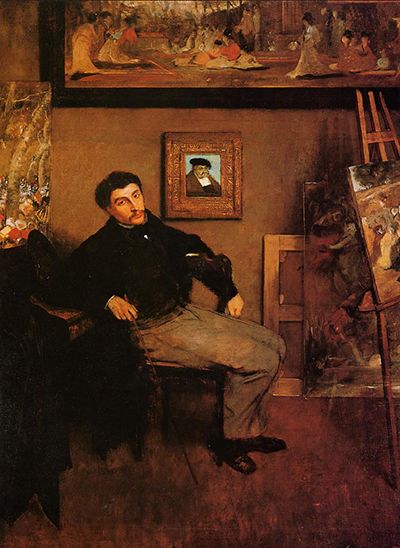
James Tissot (MS 762)1867Painting
Jeantaud, Linet et Laîné (MS 859)1871Painting
Jockey (MS 2213)1889Pastel
Jockey in a red cap (MS 1931)1868Painting
Jockeys (MS 75)1877Painting
Jockeys (MS 83)1890Painting
Jockeys at Epsom (MS 97)1860Painting
Jules Perrot (MS 755)1875Painting
L'arlequin (MS 2223)1890Pastel
La Savoisienne (MS 863)1860—1862Painting
Lady with a parasol (MS 93)1870—1872Painting
Landscapec. 1877–79Monotype
Landscape1892Monotype with pastel
Landscape (MS 1572)1892Pastel
Landscape (MS 2233)1890—1893Painting
Landscape (MS 2234)1890—1893Pastel
Landscape with houses (MS 2567)1885—1890Pastel
Landscape with path leading to a copse of trees (MS 2610)1890—1892Painting
Laundress carrying linen (MS 2351)1902Pastel
Laundresses and horse (MS 2350)1902Pastel
Laundresses carrying baskets (MS 2352)1902Pastel
Little Dancer Aged Fourteen1878–81Sculpture
Little girl carrying flowers in her apron (MS 855)1862Painting
Lyda (MS 91)1870Painting
Marguerite de Gas (MS 713)1853—1854Painting
Mary Cassatt at the Louvre: The Paintings Gallery1879–80Print
Mathilde Musson Bell (MS 706)1872—1873Pastel
Meadow along a stream (MS 1934)1870—1875Pastel
Meadow bordering a river (MS 1577)Pastel
Mlle Bécat at the Ambassadeurs (MS 1410)1885Pastel
Morning toilette (MS 2078)1894Pastel
Mountain lake (MS 2229)1890—1893Pastel
Mountainous landscape (MS 2227)1890—1893Pastel
Mountainous landscape (MS 2230)1890—1893Pastel
Mr. and Mrs. Henry Rouart (MS 2358)1904Pastel
Mr. and Mrs. Louis Rouart (MS 2357)1904Pastel
Mr. and Mrs. Louis Rouart (MS 2360)1904Pastel
Mrs Alexis Rouart and her children (MS 1396)1905Pastel
Mrs Camus (MS 1908)1869Pastel
Naked woman at rest (MS 1557)1880Pastel
Naked woman drying herself (MS 1045)1900Pastel
Naked woman drying herself (MS 1058)1886Pastel
Naked woman warming up (MS 2065)1880Pastel
Nude woman combing her hair (MS 1245)1877—1879Pastel
Nude woman combing her hair (MS 2353)1903Pastel
Olive trees in a mountaineous landscape (MS 1574)1892Pastel
Porrtaits of women (MS 857)1868Painting
Portrait of a man (MS 1733)1864Painting
Portrait of a Man (MS 2220)1890Pastel
Portrait of a man [Portrait of man in an armchair] (MS 853)1866Painting
Portrait of a woman (Attributed) (MS 1404)1867Painting
Portrait of a woman (MS 2067)1885Painting
Portrait of a woman (MS 862)1878—1889Pastel
Portrait of a woman (MS 868)1884Painting
Portrait of a woman (MS 873)1867—1868Painting
Portrait of a woman before a piano (MS 2060)1882—1885Pastel
Portrait of a woman with a hat (MS 872)1884Pastel
Portrait of a woman with hat (MS 870)1887—1890Painting
Portrait of a young girl (MS 1901)1868Painting
Portrait of a young lady (MS 867)1878Painting
Portrait of a young woman after a D-drawing attributed to Leonardo da Vinci (MS 875)1858Painting
Portrait of Brandon (MS 2084)1874—1878Painting
Portrait of Elena Carafa (MS 696)1875Painting
Portrait of Henry Michel-Lévy (MS 1414)1873Painting
Portrait of the artist (MS 690)1863Painting
Preparation for the dance class (MS 247)1890Pastel
Program for the artistic evening of May 15, 1884 at the Ponsin Gallery (MS 2071)1884Pastel
Race Horsesc. 1885–88Pastel
Race horses (MS 76)1880Pastel
Races in the country (MS 96)1869Painting
Reclining nude woman (MS 2342)1901Pastel
René de Gas (MS 720)1855Painting
René de Gas with a inkwell (MS 719)1855Painting
Resting on field (MS 2055)1882Pastel
Riverbank (MS 1571)1890Pastel
Riverbank (MS 2083)1870—1875Pastel
Road in a forest (MS 1932)1870—1875Pastel
Road in a forest (MS 1933)1870—1873Pastel
Rocky coast (MS 1413)1890—1893Pastel
Rocky landscape (MS 2228)1890—1893Painting
Rue du Quesnoy at Saint-Valery-sur-Somme (MS 2069)1895—1898Pastel
Ruins of a bridge over a river (MS 1394)1892Pastel
Scene from the Steeplechase: The Fallen Jockey1866, reworked 1880–81 and c. 1897Oil painting
Sea at low tide (MS 1916)1869Pastel
Sea shore (MS 1920)1869Pastel
Sea shore (MS 1921)1869Pastel
Sea shore (MS 1924)1869Pastel
Seascape (MS 1906)1869Pastel
Seated nude woman combing her hair (MS 1236)1890Pastel
Seated woman brushing her hair (MS 2600)1887—1890Pastel
Self-Portraitc. 1855Drawing
Self-Portrait (MS 689)1862Painting
Self-Portrait (MS 691)1856—1858Painting
Self-Portrait (MS 693)1857—1858Painting
Self-Portrait (MS 694)1857Painting
Self-Portrait with White Collarc. 1857Oil on paper on canvas
Sitting woman combing her hair (MS 2568)1887—1890Pastel
Standing man in a bowler hat (MS 717)1874Painting
Standing nude woman (MS 1237)1880Pastel
Standing nude woman (MS 2218)1890Pastel
Standing woman (MS 1737)1866Painting
Stream in the undergrowth (MS 1935)1870—1875Painting
Studies of a woman's head and a seated dancer (MS 481)1879Pastel
Study for Mr and Mrs Louis Rouart (MS 1750)1904Pastel
Study for Mrs Camus at the piano (MS 2573)1869Pastel
Study of a Nude (Dancer at the Barre)1884–1900Drawing
Study of dancers (MS 2344)1901Painting
Study of folds of a hooded cloak (MS 2074)1861—1864Painting
Study of nude woman (MS 2059)1884Pastel
Study of sky (MS 1923)1869Pastel
The ball (MS 1248)1879Painting
The ballet rehearsal (MS 298)1877Painting
The bath (MS 1586)1900—1905Pastel
The bath (MS 2222)1890Drawing
The cellist Pilet (MS 1253)1868Painting
The child in blue (MS 854)1854Painting
The chocolate cup after the bath (MS 1247)1905—1907Pastel
The convalescent (MS 702)1872—1873Painting
The conversation (MS 1570)1895Pastel
The cup of chocolate (MS 1564)1900—1905Pastel
The Dance Class1874Oil on canvas
The dance class (MS 1406)1876Pastel
The dance class (MS 2068)1876Pastel
The Dance Lessonc. 1879Oil painting
The dance lesson or ballet class (MS 212)1875Pastel
The dance lesson or ballet class (MS 215)1878Painting
The dancer's rest (MS 1724)1885Pastel
The Duchess Montejasi and her Daughters Elena and Camilla (MS 699)1881Painting
The Duchess of Montejasi-Cicerale (MS 698)1868Painting
The duet (MS 1393)1877—1879Pastel
The duet (MS 1416)1877Pastel
The Extras or The chorus (MS 1254)1877Pastel
The false start (MS 99)1870Painting
The Firesidec. 1876–77Monotype
The Giovanna and Giulia Bellelli Sisters (MS 721)1865Painting
The Holy Family - Copy. (MS 1903)1868—1872Painting
The Holy Family after Sebastiano del Piombo (MS 1751)1857Drawing
The march (MS 56)1866Painting
The pedicure (MS 1251)1873Painting
The racecourse - Amateur jockeys near a carriage (MS 1249)1878Painting
The Races1871–72Oil painting
The rehearsal of the ballet (MS 2057)1881Painting
The singer (MS 2591)1877—1880Pastel
The Tubc. 1889Sculpture
The tub (MS 1252)1886Pastel
The violist (MS 2569)1880Pastel
Three dancers (MS 1585)1889Pastel
Three dancers (MS 2064)1879Painting
Three dancers (MS 2210)1889Pastel
Three dancers (MS 2216)1899Pastel
Three dancers (MS 2354)1903Pastel
Three dancers (MS 2614)1899Pastel
Three dancers (MS 467)1895—1898Pastel
Three dancers (MS 468)1890Pastel
Three dancers in salmon pink skirts (MS 2363)1904—1906Pastel
Three heads of men (MS 860)1871Painting
Three jockeys (MS 79)1900Pastel
Three study of dancers (MS 482)1879—1880Pastel
Two bathers (MS 2347)1902Pastel
Two Dancers1873Drawing
Two dancers (MS 1722)1880—1885Pastel
Two dancers (MS 2611)1880Pastel
Two dancers (MS 295)1890Pastel
Two dancers (MS 296)1890Pastel
Two dancers at rest or Dancers in blue (MS 1229)1898Pastel
Two Dancers in bust (MS 2561)1897Pastel
Two harlequins (MS 396)1885Pastel
Two sitting dancers (MS 1736)1896Pastel
Two Womenc. 1878/1880Pastel
Two women at their bath (MS 1568)1895Pastel
Valleys (MS 2232)1890—1893Pastel
View of Saint-Valery-sur-Somme (MS 2560)1896Painting
Walter Sickert, Daniel Halévy, Ludovic Halévy, Jacques-Emile Blanche, Gervex, Boulanger-Cavé (MS 856)1885Pastel
Wheat field and line of trees (MS 2225)1890—1892Pastel
Woman at her toilette (MS 1041)1890—1894Pastel
Woman at her toilette (MS 1048)1903Pastel
Woman at her toilette (MS 1050)1900Pastel
Woman at her toilette (MS 1559)1892Pastel
Woman at her toilette (MS 1561)1905—1907Pastel
Woman at her toilette (MS 2346)1902Pastel
Woman at her toilette (MS 2565)1895—1903Pastel
Woman Bathing in a Shallow Tub1885Pastel
Woman before a mirror (MS 370)1885—1886Pastel
Woman cleaning her left foot (MS 1232)1886Pastel
Woman combing her hair (MS 1746)1894Pastel
Woman combing her hair (MS 1238)1887—1890Pastel
Woman combing her hair (MS 1560)1892—1895Pastel
Woman combing her hair (MS 1727)1890Pastel
Woman combing her hair (MS 2237)1890—1895Pastel
Woman combing her hair before a mirror (MS 1250)1870—1875Painting
Woman comnbing her hair (MS 2209)1885Pastel
Woman drying erself after the bath (MS 2236)1890—1895Pastel
Woman drying her hair (MS 1042)1894Pastel
Woman drying her hair (MS 1044)1897Pastel
Woman drying her hair (MS 1569)1900Pastel
Woman drying her hair (MS 1729)1900—1903Pastel
Woman drying her hair (MS 1732)1885Pastel
Woman drying her left arm (MS 1055)1884Pastel
Woman drying her left arm (MS 1056)1884Pastel
Woman drying her right arm (MS 1052)1884Pastel
Woman drying herself (MS 1053)1884Pastel
Woman drying herself (MS 1059)1886Pastel
Woman drying herself (MS 1397)1888Pastel
Woman drying herself after the bath (MS 1562)1895Pastel
Woman Drying herself after the bath (MS 1563)1883Pastel
Woman drying herself after the bath wearing yellow mules (MS 2208)1889Pastel
Woman getting out of the bath (MS 1240)1881Pastel
Woman Having Her Hair Combedc. 1886–88Pastel
Woman in her bath washing her left leg (MS 1234)1883Pastel
Woman in mauve dress seated in an armchair or Mrs Alexis Rouart and Her Children (MS 2366)1905Pastel
Woman in red dressing gown combing her hair (MS 2207)1880Pastel
Woman Ironingbegun c. 1876, completed c. 1887Oil painting
Woman looking through opera glasses (MS 89)1881Painting
Woman sitting on a lawn (MS 2056)1882Pastel
Woman washing up in her tub (MS 1239)1892Pastel
Woman with a dog (MS 865)1875—1880Painting
Woman with a white apron (MS 94)1855Drawing
Woman with an umbrella (Mrs Jeantaud) (MS 866)1877—1880Painting
Woman with blue hat (MS 1558)1889Pastel
Woman with opera glasses (MS 90)1877Painting
Women ironing (MS 587)1875Painting
Women on the terrace of a café (MS 1241)1877Pastel
Young girl with white shawl (MS 874)1871Painting
Young spartan girls challenging boys (MS 1412)1860Painting
Young woman (MS 871)1890Painting
Young woman in black (MS 879)1861—1865Painting
Young woman in her bath (MS 1566)1890Pastel
Young woman standing by a table (MS 1739)1855Painting
Young woman tying the ribbons of her hat (MS 1244)1882Pastel
Young woman with her hand facing her mouth (MS 864)1875Painting

Discussion

Share what you notice in Degas’s blue dancers.

Reader Insights

Close Looking

Can you follow each dancer through the overlapping blue skirts?

Context

What does the reddish edge do to the composition?

Open Question

How does the owner’s oil label distinguish this from the Pushkin pastel?

Join the Conversation

Share your reading of these works below.

References

  1. Musée d'Orsay, Danseuses bleues, RF 1951 10, object record, accessed 27 September 2026. View source
  2. Pushkin State Museum project, Blue Dancers, separate pastel record. View source
  3. Michel Schulman, Digital Catalogue Raisonné, MS1227, Orsay oil crosswalk and alternative date. View source
  4. Musée d'Orsay, Degas à l'Opéra press file, section 10, alternative exhibition dating. View source
  5. Splash image: Edgar Degas, Danseuses bleues (Blue Dancers), c. 1890 (current Orsay catalogue; other authorities differ), oil on canvas. Musée d’Orsay, Paris, RF 1951 10. Collection record. View source