

View Portrait de famille (La famille Bellelli) in its artwork record.
* As an Amazon Associate, and partner with Google Adsense and Ezoic, I earn from qualifying purchases.
 by Tom Gurney
Tom Gurney BSc (Hons) is an art history expert with over 20 years experience
Published on June 19, 2020 / Updated on September 28, 2026
Email: tomgurney1@gmail.com / Phone: +44 7429 011000
Degas Bellelli Family: Introduction
Four members of a family occupy Edgar Degas’s large painting, but they do not gather into a single pose. Laure Bellelli stands in black with one daughter close against her. Another daughter sits nearer the centre, her body angled and one leg crossing beneath her skirt. Baron Gennaro Bellelli sits at the right, turned partly toward them and partly away from us. A little dog disappears at the lower edge. Even before we know their names, the spacing makes us move between separate presences. The picture is a family portrait, yet it does not ask us to see the family as one smooth, unified shape. [1] [7]
The Musée d’Orsay owns this canvas under the title Portrait de famille (“Family Portrait”) and also lists La famille Bellelli. It dates the oil painting 1858–69 and identifies it as RF 2210. At 201 × 249.5 cm, it is far larger than an intimate sketch. Degas worked on a scale that gives his relatives the weight of a major public picture, while arranging them inside a domestic room. The result is both specific to people he knew and deliberately made: a portrait whose formal structure shapes how we think about the people in it. [1]
The Bellelli Family at a Glance
- ArtistEdgar Degas
- Owning museumMusée d’Orsay, Paris
- Museum titlePortrait de famille; also La famille Bellelli
- AccessionRF 2210
- Date and medium1858–69, oil on canvas
- Dimensions201 × 249.5 cm
- SittersLaure Bellelli, Gennaro Bellelli, their daughters Giulia and Giovanna
- Additional likenessA framed red-chalk portrait of Hilaire de Gas, Laure's recently deceased father
- French national acquisitionPurchased in 1918 after the first Degas studio sale
Contents
- Introduction
- At a Glance
- Who Is in the Room?
- Laure's Upright Form and the Child Beside Her
- The Seated Daughter and the Gap Between Groups
- Gennaro and the Right-Hand Space
- The Room Is Carefully Divided
- Scale and Time: More Than One Sitting
- A Family Subject Within Degas's Portrait Practice
- A Cautious Exhibition and Collection History
- How to Look Without Writing a Family Novel
The museum's broad date range is an important part of the object's identity. It allows for a long process of study and completion rather than one sitting in a particular year. It should not be replaced casually with “1860” simply because that date appears in some discussions of Degas's early work. The figures may have been studied in the late 1850s, and the owner record still dates the finished canvas across 1858–69. The difference between a study's date and an owner's range for a final painting deserves to be kept visible. [1][2][3]
Who Is in the Room?
Laure was Degas's paternal aunt. Orsay identifies her husband as Baron Gennaro Bellelli and names their daughters Giulia and Giovanna. They were part of the family Degas visited during his training in Italy. Orsay describes Gennaro as an Italian patriot driven from Naples, living in exile in Florence. These facts put the domestic interior in a particular political and family setting. They do not mean every gesture in the finished painting directly illustrates a known event in the household. [1]
Laure's black clothing has a specific meaning in the owner record: she was mourning her father Hilaire de Gas, who had recently died. He appears again in the picture as a framed red-chalk portrait on the wall near her. The family group therefore includes a fifth likeness, one that is not physically present in the painted room. A portrait within a portrait can connect generations without pretending that everyone sat together for Degas. It gives the wall more than a decorative role and makes the mother’s dress more legible. [1]
The daughters' names should be retained, but their exact ages need caution. Different sections of Orsay's own record do not agree about the children's dates and the ages assigned to them in 1860. The museum's separate person record identifies Giulia as a cousin of Degas and gives a date that conflicts with the ages in the painting's prose description. Nothing essential about the canvas depends on resolving this in an image caption. We can name both daughters and discuss their visible positions without presenting a disputed age as settled. [1][4]
The baron's dates are similarly inconsistent in fields of the current Orsay record. His identity and political exile are clear, but a precise death year is not. The disagreement is a reminder that even fields within one museum record can diverge; the interpretation here rests on what they agree about. [1]
Laure's Upright Form and the Child Beside Her
Laure stands at the left as the painting's tallest figure. Her dark dress forms a broad vertical mass against the blue-green wall. She places an arm around the daughter beside her, creating a direct physical connection. The girl faces outward, with pale apron and collar strongly visible against darker clothing. Mother and child share a part of the canvas, while the rest of the family occupies other zones. It is a simple arrangement that can be seen before we try to interpret it. [1]
Orsay describes Laure as dignified and authoritative. Her posture supports the museum's reading: she stands rather than sits, holds her place beside the child and wears unbroken black that distinguishes her from both daughters' white aprons. The framed image of her father appears near her head. These formal choices can suggest a figure bearing family memory and responsibility. They do not reveal exactly what she thought of Gennaro or what she said to her children. The visual evidence is the stance, the clothing, the arm and the arrangement around her. [1]
The daughter at her side faces the viewer more directly than the adults. Her pale apron opens a bright area near the edge of Laure's black dress. Her hands come together before her; her gaze meets or approaches ours. That frontal position offers a moment of contact in a picture full of angled bodies. It can make the left pair seem stable, but even there the child's face and the mother's face do not present the same direction of attention. Degas gives a bond through touch without making their responses identical. [1]
The daughter's white clothing also helps set the painting's visual rhythm. It answers the apron of her seated sister across the room. The two light shapes are separated by Laure, furniture and space, and their different poses prevent them from becoming mirror images. The family is held together pictorially by repeated dark and light forms, not by having each person do the same thing. That distinction is one reason the group portrait can feel composed and unsettled at the same time. [1]
The Seated Daughter and the Gap Between Groups
The second daughter occupies the centre with a skirt that spreads forward. Orsay singles out her almost playful position: one leg crosses under her dress, interrupting the gravity of the adults' poses. She turns toward the side rather than facing us in the way the girl at Laure's side does. The chair and her body take up the gap between her mother and father, yet they do not quite close it. The family remains a set of related figures with separate orientations. [1]
There is a temptation to turn the child's pose into a full character sketch—rebellious, bored, favoured or frightened. The museum suggests that the younger daughter's posture contrasts with the weightier atmosphere. That is a useful visual observation, and it remains an interpretation of one pose. A crossed leg can make her appear lively beside upright adults without proving how she behaved outside the studio. We should resist treating the gestures of the children as transparent windows into private personality. [1]
The table behind her is small but important. Laure's hand reaches near it, papers rest on it, and the girl's chair sits in front of it. This furniture links the left side of the room to the baron at right while also providing an obstacle between them. A painter can unite a composition with one table even when the people around it remain apart. Here the furniture has enough detail to make a credible interior but not so much that it overwhelms the sitters. [1]
The two daughters' clothing is related: dark fabric and large pale aprons. This repeated costume can mark their shared family position, while pose and placement distinguish them. One is held near Laure, one sits alone nearer the middle. The contrast is visible regardless of which child is older. Reading the picture this way avoids relying on the conflicting age data in the owner text. It also respects Degas's pictorial choices: the girls are separate people even though they form a pair within the composition. [1][4]
Gennaro and the Right-Hand Space
Gennaro sits in a large dark armchair at the right. His body turns toward the family but his chair is angled in a way that gives us much of its back and side. His lighter jacket makes him distinct from Laure's black dress, while the chair creates a substantial dark boundary around him. Orsay calls his presence relatively withdrawn beside Laure's commanding upright position. A viewer can see the difference in scale and posture without assuming that we know the full character of their marriage. [1]
Orsay interprets the portrait as evoking family tension and individual isolation. That reading has formal support: no one shares a single frontal pose; the baron sits apart; Laure and one daughter form a closer cluster; the central daughter has her own direction. The room's openings and mirror add further divisions. But a painting cannot by itself verify an argument, a lifelong estrangement or the exact emotional state of each sitter. The museum offers an interpretation of a carefully made image, and the image gives us reasons to consider it. [1]
The baron's political history belongs to the portrait's context. Orsay says he was a patriot exiled from Naples to Florence. It is possible to feel the weight of exile when viewing a man turned partly away in a family room, but the painted pose is not independent evidence of his political thoughts at the moment of sitting. A good reading lets the history enrich the picture without forcing every formal separation to become a literal historical statement. His identity as an exile and his visible place in the composition are both important; their exact causal relation remains interpretive. [1]
Behind Gennaro, a mantel supports a dark clock and decorative objects. A mirror rises above. These forms make his side of the picture more visually busy than the broad wall behind Laure. The effect can deepen the sense that the two adults inhabit different pictorial zones. It can also be read simply as Degas's way of balancing a large standing form against objects, reflection and a seated form. Meaning and design are intertwined, and neither should be reduced to a single symbolic code. [1]
Watch: Edgar Degas
Explore his paintings, drawings and sculpture in three short videos.
Degas, The Dance Class
Look closely at Degas’s off-duty dancers and his unusual view into the rehearsal room.
Watch on YouTubeThe Room Is Carefully Divided
The canvas is a domestic interior, but it is no neutral container. At the left, a narrow opening begins near the edge. Behind Laure, the framed portrait of Hilaire de Gas makes a firm rectangle on the patterned wall. At the right, mirror, mantel, clock and chair create a more layered arrangement. The floor runs across the foreground, drawing the separate figures into one room. Repeated vertical and rectangular forms organise the space around family members who do not pose as a single block. [1]
The wall's cool blue-green colour is a strong setting for the black clothing, white aprons and warmer wood. Orsay calls the colours sober. That restraint can make the family feel formal, even though one child takes an informal pose. The palette also gives the different figures a common environment: every dark sleeve and pale apron has to work against the same wall and patterned floor. A portrait of tension still needs enough visual unity to hold together as a painting. Degas finds that unity in colour and architecture rather than in a shared smile or gaze. [1]
At the lower right, the dog is cut by the canvas edge. Orsay sees in that curious crop a suggestion of escape from the room's heavy atmosphere. A viewer may see the animal as an abrupt sign that the scene continues beyond the frame. Both responses begin with the visible fact: Degas did not give us the whole dog. The crop loosens a monumental portrait just where a conventional group picture might close neatly. It introduces an ordinary, moving presence at the margin of a carefully arranged human group. [1]
The framed red-chalk portrait is a different kind of interruption. It is a small image inside a large image, and it points to a person who shaped the family but was no longer alive. Laure's mourning clothes and the drawing near her make absence visible. That connection has direct support from Orsay; it need not be inflated into a claim that every sitter consciously gazes toward the drawing. The object within the room becomes a means of keeping a deceased relative in the family's pictorial space. [1]
The room's objects also regulate distance. The table sits between the standing and seated zones; the mantel and chair fill the area around Gennaro; the framed portrait is held close to Laure. These relations are not a diagram of affection, but they make the group harder to read as four figures simply lined up for a likeness. A viewer has to cross intervals of furniture and wall to move from one person to another. The painting turns a family's shared interior into a sequence of separate visual encounters. [1]
Scale and Time: More Than One Sitting
The painting's size can surprise a viewer who knows Degas chiefly through smaller dancer images. Over two metres high and nearly two and a half metres wide, it asks to be seen as a major group portrait. Its broad wall, furniture and individual figures had to be coordinated across a large surface. Orsay calls it a masterpiece of the artist's youth. Even at a time when Degas was developing his career, he gave a family subject the scale and complexity of an ambitious exhibition picture. [1]
The long date range, 1858–69, also resists the idea of an immediate captured moment. Degas made studies of individual Bellelli family members. Orsay owns a drawing titled Portrait de Giulia Bellelli assise sur une chaise, dated about 1858–59, in graphite, charcoal and white heightening. It is an object in its own right, but its seated subject makes it relevant to the larger painting. The Met's 2023–24 Manet/Degas exhibition listed the Orsay canvas alongside privately owned studies of Laure and Giovanna. These records establish sustained work on family likenesses without revealing every step of the final canvas. [1][2][3]
The studies are useful precisely because they separate observation from finished arrangement. Drawing a family member allows close attention to head, dress and posture. A large painting then places that person among other people, furniture and architectural forms. The position of a chair or the width of a gap can change how a likeness is read. We need not reconstruct an exact chronological sequence from the surviving works to see that the portrait was built through multiple acts of looking and composing. [1][2][3]
The Met's exhibition entries identify the Giovanna and Laure studies as privately owned loans. Orsay holds the separate drawing of Giulia. Their different present-day locations help distinguish the studies from one another and from the large family canvas. Together they show Degas returning to individual likenesses while he worked toward the group portrait; they do not fix a complete sequence for every figure in it. [2][3]
A Family Subject Within Degas's Portrait Practice
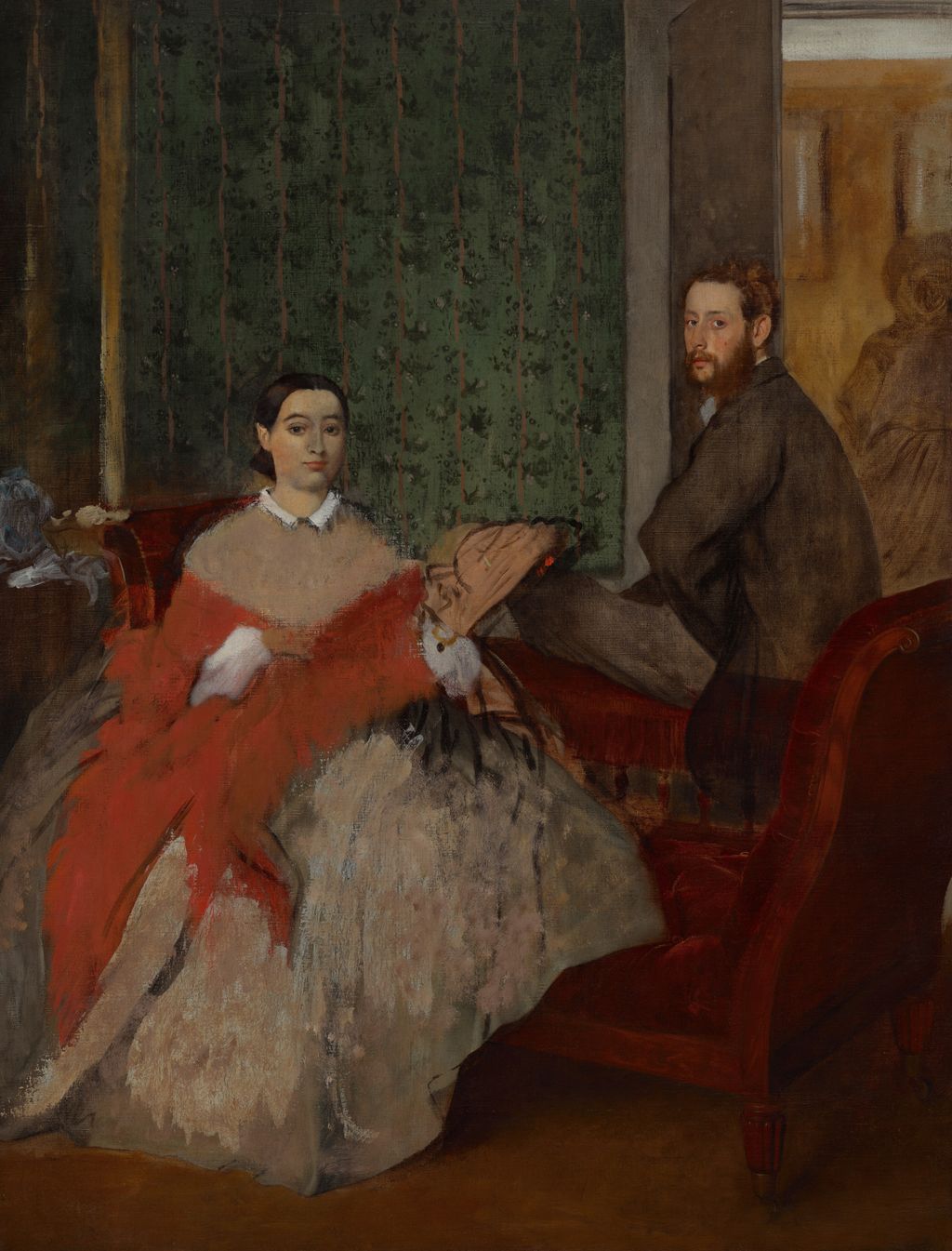
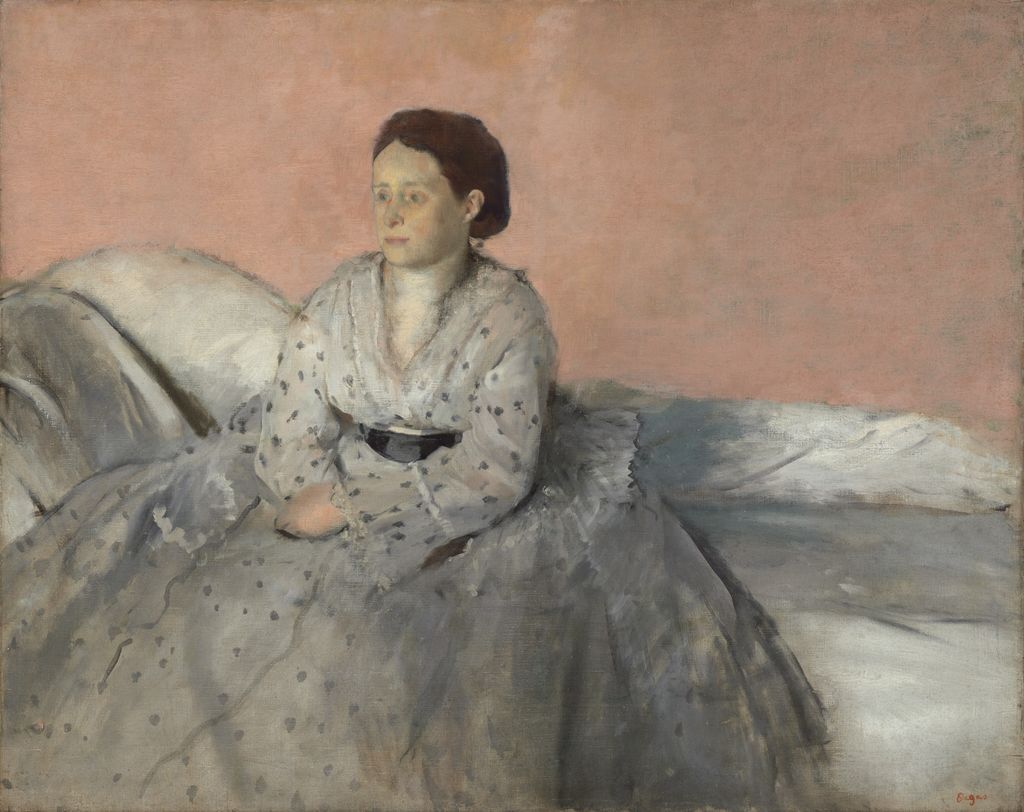
The Bellelli canvas belongs to a broader pattern of Degas painting relatives and acquaintances. It remains unusually large and complex within that pattern. A comparison with two family portraits now at the National Gallery of Art in Washington can help establish what is particular about it, while keeping the comparisons brief. They are separate people in separate rooms and years; neither should be used as evidence of Bellelli family feeling. [1][5][6]
NGA's Edmondo and Thérèse Morbilli, dated about 1865, depicts Degas's sister and her husband in a vertical oil painting. The museum describes it as unfinished, with faces more resolved than portions of the clothing. The couple occupies different parts of a sofa and the room extends into a doorway beyond them. Like the Bellelli picture, it places related sitters within an interior rather than presenting them as isolated heads. Unlike the vast four-person Bellelli group, it is a two-person canvas whose unfinished surface lets us see revisions and differing degrees of completion. [5]
The Morbilli painting can encourage a formal question: how do furniture and distance affect our sense of a relationship? It cannot answer a biographical question about Laure and Gennaro. Even with a sister and husband as sitters, an artist may arrange a portrait for compositional reasons and leave parts of it unresolved. NGA notes that the work remained in Degas's studio at his death. The visible scraping and tentative lines show making over time, a useful counterpoint to any description of family portraits as simple transcriptions of a sitting. [5]
NGA's Madame René de Gas, dated 1872/73, is a later portrait of Estelle de Gas, whom the museum identifies as Degas's cousin and sister-in-law. She sits alone in pale clothing against a lighter wall. The NGA notes that her expression does not grant us certain access to her thoughts. That warning applies equally to the Bellelli figures. A turned head or a distant gaze can be a powerful device in a portrait while still leaving a sitter's inner life unknown. Estelle's single figure also throws the Bellelli canvas's multiple lines of sight into relief. [6]
These comparisons do not make The Bellelli Family a generic family-picture type. The Orsay canvas has four named sitters, the framed likeness of a deceased fifth family member, a monumental scale and a room divided between contrasting zones. The portraiture page addresses Degas's broader choices of sitters and spaces. Here the relevant question is how this particular family becomes a pictorial group whose parts remain distinct. [1][5][6]
A Cautious Exhibition and Collection History
Orsay lists a Salon entry in 1867 for the painting, but gives its catalogue number as 444 or 445. That “or” should stay visible. It signals uncertainty in identifying the exact catalogue entry, and it is a reason not to build a confident account of a particular numbered debut from the present owner record alone. The painting's broad date range and long history of study already make a tidy one-year origin less convincing than a careful object history. [1]
The secure later event is the 1918 first sale of Degas's studio. Orsay says the painting was lot no. 4 at the Galerie Georges Petit sale and was bought for the Musée du Luxembourg with support from patrons and René de Gas. It later passed to the Louvre and the Jeu de Paume, and in 1986 was assigned to the Musée d’Orsay. This acquisition route is distinct from the Bellelli family's original circumstances. It describes how a painting long associated with Degas's own holdings became part of a national museum collection. [1]
Its present titles also have different emphases. Portrait de famille describes a type of work; La famille Bellelli names the particular people. Both are listed by Orsay. The accession RF 2210 connects either title to this canvas, its size and its provenance. That distinction matters when comparing it with a separate portrait of one Bellelli daughter or a preparatory study. [1][2]
How to Look Without Writing a Family Novel
Begin with what is secure: Degas painted Laure, Gennaro, Giulia and Giovanna Bellelli on a monumental canvas now in Orsay. Hilaire de Gas appears as a red-chalk portrait within their room. Laure's mourning, Gennaro's exile and the Florence family context come from the museum's object record. The late 1850s studies and the 1918 acquisition are anchored by identifiable museum entries. Those facts give the picture a setting; they do not tell us every exchange among the sitters. [1][2][3]
Then watch the relationships made by paint. Laure's arm rests near a daughter; the other daughter sits forward; Gennaro occupies his own chair; the wall portrait and mirror divide the background; the dog exits the frame. The room brings them into one canvas, while posture and furniture keep them from being one compact unit. Orsay reads tension and isolation in this arrangement. A viewer can consider that reading and still recognise it as an interpretation of a portrait, not a complete account of the family's private life. [1]
Finally look at the scale. At 201 × 249.5 cm, the canvas gives these relatives a public visual presence. Degas used an ambitious format, a carefully arranged interior and studied likenesses to make a family picture that remains resistant to one simple story. Its power lies in that resistance: the figures are together, each occupies a different place, and the viewer has to keep moving between them. [1]
Selected bellelli family
Artworks directory
A selected index of documented works, combining owner records with entries sampled across Michel Schulman’s digital catalogue raisonné. It is not a complete catalogue. View the full catalogue
Discussion
Share what you notice in Degas’s bellelli family.
Reader Insights
How does the room place each family member?
What does the framed portrait add to Laure’s mourning clothes?
Where does formal distance become interpretation rather than a known family fact?
Join the Conversation
Share your reading of these works below.
References
- Musée d’Orsay, Portrait de famille / La famille Bellelli, 1858–69, oil on canvas, accession RF 2210; owner description, provenance and exhibition list. View source
- Musée d’Orsay, Portrait de Giulia Bellelli assise sur une chaise, c. 1858–59, accession RF 16581. View source
- Metropolitan Museum of Art, Manet/Degas exhibition objects, 2023–24; Orsay canvas and privately lent Bellelli studies. View source
- Musée d’Orsay, Giulia Bellelli person record, current catalogue identity and dates. View source
- National Gallery of Art, Washington, Edmondo and Thérèse Morbilli, c. 1865, accession 1963.10.125. View source
- National Gallery of Art, Washington, Madame René de Gas, 1872/73, accession 1963.10.124. View source
- Splash image: Edgar Degas, Portrait de famille (La famille Bellelli), 1858–69, oil on canvas. Musée d’Orsay, RF 2210. Collection record. View source