* As an Amazon Associate, and partner with Google Adsense and Ezoic, I earn from qualifying purchases.
by Tom Gurney Tom Gurney BSc (Hons) is an art history expert with over 20 years experience
Published on June 19, 2020 / Updated on September 28, 2026
Email: tomgurney1@gmail.com / Phone: +44 7429 011000
Degas Sculptures: Introduction
Edgar Degas is familiar as a sculptor partly because Little Dancer Aged Fourteen is so widely reproduced. Yet he showed only one sculpture to the public during his life: that mixed-material figure, exhibited in 1881. After his death in 1917, more than a hundred models of dancers, horses and bathers were found in his studio. The difference between what his contemporaries saw and what museums can show today is the beginning of the story of Degas's sculpture. [1][11]
A model in wax or clay, a plaster made through molding, and a bronze cast after the artist's death are related things, but they are not the same object or the same moment of making. Degas's three-dimensional work let him examine a body from more than one side and hold a position that could change as he handled the material. It also entered a later history of discovery, repair, casting and display. To understand a figure attributed to him, first ask what the museum says it is made of and when that particular object came into being. [1][2][8][9]
Degas Sculptures at a Glance
Publicly exhibited by DegasOne sculpture: Little Dancer Aged Fourteen, shown in 1881
Studio subjectsDancers, horses and bathers among more than a hundred surviving models
Original materialsObject-specific mixtures of wax, clay, cork, wood, metal armatures and other materials
Famous originalNGA Little Dancer Aged Fourteen, accession 1999.80.28
Later historyBronzes cast at the heirs' direction after Degas's death; original waxes emerged publicly in 1955
How to read a labelCheck the medium, accession, model date and cast date separately
A drawing fixes a particular view of a body on a flat support. A small sculpture can be turned in the hand or walked around, asking different questions about balance, weight and the relation of one limb to another. Degas's sculpted dancers repeatedly pause during preparation or practice. Horses walk, gather themselves or stretch into a stride. These are subjects he also pursued in painting and drawing, but a resemblance of pose does not prove that a particular wax was made only as a preparatory model for a named picture. The surviving figures need to be read as objects in their own right. [1][4][5][6]
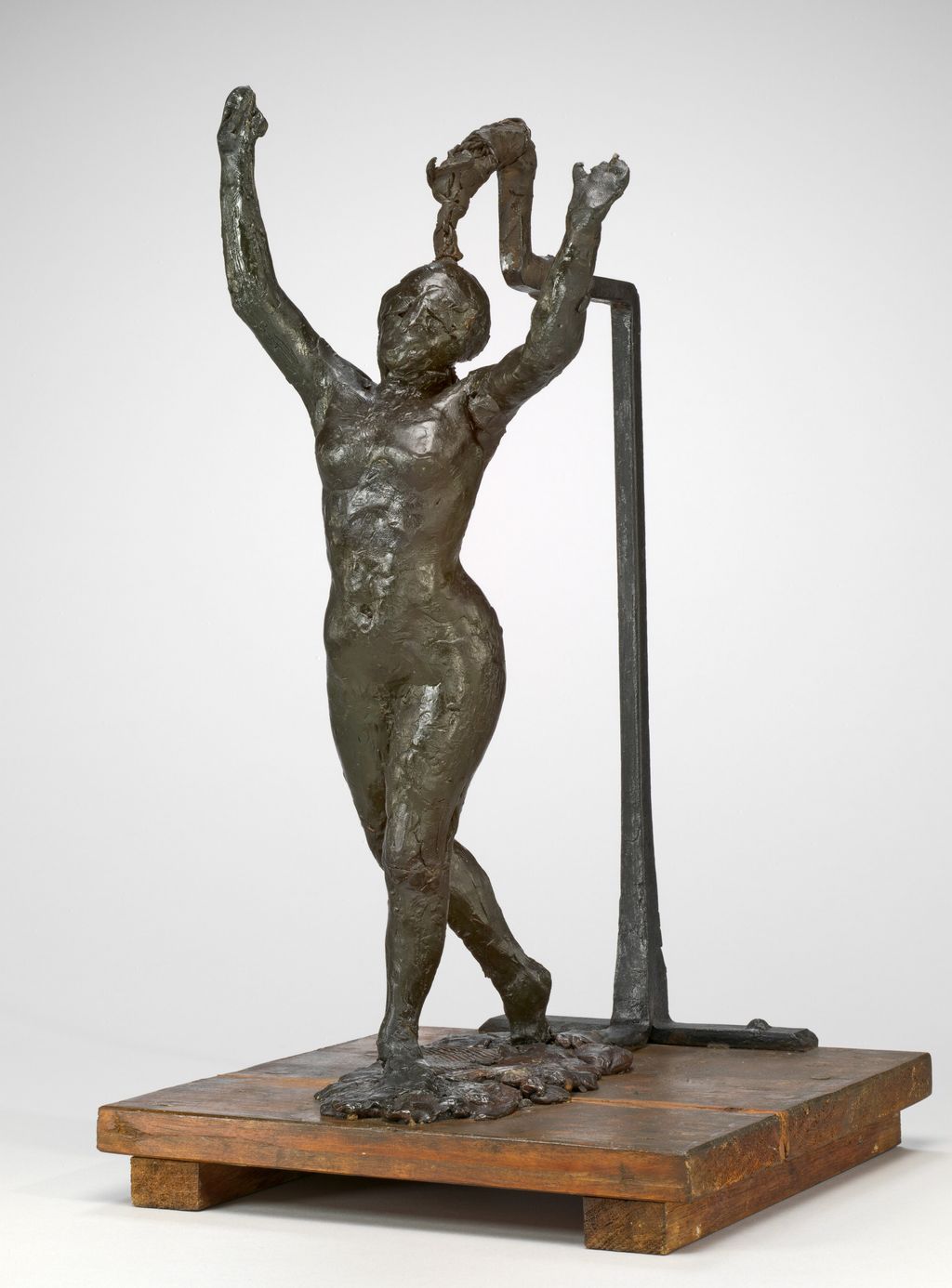
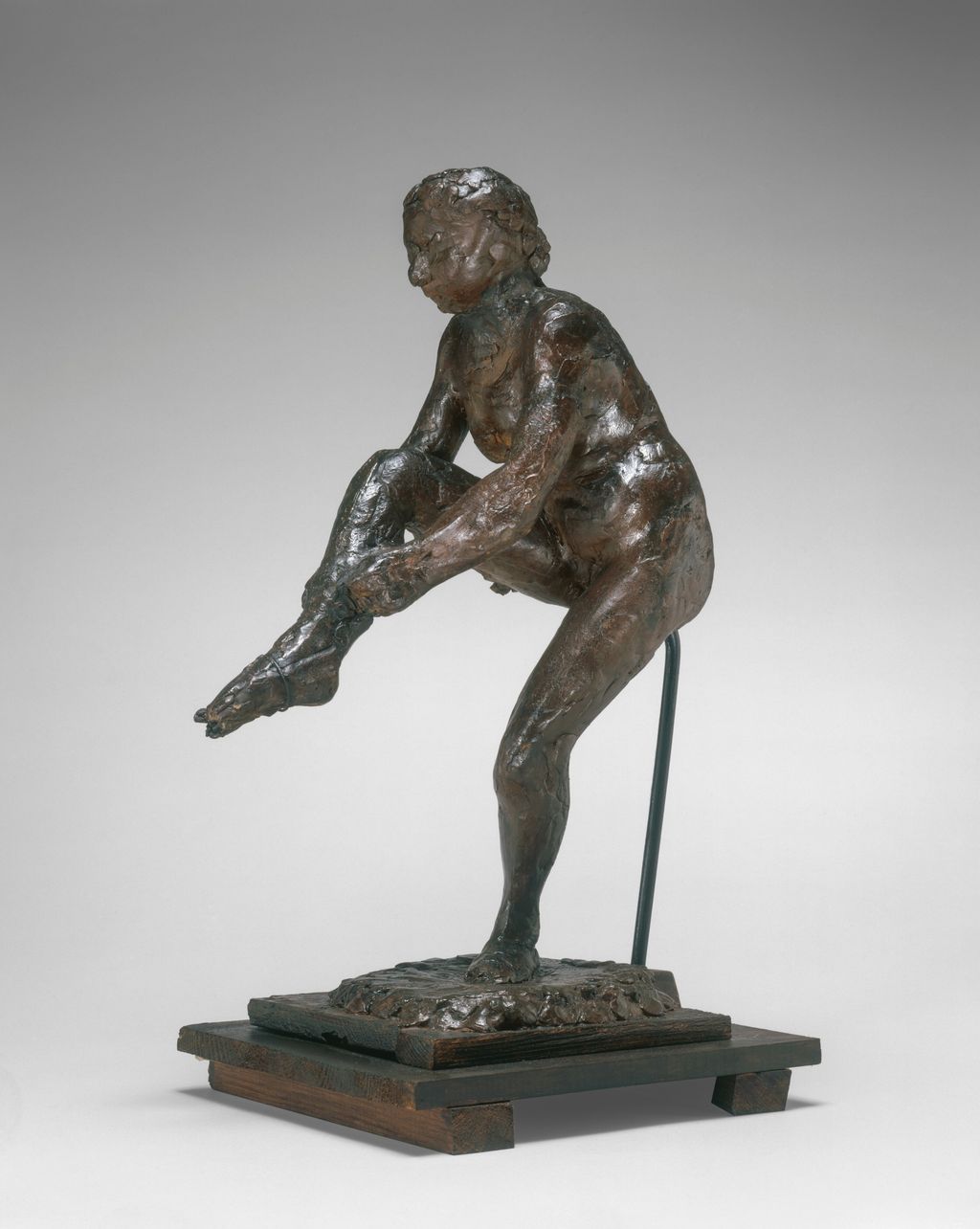
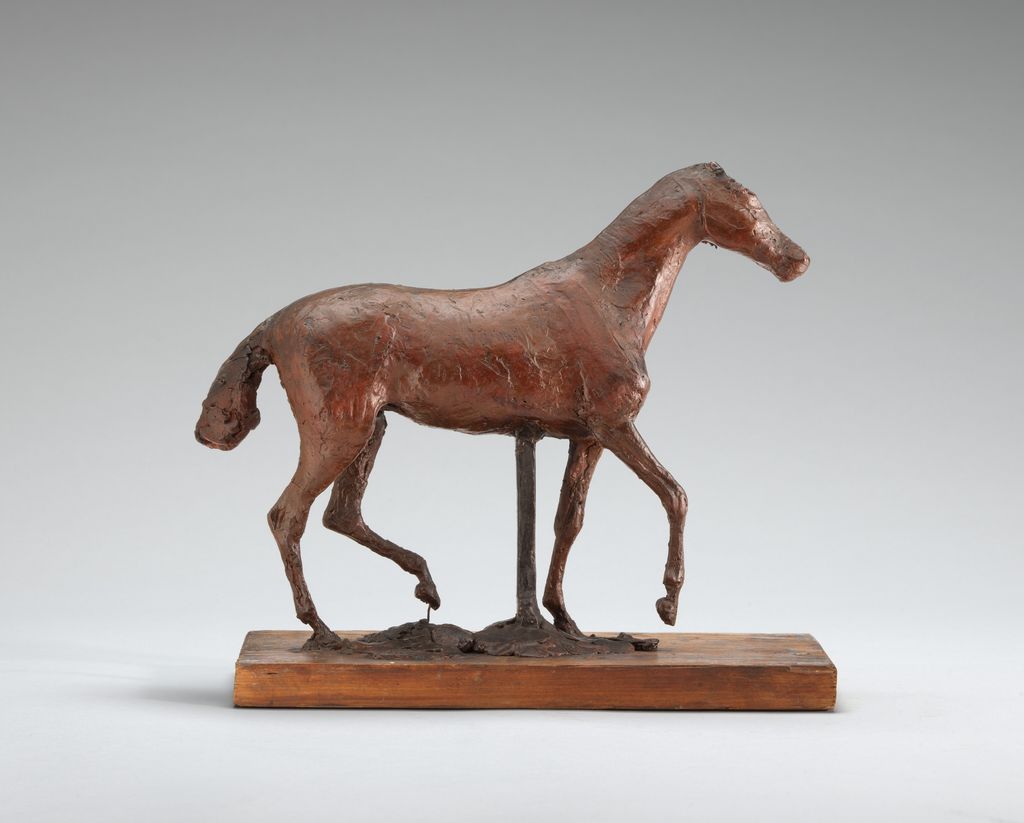
Their material variety is easy to miss in photographs. A dark, shiny surface may look like bronze on screen; the National Gallery of Art nevertheless identifies the original Dancer Moving Forward, Arms Raised as pigmented beeswax and clay over a metal armature. Its Dancer Putting on Her Stocking contains pigmented beeswax, a metal armature and cork. Horse Walking includes the same three material categories on a wooden base. A museum medium line is a firmer guide than the colour a reproduction happens to show. [4][5][6]
The support matters because these figures had to stand. Metal, wood and cork can help carry a pose while wax and clay make its surface. The exact construction differs from object to object. One should not turn the elaborate interior of Little Dancer into a recipe for every smaller dancer or horse. Degas's practice was exploratory, and the museum's separate material lists are evidence of that variation. [2][3][4][5][6]
The roughness of a model also invites care in interpretation. A visible lump, tool mark or asymmetry is part of the object we can describe. It does not automatically show that Degas considered the figure unfinished or intended it to be smoothed into a polished bronze. The NGA's publication frames his sculptural technique as a subject of continuing technical study, and the surviving objects were themselves affected by storage and later handling. What a present surface reveals about his decisions depends on that specific object's examination. [1][3]
The Original Little Dancer
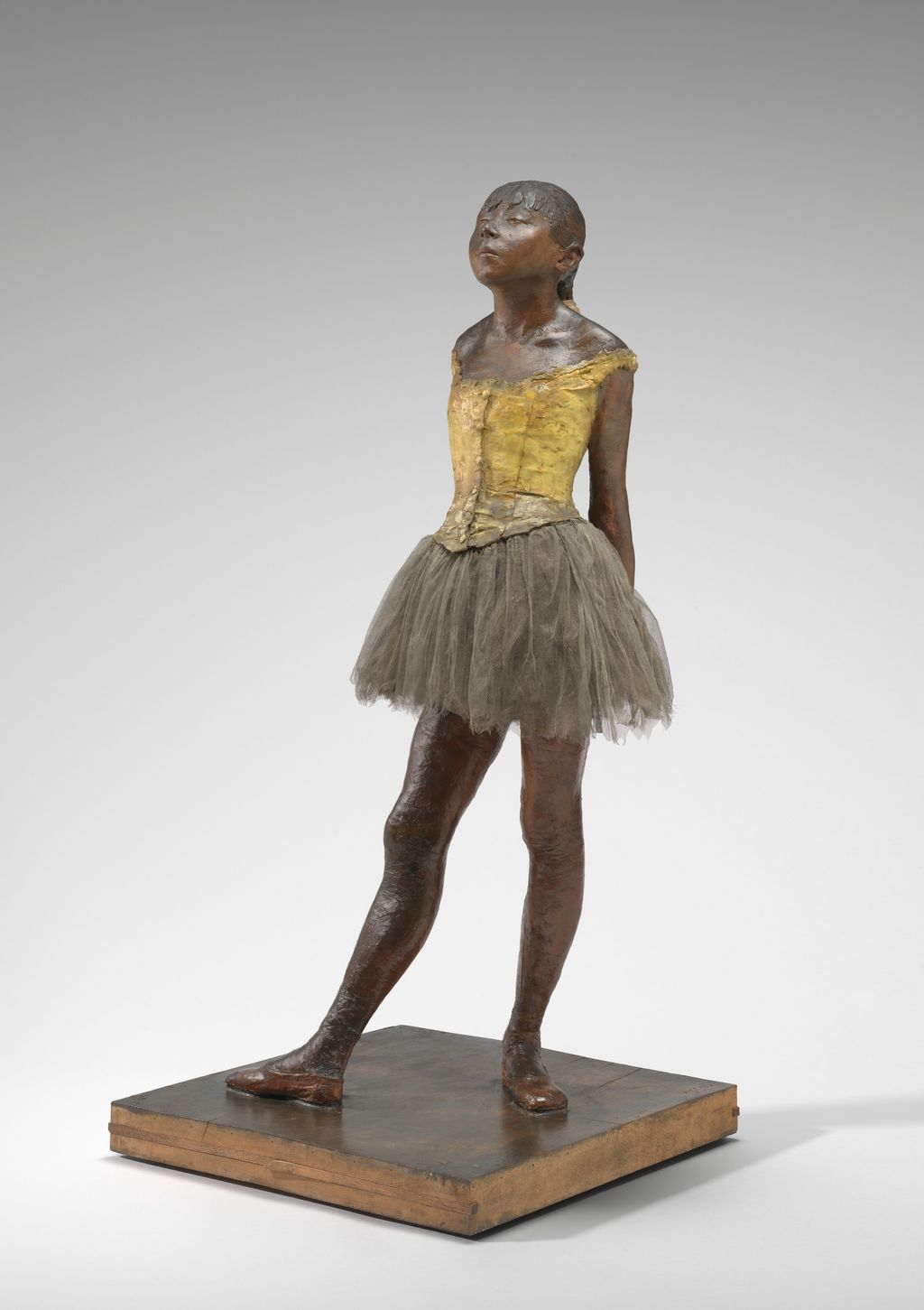
Little Dancer Aged Fourteen was made between 1878 and 1881. The original at the National Gallery of Art in Washington, accession 1999.80.28, combines pigmented beeswax, clay, a metal armature, rope, old paintbrushes, human hair and real textiles. It was near life-size and dressed in a tutu and slippers when Degas exhibited it in 1881. Such materials stood far from the smooth marble or bronze that many viewers expected of a public sculpture. Their physical presence is part of the work, not merely decoration added to a conventional statue. [1][2]
The original is not a bronze. The distinction is more than a technical footnote because a later cast can preserve a broad form while having its own date, surface, material and costume history. The Met's The Little Fourteen-Year-Old Dancer, accession 29.100.370, is identified as modeled in 1881 but cast in 1922, with a modern tutu. The two museum objects refer to the same sculptural invention across different stages of its history. A caption that calls them both simply “Degas's 1881 sculpture” loses the important difference between his wax and a bronze made after he died. [2][8]
Conservators have examined the NGA original's internal structure and surface. Their technical notes describe a metal armature supported by paintbrushes and springs, a rope-bound core covered in clay, then wax modeled and worked over the exterior. The clothing, netting and hair were added later in that sequence. That examination makes the object especially informative, but it is evidence about this one complex figure. It cannot be silently applied to each studio model. The dedicated Little Dancer page follows the sitter, exhibition reception, object history and versions in depth. [2][3]
There is also a separate Study in the Nude of Little Dancer Aged Fourteen. The NGA's technical entry describes evidence of molding during Degas's life, while explicitly treating the reasons for making and molding it as uncertain. That related work prevents a simple story in which he only pushed wax freely into shape and never worked with a mold-maker. It does not prove that he planned the later bronze editions or that every figure followed the same process. [9]
Two Dancers, Two Different Waxes
Edgar Degas, Dancer Moving Forward, Arms Raised, c. 1885–90, pigmented beeswax and clay with metal armature. National Gallery of Art, Washington, 1999.80.6. Collection record.Edgar Degas, Dancer Putting on Her Stocking, 1890s/1911, pigmented beeswax, metal armature and cork. National Gallery of Art, Washington, 1999.80.7. Collection record.
In the NGA's Dancer Moving Forward, Arms Raised, dated about 1885–90, a figure rises on one leg with arms lifted. A support behind her holds part of the pose. The model, accession 1999.80.6, is described as pigmented beeswax, unidentified clay and a metal armature on a wooden base. The extended arms and shift of weight are readable from the form itself. The support and base remind us that a sculpture of a dancer is also an engineered object that has to keep a precarious arrangement standing. [4]
This dancer is not a miniature version of the dressed Little Dancer. Its gesture stretches upward; its surface and material list differ; its scale is much smaller. We can compare how each fixes a body between movements without making one a direct study for the other. The original Little Dancer confronts a viewer at nearly human scale, while the smaller model invites closer attention to how arms, torso and support hold together. Those differences are visible and documented. A precise claim that one developed into the other would need evidence beyond a shared ballet subject. [2][4]
Dancer Putting on Her Stocking, dated broadly “1890s/1911” by the NGA, makes another sort of balance problem. The figure balances on one foot while raising the other leg, her hands working near the stocking. Its pigmented beeswax surface, metal armature, cork and wooden base form an object of about 48 centimetres overall without the base. The action is private preparation rather than a finished stage step. Degas had to arrange a bent body, lifted leg and small point of support so they could be seen together in space. [5]
The broad date should be left broad. It is tempting to turn a subject familiar from Degas's later paintings and pastels into a single year or to make it proof that he was actively modeling until exactly 1911. The owner record supplies a range; the object itself supplies the pose and material. Even the title does not identify a unique sculpture. The NGA has another Dancer Putting on Her Stocking, accession 1985.64.52, with a backboard and a different material description. A reader following an image needs its accession number to know which figure is being discussed. [5][10]
Both dancer waxes can appear bronze-like in a photograph. Their owning museum identifies them as originals in wax, not posthumous metal casts. The visual resemblance helps explain a common mistake: a reproduction can make dissimilar objects look alike. A complete caption should give the material and accession alongside the title, especially when the same action was tried more than once. [4][5][10]
Watch: Edgar Degas
Explore his paintings, drawings and sculpture in three short videos.
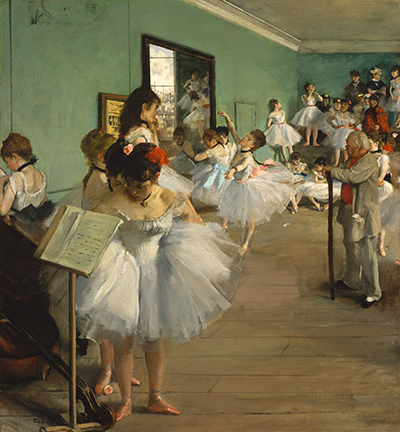
Degas, The Dance Class
Smarthistory
Look closely at Degas’s off-duty dancers and his unusual view into the rehearsal room.
Edgar Degas, Horse Walking, possibly early 1870s, pigmented beeswax, metal armature and cork. National Gallery of Art, Washington, 1999.80.13. Collection record.
Degas's horse models carry the same interest in balance beyond the ballet. Horse Walking, accession 1999.80.13, is dated “possibly early 1870s” by the NGA. The horse steps forward with legs at different points in a walking sequence; the figure is held above a wooden base by a support. The medium is pigmented beeswax, metal armature and cork. The narrow limbs and raised feet show why an internal support is not incidental: it makes a vulnerable, shifting pose physically possible. [6]
The conditional date is important. A horse in Degas's drawings or paintings may resemble this model, but resemblance does not settle when the wax was made or which image came first. The sculpture gives a view of a walking animal that changes as a viewer moves around it. From one side the lifted legs can appear to align; from another their separation becomes more apparent. That is a distinct experience from following a horse across the flat space of The Races. The horses and racing page will place such subjects in the wider culture of the racecourse, while this page stays with the modeled animal. [6]
Another NGA model, Horse Galloping on the Right Foot, accession 1999.80.11, has a different medium list: pigmented beeswax, plastiline, metal armature, cork and other organic material. Its date is given as the late 1880s. The title points to a faster phase of movement, but the object's material description also tells us that Degas could change his mixtures. The differences between a walking horse and a galloping one should not be flattened into a formula for depicting motion. Each figure has its own stance, support and surface. [7]
It is common to encounter these horses as bronzes in a museum or a reproduction. Ask whether the label names an original model or a cast and what its date means. The NGA waxes selected here survived a path through the artist's studio, his heirs, the Hébrard foundry, the art market and Paul Mellon's collection. A later bronze of a related figure followed a different physical path. Those histories belong alongside visual interpretation because the medium seen today is not a neutral window onto the object Degas handled. [1][6][7]
From Studio Models to Bronze Casts
When Degas died, the models in his studio were not a neatly finished public sculpture collection. The NGA's sculpture publication describes more than a hundred surviving figures, some dusty or damaged. Their heirs arranged bronze casting. For decades the bronzes were far more visible than the original waxes; the latter appeared on the art market in 1955, and many entered the NGA through Paul Mellon's collecting. A museum visitor now can compare material evidence that earlier generations of viewers often knew only through bronze versions. [1]
Casting is a process of making another object from a model through intermediate steps. It can carry the form of a wax or clay figure into metal, but it does not give that metal figure the wax's material, surface or date. A label may therefore say “modelled” in one year or range and “cast” decades later. The Met bronze Little Dancer makes the distinction explicit: modelled in 1881, cast in 1922. Its current costume is also described as modern. Careful wording preserves both Degas's invention and the later people who materially produced the object now on view. [8]
There is no need to turn the afterlife of the sculpture into a simple judgment that all casts are misleading or all casts are faithful. They made forms available to viewers and collections, while the surviving waxes record different evidence of Degas's own handling. A comparison should ask which model was used, when the cast was made, how the surface and clothing were treated, and what the owner record can establish. If those answers are unknown for a specific bronze, the unknowns belong in the account. The existence of some lifetime molding, documented in the related nude dancer study, does not erase the later history of bronze editions. [1][8][9]
The site has a separate page for Little Dancer Aged Fourteen because its original, casts, costume and public reception deserve object-level attention. The sculpture hub's broader lesson is how to read any Degas figure without silently moving evidence from one version to another. A dark dancer may be wax; an almost identical-looking dancer may be a bronze cast. The accession number tells us where to begin. [2][4][8]
Looking at a Degas Sculpture
Start with the material line. “Pigmented beeswax and clay,” “wax with cork and metal armature,” and “partially tinted bronze” describe different objects. If a caption says simply “bronze,” ask whether Degas modeled the original in wax and whether the date on the label refers to modeling, casting or both. With the original Little Dancer, look at the fabric, hair, wax and constructed support as parts of one work. With a small dancer, notice the armature or base that keeps a difficult pose upright. [2][3][4][5][8]
Then change your view. Does an arm overlap a face from one side? Where does a lifted foot seem to find weight? How does the curve of a horse's body connect to the pace suggested by its legs? A photograph chooses one answer to these questions; a three-dimensional object can offer several. The visible marks of modeling may become more apparent from a side or back view. This is a reason to look around the object when access permits, not a licence to infer exactly how Degas formed every surface. [4][5][6]
Finally, read its history. A private studio wax, a lifetime plaster where the evidence supports one, and a later bronze tell related but distinct stories. The original models show Degas testing posture and material; the bronzes show how heirs and foundries made that work more visible after 1917. Keeping those stories together makes the sculptures more interesting than a single tale of an artist who “made ballet dancers.” It lets a reader see both the body held in motion and the object's own movement through time. [1][8][9]
A selected index of documented works, combining owner records with entries sampled across Michel Schulman’s digital catalogue raisonné. It is not a complete catalogue. View the full catalogue
What parts of the original wax show the artist’s hand?
Context
How do cloth, hair and armatures alter your reading of a sculpture?
Open Question
Which label details distinguish an original model from a later cast?
Join the Conversation
Share your reading of these works below.
References
Suzanne Glover Lindsay, Daphne S. Barbour and Shelley G. Sturman, Edgar Degas Sculpture, National Gallery of Art online publication overview, 2011. View source
National Gallery of Art, Little Dancer Aged Fourteen, 1878–81, original mixed-material wax, accession 1999.80.28. View source
National Gallery of Art, “Technical Notes: Little Dancer Aged Fourteen”, Modeling Movement: Degas's Dancers, object-specific conservation study. View source
National Gallery of Art, Dancer Moving Forward, Arms Raised, c. 1885/1890, pigmented beeswax and clay, accession 1999.80.6. View source
National Gallery of Art, Dancer Putting on Her Stocking, 1890s/1911, pigmented beeswax, accession 1999.80.7. View source
National Gallery of Art, Horse Walking, possibly early 1870s, pigmented beeswax, accession 1999.80.13. View source
National Gallery of Art, Horse Galloping on the Right Foot, late 1880s, pigmented beeswax and plastiline, accession 1999.80.11. View source
Metropolitan Museum of Art, The Little Fourteen-Year-Old Dancer, modeled 1881, cast 1922, partially tinted bronze and textiles, accession 29.100.370. View source
National Gallery of Art, “Study in the Nude of Little Dancer Aged Fourteen: Technical Notes and Entry”, Modeling Movement: Degas's Dancers, for evidence and limits of lifetime molding. View source
National Gallery of Art, second Dancer Putting on Her Stocking, 1890s/1911, pigmented beeswax with backboard, accession 1985.64.52. View source
Splash image: Edgar Degas, Little Dancer Aged Fourteen, 1878–81, pigmented beeswax, clay and mixed materials. National Gallery of Art, Washington, 1999.80.28. Collection record. View source
Tom Gurney is an art history expert. He received a BSc (Hons) degree from Salford University, UK, and has also studied famous artists and art movements for over 20 years.
Tom has also published a number of books related to art history and continues to contribute to a number of different art websites. You can read more on Tom Gurney here.



 Buy Art Prints Now
 by Tom Gurney