

 Buy Art Prints Now
from Amazon
* As an Amazon Associate, and partner with Google Adsense and Ezoic, I earn from qualifying purchases.
 by Tom Gurney
Tom Gurney BSc (Hons) is an art history expert with over 20 years experience
Published on June 19, 2020 / Updated on September 28, 2026
Email: tomgurney1@gmail.com / Phone: +44 7429 011000
Degas Dance Class: Introduction
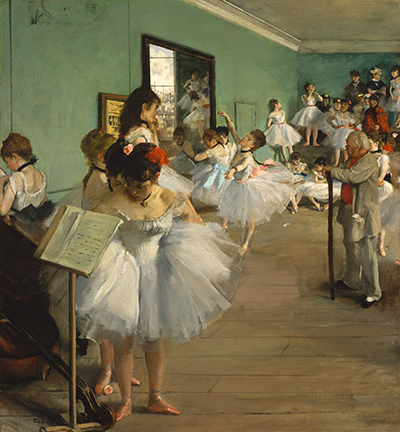
A dancer bends beside a music stand very close to the lower edge of Edgar Degas’s The Dance Class. The instrument at the left is cut by the frame. Farther back, a dancer with a pink sash holds an attitude while Jules Perrot attends to her. The eye can move directly to that central performance, but the room keeps diverting it: other dancers wait, adjust themselves or watch, and mothers sit among them. The event appears to be an examination, yet the pauses around it take up as much of the painting as the assessed movement. [1] [7]
This is the 1874 oil painting in the Metropolitan Museum of Art, accession 1987.47.1. That identification matters. Degas made several dance-class pictures, including a related vertical canvas now in the Musée d’Orsay and a smaller horizontal one now in the National Gallery of Art, Washington. Their titles are close enough to make search results and image captions confusing. The Met painting has its own arrangement, patron and documented exhibition history. Looking at it closely starts with its actual object record, rather than with a general description of “a Degas dance class.” [1][4][5]
The Dance Class at a Glance
- ArtistEdgar Degas
- Date and medium1874, oil on canvas
- Owning museumMetropolitan Museum of Art, New York
- Accession1987.47.1
- Dimensions83.5 × 77.2 cm
- Central actionA dancer in a pink sash performs an attitude before Jules Perrot
- SettingAn imaginary class in a room of the former Paris Opéra
- Early patronJean-Baptiste Faure, who commissioned and later lent the painting to the 1876 Impressionist exhibition
Contents
- Introduction
- At a Glance
- Start at the Edge, Then Find the Examination
- A Room That Appears Observed but Was Invented
- How the Floor and the Figures Direct the Eye
- The Pink Sash and the Work of Waiting
- Jean-Baptiste Faure’s Commission and the 1876 Loan
- A Painted Scene That Degas Reworked
- The Orsay La Classe de danse Is a Different Canvas
- A Third Dance Class in Washington
- What the Examination Lets Us See
- How to Identify and Look at This Painting
The museum describes a performance within an imaginary dance class. Its use of that word is important. The canvas is full of particular-looking details, but they do not amount to a report of one documented examination. Degas assembled a credible world of training, supervision and waiting. A spectator can examine its actions while keeping the distinction between a constructed scene and a dated event in the life of a real child. [1]
Start at the Edge, Then Find the Examination
The nearest figure does not offer a polished ballet pose. Bent down beside the stand, she is absorbed in an action at floor level. The stand and the cropped double bass establish the classroom’s connection with music, but they also obstruct an easy entrance into the image. We do not walk through a clear doorway into a symmetrical lesson. We meet a partial instrument and a body that has no need to face us. The first things we see are useful precisely because they are peripheral to the central test. [1]
From that low foreground, the floor carries the eye into an arc of people. At its far point, the dancer in pink becomes a momentary focus. Her lifted leg and the balance of her body make an attitude, the position named in the Met description. She is visible to the figures around her, to Perrot and to us. But Degas gives her neither an empty stage nor a crowd of uniformly attentive spectators. Other dancers are present in different states of readiness. Some bodies turn toward the examination; others make smaller motions of their own. The room accommodates multiple tempos at once. [1]
Perrot stands at the right, a clear adult authority within the painted group. The museum identifies him as the ballet master and notes that he conducts the examination. His position gives the central pose a reason: this is movement being shown to someone who can assess it. A dancer who trains for an audience must also train under the eye of a teacher. Here the teacher is inside the picture. The viewer’s gaze joins a system of looking already in progress, but the viewer has no access to Perrot’s judgement. A poised leg does not tell us what grade, correction or outcome followed. [1][6]
The mothers and waiting dancers matter as much as his presence. The Met explicitly includes mothers among those nearby. That identification prevents a simplified description of an isolated artist watching anonymous performers. The class is a social environment as well as a technical one. Adults sit, young dancers wait, and the supervised action occupies only one part of a room in use. The painting makes ballet training visible as time spent between displayed positions: a lesson contains observation, delay and ordinary gestures as well as achieved steps. [1][6]
In the Met’s audio transcript, a curator suggests that a girl near the mirror may be biting her nails. That is a possible reading of the painted hand near her face, not a record of the girl’s feelings. We can see the hand and the interrupted attention without claiming that she was anxious about an examination or identifying her by name. This distinction keeps the close-looking exercise honest. Degas gives a convincing gesture; a modern viewer supplies many possible stories for it. [1]
A Room That Appears Observed but Was Invented
The scene refers to a rehearsal room in the old Paris Opéra, whose building had burned in 1873. The Met calls the class imaginary. These two statements belong together. The picture recalls a specific institution and a lost place, but its figures are arranged in a painted event rather than recorded as one known gathering. A surviving building might be drawn directly; a former room had to be reconstructed, remembered or reimagined. The canvas offers neither an architectural survey nor a class register. Its exactness is pictorial. [1]
That exactness includes the mirrored wall, classroom furniture and the Guillaume Tell poster near the mirror. The poster does more than decorate a wall. The Met links it to the singer and collector Jean-Baptiste Faure, who commissioned the painting. Rossini’s opera Guillaume Tell supplied a role associated with him. A small printed object in the room thus joins the invented class to the work’s real patron. It is an unusual hinge between the world Degas painted and the world in which the painting was ordered. [1]
The room’s plausibility can tempt a literal reading. A viewer might suppose that the figures are in the exact old Opéra room on the day it burned, or that Faure was present at the represented examination. The museum supports neither claim. The poster can honor a patron without turning the imagined scene into a documentary record of his visit. The old setting and the historically identifiable commission show how Degas combined observed or remembered institutions with an arrangement made for art. [1][2]
That combination is central to why the image feels immediate. A moment of testing gives the composition a focus, and apparently casual actions give it the unevenness of daily use. At the same time, the pathway through figures, floor and objects has been carefully organised. We can read the work as a persuasive account of ballet training while recognising the painter’s control over what it allows us to see. The imagined status does not make the details meaningless. It asks us to treat them as decisions, rather than as automatically verifiable events. [1][6]
How the Floor and the Figures Direct the Eye
The Met audio description calls attention to an up-tilted viewpoint. Much of the floor is visible. Its broad plane lets Degas distribute dancers across the surface without flattening them into a simple row. From the foreground to the wall, each figure claims a place in the room, but the spaces between bodies are also active. A bare patch of floor can lead the eye toward the dancer being examined, while another gap sends it to a seated figure or the mirrored wall. [1]
The curator also describes an arc from the far figures to those close to us. It is possible to follow that curve in either direction. Beginning with the front dancer, we can travel backward into the room and arrive at the pink sash. Beginning with the central pose, we can follow the waiting students outward until the nearest figure bends out of the performance’s rhythm. The painting therefore does not force a single reading order. It gives the examined dancer a centre while repeatedly pulling attention back to preparation and interruption. [1]
Cropping reinforces this movement. The double bass at the left is present as a fragment. Its scale makes the near space feel occupied beyond the canvas’s edge, and its cut-off form warns us that the frame does not contain the entire room. The near dancer is also close enough to resist a tidy, distant survey. In a carefully staged theatrical picture, a painter might show every participant at a comfortable distance. Degas makes the room seem too close to fit. The frame becomes a decision about where to stop looking, not a promise that the full scene is visible. [1]
The mirror complicates the far wall. It can expand the apparent space and make figures difficult to place at a glance. It also creates another surface on which a dancer’s action may appear. This matters to a class built on observation and correction: one can be watched by a teacher, by peers and, in a mirror, by oneself. The painting does not document what any particular student saw in the glass, but its placement gives the viewer more than one way to understand a room devoted to learning bodily form. [1][3]
Compare the stillness of the architectural surfaces with the variety of human positions. The floor, wall and mirror hold a stable setting; within it, figures sit, stand, bend, wait and perform. A ballet image need not show only a dancer in airborne motion. Degas uses the schoolroom to juxtapose a held formal pose with less formal movement. The Met’s essay on ballet describes this interplay of choreographed and ordinary action as a characteristic interest in his classroom scenes. Here the pink attitude receives its meaning partly from the bodies around it. [1][6]
The Pink Sash and the Work of Waiting
Colour helps organise the crowded scene. The pink sash catches the eye around the central dancer’s waist. Against the paler dance clothing and the large room, it is a modest but effective marker of the figure currently being examined. It does not turn her into a soloist on a theatrical stage. She remains one student among a large group, and the viewer keeps discovering other pink accents, darker garments and small interruptions across the canvas. The eye’s return to her feels earned by the surrounding activity. [1]
The dancers’ white clothing is not a single unbroken field. Bodies overlap, separate and turn. The many light forms could have dissolved into decoration, but the changing gestures let us read individuals as people occupied with different parts of class time. Some are available for display; others are temporarily outside it. Degas lets the waiting condition become visible without supplying a narrative for each student. A hand at the face, a body turned aside or a seated posture may suggest a mood to us; it remains a painted posture unless an external record supports more. [1][6]
The result is a study of attention. The central dancer directs attention toward the attitude. Perrot has a professional reason to look. Nearby students may be watching, yet their bodies do not all behave as if the exam were the only event. Mothers add another set of onlookers. The viewer, too, moves between concentrated and wandering observation. This is one reason the painting remains engaging after its main action has been identified. It shows what a class looks like when one person performs and everyone else continues to inhabit time. [1]
We should be careful with the word “backstage.” It often accompanies Degas’s dancer pictures, and a training room belongs to the labor behind public performance. Yet the painting has a more exact subject than a generic behind-the-scenes glimpse. The Met identifies an examination within an imaginary class. The pose is being evaluated, while repeated practice and waiting surround it. Calling the room merely a backstage scene would lose the specific relation between a tested movement, a named ballet master and the less formal bodies in the same space. [1][6]
Jean-Baptiste Faure’s Commission and the 1876 Loan
The Met records that Faure commissioned this work in 1872 and that Degas worked on it intermittently over the next two years. Faure lent the finished painting to the 1876 Impressionist exhibition. The canvas therefore has a history outside the represented classroom: it was made for a singer and collector, then entered a public exhibition through his loan. [1][2]
Faure’s place in the history of this work should not be confused with Perrot’s. Perrot appears within the painting as the ballet master directing the examination. Faure is the patron in the painting’s making and early ownership, evoked by the Guillaume Tell poster. One man belongs to the imagined class; the other links that class to a named musical career and a collector’s decision. Both associations are documented by the Met, but they operate at different levels. [1][2]
Commission does not mean we know every instruction Faure gave Degas, how much he paid, or how either man explained the finished composition. The directly readable records used here do not provide those particulars. What they do show is enough to complicate an overly simple view of Impressionist art as work created only for an anonymous exhibition public. A commissioned painting could also be lent into the group’s 1876 exhibition, where it could be encountered beyond the patron’s home. [1][2]
The date of that loan belongs to this Met canvas. The Orsay class painting has its own museum history, and the NGA class scene has a separate exhibition record. Repeating “shown in 1876” beside any image titled The Dance Class would turn a valid fact into a mistaken attribution. The accession number 1987.47.1 is therefore more than cataloguing formality: it attaches the date, size, image and exhibition statement to a single object. [1][4][5]
Watch: Edgar Degas
Explore his paintings, drawings and sculpture in three short videos.
Degas, The Dance Class
Look closely at Degas’s off-duty dancers and his unusual view into the rehearsal room.
Watch on YouTubeA Painted Scene That Degas Reworked
The Met’s audio transcript describes changes to foreground figures and to the central dancer as Degas worked. Those documented changes fit the picture’s composed character. The final arrangement may feel like a fleeting glance, but it was subject to revision. Moving or altering a dancer can change the balance of the room, the route of the viewer’s eye and the relation between the formal attitude and everyday interruptions. Revision is part of how a crowded scene can appear coherent without appearing rigid. [1]
The Met describes the reworking but does not specify every former position or the order of the changes. That limit leaves the final painting as the place to look: its apparent immediacy came from choices about how figures, floor and mirror would direct attention. [1]
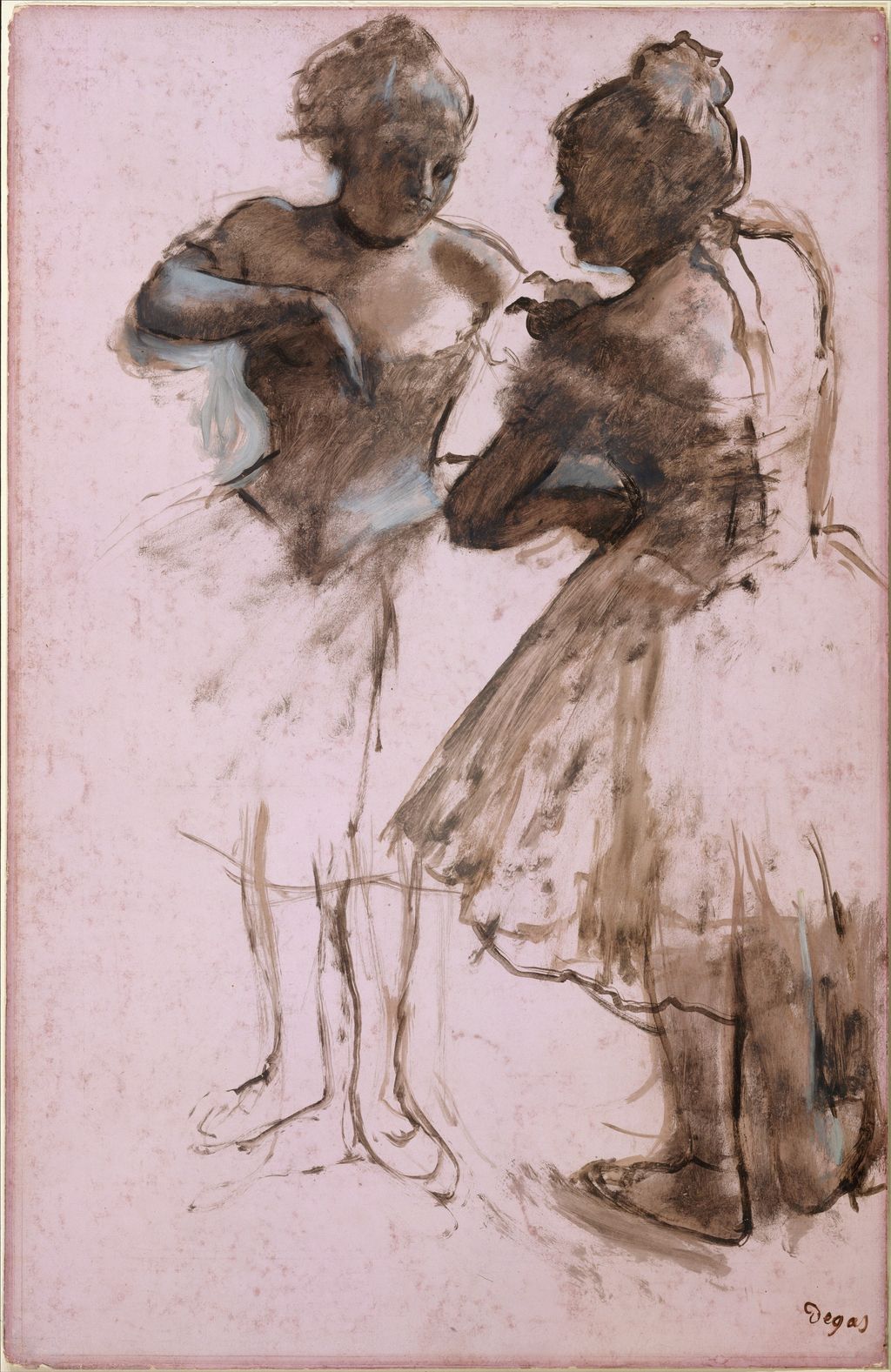
One related sheet gives a more concrete way to watch that process. The Met owns Two Dancers, accession 29.100.187, an 1873 work in dark brown wash and white gouache on pink prepared paper. Its object record explicitly relates the figures to the class paintings: both occur around Perrot in the Orsay composition, and the dancer on the right appears looking into a mirror in the Met painting. The sheet connects a specific drawn figure to different painted arrangements. [3][4]
Look at the sheet beside the canvas. A drawn pair can be inspected without the full classroom around it. In the painting, a figure’s meaning changes with the mirror, neighbours and central examination. Reuse need not mean a mechanical transfer. Degas could test a body in one medium, alter its setting and make it take part in a different network of glances. The Met record identifies the recurrence; it does not require us to invent a simple line in which every drawing was followed by one painting and then abandoned. [1][3]
The pink prepared paper itself is worth noticing. White gouache can mark light against that coloured ground, while brown wash establishes forms and shadows. This is a distinct work on paper, not a miniature version of the oil canvas. It offers evidence of Degas’s attention to bodies and poses across media. The drawings page can take that broader practice further; here the sheet is useful because the owning museum names its relationship to this exact painting. [3]
The Orsay La Classe de danse Is a Different Canvas
The Musée d’Orsay owns another ambitious class picture, La Classe de danse, dated 1873–76 and identified as RF 1976. It too includes Jules Perrot. Its dimensions, 85.5 × 75 cm, are close enough to the Met painting’s that size alone may not settle a quick identification. Yet the painted arrangement is different, and Orsay’s record has its own account of the scene and object history. The shared title and teacher explain the association; they do not merge the works. [1][4]
Orsay describes dancers at the end of a lesson in its version. That interpretation belongs to the Orsay painting. The Met says the pink-sashed dancer performs an attitude for examination in its canvas. It is tempting to use a general sentence about “the class ending” for both pictures because they share a ballet room and Perrot. Doing so would erase the specific action the Met identifies at the centre of this work. The nearby students may be waiting; the owner does not present the whole Met scene as the conclusion of a lesson. [1][4]
The Two Dancers sheet makes the relationship between versions more interesting than a simple identity error. The Met connects its figures with both the Orsay and Met compositions. Degas could draw from a stock of studied movements while changing the positions and functions of figures in separate canvases. The existence of a shared figure is therefore a reason to inspect each object more carefully. It is not evidence that a reproduction of one picture can stand in for the other. [3][4]
For a practical check, find the close foreground dancer bent by the music stand and the pink-sashed dancer performing before Perrot. Those features direct you to Met 1987.47.1. If a caption gives Orsay RF 1976, follow the Orsay owner link and look again at its particular arrangement. A reader wanting that canvas in depth can move to the separate Orsay ballet-class page. Keeping the two pages distinct allows each painting’s own evidence to be explained without making one a footnote to the other. [1][4]
A Third Dance Class in Washington
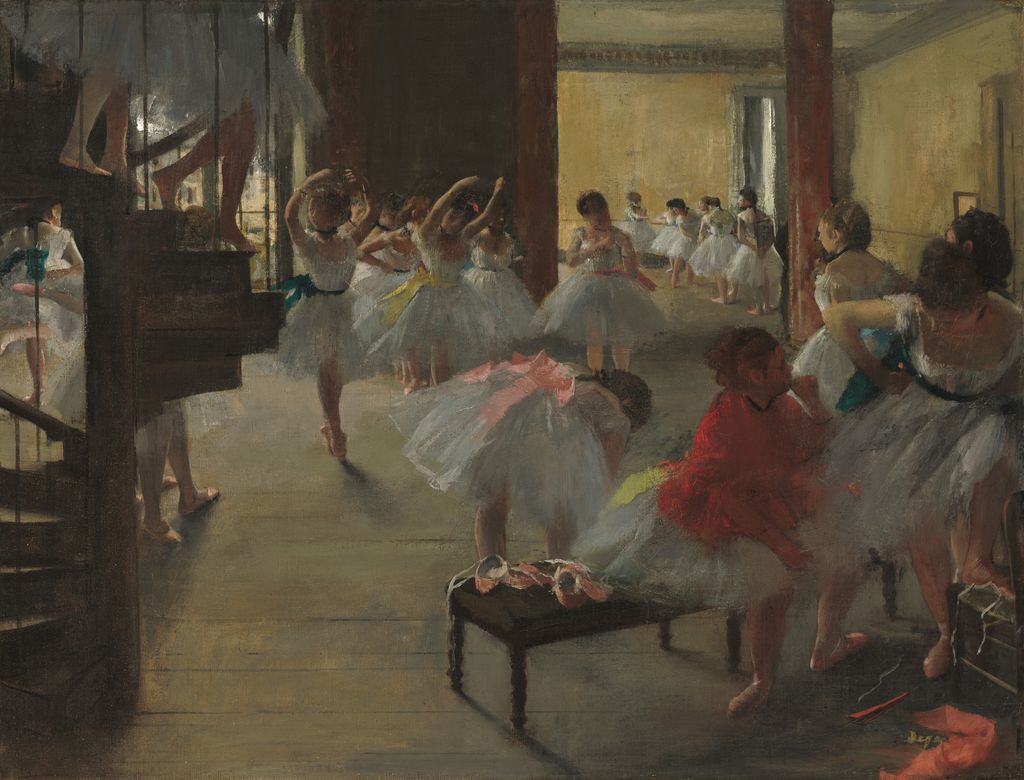
The National Gallery of Art has another Degas oil painting titled The Dance Class, dated about 1873 and catalogued 2014.79.710. It came from the Corcoran Collection. Unlike the roughly vertical Met and Orsay works, the NGA picture is horizontal and measures 47.63 × 62.23 cm. Its room is much darker, with a spiral stair at the left and a brighter space beyond. A dancer in a red jacket sits at the right. These are immediate visual clues that a search result has brought you to a third object. [5]
That picture is useful to show alongside the Met canvas because the title alone is so unhelpful. In Washington’s work, the long horizontal spread, the stair and the doorway structure the viewer’s route. In New York’s 1874 work, the foreground instrument and stand, the central attitude, the mirror and the arc of figures do that work. They are both images of ballet training, but the compositional questions they ask are different. One painting cannot illustrate the other merely because a catalogue uses the same English words. [1][5]
The NGA record gives its own exhibition history, including appearances in London in 1876 and Paris in 1877. Those entries attach to 2014.79.710, not to the Met painting. Conversely, Faure’s loan to the 1876 Impressionist exhibition is stated by the Met for 1987.47.1. Keeping these statements with their accessions protects the page from a common error: a plausible event from one Degas class picture being copied into the biography of another. [1][5]
The NGA image is a useful comparison rather than a second lead for this page. Its spiral stair, low lit room and seated red-jacketed figure make the difference visible immediately. The Met image remains the subject. Comparing specific forms, dimensions and owner records lets a reader enjoy the family resemblance among Degas’s classes while preserving the identity of each painted object. [1][5]
What the Examination Lets Us See
The pink-sashed dancer’s pose is an accomplished, formal movement. Without the surrounding class, it could be read simply as an image of ballet technique. Degas gives it an audience inside the painting and surrounds it with bodies in much less formal states. The work is consequently about the conditions under which a position is learned and evaluated. Performance is there, but so are supervision, preparation and waiting. The Met’s ballet essay places that alternation of choreographed and ordinary action at the heart of Degas’s classroom imagery. The wider ballet-dancers page follows that working world across more of his art. [1][6]
An examination also creates a hierarchy of attention. Perrot sees the performer as a teacher. Other students can compare their own work to hers. Mothers occupy another place in the room. We, viewing from outside the painted event, can wander more freely. The foreground figure has no obligation to direct us to the centre, and a small action near the mirror can hold our interest for as long as the assessed pose. The painting gives its subject a structure without dictating how long we must look at each part. [1]
That freedom is also a limit. We do not know from the canvas whether the central dancer passed, whether a waiting student dreaded her turn or whether the class had a named roster that day. The work asks for observation, not invented private history. We can describe the visible relations among figures and use the museum record for the roles it identifies. Anything further should be marked as interpretation. The difference matters especially with images of children, whose gestures can too easily become material for stories they did not tell. [1]
The old Opéra setting deepens this mixture of particularity and invention. A destroyed building, a real ballet master and a real patron’s opera poster make the room historically resonant. Yet the class itself remains an imagined assembly. Degas’s achievement is to make that assembly feel organised by the routines of a working institution. The persuasive details do not turn the canvas into a transcript; they make the fiction specific enough to examine. [1][2]
How to Identify and Look at This Painting
Begin with the museum label: Metropolitan Museum of Art, 1987.47.1, 1874, oil on canvas. Then enter at the nearest edge. Find the partial double bass, the music stand and the dancer bending beside it. Follow the floor into the group. The pink sash marks the dancer holding an attitude before Perrot. The mirror, the Guillaume Tell poster and the waiting figures give that action its classroom setting. This route through the image lets the reader experience the painting’s shifts of attention before settling on a single description. [1]
Next ask what each source can actually tell us. The Met record identifies the painting, the examination, Faure and the imaginary old-Opéra room. The audio transcript discusses viewpoint and revision. The Two Dancers record links a particular study to figures reused across the Met and Orsay compositions. Orsay’s and NGA’s records identify separate paintings. These sources do not supply the private thoughts of the students or a diary of one historical class. The distinction is an aid to looking, not a restriction on response: we can interpret the work more precisely when its observed and documented parts stay clear. [1][2][3][4][5]
Finally, return to the central dancer. Her formal pose is the picture’s event, but the painted room refuses to let performance become the whole story. Between the close foreground, the arc of waiting figures and the supervising teacher, Degas gives training a social and temporal shape. This Dance Class remains distinct from its relatives because of that particular balance: one dancer is being assessed, while an entire class continues around her. [1][6]
Selected dance class
Artworks directory
A selected index of documented works, combining owner records with entries sampled across Michel Schulman’s digital catalogue raisonné. It is not a complete catalogue. View the full catalogue
Discussion
Share what you notice in Degas’s dance class.
Reader Insights
Where does the class pull your eye away from the examined dancer?
How do the mirror and tilted floor organize the crowded room?
Which details identify this canvas as the Met version?
Join the Conversation
Share your reading of these works below.
References
- Metropolitan Museum of Art, The Dance Class, 1874, oil on canvas, accession 1987.47.1; object description and on-page audio transcript. View source
- Metropolitan Museum of Art, French record for The Dance Class, same accession 1987.47.1; 1872 Faure commission and intermittent work. View source
- Metropolitan Museum of Art, Two Dancers, 1873, wash and gouache on prepared paper, accession 29.100.187. View source
- Musée d’Orsay, La Classe de danse, 1873–76, oil on canvas, accession RF 1976. View source
- National Gallery of Art, Washington, The Dance Class, c. 1873, oil on canvas, accession 2014.79.710. View source
- Jean Sorabella, Metropolitan Museum of Art, “The Ballet”, 2004. View source
- Splash image: Edgar Degas, The Dance Class, 1874, oil on canvas. The Metropolitan Museum of Art, 1987.47.1. Collection record. View source