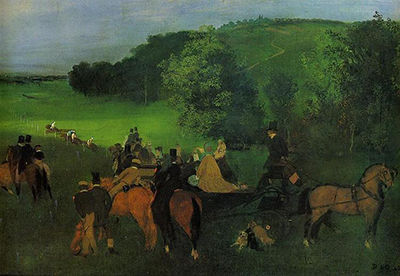
View Le Champ de courses. Jockeys amateurs près d’une voiture in its artwork record.
* As an Amazon Associate, and partner with Google Adsense and Ezoic, I earn from qualifying purchases.
by Tom Gurney Tom Gurney BSc (Hons) is an art history expert with over 20 years experience
Published on June 19, 2020 / Updated on September 28, 2026
Email: tomgurney1@gmail.com / Phone: +44 7429 011000
Degas At The Races: Introduction
Riders gather near an open carriage at a racecourse. The horses are ready to move, but Edgar Degas holds the scene in a pause. In At the Races, the attention is divided among jockeys, mounts, vehicle and open ground. No single horse wins our gaze for long. The horizontal painting makes the occasion feel social as well as athletic: people and animals wait together in a setting built for motion, while the picture studies the moment before that motion becomes a result. [1][3]
The painting is the Musée d’Orsay’s RF 1980, titled in French Le Champ de courses. Jockeys amateurs près d’une voiture (“The Racecourse: Amateur Jockeys near a Carriage”). Orsay dates the oil on canvas 1876–87 and gives its size as 65.2 × 81.2 cm. Its riders and carriage distinguish it from other racecourse pictures by Degas; “At the Races” alone is too broad a title to identify one canvas. [1]
At a glance
ArtistEdgar Degas
English title used hereAt the Races
Collection titleLe Champ de courses. Jockeys amateurs près d'une voiture
The long date range should not be shortened to a single neat year. Orsay's provenance records that Jean-Baptiste Faure commissioned the work in 1874 and received it in 1887. The current object date starts in 1876. Commission, execution range and delivery refer to different events. We can say that the painting has a long documented commission history without claiming Degas painted it continuously through every year between those dates. An older 1877–80 attribution is narrower than the current owner record. [1]
A racecourse before the decisive instant
The scene includes mounted figures and a carriage rather than a finish line or a crowd cheering a winner. Degas chooses the surroundings of racing: riders gather, horses are managed and a vehicle occupies the same field of activity. This gives the viewer several small actions to connect. One looks from horse to rider, then toward the carriage, then outward into the open space. The picture is about the racecourse as a place of preparation and observation, not only as a track on which a contest reaches its climax. [1]
Such a pause can hold a surprising amount of energy. A horse that seems still may shift its weight at any moment; a rider's posture implies readiness. The carriage gives another kind of movement, slower and social, associated with arriving, watching and leaving. Degas does not need to paint a blurred gallop to make the possibility of motion present. He places animals and people in relation to each other and lets their potential trajectories animate an apparently settled scene. [1]
The precise event is not identified in the Orsay catalogue. We should not assign a named race, date, winner or individual jockey to this picture. The French title describes amateur jockeys near a carriage; it does not supply the identities of each person. This limit is useful rather than frustrating. It keeps attention on what Degas organized visually: the spacing among riders, horses and vehicle, and the waiting quality of a course where movement is expected but not yet delivered to the viewer. [1]
The horizontal format matters here. At 81.2 centimetres across, the canvas can spread the groups over a field rather than stack them into a tight vertical view. Open ground lets the eye travel between the figures and their surroundings. That movement of looking is not the same as a horse's run, but it gives the painting a measured pace. We approach one cluster, cross to another and return to the carriage that anchors the social scene. The racecourse becomes an arrangement of relationships, not a diagram of speed. [1]
Horses, riders and a carriage
Degas's racing pictures often make a viewer notice the interaction between trained animal and human direction. Here, riders sit with their horses while a carriage introduces spectatorship and transport. The visible scene does not tell us exactly who owns the animals or who will compete. It does show how many roles can coexist around a race: riding, handling, waiting, travelling and watching. The horse is not simply an emblem of motion. Its body is one part of a coordinated human environment. [1]
The carriage also changes the sense of scale. It gives a built object against which the horses and figures can be judged. Its wheels and open structure belong to the practical world of arriving at an event. At the same time, it suggests that racing is a gathering attended by people whose relation to the sport may be social as well as athletic. Degas does not spell out a story of rank or family from this one vehicle. We can say the carriage makes the course a social place without pretending we know its passengers' names or intentions. [1]
The French title's “jockeys amateurs” is a museum title, not a licence to invent the riders' backgrounds. “Amateur” distinguishes a category of participation in the title, but the object record used here does not give biographical entries for these particular figures. Nor should a modern reader infer from the term that the riders were unskilled. The painting is interested in their presence and arrangement. Its details of costume and posture can support close looking, but not a full account of each person's training. [1]
The horses connect the picture's areas. Their bodies and directions draw lines through the composition, while the carriage supplies a contrasting geometry. A viewer can feel the difference between animal readiness and the more rigid construction of the vehicle. Both promise movement, but in different ways. This contrast helps explain why the picture can be lively without depicting a race underway. Its action is distributed across expectation rather than concentrated in a single sprint. [1]
Observation and construction
A racecourse painting can look like an informal glimpse of an event. Yet this work's date and commission history warn against imagining it as a quick, single-session record. The Orsay record places its commission in 1874, its painting date within 1876–87, and its delivery in 1887. Those markers suggest a sustained relationship between artist, patron and picture. They do not describe every revision, but they make it clear that the final scene cannot simply be equated with one afternoon at the course. [1]
This does not make the image less attentive to contemporary life. Degas could study how people and animals gather and then arrange those observations in paint. The result lets a viewer feel close to the racecourse while also sensing deliberate choices of position and spacing. It is worth separating the experience of immediacy from the historical claim of instant execution. We can describe the former from the painting; the latter would require evidence the short owner record does not provide. [1]
The painting's open spaces are part of that arrangement. Racing pictures need not fill every part of a field with a horse or spectator. Ground between groups gives each its own presence and permits the eye to imagine paths through the setting. The carriage draws one kind of attention, the riders another. Degas leaves enough room for their relationship to be read. The blank or quieter areas are therefore active in the composition, even though they do not contain the most readily named objects. [1]
The title helps set the boundary of interpretation. The current owner calls this a racecourse with amateur jockeys near a carriage. It does not call it “The Finish,” “The Winning Horse,” or “A Day at Longchamp.” Descriptions of a specific location or dramatic outcome would push beyond the catalogue. Reading the painting as a scene before decisive action remains an interpretation of its visible stillness, not a claim that the museum has dated it to moments before a known race. [1]
Watch: Edgar Degas
Explore his paintings, drawings and sculpture in three short videos.
Degas, The Dance Class
Smarthistory
Look closely at Degas’s off-duty dancers and his unusual view into the rehearsal room.
Jean-Baptiste Faure, a singer and collector, commissioned the work in 1874, according to Orsay's provenance. The record says the painting was delivered in 1887 and was in his collection that year. These dates give a broader frame than a generic label such as “late 1870s.” They also make the artist–patron relationship relevant without inviting an unsupported story about why the painting took that long. A commission date and a delivery date are evidence of endpoints, not a complete diary of work. [1]
Orsay next traces the painting through dealer Paul Durand-Ruel in 1893 and the collection of Count Isaac de Camondo from that year until his 1911 bequest to the French state. It was assigned to the Musée d'Orsay in 1986. This sequence explains how a picture commissioned for a private owner became part of a public museum. It should not be confused with the provenance of another Degas racing canvas, even if both passed through dealers or collectors with familiar names. [1]
The provenance also illustrates why an accession number is valuable. Titles may be translated, abbreviated or reused. Ownership can be complex. The museum's RF 1980 remains a stable link to this specific object across its French and English titles and exhibition references. The accession and the carriage composition together distinguish this painting from other Degas racecourse scenes. [1]
Not the Washington Races
The National Gallery of Art in Washington owns another Degas picture titled The Races, accession 1942.9.18. It is dated 1871–72, painted in oil on wood, and measures only 26.6 × 35.1 cm. Its visual description emphasizes a group of jockeys in colorful silks on a broad grassy field. That is a different support, date, size and composition from Orsay's carriage scene. The shared language of racing cannot join them into one work. [1][2]
The Washington picture can help explain Degas's continuing interest in the moments around a race. But comparison must begin with the difference. A line of colorful riders on a grassy field gives one kind of racing image; the Orsay work builds a more extended relation among riders, mounts and a vehicle. Orsay's longer commission history belongs to RF 1980, while the National Gallery's earlier date belongs to its wooden panel. Mixing those facts would produce a page that sounds specific but describes no real object accurately. [1][2]
There are racehorse studies, jockey drawings, paintings of running and waiting, and images linked to Longchamp under similar English names. The Orsay oil is one specific work within that larger subject. The Washington panel offers a comparison while remaining a different painting, with a different support and date. [1][2]
What to notice in the painting
Start with the carriage. Follow its outline to the nearby riders and then compare the horses' directions. Look across the ground between figures rather than only at the most colorful details. The space around the groups helps set the rhythm of the scene. Return to the carriage and consider how its presence shifts the subject from pure sport to a social event. Each element asks to be seen in relation to the others. [1]
Then think about time. A race result would fix attention on one instant and one winner. This picture holds several possible next actions without choosing a climax. Its long making and delivery history adds another layer of time: the painting itself moved slowly from commission to completed object. These two times should not be confused, but together they explain why the work rewards patient looking. A moment that seems casual on the canvas was part of an extended artistic undertaking. [1]
At the Races, in the precise form of Orsay RF 1980, presents Degas's racecourse as a place where motion is prepared and people gather around it. The horses, jockeys and carriage share the wide field; no single participant tells the whole story. The current museum date and title keep this image separate from similarly named racing works. Its interest lies in the poised relation of bodies, vehicle and open space before the racecourse becomes a scene of speed. See also Degas's paintings and the separate Racehorses at Longchamp painting. [1]
Artworks directory
A selected index of documented works, combining owner records with entries sampled across Michel Schulman’s digital catalogue raisonné. It is not a complete catalogue. View the full catalogue
How does the foreground carriage affect the view of the riders?
Context
Which parts of the painting suggest a scene observed from close by?
Open Question
What do the owner’s dates tell us about when the composition was finished?
Join the Conversation
Share your reading of these works below.
References
Musée d'Orsay, Le Champ de courses. Jockeys amateurs près d'une voiture, RF 1980, object record and provenance, accessed 27 September 2026. View source
National Gallery of Art, The Races, 1942.9.18, object record and visual description, accessed 27 September 2026. View source
Splash image: Edgar Degas, Le Champ de courses. Jockeys amateurs près d’une voiture, 1876–87, oil on canvas. Musée d’Orsay, Paris, RF 1980. Collection record. View source
Tom Gurney is an art history expert. He received a BSc (Hons) degree from Salford University, UK, and has also studied famous artists and art movements for over 20 years.
Tom has also published a number of books related to art history and continues to contribute to a number of different art websites. You can read more on Tom Gurney here.



 by Tom Gurney