* As an Amazon Associate, and partner with Google Adsense and Ezoic, I earn from qualifying purchases.
by Tom Gurney Tom Gurney BSc (Hons) is an art history expert with over 20 years experience
Published on June 19, 2020 / Updated on September 28, 2026
Email: tomgurney1@gmail.com / Phone: +44 7429 011000
Degas Pastels: Introduction
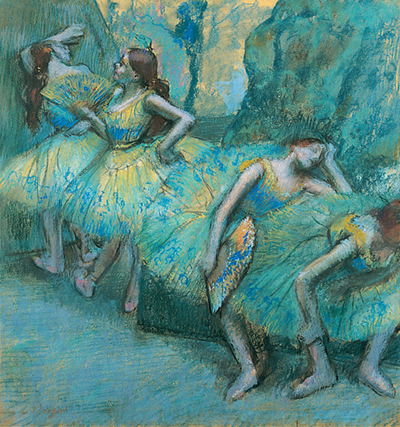
Four dancers gather near the stage in Edgar Degas's Ballet Dancers in the Wings. Blue, yellow and green marks cross the skirts, making their gauze seem to shimmer, while the figures adjust slippers and stretch. The Saint Louis Art Museum dates the pastel broadly to about 1890–1900 and notes that the four figures may show one red-haired dancer at successive moments. That reading is possible, not a settled identification. What can be seen directly is Degas's use of coloured strokes to give repeated gestures both a rhythm and a changing surface. [6][13]
Pastel let Degas work with colour as a drawing material. A stick could leave a crisp line, break across the texture of paper, spread under pressure or form a dense layer over earlier marks. He used it for dancers, bathers, milliners, portraits and landscapes, sometimes on its own and sometimes over charcoal, watercolor, a monotype or another support. The resulting work could be swiftly marked or painstakingly built. A Degas pastel is therefore neither an unfinished oil painting nor automatically a quick sketch. [1][2][3][5][6]
What Is Pastel?
Pastel is powdered colour held with a small amount of binder in a stick. Unlike oil paint, it can be applied directly without waiting for a wet layer to dry. The artist draws, but the marks can cover a surface with colour and build forms at a scale associated with painting. The Musée d'Orsay places pastel at the border of drawing and painting and notes the brilliant ready-made hues available to nineteenth-century artists. Its speed of application made repeated work possible; the time Degas spent on a large, layered sheet could still be considerable. [2][4][5]
Paper is not a neutral background. Its colour may remain visible between strokes, and its texture can catch particles on raised fibres while allowing lower areas to show through. Degas used coloured and prepared papers, tracing paper and supports joined or mounted in different ways. A line of pastel also changes with pressure: it can sit on the surface as broken powder, or it can be pressed and blended into a more even area. Those choices are part of the image rather than merely evidence of a material underneath it. [1][2][3]
Pastel was already an established medium when Degas adopted it. Orsay's collection account traces an earlier history of coloured studies and independent portraits, followed by a nineteenth-century revival. Degas extended its possibilities through repeated subjects, strong contrasts and combinations with other media. Saying he worked inventively in pastel does not require saying he invented the medium or every technique associated with it. The useful question is what a particular sheet does with powder, paper and colour. [1][2]
How Pastel Became Central to His Work
Degas's early career was strongly connected to drawing and oil painting. Pastel grew more important from the mid-1870s. The Met's career account describes its increasing presence after 1875; Musée d'Orsay says he used it almost exclusively from about 1888–90. These are broad descriptions of a changing balance among media, not a date on which oil stopped. He still made later oils, including the Met's Dancers, Pink and Green around 1890 and the NGA's Four Dancers around 1899. The paintings page follows that continued oil practice. [1][12]
The shift in emphasis had practical and visual possibilities. Orsay notes that pastel allowed Degas to return to a composition more readily than paint. He could work dry, dampen or crush the sticks, rub or erase areas, and use different lines across a surface. The museum also describes use of steam and mixtures with tempera or oil. Those are practices documented across the body of work. They should not be read as a checklist of processes performed on every image. A convincing explanation begins with a named object whose materials have been examined. [1]
The medium also travelled among Degas's subjects. Orsay's collection spans studies connected to large paintings, landscapes from the late 1860s and early 1870s, works from the independent exhibitions, and later dancers and bathers. Pastel did not announce one exclusive subject. It offered a way to revisit a body, a room or an arrangement through marks that remained visibly drawn. A colour could describe fabric, hold a figure against a background or make a passage of empty space active. [1][2]
Two Women: Paper, Watercolor and Pastel
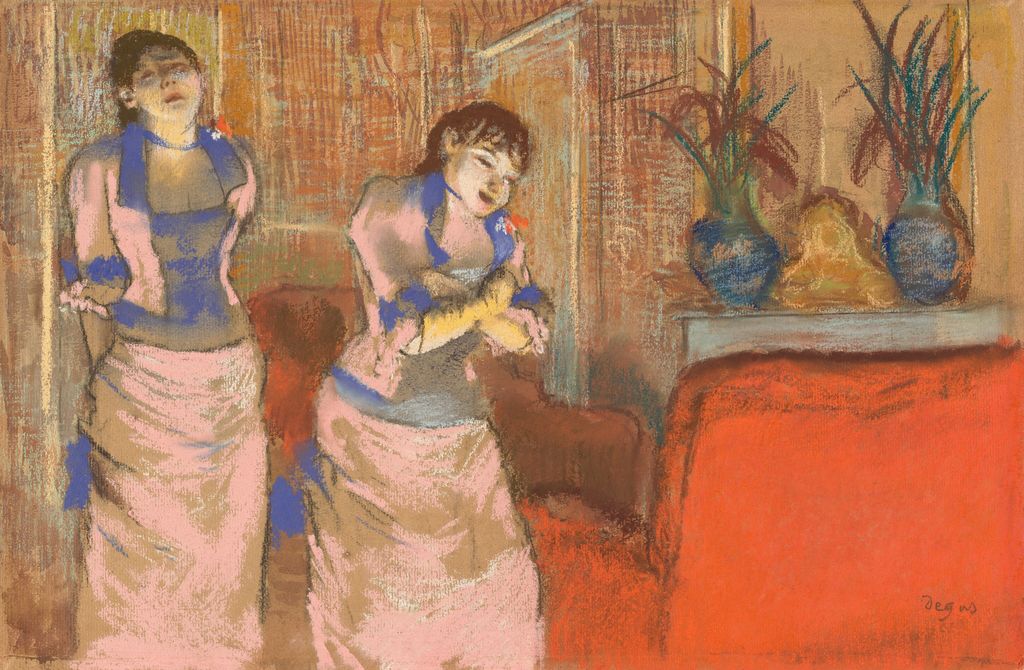
Edgar Degas, Two Women, c. 1878/1880, pastel over watercolor and charcoal on tan laid paper, mounted to board. National Gallery of Art, Washington, 2014.136.176. Collection record.
The National Gallery of Art's Two Women, dated about 1878/1880, is a particularly clear case because conservator Kimberly Schenck has examined its materials closely. Two similarly dressed women occupy a room whose wall, vases and chairs are made from different kinds of marks. The object is pastel over watercolor and charcoal on tan laid paper mounted to board. Its visible ground helps unify the scene, while denser colour makes the figures come forward. [3]
Schenck identifies a light charcoal layout beneath the pastel. She describes how a yellow stroke catches on the paper's high points, leaving tiny interruptions, while stronger pressure produces a more continuous blue in a collar. Around a face Degas combined fine brownish-purple marks with brighter strokes and used a stump to soften selected shadows. Elsewhere the colour was blended with a fingertip. On this one sheet, he did not choose between line and smoothness; he used both, placing their differences where they would matter. [3]
The wall provides another change of material. Watercolor washes and brushstrokes lie beneath dappled pastel marks. Schenck also finds crushed pastel mixed with liquid in the bodices, although she qualifies the precise way Degas applied that mixture. The result is a textured surface that can suggest fabric without being made by one uniform method. These findings come from Two Women specifically. They cannot be transferred to Ballet Dancers in the Wings or every other Degas pastel on the strength of a shared artist name. [3]
The two women may be separate people, or the composition may place a similar figure at different moments. The NGA leaves the question open. Degas's material choices keep both figures connected through repeated dress colours while their positions differ. That tension is useful for looking: repetition can be built from marks and colour as well as from a pose. The drawings page examines how he repeated and transferred figures through other procedures. [3]
A Large Pastel of a Woman Having Her Hair Combed
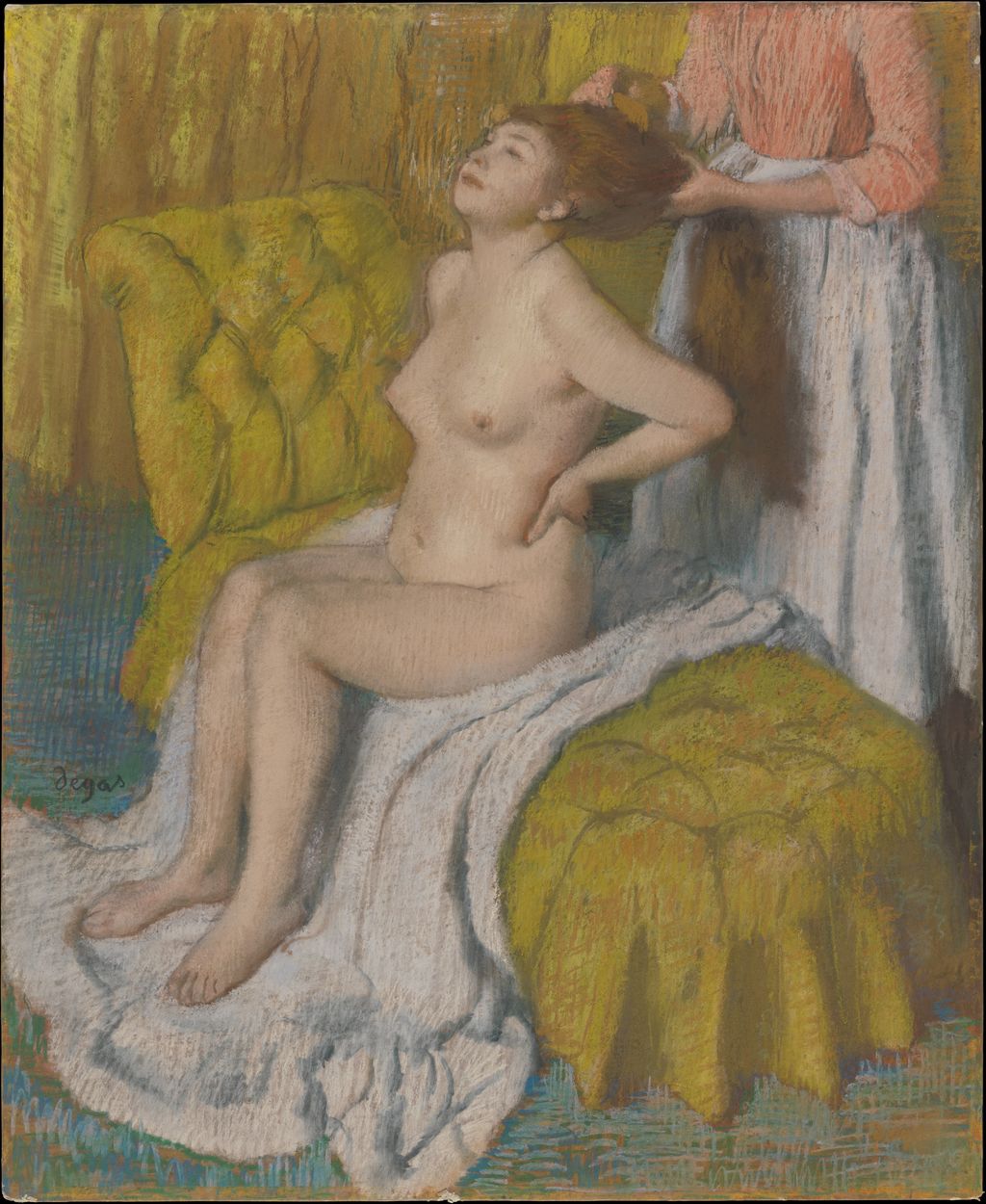
Edgar Degas, Woman Having Her Hair Combed, c. 1886–88, pastel on light green wove paper, now discolored to warm gray, affixed to original pulpboard mount. The Metropolitan Museum of Art, 29.100.35. Collection record.
The Met's Woman Having Her Hair Combed, dated about 1886–88, uses pastel on light green wove paper attached to its original pulpboard mount. A seated woman and the person tending her hair occupy a setting of drapery, upholstery and strong colour. The Met describes many layered strokes whose directions vary across the body, rug and room. The work is large and highly worked. It is a direct answer to the idea that pastel must mean a small, provisional study. [5]
The museum relates the subject to Degas's proposed group of bathing and grooming images for the 1886 independent exhibition, but it cannot establish that this particular pastel was shown. It may not have been ready or may have been withheld. A page about the medium can say what its materials and surface show without converting an uncertain exhibition history into fact. Reff's 1976 technical discussion used the historical title The Toilette for this same accession, 29.100.35; the Met's current title is Woman Having Her Hair Combed. [5][11]
The colours show how Degas could make pastel function in layers. Cooler hues enter the surrounding furnishings while warmer and lighter strokes shape the figures. The underlying paper and the orientation of the marks affect the final colour we perceive. Marjorie Shelley, writing for the Met's conservation department, explains that the pastel's loosely bound particles create a soft, diffuse reflection of light. The same loose structure makes the surface vulnerable. This is a relationship between appearance and material, not a defect discovered after the work was made. [4][5]
Shelley describes risks in this particular object from its pigment, the coloured paper and the original pulpboard backing. Some colourants and dyed papers can fade under strong light; powder can be dislodged by contact or vibration; changes in environment can strain the support. The museum keeps the original mount, which is part of the work's historical format, and controls display conditions rather than replacing it with an imagined ideal support. Orsay likewise rotates fragile pastels in its galleries. A reproduction lets us study the composition, but seeing an original is also a reminder that preserving its colour and surface governs how it can be shown. [2][4]
Watch: Edgar Degas
Explore his paintings, drawings and sculpture in three short videos.
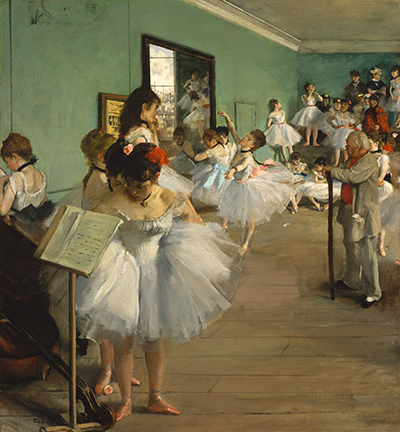
Degas, The Dance Class
Smarthistory
Look closely at Degas’s off-duty dancers and his unusual view into the rehearsal room.
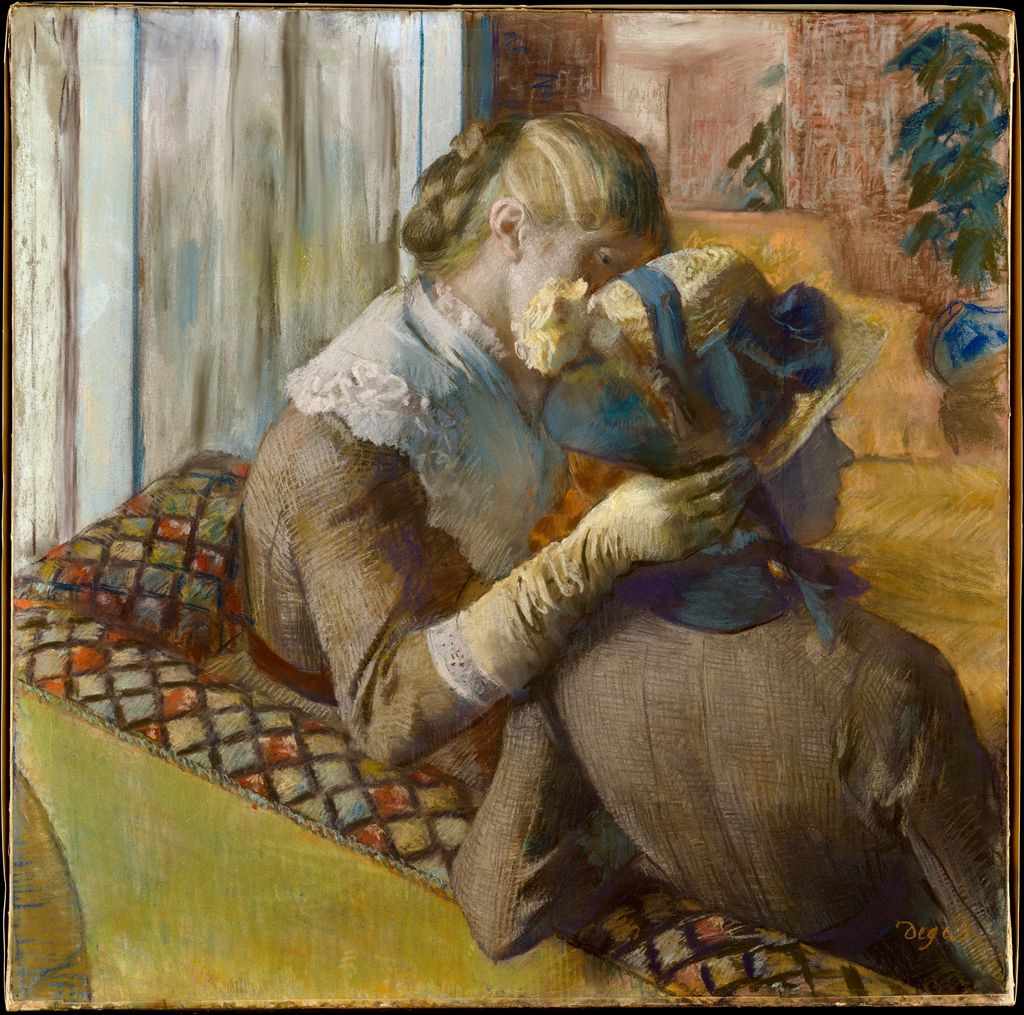
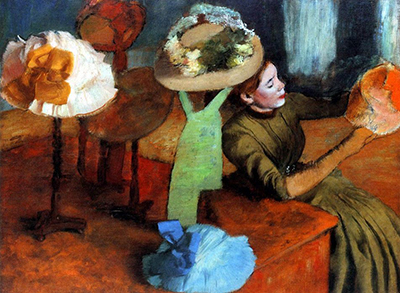
Edgar Degas, At the Milliner's, 1881, pastel on five pieces of wove paper, backed with paper, and laid down on canvas. The Metropolitan Museum of Art, 1997.391.1. Collection record.
Pastel did not always stay on a single untouched sheet. The Met identifies At the Milliner's of 1881 as pastel on five pieces of wove paper, backed with paper and laid down on canvas. A woman seen largely from behind studies or handles a hat while another figure is close beside her. The joined support matters: Degas could assemble a substantial composition from paper as well as draw on it. The final surface is a worked picture of a shop interior, not a single-page sketch. [7]
The Met suggests the scene changed during its making: a possible early shopgirl arrangement became a grouping read as customers when Degas added another woman and the sofa. The museum also qualifies the possible relationship between the women. Those are plausible readings of a revised image, rather than secure names or an account of a witnessed encounter. The physical fact of the five paper pieces is firmer. It shows how a pastel could be planned and extended through support as well as colour. [7]
Millinery was one of Degas's modern subjects, but its social history needs more than the hats in one image. This pastel's exact paper construction belongs here. Met At the Milliner's, accession 1997.391.1, is distinct from the similarly named Art Institute of Chicago work discussed on the Millinery Shop page. A repeated subject does not make two objects interchangeable. [7]
Pastel on a Printed Image
Degas sometimes began with a monotype: ink worked on a plate and transferred to paper, producing a printed basis that could then be altered. From the mid-1870s he used pastel over such impressions. Orsay's Ballet, also known as L'Étoile, is an exact example. The museum dates it about 1876–77 and lists the medium as pastel on monotype, accession RF 12258. In such a work, the print and the drawn colour are both part of the object. Calling it simply an oil painting would erase how it was made. [1][8][11]
Monotype offered a different kind of starting surface from untouched coloured paper. A printed dark could establish a tonal structure before pastel added brighter hues or altered emphasis. Reff describes this cross-media process in his account of Degas's techniques, and Orsay's record gives an owner-confirmed case. It does not follow that every pastel began as a print, or that the same order of marks can be inferred from a reproduction. The prints and monotypes page follows the printed process in its own right. [1][8][11]
The Ballet title also shows why object records matter. L'Étoile is a documented alternative title for Orsay's RF 12258, not a licence to assign every dancer in a spotlight to that work. Its specific stage arrangement and exhibition history require attention to that exact object. This hub uses it to show one material relationship: pastel laid over a monotype. [8]
Dancers, Bathers and Colour Without a Single Formula
Return to the Saint Louis Ballet Dancers in the Wings. The museum describes layered translucent blues, yellows and greens giving the tulle a shimmering effect. Four dancers wait offstage in a descending sequence of poses. The large coloured passages differ from the paper reserve and sharply varied marks of NGA Two Women, and from the tightly worked figure and surrounding furnishings in the Met bather. These works all use pastel, but each builds a different relation between line, surface and body. [3][5][6]
Degas also used pastel for women bathing and drying themselves. The National Gallery in London describes After the Bath, Woman drying herself as a work made through posed studio practice, not a scene of a woman unknowingly observed. The bathers page can ask how repetition and viewpoint affect the subject across works. The London work is one among many bath images with similar titles; its collection identity should stay attached to its image. The lesson for this medium page is narrower: a natural-looking gesture can be made through repeated, controlled study. [10]
Later blue-dancer images present another identity problem. The Pushkin Museum records a Blue Dancers pastel of about 1898, while Orsay holds different works with similar titles. Colour and title alone cannot identify a pictured object. The viewer needs the museum, dimensions, date and composition. For the Pushkin work, its record supports a 65 × 65 cm pastel on paper; it does not document every technique behind the blue passages. A study of any one version must begin with its exact image and owner record. [9]
How to Look at a Degas Pastel
Begin with the material label. “Pastel” may describe coloured sticks on paper, but an object can also be pastel over watercolor and charcoal, pastel on a monotype, or pastel across several joined sheets. The words after “pastel” in a museum record often explain why the image looks as it does. Two Women has a tan paper reserve and watercolor under colour; Orsay's Ballet has a printed base; At the Milliner's has five joined paper pieces. [3][7][8]
Then notice where the colour is broken, pressed, blended or layered. In Two Women the paper ridges interrupt lighter marks, while pressure fills other areas. In the Saint Louis dancers, translucent layers make tulle seem to shift. In the Met's hair-combing scene, densely worked strokes shape bodies, furnishings and light. Each observation should stay attached to its object, because Degas used different approaches across a long career. [3][5][6]
Finally, remember that a pastel's brilliance and fragility come from the same powdery surface. Museum lighting, glazing, careful handling and periods off display help protect materials that can be altered by light or movement. The image on this page is a useful way to compare works; the original is a physical assembly of pigment, paper and sometimes mount or printed layer. Degas used those parts to make coloured drawing capable of sustained revision and ambitious scale. [2][4]
The paper or backing can shape what survives as much as the visible colour. A sheet mounted to board gains a firm working surface but may respond differently to changing humidity from the pastel layer above it. A paper reserve can make the colour feel open, while a densely covered passage can hide the ground almost completely. These differences are easy to lose in a small reproduction. When a museum describes the support and its condition, that information is part of understanding the work, alongside the figures and composition. It explains why two images that look equally bright on screen may require different display and conservation decisions. [2][3][4][5]
A selected index of documented works, combining owner records with entries sampled across Michel Schulman’s digital catalogue raisonné. It is not a complete catalogue. View the full catalogue
Musée d'Orsay, “Pastels,” collection and material account, French. View source
Kimberly Schenck, “Edgar Degas's Experiments in Pastel and Watercolor,” National Gallery of Art, 11 August 2023; Two Women, c. 1878/1880, accession 2014.136.176. View source · View source
Marjorie Shelley, “Precious Powder: The Fragility of Degas’s Pastels,” Metropolitan Museum of Art, 27 August 2020. View source
Metropolitan Museum of Art, Woman Having Her Hair Combed, c. 1886–88, pastel on wove paper and pulpboard mount, accession 29.100.35. View source
Saint Louis Art Museum, Ballet Dancers in the Wings, c. 1890–1900, pastel, object 24:1935. View source
Metropolitan Museum of Art, At the Milliner's, 1881, pastel on five joined pieces of paper laid down on canvas, accession 1997.391.1. View source
Musée d'Orsay, Ballet / L'Étoile, c. 1876–77, pastel on monotype, RF 12258. View source
Pushkin State Museum of Fine Arts, Blue Dancers, around 1898, pastel on paper, 65 × 65 cm. View source
National Gallery, London, After the Bath, Woman drying herself, NG6295. View source
Theodore Reff, “The Artist as Technician,” in Degas: The Artist's Mind, Metropolitan Museum of Art, 1976, especially pp. 274–85 and 295–96. View source
Ruth Schenkel, “Edgar Degas (1834–1917): Painting and Drawing,” Heilbrunn Timeline of Art History, Metropolitan Museum of Art, 2004. View source
Splash image: Edgar Degas, Ballet Dancers in the Wings, c. 1890–1900, pastel. Saint Louis Art Museum, 24:1935. Collection record. View source
Tom Gurney is an art history expert. He received a BSc (Hons) degree from Salford University, UK, and has also studied famous artists and art movements for over 20 years.
Tom has also published a number of books related to art history and continues to contribute to a number of different art websites. You can read more on Tom Gurney here.



 Buy Art Prints Now
 by Tom Gurney