

 Buy Art Prints Now
from Amazon
* As an Amazon Associate, and partner with Google Adsense and Ezoic, I earn from qualifying purchases.
 by Tom Gurney
Tom Gurney BSc (Hons) is an art history expert with over 20 years experience
Published on June 19, 2020 / Updated on September 28, 2026
Email: tomgurney1@gmail.com / Phone: +44 7429 011000
Degas Drawings: Introduction
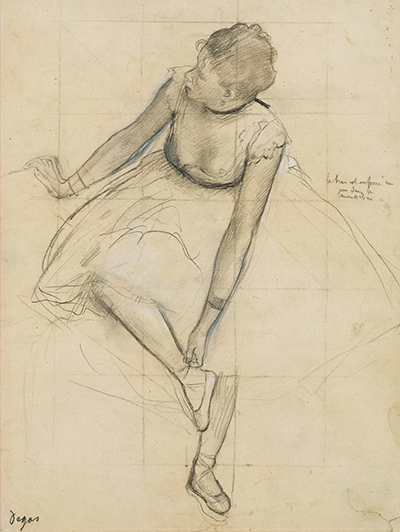
Small squares cross Edgar Degas's Dancer Adjusting Her Slipper. The dancer bends over one shoe, her body held in a moment of awkward balance. Graphite gives the pose its structure; black and white chalk make it more legible against paper that was once pink. The Metropolitan Museum of Art dates the sheet to 1873 and identifies the grid as squaring for transfer. Here is drawing doing a particular job: Degas could use a studied figure in another composition. The museum connects this one to his 1874 pastel Dancers Resting. Yet the sheet is also worth looking at on its own. Its changes of pressure, pale highlights and measured lines show the work of deciding where a body belongs in space. [4] [15]
At a Glance
- Early exampleRed-chalk self-portrait, c. 1855 [2]
- TransferMet slipper study, squared in 1873 [4]
- Late practiceLarge charcoal drawings on tracing paper [11]
Contents
- Introduction
- Learning to See Through Line
- A Figure That Could Move Into Another Picture
- Studies for the Ballet Class
- Feet, Horses and a Wider Field of Study
- Tracing as a Way to Change a Figure
- When a Drawing Was the Work
- Drawing Beside Pastel, Print and Sculpture
- How to Look at a Degas Drawing
Drawing accompanied Degas from his training into his late career, but it did not have one purpose. He copied older art, made portraits, studied bodies and animals, stored figures for later use, altered them through tracing, and sometimes made drawings he considered works in their own right. A page of charcoal could lead towards pastel; a wash on coloured paper could be presented as an independent image. The distinction between a study and a finished drawing is therefore a question about a particular object and its history, not a rule imposed by its material. [1][3][9][10]
Learning to See Through Line
Degas learned within an academic culture that valued drawing from observation and from earlier art. The National Gallery of Art records his copying of Old Master paintings at the Louvre and during his years in Italy, 1856–59. The point was more than to borrow a subject. Looking carefully at another artist's form and translating it into marks trained the eye and hand. The NGA traces a respect for line through Degas's later work, even as the subjects and materials changed. The biography follows his education and travels in fuller chronological detail. [1]
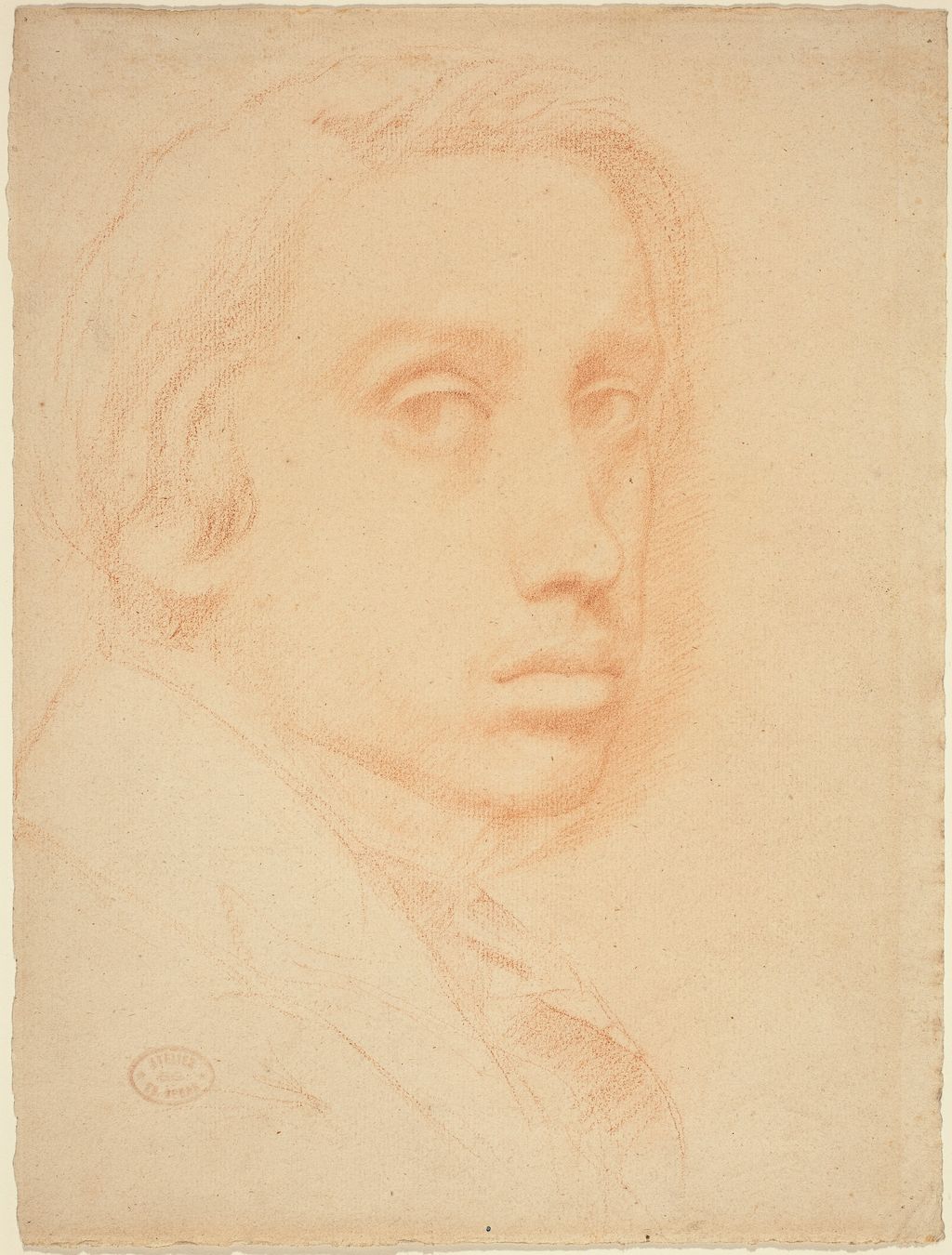
The NGA's Self-Portrait, made about 1855, shows an early use of red chalk on laid paper. Degas faces forward in a head-and-shoulders image. The hair and jacket are lightly indicated, while the eyes, nose and mouth receive concentrated attention. Fine red strokes build tone around the face, and much of the light paper remains visible. This is a portrait of a young artist looking at himself, not a documented copy of an Old Master. Its importance here lies in how little a line needs to do before a face becomes specific. The material can be soft and tentative while the gaze feels direct. [2]
An early self-portrait also helps correct the idea that Degas's drawing mattered only when he began to depict dancers. Portraits and history pictures occupied his first independent years; horses and racing entered his modern subjects before ballet became a major field. Drawing carried observation between these subjects. It was a way to investigate a face, a moving body or a compositional problem before any decision about a public picture. A catalogue label may call all these sheets “drawings,” but the reasons for making them vary. [1][2]
A Figure That Could Move Into Another Picture
Return to the Met's Dancer Adjusting Her Slipper. The dancer's action is ordinary within the work of ballet: tending a shoe rather than presenting a perfect stage pose. The grid across the drawing tells us that Degas prepared this figure for transfer. Squaring gives a maker a set of coordinates for moving an image to another scale or support; it does not, by itself, tell us every intervening step. The Met does identify a resulting use in Dancers Resting, so this case can be discussed more precisely than a generic claim that a dancer sketch “must have become” a painting. [4]
The paper matters too. The Met describes a pink wove sheet that has faded, with graphite heightened by black and white chalk. A pale line can lift a form from its coloured ground while a dark one settles weight or contour. The dancer's bent torso and extended leg remain readable even though she is not enclosed by a room or stage. Degas could study the relation of limbs before deciding how much surrounding space to give the figure. These are visible choices in this sheet; the museum's transfer finding supplies the documented relationship to another work. [4]
The Met owns another squared dancer, Seated Dancer of 1873–74. Its medium combines graphite and charcoal heightened with white on pink paper. It demonstrates that squaring was a repeatable part of Degas's practice in this period, but it is a different sheet with a different accession number. A grid on one image is useful evidence for that image. It is not a licence to say that every pose Degas reused was squared or copied in precisely the same way. [12]
The similarly titled Dancer Adjusting Her Slipper at the Detroit Institute of Arts is also a separate object: charcoal on tan paper, dated about 1879, accession 67.273. Its material, date and owner differ from the Met's 1873 squared sheet, accession 29.100.941. The Met sheet discussed separately here is the squared 1873 drawing, not the Detroit charcoal. A matching title alone cannot identify an object. [4][5]
Studies for the Ballet Class
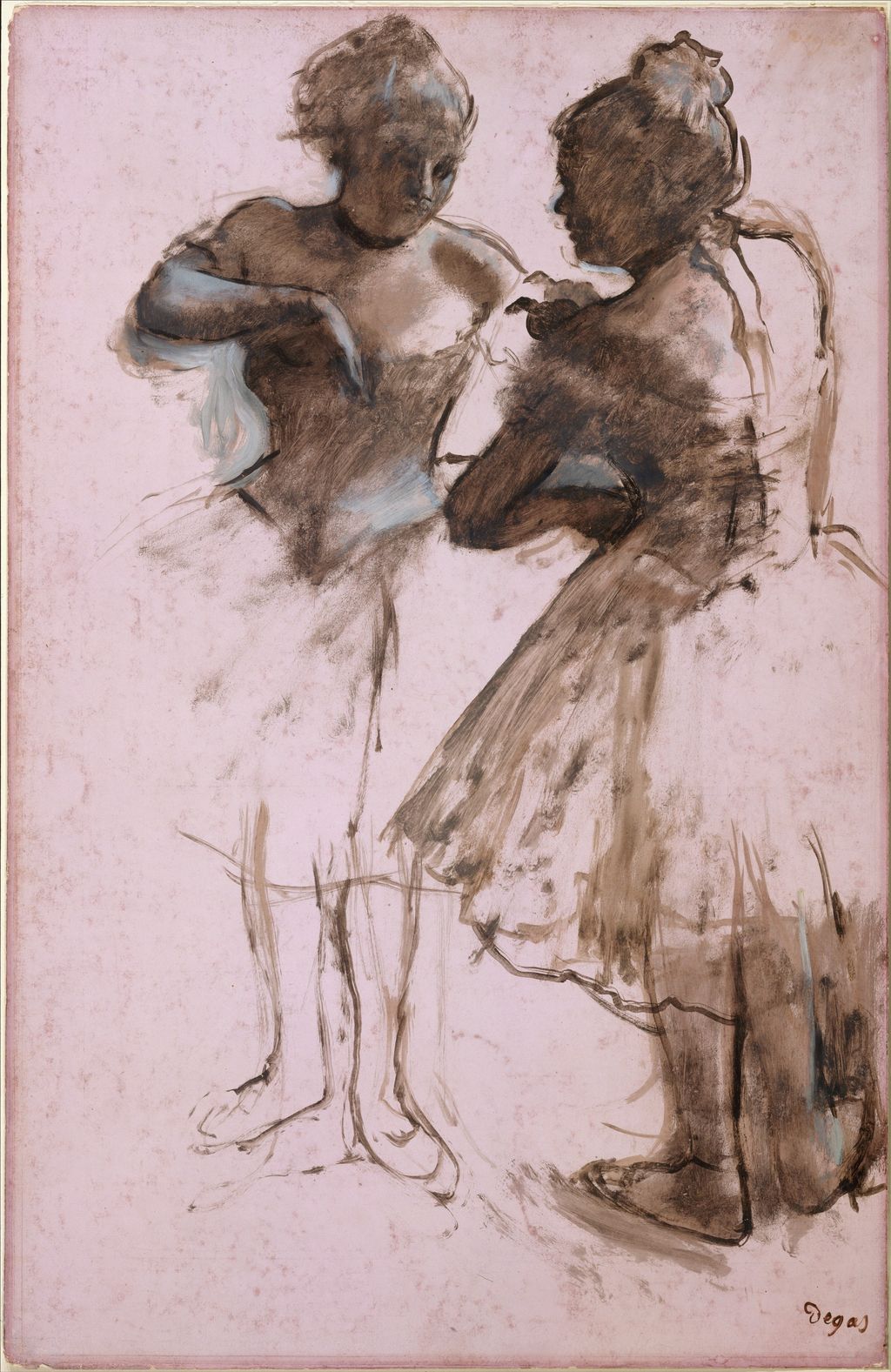
One of the clearest ways to see drawing and painting in dialogue is the Met's Two Dancers of 1873. Degas placed two figures in dark brown wash and white gouache on bright pink coated paper, now faded. One dancer adjusts her clothing; the other turns towards her. The loose brushwork leaves parts of their legs and surroundings open, yet the figures' gestures are distinct. The Met identifies them with positions in the Musée d'Orsay Dance Class and relates the figure at right to the Met's 1874 version. These relationships are attached to the museum's exact sheet, not inferred merely because all the works show a ballet class. [6]
Wash and gouache may sound closer to painting than to a dry pencil sketch. The collection nevertheless classifies Two Dancers as a drawing, and its job as a figure study is clear in the Met's account. Degas could establish weight, relation and gesture with a brush. The broad areas of tone do not have to describe the entire room. The pink support does some visual work of its own: it sits between the dark figures and the small white highlights. A drawing can be made with liquid material, and a painted surface can contain plainly drawn decisions. [6]
Another Met object, Study of a Ballet Dancer (recto); Two Studies of Dancers (verso), makes that boundary even less tidy. The recto is oil with opaque watercolor on prepared pink paper; the verso is oil on the same prepared paper. The museum dates it about 1873 and associates it with a larger group of ballet studies. Both sides of the sheet carry work. The medium and support are more informative than forcing it into a dry “drawing” or finished “painting” box. The paintings page considers what oil could do across Degas's larger practice. [13]
The Orsay's account of Degas at the Opera describes notebooks of small sketches and larger drawings on tracing paper from which he built a pool of figures. Some were squared and some were reworked; not all ended in a particular painting. That distinction is important. A study can serve a commission or composition, but it can also remain available for another arrangement. The figures in the Met wash could enter more than one dance-class scene because Degas could rethink where they stood and what they faced. Drawing was a means of retaining possibilities. [3][6]
Feet, Horses and a Wider Field of Study
The National Gallery of Art's Dancer Seen from Behind and Three Studies of Feet, dated about 1878, brings separate observations onto one blue-gray sheet. A dancer appears from the back while feet are studied at different angles. The museum records black chalk and pastel, not graphite alone. The partial studies ask the viewer to pay attention to balance and placement. Feet are not decoration in a dancer's work: they carry weight, turn and push. Degas's repeated attention to them helps explain how a final scene could show a convincing shift of posture without presenting a lesson in anatomy. [7]
The combination of chalk and pastel also makes this sheet a reminder that labels overlap. Pastel is coloured drawing material, and museums may classify a pastel-bearing sheet among drawings. The pastels page looks closely at colour, powder and layered surfaces. Here the point is Degas's separation of a body into questions he could investigate: a back turned away, several feet, more than one view of the same kind of movement. It would be inaccurate to call the NGA work a pure charcoal or pencil sketch for the sake of a simple category. [7]
His drawn studies were not confined to ballet. In the NGA's Horse and Rider, dated about 1878, oiled black chalk on cream laid paper gives a horse and its seated rider a firm but economical presence. The animal's body is attended to more fully than the surrounding setting. A viewer can follow its legs, back and head without a racetrack being drawn around it. The NGA record does not connect this exact sheet to a named painting, so the safe conclusion is that Degas was studying a subject important to his racing work. The racehorses page takes up that world and its pictures. [8]
The self-portrait, ballet figures and horse sheet show three different scales of attention: likeness, human gesture and animal form. Each can seem unfinished if judged against a fully furnished oil painting. But an open part of a sheet may be a deliberate concentration on the thing under study. The blank around the horse or the pale field around a portrait helps us see where Degas pressed hardest. “Study” describes a use; it is not a measure of the drawing's visual value. [2][7][8]
Watch: Edgar Degas
Explore his paintings, drawings and sculpture in three short videos.
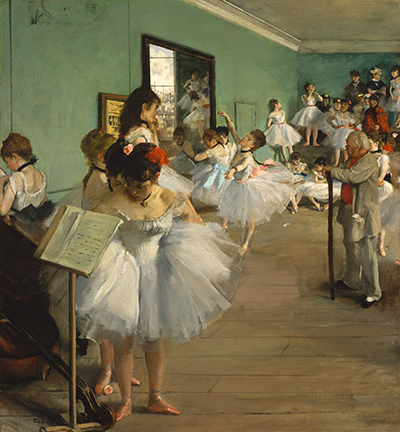
Degas, The Dance Class
Look closely at Degas’s off-duty dancers and his unusual view into the rehearsal room.
Watch on YouTubeTracing as a Way to Change a Figure
Drawing could also be a way to revise what Degas had already drawn. Tracing paper let him see a figure beneath a fresh surface, copy a contour and alter it. The Orsay describes large tracing-paper sheets repeatedly reworked for his opera subjects. This was a store of options, not an assembly line in which every tracing was identical or destined for a single painting. A change of arm, scale or direction could produce a different relationship within a composition. [3]
Conservator Marjorie Shelley's study of the Met's album of forty-five figure studies, dated about 1882–85, gives a concrete example. Degas drew on translucent leaves, turned one over another and traced a figure while changing it. Shelley follows one standing figure through several pages, noting an adjusted arm and a slight increase in the body's scale. Those small differences are evidence of thinking on paper. They are a better guide to the process than the claim that tracing meant simply repeating an image. The album's paper and page order make the relation observable in this case. [10]
Shelley also describes how this habit developed into larger late compositions on tracing paper. A charcoal drawing could become the first stage of a worked pastel rather than a separate little study hidden behind a final picture. In the Met's Two Dancers, Half-length, pastel and charcoal occupy tracing paper with a joined strip, mounted to cardboard. The physical layers matter to the final image. Shelley's examination concerns that object and the related material she studied; it should not be projected onto every late pastel without evidence. The similarly named 1873 Two Dancers in wash is a different work. [10][14]
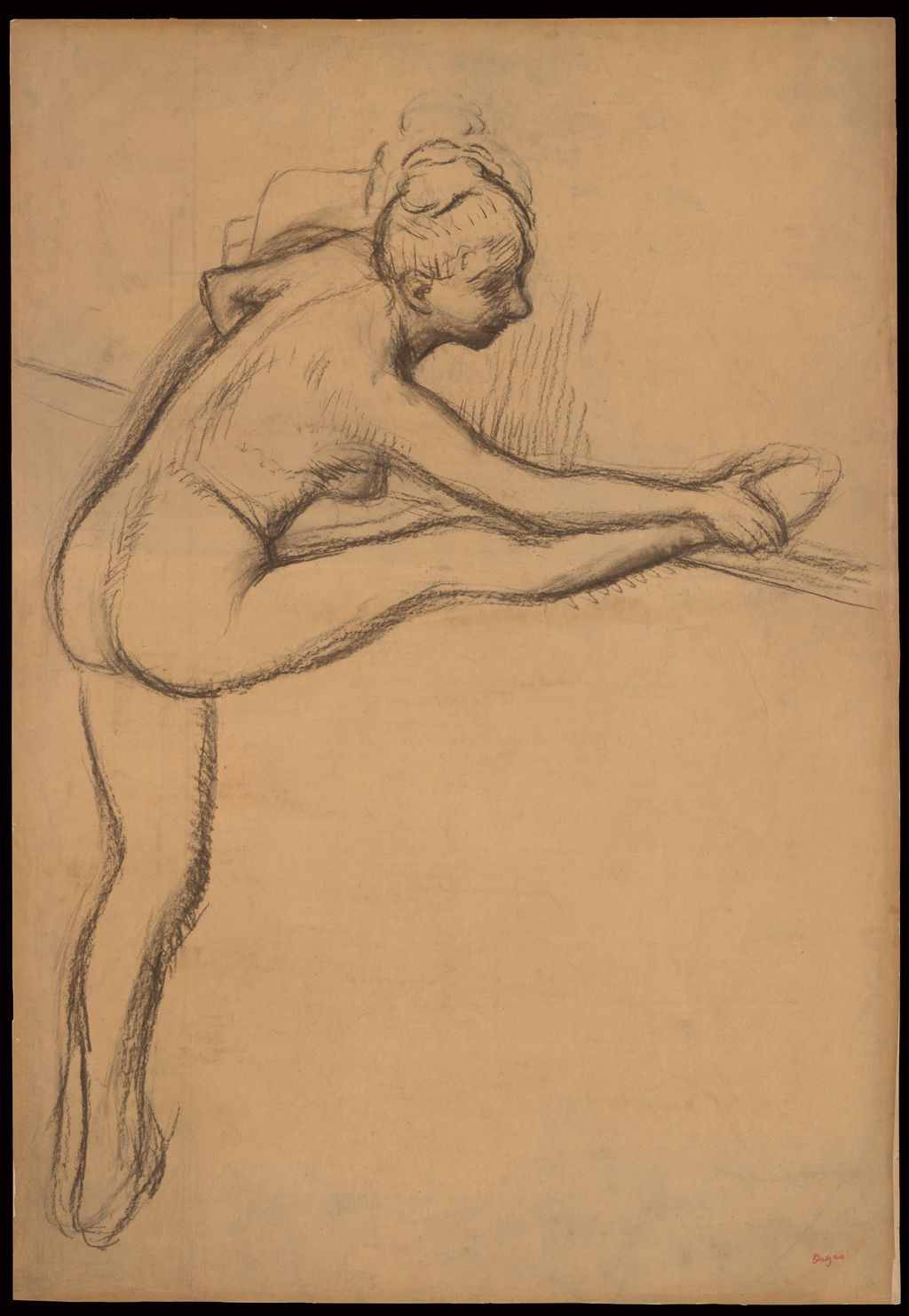
The Met's Study of a Nude (Dancer at the Barre) offers a large, relatively bare charcoal case. Its date is broad, 1884–1900; its sheet is over a metre tall. A dancer bends forward and stretches a leg on the barre. Some contours are reinforced, others remain light or multiple. The museum relates the figure to at least five other drawings and to a painting in the Phillips Collection. The visible revisions let us see a form being tested without a covering layer of colour. The exact order in which the related sheets were made is not established by that count, and the broad date should not be narrowed to a single late year. [11]
The scale of this charcoal work complicates another assumption: a “sketch” need not be small. A large sheet can be exploratory, and it can remain compelling as a drawing when Degas does not take it into pastel. The Met's departmental account describes this acquisition as a rare pure-charcoal example of his large late practice. Its open paper, heavy repeated lines and unfinished-looking edges make the process visible. They are also the image the artist left on this particular support. [11]
When a Drawing Was the Work
The Orsay notes that some opera drawings, made with a brush in diluted oils on coloured paper, were exhibited and published during Degas's lifetime. That is direct evidence against the idea that a drawing's only function was to disappear into another medium. The term “preparatory” can explain a relation when one is documented, as with the squared slipper study, but it does not describe the whole career. Degas could make an image on paper to be seen as an image on paper. [3][4]
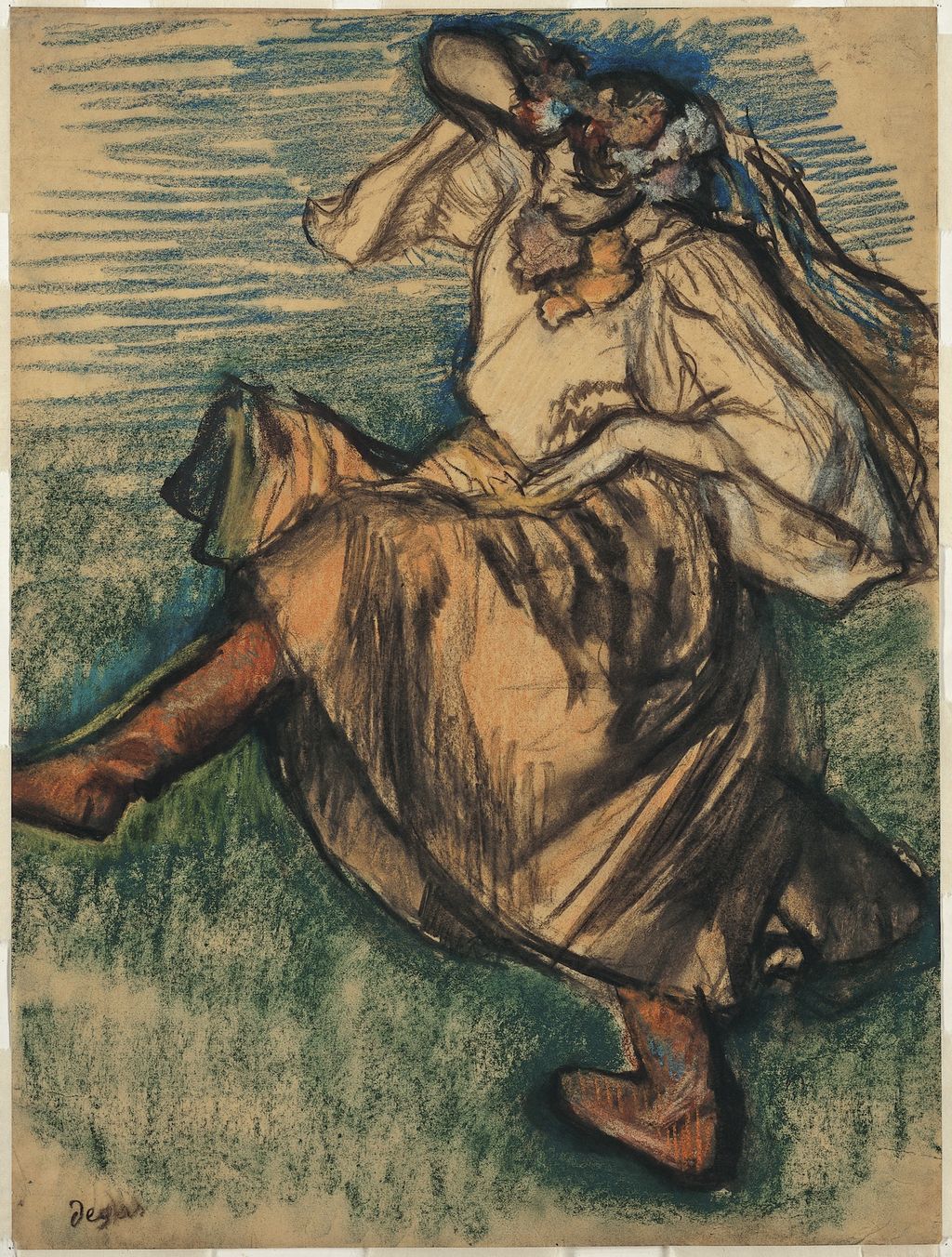
The Met's Dancer in Ukrainian Dress of 1899 makes the question especially clear. Pastel lies over charcoal on tracing paper. The museum says Degas excerpted the figure from a more developed composition of the same year and judges that he almost certainly intended this drawing for independent sale. The wording matters: it is a museum's informed assessment, not a surviving sales invoice for the sheet. What is visible is a single dancer given her own composition through strong colour and dark drawn contours. Reuse of a figure could lead towards a separate work rather than always towards a larger picture. [9]
This example also shows why “drawing” and “pastel” cannot be divided into sealed categories. The Met calls the work a drawing and gives its medium as pastel over charcoal. The charcoal underlies the colour, while the coloured marks contribute to the finished surface. The object is neither merely an invisible preparatory sketch nor an oil painting. Its material description tells us what the broad category alone cannot. The object's current museum title uses “Ukrainian Dress”; older publications sometimes used “Russian” for related dancers. The exact record should guide the caption. [9][10]
One can see a different sort of independence in the young red-chalk self-portrait. There is no recorded later picture for which the NGA sheet served as a transfer template. It makes a sustained image of the artist on paper. This does not prove Degas drew it with the same public purpose as the 1899 Met dancer, only that a drawing can be more than a step on a path to canvas. Purpose should be established from evidence for each object, not read automatically from its date or apparent degree of finish. [2][9]
Drawing Beside Pastel, Print and Sculpture
Degas's media met one another repeatedly. A charcoal outline might remain visible beneath pastel, as in the Met Ukrainian-dress dancer. A wash figure might inform a painting, as the Met relates Two Dancers to two dance-class compositions. A squared drawing might guide transfer, as the slipper study did. These relationships show drawing as a set of actions—observing, marking, repeating, adjusting—rather than a closed medium limited to graphite. [4][6][9]
They also need clear names. A monotype begins with ink transferred from a plate as a printed impression, even if Degas later added drawn colour. It is not the same thing as a charcoal study. The prints and monotypes page follows that process. Likewise, a modeled figure in wax or clay can investigate movement, but it is an object in three dimensions; the sculptures page handles that practice. Connections across media are strongest when their material differences remain visible. [1][3]
No single process explains every image. The Met's squared slipper dancer has a documented transfer relation. The two ballet-class figures are identified across works by the museum. Shelley's tracing sequence is observable in an album. The horse sheet has no exact painting relation established by its NGA record. Degas could choose different means for different problems, and a reproduced pose is not enough to identify which means he used. [4][6][8][10]
How to Look at a Degas Drawing
First, read the complete medium and support. Red chalk on laid paper, graphite and chalk on pink wove paper, wash with white gouache, oiled black chalk, charcoal on tracing paper, and pastel over charcoal are not interchangeable descriptions. Paper colour can supply tone before a mark is made; texture can break a line; translucency can allow a prior figure to be seen and changed. These are practical working conditions and visual parts of the result. [2][4][6][8][9][11]
Next, notice which passages are repeated or left open. Several contours around an arm may reveal reconsideration, as in the late Met charcoal dancer; a group of feet may isolate a movement problem, as in the NGA sheet. A grid has a different significance: on the Met slipper study it records a specific transfer procedure. Blank paper does not automatically mean the artist ran out of time. Ask what the drawn marks concentrate on and what the work's owner can document about their use. [4][7][11]
Finally, compare a drawing with another work only when their identities are secure. Similar dancer poses and repeated titles are common in Degas's art. Museum accession numbers, dimensions, media and images help distinguish related works from lookalikes. The Met's 1873 squared slipper sheet and Detroit's c. 1879 charcoal sheet are a simple warning. Drawing gave Degas a way to hold a pose still long enough to change it, place it elsewhere or leave it as a work on paper. The marks we see are evidence of those choices, provided we keep each sheet's own history in view. [3][4][5]
Selected drawings
Artworks directory
A selected index of documented works, combining owner records with entries sampled across Michel Schulman’s digital catalogue raisonné. It is not a complete catalogue. View the full catalogue
Discussion
Which marks make a Degas drawing feel finished to you? Compare the squared slipper study with the bare charcoal dancer at the barre.
Reader Insights
Where do several contours show Degas reconsidering a pose?
How does the sheet’s material change what you can see?
Which drawing holds your attention without a related painting?
Join the Conversation
Share your reading of these drawings below.
References
- National Gallery of Art, “Edgar Degas,” artist profile and career account. View source
- National Gallery of Art, Self-Portrait, c. 1855, red chalk on laid paper, accession 1991.182.23. View source
- Musée d'Orsay, “Degas at the Opera,” 2019–20 exhibition presentation. View source
- Metropolitan Museum of Art, Dancer Adjusting Her Slipper, 1873, graphite with black and white chalk on faded pink wove paper, squared for transfer, accession 29.100.941. View source
- Detroit Institute of Arts, Dancer Adjusting Her Slipper, c. 1879, charcoal on tan paper, accession 67.273. View source
- Metropolitan Museum of Art, Two Dancers, 1873, wash and white gouache on pink coated paper, accession 29.100.187. View source
- National Gallery of Art, Dancer Seen from Behind and Three Studies of Feet, c. 1878, black chalk and pastel on blue-gray laid paper, accession 1945.6.1. View source
- National Gallery of Art, Horse and Rider, c. 1878, oiled black chalk on cream laid paper, accession 1999.79.8. View source
- Metropolitan Museum of Art, Dancer in Ukrainian Dress, 1899, pastel over charcoal on tracing paper, accession 29.100.556. View source
- Marjorie Shelley, “A Disputed Pastel Reclaimed for Degas: Two Dancers, Half-Length,” Metropolitan Museum Journal 51 (2016), pp. 128–145, especially pp. 134–36. View source
- Metropolitan Museum of Art, Study of a Nude (Dancer at the Barre), 1884–1900, charcoal on tracing paper laid down on card, accession 2019.598; Ashley Dunn, “Degas Additions,” Drawings and Prints departmental newsletter, issue 2, p. 13. View source · View source
- Metropolitan Museum of Art, Seated Dancer, 1873–74, graphite and charcoal heightened with white on pink paper, squared for transfer, accession 29.100.942. View source
- Metropolitan Museum of Art, Study of a Ballet Dancer (recto); Two Studies of Dancers (verso), c. 1873, oil and opaque watercolor on prepared pink paper, accession 1975.1.611. View source
- Metropolitan Museum of Art, Two Dancers, Half-length, pastel and charcoal on joined tracing paper laid down on cardboard, accession 1974.356.31. View source
- Splash image: Edgar Degas, Dancer Adjusting Her Slipper, 1873, graphite heightened with black and white chalk on pink wove paper (now faded); squared for transfer. The Metropolitan Museum of Art, 29.100.941. Collection record. View source