Orchestra Musicians

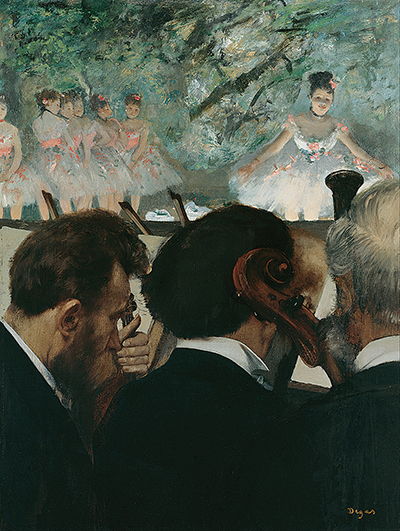
Three dark-clothed orchestra musicians in the pit below ballet dancers on stage in Degas’s Orchestra Musicians Buy Art Prints Now
from Amazon

* As an Amazon Associate, and partner with Google Adsense and Ezoic, I earn from qualifying purchases.


by
Tom Gurney BSc (Hons) is an art history expert with over 20 years experience
Published on June 19, 2020 / Updated on September 28, 2026
Email: tomgurney1@gmail.com / Phone: +44 7429 011000

Degas Orchestra Musicians: Introduction

The musicians sit in a dark mass close to the viewer. Above them, dancers appear in the brighter space of the stage. Edgar Degas's Orchestra Musicians joins the people who produce a ballet's sound to those whose bodies make its movement visible. We look from a position near the orchestra pit, unusually close to the players, while the dancers occupy the upper part of the picture. The boundary between these zones is abrupt, but neither can be understood without the other. Music and dance share one tall canvas. [1] [5]

This is the painting in the Städel Museum, Frankfurt am Main, inventory SG 237. The museum says Degas began it in 1872 and reworked it between 1874 and 1876. It was originally a landscape-format picture. By cutting and adding pieces of canvas, he turned it into a portrait-format composition that gives music and dance a more equal presence. The present oil measures 63.6 × 49 cm, according to the Städel's current Digital Collection. Those physical changes are central to the work: its unusual viewpoint was made and remade, not merely caught in passing at a performance. [1]

At a glance

  • ArtistEdgar Degas
  • TitleOrchestra Musicians
  • DateBegun 1872; reworked 1874–76
  • MediumOil on canvas
  • Dimensions63.6 × 49 cm, current Städel record
  • CollectionStädel Museum, Frankfurt am Main, SG 237

Contents

  1. Introduction
  2. At a Glance
  3. Looking out from the orchestra pit
  4. From a wide canvas to a tall one
  5. Darkness below, light above
  6. Musicians as subjects
  7. A different orchestra painting in Paris
  8. Ownership and catalogue limits
  9. Looking again

The date should be read as a working history. “1872” marks the beginning recorded by the museum, while “1874–76” marks a later period of alteration. One simple year would erase the interval in which Degas changed the shape of the image. The museum's current record also differs from an older Städel web essay over the canvas height, so the present collection entry governs the dimensions used here. These catalogue distinctions are useful because this work's physical support is part of its meaning. [1][2]

Looking out from the orchestra pit

The Städel describes the viewpoint as that of one of the musicians. This gives the foreground unusual weight. Instead of placing the orchestra far below a viewer seated in the auditorium, Degas brings us into its crowded area. The heads, instruments and dark coats make a compressed working group. The stage remains visible beyond them, but we reach it by looking past the players. Ballet appears through the people who supply its sound. [1]

That position changes the familiar hierarchy of a performance picture. On stage, dancers are normally the main sight; musicians are often concealed beneath the line of the auditorium or noticed only when the eye drops. Here the players fill the lower part of the painting and cannot be avoided. Their stillness is only apparent. Their labor takes place in attentive posture, timed movement and the coordinated act of making sound. We do not hear that sound from a canvas, but the scene makes us imagine it as the condition of the dancers' visible action. [1][2]

Degas does not provide a clean architectural diagram of the theatre. The bodies, instruments and stage edge overlap. The pit is not a detached box labelled “music” and the stage another box labelled “dance.” A viewer follows the players' upward sightline to the dancers, then comes back to the dense foreground. This movement of looking approximates the collaboration of the two groups. The music travels up to the stage; our attention travels in both directions. [1]

The painting's perspective should not be treated as a dated eyewitness report from a particular seat or performance. The Städel explains the unusual point of view and the later revisions, but it does not identify a specific show that Degas recorded at the moment. The image can feel immediate while still being a carefully revised construction. That distinction lets us appreciate its theatrical effect without claiming a documentary occasion the collection record does not establish. [1]

From a wide canvas to a tall one

The Städel's account of the canvas alteration gives a rare, concrete way to discuss Degas's compositional decisions. He began the work in 1872. Between 1874 and 1876, he removed and added canvas and changed an original landscape format into a portrait format. The result grants a stronger shared presence to orchestra and ballet, the museum says. This is more than a technical footnote. Changing the edges of a picture changes what its viewer is invited to count as the scene. [1]

A wide version might have allowed the musicians and their instruments to spread laterally as the main subject. The final tall shape lets the image climb from the pit to the stage. The eye can move vertically across the threshold between sound makers and dancers. We should not claim to know every element of the original layout from this summary alone; the short museum text does not map each cut or addition. But the documented change in orientation explains why the finished work holds two levels of performance together. [1]

This revision also complicates the idea of Degas as an artist who simply snatched a fleeting modern instant. The painted scene suggests a momentary view, yet its format evolved over years. Cutting away and adding support are deliberate physical actions. The viewer's sense of a spontaneous glimpse is the outcome of sustained work. The painting's structure therefore parallels the performance it shows: what looks light or immediate depends on preparation that may be hidden from the audience. [1]

The current recorded size, 63.6 by 49 centimetres, underscores that the image is intimate compared with a large theatre painting. Yet within that modest area, the relation of pit to stage carries considerable visual force. The portrait orientation draws us upward, while the close musician figures keep us near the bottom. We never quite leave their position. This is why the revised format matters more than a generic description of “unusual cropping.” It anchors a specific viewing movement in the object's documented material history. [1]

The museum's older Masterworks in Dialogue essay lists the height as 69 centimetres. Its newer Digital Collection gives 63.6 centimetres. The current object record supplies the dimensions given here. The two museum figures should not be blended into false precision, and the published texts do not explain why they differ. The documented change from horizontal to vertical remains secure in the current object account. [1][2]

Darkness below, light above

The pit is a zone of dark coats, sharply legible figures and concentrated presence. Above it, the dancers appear lighter and more mobile. A Städel interpretive essay describes the musicians with finer, firmer strokes and the dancers with paler, more animated handling. The contrast separates two visual kinds of work while keeping them within the same performance. It does not make the musicians merely a heavy base for decoration. Their forms establish the position from which the dance is seen. [2]

Light in the stage area makes the ballet visually prominent. The dancers' pale costumes can catch the eye from across the painting even though their bodies occupy only part of its upper section. In the foreground, dark shapes demand slower looking. We trace faces, shoulders and instruments through the close group before the stage resolves into movement. The shifts in tone and handling make the viewer change pace. A glance can leap to the dancers, but understanding the image asks us to return to the players. [1][2]

The older Städel essay interprets the two areas as dark “male” and bright “female” spheres. That is one way to describe the pictured grouping and its contrast, but the more durable observation is the relation of orchestra pit and ballet stage. It is a picture about two kinds of labor carried out together, with differences of light and visibility. There is no need to turn its tonal division into a general rule about all musicians or dancers. Staying close to this particular canvas makes the social reading more exact. [2]

The dancers' lightness also relies on what the picture makes difficult to see. We cannot hear rehearsals or follow every technical step of the performance. From the pit, we receive a partial view of bodies over the orchestra. Degas keeps that partiality. He does not lift us into an ideal, complete overview of the stage. The bright zone is attractive, but the foreground insists that a stage image has a viewpoint and that a ballet has collaborators beyond its illuminated performers. [1][2]

Watch: Edgar Degas

Explore his paintings, drawings and sculpture in three short videos.

Musicians as subjects

The title names the musicians, and the composition backs up that emphasis. Their proximity gives them a physical presence that cannot be reduced to background accompaniment. At the same time, Degas's later revision apparently increased the place of the dancers. The final work therefore sits between a group of players and a ballet scene. It asks whether the subject of theatrical art is the action a spectator sees, the sound that supports it, or the relation between them. [1]

Nothing in the short owner text requires us to identify each person in SG 237 by name. Some musicians in other Degas works were his friends, and another painting makes one particular player central. Transferring those identifications to the Frankfurt canvas would blur the very object distinction the page needs. For SG 237, the collection text supports the collective occupation and viewpoint. Their individuality can still be seen in varying heads and postures, even where names are not established in this source set. [1][2]

The musicians' closeness to one another also creates a dense social field. An orchestra is coordinated: its members act separately but must listen and move within a shared timing. Degas's overlapping foreground makes that coexistence visible. We need not assign a tune or name a production to recognize the task. The pit is full of people working together while the stage makes the result visible through bodies that move to their sound. [1]

This picture belongs to Degas's early exploration of opera and ballet, according to the Städel. Its interest is not just a love of graceful dancers. The artist looks at a system of performance. One group may be physically low and dark, another high and brightly lit, but the painting brings both into a single field. The change of canvas format made that relationship even stronger. The image becomes a way of thinking about attention: what a theatre audience notices first and what its viewing position usually lets disappear. [1]

A different orchestra painting in Paris

The Städel's Masterworks in Dialogue describes the Musée d'Orsay's The Orchestra of the Opera as a companion to the Frankfurt painting. The Orsay work is a separate oil, RF 2417, dated about 1870 and measuring 56.6 × 46 cm in its current object record. It centers on bassoonist Désiré Dihau and gives the musicians stronger dominance, while dancers are visible behind them only in part. Its provenance and portrait purpose belong to that Paris canvas, not the Frankfurt picture. [2][3]

The comparison is nevertheless revealing. Degas could combine pit and stage in more than one way. In the Orsay canvas, the musician-centered arrangement makes Dihau and his fellow players the primary encounter. The Frankfurt canvas, especially after its later change of format, moves toward a more balanced relation of orchestra and dancers. Describing them as companions recognizes a common subject without flattening their different compositions, dates and owners. [1][2][3]

The Orsay painting has a detailed account connecting Dihau to Degas. The 2019 museum dossier calls it a commissioned portrait and discusses the bassoonist's position. Those facts belong to RF 2417. That commission story and named musician belong to the Paris work, not to Frankfurt SG 237. Their distinct accession numbers keep the two histories separate. [3][4]

The title difference can still be confusing. Orchestra Musicians, Musicians in the Orchestra, and The Orchestra of the Opera sound like small variations of one scene. The visual difference is stronger. The Frankfurt image joins dark foreground musicians to a substantial bright dancer zone in a vertically reworked canvas. The Paris image is more explicitly Dihau-centered. Looking at the paintings and their records together makes clear why two pages or links should not collapse into one artwork. [1][2][3]

Ownership and catalogue limits

The Städel object record includes a provenance through Paul Durand-Ruel and singer and collector Jean-Baptiste Faure before the work reached Frankfurt. The same current record contains a dating conflict at the end: its summary says acquired in 1912, while the provenance text says sold to the city of Frankfurt in 1913. This page therefore identifies the holding collection without choosing a precise accession year. The discrepancy may have an archival explanation, but the public record as read here does not provide it. [1]

That uncertainty is separate from the painting's own 1872 and 1874–76 working dates. We should not treat a question about twentieth-century acquisition as a reason to doubt the museum's specific account of Degas's canvas alterations. Nor should a 1874 ownership entry be turned into a smooth narrative of how the later revisions happened: the short provenance and composition texts do not explain every transfer or the location of every working session. The right approach is to use each part of the record for what it actually establishes. [1]

The secure point is the painting’s identity: the Frankfurt canvas is SG 237, begun in 1872 and later reshaped. The museum’s unresolved 1912/1913 acquisition wording need not obscure those documented facts or the relationship between orchestra and stage visible in the finished work. [1]

Looking again

Begin with the musicians nearest the bottom edge. Follow the direction of their bodies and instruments until the dancers come into view above. Notice how the dark, close foreground affects the brightness of the stage and how the portrait-format canvas keeps both areas present. Then imagine the picture as a wider rectangle. The Städel's account of the actual revision makes that thought experiment more than a game: Degas changed the support to change the relationship between these subjects. [1]

Orchestra Musicians is a painting about performance seen from where performance is made. Its dark players and light dancers differ in visibility and pictorial handling, yet they form one event. The reworked canvas gives that relation its final shape. Knowing that this is Städel SG 237, rather than the Dihau-centered Orsay canvas, lets the details of its viewpoint and material history stand on their own. For the broader subject, see Degas's ballet dancers and his paintings. [1][2][3]

Artworks directory

A selected index of documented works, combining owner records with entries sampled across Michel Schulman’s digital catalogue raisonné. It is not a complete catalogue. View the full catalogue

406 artworks

NameDateMedium
>Group of dancers (MS 77)1893Pastel
[Self-Portrait with Christine and Yvonne Lerolle]probably 1895–96Photograph
A Woman Seated beside a Vase of Flowers (Madame Paul Valpinçon?)1865Oil painting
Achille de Gas as midshipman (MS 718)1857Painting
Achille Degas (MS 715)1864Painting
After the bath - Woman Drying Herself (MS 1038)1888—1892Pastel
After the bath (MS 1037)1893Pastel
After the bath (MS 1046)1905Pastel
After the bath (MS 1060)1895Pastel
After the bath (MS 1061)1898Pastel
After the bath (MS 1062)1895Pastel
After the bath (MS 1063)1896Painting
After the bath (MS 1064)1896Painting
After the bath (MS 1065)1896Painting
After the bath (MS 1391)1900Pastel
After the bath (MS 1402)1888Pastel
After the bath (MS 1744)1886Pastel
Arlequin et danseuses (MS 2224)1884Pastel
At the café Châteaudun (MS 1913)1869—1871Painting
At the horse track (MS 1929)1869—1872Painting
At the Milliner's1881Pastel
At the milliner's (MS 2587)1882—1885Painting
At the milliner's (MS 562)1882Pastel
At the milliner's (MS 565)1882Pastel
At the milliner's (MS 567)1885Painting
At the races (MS 85)1861Painting
At the races - Jockeys (MS 92)1868Painting
At the races - The start. (MS 98)1860Painting
Auguste de Gas (MS 1243)1857Painting
Autumn landscape (MS 1403)1890Pastel
Ballet Dancers in the Wingsc. 1890–1900Pastel
Ballet scene (MS 452)1885Painting
Ballet scene (MS 454)1896Painting
Ballet scene (MS 458)1887—1890Pastel
Bather Drying Herselfc. 1883–84Pastel
Beach at low tide (MS 1730)1869Pastel
Beach at low tide (MS 1742)1869Pastel
Beach at low tide (MS 1907)1869Pastel
Beach at low tide (MS 1915)1869Pastel
Beach at low tide (MS 2070)1869Pastel
Before the race (MS 73)1882Painting
Before the race (MS 74)1882Painting
Before the race (MS 81)1884Pastel
Before the race (MS 82)1885Pastel
Before the race (MS 86)1884Painting
Before the start (MS 78)1885Pastel
Boat at low tide (MS 1407)1869Pastel
Breakfast after the bath (MS 1039)1890Pastel
Breakfast after the bath (MS 1565)1895—1898Pastel
Bust of a woman (MS 869)1887—1890Painting
By the seashore (MS 1917)1869Pastel
Calm sea seen from a cliff (MS 1741)1869Painting
Chatting (MS 2061)1882—1885Pastel
Cliff on the seashore (MS 1230)1869Pastel
Cliff on the seashore (MS 671)1869Pastel
Copy after "The Finding of Moses" by Véronèse (MS 1401)1860Painting
Criminals physiognomies (MS 858)1881Pastel
Crouching nude woman from behind (MS 1235)1876Pastel
Dance exercises (MS 270)1891Pastel
Dancer (MS 282)1899Pastel
Dancer (MS 492)1880—1885Pastel
Dancer adjusting her bodice (MS 1576)1875Painting
Dancer adjusting her bodice (MS 293)1890Painting
Dancer adjusting her shoulder strap (MS 283)1899Pastel
Dancer adjusting her shoulder strap (MS 285)1889—1896Pastel
Dancer adjusting her shoulder straps (MS 275)1896—1899Pastel
Dancer Adjusting Her Slipper1873Graphite and chalk
Dancer adjusting her slipper (MS 1588)1887Pastel
Dancer adjusting her slipppers (MS 1581)1880Pastel
Dancer at the barre (MS 1731)1895—1898Pastel
Dancer at the barre (MS 2073)1874Pastel
Dancer at the barre (MS 2570)1885Pastel
Dancer bending (MS 486)1874—1879Pastel
Dancer bowing on her knee (MS 494)1895Pastel
Dancer combing her hair (MS 1390)1879Painting
Dancer dressing (MS 1745)1889Pastel
Dancer exercising (MS 483)1874Pastel
Dancer fastening her shoe (MS 2077)1887Pastel
Dancer in blue (MS 2349)1902Pastel
Dancer in bust (MS 1726)1897Pastel
Dancer in bust (MS 277)1895—1899Pastel
Dancer in green (MS 2608)1897—1901Pastel
Dancer in green (MS 273)1878Pastel
Dancer in pink bowing (MS 1418)1878Pastel
Dancer in red (MS 280)1893Pastel
Dancer in Ukrainian Dress1899Pastel
Dancer leaning (MS 2585)1874—1879Pastel
Dancer Moving Forward, Arms Raisedc. 1885–90Sculpture
Dancer nude study (MS 2348)1902Pastel
Dancer on stage (MS 1415)1879Painting
Dancer on stage (MS 478)1881—1885Pastel
Dancer Putting on Her Stocking1890s/1911Sculpture
Dancer reading (MS 165)1879Pastel
Dancer seated (MS 121)1872Painting
Dancer seen from behind (MS 2211)1889Pastel
Dancer seen from the back (MS 171)1874Painting
Dancer tilting (MS 423)1883Pastel
Dancer with a fan (MS 2592)1876Pastel
Dancer with arms crossed (MS 274)1872Painting
Dancer with arms raised (MS 1743)1891Pastel
Dancer with green bodice (MS 2345)1902Pastel
Dancer with raised arms (MS 475)1870Painting
Dancer with tambourine (MS 2053)1882Pastel
Dancer with tambourine (MS 450)1883Painting
Dancer with tambourine (MS 465)1897Painting
Dancers (MS 2215)1878Painting
Dancers (MS 2217)1890Pastel
Dancers (MS 2362)1904—1906Pastel
Dancers (MS 294)1890Pastel
Dancers (MS 471)1878Pastel
Dancers adjusting their hair (MS 286)1897Pastel
Dancers at rest (MS 1228)1898Pastel
Dancers at rest (MS 224)1874Painting
Dancers at the barre (MS 266)1877Pastel
Dancers at the barre (MS 267)1880Pastel
Dancers at the barre (MS 268)1900Painting
Dancers at the barre (MS 269)1900Pastel
Dancers Backstage1876/1883Oil painting
Dancers backstage (MS 271)1890Painting
Dancers behind the wings (MS 288)1880Pastel
Dancers bowing (MS 453)1885Pastel
Dancers in a landscape setting (MS 466)1895—1898Pastel
Dancers in pink (MS 1738)1900Pastel
Dancers in pink (MS 2364)1904Pastel
Dancers in red skirts (MS 451)1884Painting
Dancers in white (MS 1748)1878Pastel
Dancers in yellow skirts (MS 2359)1903Pastel
Dancers on stage (MS 1417)1881Pastel
Dancers on stage (MS 460)1880Pastel
Dancers on stage (MS 474)1884Pastel
Dancers resting (MS 2604)1890—1895Pastel
Dancers with fans (MS 291)1890Pastel
Dancers, Pink and Greenc. 1890Oil painting
Dante and Virgil at the Entrance of Hell (MS 2072)1857—1860Painting
Degas in studio smock (MS 688)1862Painting
Dunes along the sea (MS 1905)1869Pastel
Edmond Duranty (MS 732)1879Pastel
Elena et Camilla Primicile Carafa di Mantejasi (MS 695)1867Painting
Estelle Musson Balfour (MS 704)1872Painting
Estelle Musson Balfour (MS 710)1863—1865Painting
Fallen jockey (MS 1388)1870Painting
Farm at the foot of a cliff (MS 1918)1869Pastel
Four dancers (MS 1728)1885Pastel
Four dancers (MS 2365)1905Pastel
Four dancers (MS 287)1899Painting
Four dancers in blue (MS 2355)1903Pastel
Four dancers in the wings (MS 2356)1903Pastel
Four dancers on stage (MS 473)1897—1900Pastel
Germain Musson (MS 700)1853Painting
Getting off the bath (MS 1057)1884Pastel
Getting out of the bath (MS 1398)1898Pastel
Getting out of the bath (MS 1583)1879Pastel
Getting out of the bath (MS 1725)1900Pastel
Getting out of the bath (MS 2343)1901Pastel
Getting out of the bath (MS 2607)1895—1898Pastel
Giovanna Bellelli (MS 1242)1856Painting
Giulia Bellelli (MS 722)1858Painting
Green dancers (MS 469)1878Pastel
Hairdressing (MS 1387)1895Painting
Head of a woman (MS 290)1865Pastel
Head of a woman (MS 861)1873—1875Painting
Henri Degas and his niece Lucie Degas (MS 701)1875—1876Painting
Henri Rouart in front of his factory (MS 759)1875Painting
Horse races (MS 1928)1869—1872Painting
Horse races at Longchamp (MS 87)1873Painting
Horse riders in a lanscape (MS 2079)1860—1861Painting
Horse turned to the right (MS 95)1881—1885Pastel
Horse Walkingpossibly early 1870sSculpture
Horsemen riding on the sea shore (MS 1914)1868Pastel
Horseride (MS 80)1890—1895Painting
Horses and jockeys (MS 84)1890Painting
Horses in a medow (MS 2076)1871Painting
Houses along a cliff (MS 1587)1880—1890Painting
Houses on a cliff overlooking the sea (MS 1925)1869Pastel
Houses on the sea shore (MS 1408)1869Pastel
In the dance foyer (MS 2575)1897Pastel
James Tissot (MS 762)1867Painting
Jeantaud, Linet et Laîné (MS 859)1871Painting
Jockey (MS 2213)1889Pastel
Jockey in a red cap (MS 1931)1868Painting
Jockeys (MS 75)1877Painting
Jockeys (MS 83)1890Painting
Jockeys at Epsom (MS 97)1860Painting
Jules Perrot (MS 755)1875Painting
L'arlequin (MS 2223)1890Pastel
La Savoisienne (MS 863)1860—1862Painting
Lady with a parasol (MS 93)1870—1872Painting
Landscapec. 1877–79Monotype
Landscape1892Monotype with pastel
Landscape (MS 1572)1892Pastel
Landscape (MS 2233)1890—1893Painting
Landscape (MS 2234)1890—1893Pastel
Landscape with houses (MS 2567)1885—1890Pastel
Landscape with path leading to a copse of trees (MS 2610)1890—1892Painting
Laundress carrying linen (MS 2351)1902Pastel
Laundresses and horse (MS 2350)1902Pastel
Laundresses carrying baskets (MS 2352)1902Pastel
Little Dancer Aged Fourteen1878–81Sculpture
Little girl carrying flowers in her apron (MS 855)1862Painting
Lyda (MS 91)1870Painting
Marguerite de Gas (MS 713)1853—1854Painting
Mary Cassatt at the Louvre: The Paintings Gallery1879–80Print
Mathilde Musson Bell (MS 706)1872—1873Pastel
Meadow along a stream (MS 1934)1870—1875Pastel
Meadow bordering a river (MS 1577)Pastel
Mlle Bécat at the Ambassadeurs (MS 1410)1885Pastel
Morning toilette (MS 2078)1894Pastel
Mountain lake (MS 2229)1890—1893Pastel
Mountainous landscape (MS 2227)1890—1893Pastel
Mountainous landscape (MS 2230)1890—1893Pastel
Mr. and Mrs. Henry Rouart (MS 2358)1904Pastel
Mr. and Mrs. Louis Rouart (MS 2357)1904Pastel
Mr. and Mrs. Louis Rouart (MS 2360)1904Pastel
Mrs Alexis Rouart and her children (MS 1396)1905Pastel
Mrs Camus (MS 1908)1869Pastel
Naked woman at rest (MS 1557)1880Pastel
Naked woman drying herself (MS 1045)1900Pastel
Naked woman drying herself (MS 1058)1886Pastel
Naked woman warming up (MS 2065)1880Pastel
Nude woman combing her hair (MS 1245)1877—1879Pastel
Nude woman combing her hair (MS 2353)1903Pastel
Olive trees in a mountaineous landscape (MS 1574)1892Pastel
Porrtaits of women (MS 857)1868Painting
Portrait of a man (MS 1733)1864Painting
Portrait of a Man (MS 2220)1890Pastel
Portrait of a man [Portrait of man in an armchair] (MS 853)1866Painting
Portrait of a woman (Attributed) (MS 1404)1867Painting
Portrait of a woman (MS 2067)1885Painting
Portrait of a woman (MS 862)1878—1889Pastel
Portrait of a woman (MS 868)1884Painting
Portrait of a woman (MS 873)1867—1868Painting
Portrait of a woman before a piano (MS 2060)1882—1885Pastel
Portrait of a woman with a hat (MS 872)1884Pastel
Portrait of a woman with hat (MS 870)1887—1890Painting
Portrait of a young girl (MS 1901)1868Painting
Portrait of a young lady (MS 867)1878Painting
Portrait of a young woman after a D-drawing attributed to Leonardo da Vinci (MS 875)1858Painting
Portrait of Brandon (MS 2084)1874—1878Painting
Portrait of Elena Carafa (MS 696)1875Painting
Portrait of Henry Michel-Lévy (MS 1414)1873Painting
Portrait of the artist (MS 690)1863Painting
Preparation for the dance class (MS 247)1890Pastel
Program for the artistic evening of May 15, 1884 at the Ponsin Gallery (MS 2071)1884Pastel
Race Horsesc. 1885–88Pastel
Race horses (MS 76)1880Pastel
Races in the country (MS 96)1869Painting
Reclining nude woman (MS 2342)1901Pastel
René de Gas (MS 720)1855Painting
René de Gas with a inkwell (MS 719)1855Painting
Resting on field (MS 2055)1882Pastel
Riverbank (MS 1571)1890Pastel
Riverbank (MS 2083)1870—1875Pastel
Road in a forest (MS 1932)1870—1875Pastel
Road in a forest (MS 1933)1870—1873Pastel
Rocky coast (MS 1413)1890—1893Pastel
Rocky landscape (MS 2228)1890—1893Painting
Rue du Quesnoy at Saint-Valery-sur-Somme (MS 2069)1895—1898Pastel
Ruins of a bridge over a river (MS 1394)1892Pastel
Scene from the Steeplechase: The Fallen Jockey1866, reworked 1880–81 and c. 1897Oil painting
Sea at low tide (MS 1916)1869Pastel
Sea shore (MS 1920)1869Pastel
Sea shore (MS 1921)1869Pastel
Sea shore (MS 1924)1869Pastel
Seascape (MS 1906)1869Pastel
Seated nude woman combing her hair (MS 1236)1890Pastel
Seated woman brushing her hair (MS 2600)1887—1890Pastel
Self-Portraitc. 1855Drawing
Self-Portrait (MS 689)1862Painting
Self-Portrait (MS 691)1856—1858Painting
Self-Portrait (MS 693)1857—1858Painting
Self-Portrait (MS 694)1857Painting
Self-Portrait with White Collarc. 1857Oil on paper on canvas
Sitting woman combing her hair (MS 2568)1887—1890Pastel
Standing man in a bowler hat (MS 717)1874Painting
Standing nude woman (MS 1237)1880Pastel
Standing nude woman (MS 2218)1890Pastel
Standing woman (MS 1737)1866Painting
Stream in the undergrowth (MS 1935)1870—1875Painting
Studies of a woman's head and a seated dancer (MS 481)1879Pastel
Study for Mr and Mrs Louis Rouart (MS 1750)1904Pastel
Study for Mrs Camus at the piano (MS 2573)1869Pastel
Study of a Nude (Dancer at the Barre)1884–1900Drawing
Study of dancers (MS 2344)1901Painting
Study of folds of a hooded cloak (MS 2074)1861—1864Painting
Study of nude woman (MS 2059)1884Pastel
Study of sky (MS 1923)1869Pastel
The ball (MS 1248)1879Painting
The ballet rehearsal (MS 298)1877Painting
The bath (MS 1586)1900—1905Pastel
The bath (MS 2222)1890Drawing
The cellist Pilet (MS 1253)1868Painting
The child in blue (MS 854)1854Painting
The chocolate cup after the bath (MS 1247)1905—1907Pastel
The convalescent (MS 702)1872—1873Painting
The conversation (MS 1570)1895Pastel
The cup of chocolate (MS 1564)1900—1905Pastel
The Dance Class1874Oil on canvas
The dance class (MS 1406)1876Pastel
The dance class (MS 2068)1876Pastel
The Dance Lessonc. 1879Oil painting
The dance lesson or ballet class (MS 212)1875Pastel
The dance lesson or ballet class (MS 215)1878Painting
The dancer's rest (MS 1724)1885Pastel
The Duchess Montejasi and her Daughters Elena and Camilla (MS 699)1881Painting
The Duchess of Montejasi-Cicerale (MS 698)1868Painting
The duet (MS 1393)1877—1879Pastel
The duet (MS 1416)1877Pastel
The Extras or The chorus (MS 1254)1877Pastel
The false start (MS 99)1870Painting
The Firesidec. 1876–77Monotype
The Giovanna and Giulia Bellelli Sisters (MS 721)1865Painting
The Holy Family - Copy. (MS 1903)1868—1872Painting
The Holy Family after Sebastiano del Piombo (MS 1751)1857Drawing
The march (MS 56)1866Painting
The pedicure (MS 1251)1873Painting
The racecourse - Amateur jockeys near a carriage (MS 1249)1878Painting
The Races1871–72Oil painting
The rehearsal of the ballet (MS 2057)1881Painting
The singer (MS 2591)1877—1880Pastel
The Tubc. 1889Sculpture
The tub (MS 1252)1886Pastel
The violist (MS 2569)1880Pastel
Three dancers (MS 1585)1889Pastel
Three dancers (MS 2064)1879Painting
Three dancers (MS 2210)1889Pastel
Three dancers (MS 2216)1899Pastel
Three dancers (MS 2354)1903Pastel
Three dancers (MS 2614)1899Pastel
Three dancers (MS 467)1895—1898Pastel
Three dancers (MS 468)1890Pastel
Three dancers in salmon pink skirts (MS 2363)1904—1906Pastel
Three heads of men (MS 860)1871Painting
Three jockeys (MS 79)1900Pastel
Three study of dancers (MS 482)1879—1880Pastel
Two bathers (MS 2347)1902Pastel
Two Dancers1873Drawing
Two dancers (MS 1722)1880—1885Pastel
Two dancers (MS 2611)1880Pastel
Two dancers (MS 295)1890Pastel
Two dancers (MS 296)1890Pastel
Two dancers at rest or Dancers in blue (MS 1229)1898Pastel
Two Dancers in bust (MS 2561)1897Pastel
Two harlequins (MS 396)1885Pastel
Two sitting dancers (MS 1736)1896Pastel
Two Womenc. 1878/1880Pastel
Two women at their bath (MS 1568)1895Pastel
Valleys (MS 2232)1890—1893Pastel
View of Saint-Valery-sur-Somme (MS 2560)1896Painting
Walter Sickert, Daniel Halévy, Ludovic Halévy, Jacques-Emile Blanche, Gervex, Boulanger-Cavé (MS 856)1885Pastel
Wheat field and line of trees (MS 2225)1890—1892Pastel
Woman at her toilette (MS 1041)1890—1894Pastel
Woman at her toilette (MS 1048)1903Pastel
Woman at her toilette (MS 1050)1900Pastel
Woman at her toilette (MS 1559)1892Pastel
Woman at her toilette (MS 1561)1905—1907Pastel
Woman at her toilette (MS 2346)1902Pastel
Woman at her toilette (MS 2565)1895—1903Pastel
Woman Bathing in a Shallow Tub1885Pastel
Woman before a mirror (MS 370)1885—1886Pastel
Woman cleaning her left foot (MS 1232)1886Pastel
Woman combing her hair (MS 1746)1894Pastel
Woman combing her hair (MS 1238)1887—1890Pastel
Woman combing her hair (MS 1560)1892—1895Pastel
Woman combing her hair (MS 1727)1890Pastel
Woman combing her hair (MS 2237)1890—1895Pastel
Woman combing her hair before a mirror (MS 1250)1870—1875Painting
Woman comnbing her hair (MS 2209)1885Pastel
Woman drying erself after the bath (MS 2236)1890—1895Pastel
Woman drying her hair (MS 1042)1894Pastel
Woman drying her hair (MS 1044)1897Pastel
Woman drying her hair (MS 1569)1900Pastel
Woman drying her hair (MS 1729)1900—1903Pastel
Woman drying her hair (MS 1732)1885Pastel
Woman drying her left arm (MS 1055)1884Pastel
Woman drying her left arm (MS 1056)1884Pastel
Woman drying her right arm (MS 1052)1884Pastel
Woman drying herself (MS 1053)1884Pastel
Woman drying herself (MS 1059)1886Pastel
Woman drying herself (MS 1397)1888Pastel
Woman drying herself after the bath (MS 1562)1895Pastel
Woman Drying herself after the bath (MS 1563)1883Pastel
Woman drying herself after the bath wearing yellow mules (MS 2208)1889Pastel
Woman getting out of the bath (MS 1240)1881Pastel
Woman Having Her Hair Combedc. 1886–88Pastel
Woman in her bath washing her left leg (MS 1234)1883Pastel
Woman in mauve dress seated in an armchair or Mrs Alexis Rouart and Her Children (MS 2366)1905Pastel
Woman in red dressing gown combing her hair (MS 2207)1880Pastel
Woman Ironingbegun c. 1876, completed c. 1887Oil painting
Woman looking through opera glasses (MS 89)1881Painting
Woman sitting on a lawn (MS 2056)1882Pastel
Woman washing up in her tub (MS 1239)1892Pastel
Woman with a dog (MS 865)1875—1880Painting
Woman with a white apron (MS 94)1855Drawing
Woman with an umbrella (Mrs Jeantaud) (MS 866)1877—1880Painting
Woman with blue hat (MS 1558)1889Pastel
Woman with opera glasses (MS 90)1877Painting
Women ironing (MS 587)1875Painting
Women on the terrace of a café (MS 1241)1877Pastel
Young girl with white shawl (MS 874)1871Painting
Young spartan girls challenging boys (MS 1412)1860Painting
Young woman (MS 871)1890Painting
Young woman in black (MS 879)1861—1865Painting
Young woman in her bath (MS 1566)1890Pastel
Young woman standing by a table (MS 1739)1855Painting
Young woman tying the ribbons of her hat (MS 1244)1882Pastel
Young woman with her hand facing her mouth (MS 864)1875Painting

Discussion

Share what you notice in Degas’s orchestra musicians.

Reader Insights

Close Looking

How does the foreground musician change the view of the ballet?

Context

What does the darker orchestra pit do to the dancers above it?

Open Question

Which parts of the present format reflect Degas’s reworking?

Join the Conversation

Share your reading of these works below.

References

  1. Städel Museum, Orchestra Musicians, SG 237, Digital Collection object record, accessed 27 September 2026. View source
  2. Städel Museum, Masterworks in Dialogue, “Light-Footed Ballerinas”, interpretation and comparison, accessed 27 September 2026. View source
  3. Musée d'Orsay, L'Orchestre de l'Opéra, RF 2417, object record, accessed 27 September 2026. View source
  4. Musée d'Orsay, Degas at the Opera press dossier, 2019, section on RF 2417, consulted 27 September 2026. View source
  5. Splash image: Edgar Degas, Orchestra Musicians, 1872, reworked 1874–76, oil on canvas. Städel Museum, Frankfurt am Main, SG 237. Collection record. View source