

View Dans un café (also called L’absinthe) in its artwork record.
* As an Amazon Associate, and partner with Google Adsense and Ezoic, I earn from qualifying purchases.
 by Tom Gurney
Tom Gurney BSc (Hons) is an art history expert with over 20 years experience
Published on June 19, 2020 / Updated on September 28, 2026
Email: tomgurney1@gmail.com / Phone: +44 7429 011000
Degas Absinthe: Introduction
The nearest table in Edgar Degas’s café painting is almost empty. A folded newspaper and a small glass sit beside a dark diagonal of wood. Beyond it, another marble tabletop leads the eye toward a woman and a man who share a banquette but do not turn toward each other. A pale drink stands before the woman. The man faces away with a pipe. The picture seems to have caught an unplanned moment from a neighbouring seat, yet Degas arranged and painted it in his studio. Its appearance of everyday life is a carefully made effect. [1][4] [9]
The owning museum, Musée d’Orsay, calls the work Dans un café—“In a Café”—and records L’absinthe as another title. It dates the oil on canvas to 1875–76 and identifies it by accession RF 1984. Both titles have become part of its history. One names a place; the other names a drink and encourages a story about it. Neither can, by itself, tell us what the two people who posed actually drank or how they lived. Orsay identifies them as the actress and model Ellen Andrée and the artist and printmaker Marcellin Desboutin. Knowing their names changes how the picture should be read: these were people Degas knew, not anonymous evidence of addiction. [1][2]
L’Absinthe at a Glance
- Owning museumMusée d’Orsay, Paris
- Primary museum titleDans un café
- Other museum titleL’absinthe
- Date and medium1875–76, oil on canvas
- Accession and sizeRF 1984; 92 × 68.5 cm unframed
- People who posedEllen Andrée and Marcellin Desboutin
- Represented settingCafé de la Nouvelle Athènes, place Pigalle, Paris; painting made in the studio
- Exhibition cautionOrsay documents a 1877 display; whether the Dans un Café listed in an 1876 booklet was this exact painting remains tentative
Contents
- Introduction
- At a Glance
- Why the Title Matters
- Entering the Picture Across the Tables
- Colour and Surface Hold the Scene Together
- The Café and the Studio
- Ellen Andrée and Marcellin Desboutin
- What Does the Glass Mean?
- A Comparison: Manet’s Plum Brandy
- The Impressionist Exhibitions: One Secure Entry and One Question
- London in 1893: A Painting Becomes an Argument
- How to Look Without Mistaking the Sitters for a Story
Why the Title Matters
Dans un café leaves the subject open. It tells a viewer that the scene belongs to a café and invites attention to the room, tables, figures and act of looking. L’absinthe directs attention toward a particular glass and the social meanings later attached to it. Orsay lists the second title as an alternative, not as its present primary title. The familiar name L’absinthe and the museum's Dans un café direct attention to different aspects of the same painting. The title difference is a useful part of its history. [1][2]
The change in emphasis affects the pair. Under the café title, they might first appear to be two people sharing a public interior. Under the drink title, a viewer may begin by asking whether the woman is intoxicated and whether the man is her companion in drinking. The image supplies a pale glass in front of her and a darker glass nearer him. It does not supply a record of their habits. Orsay says the picture damaged the sitters’ reputations and that Degas had to state publicly that they were not alcoholics. To repeat an addiction label as though it described Andrée or Desboutin would reproduce the very confusion the owner record warns about. [1]
The painting’s dates need similar care. Orsay’s range, 1875–76, is preferable to a single “1876” supplied merely because a catalogue or summary uses it. Degas’s current museum label gives the bounded interval, and its accession separates the canvas from other café pictures by the artist. A title, a date and a depicted drink each tell us something; together they still do not replace the object record. [1][2]
Entering the Picture Across the Tables
Degas does not put the faces at the closest point to us. The lower half of the vertical canvas is claimed by near and middle tables. Their pale tops lead diagonally into the room, while dark gaps between them interrupt an easy path. A newspaper in the foreground carries the artist’s signature. The small objects at the near edge suggest a viewer’s possible table, though there is no painted person sitting there. This is how the picture makes us feel present without showing us whom we are supposed to be. [1][4]
The two figures sit farther back. Andrée’s light dress and hat are framed by darker upholstery and the pale mirror behind her. Desboutin’s black clothing and hat make a broad dark mass at the right. His body presses against the frame; Orsay notes that his pipe and hand are cut off. Such cropping denies the viewer a complete, balanced view of him. The woman is also displaced from the centre by the tables and by the man’s stronger dark shape. Neither figure commands the whole scene in the way a conventional single sitter might. [1]
The mirror adds another kind of presence. Behind the pair, dark silhouettes and reflections complicate the space: the viewer sees the people once in the foreground and again as shadows or reflected shapes. Orsay considers the mirror significant to the painting’s expression. It can make the room feel crowded even while the two sitters appear apart from one another. That is a visual relation within the work; it is not evidence that a passerby saw them in exactly this configuration at the café. [1]
Even the sitters' feet contribute to the unusual view. Andrée's dress continues down to pale shoes below the line of the table, while the dark space beneath Desboutin is harder to separate from his clothing and the furniture. Degas gives us many fragments of the room but few clean outlines. The bench runs across the canvas, yet the tables interrupt a straightforward view of how the pair sits on it. We have enough information to believe in a café interior and too little to read it as a floor plan. That selective clarity is part of the illusion of having glanced up from a table nearby. [1]
Orsay connects the off-centre frame and abrupt cuts with Degas’s interest in Japanese prints. Its interpretation says the displaced arrangement can produce a sense of disorientation. Those observations help explain why the image may feel closer to a glance than to a posed group portrait. The effect, however, rests on decisions about where tables, figures and edges meet. A person might describe the composition as snapshot-like; Orsay explicitly says it was not an instantaneous recording of the café. The final canvas was made in the studio. [1]
Colour and Surface Hold the Scene Together
The palette is restrained but not flat. Pale stone-like table surfaces run through much of the foreground. Andrée's cream and gray clothing connects visually to those tables and to the light behind her, while Desboutin's coat makes the strongest dark block. A reddish bench cuts across the middle of the work. In the mirror and walls, light patches and dark silhouettes alternate rather than opening onto a crisp, fully described room. The painting keeps the viewer moving between broad colour relationships and small details such as a glass rim, hat brim or signature. [1]
That movement matters for the figures. Andrée's face does not hold attention by itself. A pale sleeve, the drink, the angle of the middle table and the bright front tabletop keep drawing the eye away and back. Desboutin is cropped by the right edge but visually weighty because of his dark clothing. The two are present together without receiving equal space or identical treatment. In a conventional paired portrait, shared pose and balanced lighting might be used to declare a relationship. Here balance is withheld. The resulting unease belongs to the composition; it cannot establish whether the people who posed were uneasy with one another. [1]
Orsay's reading of Japanese-print influence concerns this off-centre framing. It is possible to look at that formal decision without calling the image an accidental photograph, and to look at the loose painted surfaces without calling them unfinished. The museum records a completed oil canvas, an exhibited and collected object. Its visible brushwork and displaced figures are choices through which Degas made a café interior feel immediate. Material, colour and viewpoint all serve that effect. [1][2]
The Café and the Studio
The Café de la Nouvelle Athènes was a place associated with artists around place Pigalle. Orsay identifies it as the setting Degas represented. A real named café gives the scene a social address, but the address does not prove that the painter placed his canvas there and copied a chance encounter. Orsay says he asked people he knew to pose and painted in his studio. This fact turns the picture’s apparent immediacy into a question of artistic construction. Degas could draw on a recognizable urban place while arranging a view that no single visitor necessarily had. [1][4]
The difference is not a minor technical detail. If we imagine a secretly observed pair, we are likely to invent a story about what they were saying or feeling. If we know that Andrée and Desboutin posed, the questions change. We can ask why the artist seated them side by side, kept their eyes from meeting, inserted two empty tabletops before them and let the frame cut off part of Desboutin. The painted space then becomes a deliberate account of public life rather than a piece of accidental evidence about the models. [1]
Orsay calls Degas an urban painter interested in enclosed places of entertainment and leisure. A café belongs to that broader attention to modern life, as do his pictures of theatres and music. Yet Dans un café has its own arrangement: here the spectator is held at a distance by furniture while the sitters occupy a visible but unreachable bench. The room appears close enough for us to inspect them and far enough that no conversation is available. That tension between proximity and separation is made by the painted tables, not by our knowledge of a real café visit. [1]
Ellen Andrée and Marcellin Desboutin
Orsay identifies Andrée as an actress and artist’s model. Desboutin was an artist and printmaker. These occupations make the pair specific members of an artistic milieu, rather than representatives of a vaguely named urban underclass. They were people Degas could ask to sit. The museum reports that the picture nevertheless exposed both to reputational damage. A viewer’s interpretation of a pose and drink can become a claim about a living person, even when the person’s work and relationship with the artist are known. [1]
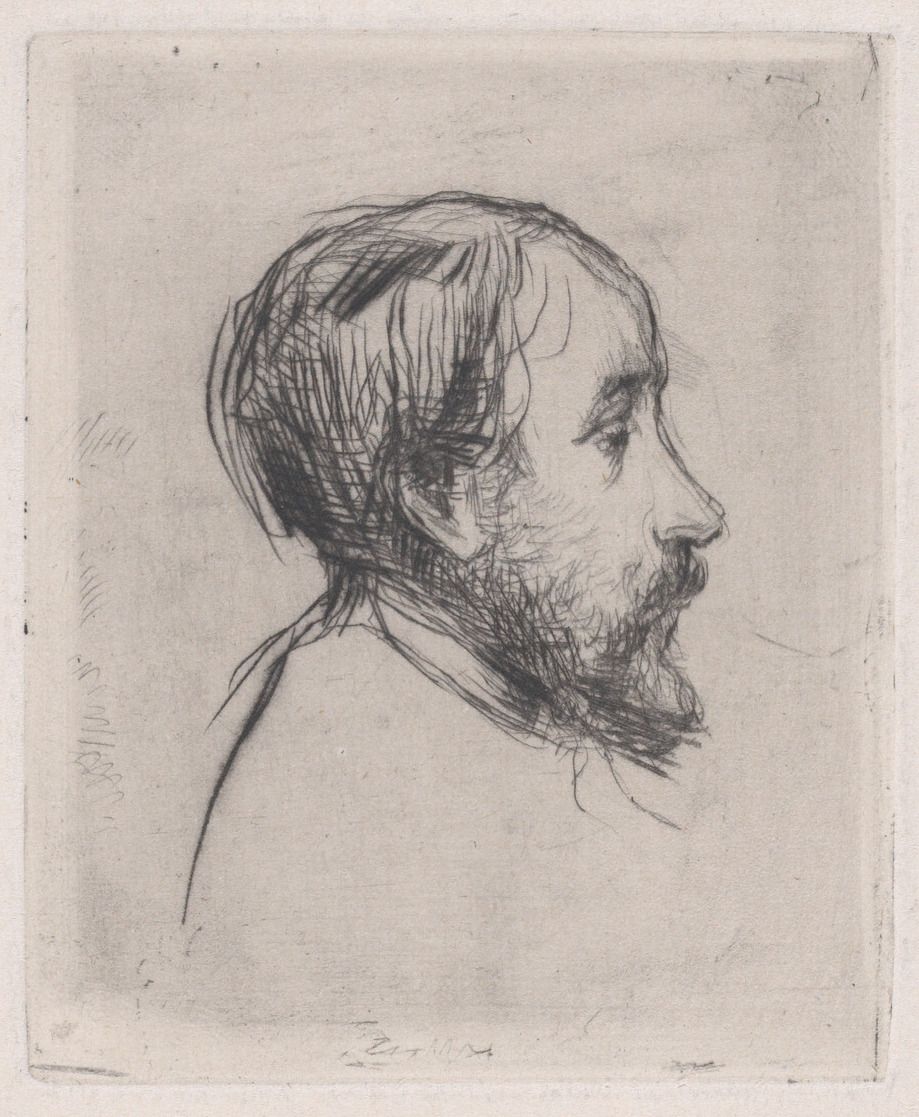
Desboutin’s own work offers a second view of the friendship. In 1876 he made a small drypoint Portrait of Edgar Degas, now in the Metropolitan Museum of Art, accession 22.63.149. The Met describes how Desboutin scratched an informal profile directly into a copper plate. It says he and Degas had a long, productive friendship, and that Desboutin encouraged Degas to return to printmaking after an extended break. In the café painting Degas depicted Desboutin; in the drypoint Desboutin depicted Degas. The two objects do not show the same event, but they place each artist in the other’s working world. [7]
That reciprocal portrait also keeps Desboutin from being reduced to “the man beside the absinthe drinker.” He had his own practice and made images of people he knew. The drypoint is a separate artwork with a different maker, medium and owner. It cannot verify what Desboutin drank when he posed for Degas, but it does document an artistic connection the café picture alone might conceal. [7]
Andrée likewise deserves to be named as an actress and model, not diagnosed from her downcast pose. Orsay’s description interprets both figures as silently isolated and invites a moral reading of the glass. Those are curatorial readings of a made image. The museum’s account of the studio sitting and the later defence of the sitters supplies a necessary limit: a painted expression can suggest a narrative without being a clinical or biographical record. [1]
Watch: Edgar Degas
Explore his paintings, drawings and sculpture in three short videos.
Degas, The Dance Class
Look closely at Degas’s off-duty dancers and his unusual view into the rehearsal room.
Watch on YouTubeWhat Does the Glass Mean?
The pale drink in front of Andrée is one reason the alternate title became so powerful. The word “absinthe” brought associations that could make a café image seem like a warning. Orsay says the painting can be seen as a denunciation of the liquor’s dangers. That phrasing allows an interpretation; it does not prove that Degas painted solely to deliver that message. The glass is a visible object, and the title is a historical label. A single declared moral purpose requires stronger evidence than either provides. [1]
The male sitter has a drink too, and the two do not look at one another. A viewer may read that separation as loneliness, detachment or an unsettling quiet. Orsay itself describes a general air of desolation. It also compares the painting with the social world of Émile Zola’s L’Assommoir, written a few years later. A later literary parallel can show how observers grouped images and writing about urban drink and distress. It cannot turn the painting into an illustration of a novel that did not yet exist when Degas made it. Nor can it disclose the private state of the two people who posed. [1]
Looking carefully at the drink is therefore useful, but only as one part of the picture. The foreground table, staged distance, cropped man and mirrored shadows shape the experience as much as the glass. If the title prompts a ready-made moral story, the composition slows that story down. It asks us to consider how a particular view was built and why we think a painted face can tell us a life. [1][4]
A Comparison: Manet’s Plum Brandy
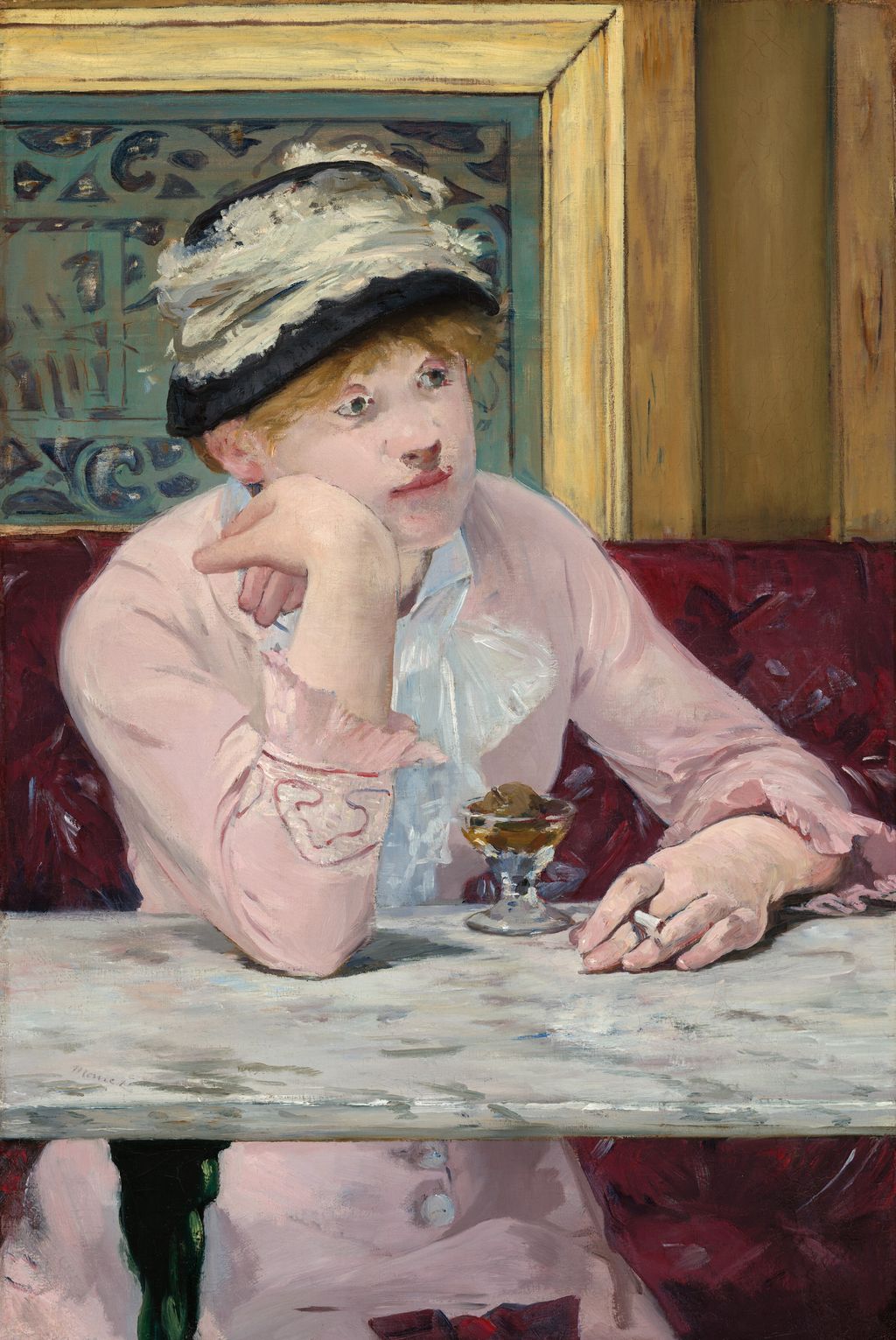
Édouard Manet’s Plum Brandy, about 1877, is a different café painting by a different artist. The National Gallery of Art in Washington owns it as accession 1971.85.1. A woman in pink sits behind a marble tabletop with a small glass containing a plum and brandy. Her elbow supports her head; a cigarette rests in her other hand. The woman faces more directly toward the viewer than either sitter in Degas’s café painting, and Manet brings her nearer the front edge of the canvas. [8]
The comparison is strongest when it stays with what both pictures visibly do. Each artist uses a café table and drink to place a woman in a public interior. Degas sends us across several empty tabletops toward two figures. Manet gives the sitter a single close table and lets her occupy most of the painting. In Plum Brandy, the glass is small against the pink dress and large arm; in Dans un café, the pale glass is one point in a longer route through furniture and bodies. Both works can invite questions about the woman’s thoughts. Neither contains her own account of them. [1][8]
Manet signs his work along the left front edge of the table, where a viewer might imagine writing on the marble. Degas places his signature with the paper on the near table. Both signatures can be found within the space of looking rather than floating outside it. Their placement helps make the table a pictorial device, though the devices differ. Manet's table appears to bring us face to face with one sitter; Degas's sequence of tables holds us apart from two. That difference is more securely visible than any imagined similarity in the women's private moods. [1][4][8]
The NGA’s object page does not identify the sitter in Plum Brandy. That matters because comparisons of these two paintings sometimes travel with confident names and claims of direct influence. The visible differences can be discussed without adding an undocumented shared identity or making one painting a copy of the other. The NGA calls Manet’s work Plum Brandy, dates it about 1877 and specifies oil on canvas. Those facts are sufficient to keep the objects distinct while making a productive visual comparison. [8]
The Impressionist Exhibitions: One Secure Entry and One Question
The painting’s early public history resists a simple debut date. Orsay’s own object record lists it at the third Impressionist exhibition in 1877, outside that exhibition’s printed catalogue. That is the secure exhibition entry for RF 1984 in the owner record. It means the canvas was shown in the artists’ exhibition context, even though a visitor relying only on the printed list would not find its title there. [2]
A digitized transcription of the second Impressionist exhibition catalogue of 1876 contains a Degas work titled Dans un Café, no. 52. The title is unmistakably present in that historical booklet. The question is whether that entry referred to the exact canvas now at Orsay. Michel Schulman’s digital Degas catalogue raisonné, which identifies the present work as MS917, puts a question mark beside the proposed 1876 no. 52 match. Its exhibition list also gives Brighton in 1876, no. 166, and the 1877 Paris showing outside the catalogue. The discrepancy should be visible to a reader, not quietly resolved by choosing whichever date is more familiar. [3][5]
The careful wording is therefore: a Dans un Café appears in the 1876 printed list; the identification of that entry with RF 1984 remains tentative in the specialist catalogue; Orsay documents this painting in the 1877 display. We can discuss the importance of the Impressionist exhibition circle without calling the 1876 listing a certain first showing of this object. This precision matters because Degas made more than one café subject, and titles in nineteenth-century catalogues can be broader than present museum identities. [2][3][5]
London in 1893: A Painting Becomes an Argument
Orsay records the canvas at London’s Grafton Galleries in 1893, catalogue no. 258. Schulman’s object catalogue gives the same exhibition and number. A contemporary issue of The Studio places L’Absinthe in the gallery’s last room and describes a clash between critics of modern painting and critics who wanted a more elevated or beautiful subject. This is direct evidence of a public argument around the work, not a reason to repeat every later story of universal outrage. [2][5][6]
The anonymous Studio writer calls the painting an example of why the new and old schools could quarrel. The article sets a hostile moral description of the figures beside praise for Degas’s handling of line and colour. It is revealing that the writer presents the scene as a true incident. From the museum’s evidence, we know it was staged with acquaintances in a studio. A critic in 1893 could experience the picture as documentary truth while missing the conditions of its making and the sitters’ actual identities. That gap is part of the painting’s reception history. [1][6]
The review also shows why period criticism needs interpretation. Its words for the pair are dismissive and socially loaded. They tell us about a critic’s assumptions and about debates over which subjects modern art could depict. They do not establish that Andrée or Desboutin were intoxicated, destitute or habitually isolated. An exhibition response is a source for what viewers said when they saw the work, not a source for everything they thought they recognized in its models. [1][6]
The argument was about form as well as morality. The Studio writer contrasts critics who prized Degas's forceful line and colour with those who wanted dignity or beauty of subject. A reader today need not accept either side's vocabulary to see the issue it exposes: an image of two ordinary café sitters challenged an expectation about what a serious painting should show. It also asked viewers to make sense of cropped bodies, foreground furniture and a moment that seemed too unceremonious for a formal picture. The same formal devices that make the scene persuasive could make some early viewers treat its suggested story as an observed fact. [6]
The London display gave the drink title further prominence, while the painting continued to circulate among collectors. Orsay’s provenance traces its movement through British and French hands in the 1870s–90s, its arrival in the collection of Isaac de Camondo, and his 1911 bequest to the French state. The museum then places it in the Louvre, the Jeu de Paume and, from 1986, the Musée d’Orsay. This institutional path helps explain why a painting debated in London is now chiefly encountered as an Orsay work. Individual ownership entries in the 1890s are intricate, so the museum record should be consulted for an exact transfer sequence. [2]
How to Look Without Mistaking the Sitters for a Story
Begin with the label: Dans un café, also called L’absinthe, 1875–76, oil on canvas, Musée d’Orsay RF 1984. The accession distinguishes this canvas from Degas’s other café scenes, whatever title a viewer knows best. Then look at the near table before the people. The newspaper and signature locate the composition’s foreground; diagonal marble tops control how the eye reaches the pair. The arrangement is one of the painting’s arguments about seeing. [1][2][4]
Next identify the people who posed. Andrée was an actress and model; Desboutin was an artist and printmaker. His own drypoint of Degas makes the artistic connection unusually tangible. A posed studio canvas can make two acquaintances look like strangers silently stranded in a café. That effect is available to the viewer, but it does not cancel the records of who the sitters were. The portraiture page considers this distance between a likeness and a person’s private life across more of Degas’s work. [1][7]
Finally separate exhibition evidence from later interpretation. The 1877 showing is recorded for this exact painting; the 1876 catalogue title has a tentative object match. A hostile or enthusiastic 1893 review tells us about contemporary reception, not the pair’s habits. Orsay’s possible absinthe warning and its account of Japanese-influenced framing are interpretations to consider alongside the visible glass, tables, crop and mirror. What makes Dans un café memorable is not that it proves a simple tale of drink. It is how convincingly Degas made a constructed view seem encountered, and how insistently that view invites us to test what we think we know about the people inside it. [1][2][3][5][6]
Selected absinthe
Artworks directory
A selected index of documented works, combining owner records with entries sampled across Michel Schulman’s digital catalogue raisonné. It is not a complete catalogue. View the full catalogue
Discussion
Share what you notice in Degas’s absinthe.
Reader Insights
How do the empty tables control your distance from the sitters?
What changes when you know the café scene was arranged in a studio?
Which ideas about the sitters come from the painting, and which from later viewers?
Join the Conversation
Share your reading of these works below.
References
- Musée d’Orsay, Dans un café, 1875–76, oil on canvas, accession RF 1984; owner description and interpretation. View source
- Musée d’Orsay, Dans un café: object details, provenance and exhibition history, accession RF 1984. View source
- Musée d’Orsay Salons database, Dans un Café, no. 52, transcription of the second Impressionist exhibition catalogue, 1876. View source
- Musée d’Orsay, Manet/Degas curator interview and French transcript, 2023. View source · View source
- Michel Schulman, Au café ou L’Absinthe, MS917, digital Degas catalogue raisonné, listing Orsay RF 1984 and a tentative identification of 1876 catalogue no. 52. View source
- The Studio, vol. 1 (1893), “Studio Gossip,” p. 36, Heidelberg University Library facsimile. View source
- Metropolitan Museum of Art, Marcellin Desboutin, Portrait of Edgar Degas, 1876, drypoint, accession 22.63.149. View source
- National Gallery of Art, Washington, Édouard Manet, Plum Brandy, c. 1877, oil on canvas, accession 1971.85.1. View source
- Splash image: Edgar Degas, Dans un café (also called L’absinthe), 1875–76, oil on canvas. Musée d’Orsay, RF 1984. Collection record. View source