

 Buy Art Prints Now
from Amazon
* As an Amazon Associate, and partner with Google Adsense and Ezoic, I earn from qualifying purchases.
 by Tom Gurney
Tom Gurney BSc (Hons) is an art history expert with over 20 years experience
Published on June 19, 2020 / Updated on September 28, 2026
Email: tomgurney1@gmail.com / Phone: +44 7429 011000
Degas Millinery Shop: Introduction
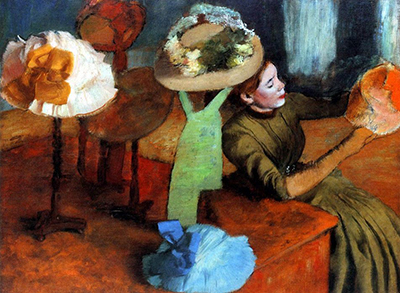
A woman sits among hats, attending to a broad brim held before her. Edgar Degas places her at the right of The Millinery Shop, leaving much of the picture to the objects spread across the shop counter. The hats are merchandise, but they are also large areas of blue, orange, green and brown that compete with the figure for attention. One hat with green trimming appears, by a trick of overlap, to rest on the woman's otherwise uncovered head. The effect is playful and slightly uncertain. Are we watching a customer choose something to wear, or a shop employee examine the stock? The painting gives us reasons to consider both possibilities. [1] [4]
This is the oil painting in the Art Institute of Chicago, accession 1933.428. The museum dates it 1879–86 and calls it the largest of Degas's paintings on the millinery subject. Other works show women and hats in shops, including pastels in the Metropolitan Museum of Art, but they are different objects. Keeping the Chicago painting in view matters because its arrangement of one woman, many hats and a visually misleading headpiece gives it a distinctive question about identity and appearance. [1][2]
At a glance
- ArtistEdgar Degas
- TitleThe Millinery Shop
- Date1879–86, the Art Institute's current range
- MediumOil on canvas
- Dimensions100 × 110.7 cm
- CollectionArt Institute of Chicago, 1933.428
- CreditMr. and Mrs. Lewis Larned Coburn Memorial Collection
Contents
- Introduction
- At a Glance
- What is happening in the shop?
- Hats as goods and as color
- The woman at the edge
- Millinery and women's work
- A carefully prepared composition
- Date and ownership
- The Chicago oil and other millinery images
- Looking once more
The broad date is worth retaining. An older Art Institute publication described the work as about 1882, and other accounts have used narrower dates. Those historical labels are part of the picture's catalogue history, but the present owner record assigns 1879–86. A reader should not mistake a once familiar single year for a documented day of completion. Degas worked through the figure in drawings and pastels, according to the museum, and the finished oil belongs to a continuing investigation of this subject. The current range acknowledges a degree of uncertainty that a neat label could hide. [1][3]
What is happening in the shop?
The woman seems absorbed in the hat before her. Her body is turned toward the display rather than toward the viewer. Her hands and gaze direct attention to the merchandise, while the counter gives the scene the practical setting of selection, handling or assessment. Yet the image does not show a cash transaction, a sale completed, or a clearly identifiable customer and employee together. It offers a pause in a sequence that we cannot fully reconstruct. We can look at how she handles and regards the hat without claiming to know exactly why she has come into the shop. [1]
The Art Institute emphasizes that the figure's social position is visually ambiguous. She wears a fashionable green wool dress and long, elegant gloves. Such clothes could have belonged to an affluent shopper, but the museum notes that shop employees might also have worn them. The hat trade demanded skill and taste and could improve the standing of women who succeeded in it. Clothing alone cannot settle whether the sitter works here. Her lack of a hat of her own adds another clue: the museum says a high-class young woman would ordinarily have worn one. But this is still a clue within the artist's arrangement, not a personnel record. [1]
That uncertainty makes the figure more interesting than a stock character in a scene of shopping. If she is a customer, the display is a set of possible selves: one of these shapes might become part of her public appearance. If she is an employee, she may be judging or preparing the objects whose fashion she must understand for a living. Both readings fit her concentration. The painting does not need us to choose one and erase the other. Its strength lies partly in how readily the same well-dressed figure can be read on either side of a commercial encounter. [1]
The Art Institute points out a witty visual accident that is likely deliberate. A green-trimmed hat behind the woman aligns with her head so that it seems to be worn by her. Look again and it belongs to the display, not securely to the sitter's body. For a moment, though, the object gives her the accessory that would appear to confirm the wealthy-customer reading. The illusion collapses as soon as we trace the hat's actual position. Degas turns the act of deciding who she is into an act of looking carefully. We discover how quickly a fashion item can change our judgment of a person, even when that item is only adjacent to her. [1]
Hats as goods and as color
The woman is surrounded by a dense arrangement of hats. In a shop, each would be an object to make, choose, fit, sell or wear. Within the painting, they are also the shapes that organize nearly the entire field. A blue hat occupies the foreground, while warmer orange and brown forms spread across the counter. The green notes near the figure draw hats and dress into the same color conversation. The items are not a decorative border around the “real” subject. Their scale makes them the other principal actors in the picture. [1]
From a distance, the broad hats can read almost as patches of color. Come closer, and their brims and trimmings regain their identities as manufactured things. Degas allows both experiences to coexist. This is why the counter feels visually active even though the woman herself is still. A viewer moves among rounded edges, tilted planes and flashes of contrasting color, then returns to the human figure who appears to be looking at them too. The painting creates a shared activity between sitter and viewer: evaluating the display. [1]
The blue in front is especially effective because it sits away from the woman and therefore pulls our attention across the painting. The warmer hats answer it from the middle area. The figure, by contrast, wears a less assertive green-brown dress that can merge with neighboring forms. This balance keeps the canvas from becoming a conventional portrait with a few props. Fashion objects command an unusual amount of space, while the person who might purchase or work with them remains at the edge of the arrangement. That allocation of space is an interpretive choice. It makes the woman legible through her relation to goods rather than through a frontal presentation of her face. [1]
It is tempting to describe every colored mark as evidence of a particular fabric or construction method. The published object record identifies the medium as oil on canvas, but a small reproduction cannot establish the exact materials of each pictured hat. The visual point can be made without inventing millinery details: broad brims, varied trimmings and saturated color present an array of possibilities. The hats promise differences of style and identity; the painting studies how those possibilities look before any one of them is chosen. [1]
The woman at the edge
Placing the figure toward the right gives the display room to dominate. We do not meet her face head-on or receive a direct invitation to read her expression as a clear emotion. Instead, we see someone engaged with objects. Her attention leads us to the counter, but her position also lets us observe her from outside the task. This double relation is common in scenes of work and shopping: the person is absorbed, while we inspect both the person and what she inspects. [1]
The glove is a particularly useful detail because it complicates easy social labels. A long, elegant glove can make the woman seem like a client ready to appear in public. The Art Institute's account warns that an employee could be dressed with similar care in this trade. The same accessory might help sell fashionable taste or express the wearer's own. Degas does not provide another figure whose clothes would fix the difference by contrast. The solitary woman must carry all these possible roles herself. [1]
Nor can the surroundings simply be treated as a neutral, documentary record of one named Paris shop. The Art Institute says Degas made multiple drawings and pastels to work out the lone figure's pose and outfit. That careful preparation makes clear that the final arrangement is constructed. The shop setting evokes a real urban trade, but the public record used here does not identify a specific business, owner or transaction. The painting's apparent informality should not make us assume it was painted as an instantaneous observation of a customer who happened to sit down. [1]
The sitter's concentration is similarly open. She may be assessing whether a hat suits someone; she may be checking the product; she may be imagining how it will look when worn. The surface offers a direction of attention, not a transcript of her thoughts. It is enough to notice that Degas refuses the conventional social exchange of a figure posing for a viewer. Her absorbed gaze gives the hats a purpose while holding her private motivation at a distance. [1]
Millinery and women's work
The Art Institute describes millinery in late nineteenth-century France as a skilled and relatively prestigious trade. It required judgment in form and fashion, not only manual labor. Successful workers could gain some social standing. This background helps explain why the sitter's outfit is so hard to read. The fashionable appearance of someone in the shop would not automatically separate buyer from maker or seller. In this painting, the uncertainty is not a failure of Degas to tell us enough. It mirrors a real overlap in how class and work could be presented through clothing. [1]
That context should still be used carefully. The public object record does not name this woman or establish her occupation. We cannot turn an account of the trade into a biography of the model. If she were an employee, the work of choosing, trimming and selling hats would matter to the scene. If she were a customer, the skill of unnamed workers would still stand behind every finished item on the counter. Either way, the merchandise connects personal appearance to women's labor. The painting gives the goods lavish visual space, while leaving the people who made them outside the frame. [1]
In 2013, the Metropolitan Museum of Art placed the Chicago oil beside two of its own millinery pastels in an exhibition on Impressionism, fashion and modernity. Its gallery text presented Degas's series as an exploration of relations between customers, salesgirls and the goods they wanted or handled. That is a useful frame for this picture, though it does not identify the Chicago sitter's role. It reminds us that a hat shop is a meeting place of work, commerce and desire. A woman who selects a hat is making a choice about appearance, while someone who supplies it is involved in shaping how another woman will be seen. [2]
The setting also changes how we might think about Degas's interest in women in modern Paris. In his ballet pictures, performers train and appear before audiences; in this shop, the visible performance is quieter. Fashion is assembled, tried, judged and perhaps sold. The woman does not dance or address a crowd, but her clothes and the counter's array participate in the same urban world of visible presentation. The comparison is thematic, not a claim that the millinery canvas depicts theatre labor or the same sitter as a dancer study. It helps show the breadth of Degas's attention to skilled, socially charged activities. [1][2]
Watch: Edgar Degas
Explore his paintings, drawings and sculpture in three short videos.
Degas, The Dance Class
Look closely at Degas’s off-duty dancers and his unusual view into the rehearsal room.
Watch on YouTubeA carefully prepared composition
The Art Institute records multiple drawings and pastels of the lone figure as Degas adjusted her pose and clothing. That evidence matters because the finished oil can seem like a glimpse into an ordinary moment. Repeated studies indicate sustained choices about how a single person would sit among the hats and what she would wear. Degas was not merely filling in a ready-made shop scene around a model. He was working out how the figure's shape and costume would interact with objects that could resemble, compete with or seem to attach themselves to her. [1]
The green-trimmed hat's apparent placement on the woman's head gains force from this compositional care. It is not only a joke hidden in the background. It strikes at the same issue as her gloves and dress: how appearance is assembled and read. A small shift in outline can convert merchandise into an apparent personal attribute. Once a viewer sees the overlap, the whole display becomes less passive. The hats are possible additions to bodies and identities, and the painting stages that possibility by lending one to the figure for an instant. [1]
Oil on canvas gives the Chicago work a different physical scale and surface from Degas's smaller pastel studies. At 100 by 110.7 centimetres, it is substantial, and the owner calls it the largest of his millinery paintings. The Met likewise described it as his largest oil on the subject in its 2013 exhibition. Those descriptions are specific. They should not be expanded into a claim that this is Degas's largest painting, or that every earlier study led directly and exclusively to this one. The secure point is that the final oil gives an unusually broad field to the woman and the display. [1][2]
When discussing process, it is easy to imagine an exact sequence: Degas sees a shop, sketches a worker, makes a pastel, and then paints the oil. The published summary does not establish such a chain. It reports studies of the figure and presents the finished composition. The existence of preparatory work helps us understand deliberate arrangement; it does not supply a complete production diary. The safest reading stays with what the museum states and what the picture visibly does. [1]
Date and ownership
The present AIC date of 1879–86 spans several years. A 1932 museum publication used “about 1882,” showing how a narrower date circulated historically. Those labels need not be forced into a false conflict where one proves the other impossible: an approximate 1882 falls inside the current interval. The more useful distinction is between an earlier shorthand and the date range currently assigned by the holding collection. The current museum range is the clearest date for this specific object. [1][3]
The later ownership is clearer at its endpoints. According to the Art Institute's provenance, Degas sold the painting to dealer Paul Durand-Ruel in Paris on 22 February 1913. It eventually entered the collection of Annie Swan Coburn and was bequeathed to the Art Institute of Chicago in 1933. The museum's provenance includes conflicting evidence for the date when Coburn acquired it: a dealer stockbook gives a 1932 sale, while a loan receipt already lists it from her in January 1930. For this reason, a precise Coburn purchase date would create more certainty than the record supports. The bequest and accession remain firm. [1]
The work's passage through a dealer and a private collector also reminds us that the painting's current title and museum context are later chapters in its life. They do not prove the identity of the depicted woman. The art-historical record can be exact about an accession number, medium and bequest while remaining uncertain about the sitter's job. Keeping those kinds of knowledge separate makes the picture easier to understand. We can say confidently where the oil is and what the owner catalogue records, then acknowledge that its central human question remains open. [1]
The Chicago oil and other millinery images
Degas returned to millinery more than once. The Met's 2013 exhibition described two of its pastels alongside the Art Institute's oil. A shared subject or a similar English title does not make these works interchangeable. For the Chicago painting, the governing identifiers are the Chicago accession 1933.428, oil medium, 100 × 110.7 centimetre size and composition with one woman to the right of a large spread of hats. A reproduction showing another grouping or another medium needs its own object record rather than a place as the lead image here. [1][2]
The distinction also sharpens what is special about this canvas. The woman is solitary, but the hats give her numerous visual companions. The display takes up enough room to become a study in color and form in its own right. More importantly, the viewer's uncertainty about her role is tied to a precise arrangement of dress, gloves, bare head and misleadingly aligned green-trimmed hat. Another millinery work may have a different relation between customer, employee and display. The series gives context, while the Chicago oil supplies the argument of this page. [1][2]
Looking once more
Begin with the woman's gloved hands and the hat she examines. Move outward to the blue foreground form and the warm colors spread through the counter. Then return to the green-trimmed hat near her head. Notice how easily the eye joins that separate object to her body, and how the mistake changes the story one starts to tell about her. The painting asks us to watch our own quick judgments as closely as we watch her attention to the merchandise. [1]
The Millinery Shop makes a modest pause in a Parisian trade into a complex image of modern appearance. The hats can be objects of skilled work, things for sale, fields of color and possible markers of status at the same time. The woman can be read as either customer or employee because Degas has made clothing and context overlap rather than resolve into a label. Its exact Chicago identity anchors the facts of the painting; the unresolved identity within it is part of what gives the work its continuing interest. For more on these methods and subjects, see Degas's paintings and his pastels. [1][2]
Artworks directory
A selected index of documented works, combining owner records with entries sampled across Michel Schulman’s digital catalogue raisonné. It is not a complete catalogue. View the full catalogue
Discussion
Share what you notice in Degas’s millinery shop.
Reader Insights
Which hat first catches your eye?
How does the arrangement of hats shape the view of the woman?
What in the painting leaves her role in the shop uncertain?
Join the Conversation
Share your reading of these works below.
References
- Art Institute of Chicago, The Millinery Shop, 1933.428, collection object record and public API record 14572, accessed 27 September 2026. View source · View source
- Metropolitan Museum of Art, “Gallery Seven—Consumer Culture,” Impressionism, Fashion, and Modernity, 2013 exhibition text, accessed 27 September 2026. View source
- Art Institute of Chicago, 1932 bulletin, historical approximate date; current collection date in reference 1 governs. View source
- Splash image: Edgar Degas, The Millinery Shop, 1879–86, oil on canvas. Art Institute of Chicago, 1933.428. Image: Art Institute of Chicago IIIF, CC0 Public Domain Designation. Collection record. View source