

View La Classe de danse in its artwork record.
* As an Amazon Associate, and partner with Google Adsense and Ezoic, I earn from qualifying purchases.
 by Tom Gurney
Tom Gurney BSc (Hons) is an art history expert with over 20 years experience
Published on June 19, 2020 / Updated on September 28, 2026
Email: tomgurney1@gmail.com / Phone: +44 7429 011000
Degas Ballet Class: Introduction
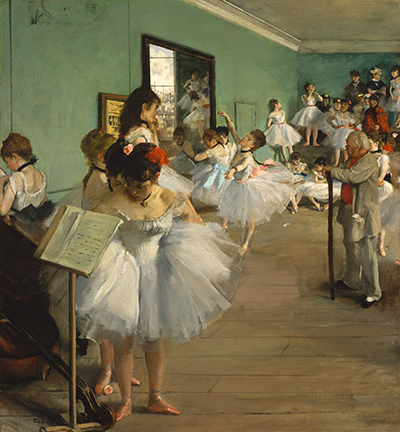
The nearest dancer in Edgar Degas’s La Classe de danse turns her back to us. A green sash marks her white skirt, and one hand rests at her waist. Beyond her, a crowded room opens diagonally toward a tall doorway. Jules Perrot stands with his baton among students who appear less concerned with one perfect position than with the small work of getting through a class: they stretch, adjust their clothes and attend to one another. The Musée d’Orsay, which owns the canvas, interprets this as a lesson coming to an end. The painting makes that interval as compelling as a finished ballet step. [1] [6]
This is the Orsay painting RF 1976, dated 1873–76. It is often called The Ballet Class in English, while the museum's title is La Classe de danse. Degas painted other class scenes, including a 1874 work at the Metropolitan Museum of Art in New York. Both Orsay and Met pictures contain Perrot and a schoolroom, but their figures, actions and histories differ. A familiar English title cannot identify the work on its own. The green-sashed dancer in the foreground and the wide diagonal of floor are useful first clues that we are looking at Orsay's canvas. [1][3]
La Classe de danse at a Glance
- ArtistEdgar Degas
- Owning museumMusée d’Orsay, Paris
- Museum titleLa Classe de danse
- AccessionRF 1976
- Date and medium1873–76, oil on canvas
- Dimensions85.5 × 75 cm
- Principal named figureJules Perrot, ballet master
- Museum's readingA lesson ending, with students stretching and readjusting after exertion
- AcquisitionBequest of Count Isaac de Camondo, accepted by the French state in 1911
Contents
- Introduction
- At a Glance
- A Class at the Moment Attention Loosens
- Read the Floor as a Working Surface
- The Doorway, the Walls and the View Across the Room
- Training Is More Than the Formal Pose
- A Drawn Pair Reappears Around Perrot
- An Earlier Class Painted Before Backstage Access
- From London to the Camondo Bequest
- This Is Not the Met Examination Picture
- What to Notice on a Second Look
The museum's broad date range should be retained. A narrower “1874” can be tempting because another famous Degas class painting belongs to that year, and some reproductions apply one date to everything bearing the title. Orsay records this canvas as made between 1873 and 1876. Its accession anchors that date to the picture in Paris. The work's history includes its delivery to a London collector by 1876 and later passage through the Camondo collection, but those facts do not reveal the day on which every section of the painting was completed. [1]
A Class at the Moment Attention Loosens
Orsay's description begins from the end of a lesson. It notices students stretching, scratching their backs, adjusting hair and clothing, an earring or a ribbon. These are not the triumphant poses a theater audience expects to applaud. They are ordinary movements that happen because the controlled actions of training have been repeated. Degas lets them occupy much of the picture. The effect is that ballet appears as work conducted over time, not just as a moment of effortless display. [1]
The green-sashed dancer gives the foreground a strong human scale. We see her from behind, close enough that her skirt occupies a substantial part of the lower left canvas. She does not offer her face as the painting's answer. Her body draws us into the room while also blocking a full view of it. Behind her, another dancer with reddish hair holds a fan. To the left, a tall dancer angles her head upward. Near the doorway, smaller figures stand or attend to their dress. Each gesture can be identified visually without needing to assign a personal history to its maker. [1]
Across from this foreground cluster, Perrot stands in darker clothing. Orsay identifies him as the real ballet master represented in the painting and describes the pupils as paying him little attention as the class winds down. His baton remains a sign of authority even though the bodies around him have moved into less formal activity. He is neither absent nor directing a single climactic performance. The painting holds supervision and slackening concentration in one space. A teacher's work is present; so is the students' time after a demanding sequence. [1]
It is reasonable to sense fatigue in the scene because Orsay itself calls the pupils exhausted. That remains a curatorial interpretation of visible action, not a record of what each girl privately felt. One dancer may adjust a ribbon for practical reasons, another may stretch a limb, and a third may simply stand. The painting does not give their names, wages, hopes or individual explanations. Those gaps matter. We can discuss how bodies behave in the room without turning the image into an invented diary of children whose experiences are not preserved here. [1]
The room is populous, but Degas does not arrange everyone into a ceremonial line. Some figures overlap at the far wall, while others sit or stand where the viewer's path meets a patch of floor. The many white skirts create a shared visual rhythm; individual gestures interrupt it. This is how the subject remains a class rather than a group portrait. We encounter a collective working environment, and the particular dancer in front is one way into it, not its sole protagonist. [1]
Read the Floor as a Working Surface
The floor is unusually prominent. Orsay points to the slightly elevated viewpoint and the diagonal line through the room, which intensify the receding perspective of the parquet boards. The boards are not simply a neutral base beneath the dancers. Their angles carry us past the near skirt, toward Perrot and then back to the clustered pupils. Bare floor also gives the many white forms room to separate. A surface on which the dancers practice becomes the painter's principal device for organising what we see. [1]
Near the bottom edge is a small dog. At the far lower left sits a green watering can. These are easy to overlook when attention settles on Perrot or the foreground dancers, yet they make the room feel used and lived in. Orsay explains that the floor was moistened to reduce slipping and that the master could strike it with his baton to mark time. The watering can is therefore more than a picturesque accessory. It points toward the maintenance of the surface on which ballet technique depended. [1]
The dog has a different role. Its small dark body interrupts the floor near the foreground dancer's feet. It does not explain the class or supply a symbolic key. It makes a viewer slow down and inspect a space that might otherwise be treated as empty. A composition filled with disciplined movement can include a minor creature apparently indifferent to the lesson. That juxtaposition is visible without claiming to know whose dog it was or whether it attended a historical class. [1]
Orsay quotes the writer Paul Valéry, who admired Degas's attention to floors. The remark was made in reflection on the artist's work, not recorded as a contemporary account of this exact class. Its usefulness here is visual: the diagonal boards make the floor both a working surface and a large part of the painting's design. The room looks deep because the boards retreat; the figures look grounded because they have different relations to that surface. Even when the eye follows a skirt, it returns to the space on which the dancer stands. [1]
The baton adds a second line to the floor's diagonals. Perrot's stick reaches down toward the boards. It can mark a rhythm and identify his teaching role, while its narrow vertical form holds his place among the moving figures. In the painting, authority is not conveyed by a theatrical throne or a raised podium. It is carried in a practical object used in a training room. Orsay's account of the baton beating time makes that visible feature more specific without asking us to hear an actual lesson. [1]
The Doorway, the Walls and the View Across the Room
The tall doorway near the centre of the back wall offers a second path into the image. Its pale frame stands out against the green walls and dark verticals. Through it we glimpse another space. The foreground dancer, the door and Perrot create a sequence: near body, architectural opening, teacher among the students. The eye can follow that route or wander across the quieter far wall where more dancers gather. This flexibility helps a busy picture remain legible without flattening its people into a diagram. [1]
The green wall occupies a surprisingly large area. It gives the room weight and keeps the white costumes from floating free of a setting. Dark pilasters and the pale door frame divide the background into sections, while the receding floorboards draw those sections into a continuous room. The picture combines stable architecture with unstable attention: bodies turn, bend and adjust against surfaces that remain still. Its sense of a particular place comes as much from that relation as from any named building. [1]
Orsay places the represented class at the old Paris Opéra on rue Le Peletier, before the Garnier building became the opera's later home. The museum says Degas regularly visited the Opéra, as a spectator and, through a musician friend, behind the scenes and in the dance foyer. These institutional details support the plausibility of the room. They do not make this canvas a photograph of one session or identify each pupil. A painted class can draw on access to a working world while remaining a composition made through selection and arrangement. [1]
The elevated view strengthens that sense of selection. The viewer seems to see across the heads and skirts from a position above the floor. That makes the broad parquet visible and allows separate actions to unfold across it. We are not standing at eye level with the nearest dancer, even though she is close. The viewpoint is a pictorial choice that makes the whole schoolroom available at once. It makes us aware of a collective pattern without erasing the small, local gestures that break the pattern. [1]
Training Is More Than the Formal Pose
Degas was drawn repeatedly to dancers at exercise, rehearsal and rest. Orsay says he was interested in the preparatory work more than the public stage and its lights. In this painting, the lesson's end makes that preference visible. The teacher and ballet clothing tell us what institution we are in; the relaxed and adjusting bodies tell us how much ordinary labor surrounds a formal performance. The work invites a reader to take the training room seriously as a subject in its own right. The wider ballet-dancers page considers that work across more objects. [1]
That interest need not be reduced to a claim that Degas exposed a single secret truth about ballet. A girl scratching her back or fixing a costume is not automatically a symbol of suffering. Nor is a student in a white skirt only an elegant decorative shape. The useful reading is more precise: Orsay describes a rigorous class, and Degas shows a moment in which concentration slackens. The contrast between formal instruction and practical gestures gives the image its rhythm. The full social histories of the individual dancers require other records. [1]
The near dancer's green sash is especially useful for seeing this balance. It distinguishes her within a field of light costumes, yet she is turned away. She can be looked at as a strong compositional figure without becoming an individually knowable character. Her placement invites us to follow her gaze into the room, though the canvas does not tell us exactly what she is watching. In that sense the foreground figure functions partly like another viewer: she occupies the space before us and keeps the rest of the class beyond her. [1]
Perrot's placement has a complementary effect. He faces into the group rather than out toward the museum visitor. The real ballet master has been made part of a painted social arrangement, not posed as an independent portrait. His baton, dark coat and stance make him identifiable, but his importance is relational. He is a teacher because of the room, the students and the training taking place around him. The image's human structure emerges from those relations more than from a single dramatic gesture. [1]
Watch: Edgar Degas
Explore his paintings, drawings and sculpture in three short videos.
Degas, The Dance Class
Look closely at Degas’s off-duty dancers and his unusual view into the rehearsal room.
Watch on YouTubeA Drawn Pair Reappears Around Perrot
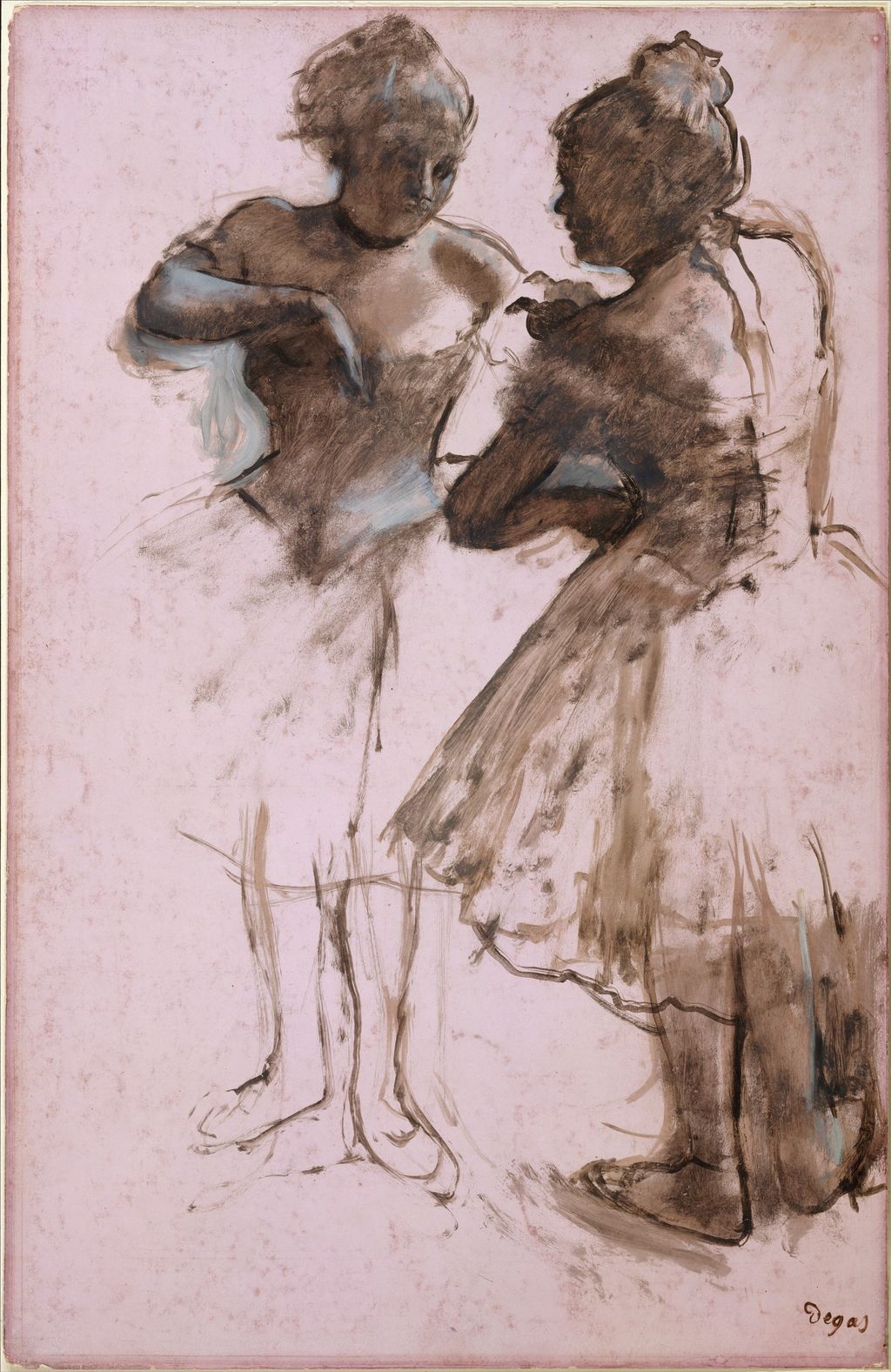
The Metropolitan Museum of Art owns a 1873 sheet titled Two Dancers, accession 29.100.187. It is made with dark brown wash and white gouache on prepared pink paper. The Met's object record states that the two figures appear on either side of Perrot in the Orsay La Classe de danse. It also connects one of them to a mirror in the Met's 1874 class picture. This is a particularly useful related work because the owner identifies the figures and the cross-picture relationship directly. [2]
The drawing shows bodies apart from the large painted room. In the Orsay canvas, their significance changes as they join Perrot, doorway, floor and other students. A pose that can be studied on paper becomes part of a collective interval at the end of class. The sheet demonstrates that Degas had a working stock of figures rather than depending on a single unaltered glance. It does not establish a neat sequence in which one finished composition was copied into another, or prove that the represented students stood together at one real lesson. [1][2]
Colour and medium also change the task. On pink paper, brown wash can define the dancer and white gouache can pick out light. On the Orsay oil canvas, pale costumes have to be distinguished from other costumes, wall, doorway and floor. The drawing isolates human form; the painting asks that form to live among many forms and architectural lines. Looking between the two gives a concrete sense of artistic construction, instead of treating “spontaneous” as though it meant “unplanned.” [1][2]
The study also helps keep the two major class paintings apart. Met's record relates the sheet to both, but it names a different placement for a dancer in the New York version. The shared material is a link between artworks, not a reason to give them one identity. Degas could return to a figure because it remained useful, while making each canvas answer a different compositional question. The drawings page considers this practice more broadly; on this page the sheet is evidence for a specific relation to RF 1976. [2][3]
An Earlier Class Painted Before Backstage Access
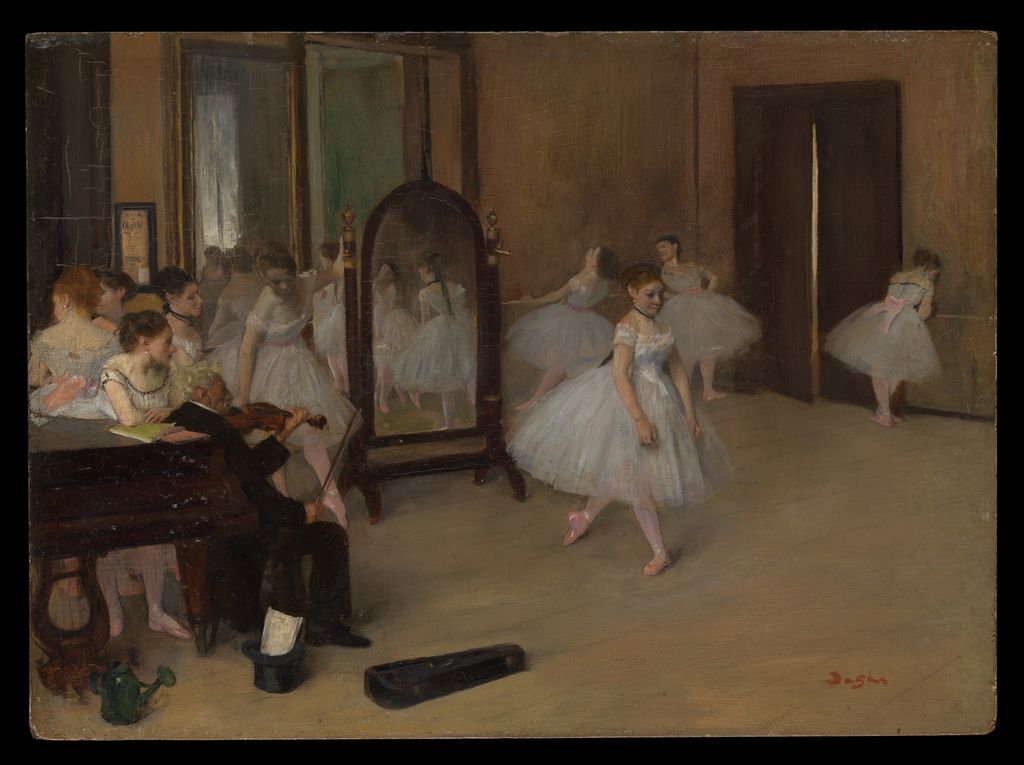
Another Met object, The Dancing Class, accession 29.100.184, is a small oil on wood dated about 1870. It is horizontal and measures 19.7 × 27 cm. The Met calls it Degas's first depiction of a class and says that, before he gained privileges to go backstage at the Paris Opéra, subjects came to his studio to pose. The earlier work does not show the same lesson or the same arrangement as Orsay RF 1976. Its value here is to make clear that a convincing ballet room could emerge from studio work as well as from access to the Opéra. [4]
In the small painting, a mirror divides the space, a musician sits toward the left and dancers occupy a room that spreads sideways. The image works at a different scale from Orsay's larger vertical canvas. It gives us a compact, early experiment in placing several ballet figures together. Its museum record supplies an important caution about Degas's method: an image of training is not automatically a transcript of what a painter witnessed on site. Even when later access supplied new observations, study and composition remained part of the making. [1][4]
The Met quotes Degas reflecting in the late 1870s that he had painted many dance examinations without seeing them. That statement is attached to the early class object in the museum's description. It should not be turned into a numerical account of how many sessions he attended or a declaration that the Orsay picture had no basis in observation. It does show the artist's own awareness of the distance between a painted class and an eyewitness record. The Orsay canvas can be read within that distance: specific gestures feel observed, while their final relation is painted. [1][4]
The two supporting Met works perform different jobs. Two Dancers is a directly connected figure study for the Orsay composition. The Dancing Class is a separate earlier painting that helps explain the broader development of studio class scenes. Keeping those roles distinct prevents an evidence problem: not every Degas picture of dancers is a study for every later dancer picture. One is explicitly linked by the owner; the other is an illuminating comparison. [2][4]
From London to the Camondo Bequest
Orsay's provenance says that Degas delivered the canvas to Ch. W. Deschamps in London by 1876. The museum's exhibition list gives a London showing in that year, no. 127, followed by a Brighton showing, no. 167. The record later places the painting with Captain Henri Hill, then in the orbit of Goupil and Michel Manzi, and finally with Count Isaac de Camondo from 1894 until his death. Camondo's 1911 bequest brought the picture into the French national museums; it entered the Musée d’Orsay when the museum opened in the 1980s. [1]
That path matters because a painting now closely associated with a Paris museum had an early public life in Britain. The title, arrangement and reception of a Degas class painting can travel across countries and catalogues. The owner record provides object-specific anchors—names, exhibition numbers and an accession—that let us follow this particular canvas without relying on a generic story about Impressionism. The chain has detailed intermediate steps in Orsay's catalogue, so an exact ownership transaction should be checked there rather than guessed from a short summary. [1]
The 1876 London and Brighton entries belong to RF 1976. They are not the same statement as the Met's note that singer and collector Jean-Baptiste Faure lent his 1874 The Dance Class to the 1876 Impressionist exhibition. Shared year, subject and English title make the two histories easy to conflate. Their owners and accession numbers keep them separate. Orsay's canvas was in a London exhibition context; the Met canvas has a documented Faure loan in the Impressionist context. [1][3]
The Camondo bequest is similarly specific. Count Isaac de Camondo assembled works that passed to the French state. Orsay records this painting as accepted under that bequest in 1911, then placed in the Louvre and later the Jeu de Paume before its Orsay assignment in 1986. That chain of custody does not tell us exactly how Degas felt about the painting or how every viewer received it. It tells us how the physical object reached the public collection in which we can identify it today. [1]
This Is Not the Met Examination Picture
The Metropolitan Museum's The Dance Class is a 1874 oil on canvas, accession 1987.47.1, measuring 83.5 × 77.2 cm. Its owner describes an imaginary examination in which a dancer wearing a pink sash performs an attitude before Perrot. The near edge contains a dancer bent by a music stand and a cropped double bass. These are not the distinctive foreground and central actions of the Orsay painting. Perrot appears in both, but his presence alone cannot decide which version we are viewing. [1][3]
Orsay's interpretation is different in time as well as arrangement: the lesson is ending. Its pupils stretch and adjust after exertion; the foreground green sash and long floor diagonal dominate the viewer's entry. The Met painting puts one tested pose at the heart of a classroom in which others wait. Those descriptions can coexist because they refer to different canvases. A page about this Orsay work should not import the Met picture's pink-sashed examination as though it were hidden somewhere in the Paris image. [1][3]
The National Gallery of Art in Washington owns yet another Degas work called The Dance Class, 2014.79.710, dated about 1873. It is a smaller horizontal canvas with a spiral stair, a dark room and a seated figure in a red jacket. These obvious visual differences make it a useful third-object check when browsing images, but that picture has its own context. It should not be folded into either the Orsay or Met article because the English words in the title match. [1][3][5]
A practical identification begins with the institution and accession, then uses the picture. If the record says Musée d’Orsay RF 1976 and the painting shows the large green-sashed foreground dancer, Perrot and the receding floor through a doorway-centred room, this is the work discussed here. If it says Met 1987.47.1 and a pink-sashed student holds an attitude for an examination, follow the separate Met Dance Class page. If it says NGA 2014.79.710 and the room opens from a spiral stair, you have a third composition. [1][3][5]
What to Notice on a Second Look
Start with the green sash, then let your eye travel away from it. The foreground skirt fills a great deal of space but conceals as much as it reveals. The dancer is close, and still we cannot see her expression. Behind her, the fan, doorway and Perrot offer successive points of attention. The floorboards connect them without telling us that one detail must be more meaningful than every other. That open structure suits a room in which different people have reached different moments of a shared lesson. [1]
Then notice how many kinds of work are visible. A technical pose may have been practiced before the moment Degas depicts; now the students adjust their clothes and bodies. Perrot's baton speaks to the measured instruction that organised the session. The watering can and floorboards point to the maintenance of the room itself. Training required not just the dancer's visible effort but a usable surface, music, teaching and time to recover. Orsay's description helps name those relationships while the painted details keep them tangible. [1]
Finally keep the source limits in view. We have an owner record for the object and its history, a directly related drawing at the Met, and an earlier class picture that shows Degas's method developing. None of these turns the Orsay canvas into evidence of one named child's private life. It is a rich picture of a working ballet environment because Degas made the end of a lesson visible through poses, objects and space. Its lasting interest lies in that combination: the class is dispersing from formal effort, and the painting is still tightly composed. [1][2][4]
Selected ballet class
Artworks directory
A selected index of documented works, combining owner records with entries sampled across Michel Schulman’s digital catalogue raisonné. It is not a complete catalogue. View the full catalogue
Discussion
Share what you notice in Degas’s ballet class.
Reader Insights
Which details suggest a lesson winding down?
How does the diagonal floor lead you among the figures?
Which cues distinguish this Orsay canvas from the Met examination?
Join the Conversation
Share your reading of these works below.
References
- Musée d’Orsay, La Classe de danse, 1873–76, oil on canvas, accession RF 1976; description, provenance and exhibitions. View source
- Metropolitan Museum of Art, Two Dancers, 1873, wash and gouache on prepared paper, accession 29.100.187. View source
- Metropolitan Museum of Art, The Dance Class, 1874, oil on canvas, accession 1987.47.1. View source
- Metropolitan Museum of Art, The Dancing Class, c. 1870, oil on wood, accession 29.100.184. View source
- National Gallery of Art, Washington, The Dance Class, c. 1873, oil on canvas, accession 2014.79.710. View source
- Splash image: Edgar Degas, La Classe de danse, 1873–76, oil on canvas. Musée d’Orsay, RF 1976. Collection record. View source