 by
Tom Gurney
Tom Gurney BSc (Hons) is an art history expert with over 20 years experience
Email:
tomgurney1@gmail.com
/ Phone:
+44 7429 011000
The Vision of the Blessed Hermann Joseph: Introduction
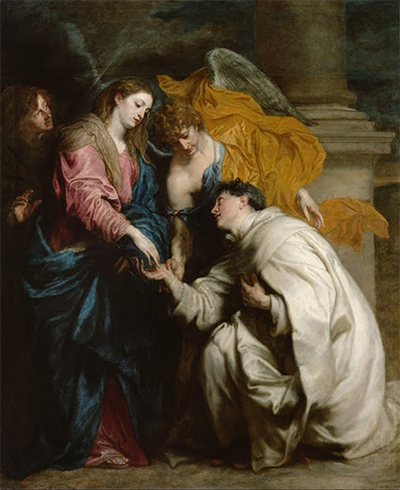
A cluster of hands at the centre of Anthony van Dyck’s The Vision of the Blessed Hermann Joseph holds the whole encounter together. An angel bends between the kneeling Hermann Joseph and the Virgin Mary, guiding an approach that the surrounding folds of cloth make surprisingly momentous.
At a Glance
- Artist Anthony van Dyck
- Date Around 1629–30
- Medium Oil on canvas
- Dimensions 159.5 × 129 cm, height × width
- Collection Kunsthistorisches Museum, Vienna
- Inventory number GG 488
- Subject Hermann Joseph’s vision of mystical marriage to the Virgin Mary. [1] [2]
This work across Anthony van Dyck’s career
Entry of Christ into Jerusalem
about 1617Frans Snyders
about 1620Rinaldo and Armida
1629–1632; Louvre commentary proposes late1631–spring1632Charles I in Three Positions
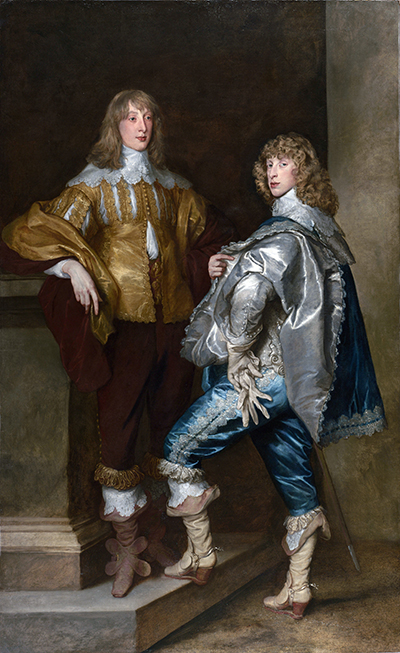
1635–before June 1636Lord John Stuart and his Brother
about 1638Cupid and Psyche
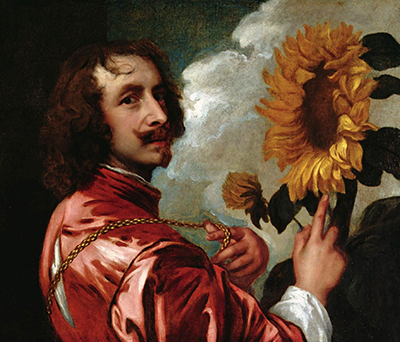
1639–40Self Portrait
c. 1640Contents
- What Hermann Joseph sees
- The angel between them
- Looking up, looking down
- White, blue and gold
- An Antwerp altarpiece
- From Antwerp to Vienna
What Hermann Joseph sees
Hermann Joseph was a medieval Premonstratensian monk whose devotion to Mary culminated, in the account represented here, in a vision of marriage to her. [1] [2] Marriage expresses spiritual attachment in this devotional encounter. Van Dyck gives that idea a physical form in this religious painting : a kneeling body, an offered hand and a face raised towards another person.
The painting supplies few distractions from this meeting. Hermann occupies the lower right, his white habit gathering around his bent legs. Mary’s pink dress and blue mantle fill the left side. Between them, the angel’s exposed chest makes a light, warm patch above the hands. The three bodies crowd the foreground, yet the small central action remains legible. A viewer can first take in the large shapes and then follow their converging lines to the fingers.
Hermann’s other hand rests against his chest. Read beside the extended arm, it makes an expressive pair: one gesture turns inward, the other reaches out. The movement connects an interior experience with something that can be shown. His raised face also matters. The encounter would feel very different if he bowed over his own hands; instead, his gaze carries the action upwards towards Mary.
The angel between them
The angel has a demanding position. His head bends down towards the meeting, a slight smile on his face, while the great spread of golden cloth behind him rises and blows out towards the right. His wing reaches upwards, but his body inclines into the narrow space between Mary and Hermann. Those opposed directions keep him from becoming a static figure inserted into a gap.
Bischoff’s museum commentary identifies him as the intermediary who helps bring Hermann’s hand towards Mary’s fingertips. [2] Looking closely, the assistance seems both practical and ceremonial. Hermann does not reach across the picture unaided. Another figure makes the encounter possible, and the angel’s lowered head directs our attention to the delicate point at which it happens.
The hands make a much smaller shape than the surrounding bodies. Their importance depends on their position and on the lines leading into them. Mary’s arm slopes down from her pink sleeve; Hermann’s arm comes across from the right; the angel bends above. The eye arrives at the meeting along several routes. Even the bright opening of the angel’s torso helps distinguish the space immediately over it from the deeper shadows below.
There is no broad embrace. Much of the picture’s interest lies in how little contact it needs. Hermann’s forward movement has brought his face close to the angel, while Mary’s head remains higher and farther away. The interval between her face and Hermann’s is held open even as their hands approach. The composition allows nearness and distance to exist together.
Looking up, looking down
The three central heads form an uneven descending line from Mary on the left, through the angel, to Hermann on the right. Each bends differently. Mary inclines her face gently towards the action. The angel looks down more sharply. Hermann lifts his chin. His movement answers theirs, creating an exchange that runs through the faces as well as the hands.
The Kunsthistorisches Museum interprets Hermann’s bearing as intensely devoted and Mary’s as cool and remote. [1] That reading draws attention to a real difference in their poses. Hermann leans into the encounter, and his white-clad back forms a long forward curve. Mary’s upper body is more upright. Yet her lowered head and extended hand also belong to the exchange. Her composure can be read as a way of sustaining its solemnity; the picture leaves room for a viewer to weigh the effect of each gesture.
A further young figure watches from the left edge. Partly hidden behind Mary, he occupies a much narrower strip than the principal group. His face and hands emerge from shadow, introducing another level of attention. We look at someone who is also looking, but whose position does not give him the central participant’s access. That small presence makes the scene feel witnessed while preserving the concentration of the main group.
Watch: Van Dyck’s art and working methods
Choose a museum introduction, a specialist lecture or a conservation film to continue exploring Van Dyck’s work.
Van Dyck, The Anatomy of Portraiture
The Frick curators introduce Van Dyck’s portraits, drawings and prints.
Watch on YouTubeWhite, blue and gold
Bischoff contrasts Van Dyck’s gentle movement and softened colour with Rubens’s treatment of comparable subjects. [2] The broad areas of colour here each have a distinct presence.
The largest light shape belongs to Hermann. His habit stretches across his shoulders and drops in ample folds towards the bottom edge. It gives weight to the kneeling pose: the back is broad, the lower cloth bunches and turns, and dark creases keep the pale surface from reading as a single flat area. His face is comparatively small above this expanse. The body’s yielding posture is visible before its expression becomes clear.
Mary’s blue mantle offers a different route through the painting. It falls from beside her head, crosses the area near her hands and spreads down the left side. Against its deep colour, the pink sleeve becomes a clear diagonal leading towards the centre. Near the lower edge, a glimpse of her foot brings the figure back to bodily scale after the eye has followed so much enveloping cloth.
The golden drapery around the angel behaves more expansively. It lifts behind his shoulder and breaks into projecting folds towards the right, against the steadier forms of the column base. Its edges seem to carry the movement beyond the limits of his body. Where Hermann’s habit settles towards the ground, the gold rises and spreads.
Close to the central hands, skin replaces those large areas of colour with smaller, more vulnerable forms. The shift of scale encourages a slower look.
An Antwerp altarpiece
Bischoff places the picture among Van Dyck’s commissions for Antwerp’s Jesuit Confraternity of Bachelors, which he had joined. It followed his Madonna and Child Enthroned with Saints Rosalia, Peter and Paul of 1629, also now in Vienna, as GG 482. She suggests that Hermann Joseph’s subject probably honoured a head of the brotherhood who shared his name. [2]
That proposed personal connection should remain a possibility. What the composition makes readily visible is the suitability of an image centred on Marian devotion for a community devoted to Mary. An individual’s encounter could give a gathered audience a concentrated image for contemplation. The figure at the left offers one possible point of entry: present at the edge, attending to an event whose meaning exceeds his own role.
The architectural setting provides solidity without opening a deep view behind the group. A substantial column and its layered base occupy the upper right. The base’s level edges contrast with the restless golden folds crossing in front of it. Across the top left, darker forms close in around the figures. We can recognise a setting, but our attention has little opportunity to wander away into it.
From Antwerp to Vienna
The Kunsthistorisches Museum records the painting with the Jesuits’ Marian congregation in Antwerp in 1630 and its acquisition from that congregation in 1776. [1] These two dates connect its early devotional setting with its later collection history.
At just under 1.6 metres high, the canvas gives the figures considerable presence. Its upright shape lets Hermann kneel low, Mary occupy the left side at greater height, and the angel bridge their levels. The format concentrates the encounter into a close group, with its decisive gesture near the middle of the picture.
Artworks directory
A selected directory of paintings, drawings and prints, including works discussed in the articles and the Frick’s 2016 portraiture exhibition. It is not a complete catalogue of Van Dyck’s work. Print titles identify collaborators or later printmakers; disputed and workshop attributions are retained. The exhibition checklist supplies additional object records; current collection information governs the updated article entries. [3]
Frequently Asked Questions
It names Hermann Joseph’s devotional vision of union with Mary. The museum connects the subject with his particular reverence for her. [1] Van Dyck represents the encounter through a gesture of joining hands, assisted by the angel. Marriage provides the image through which spiritual attachment becomes visible.
The identification has been proposed but remains unproved. Bischoff also observes that Van Dyck was older when he made the painting than this youthful figure appears. [2] The head should therefore be approached as an unidentified participant, with the self-portrait idea kept as a question.
The figures fill much of the canvas, leaving little open space around their bodies. Hermann’s pale habit approaches the lower and right edges, while Mary’s mantle spreads towards the lower left. We seem to stand near the group, where the turn of a face or the movement of a hand can carry the story.
Discussion
Look again at the images and ideas explored in The Vision of the Blessed Hermann Joseph. These editorial prompts invite your observations.
Reader Insights
How does the angel change the encounter between Hermann Joseph and Mary?
Where does your eye move first among the white habit, blue mantle and golden drapery, and how does it reach the hands?
How do Mary’s lowered head and Hermann’s raised face affect your reading of their relationship?
Join the Conversation
Share a detail, comparison or question about The Vision of the Blessed Hermann Joseph below.
References
- Kunsthistorisches Museum , Mystische Verlobung des heiligen Hermann Joseph mit Maria, GG 488. In German. View source .
- Cäcilia Bischoff , Kunsthistorisches Museum, The Vision of the Blessed Hermann Joseph, Google Arts & Culture; online entry adapted from Masterpieces of the Picture Gallery: A Brief Guide to the Kunsthistorisches Museum , 2010. View source .
- The Frick Collection, Van Dyck: The Anatomy of Portraiture, online exhibition checklist (2016). View source.