 by
Tom Gurney
Tom Gurney BSc (Hons) is an art history expert with over 20 years experience
Email:
tomgurney1@gmail.com
/ Phone:
+44 7429 011000
Crucifixion by Anthony van Dyck: Introduction
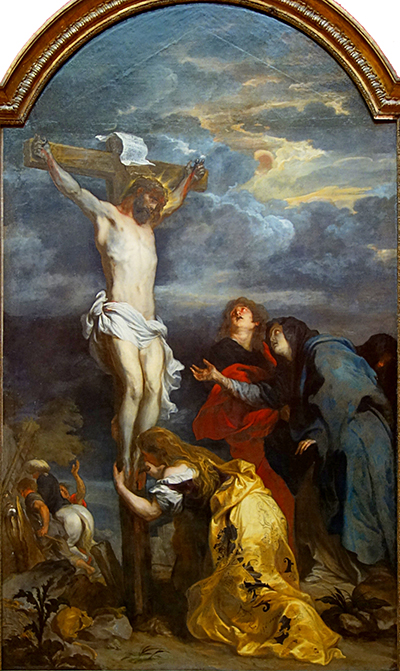
At the foot of Christ’s cross, Mary Magdalene bends so low that her golden dress seems to pour across the ground. Above her, his pale body stretches against a vast, unsettled sky. Anthony van Dyck’s Crucifixion in Lille brings the scale of a public altarpiece to an intimate subject: the few people who remain close to Jesus at his death.
At a Glance
- Artist Anthony van Dyck.
- Museum title Le Christ en croix (le Calvaire) — Christ on the Cross (Calvary).
- Date About 1630.
- Medium Oil on canvas.
- Dimensions 400 × 250 cm.
- Collection Palais des Beaux-Arts de Lille, inventory P89. [1]
- Original setting Commissioned for the convent of the Récollets in Lille. [2]
This work across Anthony van Dyck’s career
Entry of Christ into Jerusalem
about 1617Frans Snyders
about 1620Rinaldo and Armida
1629–1632; Louvre commentary proposes late1631–spring1632Charles I in Three Positions
1635–before June 1636Lord John Stuart and his Brother
about 1638Cupid and Psyche
1639–40Self Portrait
c. 1640Contents
- A cross set to one side
- Magdalene, Mary and John
- The moment after Christ’s death
- A sky that enlarges the drama
- An altarpiece for the Récollets in Lille
- The Lille painting and the Louvre Crucifixion
A cross set to one side
Van Dyck places the cross to the left of the picture’s centre. Christ’s outstretched arms occupy a relatively narrow band beneath the sky, while his long torso and legs carry the eye down towards Magdalene. On the right, two standing figures balance this great vertical: Saint John in red and the Virgin Mary in blue. Their bodies form a dense group below the open expanse of cloud.
The arrangement leaves Christ exposed. Almost nothing interrupts the outline of his body against the darkness, and the white cloth at his waist sharpens the separation between flesh and timber. His head inclines towards the people below, but his extended arms remain fixed to the cross. The difference between that rigid support and the curves of his body makes its suspended weight especially apparent.
Follow the composition from the bottom upwards and a second movement emerges. Magdalene’s spreading dress gathers the foreground into a broad mass of gold. Her bent back leads towards Christ’s feet; his legs continue the ascent; the crossbar finally carries the eye outwards. The people at the right bring it back again through their raised faces and reaching hands. This is a composition that encourages repeated looking between a body and those attending it.
There is movement elsewhere. At the lower left, small figures and a white horse occupy a passage into the distance. The museum’s description identifies the departing group as soldiers and executioners returning towards the city. [1] Their reduced scale creates a different pace from the large, arrested gestures in the foreground. They can leave the scene; the mourners remain absorbed in it.
Magdalene, Mary and John
Magdalene is the closest of the three mourners to Christ. She bends towards his feet, bringing her face and hands into the narrow space beside the upright timber. Her long hair falls forward, helping to enclose this contact. Seen from behind and to one side, she is a figure whose devotion is expressed through the whole body.
Her clothing makes the action easy to find. The brilliant gold occupies much of the lower picture, with deep folds breaking its surface into alternating light and shadow. A white edge near her shoulder catches the eye above the dress. The brightness leads towards the pale legs of Christ, joining the largest coloured area in the foreground to the body on the cross.
The Virgin, at the far right, approaches with her arms extended. Her blue mantle spreads around her as she leans towards her son. John stands beside her, his face turned upwards. The red of his drapery appears between Magdalene’s gold and Mary’s blue, giving each figure a distinct place within the close group. Their colours remain legible even as their bodies and gestures overlap.
These are three ways of approaching the same death: Magdalene bends to touch, Mary reaches, and John looks up. Each movement stops at a different distance from Christ. The painting gives grief a physical vocabulary without making every figure perform the same action. Even before the viewer knows their names, the relationships can be followed through the direction of a head, a hand or a fold of cloth.
The moment after Christ’s death
The description preserved in Lille’s collection record places the scene just after Christ has died. It identifies Magdalene’s action as an attempt to kiss his feet. [1] The stillness of his body and the active gestures beneath it give that moment its particular tension: the mourners continue to move towards someone who can no longer respond.
The Gospel of John provides an important narrative connection. It places Jesus’s mother and Mary Magdalene near the cross, together with the disciple whom Jesus loved. Before his death, Jesus entrusts his mother and that disciple to one another. The passage does not name the disciple; Lille identifies the painted figure as Saint John, following the traditional identification. [1] [3]
Van Dyck concentrates attention on this small circle. John’s Gospel also describes two others crucified alongside Jesus, soldiers dividing his clothing, and the inscription placed above him. [3] Here, the mourners fill the foreground and the principal cross stands alone within the picture. A pale notice attached to its upper part is visible, but its lettering is not the composition’s main means of telling the story. The figures’ proximity to Christ matters more immediately than any text the viewer might read.
Magdalene’s kiss belongs to the painting’s devotional interpretation of the event. John’s account names her presence but does not describe her kissing Christ’s feet at the Crucifixion. [3] By giving her this action, Van Dyck turns attendance into touch. For a viewer standing before the painting, she offers a visible way of approaching the body that remains high above.
The distinction between this scene and a Deposition or Lamentation is also worth observing. Christ is still on the cross. Nobody has yet taken his weight into their arms, and no shroud gathers the mourners around a body on the ground. The separation between his elevated position and their reaching gestures is central to this image.
Watch: Van Dyck’s art and working methods
Choose a museum introduction, a specialist lecture or a conservation film to continue exploring Van Dyck’s work.
Van Dyck, The Anatomy of Portraiture
The Frick curators introduce Van Dyck’s portraits, drawings and prints.
Watch on YouTubeA sky that enlarges the drama
The sky takes up an extraordinary amount of space. Clouds sweep across the arched upper part of the canvas, with slate blue and grey interrupted by warmer openings towards the right. The darkest passages gather around and behind the figures, making Christ’s light body conspicuous. Higher up, the shifts of light keep the empty air active.
Matthew’s Gospel describes darkness over the land before Jesus’s death, followed by an earthquake. [4] That narrative offers a way of understanding the disturbed sky as part of the Passion story. The painted clouds need not be treated as a report of particular weather. They give the death a setting that extends far beyond the few people gathered at the cross.
The effect depends on proportion as much as on darkness. In a tighter image, Christ’s body might fill most of the available space. Here, the reach of the sky makes the figures appear exposed to something larger than their immediate gathering. Yet the warm light among the clouds prevents the upper picture from becoming a uniform black backdrop. The eye moves through changes of atmosphere before returning to the sharply visible body below.
At the bottom, the opposite kind of space appears: rough earth, stones and scattered plants. Magdalene’s heavy drapery settles close to this ground. Between earth and sky, Christ’s long body gives the picture its main connection. The contrast is visible in the differing textures too: the angular foreground, the broad cloth folds and the soft boundaries of the clouds.
An altarpiece for the Récollets in Lille
The Palais des Beaux-Arts identifies Christ on the Cross as a commission for Lille’s convent of the Récollets. Its teaching material also lists Van Dyck’s Miracle of the Mule , dated about 1627–30, as a commission for that convent. [2] The Crucifixion therefore belonged to a specific setting of religious patronage in the city, where Van Dyck supplied more than one sacred subject.
Its height of four metres is essential to imagining the picture beyond a small reproduction. [1] The standing figures and the extended body would confront a viewer on a scale very different from an illustration on a page. The few broad colour areas, the clear outline of Christ and the strongly directed gestures make sense within that large format. From a distance, the main relationships remain visible; closer looking brings attention to Magdalene’s hands, the hanging cloth and the smaller figures beyond.
The rounded upper edge gives the clouds room to rise over the cross. It also helps the canvas read as an image made for an architectural setting, though the shape alone cannot establish the details of its original installation. What can be followed within the painting is the movement it proposes for a viewer: from the low foreground towards the feet, body and arms of Christ.
In that devotional setting, the mourners could offer different points of entry into contemplation. Magdalene’s touch, Mary’s outstretched arms and John’s upward gaze make sustained attention visible. This is an interpretation suggested by their arrangement; the painting does not require us to imagine a single, uniform response from everyone who stood before it. Van Dyck’s wider range of religious and mythological paintings similarly rewards attention to how bodies and gestures make a story accessible.
The Lille painting and the Louvre Crucifixion
Van Dyck returned to the Crucifixion in different works. The Louvre’s Christ on the Cross, the Virgin, Saint John and Saint Mary Magdalene , inventory INV1766, is an earlier painting, dated 1617–19. It measures 330 × 282 cm, giving it broader proportions than the tall Lille canvas. The Louvre records its acquisition from Rubens by the town of Bergues around 1620–21 for the Jesuits there. [5]
Lille’s P89 dates from about 1630 and was commissioned for the Récollets. [1] [2] The recurrence of Christ, Mary, John and Magdalene shows how Van Dyck could revisit a central devotional subject for different settings, while changing its proportions and the space around its figures.
Artworks directory
A selected directory of paintings, drawings and prints, including works discussed in the articles and the Frick’s 2016 portraiture exhibition. It is not a complete catalogue of Van Dyck’s work. Print titles identify collaborators or later printmakers; disputed and workshop attributions are retained. The exhibition checklist supplies additional object records; current collection information governs the updated article entries. [6]
Frequently Asked Questions
It belongs to the Palais des Beaux-Arts de Lille, where it is catalogued as Le Christ en croix (le Calvaire) , inventory P89. [1]
They are Mary Magdalene, bending towards Christ’s feet; Saint John, looking upwards; and the Virgin Mary, extending her arms towards her son. [1] Gold, red and blue help distinguish them within the closely grouped composition.
Lille’s description identifies the moment as immediately after his death. [1] The mourners’ active gestures surround his suspended, unresponsive body, before it has been taken down from the cross.
No. The Louvre canvas, INV1766, dates from 1617–19 and has a separate history connected with the Jesuits of Bergues. [5] The Lille painting is the taller, later canvas made for the Récollets.
Discussion
Look again at the images and ideas explored in Crucifixion by Anthony van Dyck. These editorial prompts invite your observations.
Reader Insights
How does placing the cross to the left change the balance between Christ, the mourners and the open sky?
Which gesture brings you closest to the scene: Magdalene’s touch, Mary’s reaching arms or John’s upward gaze?
What changes when you imagine this image four metres high, instead of seeing it as a small reproduction?
Join the Conversation
Share a detail, comparison or question about Crucifixion by Anthony van Dyck below.
References
- Palais des Beaux-Arts de Lille , Le Christ en croix (le Calvaire), P89. In French. View source .
- Palais des Beaux-Arts de Lille , Fiche œuvre: Peter Paul Rubens, Descente de croix, thematic list of altarpieces, p. 2. In French. View source .
- Bible , John 19, especially verses 17–30, King James Version. English translation. View source .
- Bible , Matthew 27, especially verses 45–56, King James Version. English translation. View source .
- Musée du Louvre , Christ en croix, la Vierge, saint Jean et sainte Madeleine, INV1766. In French. View source .
- The Frick Collection, Van Dyck: The Anatomy of Portraiture, online exhibition checklist (2016). View source.