 by
Tom Gurney
Tom Gurney BSc (Hons) is an art history expert with over 20 years experience
Email:
tomgurney1@gmail.com
/ Phone:
+44 7429 011000
The Lomellini Family: Introduction
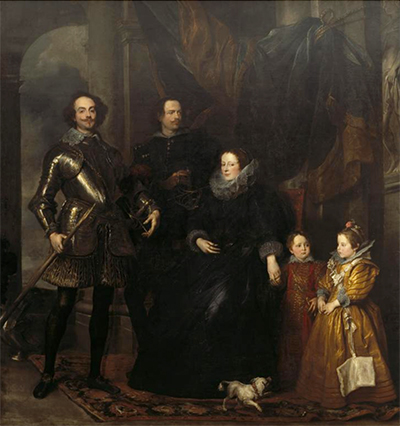
A young man in armour meets the viewer at the edge of Anthony van Dyck’s The Lomellini Family . Behind him, the group steps down through different heights, ending with two small children in red and gold. Heavy curtains and architecture give the gathering a ceremonial setting, while a little dog stands on the carpet below. The picture invites us to look at a family together and at the different ways each person occupies that shared space.
At a Glance
- Artist Anthony van Dyck
- Date About 1625–27
- Medium Oil on canvas
- Dimensions 269 × 254 cm
- Collection National Galleries of Scotland, Edinburgh
- Inventory number NG120
- Subject Five members of the Lomellini family. [1]
This work across Anthony van Dyck’s career
Entry of Christ into Jerusalem
about 1617Frans Snyders
about 1620The Lomellini Family (current article)
c. 1625–27Rinaldo and Armida
1629–1632; Louvre commentary proposes late1631–spring1632Charles I in Three Positions
1635–before June 1636Lord John Stuart and his Brother
about 1638Cupid and Psyche
1639–40Self Portrait
c. 1640Contents
- The family and the absent doge
- A group built from different heights
- Armour, black cloth and gold
- Hands that connect and distinguish
- Architecture and a curtain larger than the family
- From Genoese portrait to Scottish collection
The family and the absent doge
The sitters are Barbara Spinola Lomellini, Giacomo Lomellini’s second wife; his elder sons, Nicolo and Gio. Francesco; and the younger children, Vittoria and Agostino. Giacomo was doge of Genoa in 1625–27. The museum explains his absence through rules forbidding portraits of serving doges, designed to restrain personal promotion. [1]
That absence gives the portrait an unusual public dimension. We see the household associated with an office whose holder cannot appear. Nothing in the arrangement looks like an empty place waiting to be filled: the standing men, seated woman and children form a complete group. Yet knowledge of the missing father changes how we read their presence. The display of family standing carries a political context beyond the five visible faces.
Van Dyck gives each sitter a distinct place within that display. The two young men occupy the left side, Barbara anchors the centre, and the children gather beside her on the right. Their unequal heights make the passage across the picture easy to follow. The composition joins people of different generations without forcing them into an evenly spaced line.
A group built from different heights
The armoured figure stands closest to the left edge. His head is high against the lighter opening behind him, and his legs carry the eye almost to the bottom of the canvas. The dark-clad man beside him appears farther back. Their shoulders overlap, so that two separate full-length presences occupy a comparatively narrow part of the picture.
Barbara’s seated body opens out below them. Her dark skirt spreads towards the foreground, giving the central group a broad base. Above it, the pale ruff frames a small, clearly visible face. The children bring the line of heads down towards the right. Their bright clothes remain legible beside the much larger area of black fabric.
This descent is enlivened by the directions in which people turn. The armoured man looks out towards us, while the others direct their attention across the group in different ways. Their faces never become five repetitions of the same pose. The viewer can enter through the outward-facing young man, then follow the changes of angle towards the mother and children.
The little dog supplies a further change of scale at the bottom. Its pale body interrupts the dark hem and patterned carpet, well below every human face. It also gives the eye a reason to travel through the whole height of the painting. The grand setting continues down to a small animal close to the family’s feet.
Watch: Van Dyck’s art and working methods
Choose a museum introduction, a specialist lecture or a conservation film to continue exploring Van Dyck’s work.
Van Dyck, The Anatomy of Portraiture
The Frick curators introduce Van Dyck’s portraits, drawings and prints.
Watch on YouTubeArmour, black cloth and gold
The armour makes the most abrupt statement about a body in this group. Bright curved edges pick out the shoulder, breastplate and arm against the darker metal. The hard surface appears to catch light in narrow flashes. Around it, cloth falls, bunches and spreads, offering a quite different account of movement and weight.
Beside the armour, the second young man’s dark costume merges more readily with the background. A pale collar and the exposed hands prevent his figure from disappearing into it. The visual difference between the two men is strong even before we know their names: one has a sharply articulated, reflective outline; the other emerges more quietly from a continuous field of darkness.
Barbara’s dress extends that dark field towards the centre and foreground. It takes a moment to distinguish its folds from its broad silhouette. The ruff, face and hands become particularly prominent because they interrupt so much black. Her clothing gives the composition weight without introducing another large, brilliant colour.
The children alter the balance. Red and gold cluster on the right, where small bodies receive some of the richest colour. The gold costume has an especially broken surface: pale edging, sleeves and folds divide it into many small passages of light. Across the picture, the broad sweep of the curtain answers these warm colours on a much larger scale. The eye moves between family dress and hanging fabric, carrying the right-hand brightness back into the upper half.
Hands that connect and distinguish
Look below the faces and the group acquires another rhythm. The armoured man has one hand low beside the long diagonal shaft, while the other opens near his waist. His arms make his stance wider than the narrow line of his legs. Those gestures help him occupy the foreground with assurance; they do not require us to invent an episode of military action.
Barbara’s hands are separated. One rests across the dark fabric near her waist; the other descends beside the child dressed in red. Their light colour carries the eye down from the ruff and towards the children. The close gathering of the smaller figures’ hands creates a more intricate passage at the right.
The family coheres through proximity and overlap as well as touch. Each face and body retains its own direction.
Architecture and a curtain larger than the family
The figures inhabit an imposing space. On the left, an arch opens towards cloudy light; upright architectural forms divide that opening from the darker interior. Overhead, a great sweep of fabric gathers in deep folds. At the far right, a pale sculptural form adds another kind of body to the background.
The curtain does much of the work of enclosing the group. Its diagonal folds carry movement above the comparatively still heads, while its dark centre makes the faces easier to see. The architecture supplies firm verticals; the cloth loosens them. Together they create a setting with both solidity and motion.
The view through the arch also matters. Its lighter patch separates the armoured man from the background and suggests space beyond the gathering. Towards the right, the curtain closes that distance off. The family therefore occupies a pictorial space that alternately opens and shelters. We can describe these visible effects without identifying the setting as a particular room or reading every background feature as a fixed symbol.
The near-square format holds the wide group and the towering backdrop together. There is enough height for the curtain to feel monumental, but the people still extend across most of the width. Their bodies remain the measure against which we understand the scale of everything around them.
From Genoese portrait to Scottish collection
The Royal Institution purchased the painting in 1830; its transfer to the National Gallery followed in 1859. [1] A figure in its later journey was the Scottish painter and dealer Andrew Wilson. The National Galleries of Scotland records that he settled in Italy in 1826 and that The Lomellini Family was among the pictures which passed through his hands. [2]
Artworks directory
A selected directory of paintings, drawings and prints, including works discussed in the articles and the Frick’s 2016 portraiture exhibition. It is not a complete catalogue of Van Dyck’s work. Print titles identify collaborators or later printmakers; disputed and workshop attributions are retained. The exhibition checklist supplies additional object records; current collection information governs the updated article entries. [3]
Frequently Asked Questions
Rules barred portraits of serving doges to limit personal promotion. His family appears during his term of office. [1]
He varies their height, depth and direction. The standing men overlap on the left, Barbara’s seated form broadens the centre, and the children occupy the lower right. Large areas of dark clothing hold the group together while pale faces, collars and hands distinguish its members.
The visible architecture does not establish a specific room. Its clear pictorial effects are easier to trace: the left-hand opening brings in distance and light, the verticals give the group structure, and the curtain encloses the central figures.
The dog near the lower edge. Its pale coat catches the eye beneath the dark dress, drawing attention to the carpet and the figures’ footing. It introduces a small, irregular shape into a composition dominated by upright bodies and sweeping folds.
Discussion
Look again at the images and ideas explored in The Lomellini Family. These editorial prompts invite your observations.
Reader Insights
How does the portrait change when you learn why the family’s father is absent?
Follow the light from armour to ruff, hands and gold clothing. Which passage brings you closest to an individual sitter?
What changes in your experience of the group when you cover the curtain and architecture and look only at the figures?
Join the Conversation
Share a detail, comparison or question about The Lomellini Family below.
References
- National Galleries of Scotland , The Lomellini Family, NG120. View source .
- National Galleries of Scotland , Andrew Wilson. View source .
- The Frick Collection, Van Dyck: The Anatomy of Portraiture, online exhibition checklist (2016). View source.