 by
Tom Gurney
Tom Gurney BSc (Hons) is an art history expert with over 20 years experience
Email:
tomgurney1@gmail.com
/ Phone:
+44 7429 011000
Portrait Study of Henrietta of Lorraine: Introduction
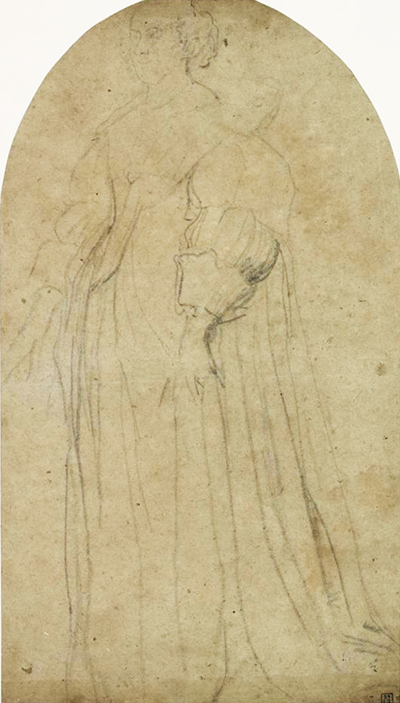
A small, faint head sits above an expansive gown in Anthony van Dyck’s Portrait Study of Henrietta of Lorraine . The eye follows the dark folds downwards, then returns to the sharply bent arm. This is preparation for a full-length painted portrait: a drawing concerned with how a figure occupies space and how clothing gives that figure shape. [1]
At a Glance
- Artist Anthony van Dyck.
- Date 1634.
- Medium Black chalk with traces of white chalk on light grey paper, probably formerly blue.
- Dimensions 52.9 × 30.2 cm; rounded top.
- Collection National Galleries of Scotland, Edinburgh.
- Accession number D 1738. [1]
This work across Anthony van Dyck’s career
Entry of Christ into Jerusalem
about 1617Frans Snyders
about 1620Rinaldo and Armida
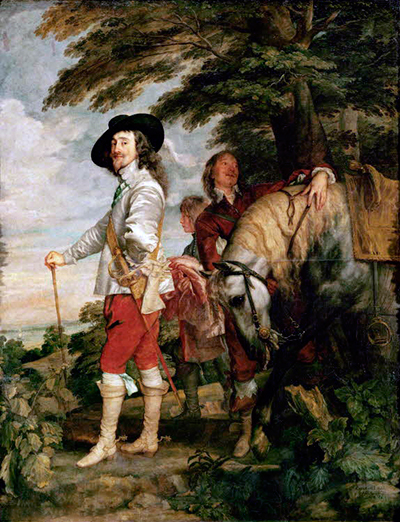
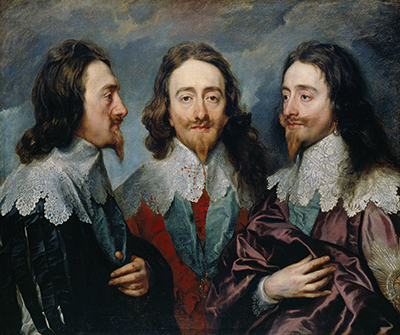
1629–1632; Louvre commentary proposes late1631–spring1632Charles I in Three Positions
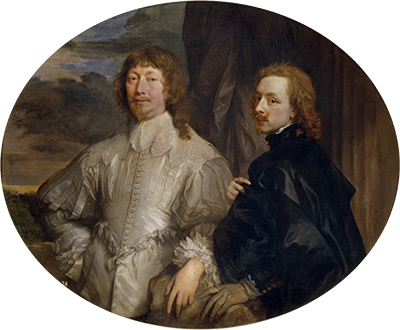
1635–before June 1636Lord John Stuart and his Brother
about 1638Cupid and Psyche
1639–40Self Portrait
c. 1640Contents
- A princess in Brussels
- Follow the sleeve, waist and skirt
- What the faint passages can tell us
- From this sheet to the Kenwood portrait
- A pose with a longer history
A princess in Brussels
Henrietta of Lorraine (1611–1660) had fled Nancy as French troops approached and found refuge in Brussels. [1] Van Dyck portrayed both her and her sister Marguerite there in 1634. Marguerite’s secret marriage to Gaston, Duke of Orleans, the younger brother of Louis XIII, formed part of the sisters’ difficult political circumstances. [2] English Heritage explains that Louis rejected the marriage, excluded the couple and Henrietta from France, and seized their property. [3] The family dispute therefore had material consequences as well as dynastic ones. Henrietta’s dignified appearance belongs to this period of exile, when the security usually associated with her rank had been disrupted.
Henrietta of Lorraine should be distinguished from Queen Henrietta Maria, Charles I’s wife, another of Van Dyck’s sitters. Here the connection between aristocratic portraiture and displacement is especially striking. The drawing gives no direct account of flight or refuge. Its subject appears upright, fully dressed and composed within the narrow sheet. Knowing the circumstances adds a sense of how portable a courtly identity could be: a princess could be represented through bearing and costume even away from home. That is a reading of the portrait’s effect, rather than evidence of what Henrietta asked Van Dyck to express.
Follow the sleeve, waist and skirt
Begin with the arm on the right of the image. A rounded upper sleeve projects from the torso; below it, several darker curved strokes gather around the bend of the arm. The cuff has a more angular, almost crumpled outline. The hand lies near the waist, leaving an open interval between arm and body. This pocket of space keeps the broad sleeve from merging into the gown.
On the opposite side, the arm reaches towards the edge of the paper. The two arms therefore work differently: one brings attention back towards the waist while the other opens the figure outwards. Even with little facial information, these unequal gestures give the pose direction. Cover the head for a moment and the body remains legible.
The Frick’s account identifies Van Dyck’s particular attention to the swollen sleeves, lace cuffs and tapering stomacher, the pointed front panel of the bodice. [2] These details explain the dress’s construction, but their effect can also be followed as a pattern of widths. The upper body expands at the sleeves, contracts at the middle, then opens into the skirt. A few dark marks can make that sequence readable without filling every area with tone.
Long lines dominate the lower half. Some descend almost vertically; others veer towards the right edge, widening the silhouette near the bottom. The uneven intervals between them suggest folds with different depths. They also keep the skirt from reading as a flat triangle. Near the waist, shorter strokes bunch together; further down, the chalk travels across much larger stretches of paper. The change in scale makes the fabric seem to release from its gathered upper portion into a broad fall.
Look, too, at how much surface remains empty. The body is enclosed by broken boundaries, with very little surrounding furniture or setting to locate it. The chalk does not have to describe every inch of cloth for us to complete the gown in our minds. This economy is one reason a preparatory sheet can be so absorbing: the marks remain distinct, and we can see how much each contributes.
Watch: Van Dyck’s art and working methods
Choose a museum introduction, a specialist lecture or a conservation film to continue exploring Van Dyck’s work.
Stijn Alsteens: Drawing for Portraits
Stijn Alsteens explores how portrait drawings prepare and develop a likeness.
Watch on YouTubeWhat the faint passages can tell us
The face receives much less definition than the clothing. It is difficult to pick out a sustained expression in the reproduction, and the head feels lightly suspended above the more firmly articulated arm. The Frick notes that the abbreviated features scarcely resemble the face in the finished painting. [2] The difference helps show where Van Dyck concentrated his attention on this sheet.
The paper’s present appearance also needs care. Its probable former blue colour is qualified in the Scottish collection record. [1] The Frick reports that much of the white chalk heightening has been abraded. [2] We are looking at a sheet whose light accents have diminished, so its faintness cannot all be assigned to Van Dyck’s original choices.
At the same time, the surviving dark strokes have a clear hierarchy. The cuff and the turn of the sleeve catch the eye sooner than the head. It is useful to let that hierarchy guide a first look, then return to the paler passages. The reproduction supports an account of where the drawing is most legible; it cannot establish the original strength of every line or highlight.
From this sheet to the Kenwood portrait
The related painting, Princess Henrietta of Lorraine, Attended by a Page , is at Kenwood. Dated 1634, it is an oil on canvas measuring 213.4 × 127 cm. The English Heritage description records a young Black page helping Henrietta gather roses; his identity is unknown. [4] The record does not establish his individual legal status.
There is no comparably developed attendant in this drawing. It is best approached as a focused study of the standing woman’s arrangement. Its narrow field makes the gown feel close to the edges, while the space beside the extended arm remains lightly described. The relationship with the painting helps explain the sheet’s purpose, but does not turn every pale mark into a complete plan for the later scene.
In the painting, the hand on the right of the image hangs lower against the dark skirt, with the fingers extending beyond the lace cuff. The other rests on the boy’s shoulder. His upturned face gives that gesture a recipient, while her light collar and cuffs stand out against the black gown. [5] Returning to the drawing makes its selectiveness clearer: the sleeves and long fall of cloth are already substantial concerns, but the relationship between the two people belongs to the fuller painted arrangement.
The Scottish collection relates the drawing to Roger de Piles’s 1708 description of brief chalk studies of pose and drapery. [1] His later account describes a general method; it does not time this sitting or establish its precise sequence.
For another way of following gesture through a working sheet, see the Portrait Study of a Lady with Studies of Her Hands . The broader range of purposes served by these sheets is explored in Van Dyck’s drawings .
A pose with a longer history
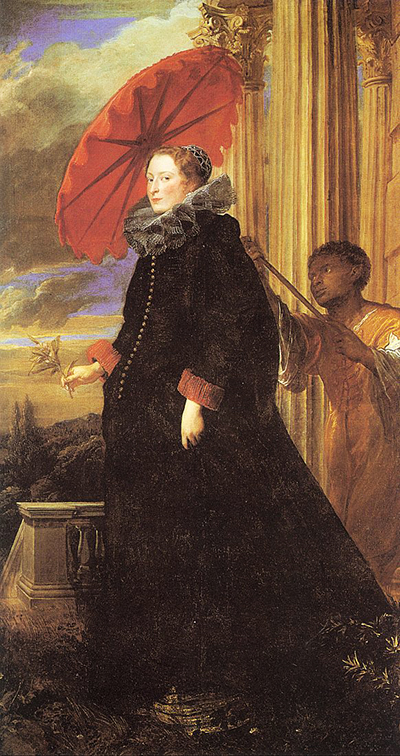
Blaise Ducos’s Louvre catalogue places Henrietta’s finished portrait beside Van Dyck’s earlier Portrait of a Genoese Lady , painted in 1626–27. Ducos points to a compositional exchange: the chair beside the Genoese woman has given way to the page beside Henrietta. He sees Van Dyck reworking a successful Italian arrangement across the geographical divisions of his career. [5]
That comparison helps explain why the outward-reaching arm deserves attention in the Scottish sheet. A full-length portrait needs to connect its standing figure with the space alongside her. Here that connection remains lightly stated; in the Kenwood painting, the contact of hand and shoulder makes it explicit. The boy also looks upwards while Henrietta faces out towards the viewer. Their different directions of attention animate an arrangement whose central figure remains composed. The drawing allows us to concentrate on the woman’s stance before taking in this more elaborate exchange.
Artworks directory
A selected directory of paintings, drawings and prints, including works discussed in the articles and the Frick’s 2016 portraiture exhibition. It is not a complete catalogue of Van Dyck’s work. Print titles identify collaborators or later printmakers; disputed and workshop attributions are retained. The exhibition checklist supplies additional object records; current collection information governs the updated article entries. [6]
Frequently Asked Questions
No. The Scottish collection identifies Henrietta of Lorraine. [1] Queen Henrietta Maria, Charles I’s wife, was a different sitter.
The sheet concentrates on the pose and costume. [1] The sweep of the skirt, breadth of the sleeves and placement of the arms carry much of its visual information. Its abbreviated face should not be treated as a finished likeness.
It is at Kenwood, London. The painted portrait includes a young page and a rose-gathering action, elements described in English Heritage’s record of that separate work. [4]
Discussion
Look again at the images and ideas explored in Portrait Study of Henrietta of Lorraine. These editorial prompts invite your observations.
Reader Insights
Which few lines do most to make the skirt feel three-dimensional?
How does the pose change when you concentrate on the space between the bent arm and the waist?
Does knowing Henrietta’s situation in Brussels affect your response to her composed bearing?
Join the Conversation
Share a detail, comparison or question about Portrait Study of Henrietta of Lorraine below.
References
- National Galleries of Scotland , Study for the Portrait of Henrietta of Lorraine (1611–1660) , D 1738. View source .
- The Frick Collection , Portrait Study of Henrietta of Lorraine , Van Dyck: The Anatomy of Portraiture , exhibition object 23, 2016. View source .
- English Heritage , Kenwood Collection Highlights , “Princess Henrietta of Lorraine, Attended by a Page”. View source .
- English Heritage , Kenwood, Princess Henrietta of Lorraine (1611–1660), Attended by a Page , collection record supplied to Art UK. View source .
- Blaise Ducos , Portrait d’une dame génoise , cat. 9, paragraphs 5–6 and fig. 9-2, Antoon Van Dyck. Catalogue raisonné des tableaux du musée du Louvre , Musée du Louvre éditions, 2023 (French). View source .
- The Frick Collection, Van Dyck: The Anatomy of Portraiture, online exhibition checklist (2016). View source.