



 by Tom Gurney
Tom Gurney BSc (Hons) is an art history expert with over 20 years experience
Published on June 19, 2020 / Updated on November 3, 2026
Email: tomgurney1@gmail.com / Phone: +44 7429 011000
The Canterbury Pilgrims by William Blake: Introduction
The riders fill almost the entire width of William Blake’s The Canterbury Pilgrims. Horses overlap, faces turn towards companions, and an expansive gesture near the centre reaches across the company. At the left, more travellers emerge from an inn; at the right, the leading horses are already carrying the procession beyond the picture. Blake has made a departure feel like a whole society gathering into motion. The painting, dated about 1808, belongs to the Pollok House collection in Glasgow, accession PC.89. It is tempera on canvas, measuring 46.8 × 137 centimetres. [1][2]
Its subject is the company introduced in Geoffrey Chaucer’s Canterbury Tales, travelling from Southwark to the shrine of Thomas Becket. For Blake, however, the pilgrims also represented enduring forms of human character. His catalogue declared, “Every age is a Canterbury Pilgrimage.” The proposition explains why this apparently historical scene became such an important statement about his own art. The canvas brings together his reading of Chaucer, his belief in sharply distinguished forms and his demand to be recognised as a painter capable of finished work. [3]
At a Glance
- Datec.1808 [1]
- MediumTempera on canvas [1]
- Size46.8 × 137 cm [1]
- Collection referencePollok House painting, PC.89 [1][2]
This work across William Blake’s career
Gothic art and antiquarian study
Apprenticeship, 1772–1779 [4]Poetical Sketches
1783 [5]The Marriage of Heaven and Hell
Offered in the 1793 prospectus [7]Night Thoughts
Published selection, 1797 [9]The Ghost of a Flea
c.1819–1820 [10]Job engravings
Agreement 1823; issue 1826 [11]Dante illustrations
1824–1827 [12]Contents
- The morning before the stories
- Following the procession
- The poor men and the lawyer
- Two kinds of strength
- The Prioress and the Wife of Bath
- Why the outlines mattered
- A public challenge in 1809
- From painting to engraving
The morning before the stories
The Gothic gateway of the Tabard Inn anchors the left side. Its pointed arch, patterned windows and little figures above the roof give the building an elaborate presence beside the riders. Across the remaining width, a low landscape opens beneath a much larger sky. Birds cross above the inn; pale rays spread from the horizon at the right. The space behind the company feels extensive, while the people and animals occupy a comparatively shallow strip of foreground. [2]
Blake’s catalogue identifies the time as early morning before sunrise, with the pilgrims just leaving the inn. He describes an imagined eastward view from Southwark, including cottages, villages and distant buildings. This is his reconstruction of Chaucer’s world. The painting offers no basis for treating its skyline as a measured record of medieval London or for identifying a distant church as Canterbury Cathedral. Ritchie, discussing the landscape, considers the catalogue’s unnamed great city more likely to mean London than Canterbury. [1][3]
Chaucer’s General Prologue begins much earlier in the experience of the journey. Spring awakens the wish to travel; the narrator encounters twenty-nine pilgrims at the Tabard and joins their company. The long series of portraits then allows readers to meet them before they set out. At supper, the Host proposes a storytelling contest: each traveller will tell two tales on the outward journey and two coming home, with a supper as the reward for the best performance. Shared travel becomes the occasion for competing voices. [13]
The painting concentrates that prospect in the Host’s body. Placed near the centre, he opens his arms across the company, connecting people who face and sit in different directions. Blake explains that he directs attention towards the Knight as the likely first storyteller. In Chaucer’s narrative, the travellers draw lots after they have ridden a short distance, and the Knight receives the first turn. Blake brings the expectation of that event into the departure. His picture gathers character, conversation and the coming contest into one scene. [2][3][13]
Following the procession
The easiest way to enter the company is to begin at the right and work back towards the inn. Blake places the Knight, Squire and Yeoman at the front, following the opening order of Chaucer’s portraits. The leading horses have pale bodies and lifted legs, making their movement especially conspicuous against the darker ground. Rich red accents mark the riders and harness. Behind them, the veiled women and accompanying priests form a compact cluster, with small dogs running below. [2][3]
The contrast between the front and rear gives the wide composition a structure. At the right, horses stretch towards the edge; at the left, riders are still compressed beneath and beside the gateway. The last horse’s dark body stands out against the inn. Blake identifies its rider as the Reeve, whom Chaucer explicitly places at the rear. The spectators beside the entrance—an older man, a woman and children in Blake’s account—remain outside the mounted company, marking the difference between those who travel and those who watch them go. [2][3][13]
Between these ends, the figures are packed closely without becoming an undifferentiated crowd. Heads appear at different heights and turn through different angles. Broad hats interrupt the succession of hoods, veils and uncovered hair. Upright torsos alternate with bodies leaning or turning towards others. At the lower edge, horses’ legs cross in a dense succession of diagonals, while small animals move through the spaces beneath them. The bodies continually overlap, but their outlines preserve a sense of separate participants. [2]
Blake says that he varied the horses to correspond with their riders. Chaucer had already made mounts part of his character portraits: the Clerk’s horse is lean like its owner, the Monk has an excellent horse, and the Shipman sits on his mount as best he can. Blake extends that attentiveness across the company. Differences of size, colour, bearing and equipment make the animals active parts of the social picture. Looking only at the faces would miss much of its characterisation. [2][3][13]
At the rear, the Oxford Clerk rides close to Chaucer. In the poem, the Clerk values books above fine clothes and is devoted to learning and teaching. Blake turns the adjacency into a particular lesson. His catalogue imagines the younger philosopher placing himself under the mature poet’s tuition. This relationship is Blake’s addition to the scene’s meaning: he wants philosophy to serve inspired imagination. Chaucer’s contemplative scholar becomes part of a debate between kinds of knowledge. [3][13]
Elsewhere the company offers the beginnings of sound as well as movement. Chaucer gives the Miller a bagpipe, with which he leads the travellers out of town, and makes the Pardoner and Summoner sing together. Those details help a reader imagine the noisy life compressed into Blake’s comparatively formal arrangement. They also complicate its order: the Knight heads Blake’s composition, while the poem assigns a conspicuous part in the departure to the Miller’s music. The painting selects and rearranges, even when it insists on fidelity to its source. [3][13]
Even the size of the company required interpretation. Chaucer announces twenty-nine companions, but reconciling that number with all the named roles proved a problem for Blake. His catalogue proposes that the Weaver and Tapestry-Weaver could be one person, then conjectures a different reading of the guildsmen’s list. He acknowledges the uncertainty of his opinion. Purves’s text names a Haberdasher, Carpenter, Weaver, Dyer and Tapestry-Maker separately. The painting’s company therefore emerges from an act of reading and selection, including choices a later reader can question. Its crowded width should not be mistaken for proof that Blake has simply copied a complete, unambiguous passenger list. [3][13]
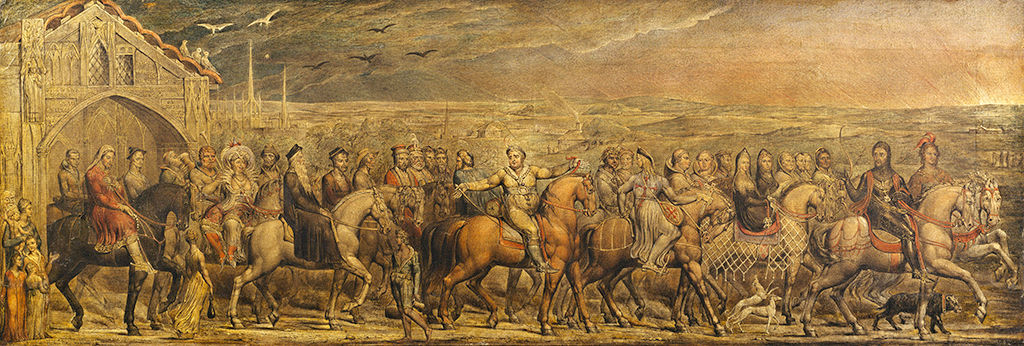
William Blake, The Canterbury Pilgrims, c.1808. Tempera on canvas; Pollok House painting, PC.89.
The poor men and the lawyer
One of Blake’s most revealing decisions concerns the Parson, his brother the Ploughman and the Sergeant of the Law. His catalogue says that the lawyer rides between the brothers and appears pleased with the Parson’s company. Blake then gives the grouping a wish: men of law should keep such company and seek their advice in difficult matters. A position within the procession becomes an argument about whose judgement deserves attention. [3]
Chaucer supplies the grounds for Blake’s admiration. The Parson visits the distant members of his parish on foot, through bad weather and illness. He gives to the poor instead of ruthlessly demanding his own income, and practises the teaching he offers to others. His authority grows from conduct. Chaucer’s portrait repeatedly distinguishes him from the cleric who pursues income or status while abandoning the people entrusted to him. [13]
The Ploughman’s goodness is equally practical. He works hard, lives charitably and helps poor neighbours without payment when he can. His love of God is joined to his love of other people. Blake insists that the figure is thin through labour, rather than simply an exhausted old man. He wants the viewer to recognise strength beneath an appearance that carries little social distinction. [3][13]
The lawyer has a more ambiguous portrait in Chaucer. He is knowledgeable, respected and prosperous, yet the narrator also remarks that he seems busier than he is. Blake’s catalogue stresses his venerable mastery of law. It then places that professional competence beside the brothers’ charity. The grouping does not demand that learning or public office disappear. It asks them to recognise a moral authority carried by people whose service brings little reward. [3][13]
This makes the Parson an essential counterweight to the more conspicuous religious figures. The Monk enjoys hunting and luxury; the Friar cultivates profitable acquaintances; the Pardoner converts dubious relics and persuasive performance into money. Chaucer gives each a different mixture of skill, appetite and abuse. Blake gives the good Parson an almost apostolic status, then warns that rich and powerful people may continue to follow the Friar or Pardoner instead. Outward solemnity cannot, by itself, identify a trustworthy guide. [3][13]
Two kinds of strength
Blake’s reading of the Ploughman reaches well beyond medieval social observation. He proposes that Chaucer divided Hercules between the Ploughman and the Miller. The one embodies strength joined to benevolence; the other presents its brutal and frightening aspect. Their shared power has different consequences for the people around them. This is Blake’s interpretation of Chaucer through classical myth, rather than an identification made by Chaucer himself. [3]
The distinction helps explain the catalogue’s comparisons with ancient gods. Blake associates the Franklin’s abundant hospitality with Bacchus, the Physician with Aesculapius, the Host with Silenus and the Squire with Apollo. In his view, the pilgrims embody recurrent powers of life: pleasure, healing, conviviality, artistry and strength. The costumes belong to a particular period, while the powers they express can appear in other ages under other names. [3]
Yet Blake interrupts this mythological system with a warning. Such powers become destructive when they are elevated above humanity and demand human sacrifice. He insists that they should serve human beings. The Ploughman’s labour therefore gives strength a different value from domination: his physical capacity answers another person’s need. The catalogue’s apparently extravagant mythmaking returns to the ordinary question of what someone does for a neighbour. [3]
The painting makes these claims tangible through a company of bodies. No god descends above the cavalcade to explain it. The viewer encounters dress, gestures, faces, horses and proximity. Blake asks those material distinctions to carry an account of human possibilities. His insistence that each character is complete in its kind can be illuminating, though it also makes his reading more fixed than Chaucer’s slippery mixture of praise, irony and self-revelation. [2][3][13]
Watch: William Blake’s world and working methods
Choose an introduction to Blake, a printing demonstration, or a discussion of his radical ideas.
William Blake: Poet, Artist & Visionary - a genius of early Romanticism in England
An introduction to Blake’s art, poetry and imaginative world.
Watch on YouTubeThe Prioress and the Wife of Bath
The treatment of the two principal women exposes the limits as well as the force of Blake’s system. The Prioress appears towards the front, within the group of veiled figures and priests. Small dogs run beneath the horses nearby, recalling Chaucer’s account of the animals she feeds with fine food. Blake’s catalogue admires her elegance and high rank, allowing her delicate affectations without treating them as destructive faults. [2][3][13]
Chaucer’s portrait leaves more room for questioning that elegance. He describes her cultivated manners, her imitation of courtly behaviour, her well-arranged clothing and her extravagant tenderness towards animals. The gold brooch carrying a declaration that love conquers all adds another suggestive detail. The portrait holds religious vocation, social aspiration and feeling together without reducing them to a single label. Blake gives greater emphasis to the dignity he believes the figure should retain. [3][13]
His Wife of Bath receives a much harsher judgement. Chaucer describes an accomplished cloth-maker and experienced traveller, with five husbands behind her, scarlet stockings, a broad hat and a lively manner in company. Blake’s catalogue instead makes her a threatening recurring type. He calls her a “scourge and a blight” and advises the young reader to regard her as a warning. His contrast turns two complicated portraits into opposed kinds of womanhood. [3][13]
That judgement belongs to Blake and should remain recognisable as his. The General Prologue gives the Wife professional skill, appetite, anger, confidence and worldly experience. Even a reader who stays within that introductory portrait can see how much exceeds the catalogue’s hostile category. Blake also says, during his attack on the rival painting, that she has had four husbands, although Chaucer’s introductory portrait says five. His passionate demand for accurate reading coexists with his own errors and interpretive pressures. [3][13]
Within the picture, the Wife remains part of the company’s activity. Blake identifies her and the Cook as taking a morning drink near the inn. This is characteristic of the painting’s relation to its catalogue: the prose can deliver a severe verdict, while the depicted figure continues to share space, movement and pleasure with everyone else. The viewer can attend to that participation without accepting every judgement in Blake’s commentary. [2][3]
Why the outlines mattered
Blake’s defence of his handling is unusually explicit. He contrasts the broken lines, masses and colours he associates with Venetian and Flemish painting with the continuity he claims for his own. Finding and preserving form, he argues, makes character possible. The disagreement concerns how a person can remain distinctly present within a picture. [3]
Look at the contrast between the crowded horses and their clearly described bridles, necks and limbs, or between the patterned covering of a horse near the front and the dark clothing above it. The details offer many stopping points within the long view. Blake wants the spectator to be able to distinguish one form from another, even where the company is tightly assembled. His catalogue makes that visible precision inseparable from his claim to understand the pilgrims. [2][3]
The canvas also tests the relationship between individuality and shared life. Caroline Anjali Ritchie reads the procession’s turned figures, implied conversations and balanced groupings as ways of qualifying its forward movement. In her account, Blake sustains both social connection and distinct bodies. The pilgrims share a journey without becoming interchangeable units moving towards a fixed destination. [1]
That reading offers a useful way to return to the Host. His arms extend across a group whose members remain differently dressed, differently occupied and differently inclined towards him. The gesture makes a centre, but it does not absorb everyone into one response. The company’s cohesion has to accommodate the differences that will produce its stories. [2][13]
A public challenge in 1809
Blake exhibited the painting at 28 Broad Street, Golden Square, in 1809. His advertisement offered paintings and drawings for inspection and sale, while the accompanying Descriptive Catalogue made the case for his art. He called his method fresco and promoted a portable form of it. The Pollok work is catalogued as tempera on canvas; his use of fresco describes his own artistic claims and terminology, rather than establishing that the picture was painted on wet wall plaster. [1][3]
The exhibition also put his version of Chaucer in public competition with Thomas Stothard’s The Pilgrimage to Canterbury, painted in 1806–07 for the engraver and publisher Robert Hartley Cromek. The quarrel became entangled with Blake’s earlier disappointment over The Grave, for which his designs had been engraved by Luigi Schiavonetti. In the Canterbury catalogue entry, Blake presents his painting as a defence against accusations that he could not produce finished, accomplished art. His objections to Stothard’s characters and handling are inseparable from that defence. [3][14]
The claim that Cromek stole Blake’s idea remains disputed. Aileen Ward’s reassessment examines the later testimony behind it, including John Linnell’s recollections, and stresses contradictions in the chronology. She also observes that Blake’s 1809 catalogue does not make the explicit theft accusation often associated with the episode. Its charges concern his treatment by competitors, the disparagement of his abilities and what he considers a mistaken reading of Chaucer. [3][14]
The catalogue leaves no doubt about the intensity of the artistic rivalry. Blake attacks the rival prospectus’s treatment of the Squire, insists that Chaucer’s Reeve should remain at the rear and objects to a conception of the company as burlesque. His own treatment dignifies many figures who possess faults. Even the powerful knaves have, in his reading, substantial roles in human life. To portray them adequately is to recognise the scale of the forces they embody. [3]
This does not make his criticism impartial. It is an artist’s interested, combative account of what his own picture achieves. Reading the painting with the catalogue allows us to understand those ambitions while continuing to test them against Chaucer and against what the canvas actually shows. [2][3][13]
From painting to engraving
An engraving was part of Blake’s public plan from the exhibition period. His prospectus of 15 May 1809 proposed that he engrave the painting himself in a finished line manner associated with earlier masters. He argued that the original painter could best preserve the characters and expressions. The subscription offered a way for viewers of the canvas to support its passage into a print. [15]
The exhibition’s conditions of sale made that relationship concrete. A buyer of the painting had to allow it to remain in Blake’s hands for twelve months so that he could engrave it. The canvas could be sold, but its immediate availability to the artist remained part of the agreement. Painting, exhibition and printmaking were connected stages of the undertaking. [3]
The resulting engraving carries a publication line dated 8 October 1810. Individual surviving impressions need their own descriptions. The Morgan Library’s 2005.190, for example, is a third-state copper engraving dated about 1810–20, with watercolour added by Blake. Its date range, material, colouring and provenance describe that sheet. They do not describe the Pollok canvas, whose broad coloured procession remains the subject here. Blake’s wider practice as a printmaker is explored in his engravings. [16]
The rival print after Stothard appeared in 1817, following repeated delays. The project was eventually completed. The competing enterprises belong to the picture’s history, but neither commercial results nor disputed priority claims can settle how well Blake understood Chaucer. That question remains available in the encounter between text, catalogue and image. [14]
Return finally to the riders at the inn. They have assembled for a religious journey, yet their company contains hospitality, learning, vanity, labour, exploitation, generosity and pleasure. Blake’s theory assigns those qualities enduring forms. His painting gives them somewhere to coexist: a narrow road, a succession of horses and a morning in which the stories are still about to begin. [2][3][13]
Works and designs directory
Browse separate works, impressions and book components. Dates distinguish versions; six Tate copies after Blake are labelled. These records are not a complete catalogue of unique designs.
| Name | Date | Medium |
|---|---|---|
| A Figure Standing in a Gothic Apse, perhaps the Empress Maud. Verso: Detailed Drawings for ‘The Empress Maud in Bed’ | c.1819 | Pencil drawing |
| A Rolling Stone Is Ever Bare of Moss, from Thornton's "Pastorals of Virgil" | 1821 | Wood engraving |
| A Title Page for The Grave | 1806 | Watercolour |
| A Vision of the Last Judgment | 1808 | Watercolour |
| A Vision: The Inspiration of the Poet (Elisha in the Chamber on the Wall) | c.1819–20? | Watercolour |
| Adam and the Beasts, Frontispiece to Hayley's "Ballads" | June 1, 1802 | Engraving |
| Age Teaching Youth | c.1785–90 | Watercolour |
| Alfred and the Neat-Herd’s Wife (after Henry Fuseli) | 1797, published 1798 | Etching and engraving |
| An Allegory of the Bible. Verso: The Shins of an Écorché Male Figure | c.1780–5, ?c.1780 | Watercolour |
| Angel of the Divine Presence Bringing Eve to Adam (The Creation of Eve: "And She Shall be Called Woman) (recto); Sketch for the same (verso) | ca. 1803 | Watercolour |
| Angel of the Revelation (Book of Revelation, chapter 10) | ca. 1803–5 | Watercolour |
| Antaeus setting down Dante and Virgil in the Last Circle of Hell | 1824–1827 | Watercolour |
| Bathsheba at the Bath | c.1799–1800 | Tempera |
| Beatrice Addressing Dante from the Car | 1824–7 | Watercolour |
| Behemoth and Leviathan | 1825–26 | Engraving |
| Behemoth and Leviathan | 1825, reprinted 1874 | Engraving |
| Behemoth and Leviathan | 1826 | Engraving |
| Blasted Trees and Flattened Crops, from Thornton's "Pastorals of Virgil" | 1821 | Wood engraving |
| Boy Returning Joyfully, with Plough and Oxen, from Thornton's "Pastorals of Virgil" | 1821 | Wood engraving |
| Boy Returning Joyfully, with Plough and Oxen, from Thornton's "Pastorals of Virgil" | 1821 | Wood engraving |
| Catherine Blake. Verso: A Man’s Head and Other Drawings | c.1805 | Pencil drawing |
| Cerberus | 1824–7 | Watercolour |
| Cerberus (second version) | 1824–1827 | Watercolour |
| Chaucer’s Canterbury Pilgrims | 1810, reprinted before 1881 | Engraving |
| Christ Appearing to His Disciples After the Resurrection | c.1795 | Colour print |
| Christ Appearing to the Apostles after the Resurrection | c.1795 | Watercolour |
| Christ Blessing the Little Children | 1799 | Tempera |
| Christ in the Carpenter’s Shop: The Humility of the Saviour (after William Blake) | Date not stated | Watercolour |
| Ciampolo the Barrator Tormented by the Devils | 1826–7, reprinted 1892 | Engraving |
| Ciampolo the Barrator Tormented by the Devils | 1826–7, reprinted 1968 | Engraving |
| Circle of Theives: Agnello Brunelleschi Attacked By a Six-Footed Serpent | ca. 1825–27 | Engraving |
| Clarence's Dream (Shakespeare, Richard III, Act 1, Scene 4) | 1774 | Etching and engraving |
| Colinet Mocked by Two Boys, from Thornton's "Pastorals of Virgil" | 1821 | Wood engraving |
| Colinet Rests by a Stream at Night | c.1821, printed 1830 | Wood engraving |
| Colinet Rests by a Stream at Night | 1821, reprinted 1977 | Wood engraving |
| Colinet with his Shepherd’s Pipe, Mocked by Two Boys | c.1821, printed 1830 | Wood engraving |
| Colinet with his Shepherd’s Pipe, Mocked by Two Boys | 1821, reprinted 1977 | Wood engraving |
| Colinet's Journey, Milestone Marked 'LXII Miles to London', from Thornton's "Pastorals of Virgil" | 1821 | Wood engraving |
| Colinet's Journey: Milestone Marked 'LXII Miles to London', from Thornton's "Pastorals of Virgil" | 1821 | Wood engraving |
| Colinet’s Fond Desire Strange Lands to Know | 1821, reprinted 1977 | Wood engraving |
| Colinet’s ‘Fond Desire Strange Lands to Know’ | c.1821, printed 1830 | Wood engraving |
| Composition Sketch for ‘The Fall of the Rebel Angels’? Verso: Standing Figure with Flaming Hair | ?c.1805–10 | Pencil drawing |
| Composition Sketch, Possibly a Subject from Dante. Verso: A Man Standing over a Figure Reclining on a Bed | ?1824–7, ?c.1800–10 | Pencil drawing |
| Composition Sketch. Verso: Standing Figure Holding a Spear | ?c.1805–10 | Pencil drawing |
| Dante and Virgil Approaching the Angel Who Guards the Entrance of Purgatory | 1824–7 | Watercolour |
| Dante and Virgil Penetrating the Forest | 1824–7 | Watercolour |
| Dante in the Empyrean, Drinking at the River of Light | 1824–7 | Watercolour |
| Dante running from the Three Beasts | 1824–1827 | Watercolour |
| Dante Striking against Bocca Degli Abati | 1826–7, reprinted 1892 | Engraving |
| Dante Striking Against Bocca degli Abati | 1826–7, reprinted 1968 | Engraving |
| David Delivered out of Many Waters | c.1805 | Watercolour |
| David Delivered out of Many Waters (after William Blake) | Date not stated | Watercolour |
| Detailed Drawings for ‘A Figure Standing in a Gothic Apse’ | 1819 | Pencil drawing |
| Elohim Creating Adam | 1795–c.1805 | Colour print |
| Enoch | 1806–7 | Lithograph |
| Epitome of James Hervey’s ‘Meditations among the Tombs’ | c.1820–5 | Watercolour |
| Europe. A Prophecy; Frontispiece | ca. 1820 | Relief etching |
| Evening | c.1820/1825 | Watercolour |
| Every Man also Gave him a Piece of Money | 1825, reprinted 1874 | Engraving |
| Every Man also Gave him a Piece of Money. Verso: God the Father with Attendant Angels | c.1821–3 | Watercolour |
| Every One also Gave Him a Piece of Money | 1826 | Engraving |
| Fertilization of Egypt, from Erasmus Darwin's "The Botanic Garden" | 1791 | Engraving |
| First Book of Urizen pl. 10 | 1796, c.1818 | Etching |
| First Book of Urizen pl. 11 | 1796, c.1818 | Etching |
| First Book of Urizen pl. 15 | 1796, c.1818 | Etching |
| First Book of Urizen pl. 17 | 1796, c.1818 | Etching |
| First Book of Urizen pl. 21 | 1796, c.1818 | Etching |
| First Book of Urizen pl. 6 | 1796, c.1818 | Etching |
| Frontispiece to Jerusalem, the Emanation of the Great Albion | [ca. 1804–20] (?) | Engraving |
| Frontispiece to ‘Visions of the Daughters of Albion’ | c.1795 | Relief etching |
| Frontispiece: Thenot and Colinet | c.1821, printed 1830 | Wood engraving |
| George Cumberland's Message Card | 1827 | Engraving |
| God Judging Adam | ca. 1795 | Relief etching |
| God Judging Adam | 1795 | Relief etching |
| Hiding of Moses, from "Remember Me!, or a Pocket Companion" | 1825 | Engraving |
| Homer and the Ancient Poets | 1824–7 | Watercolour |
| Illustration 1 to Milton’s On the Morning of Christ’s Nativity: The Descent of Peace | c.1814–1816 | Watercolour |
| Illustration 1 to Milton’s Paradise Lost: Satan Calling Up His Legions | 1807 | Watercolour |
| Job accepting Charity | 1825–26 | Engraving |
| Job and his Daughters | 1825–26 | Engraving |
| Job and his Daughters | 1825, reprinted 1874 | Engraving |
| Job and His Daughters | 1826 | Engraving |
| Job and His Family | 1825–26 | Engraving |
| Job and his Family | Reprinted 1874; engraved 1828 date is an error | Engraving |
| Job and His Family | 1826 | Engraving |
| Job and his Family Restored to Prosperity | 1825, reprinted 1874 | Engraving |
| Job and his Wife restored to Prosperity | 1825–26 | Engraving |
| Job rebuked by his Friends | 1825–26 | Engraving |
| Job Rebuked by his Friends | 1825, reprinted 1874 | Engraving |
| Job Rebuked by His Friends | 1826 | Engraving |
| Job's Comforters | 1825–26 | Engraving |
| Job's Comforters | 1826 | Engraving |
| Job's Despair | 1825–26 | Engraving |
| Job's Evil Dreams | 1825–26 | Engraving |
| Job's Evil Dreams | 1826 | Engraving |
| Job's Sacrifice | 1825–26 | Engraving |
| Job's Sons and Daughters Overwhelmed by Satan | 1826 | Engraving |
| Job, his Wife and his Friends: The Complaint of Job. Verso: Job’s Wife and Eight Other Sketches | c.1785 | Watercolour |
| Job’s Comforters | 1825, reprinted 1874 | Engraving |
| Job’s Despair | 1825, reprinted 1874 | Engraving |
| Job’s Evil Dreams | 1825, reprinted 1874 | Engraving |
| Job’s Sacrifice | 1825, reprinted 1874 | Engraving |
| Job’s Sons and Daughters Overwhelmed by Satan | 1825, reprinted 1874 | Engraving |
| John Linnell | 1825 | Pencil drawing |
| Joseph of Arimathea Preaching to the Britons | c.1794/1796 | Relief etching |
| Judas Betrays Him | c.1803–5 | Watercolour |
| King John Absolved by Pandulph (after Henry Fuseli) | 1797, published 1798 | Etching and engraving |
| Lamech and his Two Wives | 1795 | Colour print |
| Landscape near Felpham | c.1800 | Watercolour |
| Lear and Cordelia in Prison | c.1779 | Watercolour |
| Los and Orc | c.1792–3 | Watercolour |
| Lower Half of a Woman Playing a Harp. Verso: Seraphim and Other Drawings | c.1785, c.?1807 | Pencil drawing |
| Menalcus Watching Women Dance, from Thornton's "Pastorals of Virgil" | 1821 | Wood engraving |
| Menalcus Watching Women Dance, from Thornton's "Pastorals of Virgil" | 1821 | Wood engraving |
| Moses Indignant at the Golden Calf | c.1799–1800 | Tempera |
| Nebuchadnezzar | 1795–c.1805 | Colour print |
| Newton | 1795–c.1805 | Colour print |
| Oberon, Titania and Puck with Fairies Dancing | c.1786 | Watercolour |
| Pity | ca. 1795 | Relief etching |
| Pity | c.1795 | Colour print |
| Plate 2 of ‘Urizen’: ‘Teach these Souls to Fly’ | ?1796 | Relief etching |
| Plate 3 of ‘Urizen’: Oh! Flames of Furious Desires’ (after William Blake) | Date not stated | Watercolour |
| Plate 4 of ‘Visions of the Daughters of Albion’ | c.1795 | Relief etching |
| Plutus | 1824–7 | Watercolour |
| Preliminary Sketch for ‘Christ Girding Himself with Strength’. Verso: Standing Figure with One Arm Raised | c.1805, c.1805–10 | Pencil drawing |
| Preludium. "The shadowy daughter of Urthona stood before red Orc..." (Plate 3) | 1793 | Relief etching |
| Queen Elizabeth and Essex (after Henry Fuseli) | 1797, published 1798 | Engraving |
| Sabrina's Silvery Flood, from Thornton's "Pastorals of Virgil" | 1821 | Wood engraving |
| Sabrina's Silvery Flood, from Thornton's "Pastorals of Virgil" | 1821 | Wood engraving |
| Sabrina’s Silvery Flood | c.1821, printed 1830 | Wood engraving |
| Sabrina’s Silvery Flood | 1821, reprinted 1977 | Wood engraving |
| Satan Before the Throne of God | 1825–26 | Engraving |
| Satan before the Throne of God | 1825, reprinted 1874 | Engraving |
| Satan before the Throne of God | 1826 | Engraving |
| Satan calling up his Legions | c.1800–05 | Tempera |
| Satan Exulting over Eve | c.1795 | Colour print |
| Satan Going Forth from the Presence of the Lord, and Job’s Charity | 1825, reprinted 1874 | Engraving |
| Satan Going Forth fron the Presence of the Lord | 1825–26 | Engraving |
| Satan in his Original Glory: ‘Thou wast Perfect till Iniquity was Found in Thee’ | c.1805 | Watercolour |
| Satan Smiting Job with Boils | 1825–26 | Engraving |
| Satan Smiting Job with Sore Boils | 1825, reprinted 1874 | Engraving |
| Satan Smiting Job with Sore Boils | c.1826 | Tempera |
| Satan Smiting Job with Sore Boils | 1826 | Engraving |
| Shepherd Chases Away a Wolf, from Thornton's "Pastorals of Virgil" | 1821 | Wood engraving |
| Shepherd Chases Away a Wolf, from Thornton's "Pastorals of Virgil" | 1821 | Wood engraving |
| Sketch for the Title-Page of the Engraved Illustrations to the Book of Job | c.1823/1826 | Pencil drawing |
| Sketch for ‘The Four and Twenty Elders Casting their Crowns before the Divine Throne’. Verso: Standing Figure with Arms at his Side | c.1803, c.1805–10 | Pencil drawing |
| Sketch for ‘Tiriel Supporting the Dying Myratana’. Verso: Sketch for ‘Tiriel Supporting the Dying Myratana’ | c.1786–9 | Pencil drawing |
| Songs of Experience: A Little Boy Lost | [1794] printed ca. 1825 | Relief etching |
| Songs of Experience: A Little Girl Lost | [1794] printed ca. 1825 | Relief etching |
| Songs of Experience: A Poison Tree | [1794] printed ca. 1825 | Relief etching |
| Songs of Experience: Earth's Answer | [1794] printed ca. 1825 | Relief etching |
| Songs of Experience: Frontispiece | [1794] printed ca. 1825 | Relief etching |
| Songs of Experience: Holy Thursday | [1794] printed ca. 1825 | Relief etching |
| Songs of Experience: Infant Sorrow | [1794] printed ca. 1825 | Relief etching |
| Songs of Experience: Introduction | [1794] printed ca. 1825 | Relief etching |
| Songs of Experience: London | [1794] printed ca. 1825 | Relief etching |
| Songs of Experience: My Pretty Rose Tree, Ah! Sun-Flower, The Lilly | [1794] printed ca. 1825 | Relief etching |
| Songs of Experience: Nurses Song | [1794] printed ca. 1825 | Relief etching |
| Songs of Experience: The Angel | [1794] printed ca. 1825 | Relief etching |
| Songs of Experience: The Chimney Sweeper | [1794] printed ca. 1825 | Relief etching |
| Songs of Experience: The Clod & the Pebble | [1794] printed ca. 1825 | Relief etching |
| Songs of Experience: The Fly | [1794] printed ca. 1825 | Relief etching |
| Songs of Experience: The Garden of Love | [1794] printed ca. 1825 | Relief etching |
| Songs of Experience: The Human Abstract | [1794] printed ca. 1825 | Relief etching |
| Songs of Experience: The Little Girl Found (second plate) | [1789] printed ca. 1825 | Relief etching |
| Songs of Experience: The Little Girl Lost | [1789] printed ca. 1825 | Relief etching |
| Songs of Experience: The Little Girl Lost (second plate); The Little Girl Found | [1789] printed ca. 1825 | Relief etching |
| Songs of Experience: The Little Vagabond | [1794] printed ca. 1825 | Relief etching |
| Songs of Experience: The School Boy | [1789] printed ca. 1825 | Relief etching |
| Songs of Experience: The Sick Rose | [1794] printed ca. 1825 | Relief etching |
| Songs of Experience: The Tyger | [1794] printed ca. 1825 | Relief etching |
| Songs of Experience: The Voice of the Ancient Bard | [1789] printed ca. 1825 | Relief etching |
| Songs of Experience: Title-page | [1794] printed ca. 1825 | Relief etching |
| Songs of Experience: To Tirzah | [1794] printed ca. 1825 | Relief etching |
| Songs of Innocence and of Experience, Shewing the Two Contrary States of the Human Soul: Combined Title-page | [1789–94] printed ca. 1825 | Relief etching |
| Songs of Innocence and of Experience: Infant Sorrow | 1794, reprinted 1831 or later | Relief etching |
| Songs of Innocence: A Cradle Song | [1789] printed ca. 1825 | Relief etching |
| Songs of Innocence: A Cradle Song (second plate) | [1789] printed ca. 1825 | Relief etching |
| Songs of Innocence: A Dream | [1794] printed ca. 1825 | Relief etching |
| Songs of Innocence: Frontispiece | [1789] printed ca. 1825 | Relief etching |
| Songs of Innocence: Holy Thursday | [1789] printed ca. 1825 | Relief etching |
| Songs of Innocence: Infant Joy | [1789] printed ca. 1825 | Relief etching |
| Songs of Innocence: Introduction | [1789] printed ca. 1825 | Relief etching |
| Songs of Innocence: Laughing Song | [1789] printed ca. 1825 | Relief etching |
| Songs of Innocence: Little Boy Lost | [1789] printed ca. 1825 | Relief etching |
| Songs of Innocence: Night | [1789] printed ca. 1825 | Relief etching |
| Songs of Innocence: Night (second plate) | [1789] printed ca. 1825 | Relief etching |
| Songs of Innocence: Nurse's Song | [1789] printed ca. 1825 | Relief etching |
| Songs of Innocence: On Anothers Sorrow | [1789] printed ca. 1825 | Relief etching |
| Songs of Innocence: Spring | [1789] printed ca. 1825 | Relief etching |
| Songs of Innocence: Spring (second plate) | [1789] printed ca. 1825 | Relief etching |
| Songs of Innocence: The Blossom | [1789] printed ca. 1825 | Relief etching |
| Songs of Innocence: The Chimney Sweeper | [1789] printed ca. 1825 | Relief etching |
| Songs of Innocence: The Divine Image | [1789] printed ca. 1825 | Relief etching |
| Songs of Innocence: The Ecchoing Green | [1789] printed ca. 1825 | Relief etching |
| Songs of Innocence: The Ecchoing Green (second plate) | [1789] printed ca. 1825 | Relief etching |
| Songs of Innocence: The Lamb | [1789] printed ca. 1825 | Relief etching |
| Songs of Innocence: The Little Black Boy | [1789] printed ca. 1825 | Relief etching |
| Songs of Innocence: The Little Black Boy (second plate) | [1789] printed ca. 1825 | Relief etching |
| Songs of Innocence: The Little Boy Found | [1789] printed ca. 1825 | Relief etching |
| Songs of Innocence: The Shepherd | [1789] printed ca. 1825 | Relief etching |
| Songs of Innocence: Title Page | [1789] printed ca. 1825 | Relief etching |
| St Christopher, Copy from an Engraving? Verso:Part of a Face: Copy from a Plaster Cast: a Daughter of Niobe? | ?c.1779–80 | Pencil drawing |
| The Agony in the Garden | c.1799–1800 | Tempera |
| The Angel Appearing to Zacharias | 1799–1800 | Tempera |
| The Ascent of the Mountain of Purgatory | 1824–7 | Watercolour |
| The Baffled Devils Fighting | 1826–7, reprinted 1892 | Engraving |
| The Baffled Devils Fighting | 1826–7, reprinted 1968 | Engraving |
| The Bard, from Gray | ?1809 | Tempera |
| The Beggar's Opera, Act III | July 1, 1790 | Etching and engraving |
| The Beggar's Opera, Act III | July 1, 1790 | Engraving |
| The Beggar's Opera, Act III | 1790 | Engraving |
| The Blasphemer | c.1800 | Watercolour |
| The Blighted Corn | c.1821, printed 1830 | Wood engraving |
| The Blighted Corn | 1821, reprinted 1977 | Wood engraving |
| The Body of Abel Found by Adam and Eve | c.1826 | Tempera |
| The Body of Christ Borne to the Tomb | c.1799–1800 | Tempera |
| The Book of Job: Title Page | 1825 | Engraving |
| The Book of Thel pl. 6 | 1796, c.1818 | Etching |
| The Circle of Corrupt Officials: The Devils Mauling Each Other | ca. 1825–27 | Engraving |
| The Circle of Corrupt Officials: The Devils Tormenting Ciampolo | ca. 1825–27 | Engraving |
| The Circle of the Lustful: Francesca da Rimini (‘The Whirlwind of Lovers’) | 1826–7, reprinted 1892 | Engraving |
| The Circle of the Lustful: Francesca da Rimini (‘The Whirlwind of Lovers’) | 1826–7, reprinted 1968 | Engraving |
| The Circle of the Lustful: Paolo and Francesca | ca. 1825–27 | Engraving |
| The Circle of the Thieves; Buoso Donati Attacked by the Serpent | ca. 1825–27 | Engraving |
| The Circle of Traitors: Dante's Foot Striking Bocca degli Abbate | ca. 1825–27 | Engraving |
| The Complaint and the Consolation; or, Night Thoughts | 1797 | Etching and engraving |
| The Creation | 1825–26 | Engraving |
| The Crucifixion | c.1825–7 | Pencil drawing |
| The Crucifixion: ‘Behold Thy Mother’ | c.1805 | Watercolour |
| The Dance of Albion (Glad Day) | c.1803/1810 | Engraving |
| The Death of Lucretia, from Allen's "New and Impartial Roman History" | 1797 | Engraving |
| The Death of Saint Joseph | 1803 | Watercolour |
| The Death of the Virgin | 1803 | Watercolour |
| The Descent of Peace [recto] | c.1815 | Pencil drawing |
| The Destruction of Job's Sons | 1825–26 | Engraving |
| The Devils, with Dante and Virgil by the Side of the Pool | 1824–7 | Watercolour |
| The Entombment | c.1805 | Watercolour |
| The Fall of Rosamond (after Thomas Stothard) | 1783 | Etching and engraving |
| The Fall of Satan | 1825–26 | Engraving |
| The Fall of Satan | 1825, reprinted 1874 | Engraving |
| The Fall of Satan | 1826 | Engraving |
| The Four and Twenty Elders Casting their Crowns before the Divine Throne | c.1803–5 | Watercolour |
| The Ghost of a Flea | c.1819–20 | Tempera |
| The Good and Evil Angels | 1795–?c.1805 | Colour print |
| The Good Farmer, Probably the Parable of the Wheat and the Tares. Verso: Rough Sketch of Two or Three Figures in a Landscape | c.1780–5 | Watercolour |
| The Great Red Dragon and the Beast from the Sea | c.1805 | Watercolour |
| The Great Red Dragon and the Woman Clothed with the Sun | c.1805 | Watercolour |
| The Head of the Ghost of a Flea. Verso: A Profile and a Reduced Drawing of Milton’s First Wife | c.1819 | Pencil drawing |
| The Hermit’s Dog, from William Hayley’s "Ballads" | 1805 | Etching and engraving |
| The Hiding of Moses | 1824 | Engraving |
| The House of Death | 1795–c.1805 | Colour print |
| The House of Death | c.1790 | Watercolour |
| The Hypocrites with Caiaphas. Verso: Sketch of a Stooping Figure | 1824–7 | Watercolour |
| The Inscription over the Gate | 1824–7 | Watercolour |
| The Laborious Passage along the Rocks | 1824–7 | Watercolour |
| The Last Trumpet (recto); Two studies of a right eye, a profile of an open-mouthed young man, the head of an eagle, and the head of a lion (verso) | 1780–85 | Pencil drawing |
| The Lord Answering Job out of the Whirlwind | 1825–26 | Engraving |
| The Lord Answering Job out of the Whirlwind | 1825, reprinted 1874 | Engraving |
| The Man Who Taught Blake Painting in his Dreams (counterproof) (after William Blake) | after c.1819–20 | Pencil drawing |
| The Marriage of Heaven and Hell pl. 16 | 1796, c.1818 | Etching |
| The Messengers tell Job of his Misfortunes | 1825–26 | Engraving |
| The Messengers tell Job of his Misfortunes | 1825, reprinted 1874 | Engraving |
| The Night of Enitharmon’s Joy (formerly called ‘Hecate’) | c.1795 | Colour print |
| The Parable of the Wise and Foolish Virgins | ca. 1799–1800 | Watercolour |
| The Parable of the Wise and Foolish Virgins (after William Blake) | Date not stated | Watercolour |
| The Pastorals of Virgil, with a Course of English Reading, Adapted for Schools, Vol. I | 1821 | Wood engraving |
| The Penance of Jane Shore in St Paul’s Church | c.1793 | Watercolour |
| The Pit of Disease: The Falsifiers | 1826–7, reprinted 1892 | Engraving |
| The Pit of Disease: The Falsifiers | 1824–7 | Watercolour |
| The Pit of Disease: The Falsifiers | 1826–7, reprinted 1968 | Engraving |
| The Primaeval Giants Sunk in the Soil | 1824–7 | Watercolour |
| The Punishment of the Thieves | 1824–7 | Watercolour |
| The Raising of Lazarus (after William Blake) | Date not stated | Watercolour |
| The Rest on the Flight into Egypt (The Repose of the Holy Family in Egypt) | 1806 | Watercolour |
| The River of Life | c.1805 | Watercolour |
| The Rock Sculptured with the Recovery of the Ark and the Annunciation | 1824–7 | Watercolour |
| The Serpent Attacking Buoso Donati | 1826–7, reprinted 1892 | Engraving |
| The Serpent Attacking Buoso Donati | 1826–7, reprinted 1968 | Engraving |
| The Serpent Attacking Buoso Donati. Verso: A Man with a Transparent Hood (?) over his Head | 1824–7 | Watercolour |
| The Simoniac Pope | 1824–7 | Watercolour |
| The Six-Footed Serpent Attacking Agnolo Brunelleschi | 1826–7, reprinted 1892 | Engraving |
| The Six-Footed Serpent Attacking Agnolo Brunelleschi | 1826–7, reprinted 1968 | Engraving |
| The Soul Hovering over the Body Reluctantly Parting with Life | c.1805 | Pencil drawing |
| The Spiritual Form of Nelson Guiding Leviathan | c.1805–9 | Tempera |
| The Spiritual Form of Pitt Guiding Behemoth | ?1805 | Tempera |
| The Sun at His Eastern Gate | c.1816–1820 | Watercolour |
| The Temple of Mirth, after Thomas Stothard | 1784 | Engraving |
| The Temptation and Fall of Eve | 1807 | Watercolour |
| The Temptation and Fall of Eve (Illustration to Milton’s Paradise Lost) | 1808 | Watercolour |
| The Thieves and Serpents | 1824–1827 | Watercolour |
| The Vision of Christ | 1825, reprinted 1874 | Engraving |
| The Vision of Eliphaz | 1825–26 | Engraving |
| The Vision of Eliphaz | 1825, reprinted 1874 | Engraving |
| The Vision of God | 1825–26 | Engraving |
| The Wood of the Self-Murderers: The Harpies and the Suicides | 1824–7 | Watercolour |
| The Wrath of Elihu | 1825–26 | Engraving |
| The Wrath of Elihu | 1825, reprinted 1874 | Engraving |
| Thenot and Colinet | 1821, reprinted 1977 | Wood engraving |
| Thenot and Colinet at Supper | c.1821, printed 1830 | Wood engraving |
| Thenot and Colinet at Supper | 1821, reprinted 1977 | Wood engraving |
| Thenot and Colinet Converse Seated between Two Trees | c.1821, printed 1830 | Wood engraving |
| Thenot and Colinet Converse Seated between Two Trees | 1821, reprinted 1977 | Wood engraving |
| Thenot and Colinet Eat Their Evening Meal, from Thornton's "Pastorals of Virgil" | 1821 | Wood engraving |
| Thenot and Colinet Folding their Flocks together at Sunset | c.1821, printed 1830 | Wood engraving |
| Thenot and Colinet Folding their Flocks together at Sunset | 1821, reprinted 1977 | Wood engraving |
| Thenot and Colinet Lead Their Flocks Together, from Thornton's "Pastorals of Virgil" | 1821 | Wood engraving |
| Thenot and Colinet Lead Their Flocks Together, from Thornton's "Pastorals of Virgil" | 1821 | Wood engraving |
| Thenot Remonstrates with Colinet | c.1821, printed 1830 | Wood engraving |
| Thenot Remonstrates with Colinet | 1821, reprinted 1977 | Wood engraving |
| Thenot Remonstrates With Colinet, from Thornton's "Pastorals of Virgil" | 1821 | Wood engraving |
| Thenot Remonstrates With Colinet, from Thornton's "Pastorals of Virgil" | 1821 | Wood engraving |
| Thenot Remonstrates with Colinet, Lightfoot in the Background, from Thornton's "Pastorals of Virgil" | 1821 | Wood engraving |
| Thenot Remonstrates with Colinet: Lightfoot in the Distance | 1821, reprinted 1977 | Wood engraving |
| Thenot Remonstrates with Colinet; Lightfoot in the Distance | c.1821, printed 1830 | Wood engraving |
| Thenot Under a Fruit Tree, from Thornton's "Pastorals of Virgil" | 1821 | Wood engraving |
| Thenot, with Colinet Waving his Arms in Sorrow | c.1821, printed 1830 | Wood engraving |
| Thenot, with Colinet Waving his Arms in Sorrow | 1821, reprinted 1977 | Wood engraving |
| Title Page: Illustrations of the Book of Job | 1825–26 | Engraving |
| Title-Page of ‘The Book of Job’ | 1825, reprinted 1874 | Engraving |
| Tornado–Zeus Battling Typhon, from Erasmus Darwin's "Botanic Garden" | August 1, 1795 | Engraving |
| Tornado–Zeus Battling Typhon, from Erasmus Darwin's "The Botanic Garden" | August 1, 1795 | Engraving |
| Two Figures in a Decorative Border | c.1790 | Pencil drawing |
| Unyok'd Heifers, Loitering Homeward (Return of the Shepherd), from Thornton's "Pastorals of Virgil" | 1821 | Wood engraving |
| Virgil Girding Dante’s Brow with a Rush | 1824–7 | Watercolour |
| Wat Tyler and the Tax-Gatherer (after Henry Fuseli) | 1797, published 1798 | Etching and engraving |
| When the Morning Stars Sang Together | 1825, reprinted 1874 | Engraving |
| When the Morning Stars Sang Together | 1826 | Engraving |
| Winged Figure Flying Through Clouds, from Bell's "Poets" | 1790 | Etching and engraving |
| Winter | c.1820–5 | Tempera |
| ‘A Rolling Stone is ever Bare of Moss’ | c.1821, printed 1830 | Wood engraving |
| ‘A Rolling Stone is ever Bare of Moss’ | 1821, reprinted 1977 | Wood engraving |
| ‘And Unyok’d Heifers, Loitering Homeward, Low’ | c.1821, printed 1830 | Wood engraving |
| ‘And Unyok’d Heifers, Loitering Homewards, Low’ | 1821, reprinted 1977 | Wood engraving |
| ‘Europe’: Fragment of Pages 3 and 4 | 1794–c.1830–5 | Relief etching |
| ‘For him Our Yearly Wakes and Feasts We Hold’ | c.1821, printed 1830 | Wood engraving |
| ‘For him Our Yearly Wakes and Feasts We Hold’ | 1821, reprinted 1977 | Wood engraving |
| ‘Nor Fox, nor Wolf, nor Rat among our Sheep’ | c.1821, printed 1830 | Wood engraving |
| ‘Nor Fox, nor Wolf, nor Rat among our Sheep’ | 1821, reprinted 1977 | Wood engraving |
| ‘Songs of Innocence and of Experience’: ‘Infant Sorrow’ | 1794, reprinted 1831 or later | Relief etching |
| ‘Songs of Innocence and of Experience’: ‘Spring’ | 1794, reprinted 1831 or later | Relief etching |
| ‘Songs of Innocence’: Title-Page | 1789, reprinted 1831 or later | Relief etching |
| ‘Songs of Innocence’: Title-Page | 1789, reprinted 1831 or later | Relief etching |
| ‘With Songs the Jovial Hinds Return from Plow’ | c.1821, printed 1830 | Wood engraving |
| ‘With Songs the Jovial Hinds Return from Plow’ | 1821, reprinted 1977 | Wood engraving |
Frequently Asked Questions
Discussion
Look again at the images and ideas explored in The Canterbury Pilgrims by William Blake. These editorial prompts invite your observations.
Reader Insights
Look along the procession and compare the riders’ different postures. How does Blake keep individual characters within a moving company?
Choose a figure whose clothing or equipment stands out. What does that detail tell you before you consult Blake’s character description?
Compare the dense company with the landscape around it. How does the long canvas shape the experience of travelling together?
Join the Conversation
Share a detail, comparison or question about The Canterbury Pilgrims by William Blake below.
References
- Caroline Anjali Ritchie, “Mapping Bunyan, Mapping Blake: William Blake’s (Anti-)cartographic Imagination”, Literary Geographies 9.1 (2023), pp.69–100, especially pp.93–94 and fig.15, identifying the Pollok House painting, PC.89, and discussing the social relations within the procession. Read the article. View source.
- Glasgow Life Museums / Art UK, William Blake, The Canterbury Pilgrims, PC.89, digital image GL_GM_PC_89-001; compared with the painting reproduced in Ritchie’s fig.15. View the collection image. Collection record. View source 1. View source 2.
- William Blake, A Descriptive Catalogue of Pictures, Poetical and Historical Inventions (1809), no.III, printed pp.7–34, E532–540; exhibition advertisement and portable-fresco preamble, in David V. Erdman, ed., The Complete Poetry and Prose of William Blake, Arizona State University electronic transcription. Read the primary text. View source.
- Society of Antiquaries of London. “William Blake's drawings of Westminster Abbey,” collection highlight, apprenticeship and antiquarian drawings. View source.
- The Morgan Library & Museum. “175. Poetical Sketches,” 1783, copy X, PML 61487, William Blake's World. View source.
- William Blake. Songs of Innocence and of Experience , title pages; “Introduction,” “The Lamb,” both “The Chimney Sweeper” poems, “The Tyger” and “London,” Erdman digital transcription, Arizona State University. View source.
- William Blake. To the Public , prospectus dated 10 October 1793, E692–693. David V. Erdman edition, electronic transcription. View source.
- Tate; Martin Butlin. Newton , 1795/c.1805, N05058, collection record and catalogue entry in William Blake 1757–1827 , Tate Gallery Collections V (London: Tate Gallery, 1990). View source.
- Sir John Soane's Museum. Edward Young, The Complaint, and the Consolation; or, Night Thoughts (London: R. Noble for R. Edwards, 1797), library reference 3653, collection catalogue. View source.
- Tate; Martin Butlin. The Ghost of a Flea , c.1819–20, N05889, collection record and catalogue entry in William Blake 1757–1827 , Tate Gallery Collections V (1990), including discussion of Varley and Cunningham's testimony. View source.
- Tate; Martin Butlin. Job and his Family , A00012, catalogue introduction to Illustrations to the Book of Job: Engravings , in William Blake 1757–1827 , Tate Gallery Collections V (1990), agreement, publication and textual borders. View source.
- Tate; Martin Butlin. Dante and Virgil Penetrating the Forest , 1824–27, N03351, collection record, 2023 display caption and catalogue entry in William Blake 1757–1827 , Tate Gallery Collections V (1990). View source.
- Geoffrey Chaucer, The Canterbury Tales, “The Prologue”, complete, in D. Laing Purves, ed., The Canterbury Tales and Other Poems, Project Gutenberg eBook 2383; character portraits and concluding Host agreement, departure and drawing of lots. Read the text. View source.
- Aileen Ward, “Canterbury Revisited: The Blake-Cromek Controversy”, Blake/An Illustrated Quarterly 22.3 (Winter 1988/89), pp.80–88, especially pp.80–81 and 83–87, on the competing projects, documentary chronology and later testimony. Read the article. View source.
- William Blake, first prospectus for Blake’s Chaucer: The Canterbury Pilgrims, 15 May 1809, E567–568, in Erdman, Complete Poetry and Prose, Arizona State University electronic transcription. Read the prospectus. View source.
- The Morgan Library & Museum / Andaleeb Banta, Chaucers Canterbury Pilgrims, 2005.190, current object fields, commentary and inscriptions; third state, c.1810–20, copper engraving with watercolour by Blake, imprint 8 October 1810. View the record. View source.


