



 by Tom Gurney
Tom Gurney BSc (Hons) is an art history expert with over 20 years experience
Published on June 19, 2020 / Updated on November 3, 2026
Email: tomgurney1@gmail.com / Phone: +44 7429 011000
The Ancient of Days by William Blake: Introduction
An old man bends out of a circle of light and lowers a pair of compasses into darkness. His hair streams sideways, his body folds tightly, and the instrument opens beneath his hand like a flash of lightning. William Blake gives the act of measurement the force of a cosmic event. Yet the image leaves a question hanging between its two sharp points: is this the beginning of a world, or the drawing of a boundary around it?
Known as The Ancient of Days, the design was made for the frontispiece of Blake’s illuminated book Europe a Prophecy, dated 1794. The British Museum describes the bearded figure cautiously as “probably Urizen”, the powerful lawgiver who appears in Blake’s poetry. That qualification matters. The image draws upon recognisable traditions of divine creation, but Blake places them inside a book preoccupied with confinement, religious authority and the violent release of human energies. Its splendour does not settle its meaning. [1][2]
There is also more than one Ancient of Days. Blake printed the design and returned to individual impressions with different inks and colours. An early colour print, a brown proof now at Yale, and a late, richly coloured sheet at the Whitworth share the composition while giving it different weights and temperatures. Looking between them reveals both the strength of the underlying design and the freedom with which Blake could renew it. [1][3][4]
At a Glance
- BookFrontispiece to Europe a Prophecy [2]
- Publication settingLambeth, 1794 [2]
- ComparisonNewton also measures with compasses [5]
This work across William Blake’s career
Gothic art and antiquarian study
Apprenticeship, 1772–1779 [6]Poetical Sketches
1783 [7]The Marriage of Heaven and Hell
Offered in the 1793 prospectus [9]The Ancient of Days (current article)
Design 1794; later impressions vary [1]Night Thoughts
Published selection, 1797 [11]The Ghost of a Flea
c.1819–1820 [13]Job engravings
Agreement 1823; issue 1826 [14]Dante illustrations
1824–1827 [15]Contents
- A body poised between circle and abyss
- What the title brings from the Bible
- Urizen and the desire to fix everything
- The world inside Europe a Prophecy
- How Blake made a cosmic image on paper
- One design, several distinct impressions
- Why the comparison with Newton matters
- The impression Blake worked on near the end
- Annotated details
A body poised between circle and abyss
Start with the figure’s posture. The head bows towards the hand, one knee rises high beside the shoulder, and a foot presses against the lower edge of the luminous circle. The body seems immense because there is nothing nearby to provide an ordinary human scale. At the same time, it is compressed into a remarkably small space. The circle contains the man almost completely; the long arm escapes its lower boundary and carries the action down into the rest of the picture. [3]
This is a vision of power exerting itself. Blake could have shown an enthroned deity calmly surveying a completed creation. Instead he makes the body work. The back curves, the shoulder bears down, and the fingers gather around the meeting point of the instrument. Everything depends upon the reach from the folded torso to the stretched arm. The figure’s concentration is so complete that he offers no answering look to the viewer. We encounter him in the middle of a task. [3]
The flowing hair makes that concentration more striking. Long strands run almost horizontally across the image, interrupting the downward movement of head and arm. They suggest a current sweeping past the body while the hand remains fixed upon its work. Beard and hair identify age, but the muscular limbs resist any impression of physical frailty. Ancient experience and strenuous activity occupy the same figure. Even the folds of the pose have an active spring: the bent knee appears capable of unfolding far beyond the circle that presently holds it. [3]
The Yale Center for British Art’s brown-ink proof is particularly revealing here. Without the strong reds and yellows of coloured impressions, the structure of the image comes forward. The head, shoulder and knee stand out as broad areas of pale paper, while close lines gather in the shadows beneath the face and body. Hair becomes a network of thin, wavering strokes. Around the circle, many smaller lines cross and bend to turn the surrounding darkness into a moving field. The apparent simplicity of a single giant and a single instrument rests upon this restless surface. [3]
Follow the lines below the clouds. They radiate towards the lower corners, giving the hand a reach larger than the arm itself. The compasses stand out through their long, pale, tapering legs. They are solid enough to recognise as an instrument and bright enough to merge imaginatively with the rays. Blake lets the tool belong simultaneously to a workshop and to the heavens. Its geometry is instantly legible even when the scale of the action remains impossible to calculate. [3]
The clouds complicate the circle. They approach it from the sides, cut across its radiance and break any simple division between an ordered centre and an empty surrounding void. Their rounded swellings answer the rounded head, knee and shoulder, while the straight compass legs point away from those repeated curves. The resulting rhythm carries the eye from enclosure to extension: circle, folded body, hanging arm, widening instrument. The picture holds its tremendous outward movement in a tight arrangement. [3]
We never see a finished map, a neatly drawn circumference or a populated earth beneath the points. That absence sustains the drama. The act comes before its completed result, leaving the darkness open to possibility. It can be approached as the material awaiting shape, as a space about to be divided, or as something larger than the figure’s measuring reach. The composition permits each response before the book’s words begin to direct our attention towards the danger of limits. [3][2]
What the title brings from the Bible
The name The Ancient of Days recalls the vision in chapter 7 of Daniel. There an ancient divine figure sits in judgment with hair compared to pure wool; the throne and its wheels burn, and a fiery stream issues before him. Books are opened in a scene concerned with kingdoms, dominion and the ending of oppressive power. Blake’s old man, streaming white hair and surrounding radiance can bring that biblical atmosphere to mind. [16]
Daniel’s figure, however, does not lean down with a pair of compasses. The biblical passage describes judgment, while Blake’s frontispiece concentrates on an act that looks like creation or measurement. The familiar name therefore provides a point of entry without identifying a verse that the print simply illustrates. It encourages us to recognise the authority of an ancient deity, then leaves us to consider what that authority is doing. [3][16]
Another scriptural passage helps explain the instrument. In Proverbs 8, personified Wisdom recalls being present before and during creation, including the moment when God sets a compass upon the face of the deep. The chapter joins the establishing of heaven, the restraining of the sea and the foundations of the earth to wisdom and delight. Here the idea of a circuit or boundary belongs to a good and habitable creation. The words do not require the enormous mechanical instrument Blake shows, but they connect divine ordering with the depth below. [17]
Milton supplies a much closer verbal image. In Book VII of Paradise Lost, the Son goes forth to create worlds, enters Chaos and takes the golden compasses from God’s eternal store. One point is centred while the other turns through the obscure abyss, establishing the world’s circumference. The passage gives creation an exact gesture: an arm, an instrument and a boundary drawn in darkness. Its combination of brilliant authority and immeasurable space offers a compelling comparison with Blake’s design. [18]
Blake also knew how to question Milton’s account of divine power. In The Marriage of Heaven and Hell, he turns the relations between reason, desire, obedience and rebellion inside out, and argues that Milton’s poetic energies exceed the allegiance his theology seems to demand. Reading the compasses through Milton consequently opens a dispute as well as a resemblance. The artist can draw upon the grandeur of a creator setting bounds while making those bounds themselves troubling. The inherited image gives his challenge something substantial to work upon. [19]
Urizen and the desire to fix everything
Urizen offers the most productive way of connecting the frontispiece to Blake’s own imaginative world. His name belongs to a figure whose authority takes the form of division, abstraction and law. The identification is strongly supported by the poems, but it should remain sensitive to the particular image. Blake’s mythic figures change across his books, and an aged beard by itself cannot turn every old man he drew into the same person. [1][2][20]
In The First Book of Urizen, also dated 1794, the trouble begins with withdrawal. Urizen is isolated, brooding and enclosed within himself. He divides time and measures space before the world familiar to human beings has fully emerged. His enormous activity creates separation; what appears to him as the establishment of order appears to the other eternal beings as a terrifying rupture. Blake makes the origin of limitation into a dramatic event involving fear, labour and pain. [20]
Urizen’s motives are more revealing than a simple appetite for cruelty would be. He declares that he has sought a joy without pain and a solidity without change. Those desires are understandable. Their consequences become disastrous when he tries to give them universal authority. He writes wisdom in metal books and calls for a single command, weight, measure, king, God and law. The desire for security hardens into an insistence that all existence conform to one arrangement. [20]
The measuring tools appear explicitly in chapter VII. Urizen makes a line and plummet, a dividing rule, scales, weights, a quadrant and golden compasses before exploring the abyss. The compasses in The Ancient of Days therefore belong to a larger family of devices for making things comparable, divisible and fixed. They give a visible form to an ambition that the poem expresses through repeated acts of determining and separating. A small familiar tool carries the implications of an entire system. [20]
Yet the text also allows Urizen to suffer. In the following chapter he confronts the sorrow of his creations and discovers that living beings cannot keep his iron laws even for a moment. He sees life feeding upon death and weeps. Pity does not immediately release him from the enclosure he has made; his grief spreads a cold shadow that becomes another dividing heaven. This is a tragic structure, in which the ruler’s response continues to produce the conditions that distress him. [20]
That complexity helps us look again at the bowed head. It may communicate concentrated mastery, but it can also look burdened, as though the labour of ordering were consuming the figure who performs it. The streaming hair and compressed body offer dignity without requiring approval. Nothing in the visible expression resembles casual pleasure in domination. The image can make an oppressive power magnificent and vulnerable to the consequences of its own act. That is a reading grounded in the meeting of pose and poem, rather than a claim that a facial expression alone unlocks Blake’s mythology. [3][20]
A concise statement in The Marriage of Heaven and Hell sharpens the issue: “Reason is the bound or outward circumference of Energy.” The phrase gives reason a necessary relationship with energy, while making a boundary central to that relationship. Elsewhere the same work insists upon the need for contraries. These formulations invite a more demanding interpretation than the idea that all reasoning must be destroyed. The danger arises when a faculty becomes sovereign and treats the life it defines as something it has wholly explained. [19]
Anthony Blunt’s influential reading takes the frontispiece’s creative act as the reduction of infinity to a finite order. Glasgow University Library’s discussion of Europe presents his argument as an explanation of the apparent paradox: a sublime image of creation can embody a profound error. This is a powerful account of the compasses, and it gains force from Urizen’s textual instruments. It is best understood as an interpretation supported by those connections, rather than as a label that removes everything troubling or beautiful from the figure. [21]
The world inside Europe a Prophecy
The book gives the image a larger stage. Its title and colophon locate it in Lambeth in 1794, and its poetry moves through Christian history towards revolutionary France. Rather than offering a conventional account of creation followed by a sequence of historical events, Blake brings gods, human bodies, churches, streets and political upheaval into the same imaginative space. The frontispiece establishes a scale in which an act of thought can shape the world people inhabit. [2]
An early voice in the poem asks who can bind the infinite with an eternal band and surround it with swaddling bands. The question makes enclosure both cosmic and bodily. What seems protective or nurturing can become restrictive when it claims to contain the infinite. Read beside that question, the stretching arm and open compasses become more uneasy. A picture that initially seems to celebrate immeasurable power now invites scrutiny of the power to impose a measure. [2]
The poem’s treatment of the senses develops the same problem. Human perception changes from something flexible and expansive into fixed organs and closed gates. The infinite is shut within finite revolutions, and heaven becomes a mighty turning circle. Blake does not give the reader a neutral description of anatomy or astronomy. He creates a history of narrowing, in which living capacities become structures that obstruct the very infinity they once opened upon. The frontispiece’s radiant circle belongs in this field of questions without needing to stand for a single astronomical object. [2]
Urizen appears directly within Europe. Albion’s Angel sees him over the Atlantic with a brazen book whose authority has been copied by kings and priests. The connection between cosmic power and earthly institutions becomes explicit. Later, the poem fills houses and streets with prohibitions, fear and heavy restraints. Its inhabitants are bound into their built environment. Measurement at the beginning of the book can thus lead the reader towards forms of rule that reach into ordinary human movement and desire. [2]
Enitharmon’s long sleep gives this history its strange duration. She sleeps for eighteen hundred years while human existence becomes dreamlike and oppressive institutions gather strength. Her pronouncement that sexual love is sinful helps establish a culture of prohibition and deferred fulfilment. The text’s accusations belong to Blake’s mythic drama, with its unstable speakers and unsettling treatment of gender. We need not accept its personifications as universal statements about women to follow its attack upon the use of religious doctrine to govern desire. [2]
The sleep is also full of music, beauty and pleasure. Enitharmon calls her children into an elaborate nocturnal company: waters, flowers, wings, perfume, dew and flames crowd the verse. Their revelry passes through nature until morning arrives and each returns to a station. The sensuous abundance is a crucial counterweight to the solitary measurer. Blake’s world contains exuberance that cannot be exhausted by compasses, and its delights are themselves entangled with delusion and control. Freedom is harder to recognise here than a simple opposition of colour and darkness would suggest. [2]
Near the end, a spirit named Newton seizes the trumpet that Albion’s Angel cannot sound and blows a blast that sends angelic hosts falling. That extraordinary appearance complicates any attempt to make Newton a uniformly inactive or merely foolish figure in Blake’s imagination. Within the poem he participates in an upheaval of established powers. The event belongs to a history moving towards the fiery arrival of Orc in France; scientific authority and apocalyptic disruption do not remain neatly separated. [2]
The conclusion is equally resistant to an easy promise of liberation. Orc’s fury appears among the vineyards of France, but the imagery includes blood, predation, terror and Enitharmon’s anguish. Los calls his sons into violent struggle. Revolutionary energy has broken through; the poem does not supply a peaceful aftermath in which every earlier contradiction disappears. Its frontispiece can be read as a challenge to imposed order without requiring us to treat every force that opposes order as automatically merciful. [2]
Glasgow’s discussion, drawing upon Detlef W. Dörrbecker, emphasises the reader’s active part in interpreting such uncertainties. That is useful preparation for the frontispiece. The question is not merely which name belongs beneath the old man, but how an apparently sovereign image changes as the rest of the book is read. Blake gives us a commanding first encounter and then complicates it with competing voices, transformations and events. The reader has to keep looking back. [21]
Watch: William Blake’s world and working methods
Choose an introduction to Blake, a printing demonstration, or a discussion of his radical ideas.
William Blake: Poet, Artist & Visionary - a genius of early Romanticism in England
An introduction to Blake’s art, poetry and imaginative world.
Watch on YouTubeHow Blake made a cosmic image on paper
The image began with the practical intelligence of a printmaker. Relief etching allowed Blake to retain printable forms on a metal plate while acid removed surrounding copper. In his illuminated books, words and pictures could belong to the same designed surface. Robert N. Essick and Joseph Viscomi distinguish that method from the separate question of colour: a relief-etched page might be printed in one coloured ink, printed in several colours, or further painted after printing. These are different operations, even when a finished impression brings them together. [22]
The frontispiece’s contrast between dark areas and fine pale lines also explains why museum records name white-line etching alongside relief etching. In the Yale proof, the brown surrounding field gives the uninked lines their brightness. Dense groups of these lines make clouds, rays and the atmosphere around the central circle. The visual effect depends upon relationships between the printed ink and the paper that remains visible. Light is built into the print’s structure; it does not have to wait for yellow paint to be added. [3]
This matters when we call The Ancient of Days a painting. Some impressions are so thoroughly coloured that the term feels natural, and hand finishing is an essential part of their appearance. Nevertheless, the design’s repeatable printed structure gives it a material history different from a single canvas. A coloured impression can retain the authority of an independent work while sharing its matrix with another sheet. Recognising that relationship helps explain why different collections hold authentic versions of what appears at first to be one unique object. [1][3][4]
Blake’s own writing connects the handling of materials with the making of meaning. In The Marriage of Heaven and Hell, corrosives become an imaginative means of removing apparent surfaces and revealing an infinity hidden beneath them. The passage turns a real operation of the etcher’s workshop into a fable about perception. It is not a set of instructions for making this particular plate, but it shows how closely Blake could join a physical process to the intellectual work he wanted an image or a book to perform. [19]
His December 1795 letter to George Cumberland offers a more direct statement about artistic labour. Blake objects to the separation of invention from execution and insists that the faculty able to invent can also carry an idea into material form. In the same letter he discusses wax, a warm plate, pressure and the preparation of paper. The proximity is telling: exalted claims for artistic independence sit beside the exact adjustments upon which a print depends. [23]
The compasses consequently occupy an unusually charged position. They belong to a figure associated with limiting systems, but they are also a maker’s instrument, placed there by an artist who valued precise execution. The picture cannot be reduced to a quarrel between free inspiration and any use of tools. Its energy is produced through exact decisions about curves, intervals, the direction of lines and the reach of a pointed shape. Blake makes form itself carry a dispute about what happens when form claims absolute authority. [3][20][23]
One design, several distinct impressions
The British Museum’s two early copies offer a clear material comparison. In copy A, the frontispiece is printed in blue-green ink; the museum places it within an incomplete proof copy, largely without hand colouring. In copy D, the frontispiece combines colour relief and white-line etching in blue, black, red and yellow with additional hand colouring. Both are dated 1794 in the collection records. The difference lies in individual treatments of a shared design, rather than in one reproduction being the naturally correct colour scheme for every other version. [1][24]
The Yale proof belongs to another moment. The collection identifies B1992.8.1(106) as an impression of about 1820, printed in brown ink. Its reverse carries a colour-printed proof of plate 30 of Jerusalem. The two sides preserve evidence of Blake’s continuing activity across different books. The date of the Europe design and the approximate date assigned to this sheet therefore answer different questions. A composition invented in 1794 could remain present in his workshop decades later. [3]
The proof also changes the experience of looking. The pale interior of the circle is relatively open, while brown shadows carve the body into a few strong planes. The absence of a lavish painted surface lets the viewer follow how the head merges with its mass of hair, how the bent leg presses towards the shoulder, and how the long arm descends between the two. Slight breaks and variations in the printed marks prevent the geometry from becoming impersonal. The design remains a physical encounter between a prepared surface, ink and paper. [3]
At the Whitworth, the sheet catalogued as D.1892.32 offers a different experience. Its collection record dates it to about 1827 and records etching with brown pen and ink, watercolour and gold bodycolour. The record gives dimensions of 232 by 170 millimetres. In this impression, a red and orange circle glows behind the figure, and a yellow radiance escapes between the heavy dark clouds. The pale hair and compass legs cut across much deeper surrounding tones. Colour makes the enclosure hot, urgent and almost furnace-like. [4]
The Whitworth’s combination of printed marks, watercolour and bodycolour shows how far the making of an impression could continue after its passage through the press. On the finished sheet, the colouring alters the balance between figure, circle and cloud. Where the Yale proof invites attention to the working of lines, the Whitworth sheet makes the contrast between illumination and darkness exceptionally forceful. Neither response cancels the other. [3][4]
These differences also affect interpretation. A bright circle can look life-giving, commanding or dangerously enclosed; its surrounding dark can appear threatening or full of possibility. Hand colouring can emphasise one visual relationship without replacing the underlying problem. The changing impressions encourage us to examine the relation between what the figure does and how the particular sheet makes that action feel. Blake’s design has enough coherence to sustain those changes and enough tension to resist becoming a fixed emblem with an automatic meaning. [3][4]
The surviving objects are small beside the scale of the action they depict. The Whitworth image is scarcely more than twenty-three centimetres high, yet the bent figure seems to operate beyond any measurable landscape. The transformation is part of the achievement. A reader approaching an illuminated book encounters an intimate object whose first image demands an almost impossible enlargement of imagination. Physical smallness intensifies the discrepancy between the hand-held page and the world-making hand within it. [4][2]
Annotated Details from The Ancient of Days: Yale Proof
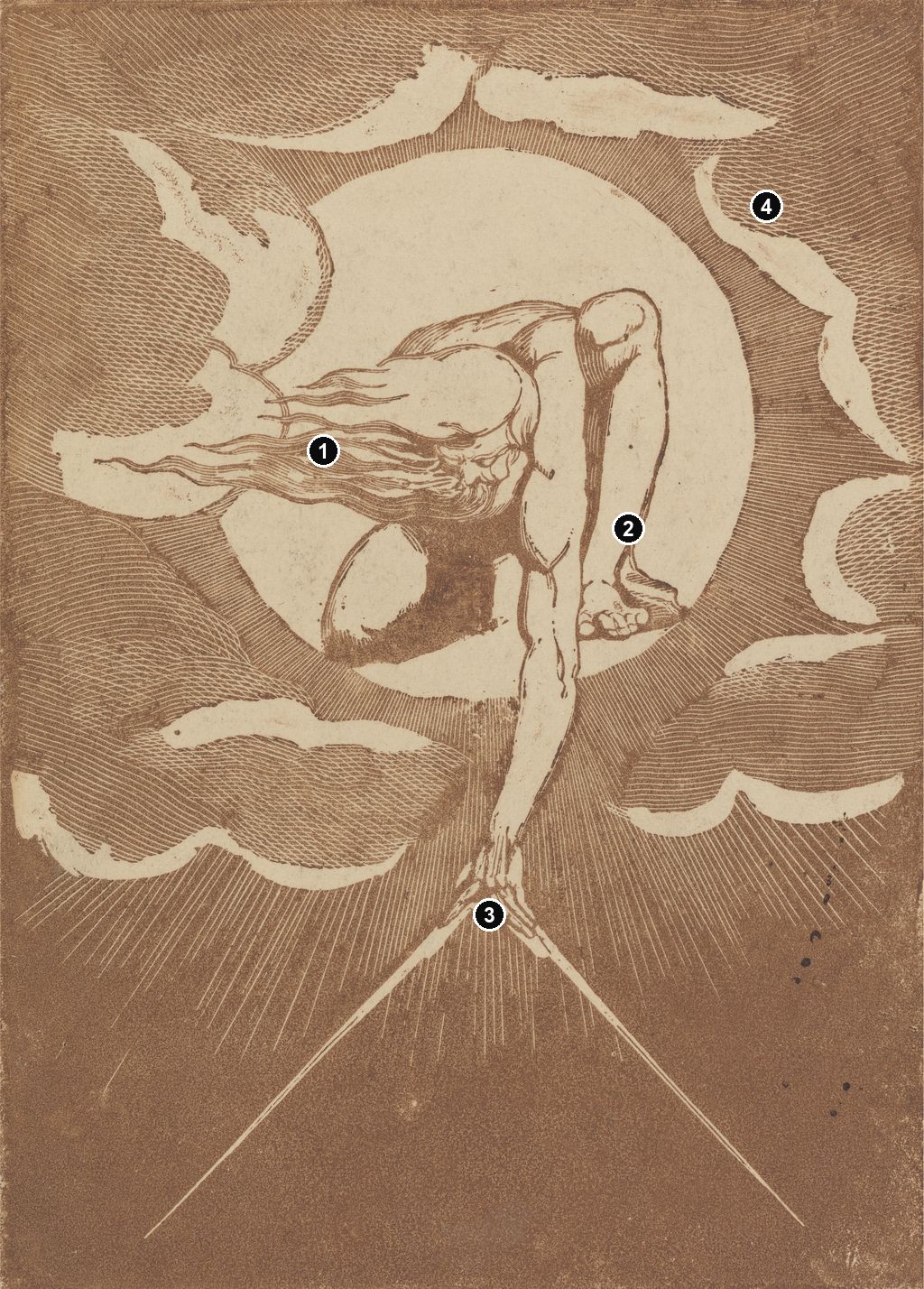
These details show a brown-ink proof of the Europe frontispiece, dated about 1820 by the Yale Center for British Art, B1992.8.1(106). Compare its printed lines with the coloured versions discussed above. The numbers mark visible features of this particular impression.
Details from THE ANCIENT OF DAYS: YALE PROOF
Follow the moving hair, folded body and straight compass legs, then look at the fine white lines surrounding them. Each detail comes directly from the same high-resolution Yale master.
Hair moving across the circle
The hair streams sideways while the face turns down. Its long curves carry the eye across the circular opening, before the descending arm changes the direction of the movement.
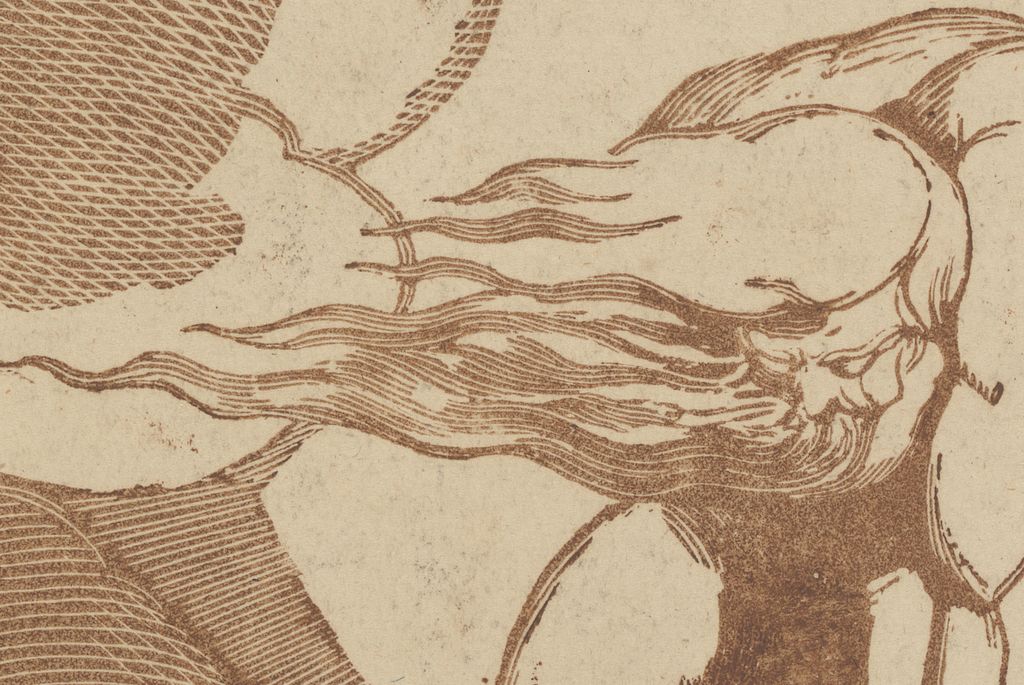
The folded body
The raised knee and visible toes compress the body into the circular space. The stretched arm escapes that compact pose, joining the curved enclosure above to the straight lines below.
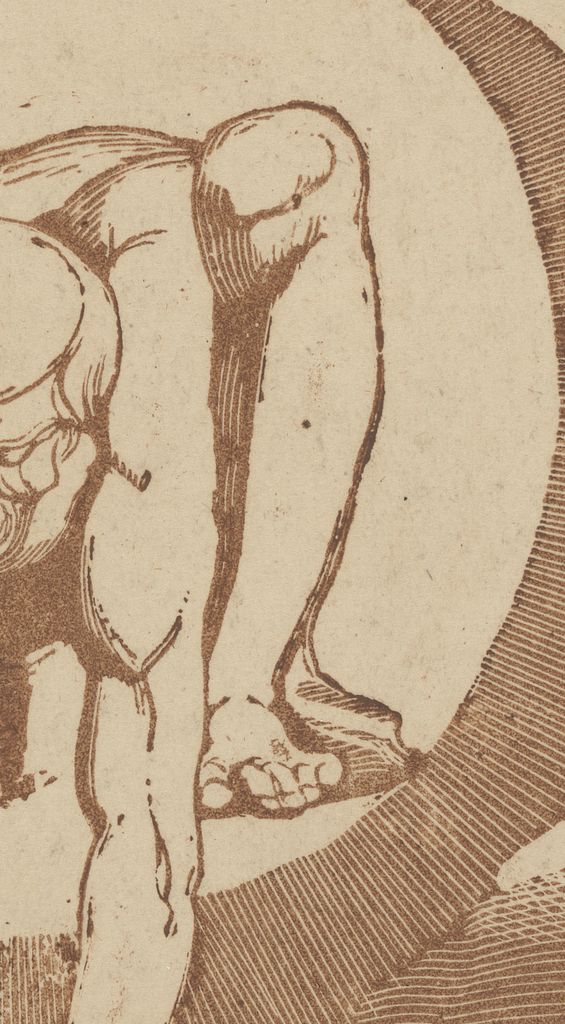
Fingers and compass legs
The fingers meet the two diverging compass legs. Their straight edges make an abrupt change from the flowing hair and rounded limbs, giving the act of measurement its sharp visual emphasis.
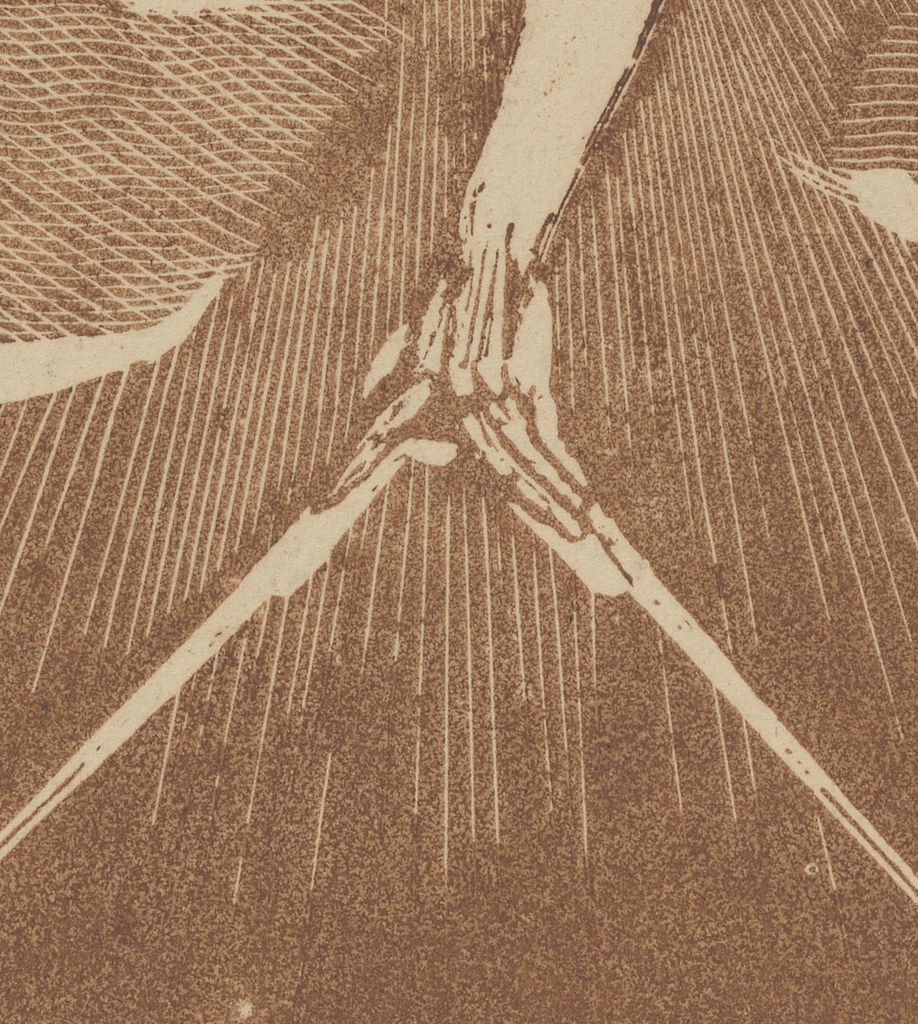
White lines in brown ink
Fine white lines run through the printed brown field. In this uncoloured proof, their changing directions are easy to follow around the pale clouds and the circular opening.
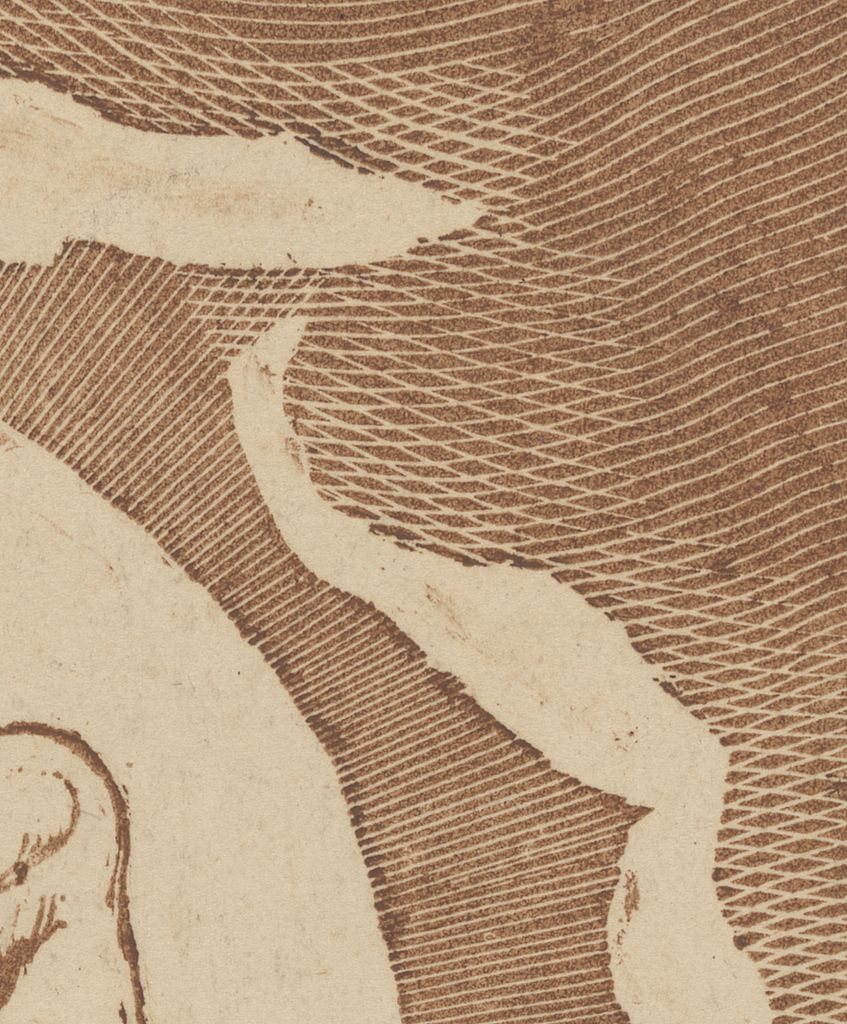
Image: Yale Center for British Art, B1992.8.1(106). Numbered overview and detail crops from the collection’s original image. Collection record · CC0 1.0
Why the comparison with Newton matters
Blake’s Newton provides the clearest companion to the frontispiece’s act of measurement. The scientist crouches over a diagram with compasses in hand. His body is youthful and powerfully built, yet his attention turns inward towards a narrow field of calculation. Tate’s catalogue connects the two designs through the instrument, an earlier compass-bearing figure in There is No Natural Religion, and the broader question of reason’s relation to the infinite. The subjects differ, but the bodily absorption is immediately recognisable. [5]
In The Ancient of Days, the figure reaches out from a radiant enclosure into a surrounding depth. In Newton, the body bends down over a diagram immediately before it. One gesture appears cosmic and legislative; the other appears intensely local and analytical. Both create a visual problem of attention. A magnificent body concentrates upon a measured field, leaving the viewer to consider what its concentration includes and what it excludes. The resemblance makes the compasses more than an identifying attribute attached to two unrelated characters. [3][5]
Tate’s account also reports proposed sources that connect the image with the public celebration of scientific authority. These include a suggested relationship with the frontispiece to Andrew Motte’s 1729 English edition of Newton’s Principia, as well as a possible connection with Blake’s own commercial engraving after Thomas Stothard for Bonnycastle’s Introduction to Mensuration and Practical Geometry. They are useful proposals, not a documented sequence in which each source has been proved to generate the finished design. They place the tool within a visual culture Blake could question from a position of professional familiarity. [5]
The poetry makes that questioning explicit. In The Song of Los, Urizen gives the philosophy of the five senses to Newton and Locke after a sequence describing human contraction and the spread of abstract systems. The poem treats a mode of knowing as part of a larger history of restriction. Its argument concerns the authority granted to limited perception, rather than the detailed accuracy of any particular scientific calculation. Reading it alongside the frontispiece gives the downward reach a philosophical pressure that is absent from the tool considered by itself. [25]
The famous reference to “Single vision & Newtons sleep” comes from a letter to Thomas Butts dated 22 November 1802. Blake encloses verses about a walk, inward and outward seeing, spiritual encounters, artistic work and the competing claims of those close to him. He explains that they were composed more than a year earlier. The movement towards fourfold vision emerges from that richly inhabited experience. Newton’s name marks the danger of seeing through one restricted mode; the surrounding poem offers an abundance of perceptions and relationships that refuse such restriction. [26]
It would still be too easy to turn these passages into a universal opposition between Blake and knowledge. His objections are made through poetry, professional craft and close discrimination between kinds of vision. The letter’s multiple seeing and Europe’s trumpet-blowing Newton complicate a slogan about the triumph of imagination over a mindless scientist. In the frontispiece, the figure’s formidable powers are part of what makes their use disturbing. The question concerns a faculty claiming the whole world for its own measure. [2][23][26]

Newton. The separate large colour-print design compared with The Ancient of Days.
The impression Blake worked on near the end
The design’s late history gives its apparent severity an unexpectedly intimate setting. John Thomas Smith, in the second volume of Nollekens and His Times, describes Frederick Tatham commissioning a coloured impression. Smith says he has the sheet before him as he writes and reports that Blake worked on it propped up in bed only a few days before his death. The account locates an immense act of cosmic labour within the ordinary circumstances of a commission, a payment and a sick artist continuing to work. [27]
Smith distinguishes what he has seen from what Tatham has told him. The famous declaration after Blake’s repeated touches and inspections of the sheet comes through Tatham: “There, that will do! I cannot mend it.” Smith then explains that another work followed, a likeness of Catherine. The anecdote supports the claim that colouring The Ancient of Days occupied Blake very late in his life; it does not make this unambiguously his final artistic act. [28]
Alexander Gilchrist retells the episode in his 1863 biography, explicitly identifying Tatham’s recollection as reported by Smith. His account gives the commission a place within a larger portrait of Blake’s final illness and enduring devotion to art. It is moving testimony, but it remains a transmitted story. The late Whitworth impression is traditionally associated with this episode, and the collection presents that association as a belief about the last version Blake worked upon. The story should retain those qualifications. [4][28]
Smith also records Blake’s reported vision of the figure above a staircase and his particular pleasure in colouring the design. These claims belong to the history of how the artist spoke about his experience and how others remembered him. They cannot independently demonstrate a supernatural event, nor do they tell us that he approved of every quality embodied by Urizen. Enjoying the making of a formidable image and endorsing the authority it represents are separate possibilities. [27]
The return to an early design after more than thirty years is significant enough without making it a perfect final symbol. Blake could revisit its lines, alter its colour and judge the finished impression with a craftsman’s exacting satisfaction. The old man in the circle continued to demand attention because the image remained alive as an artistic problem. Its lasting force comes from that unresolved conjunction: a hand creating form, a body straining within a boundary, and an immeasurable darkness awaiting the touch of two points. [3][28]
Works and designs directory
Browse separate works, impressions and book components. Dates distinguish versions; six Tate copies after Blake are labelled. These records are not a complete catalogue of unique designs.
| Name | Date | Medium |
|---|---|---|
| A Figure Standing in a Gothic Apse, perhaps the Empress Maud. Verso: Detailed Drawings for ‘The Empress Maud in Bed’ | c.1819 | Pencil drawing |
| A Rolling Stone Is Ever Bare of Moss, from Thornton's "Pastorals of Virgil" | 1821 | Wood engraving |
| A Title Page for The Grave | 1806 | Watercolour |
| A Vision of the Last Judgment | 1808 | Watercolour |
| A Vision: The Inspiration of the Poet (Elisha in the Chamber on the Wall) | c.1819–20? | Watercolour |
| Adam and the Beasts, Frontispiece to Hayley's "Ballads" | June 1, 1802 | Engraving |
| Age Teaching Youth | c.1785–90 | Watercolour |
| Alfred and the Neat-Herd’s Wife (after Henry Fuseli) | 1797, published 1798 | Etching and engraving |
| An Allegory of the Bible. Verso: The Shins of an Écorché Male Figure | c.1780–5, ?c.1780 | Watercolour |
| Angel of the Divine Presence Bringing Eve to Adam (The Creation of Eve: "And She Shall be Called Woman) (recto); Sketch for the same (verso) | ca. 1803 | Watercolour |
| Angel of the Revelation (Book of Revelation, chapter 10) | ca. 1803–5 | Watercolour |
| Antaeus setting down Dante and Virgil in the Last Circle of Hell | 1824–1827 | Watercolour |
| Bathsheba at the Bath | c.1799–1800 | Tempera |
| Beatrice Addressing Dante from the Car | 1824–7 | Watercolour |
| Behemoth and Leviathan | 1825–26 | Engraving |
| Behemoth and Leviathan | 1825, reprinted 1874 | Engraving |
| Behemoth and Leviathan | 1826 | Engraving |
| Blasted Trees and Flattened Crops, from Thornton's "Pastorals of Virgil" | 1821 | Wood engraving |
| Boy Returning Joyfully, with Plough and Oxen, from Thornton's "Pastorals of Virgil" | 1821 | Wood engraving |
| Boy Returning Joyfully, with Plough and Oxen, from Thornton's "Pastorals of Virgil" | 1821 | Wood engraving |
| Catherine Blake. Verso: A Man’s Head and Other Drawings | c.1805 | Pencil drawing |
| Cerberus | 1824–7 | Watercolour |
| Cerberus (second version) | 1824–1827 | Watercolour |
| Chaucer’s Canterbury Pilgrims | 1810, reprinted before 1881 | Engraving |
| Christ Appearing to His Disciples After the Resurrection | c.1795 | Colour print |
| Christ Appearing to the Apostles after the Resurrection | c.1795 | Watercolour |
| Christ Blessing the Little Children | 1799 | Tempera |
| Christ in the Carpenter’s Shop: The Humility of the Saviour (after William Blake) | Date not stated | Watercolour |
| Ciampolo the Barrator Tormented by the Devils | 1826–7, reprinted 1892 | Engraving |
| Ciampolo the Barrator Tormented by the Devils | 1826–7, reprinted 1968 | Engraving |
| Circle of Theives: Agnello Brunelleschi Attacked By a Six-Footed Serpent | ca. 1825–27 | Engraving |
| Clarence's Dream (Shakespeare, Richard III, Act 1, Scene 4) | 1774 | Etching and engraving |
| Colinet Mocked by Two Boys, from Thornton's "Pastorals of Virgil" | 1821 | Wood engraving |
| Colinet Rests by a Stream at Night | c.1821, printed 1830 | Wood engraving |
| Colinet Rests by a Stream at Night | 1821, reprinted 1977 | Wood engraving |
| Colinet with his Shepherd’s Pipe, Mocked by Two Boys | c.1821, printed 1830 | Wood engraving |
| Colinet with his Shepherd’s Pipe, Mocked by Two Boys | 1821, reprinted 1977 | Wood engraving |
| Colinet's Journey, Milestone Marked 'LXII Miles to London', from Thornton's "Pastorals of Virgil" | 1821 | Wood engraving |
| Colinet's Journey: Milestone Marked 'LXII Miles to London', from Thornton's "Pastorals of Virgil" | 1821 | Wood engraving |
| Colinet’s Fond Desire Strange Lands to Know | 1821, reprinted 1977 | Wood engraving |
| Colinet’s ‘Fond Desire Strange Lands to Know’ | c.1821, printed 1830 | Wood engraving |
| Composition Sketch for ‘The Fall of the Rebel Angels’? Verso: Standing Figure with Flaming Hair | ?c.1805–10 | Pencil drawing |
| Composition Sketch, Possibly a Subject from Dante. Verso: A Man Standing over a Figure Reclining on a Bed | ?1824–7, ?c.1800–10 | Pencil drawing |
| Composition Sketch. Verso: Standing Figure Holding a Spear | ?c.1805–10 | Pencil drawing |
| Dante and Virgil Approaching the Angel Who Guards the Entrance of Purgatory | 1824–7 | Watercolour |
| Dante and Virgil Penetrating the Forest | 1824–7 | Watercolour |
| Dante in the Empyrean, Drinking at the River of Light | 1824–7 | Watercolour |
| Dante running from the Three Beasts | 1824–1827 | Watercolour |
| Dante Striking against Bocca Degli Abati | 1826–7, reprinted 1892 | Engraving |
| Dante Striking Against Bocca degli Abati | 1826–7, reprinted 1968 | Engraving |
| David Delivered out of Many Waters | c.1805 | Watercolour |
| David Delivered out of Many Waters (after William Blake) | Date not stated | Watercolour |
| Detailed Drawings for ‘A Figure Standing in a Gothic Apse’ | 1819 | Pencil drawing |
| Elohim Creating Adam | 1795–c.1805 | Colour print |
| Enoch | 1806–7 | Lithograph |
| Epitome of James Hervey’s ‘Meditations among the Tombs’ | c.1820–5 | Watercolour |
| Europe. A Prophecy; Frontispiece | ca. 1820 | Relief etching |
| Evening | c.1820/1825 | Watercolour |
| Every Man also Gave him a Piece of Money | 1825, reprinted 1874 | Engraving |
| Every Man also Gave him a Piece of Money. Verso: God the Father with Attendant Angels | c.1821–3 | Watercolour |
| Every One also Gave Him a Piece of Money | 1826 | Engraving |
| Fertilization of Egypt, from Erasmus Darwin's "The Botanic Garden" | 1791 | Engraving |
| First Book of Urizen pl. 10 | 1796, c.1818 | Etching |
| First Book of Urizen pl. 11 | 1796, c.1818 | Etching |
| First Book of Urizen pl. 15 | 1796, c.1818 | Etching |
| First Book of Urizen pl. 17 | 1796, c.1818 | Etching |
| First Book of Urizen pl. 21 | 1796, c.1818 | Etching |
| First Book of Urizen pl. 6 | 1796, c.1818 | Etching |
| Frontispiece to Jerusalem, the Emanation of the Great Albion | [ca. 1804–20] (?) | Engraving |
| Frontispiece to ‘Visions of the Daughters of Albion’ | c.1795 | Relief etching |
| Frontispiece: Thenot and Colinet | c.1821, printed 1830 | Wood engraving |
| George Cumberland's Message Card | 1827 | Engraving |
| God Judging Adam | ca. 1795 | Relief etching |
| God Judging Adam | 1795 | Relief etching |
| Hiding of Moses, from "Remember Me!, or a Pocket Companion" | 1825 | Engraving |
| Homer and the Ancient Poets | 1824–7 | Watercolour |
| Illustration 1 to Milton’s On the Morning of Christ’s Nativity: The Descent of Peace | c.1814–1816 | Watercolour |
| Illustration 1 to Milton’s Paradise Lost: Satan Calling Up His Legions | 1807 | Watercolour |
| Job accepting Charity | 1825–26 | Engraving |
| Job and his Daughters | 1825–26 | Engraving |
| Job and his Daughters | 1825, reprinted 1874 | Engraving |
| Job and His Daughters | 1826 | Engraving |
| Job and His Family | 1825–26 | Engraving |
| Job and his Family | Reprinted 1874; engraved 1828 date is an error | Engraving |
| Job and His Family | 1826 | Engraving |
| Job and his Family Restored to Prosperity | 1825, reprinted 1874 | Engraving |
| Job and his Wife restored to Prosperity | 1825–26 | Engraving |
| Job rebuked by his Friends | 1825–26 | Engraving |
| Job Rebuked by his Friends | 1825, reprinted 1874 | Engraving |
| Job Rebuked by His Friends | 1826 | Engraving |
| Job's Comforters | 1825–26 | Engraving |
| Job's Comforters | 1826 | Engraving |
| Job's Despair | 1825–26 | Engraving |
| Job's Evil Dreams | 1825–26 | Engraving |
| Job's Evil Dreams | 1826 | Engraving |
| Job's Sacrifice | 1825–26 | Engraving |
| Job's Sons and Daughters Overwhelmed by Satan | 1826 | Engraving |
| Job, his Wife and his Friends: The Complaint of Job. Verso: Job’s Wife and Eight Other Sketches | c.1785 | Watercolour |
| Job’s Comforters | 1825, reprinted 1874 | Engraving |
| Job’s Despair | 1825, reprinted 1874 | Engraving |
| Job’s Evil Dreams | 1825, reprinted 1874 | Engraving |
| Job’s Sacrifice | 1825, reprinted 1874 | Engraving |
| Job’s Sons and Daughters Overwhelmed by Satan | 1825, reprinted 1874 | Engraving |
| John Linnell | 1825 | Pencil drawing |
| Joseph of Arimathea Preaching to the Britons | c.1794/1796 | Relief etching |
| Judas Betrays Him | c.1803–5 | Watercolour |
| King John Absolved by Pandulph (after Henry Fuseli) | 1797, published 1798 | Etching and engraving |
| Lamech and his Two Wives | 1795 | Colour print |
| Landscape near Felpham | c.1800 | Watercolour |
| Lear and Cordelia in Prison | c.1779 | Watercolour |
| Los and Orc | c.1792–3 | Watercolour |
| Lower Half of a Woman Playing a Harp. Verso: Seraphim and Other Drawings | c.1785, c.?1807 | Pencil drawing |
| Menalcus Watching Women Dance, from Thornton's "Pastorals of Virgil" | 1821 | Wood engraving |
| Menalcus Watching Women Dance, from Thornton's "Pastorals of Virgil" | 1821 | Wood engraving |
| Moses Indignant at the Golden Calf | c.1799–1800 | Tempera |
| Nebuchadnezzar | 1795–c.1805 | Colour print |
| Newton | 1795–c.1805 | Colour print |
| Oberon, Titania and Puck with Fairies Dancing | c.1786 | Watercolour |
| Pity | ca. 1795 | Relief etching |
| Pity | c.1795 | Colour print |
| Plate 2 of ‘Urizen’: ‘Teach these Souls to Fly’ | ?1796 | Relief etching |
| Plate 3 of ‘Urizen’: Oh! Flames of Furious Desires’ (after William Blake) | Date not stated | Watercolour |
| Plate 4 of ‘Visions of the Daughters of Albion’ | c.1795 | Relief etching |
| Plutus | 1824–7 | Watercolour |
| Preliminary Sketch for ‘Christ Girding Himself with Strength’. Verso: Standing Figure with One Arm Raised | c.1805, c.1805–10 | Pencil drawing |
| Preludium. "The shadowy daughter of Urthona stood before red Orc..." (Plate 3) | 1793 | Relief etching |
| Queen Elizabeth and Essex (after Henry Fuseli) | 1797, published 1798 | Engraving |
| Sabrina's Silvery Flood, from Thornton's "Pastorals of Virgil" | 1821 | Wood engraving |
| Sabrina's Silvery Flood, from Thornton's "Pastorals of Virgil" | 1821 | Wood engraving |
| Sabrina’s Silvery Flood | c.1821, printed 1830 | Wood engraving |
| Sabrina’s Silvery Flood | 1821, reprinted 1977 | Wood engraving |
| Satan Before the Throne of God | 1825–26 | Engraving |
| Satan before the Throne of God | 1825, reprinted 1874 | Engraving |
| Satan before the Throne of God | 1826 | Engraving |
| Satan calling up his Legions | c.1800–05 | Tempera |
| Satan Exulting over Eve | c.1795 | Colour print |
| Satan Going Forth from the Presence of the Lord, and Job’s Charity | 1825, reprinted 1874 | Engraving |
| Satan Going Forth fron the Presence of the Lord | 1825–26 | Engraving |
| Satan in his Original Glory: ‘Thou wast Perfect till Iniquity was Found in Thee’ | c.1805 | Watercolour |
| Satan Smiting Job with Boils | 1825–26 | Engraving |
| Satan Smiting Job with Sore Boils | 1825, reprinted 1874 | Engraving |
| Satan Smiting Job with Sore Boils | c.1826 | Tempera |
| Satan Smiting Job with Sore Boils | 1826 | Engraving |
| Shepherd Chases Away a Wolf, from Thornton's "Pastorals of Virgil" | 1821 | Wood engraving |
| Shepherd Chases Away a Wolf, from Thornton's "Pastorals of Virgil" | 1821 | Wood engraving |
| Sketch for the Title-Page of the Engraved Illustrations to the Book of Job | c.1823/1826 | Pencil drawing |
| Sketch for ‘The Four and Twenty Elders Casting their Crowns before the Divine Throne’. Verso: Standing Figure with Arms at his Side | c.1803, c.1805–10 | Pencil drawing |
| Sketch for ‘Tiriel Supporting the Dying Myratana’. Verso: Sketch for ‘Tiriel Supporting the Dying Myratana’ | c.1786–9 | Pencil drawing |
| Songs of Experience: A Little Boy Lost | [1794] printed ca. 1825 | Relief etching |
| Songs of Experience: A Little Girl Lost | [1794] printed ca. 1825 | Relief etching |
| Songs of Experience: A Poison Tree | [1794] printed ca. 1825 | Relief etching |
| Songs of Experience: Earth's Answer | [1794] printed ca. 1825 | Relief etching |
| Songs of Experience: Frontispiece | [1794] printed ca. 1825 | Relief etching |
| Songs of Experience: Holy Thursday | [1794] printed ca. 1825 | Relief etching |
| Songs of Experience: Infant Sorrow | [1794] printed ca. 1825 | Relief etching |
| Songs of Experience: Introduction | [1794] printed ca. 1825 | Relief etching |
| Songs of Experience: London | [1794] printed ca. 1825 | Relief etching |
| Songs of Experience: My Pretty Rose Tree, Ah! Sun-Flower, The Lilly | [1794] printed ca. 1825 | Relief etching |
| Songs of Experience: Nurses Song | [1794] printed ca. 1825 | Relief etching |
| Songs of Experience: The Angel | [1794] printed ca. 1825 | Relief etching |
| Songs of Experience: The Chimney Sweeper | [1794] printed ca. 1825 | Relief etching |
| Songs of Experience: The Clod & the Pebble | [1794] printed ca. 1825 | Relief etching |
| Songs of Experience: The Fly | [1794] printed ca. 1825 | Relief etching |
| Songs of Experience: The Garden of Love | [1794] printed ca. 1825 | Relief etching |
| Songs of Experience: The Human Abstract | [1794] printed ca. 1825 | Relief etching |
| Songs of Experience: The Little Girl Found (second plate) | [1789] printed ca. 1825 | Relief etching |
| Songs of Experience: The Little Girl Lost | [1789] printed ca. 1825 | Relief etching |
| Songs of Experience: The Little Girl Lost (second plate); The Little Girl Found | [1789] printed ca. 1825 | Relief etching |
| Songs of Experience: The Little Vagabond | [1794] printed ca. 1825 | Relief etching |
| Songs of Experience: The School Boy | [1789] printed ca. 1825 | Relief etching |
| Songs of Experience: The Sick Rose | [1794] printed ca. 1825 | Relief etching |
| Songs of Experience: The Tyger | [1794] printed ca. 1825 | Relief etching |
| Songs of Experience: The Voice of the Ancient Bard | [1789] printed ca. 1825 | Relief etching |
| Songs of Experience: Title-page | [1794] printed ca. 1825 | Relief etching |
| Songs of Experience: To Tirzah | [1794] printed ca. 1825 | Relief etching |
| Songs of Innocence and of Experience, Shewing the Two Contrary States of the Human Soul: Combined Title-page | [1789–94] printed ca. 1825 | Relief etching |
| Songs of Innocence and of Experience: Infant Sorrow | 1794, reprinted 1831 or later | Relief etching |
| Songs of Innocence: A Cradle Song | [1789] printed ca. 1825 | Relief etching |
| Songs of Innocence: A Cradle Song (second plate) | [1789] printed ca. 1825 | Relief etching |
| Songs of Innocence: A Dream | [1794] printed ca. 1825 | Relief etching |
| Songs of Innocence: Frontispiece | [1789] printed ca. 1825 | Relief etching |
| Songs of Innocence: Holy Thursday | [1789] printed ca. 1825 | Relief etching |
| Songs of Innocence: Infant Joy | [1789] printed ca. 1825 | Relief etching |
| Songs of Innocence: Introduction | [1789] printed ca. 1825 | Relief etching |
| Songs of Innocence: Laughing Song | [1789] printed ca. 1825 | Relief etching |
| Songs of Innocence: Little Boy Lost | [1789] printed ca. 1825 | Relief etching |
| Songs of Innocence: Night | [1789] printed ca. 1825 | Relief etching |
| Songs of Innocence: Night (second plate) | [1789] printed ca. 1825 | Relief etching |
| Songs of Innocence: Nurse's Song | [1789] printed ca. 1825 | Relief etching |
| Songs of Innocence: On Anothers Sorrow | [1789] printed ca. 1825 | Relief etching |
| Songs of Innocence: Spring | [1789] printed ca. 1825 | Relief etching |
| Songs of Innocence: Spring (second plate) | [1789] printed ca. 1825 | Relief etching |
| Songs of Innocence: The Blossom | [1789] printed ca. 1825 | Relief etching |
| Songs of Innocence: The Chimney Sweeper | [1789] printed ca. 1825 | Relief etching |
| Songs of Innocence: The Divine Image | [1789] printed ca. 1825 | Relief etching |
| Songs of Innocence: The Ecchoing Green | [1789] printed ca. 1825 | Relief etching |
| Songs of Innocence: The Ecchoing Green (second plate) | [1789] printed ca. 1825 | Relief etching |
| Songs of Innocence: The Lamb | [1789] printed ca. 1825 | Relief etching |
| Songs of Innocence: The Little Black Boy | [1789] printed ca. 1825 | Relief etching |
| Songs of Innocence: The Little Black Boy (second plate) | [1789] printed ca. 1825 | Relief etching |
| Songs of Innocence: The Little Boy Found | [1789] printed ca. 1825 | Relief etching |
| Songs of Innocence: The Shepherd | [1789] printed ca. 1825 | Relief etching |
| Songs of Innocence: Title Page | [1789] printed ca. 1825 | Relief etching |
| St Christopher, Copy from an Engraving? Verso:Part of a Face: Copy from a Plaster Cast: a Daughter of Niobe? | ?c.1779–80 | Pencil drawing |
| The Agony in the Garden | c.1799–1800 | Tempera |
| The Angel Appearing to Zacharias | 1799–1800 | Tempera |
| The Ascent of the Mountain of Purgatory | 1824–7 | Watercolour |
| The Baffled Devils Fighting | 1826–7, reprinted 1892 | Engraving |
| The Baffled Devils Fighting | 1826–7, reprinted 1968 | Engraving |
| The Bard, from Gray | ?1809 | Tempera |
| The Beggar's Opera, Act III | July 1, 1790 | Etching and engraving |
| The Beggar's Opera, Act III | July 1, 1790 | Engraving |
| The Beggar's Opera, Act III | 1790 | Engraving |
| The Blasphemer | c.1800 | Watercolour |
| The Blighted Corn | c.1821, printed 1830 | Wood engraving |
| The Blighted Corn | 1821, reprinted 1977 | Wood engraving |
| The Body of Abel Found by Adam and Eve | c.1826 | Tempera |
| The Body of Christ Borne to the Tomb | c.1799–1800 | Tempera |
| The Book of Job: Title Page | 1825 | Engraving |
| The Book of Thel pl. 6 | 1796, c.1818 | Etching |
| The Circle of Corrupt Officials: The Devils Mauling Each Other | ca. 1825–27 | Engraving |
| The Circle of Corrupt Officials: The Devils Tormenting Ciampolo | ca. 1825–27 | Engraving |
| The Circle of the Lustful: Francesca da Rimini (‘The Whirlwind of Lovers’) | 1826–7, reprinted 1892 | Engraving |
| The Circle of the Lustful: Francesca da Rimini (‘The Whirlwind of Lovers’) | 1826–7, reprinted 1968 | Engraving |
| The Circle of the Lustful: Paolo and Francesca | ca. 1825–27 | Engraving |
| The Circle of the Thieves; Buoso Donati Attacked by the Serpent | ca. 1825–27 | Engraving |
| The Circle of Traitors: Dante's Foot Striking Bocca degli Abbate | ca. 1825–27 | Engraving |
| The Complaint and the Consolation; or, Night Thoughts | 1797 | Etching and engraving |
| The Creation | 1825–26 | Engraving |
| The Crucifixion | c.1825–7 | Pencil drawing |
| The Crucifixion: ‘Behold Thy Mother’ | c.1805 | Watercolour |
| The Dance of Albion (Glad Day) | c.1803/1810 | Engraving |
| The Death of Lucretia, from Allen's "New and Impartial Roman History" | 1797 | Engraving |
| The Death of Saint Joseph | 1803 | Watercolour |
| The Death of the Virgin | 1803 | Watercolour |
| The Descent of Peace [recto] | c.1815 | Pencil drawing |
| The Destruction of Job's Sons | 1825–26 | Engraving |
| The Devils, with Dante and Virgil by the Side of the Pool | 1824–7 | Watercolour |
| The Entombment | c.1805 | Watercolour |
| The Fall of Rosamond (after Thomas Stothard) | 1783 | Etching and engraving |
| The Fall of Satan | 1825–26 | Engraving |
| The Fall of Satan | 1825, reprinted 1874 | Engraving |
| The Fall of Satan | 1826 | Engraving |
| The Four and Twenty Elders Casting their Crowns before the Divine Throne | c.1803–5 | Watercolour |
| The Ghost of a Flea | c.1819–20 | Tempera |
| The Good and Evil Angels | 1795–?c.1805 | Colour print |
| The Good Farmer, Probably the Parable of the Wheat and the Tares. Verso: Rough Sketch of Two or Three Figures in a Landscape | c.1780–5 | Watercolour |
| The Great Red Dragon and the Beast from the Sea | c.1805 | Watercolour |
| The Great Red Dragon and the Woman Clothed with the Sun | c.1805 | Watercolour |
| The Head of the Ghost of a Flea. Verso: A Profile and a Reduced Drawing of Milton’s First Wife | c.1819 | Pencil drawing |
| The Hermit’s Dog, from William Hayley’s "Ballads" | 1805 | Etching and engraving |
| The Hiding of Moses | 1824 | Engraving |
| The House of Death | 1795–c.1805 | Colour print |
| The House of Death | c.1790 | Watercolour |
| The Hypocrites with Caiaphas. Verso: Sketch of a Stooping Figure | 1824–7 | Watercolour |
| The Inscription over the Gate | 1824–7 | Watercolour |
| The Laborious Passage along the Rocks | 1824–7 | Watercolour |
| The Last Trumpet (recto); Two studies of a right eye, a profile of an open-mouthed young man, the head of an eagle, and the head of a lion (verso) | 1780–85 | Pencil drawing |
| The Lord Answering Job out of the Whirlwind | 1825–26 | Engraving |
| The Lord Answering Job out of the Whirlwind | 1825, reprinted 1874 | Engraving |
| The Man Who Taught Blake Painting in his Dreams (counterproof) (after William Blake) | after c.1819–20 | Pencil drawing |
| The Marriage of Heaven and Hell pl. 16 | 1796, c.1818 | Etching |
| The Messengers tell Job of his Misfortunes | 1825–26 | Engraving |
| The Messengers tell Job of his Misfortunes | 1825, reprinted 1874 | Engraving |
| The Night of Enitharmon’s Joy (formerly called ‘Hecate’) | c.1795 | Colour print |
| The Parable of the Wise and Foolish Virgins | ca. 1799–1800 | Watercolour |
| The Parable of the Wise and Foolish Virgins (after William Blake) | Date not stated | Watercolour |
| The Pastorals of Virgil, with a Course of English Reading, Adapted for Schools, Vol. I | 1821 | Wood engraving |
| The Penance of Jane Shore in St Paul’s Church | c.1793 | Watercolour |
| The Pit of Disease: The Falsifiers | 1826–7, reprinted 1892 | Engraving |
| The Pit of Disease: The Falsifiers | 1824–7 | Watercolour |
| The Pit of Disease: The Falsifiers | 1826–7, reprinted 1968 | Engraving |
| The Primaeval Giants Sunk in the Soil | 1824–7 | Watercolour |
| The Punishment of the Thieves | 1824–7 | Watercolour |
| The Raising of Lazarus (after William Blake) | Date not stated | Watercolour |
| The Rest on the Flight into Egypt (The Repose of the Holy Family in Egypt) | 1806 | Watercolour |
| The River of Life | c.1805 | Watercolour |
| The Rock Sculptured with the Recovery of the Ark and the Annunciation | 1824–7 | Watercolour |
| The Serpent Attacking Buoso Donati | 1826–7, reprinted 1892 | Engraving |
| The Serpent Attacking Buoso Donati | 1826–7, reprinted 1968 | Engraving |
| The Serpent Attacking Buoso Donati. Verso: A Man with a Transparent Hood (?) over his Head | 1824–7 | Watercolour |
| The Simoniac Pope | 1824–7 | Watercolour |
| The Six-Footed Serpent Attacking Agnolo Brunelleschi | 1826–7, reprinted 1892 | Engraving |
| The Six-Footed Serpent Attacking Agnolo Brunelleschi | 1826–7, reprinted 1968 | Engraving |
| The Soul Hovering over the Body Reluctantly Parting with Life | c.1805 | Pencil drawing |
| The Spiritual Form of Nelson Guiding Leviathan | c.1805–9 | Tempera |
| The Spiritual Form of Pitt Guiding Behemoth | ?1805 | Tempera |
| The Sun at His Eastern Gate | c.1816–1820 | Watercolour |
| The Temple of Mirth, after Thomas Stothard | 1784 | Engraving |
| The Temptation and Fall of Eve | 1807 | Watercolour |
| The Temptation and Fall of Eve (Illustration to Milton’s Paradise Lost) | 1808 | Watercolour |
| The Thieves and Serpents | 1824–1827 | Watercolour |
| The Vision of Christ | 1825, reprinted 1874 | Engraving |
| The Vision of Eliphaz | 1825–26 | Engraving |
| The Vision of Eliphaz | 1825, reprinted 1874 | Engraving |
| The Vision of God | 1825–26 | Engraving |
| The Wood of the Self-Murderers: The Harpies and the Suicides | 1824–7 | Watercolour |
| The Wrath of Elihu | 1825–26 | Engraving |
| The Wrath of Elihu | 1825, reprinted 1874 | Engraving |
| Thenot and Colinet | 1821, reprinted 1977 | Wood engraving |
| Thenot and Colinet at Supper | c.1821, printed 1830 | Wood engraving |
| Thenot and Colinet at Supper | 1821, reprinted 1977 | Wood engraving |
| Thenot and Colinet Converse Seated between Two Trees | c.1821, printed 1830 | Wood engraving |
| Thenot and Colinet Converse Seated between Two Trees | 1821, reprinted 1977 | Wood engraving |
| Thenot and Colinet Eat Their Evening Meal, from Thornton's "Pastorals of Virgil" | 1821 | Wood engraving |
| Thenot and Colinet Folding their Flocks together at Sunset | c.1821, printed 1830 | Wood engraving |
| Thenot and Colinet Folding their Flocks together at Sunset | 1821, reprinted 1977 | Wood engraving |
| Thenot and Colinet Lead Their Flocks Together, from Thornton's "Pastorals of Virgil" | 1821 | Wood engraving |
| Thenot and Colinet Lead Their Flocks Together, from Thornton's "Pastorals of Virgil" | 1821 | Wood engraving |
| Thenot Remonstrates with Colinet | c.1821, printed 1830 | Wood engraving |
| Thenot Remonstrates with Colinet | 1821, reprinted 1977 | Wood engraving |
| Thenot Remonstrates With Colinet, from Thornton's "Pastorals of Virgil" | 1821 | Wood engraving |
| Thenot Remonstrates With Colinet, from Thornton's "Pastorals of Virgil" | 1821 | Wood engraving |
| Thenot Remonstrates with Colinet, Lightfoot in the Background, from Thornton's "Pastorals of Virgil" | 1821 | Wood engraving |
| Thenot Remonstrates with Colinet: Lightfoot in the Distance | 1821, reprinted 1977 | Wood engraving |
| Thenot Remonstrates with Colinet; Lightfoot in the Distance | c.1821, printed 1830 | Wood engraving |
| Thenot Under a Fruit Tree, from Thornton's "Pastorals of Virgil" | 1821 | Wood engraving |
| Thenot, with Colinet Waving his Arms in Sorrow | c.1821, printed 1830 | Wood engraving |
| Thenot, with Colinet Waving his Arms in Sorrow | 1821, reprinted 1977 | Wood engraving |
| Title Page: Illustrations of the Book of Job | 1825–26 | Engraving |
| Title-Page of ‘The Book of Job’ | 1825, reprinted 1874 | Engraving |
| Tornado–Zeus Battling Typhon, from Erasmus Darwin's "Botanic Garden" | August 1, 1795 | Engraving |
| Tornado–Zeus Battling Typhon, from Erasmus Darwin's "The Botanic Garden" | August 1, 1795 | Engraving |
| Two Figures in a Decorative Border | c.1790 | Pencil drawing |
| Unyok'd Heifers, Loitering Homeward (Return of the Shepherd), from Thornton's "Pastorals of Virgil" | 1821 | Wood engraving |
| Virgil Girding Dante’s Brow with a Rush | 1824–7 | Watercolour |
| Wat Tyler and the Tax-Gatherer (after Henry Fuseli) | 1797, published 1798 | Etching and engraving |
| When the Morning Stars Sang Together | 1825, reprinted 1874 | Engraving |
| When the Morning Stars Sang Together | 1826 | Engraving |
| Winged Figure Flying Through Clouds, from Bell's "Poets" | 1790 | Etching and engraving |
| Winter | c.1820–5 | Tempera |
| ‘A Rolling Stone is ever Bare of Moss’ | c.1821, printed 1830 | Wood engraving |
| ‘A Rolling Stone is ever Bare of Moss’ | 1821, reprinted 1977 | Wood engraving |
| ‘And Unyok’d Heifers, Loitering Homeward, Low’ | c.1821, printed 1830 | Wood engraving |
| ‘And Unyok’d Heifers, Loitering Homewards, Low’ | 1821, reprinted 1977 | Wood engraving |
| ‘Europe’: Fragment of Pages 3 and 4 | 1794–c.1830–5 | Relief etching |
| ‘For him Our Yearly Wakes and Feasts We Hold’ | c.1821, printed 1830 | Wood engraving |
| ‘For him Our Yearly Wakes and Feasts We Hold’ | 1821, reprinted 1977 | Wood engraving |
| ‘Nor Fox, nor Wolf, nor Rat among our Sheep’ | c.1821, printed 1830 | Wood engraving |
| ‘Nor Fox, nor Wolf, nor Rat among our Sheep’ | 1821, reprinted 1977 | Wood engraving |
| ‘Songs of Innocence and of Experience’: ‘Infant Sorrow’ | 1794, reprinted 1831 or later | Relief etching |
| ‘Songs of Innocence and of Experience’: ‘Spring’ | 1794, reprinted 1831 or later | Relief etching |
| ‘Songs of Innocence’: Title-Page | 1789, reprinted 1831 or later | Relief etching |
| ‘Songs of Innocence’: Title-Page | 1789, reprinted 1831 or later | Relief etching |
| ‘With Songs the Jovial Hinds Return from Plow’ | c.1821, printed 1830 | Wood engraving |
| ‘With Songs the Jovial Hinds Return from Plow’ | 1821, reprinted 1977 | Wood engraving |
Frequently Asked Questions
Several collections hold individual impressions. Examples include the British Museum, the Yale Center for British Art and the Whitworth. Their objects should be distinguished by date, copy or accession number and treatment, rather than treated as interchangeable photographs of a single sheet. [1][3][24][4]
Smith reports that Blake coloured an impression shortly before his death, relaying Tatham’s account of its completion. He also states that Blake then drew Catherine. Calling The Ancient of Days his final artwork removes a distinction present in the early testimony. [27]
Discussion
Look again at the images and ideas explored in The Ancient of Days by William Blake. These editorial prompts invite your observations.
Reader Insights
The circle compresses an immense figure into a small space. His reaching arm carries the action beyond that boundary.
Daniel’s Ancient of Days supplies an atmosphere of judgement, kingdoms and the ending of oppressive power.
The blue-green proof and the multicoloured copy are distinct treatments of one design. Neither gives every impression its natural colour scheme.
Join the Conversation
Share a detail, comparison or question about The Ancient of Days by William Blake below.
References
- British Museum. William Blake, Europe: a Prophecy, copy D, plate 1, frontispiece, 1794. Museum no. 1859,0625.72; object description, materials and curator’s comments. View source.
- William Blake. Europe a Prophecy (1794), in David V. Erdman, ed., The Complete Poetry and Prose of William Blake, digital transcription, E60–66; preludium, plates 3–5 and 9–15. View source.
- Yale Center for British Art. William Blake, Europe. A Prophecy; Frontispiece, ca. 1820. B1992.8.1(106); collection record and official digital images, especially recto proof. View source.
- The Whitworth, University of Manchester. William Blake, ‘Europe’ Plate i: Frontispiece, ‘The Ancient of Days’, c.1827. D.1892.32; collection description, medium and dimensions. View source.
- Martin Butlin, Tate. Catalogue entry for William Blake, Newton, N05058, in William Blake 1757–1827, Tate Gallery Collections, vol. V (London: Tate Gallery, 1990), reproduced in Tate’s online collection record; comparative designs, sources and interpretation. View source.
- Society of Antiquaries of London. “William Blake's drawings of Westminster Abbey,” collection highlight, apprenticeship and antiquarian drawings. View source.
- The Morgan Library & Museum. “175. Poetical Sketches,” 1783, copy X, PML 61487, William Blake's World. View source.
- William Blake. Songs of Innocence and of Experience , title pages; “Introduction,” “The Lamb,” both “The Chimney Sweeper” poems, “The Tyger” and “London,” Erdman digital transcription, Arizona State University. View source.
- William Blake. To the Public , prospectus dated 10 October 1793, E692–693. David V. Erdman edition, electronic transcription. View source.
- Tate; Martin Butlin. Newton , 1795/c.1805, N05058, collection record and catalogue entry in William Blake 1757–1827 , Tate Gallery Collections V (London: Tate Gallery, 1990). View source.
- Sir John Soane's Museum. Edward Young, The Complaint, and the Consolation; or, Night Thoughts (London: R. Noble for R. Edwards, 1797), library reference 3653, collection catalogue. View source.
- William Blake. Exhibition advertisements, conditions of sale and A Descriptive Catalogue , 1809, especially preface and nos. I–V, IX and XI–XVI, E527–550. David V. Erdman edition, electronic transcription. View source.
- Tate; Martin Butlin. The Ghost of a Flea , c.1819–20, N05889, collection record and catalogue entry in William Blake 1757–1827 , Tate Gallery Collections V (1990), including discussion of Varley and Cunningham's testimony. View source.
- Tate; Martin Butlin. Job and his Family , A00012, catalogue introduction to Illustrations to the Book of Job: Engravings , in William Blake 1757–1827 , Tate Gallery Collections V (1990), agreement, publication and textual borders. View source.
- Tate; Martin Butlin. Dante and Virgil Penetrating the Forest , 1824–27, N03351, collection record, 2023 display caption and catalogue entry in William Blake 1757–1827 , Tate Gallery Collections V (1990). View source.
- The Holy Bible, King James Version. Daniel 7:9–28, especially 7:9–14. Project Gutenberg transcription. View source.
- The Holy Bible, King James Version. Proverbs 8:22–36, especially 8:27–31. Project Gutenberg transcription. View source.
- John Milton. Paradise Lost, twelve-book text, Book VII, especially lines 192–242 and the golden compasses at 225–231. Project Gutenberg transcription. View source.
- William Blake. The Marriage of Heaven and Hell, in Erdman, ed., Complete Poetry and Prose, digital transcription, E33–45; plates 3–6, 11–14 and 16–17. View source.
- William Blake. The [First] Book of Urizen (1794), in Erdman, ed., Complete Poetry and Prose, digital transcription, E70–83; chapters I–V and VII–VIII, especially II.4–8 and VII.7–8. View source.
- Robert MacLean, Glasgow University Library Special Collections. “William Blake: Europe: a Prophecy,” Book of the Month, November 2007. Frontispiece discussion and attributed accounts of Anthony Blunt and Detlef W. Dörrbecker. View source.
- Robert N. Essick and Joseph Viscomi. “An Inquiry into William Blake’s Method of Color Printing,” Blake/An Illustrated Quarterly 35, no. 3 (Winter 2002): 74–103; opening technical distinctions and account of early illuminated printing. View source.
- William Blake. Letter to George Cumberland, 6 December 1795, in Erdman, ed., Complete Poetry and Prose, E699–700; letter 2. View source.
- British Museum. William Blake, Europe: a Prophecy, copy A, plate 1, frontispiece, 1794. Museum no. 1936,1116.32; object description and curator’s comments on the incomplete proof copy. View source.
- William Blake. The Song of Los (1795), “Africa”, in Erdman, ed., Complete Poetry and Prose, E67–68; the philosophy of the five senses and Newton and Locke. View source.
- William Blake. Letter to Thomas Butts, 22 November 1802, in Erdman, ed., Complete Poetry and Prose, E720–23; letter 23, enclosed verses on multiple vision. View source.
- John Thomas Smith. “Blake,” in Nollekens and His Times, 2nd ed., vol. II (London: Henry Colburn, 1829), especially note 9 on the Europe frontispiece, Tatham’s commission and Blake’s final colouring. Wikisource transcription. View source.
- Alexander Gilchrist. Life of William Blake, “Pictor Ignotus”, vol. I (London: Macmillan, 1863), chapter XXXVII, “Last Days,” pp. 359–62, especially p. 360. Digital transcription, The Blake Society. View source.


