



 by Tom Gurney
Tom Gurney BSc (Hons) is an art history expert with over 20 years experience
Published on June 19, 2020 / Updated on November 3, 2026
Email: tomgurney1@gmail.com / Phone: +44 7429 011000
William Blake Prints: Designs, Sheets and Printing Dates: Introduction
A print by William Blake can be a small page of poetry, a densely engraved biblical scene, a dark pastoral landscape or a broad sheet worked with colour until it resembles a painting. These objects offer different experiences of scale, reading and looking. Their common ground is an image transferred from a prepared surface to paper; what happens before and after that transfer can vary considerably. Blake’s own advertisements recognised this variety, distinguishing historical engravings, illuminated books and large prints in colours. [1][2]
Begin with the kind of object behind the image. Is it one leaf of a book, a separate impression from an engraved plate, or a colour print with extensive hand finishing? A second question follows: which particular object are we seeing? The title identifies a composition, but the collection record can identify a sheet, a printing, a state or a book copy. Learning to read those distinctions makes Blake’s prints more rewarding to compare.
At a Glance
- DesignA composition that can recur [3]
- MatrixThe surface used for printing [3]
- ImpressionA particular printed result [3]
William Blake in context
Gothic art and antiquarian study
Apprenticeship, 1772–1779 [4]Poetical Sketches
1783 [5]The Marriage of Heaven and Hell
Offered in the 1793 prospectus [7]Night Thoughts
Published selection, 1797 [9]The Ghost of a Flea
c.1819–1820 [11]Job engravings
Agreement 1823; issue 1826 [12]Dante illustrations
1824–1827 [13]Contents
- Four ways into Blake’s prints
- The design and the sheet
- Reading colour in the catalogue
- What a proof can mean
- An edition and a book copy
- Several dates can all be useful
- Printing after Blake
- What close examination can change
- Comparing prints with a question in mind
Four ways into Blake’s prints
The Illustrations of the Book of Job offer a concentrated encounter with line. Blake cut the images with burins, building their forms through strokes recessed in copper. Ink held in those cuts supplied the printed lines. In the printed sheets, dark lines turn around bodies, gather into shadow and give different textures to hair, rock and fabric. The surrounding biblical inscriptions belong to the engraved design as fully as the people at its centre. The Job series is especially useful for seeing how picture, border and words can work across one sheet. [14][15]
The illuminated books give writing another material presence. In most of these works, Blake’s letters and designs were etched in relief: they stood above the metal around them and could receive ink together. A poem’s lettering could grow into the vegetation beside it, while a figure occupied the space below the last stanza. Their designed pages can be read individually, but also belong to sequences. The illuminated books introduce this sustained exchange between a printed page and its neighbours. [16]
Wood engraving offers a third encounter. Their ink comes from the raised surface of a wooden block, while cuts into it can appear as light. The small landscapes made for Thornton’s Pastorals of Virgil are organised through dark masses opened by pale marks. A distant route, a glint on a garment or a slender tree can emerge from a remarkably narrow field. The book appeared in 1821, but surviving impressions also belong to later printings. The Virgil illustrations invite attention to both their concentrated imagery and the long lives of the blocks. [17][18]
The large colour prints, including Newton, change the scale again. Their transferred colour was worked with pen and watercolour to develop particular impressions. A repeatable composition could yield materially different pictures. Joseph Viscomi uses the term monoprint for this combination of a fixed design and an individual, variable result. The word helps describe the productive tension: an image capable of returning, each time through fresh applications of colour and finishing. [3]
These four encounters introduce a varied practice that included further experiments. They also show why a technical name and the broad word print do different jobs. Engraving can describe how a surface was cut; relief etching identifies another way of preparing it; colour print directs attention towards what was transferred. More detailed accounts of the tools and processes belong with Blake’s etchings and engravings. Here, those differences help us recognise the objects they produced. [14][16][3]
The design and the sheet
A design is the composition that can recur. A matrix is the surface from which it is printed: an engraved copperplate or a wooden block, for example. An impression is the particular printed result. These terms let us move between the image we recognise and the material thing preserved by a museum. Two impressions can share a design while differing in ink, paper, colouring and the date at which they were made. [3]
Yale’s brown-ink proof of the Europe frontispiece, better known as The Ancient of Days, gives the distinction a memorable form. The crouching figure reaches down with compasses inside an immense circular opening. Long pale strands cross the surrounding brown field; the exposed paper supplies much of the body’s light. Yale identifies the object as relief and white-line etching, catalogued around 1820, accession B1992.8.1(106). Another colour-printed proof occupies its reverse. [19]
The design is recognisable without the glowing colours familiar from other reproductions. What comes forward here is the distribution of brown and unprinted paper: the dense sky, the light body and the pale radiating marks below. Its appearance encourages a different kind of attention from a richly coloured version. The shared composition supplies a basis for comparison, while this impression’s restricted colour makes particular relationships easier to follow. [19]
The two sides extend the encounter beyond the image normally displayed on a screen. A photograph of the front can make the work seem like a single, self-contained picture. The catalogue’s account of the back restores a piece of its material life. Recto means the front of a leaf and verso its reverse; those simple terms can reveal that two reproduced images are carried by one physical piece of paper. [19]
A state concerns a change to the printable image. If a plate is altered and impressions are taken from its new form, the difference can be described through states. The National Gallery defines the term through stages in the development of an image from which impressions are pulled. In the Job series, Tate records the removal of the word Proof from the copper, with traces still visible on one of its impressions. A small alteration to lettering can matter as much to a state description as a conspicuous change within the scene. [20][15]
By contrast, applying a different wash to an already printed sheet does not itself recut the plate. This gives comparison a useful order. First look for changes in the recurring printed structure, then examine the treatment of the individual impression. A blue passage where another sheet has yellow may transform the picture’s atmosphere while leaving its matrix unchanged. Distinguishing those possibilities allows colour variation and plate revision to remain equally interesting, without confusing their causes. [16]
Reading colour in the catalogue
A coloured print can contain several different kinds of colour. Ink may supply the printed lines. Other pigments can be transferred from the matrix. Watercolour and pen can then develop the impression on paper. A museum’s medium line often compresses this sequence into a few words; reading those words slowly can change how the image is understood. [16][3]
The Met’s Tyger, from Songs of Innocence and of Experience copy Y, provides a clear example. Its record specifies relief etching in orange-brown ink, hand colouring in watercolour and shell gold. The animal’s stripes, the washes beside the poem and the fine outer ornament belong to an object with several material contributions. The catalogue distinguishes its design date, 1794, from a printing around 1825. [21]
Look at the whole page before enlarging the tiger. The poem sits inside a coloured rectangle, with a tree rising along the right. Green loops surround the inner boundary, extending the page’s activity into otherwise open paper. Above them, the red page number occupies another small zone. The image has several nested scales: an animal, a poem and picture together, an outer ornamental frame, then the sheet carrying them. A close crop of the animal preserves only one of those encounters. [21]
The museum gives the sheet’s dimensions as 15.7 by 14.1 centimetres. Keeping that small physical size in mind changes an enlarged view. The loops around the border and the uneven movements of lettering occupy an intimate surface, even when a screen makes them large enough to inspect individually. An enlargement can disclose detail while obscuring the bodily scale at which the page was made to be handled. [21]
Colour printing describes a different operation from applying all the colour afterwards. The Morgan’s plate 3 of The Marriage of Heaven and Hell, copy F, was printed around 1794, although 1790 appears in ink on the page. The museum explains that pigments for the background were applied directly to the shallowly etched plate. That particular record gives the reader grounds for understanding the coloured background as part of printing. Appearance alone would provide a less secure account of how the colour reached the paper. [22]
A useful comparison therefore keeps both sight and description active. Observe whether colour strengthens an edge, fills a field or passes beyond a printed boundary. Then consult the catalogue for the operations actually documented. A photograph can show a striking texture, but identifying the material event responsible may require study beyond what that photograph permits. The pleasure of looking need not depend on resolving every brushmark into a precise stage of manufacture.
What a proof can mean
The word proof needs its own context. It can refer to an impression used while a print is being developed, allowing the maker to inspect the plate’s progress. Yet a finished issue can also carry the word. Tate’s account of Job distinguishes working proofs, including experiments with border designs, from the issued sets marked Proof. Treating every occurrence as evidence of an unfinished image would erase that documented difference. [15]
The series makes a particularly useful test because its principal picture is only part of what Blake was developing. In Job and His Family, the central gathering sits inside a broad structure of words and outlined forms. Musical instruments hang above the people; sheep rest below them. The lettering and small objects around the lower margin ask the eye to move between reading and looking. A working proof of such a design could concern the relationship of picture and border as well as details inside the main scene. [15]
Tate’s historical catalogue records twenty-one subjects and a title plate in the completed undertaking. Its own set is associated, with qualification, with the 1874 printing, long after Blake’s death. It dates the issue to 1826, while most engraved publication lines carry 8 March 1825. The first subject bears the anomalous year 1828, which the catalogue identifies as an error. The objects consequently teach a practical habit: read an inscription as evidence, then ask what the catalogue establishes about it. The date written into the matrix cannot automatically date every later sheet pulled from it. [15]
The Dante prints raise a different question. Blake was still working towards the engraved undertaking late in life. In his letter to John Linnell of 25 April 1827, he reports having taken proofs of six plates and having prepared the fighting devils for copper. Tate identifies the fighting devils engraving as noticeably incomplete and leaves open whether Blake intended more work on the others. Together, the letter and the surviving prints catch the undertaking between stages. A later set of seven printed images consequently preserves a project whose engraved development was interrupted. [23]
For a reader comparing images, proof becomes an invitation to be specific. Is the term describing a trial during work, lettering retained on an issued impression, or a museum’s classification of a particular object? The answer changes what can be inferred about finish. A sheet can be complete as a surviving object while preserving a design that the artist might still have developed. The difference is particularly valuable when moving between Job and Dante.
An edition and a book copy
An edition groups impressions made for a particular publication or printing campaign. It concerns their production and issue, while a state concerns the printable image’s development. Blake’s work does not fit one edition rule that can be applied indiscriminately to every title. Eaves, Essick and Viscomi describe early illuminated-book printing in sessions that produced stock, with sheets subsequently coloured and assembled into copies. Their account includes Catherine Blake in both printing and colouring. The history of an individual volume can therefore involve more than one moment of making and more than William’s work alone. [16]
A copy letter identifies a particular surviving book within the study of that title. Songs copy Y at the Met and Marriage copy F at the Morgan are two different objects in two different copy histories. The letter is a locator, helping the reader keep a book’s contents and material treatment together. An accession number anchors it within a collection. These identifiers make it possible to ask which version of a familiar poem or picture is actually being discussed. [21][22]
The Archive editors’ account of Songs copy E shows why the distinction matters. Prepared for Thomas Butts in 1806, it combined impressions from earlier printing sessions. Blake revisited faintly printed passages with pen and renewed colouring. The copy contained duplicate impressions of Laughing Song and lacked The Clod & the Pebble until a later owner supplied a posthumous impression. Counting impressions, counting different designs and describing the assembled book consequently answer different questions. [24]
That history offers a compact exercise in comparison. Instead of assuming that the book’s assembly date describes all its printing, ask what happened at each stage: which sheets were available, what finishing made them legible, and what a later owner added. The object’s present coherence can be the result of attention across time. A copy is a material arrangement with a history, as well as a bearer of a familiar title. [24]
Sequence is another part of that arrangement. The Archive’s 2016 account records a changed plate order in Marriage copy G, where plates 15 and 14 precede 12–13. Looking for the corresponding design in another copy may therefore require more than turning to the same numerical position. The change also alters which passages a reader encounters next to one another. The Marriage guide follows the book’s argument; comparison between copies shows that its material ordering has a history too. [25]
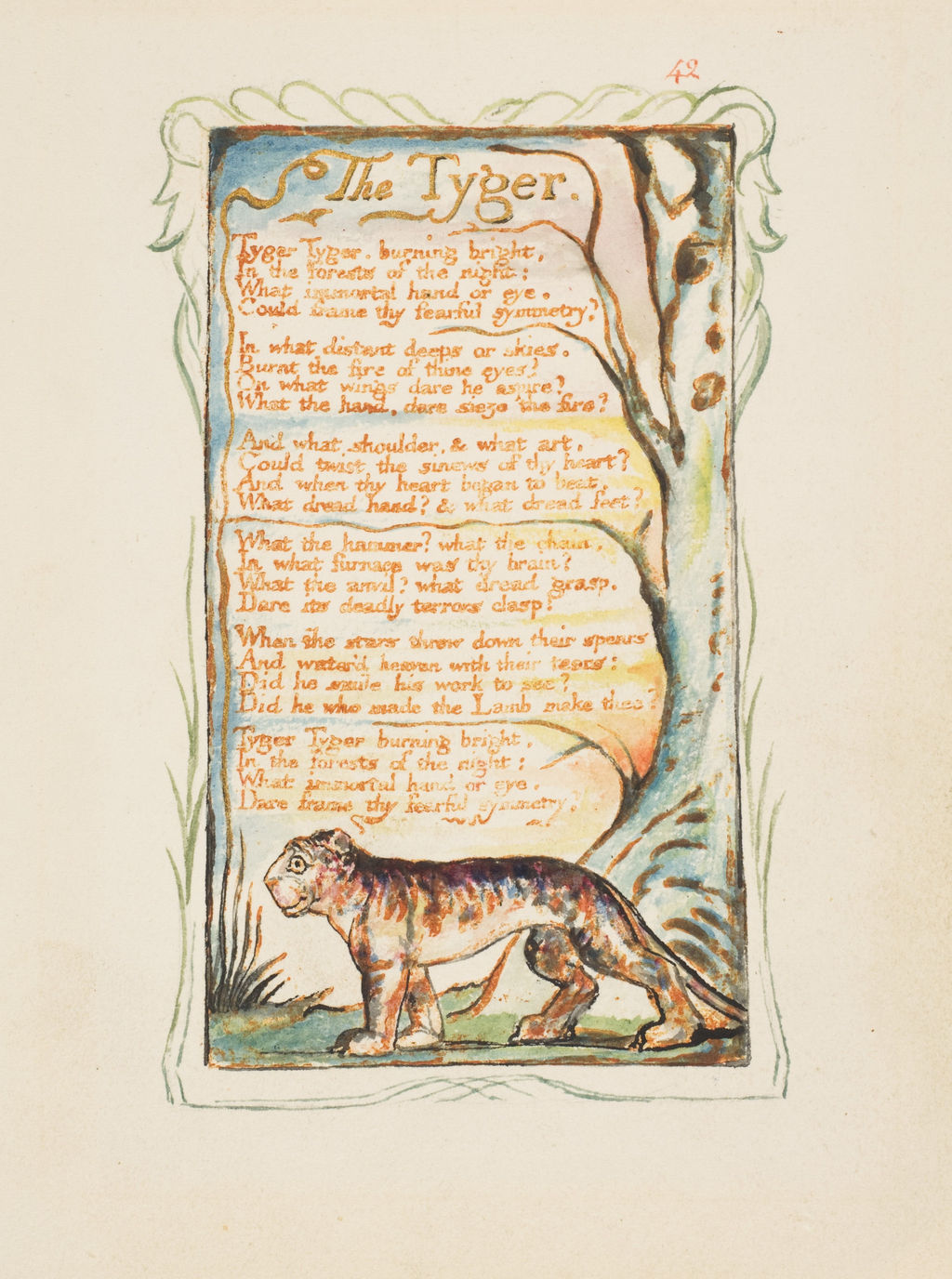
The Tyger, copy Y, plate 42, Metropolitan Museum of Art, 17.10.42. Design 1794, printed c.1825.
Several dates can all be useful
The Tate Newton has an especially instructive date problem. Its inscription includes 1795, but its paper carries an 1804 watermark. The watermark places the manufacture of the paper no earlier than 1804, ruling out an impression on this sheet in 1795. Tate’s catalogue accordingly distinguishes the design’s earlier history from the later impression, placed around 1805. A mark in the paper and a date attached to an image have preserved different events. [26]
The distinction matters visually as well as chronologically. The familiar composition concentrates Newton’s bent body over a geometric drawing, with a great rock occupying the left and a dark field behind. The individual surface also contains transferred colour and hand work. Understanding that a design could be revisited brings decisions taken during later printing and finishing into view. The date of conception does not have to carry the whole burden of explaining what the viewer sees. [26]
Signatures introduce a further stage. Viscomi’s study proposes that Blake often signed non-commissioned works on sale, rather than when first executing them, and reconstructs sequences of large colour prints from differing signature forms. That is a scholarly argument, dependent on comparisons and documents, rather than a universal instruction for dating every sheet. It demonstrates how the making of an image, its finishing and its passage to another person may leave different kinds of evidence. [3]
Blake’s letter to Dawson Turner of 9 June 1818 supplies another kind of date: an offer. It lists illuminated books and twelve large prints in colours, then asks anyone wanting works to send an order. He explains that he has been unable to produce enough for general sale through a regular publisher. The letter documents what he offered and how he hoped to supply it. It does not establish that a particular surviving impression was printed that year. [2]
The 1793 prospectus captures another public presentation. Alongside illuminated books, it advertises a separate historical engraving of Job, distinct from the later suite commissioned by Linnell. Formats and prices vary across the list. The document brings several kinds of printed work together at Blake’s Lambeth address and closes by saying that no subscriptions are sought. Its historical interest lies in that particular offer, rather than in a complete tally of everything he made. [1][15]
The contrast between the two documents makes Blake’s public activity more tangible. In 1793 he presents works available at his own premises; in 1818 he explains the need for direct orders. A print can belong to an artist’s imaginative undertaking, a workshop’s available stock and a continuing effort to reach readers. Those circumstances help explain why the dates of a work’s invention and an individual encounter with it can lie far apart. [1][2]
Printing after Blake
A matrix can remain usable after its maker’s death. Tate’s Circle of the Lustful, T01950, belongs to a set printed in 1968 by Harry Hoehn for Lessing J. Rosenwald from Blake’s original copperplates. The sheet carries a later pencil statement identifying it as a restrike. Its design belongs to Blake’s Dante project, while the impression belongs to a documented twentieth-century printing. Both facts describe the same object. [27]
The Virgil blocks offer a related but more varied history. Some designs were originally cut together, then separated and reduced for their position with captions in Thornton’s book. Later impressions could be taken separately from those blocks. Tate also distinguishes printing from electrotypes, metal duplicates made from the blocks for the 1937 publication. The image’s continuing life could thus involve either the original wooden surface or another surface derived from it. [17]
For its Thenot and Colinet, T02115, Tate specifies the British Museum printing of 1977. The catalogue reports that the printers’ efforts brought out details and tonal gradations not apparent in earlier printings. That observation makes chronology an inadequate substitute for looking. Ask what this impression records of the block under the conditions in which it was printed. A later date can accompany newly legible visual information. [18]
A facsimile introduces a different relationship again. The Morgan holds William Muir’s hand-coloured 1885 facsimile of The Marriage of Heaven and Hell, PML 129457, based on copy A. Its cover carries 1790, while the catalogue identifies the later publication. This is a reproduction of a particular book copy, distinct from a new impression pulled from Blake’s own copper. The distinction concerns the route by which an image has been transmitted and the people responsible for its present form. [28]
Such objects belong to the history of seeing Blake. Later printers, reproductions, collectors and libraries helped carry images into new settings. A careful description allows us to recognise those contributions alongside the artist’s invention. It also makes comparison more exact: the same apparent subject may have reached the page through a surviving original matrix, a duplicate surface or a reproduced book.
What close examination can change
Louise Wilson’s conservation study of the Virgil engravings at the National Gallery of Victoria gives comparison a revealing physical test. The group contains four paper types, indicating different printing sessions. In other collections, some impressions initially appeared to be on Western laid paper, with its characteristic lines. Examining them with light passing through the sheet showed that several were actually on China paper. Their apparent laid lines came from areas of reduced printing. [29]
Wilson proposes that a piece of laid paper placed above the thin printing paper could have affected contact with the block. That explanation remains a reconstruction, but the distinction it addresses is concrete: a pattern visible in an impression may record the printing arrangement rather than the manufacture of its support. Her study also separates evidence from certainty about a printer’s identity. It demonstrates why an ordinary reproduction, useful as it is, cannot answer every material question. [29]
This gives the reader a productive limit. Use an image to identify the passage that needs explaining, then look for the kind of examination that could explain it. A repeated pale line might belong to the design, a printing irregularity or the paper. Recognising those alternatives can make a small detail more interesting before its cause has been settled.
Related viewing: Michael Phillips demonstrates Blake’s printing process for the British Library.
Comparing prints with a question in mind
Begin a comparison by keeping one thing stable. Choose the same design in two identified impressions, or choose two different techniques to investigate a particular visual effect. The first comparison can disclose variation within a repeated image. The second can show how different materials make light, texture or lettering possible. Both are easier to follow when the title, collection and particular copy or accession remain visible beside the images.
Then look at the whole object. Find the edges of the sheet, the pictured area, any plate impression, inscriptions and margins. The Tate record for Job and His Family distinguishes the engraved image, its platemark and the larger paper support. The Met’s Tyger gives sheet dimensions. Those measurements describe different boundaries. Comparing one museum’s image measurement with another’s sheet measurement would produce a misleading idea of relative size. [15][21]
Move inward only after establishing those relationships. In the brown Ancient of Days, follow the broad opening around the body before examining its fine radiating marks. In The Tyger, locate the little animal within the full arrangement of verse, tree and outer ornament. On a Job sheet, read around the picture as well as through its centre. The exercise changes from recognising a famous composition to discovering how this particular object directs attention. [19][21][15]
For a first sustained encounter with repeated line, choose Job. For variation in a familiar poem’s setting, choose Songs of Innocence and of Experience. For the meeting of printed colour and painting, turn to Newton and the other large colour prints. For a tiny image whose landscape seems to exceed its physical size, try the Virgil engravings. Each beginning leads towards a different strength of Blake’s art: exact marks, designed reading, mutable colour or concentrated space. [14][16][3][17]
The identifying details need occupy very little space beside the image. Their value is that they let looking become specific. A title brings us to a design; a record brings us to an object; comparison reveals the decisions and later events through which that object took its present form. The print’s capacity to recur is part of its fascination, and the individual sheet gives that recurring image a particular life.
Works and designs directory
Browse separate works, impressions and book components. Dates distinguish versions; six Tate copies after Blake are labelled. These records are not a complete catalogue of unique designs.
| Name | Date | Medium |
|---|---|---|
| A Figure Standing in a Gothic Apse, perhaps the Empress Maud. Verso: Detailed Drawings for ‘The Empress Maud in Bed’ | c.1819 | Pencil drawing |
| A Rolling Stone Is Ever Bare of Moss, from Thornton's "Pastorals of Virgil" | 1821 | Wood engraving |
| A Title Page for The Grave | 1806 | Watercolour |
| A Vision of the Last Judgment | 1808 | Watercolour |
| A Vision: The Inspiration of the Poet (Elisha in the Chamber on the Wall) | c.1819–20? | Watercolour |
| Adam and the Beasts, Frontispiece to Hayley's "Ballads" | June 1, 1802 | Engraving |
| Age Teaching Youth | c.1785–90 | Watercolour |
| Alfred and the Neat-Herd’s Wife (after Henry Fuseli) | 1797, published 1798 | Etching and engraving |
| An Allegory of the Bible. Verso: The Shins of an Écorché Male Figure | c.1780–5, ?c.1780 | Watercolour |
| Angel of the Divine Presence Bringing Eve to Adam (The Creation of Eve: "And She Shall be Called Woman) (recto); Sketch for the same (verso) | ca. 1803 | Watercolour |
| Angel of the Revelation (Book of Revelation, chapter 10) | ca. 1803–5 | Watercolour |
| Antaeus setting down Dante and Virgil in the Last Circle of Hell | 1824–1827 | Watercolour |
| Bathsheba at the Bath | c.1799–1800 | Tempera |
| Beatrice Addressing Dante from the Car | 1824–7 | Watercolour |
| Behemoth and Leviathan | 1825–26 | Engraving |
| Behemoth and Leviathan | 1825, reprinted 1874 | Engraving |
| Behemoth and Leviathan | 1826 | Engraving |
| Blasted Trees and Flattened Crops, from Thornton's "Pastorals of Virgil" | 1821 | Wood engraving |
| Boy Returning Joyfully, with Plough and Oxen, from Thornton's "Pastorals of Virgil" | 1821 | Wood engraving |
| Boy Returning Joyfully, with Plough and Oxen, from Thornton's "Pastorals of Virgil" | 1821 | Wood engraving |
| Catherine Blake. Verso: A Man’s Head and Other Drawings | c.1805 | Pencil drawing |
| Cerberus | 1824–7 | Watercolour |
| Cerberus (second version) | 1824–1827 | Watercolour |
| Chaucer’s Canterbury Pilgrims | 1810, reprinted before 1881 | Engraving |
| Christ Appearing to His Disciples After the Resurrection | c.1795 | Colour print |
| Christ Appearing to the Apostles after the Resurrection | c.1795 | Watercolour |
| Christ Blessing the Little Children | 1799 | Tempera |
| Christ in the Carpenter’s Shop: The Humility of the Saviour (after William Blake) | Date not stated | Watercolour |
| Ciampolo the Barrator Tormented by the Devils | 1826–7, reprinted 1892 | Engraving |
| Ciampolo the Barrator Tormented by the Devils | 1826–7, reprinted 1968 | Engraving |
| Circle of Theives: Agnello Brunelleschi Attacked By a Six-Footed Serpent | ca. 1825–27 | Engraving |
| Clarence's Dream (Shakespeare, Richard III, Act 1, Scene 4) | 1774 | Etching and engraving |
| Colinet Mocked by Two Boys, from Thornton's "Pastorals of Virgil" | 1821 | Wood engraving |
| Colinet Rests by a Stream at Night | c.1821, printed 1830 | Wood engraving |
| Colinet Rests by a Stream at Night | 1821, reprinted 1977 | Wood engraving |
| Colinet with his Shepherd’s Pipe, Mocked by Two Boys | c.1821, printed 1830 | Wood engraving |
| Colinet with his Shepherd’s Pipe, Mocked by Two Boys | 1821, reprinted 1977 | Wood engraving |
| Colinet's Journey, Milestone Marked 'LXII Miles to London', from Thornton's "Pastorals of Virgil" | 1821 | Wood engraving |
| Colinet's Journey: Milestone Marked 'LXII Miles to London', from Thornton's "Pastorals of Virgil" | 1821 | Wood engraving |
| Colinet’s Fond Desire Strange Lands to Know | 1821, reprinted 1977 | Wood engraving |
| Colinet’s ‘Fond Desire Strange Lands to Know’ | c.1821, printed 1830 | Wood engraving |
| Composition Sketch for ‘The Fall of the Rebel Angels’? Verso: Standing Figure with Flaming Hair | ?c.1805–10 | Pencil drawing |
| Composition Sketch, Possibly a Subject from Dante. Verso: A Man Standing over a Figure Reclining on a Bed | ?1824–7, ?c.1800–10 | Pencil drawing |
| Composition Sketch. Verso: Standing Figure Holding a Spear | ?c.1805–10 | Pencil drawing |
| Dante and Virgil Approaching the Angel Who Guards the Entrance of Purgatory | 1824–7 | Watercolour |
| Dante and Virgil Penetrating the Forest | 1824–7 | Watercolour |
| Dante in the Empyrean, Drinking at the River of Light | 1824–7 | Watercolour |
| Dante running from the Three Beasts | 1824–1827 | Watercolour |
| Dante Striking against Bocca Degli Abati | 1826–7, reprinted 1892 | Engraving |
| Dante Striking Against Bocca degli Abati | 1826–7, reprinted 1968 | Engraving |
| David Delivered out of Many Waters | c.1805 | Watercolour |
| David Delivered out of Many Waters (after William Blake) | Date not stated | Watercolour |
| Detailed Drawings for ‘A Figure Standing in a Gothic Apse’ | 1819 | Pencil drawing |
| Elohim Creating Adam | 1795–c.1805 | Colour print |
| Enoch | 1806–7 | Lithograph |
| Epitome of James Hervey’s ‘Meditations among the Tombs’ | c.1820–5 | Watercolour |
| Europe. A Prophecy; Frontispiece | ca. 1820 | Relief etching |
| Evening | c.1820/1825 | Watercolour |
| Every Man also Gave him a Piece of Money | 1825, reprinted 1874 | Engraving |
| Every Man also Gave him a Piece of Money. Verso: God the Father with Attendant Angels | c.1821–3 | Watercolour |
| Every One also Gave Him a Piece of Money | 1826 | Engraving |
| Fertilization of Egypt, from Erasmus Darwin's "The Botanic Garden" | 1791 | Engraving |
| First Book of Urizen pl. 10 | 1796, c.1818 | Etching |
| First Book of Urizen pl. 11 | 1796, c.1818 | Etching |
| First Book of Urizen pl. 15 | 1796, c.1818 | Etching |
| First Book of Urizen pl. 17 | 1796, c.1818 | Etching |
| First Book of Urizen pl. 21 | 1796, c.1818 | Etching |
| First Book of Urizen pl. 6 | 1796, c.1818 | Etching |
| Frontispiece to Jerusalem, the Emanation of the Great Albion | [ca. 1804–20] (?) | Engraving |
| Frontispiece to ‘Visions of the Daughters of Albion’ | c.1795 | Relief etching |
| Frontispiece: Thenot and Colinet | c.1821, printed 1830 | Wood engraving |
| George Cumberland's Message Card | 1827 | Engraving |
| God Judging Adam | ca. 1795 | Relief etching |
| God Judging Adam | 1795 | Relief etching |
| Hiding of Moses, from "Remember Me!, or a Pocket Companion" | 1825 | Engraving |
| Homer and the Ancient Poets | 1824–7 | Watercolour |
| Illustration 1 to Milton’s On the Morning of Christ’s Nativity: The Descent of Peace | c.1814–1816 | Watercolour |
| Illustration 1 to Milton’s Paradise Lost: Satan Calling Up His Legions | 1807 | Watercolour |
| Job accepting Charity | 1825–26 | Engraving |
| Job and his Daughters | 1825–26 | Engraving |
| Job and his Daughters | 1825, reprinted 1874 | Engraving |
| Job and His Daughters | 1826 | Engraving |
| Job and His Family | 1825–26 | Engraving |
| Job and his Family | Reprinted 1874; engraved 1828 date is an error | Engraving |
| Job and His Family | 1826 | Engraving |
| Job and his Family Restored to Prosperity | 1825, reprinted 1874 | Engraving |
| Job and his Wife restored to Prosperity | 1825–26 | Engraving |
| Job rebuked by his Friends | 1825–26 | Engraving |
| Job Rebuked by his Friends | 1825, reprinted 1874 | Engraving |
| Job Rebuked by His Friends | 1826 | Engraving |
| Job's Comforters | 1825–26 | Engraving |
| Job's Comforters | 1826 | Engraving |
| Job's Despair | 1825–26 | Engraving |
| Job's Evil Dreams | 1825–26 | Engraving |
| Job's Evil Dreams | 1826 | Engraving |
| Job's Sacrifice | 1825–26 | Engraving |
| Job's Sons and Daughters Overwhelmed by Satan | 1826 | Engraving |
| Job, his Wife and his Friends: The Complaint of Job. Verso: Job’s Wife and Eight Other Sketches | c.1785 | Watercolour |
| Job’s Comforters | 1825, reprinted 1874 | Engraving |
| Job’s Despair | 1825, reprinted 1874 | Engraving |
| Job’s Evil Dreams | 1825, reprinted 1874 | Engraving |
| Job’s Sacrifice | 1825, reprinted 1874 | Engraving |
| Job’s Sons and Daughters Overwhelmed by Satan | 1825, reprinted 1874 | Engraving |
| John Linnell | 1825 | Pencil drawing |
| Joseph of Arimathea Preaching to the Britons | c.1794/1796 | Relief etching |
| Judas Betrays Him | c.1803–5 | Watercolour |
| King John Absolved by Pandulph (after Henry Fuseli) | 1797, published 1798 | Etching and engraving |
| Lamech and his Two Wives | 1795 | Colour print |
| Landscape near Felpham | c.1800 | Watercolour |
| Lear and Cordelia in Prison | c.1779 | Watercolour |
| Los and Orc | c.1792–3 | Watercolour |
| Lower Half of a Woman Playing a Harp. Verso: Seraphim and Other Drawings | c.1785, c.?1807 | Pencil drawing |
| Menalcus Watching Women Dance, from Thornton's "Pastorals of Virgil" | 1821 | Wood engraving |
| Menalcus Watching Women Dance, from Thornton's "Pastorals of Virgil" | 1821 | Wood engraving |
| Moses Indignant at the Golden Calf | c.1799–1800 | Tempera |
| Nebuchadnezzar | 1795–c.1805 | Colour print |
| Newton | 1795–c.1805 | Colour print |
| Oberon, Titania and Puck with Fairies Dancing | c.1786 | Watercolour |
| Pity | ca. 1795 | Relief etching |
| Pity | c.1795 | Colour print |
| Plate 2 of ‘Urizen’: ‘Teach these Souls to Fly’ | ?1796 | Relief etching |
| Plate 3 of ‘Urizen’: Oh! Flames of Furious Desires’ (after William Blake) | Date not stated | Watercolour |
| Plate 4 of ‘Visions of the Daughters of Albion’ | c.1795 | Relief etching |
| Plutus | 1824–7 | Watercolour |
| Preliminary Sketch for ‘Christ Girding Himself with Strength’. Verso: Standing Figure with One Arm Raised | c.1805, c.1805–10 | Pencil drawing |
| Preludium. "The shadowy daughter of Urthona stood before red Orc..." (Plate 3) | 1793 | Relief etching |
| Queen Elizabeth and Essex (after Henry Fuseli) | 1797, published 1798 | Engraving |
| Sabrina's Silvery Flood, from Thornton's "Pastorals of Virgil" | 1821 | Wood engraving |
| Sabrina's Silvery Flood, from Thornton's "Pastorals of Virgil" | 1821 | Wood engraving |
| Sabrina’s Silvery Flood | c.1821, printed 1830 | Wood engraving |
| Sabrina’s Silvery Flood | 1821, reprinted 1977 | Wood engraving |
| Satan Before the Throne of God | 1825–26 | Engraving |
| Satan before the Throne of God | 1825, reprinted 1874 | Engraving |
| Satan before the Throne of God | 1826 | Engraving |
| Satan calling up his Legions | c.1800–05 | Tempera |
| Satan Exulting over Eve | c.1795 | Colour print |
| Satan Going Forth from the Presence of the Lord, and Job’s Charity | 1825, reprinted 1874 | Engraving |
| Satan Going Forth fron the Presence of the Lord | 1825–26 | Engraving |
| Satan in his Original Glory: ‘Thou wast Perfect till Iniquity was Found in Thee’ | c.1805 | Watercolour |
| Satan Smiting Job with Boils | 1825–26 | Engraving |
| Satan Smiting Job with Sore Boils | 1825, reprinted 1874 | Engraving |
| Satan Smiting Job with Sore Boils | c.1826 | Tempera |
| Satan Smiting Job with Sore Boils | 1826 | Engraving |
| Shepherd Chases Away a Wolf, from Thornton's "Pastorals of Virgil" | 1821 | Wood engraving |
| Shepherd Chases Away a Wolf, from Thornton's "Pastorals of Virgil" | 1821 | Wood engraving |
| Sketch for the Title-Page of the Engraved Illustrations to the Book of Job | c.1823/1826 | Pencil drawing |
| Sketch for ‘The Four and Twenty Elders Casting their Crowns before the Divine Throne’. Verso: Standing Figure with Arms at his Side | c.1803, c.1805–10 | Pencil drawing |
| Sketch for ‘Tiriel Supporting the Dying Myratana’. Verso: Sketch for ‘Tiriel Supporting the Dying Myratana’ | c.1786–9 | Pencil drawing |
| Songs of Experience: A Little Boy Lost | [1794] printed ca. 1825 | Relief etching |
| Songs of Experience: A Little Girl Lost | [1794] printed ca. 1825 | Relief etching |
| Songs of Experience: A Poison Tree | [1794] printed ca. 1825 | Relief etching |
| Songs of Experience: Earth's Answer | [1794] printed ca. 1825 | Relief etching |
| Songs of Experience: Frontispiece | [1794] printed ca. 1825 | Relief etching |
| Songs of Experience: Holy Thursday | [1794] printed ca. 1825 | Relief etching |
| Songs of Experience: Infant Sorrow | [1794] printed ca. 1825 | Relief etching |
| Songs of Experience: Introduction | [1794] printed ca. 1825 | Relief etching |
| Songs of Experience: London | [1794] printed ca. 1825 | Relief etching |
| Songs of Experience: My Pretty Rose Tree, Ah! Sun-Flower, The Lilly | [1794] printed ca. 1825 | Relief etching |
| Songs of Experience: Nurses Song | [1794] printed ca. 1825 | Relief etching |
| Songs of Experience: The Angel | [1794] printed ca. 1825 | Relief etching |
| Songs of Experience: The Chimney Sweeper | [1794] printed ca. 1825 | Relief etching |
| Songs of Experience: The Clod & the Pebble | [1794] printed ca. 1825 | Relief etching |
| Songs of Experience: The Fly | [1794] printed ca. 1825 | Relief etching |
| Songs of Experience: The Garden of Love | [1794] printed ca. 1825 | Relief etching |
| Songs of Experience: The Human Abstract | [1794] printed ca. 1825 | Relief etching |
| Songs of Experience: The Little Girl Found (second plate) | [1789] printed ca. 1825 | Relief etching |
| Songs of Experience: The Little Girl Lost | [1789] printed ca. 1825 | Relief etching |
| Songs of Experience: The Little Girl Lost (second plate); The Little Girl Found | [1789] printed ca. 1825 | Relief etching |
| Songs of Experience: The Little Vagabond | [1794] printed ca. 1825 | Relief etching |
| Songs of Experience: The School Boy | [1789] printed ca. 1825 | Relief etching |
| Songs of Experience: The Sick Rose | [1794] printed ca. 1825 | Relief etching |
| Songs of Experience: The Tyger | [1794] printed ca. 1825 | Relief etching |
| Songs of Experience: The Voice of the Ancient Bard | [1789] printed ca. 1825 | Relief etching |
| Songs of Experience: Title-page | [1794] printed ca. 1825 | Relief etching |
| Songs of Experience: To Tirzah | [1794] printed ca. 1825 | Relief etching |
| Songs of Innocence and of Experience, Shewing the Two Contrary States of the Human Soul: Combined Title-page | [1789–94] printed ca. 1825 | Relief etching |
| Songs of Innocence and of Experience: Infant Sorrow | 1794, reprinted 1831 or later | Relief etching |
| Songs of Innocence: A Cradle Song | [1789] printed ca. 1825 | Relief etching |
| Songs of Innocence: A Cradle Song (second plate) | [1789] printed ca. 1825 | Relief etching |
| Songs of Innocence: A Dream | [1794] printed ca. 1825 | Relief etching |
| Songs of Innocence: Frontispiece | [1789] printed ca. 1825 | Relief etching |
| Songs of Innocence: Holy Thursday | [1789] printed ca. 1825 | Relief etching |
| Songs of Innocence: Infant Joy | [1789] printed ca. 1825 | Relief etching |
| Songs of Innocence: Introduction | [1789] printed ca. 1825 | Relief etching |
| Songs of Innocence: Laughing Song | [1789] printed ca. 1825 | Relief etching |
| Songs of Innocence: Little Boy Lost | [1789] printed ca. 1825 | Relief etching |
| Songs of Innocence: Night | [1789] printed ca. 1825 | Relief etching |
| Songs of Innocence: Night (second plate) | [1789] printed ca. 1825 | Relief etching |
| Songs of Innocence: Nurse's Song | [1789] printed ca. 1825 | Relief etching |
| Songs of Innocence: On Anothers Sorrow | [1789] printed ca. 1825 | Relief etching |
| Songs of Innocence: Spring | [1789] printed ca. 1825 | Relief etching |
| Songs of Innocence: Spring (second plate) | [1789] printed ca. 1825 | Relief etching |
| Songs of Innocence: The Blossom | [1789] printed ca. 1825 | Relief etching |
| Songs of Innocence: The Chimney Sweeper | [1789] printed ca. 1825 | Relief etching |
| Songs of Innocence: The Divine Image | [1789] printed ca. 1825 | Relief etching |
| Songs of Innocence: The Ecchoing Green | [1789] printed ca. 1825 | Relief etching |
| Songs of Innocence: The Ecchoing Green (second plate) | [1789] printed ca. 1825 | Relief etching |
| Songs of Innocence: The Lamb | [1789] printed ca. 1825 | Relief etching |
| Songs of Innocence: The Little Black Boy | [1789] printed ca. 1825 | Relief etching |
| Songs of Innocence: The Little Black Boy (second plate) | [1789] printed ca. 1825 | Relief etching |
| Songs of Innocence: The Little Boy Found | [1789] printed ca. 1825 | Relief etching |
| Songs of Innocence: The Shepherd | [1789] printed ca. 1825 | Relief etching |
| Songs of Innocence: Title Page | [1789] printed ca. 1825 | Relief etching |
| St Christopher, Copy from an Engraving? Verso:Part of a Face: Copy from a Plaster Cast: a Daughter of Niobe? | ?c.1779–80 | Pencil drawing |
| The Agony in the Garden | c.1799–1800 | Tempera |
| The Angel Appearing to Zacharias | 1799–1800 | Tempera |
| The Ascent of the Mountain of Purgatory | 1824–7 | Watercolour |
| The Baffled Devils Fighting | 1826–7, reprinted 1892 | Engraving |
| The Baffled Devils Fighting | 1826–7, reprinted 1968 | Engraving |
| The Bard, from Gray | ?1809 | Tempera |
| The Beggar's Opera, Act III | July 1, 1790 | Etching and engraving |
| The Beggar's Opera, Act III | July 1, 1790 | Engraving |
| The Beggar's Opera, Act III | 1790 | Engraving |
| The Blasphemer | c.1800 | Watercolour |
| The Blighted Corn | c.1821, printed 1830 | Wood engraving |
| The Blighted Corn | 1821, reprinted 1977 | Wood engraving |
| The Body of Abel Found by Adam and Eve | c.1826 | Tempera |
| The Body of Christ Borne to the Tomb | c.1799–1800 | Tempera |
| The Book of Job: Title Page | 1825 | Engraving |
| The Book of Thel pl. 6 | 1796, c.1818 | Etching |
| The Circle of Corrupt Officials: The Devils Mauling Each Other | ca. 1825–27 | Engraving |
| The Circle of Corrupt Officials: The Devils Tormenting Ciampolo | ca. 1825–27 | Engraving |
| The Circle of the Lustful: Francesca da Rimini (‘The Whirlwind of Lovers’) | 1826–7, reprinted 1892 | Engraving |
| The Circle of the Lustful: Francesca da Rimini (‘The Whirlwind of Lovers’) | 1826–7, reprinted 1968 | Engraving |
| The Circle of the Lustful: Paolo and Francesca | ca. 1825–27 | Engraving |
| The Circle of the Thieves; Buoso Donati Attacked by the Serpent | ca. 1825–27 | Engraving |
| The Circle of Traitors: Dante's Foot Striking Bocca degli Abbate | ca. 1825–27 | Engraving |
| The Complaint and the Consolation; or, Night Thoughts | 1797 | Etching and engraving |
| The Creation | 1825–26 | Engraving |
| The Crucifixion | c.1825–7 | Pencil drawing |
| The Crucifixion: ‘Behold Thy Mother’ | c.1805 | Watercolour |
| The Dance of Albion (Glad Day) | c.1803/1810 | Engraving |
| The Death of Lucretia, from Allen's "New and Impartial Roman History" | 1797 | Engraving |
| The Death of Saint Joseph | 1803 | Watercolour |
| The Death of the Virgin | 1803 | Watercolour |
| The Descent of Peace [recto] | c.1815 | Pencil drawing |
| The Destruction of Job's Sons | 1825–26 | Engraving |
| The Devils, with Dante and Virgil by the Side of the Pool | 1824–7 | Watercolour |
| The Entombment | c.1805 | Watercolour |
| The Fall of Rosamond (after Thomas Stothard) | 1783 | Etching and engraving |
| The Fall of Satan | 1825–26 | Engraving |
| The Fall of Satan | 1825, reprinted 1874 | Engraving |
| The Fall of Satan | 1826 | Engraving |
| The Four and Twenty Elders Casting their Crowns before the Divine Throne | c.1803–5 | Watercolour |
| The Ghost of a Flea | c.1819–20 | Tempera |
| The Good and Evil Angels | 1795–?c.1805 | Colour print |
| The Good Farmer, Probably the Parable of the Wheat and the Tares. Verso: Rough Sketch of Two or Three Figures in a Landscape | c.1780–5 | Watercolour |
| The Great Red Dragon and the Beast from the Sea | c.1805 | Watercolour |
| The Great Red Dragon and the Woman Clothed with the Sun | c.1805 | Watercolour |
| The Head of the Ghost of a Flea. Verso: A Profile and a Reduced Drawing of Milton’s First Wife | c.1819 | Pencil drawing |
| The Hermit’s Dog, from William Hayley’s "Ballads" | 1805 | Etching and engraving |
| The Hiding of Moses | 1824 | Engraving |
| The House of Death | 1795–c.1805 | Colour print |
| The House of Death | c.1790 | Watercolour |
| The Hypocrites with Caiaphas. Verso: Sketch of a Stooping Figure | 1824–7 | Watercolour |
| The Inscription over the Gate | 1824–7 | Watercolour |
| The Laborious Passage along the Rocks | 1824–7 | Watercolour |
| The Last Trumpet (recto); Two studies of a right eye, a profile of an open-mouthed young man, the head of an eagle, and the head of a lion (verso) | 1780–85 | Pencil drawing |
| The Lord Answering Job out of the Whirlwind | 1825–26 | Engraving |
| The Lord Answering Job out of the Whirlwind | 1825, reprinted 1874 | Engraving |
| The Man Who Taught Blake Painting in his Dreams (counterproof) (after William Blake) | after c.1819–20 | Pencil drawing |
| The Marriage of Heaven and Hell pl. 16 | 1796, c.1818 | Etching |
| The Messengers tell Job of his Misfortunes | 1825–26 | Engraving |
| The Messengers tell Job of his Misfortunes | 1825, reprinted 1874 | Engraving |
| The Night of Enitharmon’s Joy (formerly called ‘Hecate’) | c.1795 | Colour print |
| The Parable of the Wise and Foolish Virgins | ca. 1799–1800 | Watercolour |
| The Parable of the Wise and Foolish Virgins (after William Blake) | Date not stated | Watercolour |
| The Pastorals of Virgil, with a Course of English Reading, Adapted for Schools, Vol. I | 1821 | Wood engraving |
| The Penance of Jane Shore in St Paul’s Church | c.1793 | Watercolour |
| The Pit of Disease: The Falsifiers | 1826–7, reprinted 1892 | Engraving |
| The Pit of Disease: The Falsifiers | 1824–7 | Watercolour |
| The Pit of Disease: The Falsifiers | 1826–7, reprinted 1968 | Engraving |
| The Primaeval Giants Sunk in the Soil | 1824–7 | Watercolour |
| The Punishment of the Thieves | 1824–7 | Watercolour |
| The Raising of Lazarus (after William Blake) | Date not stated | Watercolour |
| The Rest on the Flight into Egypt (The Repose of the Holy Family in Egypt) | 1806 | Watercolour |
| The River of Life | c.1805 | Watercolour |
| The Rock Sculptured with the Recovery of the Ark and the Annunciation | 1824–7 | Watercolour |
| The Serpent Attacking Buoso Donati | 1826–7, reprinted 1892 | Engraving |
| The Serpent Attacking Buoso Donati | 1826–7, reprinted 1968 | Engraving |
| The Serpent Attacking Buoso Donati. Verso: A Man with a Transparent Hood (?) over his Head | 1824–7 | Watercolour |
| The Simoniac Pope | 1824–7 | Watercolour |
| The Six-Footed Serpent Attacking Agnolo Brunelleschi | 1826–7, reprinted 1892 | Engraving |
| The Six-Footed Serpent Attacking Agnolo Brunelleschi | 1826–7, reprinted 1968 | Engraving |
| The Soul Hovering over the Body Reluctantly Parting with Life | c.1805 | Pencil drawing |
| The Spiritual Form of Nelson Guiding Leviathan | c.1805–9 | Tempera |
| The Spiritual Form of Pitt Guiding Behemoth | ?1805 | Tempera |
| The Sun at His Eastern Gate | c.1816–1820 | Watercolour |
| The Temple of Mirth, after Thomas Stothard | 1784 | Engraving |
| The Temptation and Fall of Eve | 1807 | Watercolour |
| The Temptation and Fall of Eve (Illustration to Milton’s Paradise Lost) | 1808 | Watercolour |
| The Thieves and Serpents | 1824–1827 | Watercolour |
| The Vision of Christ | 1825, reprinted 1874 | Engraving |
| The Vision of Eliphaz | 1825–26 | Engraving |
| The Vision of Eliphaz | 1825, reprinted 1874 | Engraving |
| The Vision of God | 1825–26 | Engraving |
| The Wood of the Self-Murderers: The Harpies and the Suicides | 1824–7 | Watercolour |
| The Wrath of Elihu | 1825–26 | Engraving |
| The Wrath of Elihu | 1825, reprinted 1874 | Engraving |
| Thenot and Colinet | 1821, reprinted 1977 | Wood engraving |
| Thenot and Colinet at Supper | c.1821, printed 1830 | Wood engraving |
| Thenot and Colinet at Supper | 1821, reprinted 1977 | Wood engraving |
| Thenot and Colinet Converse Seated between Two Trees | c.1821, printed 1830 | Wood engraving |
| Thenot and Colinet Converse Seated between Two Trees | 1821, reprinted 1977 | Wood engraving |
| Thenot and Colinet Eat Their Evening Meal, from Thornton's "Pastorals of Virgil" | 1821 | Wood engraving |
| Thenot and Colinet Folding their Flocks together at Sunset | c.1821, printed 1830 | Wood engraving |
| Thenot and Colinet Folding their Flocks together at Sunset | 1821, reprinted 1977 | Wood engraving |
| Thenot and Colinet Lead Their Flocks Together, from Thornton's "Pastorals of Virgil" | 1821 | Wood engraving |
| Thenot and Colinet Lead Their Flocks Together, from Thornton's "Pastorals of Virgil" | 1821 | Wood engraving |
| Thenot Remonstrates with Colinet | c.1821, printed 1830 | Wood engraving |
| Thenot Remonstrates with Colinet | 1821, reprinted 1977 | Wood engraving |
| Thenot Remonstrates With Colinet, from Thornton's "Pastorals of Virgil" | 1821 | Wood engraving |
| Thenot Remonstrates With Colinet, from Thornton's "Pastorals of Virgil" | 1821 | Wood engraving |
| Thenot Remonstrates with Colinet, Lightfoot in the Background, from Thornton's "Pastorals of Virgil" | 1821 | Wood engraving |
| Thenot Remonstrates with Colinet: Lightfoot in the Distance | 1821, reprinted 1977 | Wood engraving |
| Thenot Remonstrates with Colinet; Lightfoot in the Distance | c.1821, printed 1830 | Wood engraving |
| Thenot Under a Fruit Tree, from Thornton's "Pastorals of Virgil" | 1821 | Wood engraving |
| Thenot, with Colinet Waving his Arms in Sorrow | c.1821, printed 1830 | Wood engraving |
| Thenot, with Colinet Waving his Arms in Sorrow | 1821, reprinted 1977 | Wood engraving |
| Title Page: Illustrations of the Book of Job | 1825–26 | Engraving |
| Title-Page of ‘The Book of Job’ | 1825, reprinted 1874 | Engraving |
| Tornado–Zeus Battling Typhon, from Erasmus Darwin's "Botanic Garden" | August 1, 1795 | Engraving |
| Tornado–Zeus Battling Typhon, from Erasmus Darwin's "The Botanic Garden" | August 1, 1795 | Engraving |
| Two Figures in a Decorative Border | c.1790 | Pencil drawing |
| Unyok'd Heifers, Loitering Homeward (Return of the Shepherd), from Thornton's "Pastorals of Virgil" | 1821 | Wood engraving |
| Virgil Girding Dante’s Brow with a Rush | 1824–7 | Watercolour |
| Wat Tyler and the Tax-Gatherer (after Henry Fuseli) | 1797, published 1798 | Etching and engraving |
| When the Morning Stars Sang Together | 1825, reprinted 1874 | Engraving |
| When the Morning Stars Sang Together | 1826 | Engraving |
| Winged Figure Flying Through Clouds, from Bell's "Poets" | 1790 | Etching and engraving |
| Winter | c.1820–5 | Tempera |
| ‘A Rolling Stone is ever Bare of Moss’ | c.1821, printed 1830 | Wood engraving |
| ‘A Rolling Stone is ever Bare of Moss’ | 1821, reprinted 1977 | Wood engraving |
| ‘And Unyok’d Heifers, Loitering Homeward, Low’ | c.1821, printed 1830 | Wood engraving |
| ‘And Unyok’d Heifers, Loitering Homewards, Low’ | 1821, reprinted 1977 | Wood engraving |
| ‘Europe’: Fragment of Pages 3 and 4 | 1794–c.1830–5 | Relief etching |
| ‘For him Our Yearly Wakes and Feasts We Hold’ | c.1821, printed 1830 | Wood engraving |
| ‘For him Our Yearly Wakes and Feasts We Hold’ | 1821, reprinted 1977 | Wood engraving |
| ‘Nor Fox, nor Wolf, nor Rat among our Sheep’ | c.1821, printed 1830 | Wood engraving |
| ‘Nor Fox, nor Wolf, nor Rat among our Sheep’ | 1821, reprinted 1977 | Wood engraving |
| ‘Songs of Innocence and of Experience’: ‘Infant Sorrow’ | 1794, reprinted 1831 or later | Relief etching |
| ‘Songs of Innocence and of Experience’: ‘Spring’ | 1794, reprinted 1831 or later | Relief etching |
| ‘Songs of Innocence’: Title-Page | 1789, reprinted 1831 or later | Relief etching |
| ‘Songs of Innocence’: Title-Page | 1789, reprinted 1831 or later | Relief etching |
| ‘With Songs the Jovial Hinds Return from Plow’ | c.1821, printed 1830 | Wood engraving |
| ‘With Songs the Jovial Hinds Return from Plow’ | 1821, reprinted 1977 | Wood engraving |
Frequently Asked Questions
They describe the composition, printing surface and particular printed result. Two impressions can share one design while differing materially. [3]
No. Tate distinguishes working proofs of Job from the finished issued sets marked Proof. [15]
Discussion
Look again at the images and ideas explored in William Blake Prints: Designs, Sheets and Printing Dates. These editorial prompts invite your observations.
Reader Insights
The same design can recur on different papers, in different inks and at different dates. An impression identifies the particular result.
Proof can name a working stage or an issued set. The word alone does not establish that an image is unfinished.
A twentieth-century print can still come from Blake’s original copper. The design’s date and the sheet’s printing belong to separate histories.
Join the Conversation
Share a detail, comparison or question about William Blake Prints: Designs, Sheets and Printing Dates below.
References
- William Blake. To the Public, prospectus, 10 October 1793, E692–693, in David V. Erdman, ed., The Complete Poetry and Prose of William Blake, revised edition. Read the prospectus. View source.
- William Blake. Letter to Dawson Turner, 9 June 1818, E771, in Erdman, Complete Poetry and Prose. Read the letter. View source.
- Joseph Viscomi. “Signing Large Color Prints: The Significance of Blake’s Signatures”, Huntington Library Quarterly 80.3 (2017), pp.365–402, especially pp.365–370 and 393–398. Read the article. View source.
- Society of Antiquaries of London. “William Blake's drawings of Westminster Abbey,” collection highlight, apprenticeship and antiquarian drawings. View source.
- The Morgan Library & Museum. “175. Poetical Sketches,” 1783, copy X, PML 61487, William Blake's World. View source.
- William Blake. Songs of Innocence and of Experience , title pages; “Introduction,” “The Lamb,” both “The Chimney Sweeper” poems, “The Tyger” and “London,” Erdman digital transcription, Arizona State University. View source.
- William Blake. To the Public , prospectus dated 10 October 1793, E692–693. David V. Erdman edition, electronic transcription. View source.
- Tate; Martin Butlin. Newton , 1795/c.1805, N05058, collection record and catalogue entry in William Blake 1757–1827 , Tate Gallery Collections V (London: Tate Gallery, 1990). View source.
- Sir John Soane's Museum. Edward Young, The Complaint, and the Consolation; or, Night Thoughts (London: R. Noble for R. Edwards, 1797), library reference 3653, collection catalogue. View source.
- William Blake. Exhibition advertisements, conditions of sale and A Descriptive Catalogue , 1809, especially preface and nos. I–V, IX and XI–XVI, E527–550. David V. Erdman edition, electronic transcription. View source.
- Tate; Martin Butlin. The Ghost of a Flea , c.1819–20, N05889, collection record and catalogue entry in William Blake 1757–1827 , Tate Gallery Collections V (1990), including discussion of Varley and Cunningham's testimony. View source.
- Tate; Martin Butlin. Job and his Family , A00012, catalogue introduction to Illustrations to the Book of Job: Engravings , in William Blake 1757–1827 , Tate Gallery Collections V (1990), agreement, publication and textual borders. View source.
- Tate; Martin Butlin. Dante and Virgil Penetrating the Forest , 1824–27, N03351, collection record, 2023 display caption and catalogue entry in William Blake 1757–1827 , Tate Gallery Collections V (1990). View source.
- Joseph Viscomi. “Illuminated Printing”, in Morris Eaves, ed., The Cambridge Companion to William Blake (Cambridge University Press, 2003), pp.37–62; illustrated digital text, opening discussion of the Job engravings, digital pp.1–2. Read the illustrated text. View source.
- Tate / Martin Butlin. Job and His Family, A00012, shared series history and individual entry in William Blake 1757–1827, Tate Gallery Collections V (1990), reproduced with the current collection record. View the record. View source.
- Morris Eaves, Robert N. Essick and Joseph Viscomi. Introduction to The Early Illuminated Books, William Blake’s Illuminated Books, vol.3 (1993), digital pp.1–2 and opening of p.3: relief etching, printing sessions, Catherine Blake, colouring and assembly. Read the introduction. View source.
- Tate / Martin Butlin. Frontispiece: Thenot and Colinet, A00111, and shared Pastorals of Virgil history in William Blake 1757–1827 (1990). View the record. View source.
- Tate / Martin Butlin. Frontispiece: Thenot and Colinet, T02115, and shared history of the 1977 restrikes in William Blake 1757–1827 (1990). View the record. View source.
- Yale Center for British Art. Europe. A Prophecy; Frontispiece, ca.1820, B1992.8.1(106), Paul Mellon Collection. Object metadata, recto image and verso description in the official digital manifest. View the collection record; digital object metadata. View source 1. View source 2.
- National Gallery, London. “State”, glossary. Read the definition. View source.
- The Metropolitan Museum of Art. Songs of Experience: The Tyger, copy Y, plate 42, 17.10.42; design 1794, printed ca.1825. Medium, sheet dimensions, object history and image. View the record. View source.
- The Morgan Library & Museum. The Marriage of Heaven and Hell, copy F, plate 3, PML 63935, printed ca.1794. William Blake’s World, item 138. Read the object label. View source.
- William Blake; Tate / Martin Butlin. Letter to John Linnell, 25 April 1827, E784, in Erdman, Complete Poetry and Prose; Tate, The Circle of the Lustful, A00005, shared Dante engraving introduction in William Blake 1757–1827 (1990), on the incomplete fighting devils and possible further work. Read the letter; read the collection account. View source 1. View source 2.
- Morris Eaves, Robert N. Essick and Joseph Viscomi, editors. “Publication Announcement: Songs of Innocence and of Experience, Copy E”, William Blake Archive, 1 November 2011. Read the account. View source.
- William Blake Archive editors. “The Marriage of Heaven and Hell Copy A”, 30 August 2016. Copy printing and ordering histories. Read the announcement. View source.
- Tate / Martin Butlin. Newton, N05058, current collection fields and historical catalogue entry in William Blake 1757–1827 (1990). Watermark, inscription, printing and finishing. View the record. View source.
- Tate / Martin Butlin. The Circle of the Lustful: Francesca da Rimini (‘The Whirlwind of Lovers’), T01950, and shared history of the 1968 Dante restrikes in William Blake 1757–1827 (1990). View the record. View source.
- The Morgan Library & Museum. William Muir, The Marriage of Heaven and Hell, 1885, PML 129457. Hand-coloured facsimile of copy A; publication, cover date and copy description. View the book record. View source.
- Louise Wilson. “A technical examination of William Blake’s Virgil wood engravings”, National Gallery of Victoria, 30 June 2025; an earlier version appeared in Blake/An Illustrated Quarterly 56.2 (Fall 2022). Paper supports, reduced printing, comparison under transmitted light and qualified reconstruction of printing arrangements. Read the conservation study. View source.


