



 by Tom Gurney
Tom Gurney BSc (Hons) is an art history expert with over 20 years experience
Published on June 19, 2020 / Updated on November 3, 2026
Email: tomgurney1@gmail.com / Phone: +44 7429 011000
Every One Also Gave Him a Piece of Money by William Blake: Introduction
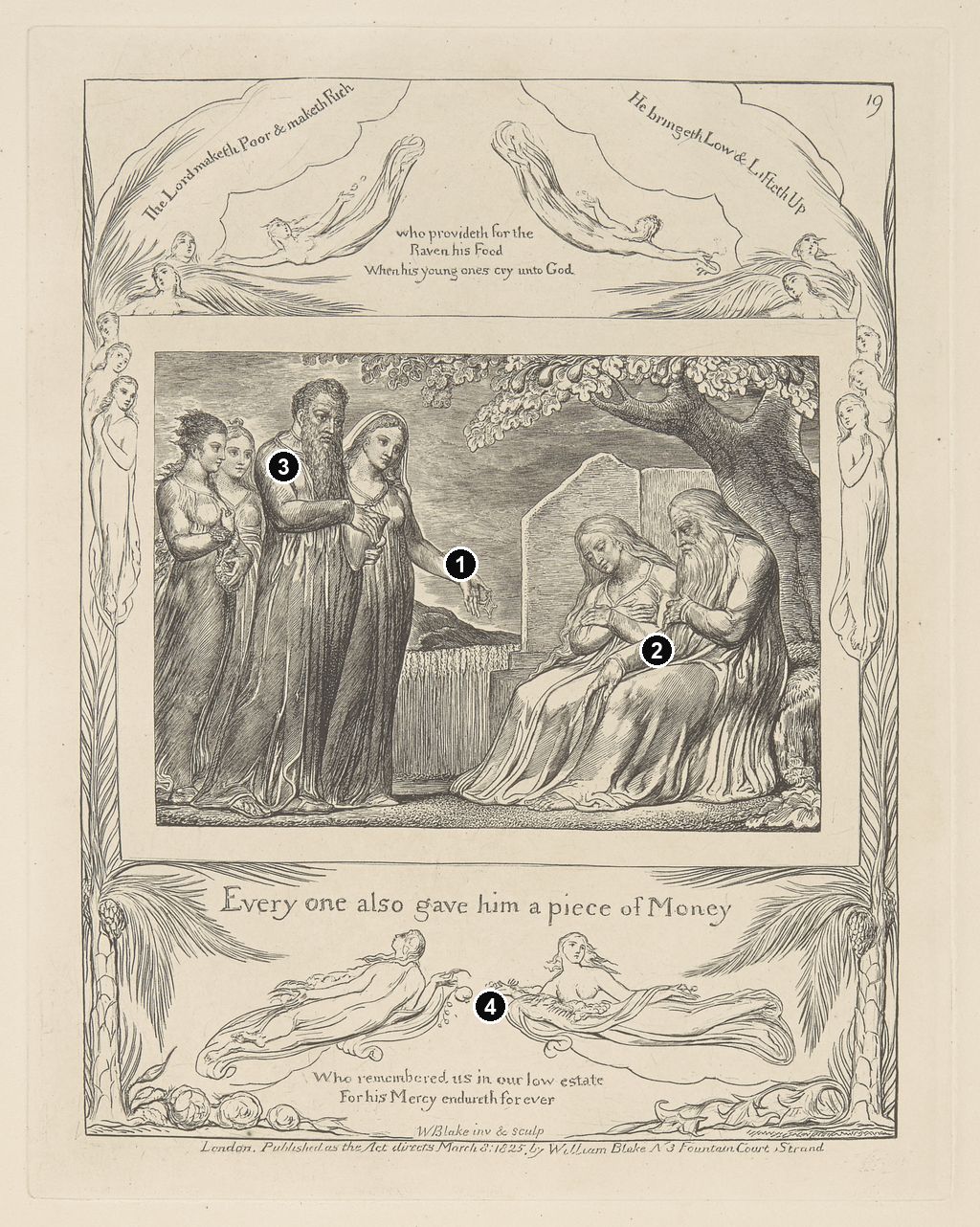
A small ornament hangs from the hand extended towards Job and his wife. The fingers turn downwards, bringing the gift into the open space between the visitors and the seated couple. Nearby, a bearded man reaches towards a cup, and two younger women wait behind him with objects of their own. William Blake’s Every One Also Gave Him a Piece of Money makes renewed companionship visible through things people can hold, carry and offer. The small gifts draw the two groups together. [1] [2]
This is the nineteenth numbered engraving in Blake’s Illustrations of the Book of Job. Its main inscription comes from Job 42:11, where relatives and acquaintances return to the afflicted man, share a meal and bring presents. Around this domestic encounter, Blake places airborne figures, ripening plants and biblical words about poverty, food and mercy. The surrounding imagery extends this moment of human assistance across the sheet. [1] [3]
At a Glance
- Tate impressionA00030, reprinted 1874 [1]
- Biblical encounterJob 42:11 [3]
- Alternative drawingTate T03233, c.1821–3 [4]
This work across William Blake’s career
Gothic art and antiquarian study
Apprenticeship, 1772–1779 [5]Poetical Sketches
1783 [6]The Marriage of Heaven and Hell
Offered in the 1793 prospectus [8]Night Thoughts
Published selection, 1797 [10]The Ghost of a Flea
c.1819–1820 [12]Job engravings
Agreement 1823; issue 1826 [13]Dante illustrations
1824–1827 [14]Every One Also Gave Him a Piece of Money (current article)
Suite issued 1826; later printings vary [1]Contents
- Visitors with their hands occupied
- The couple beneath the tree
- What the returning relatives do
- Poverty, food and mercy in the border
- A harvest behind the encounter
- A different arrangement Blake set aside
- One design and different impressions
- Comfort that remembers the loss
- Annotated details
Visitors with their hands occupied
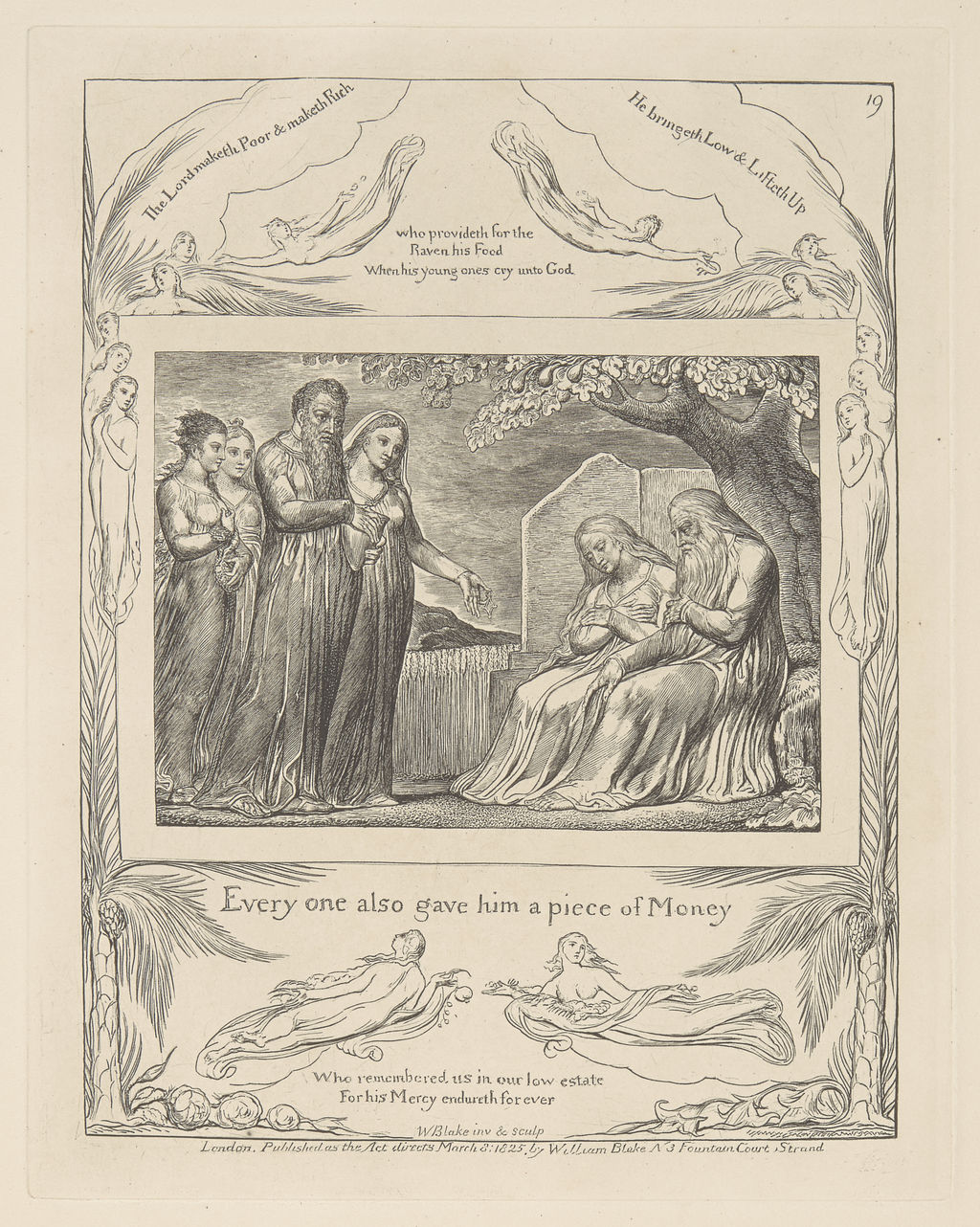
Four visitors stand on the left, facing the couple beneath the tree. Their heads make a compact gathering: the two younger women at the back, the tall bearded man and the woman whose arm extends across the centre. Their long robes descend in close, parallel folds. Together they form an upright mass opposite the lower, sloping shapes of Job and his wife. The arrangement gives the encounter a direction, but there is room between the groups for the offered hand to remain clearly visible. [2]
Look closely at that hand. Its fingers support an angular, open-centred ornament, suspended below the palm. The biblical verse names a gold earring as well as money, making a jewel an appropriate offering here. The engraving does not supply a label for this particular object, however. Its visible shape and the scriptural list can be related without treating the tiny form as a securely identified archaeological specimen. Nothing in it establishes a monetary denomination. [2] [3]
The other gifts invite equally close attention. At the far left, a young woman holds a small rounded form near her chest, with a larger patterned vessel below. Beside the bearded visitor, another vessel has a narrow stem and open bowl. His hand bends over its rim while the woman holds it upright. The overlapping fingers make the exchange tangible: objects must be supported as they pass between people. [2]
The visitors’ faces also resist becoming a single expression. The two younger women look towards the seated pair from behind the older man’s shoulder. His deeply lined face and long beard give weight to his forward attention; the woman beside him inclines her head as she extends her arm. Their quiet grouping creates a sense of waiting. Job and his wife have space to receive what is being brought to them. [2]
The couple beneath the tree
Job sits at the right, with his wife immediately beside him. Her head inclines towards her shoulder and her hands fold across her breast. He holds one hand near his chest while the other extends down across his robe. Neither reaches abruptly to seize an offering. Their lowered heads and gathered hands make acceptance seem inward and deliberate. The visitors’ gifts enter a space shaped by this stillness. [2]
A high, angular backing rises behind the couple. Its hard edges contrast with the tree trunk curving above Job and the drapery spreading towards their feet. Fine engraved strokes distinguish stone, bark and cloth, while long strands of hair descend into the folds. The two seated bodies remain separate, yet their robes flow together across the lower right corner. Blake gives the household a visible intimacy within the larger act of welcome. [2]
Tate’s display caption interprets Job’s ability to accept sympathy and gifts through his acquired humility. That reading helps explain the lowered posture, but the picture also allows the wife a substantial share in the scene. Her place beside Job makes the kindness a visit to a couple who have suffered together. The title singles out the biblical man; the composition gives his wife an equally immediate presence as someone to whom comfort is being offered. [1] [2]
Penelope Minney compares the seated pair receiving presents with the Holy Family receiving the Magi. It is a suggestive visual association: a compact group approaches people seated together, and gifts become the means of honouring them. Minney also observes that Blake places this scene outdoors, among ripening grain and fruit. The comparison enriches the gesture of offering without changing the visitors into the Gospel’s Magi or making the biblical episode an account of Christ’s infancy. [15]
What the returning relatives do
Job 42 gives the visit a precise place within the ending. Job first acknowledges the difference between having heard of God and now seeing him. God then addresses Eliphaz and the other two disputants, condemning their speech and requiring them to seek Job’s prayer. They bring the prescribed offerings, and Job intercedes for them. Verse 10 joins this prayer to the reversal of his fortunes. The visitors bringing gifts belong to the next verse, which names a broader circle of brothers, sisters and former acquaintances. [3]
That distinction matters when we look at Blake’s gathering. These visitors need not be identified as the three men who argued with Job. Their return brings another relationship into view: the sufferer’s place among people who knew him before disaster. In chapter 19, Job had described relatives grown distant, acquaintances estranged and familiar friends who had forgotten him. The late visit answers that experience of abandonment through renewed presence. [3]
The verse gives their actions an important order. They eat bread with Job in his house, mourn with him and comfort him concerning his suffering; then each gives money and a gold earring. Material help accompanies company and acknowledgement. Blake concentrates the scene around portable offerings, while the vessels bring the meal’s world of hospitality close to the act of giving. The biblical visit includes both practical assistance and a willingness to sit with what has happened. [2] [3]
Even the title involves a small change of emphasis. The Authorised Version says that every man gave money, followed by every one giving an earring. Blake uses “Every one” in his main inscription. Tate’s catalogue records that alteration, which suits the women’s conspicuous participation in the engraved gathering. Their hands carry much of its activity, and the extended ornament gives one woman the most outward-reaching gesture. [1] [2] [3]
The money remains deliberately unspecific in the English wording. The Hebrew term, usually transliterated qesitah, is defined in the historical Brown–Driver–Briggs lexicon as a unit of unknown value, possibly a weight. It does not justify translating the gift into a familiar modern coin. For the reader of Blake’s page, its significance lies in the fact that each visitor gives something of value, alongside the more explicitly described gold ornament. [16] [3]
Annotated Details from Every One Also Gave Him a Piece of Money: Hands and Exchange
These details show the Yale Center for British Art’s 1826 impression, B1978.43.1521. Look at the visitors’ hands, the seated couple and the smaller figures around the picture.
Details from EVERY ONE ALSO GAVE HIM A PIECE OF MONEY: HANDS AND EXCHANGE
The details retain this impression’s engraved lines and paper tone.
An open hand between the groups
A visitor extends an open hand towards the seated pair. The gesture crosses the empty interval between the standing figures and the high-backed seat.
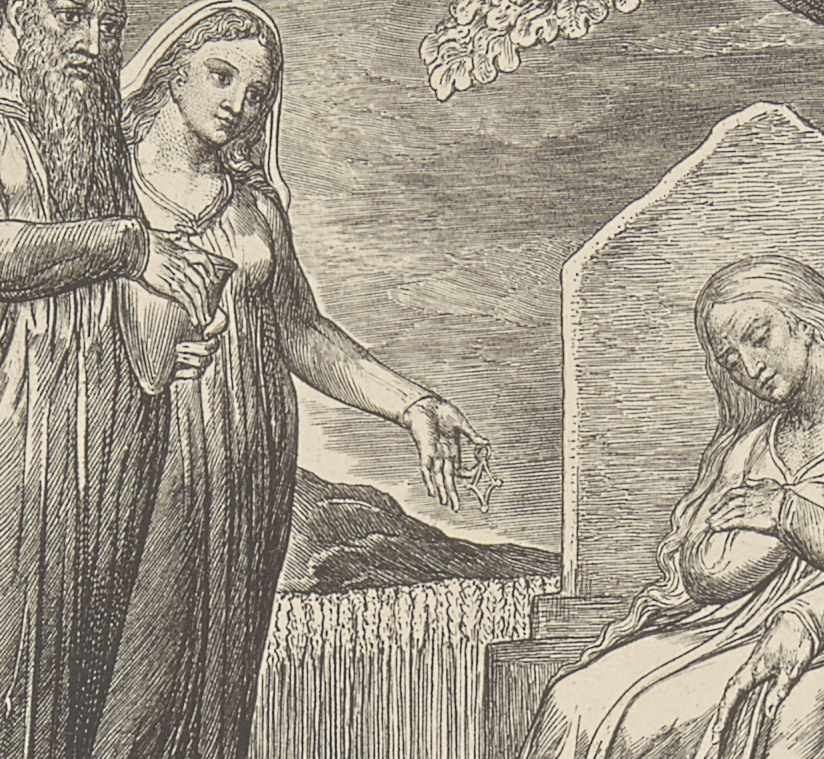
The seated couple beneath the tree
The seated figures incline their heads beneath a spreading tree. Their folded and lowered hands bring attention back towards their bodies.
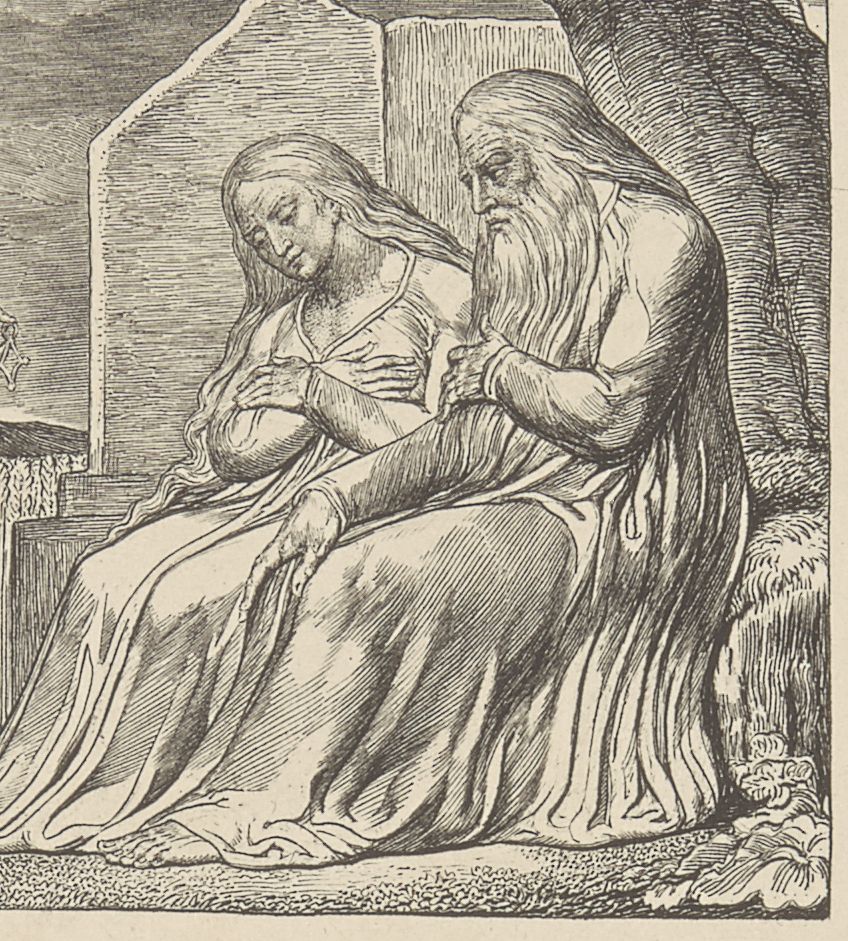
Faces and fine lines
Several faces overlap at the left. Small changes in eyes, mouths and hair distinguish the visitors within the compact group.
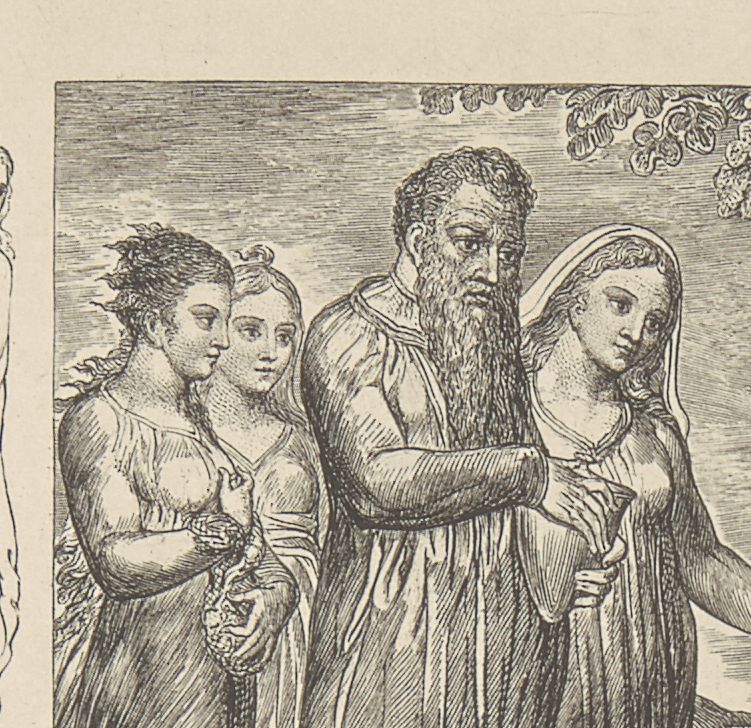
Two floating figures in the border
Two lightly draped figures extend across the lower margin. Their long curves frame the lettering beneath the main scene.
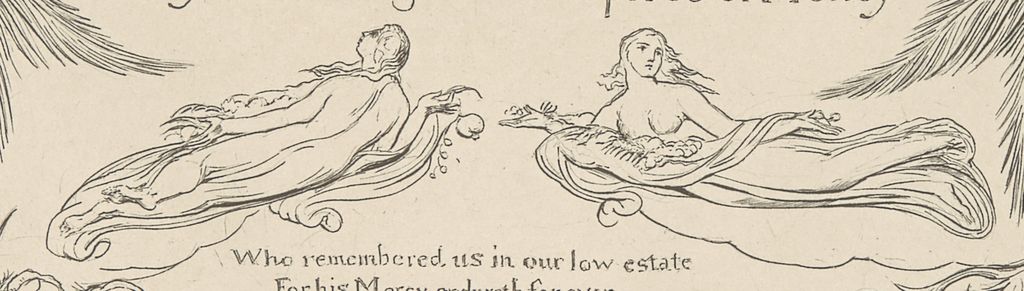
Image: Yale Center for British Art, B1978.43.1521. Numbered overview and detail crops from the collection’s original image. Collection record · CC0 1.0
Poverty, food and mercy in the border
Above the picture, two long figures sweep outwards through the clouds. The words accompanying their movement come from Hannah’s prayer in 1 Samuel 2:7: the Lord makes poor and rich, brings low and raises up. Hannah’s whole prayer celebrates reversals of power, hunger and social standing. In its next verse, the poor are raised from dust and the beggar from the dunghill. Blake places the seated couple’s changed circumstances beneath language concerned with the lifting of those brought low. [1] [2] [3]
The inscription is divided across the two upper curves, so its balancing actions become part of the page’s structure. Poverty and riches occupy one side; lowering and lifting occupy the other. Beneath them, a smaller passage asks who provides food for the raven when its young cry to God. The eye moves from an immense change of fortune towards a creature’s immediate need to eat. [2] [3]
This question comes from the end of Job 38, within God’s answer from the whirlwind. Earlier in the chapter, Job has been asked about the foundations of the earth, the sea, morning, rain, stars and clouds. Near its close, the questioning turns to food for lions and ravens. Brought into this later border, the raven’s hunger connects the great vision of creation with the ordinary dependence expressed in a gift or shared meal. The young birds’ need remains specific even within that vast divine address. [3]
At the bottom, another pair floats towards the middle of the sheet. Their drapery sweeps beneath them in long, curling folds. One carries a rounded object with a trail of small descending forms; the other has gathered produce-like shapes into the cloth across the body. The objects are lightly outlined, and their exact contents need not be fixed for the parallel to become apparent. These airy figures extend the central picture’s language of carrying and offering into the surrounding space. [2]
Below them, Blake quotes Psalm 136:23, remembering people in their low condition through enduring mercy. The psalm repeats its affirmation of mercy after every verse, moving through creation, deliverance, conquest and the giving of food to living creatures. Blake selects the moment of remembered need. Beside the raven passage above, it allows material provision to belong to the page’s religious meaning. Mercy takes a form that can sustain vulnerable life. [1] [3]
Tall ears of grain frame both sides, with small human figures appearing among their rising stems. The border thus has its own inhabitants as well as its own scriptural voices. Its sparse outlines leave much of the paper light, in contrast with the closely worked darkness of the central scene. Minney interprets the descending marginal angels as bringing heaven and earth together. Whatever larger theological weight we give that reading, the formal connection is visible: the page surrounds human gifts with a continuing movement of bodies, plants and offered things. [2] [15]
Watch: William Blake’s world and working methods
Choose an introduction to Blake, a printing demonstration, or a discussion of his radical ideas.
William Blake: Poet, Artist & Visionary - a genius of early Romanticism in England
An introduction to Blake’s art, poetry and imaginative world.
Watch on YouTubeA harvest behind the encounter
The tree’s thick trunk shelters Job’s side of the composition. Branches reach over both groups, carrying broad leaves and hanging fruit. Behind the gap between visitors and recipients, a field of grain rises in a dense vertical band. These forms put abundance close to the offered hand. Food is present as a growing resource, while the small vessels and gifts introduce the ways it can become part of human relationships. [2]
Tate’s catalogue reads the landscape as early morning, with the sun about to rise. It compares this nineteenth design especially with the fourth, in which Job receives news of disaster. The repeated situation of receiving links the two moments, while ripe corn replaces that earlier background’s sheep and Gothic cathedral. The difference reaches beyond a change in wealth: visitors now bring the means of helping instead of news that overwhelms the household. [1]
The harvest does not require us to imagine a quick transaction in which every gift immediately becomes greater riches. It belongs to the scene’s wider environment of renewal. The tree offers shelter, grain stands ready, and people arrive carrying things. Blake distributes abundance across the page so that it includes a place to sit, food growing nearby and other people willing to approach. [2]
A different arrangement Blake set aside
Blake considered an upright alternative to this scene. Tate’s Every Man also Gave him a Piece of Money, T03233, is a separate unfinished work in graphite, ink and watercolour, dated about 1821–3. In its recto composition, Job and his wife occupy the centre, with visitors bringing gifts from either side. Above them, God the Father moves through a broad circle of clouds and attendant angels. The sheet puts the earthly exchange directly beneath a conspicuous heavenly appearance. [4]
The drawing helps us see a choice in the engraving’s arrangement. In the finished horizontal scene, the seated pair move to the right and the visitors gather at the left; the intervening hand becomes the hinge between them. Heavenly figures move through the border; the drawing places God and the angels above the people within one continuous picture. These are different ways of connecting a gift with its spiritual setting. [2] [4]
Tate’s catalogue identifies the drawing as an alternative project, developed through other studies before Blake returned to the oblong arrangement for the engraved plate. It is therefore valuable as evidence of reconsideration. Its delicate marks and unfinished colouring should be studied on their own terms. They belong to a distinct sheet, whose reverse also carries a separate divine study, rather than to another printing of the engraving. [4]
One design and different impressions
The line at the foot of the engraving gives a publication date of 8 March 1825. Tate’s shared catalogue distinguishes that inscribed date from the finished suite’s issue in 1826. The historical catalogue associates Tate’s own impression, A00030, with the later printing of 1874; the current object record reads 1825, reprinted 1874. The engraved publication line, the suite’s actual issue and a particular impression’s later production are separate pieces of evidence. [1]
Yale’s B1978.43.1521, a separately identified impression useful for examining the small gifts and fine lines, is dated 1826 in its official digital image record. The familiar composition and the date engraved below it recur across impressions. Recognising them does not establish the exact physical sheet behind every reproduction. The wider history of the commission and editions belongs to the complete Book of Job series; here the distinct collection examples help us look closely at the same carefully organised encounter. [2] [1]
Every One also Gave Him a Piece of Money. Yale Center for British Art, B1978.43.1521, identified impression dated 1826. The engraved 1825 publication line is a separate date.
Comfort that remembers the loss
The book’s restored possessions have an exact arithmetic: the later numbers of sheep, camels, oxen and asses double the opening numbers. The children do not fit that calculation. Chapter 1 reports the deaths of seven sons and three daughters; chapter 42 describes seven sons and three daughters in Job’s later household. The ending does not say that the dead children return. A reader can recognise renewal while retaining the weight of those deaths. [3]
That weight gives the gifts their particular tenderness. The visitors come to mourn and comfort as well as to give. The seated couple’s lowered heads leave room for a response more complicated than celebration, even as ripe grain, fruit and the border’s moving figures offer a prospect of abundance. We cannot read their inner thoughts from their faces, but we can see that Blake has made receiving a quiet action, sustained by the attention of others. [2] [3]
The scene belongs near the end of the sequence, after accusation, vision and intercession. Its scale is intimate: a vessel steadied between hands, an ornament hanging from fingers, two people sitting together under a tree. Here mercy can be encountered through the small things that returning companions bring, and through their willingness to come close enough to offer them. [1] [2] [3]
Works and designs directory
Browse separate works, impressions and book components. Dates distinguish versions; six Tate copies after Blake are labelled. These records are not a complete catalogue of unique designs.
| Name | Date | Medium |
|---|---|---|
| A Figure Standing in a Gothic Apse, perhaps the Empress Maud. Verso: Detailed Drawings for ‘The Empress Maud in Bed’ | c.1819 | Pencil drawing |
| A Rolling Stone Is Ever Bare of Moss, from Thornton's "Pastorals of Virgil" | 1821 | Wood engraving |
| A Title Page for The Grave | 1806 | Watercolour |
| A Vision of the Last Judgment | 1808 | Watercolour |
| A Vision: The Inspiration of the Poet (Elisha in the Chamber on the Wall) | c.1819–20? | Watercolour |
| Adam and the Beasts, Frontispiece to Hayley's "Ballads" | June 1, 1802 | Engraving |
| Age Teaching Youth | c.1785–90 | Watercolour |
| Alfred and the Neat-Herd’s Wife (after Henry Fuseli) | 1797, published 1798 | Etching and engraving |
| An Allegory of the Bible. Verso: The Shins of an Écorché Male Figure | c.1780–5, ?c.1780 | Watercolour |
| Angel of the Divine Presence Bringing Eve to Adam (The Creation of Eve: "And She Shall be Called Woman) (recto); Sketch for the same (verso) | ca. 1803 | Watercolour |
| Angel of the Revelation (Book of Revelation, chapter 10) | ca. 1803–5 | Watercolour |
| Antaeus setting down Dante and Virgil in the Last Circle of Hell | 1824–1827 | Watercolour |
| Bathsheba at the Bath | c.1799–1800 | Tempera |
| Beatrice Addressing Dante from the Car | 1824–7 | Watercolour |
| Behemoth and Leviathan | 1825–26 | Engraving |
| Behemoth and Leviathan | 1825, reprinted 1874 | Engraving |
| Behemoth and Leviathan | 1826 | Engraving |
| Blasted Trees and Flattened Crops, from Thornton's "Pastorals of Virgil" | 1821 | Wood engraving |
| Boy Returning Joyfully, with Plough and Oxen, from Thornton's "Pastorals of Virgil" | 1821 | Wood engraving |
| Boy Returning Joyfully, with Plough and Oxen, from Thornton's "Pastorals of Virgil" | 1821 | Wood engraving |
| Catherine Blake. Verso: A Man’s Head and Other Drawings | c.1805 | Pencil drawing |
| Cerberus | 1824–7 | Watercolour |
| Cerberus (second version) | 1824–1827 | Watercolour |
| Chaucer’s Canterbury Pilgrims | 1810, reprinted before 1881 | Engraving |
| Christ Appearing to His Disciples After the Resurrection | c.1795 | Colour print |
| Christ Appearing to the Apostles after the Resurrection | c.1795 | Watercolour |
| Christ Blessing the Little Children | 1799 | Tempera |
| Christ in the Carpenter’s Shop: The Humility of the Saviour (after William Blake) | Date not stated | Watercolour |
| Ciampolo the Barrator Tormented by the Devils | 1826–7, reprinted 1892 | Engraving |
| Ciampolo the Barrator Tormented by the Devils | 1826–7, reprinted 1968 | Engraving |
| Circle of Theives: Agnello Brunelleschi Attacked By a Six-Footed Serpent | ca. 1825–27 | Engraving |
| Clarence's Dream (Shakespeare, Richard III, Act 1, Scene 4) | 1774 | Etching and engraving |
| Colinet Mocked by Two Boys, from Thornton's "Pastorals of Virgil" | 1821 | Wood engraving |
| Colinet Rests by a Stream at Night | c.1821, printed 1830 | Wood engraving |
| Colinet Rests by a Stream at Night | 1821, reprinted 1977 | Wood engraving |
| Colinet with his Shepherd’s Pipe, Mocked by Two Boys | c.1821, printed 1830 | Wood engraving |
| Colinet with his Shepherd’s Pipe, Mocked by Two Boys | 1821, reprinted 1977 | Wood engraving |
| Colinet's Journey, Milestone Marked 'LXII Miles to London', from Thornton's "Pastorals of Virgil" | 1821 | Wood engraving |
| Colinet's Journey: Milestone Marked 'LXII Miles to London', from Thornton's "Pastorals of Virgil" | 1821 | Wood engraving |
| Colinet’s Fond Desire Strange Lands to Know | 1821, reprinted 1977 | Wood engraving |
| Colinet’s ‘Fond Desire Strange Lands to Know’ | c.1821, printed 1830 | Wood engraving |
| Composition Sketch for ‘The Fall of the Rebel Angels’? Verso: Standing Figure with Flaming Hair | ?c.1805–10 | Pencil drawing |
| Composition Sketch, Possibly a Subject from Dante. Verso: A Man Standing over a Figure Reclining on a Bed | ?1824–7, ?c.1800–10 | Pencil drawing |
| Composition Sketch. Verso: Standing Figure Holding a Spear | ?c.1805–10 | Pencil drawing |
| Dante and Virgil Approaching the Angel Who Guards the Entrance of Purgatory | 1824–7 | Watercolour |
| Dante and Virgil Penetrating the Forest | 1824–7 | Watercolour |
| Dante in the Empyrean, Drinking at the River of Light | 1824–7 | Watercolour |
| Dante running from the Three Beasts | 1824–1827 | Watercolour |
| Dante Striking against Bocca Degli Abati | 1826–7, reprinted 1892 | Engraving |
| Dante Striking Against Bocca degli Abati | 1826–7, reprinted 1968 | Engraving |
| David Delivered out of Many Waters | c.1805 | Watercolour |
| David Delivered out of Many Waters (after William Blake) | Date not stated | Watercolour |
| Detailed Drawings for ‘A Figure Standing in a Gothic Apse’ | 1819 | Pencil drawing |
| Elohim Creating Adam | 1795–c.1805 | Colour print |
| Enoch | 1806–7 | Lithograph |
| Epitome of James Hervey’s ‘Meditations among the Tombs’ | c.1820–5 | Watercolour |
| Europe. A Prophecy; Frontispiece | ca. 1820 | Relief etching |
| Evening | c.1820/1825 | Watercolour |
| Every Man also Gave him a Piece of Money | 1825, reprinted 1874 | Engraving |
| Every Man also Gave him a Piece of Money. Verso: God the Father with Attendant Angels | c.1821–3 | Watercolour |
| Every One also Gave Him a Piece of Money | 1826 | Engraving |
| Fertilization of Egypt, from Erasmus Darwin's "The Botanic Garden" | 1791 | Engraving |
| First Book of Urizen pl. 10 | 1796, c.1818 | Etching |
| First Book of Urizen pl. 11 | 1796, c.1818 | Etching |
| First Book of Urizen pl. 15 | 1796, c.1818 | Etching |
| First Book of Urizen pl. 17 | 1796, c.1818 | Etching |
| First Book of Urizen pl. 21 | 1796, c.1818 | Etching |
| First Book of Urizen pl. 6 | 1796, c.1818 | Etching |
| Frontispiece to Jerusalem, the Emanation of the Great Albion | [ca. 1804–20] (?) | Engraving |
| Frontispiece to ‘Visions of the Daughters of Albion’ | c.1795 | Relief etching |
| Frontispiece: Thenot and Colinet | c.1821, printed 1830 | Wood engraving |
| George Cumberland's Message Card | 1827 | Engraving |
| God Judging Adam | ca. 1795 | Relief etching |
| God Judging Adam | 1795 | Relief etching |
| Hiding of Moses, from "Remember Me!, or a Pocket Companion" | 1825 | Engraving |
| Homer and the Ancient Poets | 1824–7 | Watercolour |
| Illustration 1 to Milton’s On the Morning of Christ’s Nativity: The Descent of Peace | c.1814–1816 | Watercolour |
| Illustration 1 to Milton’s Paradise Lost: Satan Calling Up His Legions | 1807 | Watercolour |
| Job accepting Charity | 1825–26 | Engraving |
| Job and his Daughters | 1825–26 | Engraving |
| Job and his Daughters | 1825, reprinted 1874 | Engraving |
| Job and His Daughters | 1826 | Engraving |
| Job and His Family | 1825–26 | Engraving |
| Job and his Family | Reprinted 1874; engraved 1828 date is an error | Engraving |
| Job and His Family | 1826 | Engraving |
| Job and his Family Restored to Prosperity | 1825, reprinted 1874 | Engraving |
| Job and his Wife restored to Prosperity | 1825–26 | Engraving |
| Job rebuked by his Friends | 1825–26 | Engraving |
| Job Rebuked by his Friends | 1825, reprinted 1874 | Engraving |
| Job Rebuked by His Friends | 1826 | Engraving |
| Job's Comforters | 1825–26 | Engraving |
| Job's Comforters | 1826 | Engraving |
| Job's Despair | 1825–26 | Engraving |
| Job's Evil Dreams | 1825–26 | Engraving |
| Job's Evil Dreams | 1826 | Engraving |
| Job's Sacrifice | 1825–26 | Engraving |
| Job's Sons and Daughters Overwhelmed by Satan | 1826 | Engraving |
| Job, his Wife and his Friends: The Complaint of Job. Verso: Job’s Wife and Eight Other Sketches | c.1785 | Watercolour |
| Job’s Comforters | 1825, reprinted 1874 | Engraving |
| Job’s Despair | 1825, reprinted 1874 | Engraving |
| Job’s Evil Dreams | 1825, reprinted 1874 | Engraving |
| Job’s Sacrifice | 1825, reprinted 1874 | Engraving |
| Job’s Sons and Daughters Overwhelmed by Satan | 1825, reprinted 1874 | Engraving |
| John Linnell | 1825 | Pencil drawing |
| Joseph of Arimathea Preaching to the Britons | c.1794/1796 | Relief etching |
| Judas Betrays Him | c.1803–5 | Watercolour |
| King John Absolved by Pandulph (after Henry Fuseli) | 1797, published 1798 | Etching and engraving |
| Lamech and his Two Wives | 1795 | Colour print |
| Landscape near Felpham | c.1800 | Watercolour |
| Lear and Cordelia in Prison | c.1779 | Watercolour |
| Los and Orc | c.1792–3 | Watercolour |
| Lower Half of a Woman Playing a Harp. Verso: Seraphim and Other Drawings | c.1785, c.?1807 | Pencil drawing |
| Menalcus Watching Women Dance, from Thornton's "Pastorals of Virgil" | 1821 | Wood engraving |
| Menalcus Watching Women Dance, from Thornton's "Pastorals of Virgil" | 1821 | Wood engraving |
| Moses Indignant at the Golden Calf | c.1799–1800 | Tempera |
| Nebuchadnezzar | 1795–c.1805 | Colour print |
| Newton | 1795–c.1805 | Colour print |
| Oberon, Titania and Puck with Fairies Dancing | c.1786 | Watercolour |
| Pity | ca. 1795 | Relief etching |
| Pity | c.1795 | Colour print |
| Plate 2 of ‘Urizen’: ‘Teach these Souls to Fly’ | ?1796 | Relief etching |
| Plate 3 of ‘Urizen’: Oh! Flames of Furious Desires’ (after William Blake) | Date not stated | Watercolour |
| Plate 4 of ‘Visions of the Daughters of Albion’ | c.1795 | Relief etching |
| Plutus | 1824–7 | Watercolour |
| Preliminary Sketch for ‘Christ Girding Himself with Strength’. Verso: Standing Figure with One Arm Raised | c.1805, c.1805–10 | Pencil drawing |
| Preludium. "The shadowy daughter of Urthona stood before red Orc..." (Plate 3) | 1793 | Relief etching |
| Queen Elizabeth and Essex (after Henry Fuseli) | 1797, published 1798 | Engraving |
| Sabrina's Silvery Flood, from Thornton's "Pastorals of Virgil" | 1821 | Wood engraving |
| Sabrina's Silvery Flood, from Thornton's "Pastorals of Virgil" | 1821 | Wood engraving |
| Sabrina’s Silvery Flood | c.1821, printed 1830 | Wood engraving |
| Sabrina’s Silvery Flood | 1821, reprinted 1977 | Wood engraving |
| Satan Before the Throne of God | 1825–26 | Engraving |
| Satan before the Throne of God | 1825, reprinted 1874 | Engraving |
| Satan before the Throne of God | 1826 | Engraving |
| Satan calling up his Legions | c.1800–05 | Tempera |
| Satan Exulting over Eve | c.1795 | Colour print |
| Satan Going Forth from the Presence of the Lord, and Job’s Charity | 1825, reprinted 1874 | Engraving |
| Satan Going Forth fron the Presence of the Lord | 1825–26 | Engraving |
| Satan in his Original Glory: ‘Thou wast Perfect till Iniquity was Found in Thee’ | c.1805 | Watercolour |
| Satan Smiting Job with Boils | 1825–26 | Engraving |
| Satan Smiting Job with Sore Boils | 1825, reprinted 1874 | Engraving |
| Satan Smiting Job with Sore Boils | c.1826 | Tempera |
| Satan Smiting Job with Sore Boils | 1826 | Engraving |
| Shepherd Chases Away a Wolf, from Thornton's "Pastorals of Virgil" | 1821 | Wood engraving |
| Shepherd Chases Away a Wolf, from Thornton's "Pastorals of Virgil" | 1821 | Wood engraving |
| Sketch for the Title-Page of the Engraved Illustrations to the Book of Job | c.1823/1826 | Pencil drawing |
| Sketch for ‘The Four and Twenty Elders Casting their Crowns before the Divine Throne’. Verso: Standing Figure with Arms at his Side | c.1803, c.1805–10 | Pencil drawing |
| Sketch for ‘Tiriel Supporting the Dying Myratana’. Verso: Sketch for ‘Tiriel Supporting the Dying Myratana’ | c.1786–9 | Pencil drawing |
| Songs of Experience: A Little Boy Lost | [1794] printed ca. 1825 | Relief etching |
| Songs of Experience: A Little Girl Lost | [1794] printed ca. 1825 | Relief etching |
| Songs of Experience: A Poison Tree | [1794] printed ca. 1825 | Relief etching |
| Songs of Experience: Earth's Answer | [1794] printed ca. 1825 | Relief etching |
| Songs of Experience: Frontispiece | [1794] printed ca. 1825 | Relief etching |
| Songs of Experience: Holy Thursday | [1794] printed ca. 1825 | Relief etching |
| Songs of Experience: Infant Sorrow | [1794] printed ca. 1825 | Relief etching |
| Songs of Experience: Introduction | [1794] printed ca. 1825 | Relief etching |
| Songs of Experience: London | [1794] printed ca. 1825 | Relief etching |
| Songs of Experience: My Pretty Rose Tree, Ah! Sun-Flower, The Lilly | [1794] printed ca. 1825 | Relief etching |
| Songs of Experience: Nurses Song | [1794] printed ca. 1825 | Relief etching |
| Songs of Experience: The Angel | [1794] printed ca. 1825 | Relief etching |
| Songs of Experience: The Chimney Sweeper | [1794] printed ca. 1825 | Relief etching |
| Songs of Experience: The Clod & the Pebble | [1794] printed ca. 1825 | Relief etching |
| Songs of Experience: The Fly | [1794] printed ca. 1825 | Relief etching |
| Songs of Experience: The Garden of Love | [1794] printed ca. 1825 | Relief etching |
| Songs of Experience: The Human Abstract | [1794] printed ca. 1825 | Relief etching |
| Songs of Experience: The Little Girl Found (second plate) | [1789] printed ca. 1825 | Relief etching |
| Songs of Experience: The Little Girl Lost | [1789] printed ca. 1825 | Relief etching |
| Songs of Experience: The Little Girl Lost (second plate); The Little Girl Found | [1789] printed ca. 1825 | Relief etching |
| Songs of Experience: The Little Vagabond | [1794] printed ca. 1825 | Relief etching |
| Songs of Experience: The School Boy | [1789] printed ca. 1825 | Relief etching |
| Songs of Experience: The Sick Rose | [1794] printed ca. 1825 | Relief etching |
| Songs of Experience: The Tyger | [1794] printed ca. 1825 | Relief etching |
| Songs of Experience: The Voice of the Ancient Bard | [1789] printed ca. 1825 | Relief etching |
| Songs of Experience: Title-page | [1794] printed ca. 1825 | Relief etching |
| Songs of Experience: To Tirzah | [1794] printed ca. 1825 | Relief etching |
| Songs of Innocence and of Experience, Shewing the Two Contrary States of the Human Soul: Combined Title-page | [1789–94] printed ca. 1825 | Relief etching |
| Songs of Innocence and of Experience: Infant Sorrow | 1794, reprinted 1831 or later | Relief etching |
| Songs of Innocence: A Cradle Song | [1789] printed ca. 1825 | Relief etching |
| Songs of Innocence: A Cradle Song (second plate) | [1789] printed ca. 1825 | Relief etching |
| Songs of Innocence: A Dream | [1794] printed ca. 1825 | Relief etching |
| Songs of Innocence: Frontispiece | [1789] printed ca. 1825 | Relief etching |
| Songs of Innocence: Holy Thursday | [1789] printed ca. 1825 | Relief etching |
| Songs of Innocence: Infant Joy | [1789] printed ca. 1825 | Relief etching |
| Songs of Innocence: Introduction | [1789] printed ca. 1825 | Relief etching |
| Songs of Innocence: Laughing Song | [1789] printed ca. 1825 | Relief etching |
| Songs of Innocence: Little Boy Lost | [1789] printed ca. 1825 | Relief etching |
| Songs of Innocence: Night | [1789] printed ca. 1825 | Relief etching |
| Songs of Innocence: Night (second plate) | [1789] printed ca. 1825 | Relief etching |
| Songs of Innocence: Nurse's Song | [1789] printed ca. 1825 | Relief etching |
| Songs of Innocence: On Anothers Sorrow | [1789] printed ca. 1825 | Relief etching |
| Songs of Innocence: Spring | [1789] printed ca. 1825 | Relief etching |
| Songs of Innocence: Spring (second plate) | [1789] printed ca. 1825 | Relief etching |
| Songs of Innocence: The Blossom | [1789] printed ca. 1825 | Relief etching |
| Songs of Innocence: The Chimney Sweeper | [1789] printed ca. 1825 | Relief etching |
| Songs of Innocence: The Divine Image | [1789] printed ca. 1825 | Relief etching |
| Songs of Innocence: The Ecchoing Green | [1789] printed ca. 1825 | Relief etching |
| Songs of Innocence: The Ecchoing Green (second plate) | [1789] printed ca. 1825 | Relief etching |
| Songs of Innocence: The Lamb | [1789] printed ca. 1825 | Relief etching |
| Songs of Innocence: The Little Black Boy | [1789] printed ca. 1825 | Relief etching |
| Songs of Innocence: The Little Black Boy (second plate) | [1789] printed ca. 1825 | Relief etching |
| Songs of Innocence: The Little Boy Found | [1789] printed ca. 1825 | Relief etching |
| Songs of Innocence: The Shepherd | [1789] printed ca. 1825 | Relief etching |
| Songs of Innocence: Title Page | [1789] printed ca. 1825 | Relief etching |
| St Christopher, Copy from an Engraving? Verso:Part of a Face: Copy from a Plaster Cast: a Daughter of Niobe? | ?c.1779–80 | Pencil drawing |
| The Agony in the Garden | c.1799–1800 | Tempera |
| The Angel Appearing to Zacharias | 1799–1800 | Tempera |
| The Ascent of the Mountain of Purgatory | 1824–7 | Watercolour |
| The Baffled Devils Fighting | 1826–7, reprinted 1892 | Engraving |
| The Baffled Devils Fighting | 1826–7, reprinted 1968 | Engraving |
| The Bard, from Gray | ?1809 | Tempera |
| The Beggar's Opera, Act III | July 1, 1790 | Etching and engraving |
| The Beggar's Opera, Act III | July 1, 1790 | Engraving |
| The Beggar's Opera, Act III | 1790 | Engraving |
| The Blasphemer | c.1800 | Watercolour |
| The Blighted Corn | c.1821, printed 1830 | Wood engraving |
| The Blighted Corn | 1821, reprinted 1977 | Wood engraving |
| The Body of Abel Found by Adam and Eve | c.1826 | Tempera |
| The Body of Christ Borne to the Tomb | c.1799–1800 | Tempera |
| The Book of Job: Title Page | 1825 | Engraving |
| The Book of Thel pl. 6 | 1796, c.1818 | Etching |
| The Circle of Corrupt Officials: The Devils Mauling Each Other | ca. 1825–27 | Engraving |
| The Circle of Corrupt Officials: The Devils Tormenting Ciampolo | ca. 1825–27 | Engraving |
| The Circle of the Lustful: Francesca da Rimini (‘The Whirlwind of Lovers’) | 1826–7, reprinted 1892 | Engraving |
| The Circle of the Lustful: Francesca da Rimini (‘The Whirlwind of Lovers’) | 1826–7, reprinted 1968 | Engraving |
| The Circle of the Lustful: Paolo and Francesca | ca. 1825–27 | Engraving |
| The Circle of the Thieves; Buoso Donati Attacked by the Serpent | ca. 1825–27 | Engraving |
| The Circle of Traitors: Dante's Foot Striking Bocca degli Abbate | ca. 1825–27 | Engraving |
| The Complaint and the Consolation; or, Night Thoughts | 1797 | Etching and engraving |
| The Creation | 1825–26 | Engraving |
| The Crucifixion | c.1825–7 | Pencil drawing |
| The Crucifixion: ‘Behold Thy Mother’ | c.1805 | Watercolour |
| The Dance of Albion (Glad Day) | c.1803/1810 | Engraving |
| The Death of Lucretia, from Allen's "New and Impartial Roman History" | 1797 | Engraving |
| The Death of Saint Joseph | 1803 | Watercolour |
| The Death of the Virgin | 1803 | Watercolour |
| The Descent of Peace [recto] | c.1815 | Pencil drawing |
| The Destruction of Job's Sons | 1825–26 | Engraving |
| The Devils, with Dante and Virgil by the Side of the Pool | 1824–7 | Watercolour |
| The Entombment | c.1805 | Watercolour |
| The Fall of Rosamond (after Thomas Stothard) | 1783 | Etching and engraving |
| The Fall of Satan | 1825–26 | Engraving |
| The Fall of Satan | 1825, reprinted 1874 | Engraving |
| The Fall of Satan | 1826 | Engraving |
| The Four and Twenty Elders Casting their Crowns before the Divine Throne | c.1803–5 | Watercolour |
| The Ghost of a Flea | c.1819–20 | Tempera |
| The Good and Evil Angels | 1795–?c.1805 | Colour print |
| The Good Farmer, Probably the Parable of the Wheat and the Tares. Verso: Rough Sketch of Two or Three Figures in a Landscape | c.1780–5 | Watercolour |
| The Great Red Dragon and the Beast from the Sea | c.1805 | Watercolour |
| The Great Red Dragon and the Woman Clothed with the Sun | c.1805 | Watercolour |
| The Head of the Ghost of a Flea. Verso: A Profile and a Reduced Drawing of Milton’s First Wife | c.1819 | Pencil drawing |
| The Hermit’s Dog, from William Hayley’s "Ballads" | 1805 | Etching and engraving |
| The Hiding of Moses | 1824 | Engraving |
| The House of Death | 1795–c.1805 | Colour print |
| The House of Death | c.1790 | Watercolour |
| The Hypocrites with Caiaphas. Verso: Sketch of a Stooping Figure | 1824–7 | Watercolour |
| The Inscription over the Gate | 1824–7 | Watercolour |
| The Laborious Passage along the Rocks | 1824–7 | Watercolour |
| The Last Trumpet (recto); Two studies of a right eye, a profile of an open-mouthed young man, the head of an eagle, and the head of a lion (verso) | 1780–85 | Pencil drawing |
| The Lord Answering Job out of the Whirlwind | 1825–26 | Engraving |
| The Lord Answering Job out of the Whirlwind | 1825, reprinted 1874 | Engraving |
| The Man Who Taught Blake Painting in his Dreams (counterproof) (after William Blake) | after c.1819–20 | Pencil drawing |
| The Marriage of Heaven and Hell pl. 16 | 1796, c.1818 | Etching |
| The Messengers tell Job of his Misfortunes | 1825–26 | Engraving |
| The Messengers tell Job of his Misfortunes | 1825, reprinted 1874 | Engraving |
| The Night of Enitharmon’s Joy (formerly called ‘Hecate’) | c.1795 | Colour print |
| The Parable of the Wise and Foolish Virgins | ca. 1799–1800 | Watercolour |
| The Parable of the Wise and Foolish Virgins (after William Blake) | Date not stated | Watercolour |
| The Pastorals of Virgil, with a Course of English Reading, Adapted for Schools, Vol. I | 1821 | Wood engraving |
| The Penance of Jane Shore in St Paul’s Church | c.1793 | Watercolour |
| The Pit of Disease: The Falsifiers | 1826–7, reprinted 1892 | Engraving |
| The Pit of Disease: The Falsifiers | 1824–7 | Watercolour |
| The Pit of Disease: The Falsifiers | 1826–7, reprinted 1968 | Engraving |
| The Primaeval Giants Sunk in the Soil | 1824–7 | Watercolour |
| The Punishment of the Thieves | 1824–7 | Watercolour |
| The Raising of Lazarus (after William Blake) | Date not stated | Watercolour |
| The Rest on the Flight into Egypt (The Repose of the Holy Family in Egypt) | 1806 | Watercolour |
| The River of Life | c.1805 | Watercolour |
| The Rock Sculptured with the Recovery of the Ark and the Annunciation | 1824–7 | Watercolour |
| The Serpent Attacking Buoso Donati | 1826–7, reprinted 1892 | Engraving |
| The Serpent Attacking Buoso Donati | 1826–7, reprinted 1968 | Engraving |
| The Serpent Attacking Buoso Donati. Verso: A Man with a Transparent Hood (?) over his Head | 1824–7 | Watercolour |
| The Simoniac Pope | 1824–7 | Watercolour |
| The Six-Footed Serpent Attacking Agnolo Brunelleschi | 1826–7, reprinted 1892 | Engraving |
| The Six-Footed Serpent Attacking Agnolo Brunelleschi | 1826–7, reprinted 1968 | Engraving |
| The Soul Hovering over the Body Reluctantly Parting with Life | c.1805 | Pencil drawing |
| The Spiritual Form of Nelson Guiding Leviathan | c.1805–9 | Tempera |
| The Spiritual Form of Pitt Guiding Behemoth | ?1805 | Tempera |
| The Sun at His Eastern Gate | c.1816–1820 | Watercolour |
| The Temple of Mirth, after Thomas Stothard | 1784 | Engraving |
| The Temptation and Fall of Eve | 1807 | Watercolour |
| The Temptation and Fall of Eve (Illustration to Milton’s Paradise Lost) | 1808 | Watercolour |
| The Thieves and Serpents | 1824–1827 | Watercolour |
| The Vision of Christ | 1825, reprinted 1874 | Engraving |
| The Vision of Eliphaz | 1825–26 | Engraving |
| The Vision of Eliphaz | 1825, reprinted 1874 | Engraving |
| The Vision of God | 1825–26 | Engraving |
| The Wood of the Self-Murderers: The Harpies and the Suicides | 1824–7 | Watercolour |
| The Wrath of Elihu | 1825–26 | Engraving |
| The Wrath of Elihu | 1825, reprinted 1874 | Engraving |
| Thenot and Colinet | 1821, reprinted 1977 | Wood engraving |
| Thenot and Colinet at Supper | c.1821, printed 1830 | Wood engraving |
| Thenot and Colinet at Supper | 1821, reprinted 1977 | Wood engraving |
| Thenot and Colinet Converse Seated between Two Trees | c.1821, printed 1830 | Wood engraving |
| Thenot and Colinet Converse Seated between Two Trees | 1821, reprinted 1977 | Wood engraving |
| Thenot and Colinet Eat Their Evening Meal, from Thornton's "Pastorals of Virgil" | 1821 | Wood engraving |
| Thenot and Colinet Folding their Flocks together at Sunset | c.1821, printed 1830 | Wood engraving |
| Thenot and Colinet Folding their Flocks together at Sunset | 1821, reprinted 1977 | Wood engraving |
| Thenot and Colinet Lead Their Flocks Together, from Thornton's "Pastorals of Virgil" | 1821 | Wood engraving |
| Thenot and Colinet Lead Their Flocks Together, from Thornton's "Pastorals of Virgil" | 1821 | Wood engraving |
| Thenot Remonstrates with Colinet | c.1821, printed 1830 | Wood engraving |
| Thenot Remonstrates with Colinet | 1821, reprinted 1977 | Wood engraving |
| Thenot Remonstrates With Colinet, from Thornton's "Pastorals of Virgil" | 1821 | Wood engraving |
| Thenot Remonstrates With Colinet, from Thornton's "Pastorals of Virgil" | 1821 | Wood engraving |
| Thenot Remonstrates with Colinet, Lightfoot in the Background, from Thornton's "Pastorals of Virgil" | 1821 | Wood engraving |
| Thenot Remonstrates with Colinet: Lightfoot in the Distance | 1821, reprinted 1977 | Wood engraving |
| Thenot Remonstrates with Colinet; Lightfoot in the Distance | c.1821, printed 1830 | Wood engraving |
| Thenot Under a Fruit Tree, from Thornton's "Pastorals of Virgil" | 1821 | Wood engraving |
| Thenot, with Colinet Waving his Arms in Sorrow | c.1821, printed 1830 | Wood engraving |
| Thenot, with Colinet Waving his Arms in Sorrow | 1821, reprinted 1977 | Wood engraving |
| Title Page: Illustrations of the Book of Job | 1825–26 | Engraving |
| Title-Page of ‘The Book of Job’ | 1825, reprinted 1874 | Engraving |
| Tornado–Zeus Battling Typhon, from Erasmus Darwin's "Botanic Garden" | August 1, 1795 | Engraving |
| Tornado–Zeus Battling Typhon, from Erasmus Darwin's "The Botanic Garden" | August 1, 1795 | Engraving |
| Two Figures in a Decorative Border | c.1790 | Pencil drawing |
| Unyok'd Heifers, Loitering Homeward (Return of the Shepherd), from Thornton's "Pastorals of Virgil" | 1821 | Wood engraving |
| Virgil Girding Dante’s Brow with a Rush | 1824–7 | Watercolour |
| Wat Tyler and the Tax-Gatherer (after Henry Fuseli) | 1797, published 1798 | Etching and engraving |
| When the Morning Stars Sang Together | 1825, reprinted 1874 | Engraving |
| When the Morning Stars Sang Together | 1826 | Engraving |
| Winged Figure Flying Through Clouds, from Bell's "Poets" | 1790 | Etching and engraving |
| Winter | c.1820–5 | Tempera |
| ‘A Rolling Stone is ever Bare of Moss’ | c.1821, printed 1830 | Wood engraving |
| ‘A Rolling Stone is ever Bare of Moss’ | 1821, reprinted 1977 | Wood engraving |
| ‘And Unyok’d Heifers, Loitering Homeward, Low’ | c.1821, printed 1830 | Wood engraving |
| ‘And Unyok’d Heifers, Loitering Homewards, Low’ | 1821, reprinted 1977 | Wood engraving |
| ‘Europe’: Fragment of Pages 3 and 4 | 1794–c.1830–5 | Relief etching |
| ‘For him Our Yearly Wakes and Feasts We Hold’ | c.1821, printed 1830 | Wood engraving |
| ‘For him Our Yearly Wakes and Feasts We Hold’ | 1821, reprinted 1977 | Wood engraving |
| ‘Nor Fox, nor Wolf, nor Rat among our Sheep’ | c.1821, printed 1830 | Wood engraving |
| ‘Nor Fox, nor Wolf, nor Rat among our Sheep’ | 1821, reprinted 1977 | Wood engraving |
| ‘Songs of Innocence and of Experience’: ‘Infant Sorrow’ | 1794, reprinted 1831 or later | Relief etching |
| ‘Songs of Innocence and of Experience’: ‘Spring’ | 1794, reprinted 1831 or later | Relief etching |
| ‘Songs of Innocence’: Title-Page | 1789, reprinted 1831 or later | Relief etching |
| ‘Songs of Innocence’: Title-Page | 1789, reprinted 1831 or later | Relief etching |
| ‘With Songs the Jovial Hinds Return from Plow’ | c.1821, printed 1830 | Wood engraving |
| ‘With Songs the Jovial Hinds Return from Plow’ | 1821, reprinted 1977 | Wood engraving |
Frequently Asked Questions
Job’s prayer for the disputants precedes a visit by a broader circle of relatives and acquaintances. [3]
Discussion
Look again at the images and ideas explored in Every One Also Gave Him a Piece of Money by William Blake. These editorial prompts invite your observations.
Reader Insights
The gifts make companionship something held and offered. A clear space between groups keeps the extended hand legible.
The couple’s gathered hands and lowered heads slow the exchange. Receiving appears inward and deliberate.
Renewal does not undo the children’s deaths. The repeated family numbers need not become a claim that the dead return.
Join the Conversation
Share a detail, comparison or question about Every One Also Gave Him a Piece of Money by William Blake below.
References
- Tate / Martin Butlin. William Blake, Every Man also Gave him a Piece of Money, A00030. Complete current object fields, August 2004 display caption and shared/individual catalogue entries in William Blake 1757–1827, Tate Gallery Collections V (London, 1990). Plate 19; main and marginal inscriptions; plate 4 comparison; design, issue and reprint distinctions. View the object record. View source.
- Yale Center for British Art. William Blake, Every One also Gave Him a Piece of Money, B1978.43.1521, Paul Mellon Collection, 1826. Complete official IIIF manifest for object 2451 and native recto image; full view and details of the gifts, visitors, seated pair, tree and border. This is a separately identified comparison impression. Read the official image record. View source.
- The Bible, King James Version / Authorised Version. Job 1 and 42 complete; Job 19:8–29 and 38 complete; 1 Samuel 2:1–11; Psalm 136 complete. Narrative sequence, actual marginal sources and their surrounding contexts. Project Gutenberg, ebook 10. Read the source edition. View source.
- Tate / Martin Butlin. William Blake, Every Man also Gave him a Piece of Money. Verso: God the Father with Attendant Angels, T03233, c.1821–3. Complete current fields, June 2024 display caption, catalogue entry in William Blake 1757–1827 (1990), and recto image. Separate unfinished drawing and alternative composition; verso described from the catalogue. View the drawing record. View source.
- Society of Antiquaries of London. “William Blake's drawings of Westminster Abbey,” collection highlight, apprenticeship and antiquarian drawings. View source.
- The Morgan Library & Museum. “175. Poetical Sketches,” 1783, copy X, PML 61487, William Blake's World. View source.
- William Blake. Songs of Innocence and of Experience , title pages; “Introduction,” “The Lamb,” both “The Chimney Sweeper” poems, “The Tyger” and “London,” Erdman digital transcription, Arizona State University. View source.
- William Blake. To the Public , prospectus dated 10 October 1793, E692–693. David V. Erdman edition, electronic transcription. View source.
- Tate; Martin Butlin. Newton , 1795/c.1805, N05058, collection record and catalogue entry in William Blake 1757–1827 , Tate Gallery Collections V (London: Tate Gallery, 1990). View source.
- Sir John Soane's Museum. Edward Young, The Complaint, and the Consolation; or, Night Thoughts (London: R. Noble for R. Edwards, 1797), library reference 3653, collection catalogue. View source.
- William Blake. Exhibition advertisements, conditions of sale and A Descriptive Catalogue , 1809, especially preface and nos. I–V, IX and XI–XVI, E527–550. David V. Erdman edition, electronic transcription. View source.
- Tate; Martin Butlin. The Ghost of a Flea , c.1819–20, N05889, collection record and catalogue entry in William Blake 1757–1827 , Tate Gallery Collections V (1990), including discussion of Varley and Cunningham's testimony. View source.
- Tate; Martin Butlin. Job and his Family , A00012, catalogue introduction to Illustrations to the Book of Job: Engravings , in William Blake 1757–1827 , Tate Gallery Collections V (1990), agreement, publication and textual borders. View source.
- Tate; Martin Butlin. Dante and Virgil Penetrating the Forest , 1824–27, N03351, collection record, 2023 display caption and catalogue entry in William Blake 1757–1827 , Tate Gallery Collections V (1990). View source.
- Penelope Minney. Job’s Gethsemane: Tradition and Imagination in William Blake’s Illustrations for the Book of Job, M.Litt. thesis, Durham University, 1997, printed pp.180–182, especially the complete discussion of no.19 on p.181. Holy Family/Magi comparison, ripening landscape and marginal angels. Read the thesis. View source.
- Francis Brown, S. R. Driver and Charles A. Briggs. A Hebrew and English Lexicon of the Old Testament (1906), entry for qesitah, reproduced in BibleHub’s Hebrew 7192 resource. Historical lexical definition: a unit of unknown value, perhaps weight. The site's separate modern topical commentary is not the source of this definition. Read the reproduced lexical entry. View source.


