



 by Tom Gurney
Tom Gurney BSc (Hons) is an art history expert with over 20 years experience
Published on June 19, 2020 / Updated on November 3, 2026
Email: tomgurney1@gmail.com / Phone: +44 7429 011000
Job’s Sons and Daughters Overwhelmed by Satan: Introduction
Satan crouches where the roof should be. His wings stretch across the upper part of the image, their jagged edges enclosing his muscular body in darkness. Below his feet, great blocks of masonry are coming apart. People reach upwards, recoil and fall among them. In the foreground a woman lies stretched across the ground, her closed eyes and still hands separated from the frantic gestures above. William Blake makes the destruction of Job’s household immediate and bodily. [1]
This is the third numbered illustration in Blake’s engraved Book of Job. A full impression, such as Yale’s separately identified print B1978.43.1505, also shows the scriptural writing and lightly drawn forms that surround the catastrophe. The central scene concentrates violence into a narrow rectangle; the larger page asks how that violence is to be understood. Satan’s presence answers one question about agency while leaving the suffering of the people below painfully exposed. [1] [2]
At a Glance
- SequenceJob illustration 3 [1][2]
- Identified comparisonYale B1978.43.1505 [1][2]
- Upper reportFire of God: Job 1:16 [1][3]
This work across William Blake’s career
Gothic art and antiquarian study
Apprenticeship, 1772–1779 [4]Poetical Sketches
1783 [5]The Marriage of Heaven and Hell
Offered in the 1793 prospectus [7]Night Thoughts
Published selection, 1797 [9]The Ghost of a Flea
c.1819–1820 [11]Job engravings
Agreement 1823; issue 1826 [12]Dante illustrations
1824–1827 [13]Job's Sons and Daughters Overwhelmed by Satan (current article)
Suite issued 1826; later printings vary [1]Contents
- The disaster reaches Job as news
- Wings, hands and falling stone
- Familiar gestures made terrible
- The words surrounding the catastrophe
- The parents outside the picture
- A design printed at different dates
- Annotated details
The disaster reaches Job as news
The biblical narrative introduces a household whose children regularly gather to eat together. Job worries that they may have sinned and offers sacrifices on their behalf. His fear is recorded as a possibility, not confirmed as a discovery. The opening describes Job as upright, and God repeats that judgement when Satan questions whether his faith depends on his prosperity. Permission is given to attack what he possesses, with a restriction protecting Job’s own person. [3]
What follows reaches Job through successive messengers. The first reports the theft of his oxen and asses and the killing of servants. Before that speaker has finished, another reports that fire from heaven has consumed the sheep and their keepers. A third brings news of a raid on the camels. The final messenger tells him that a great wind from the wilderness struck the eldest brother’s house, where the children were eating and drinking wine. The building fell, killing those inside. [3]
The speed matters. Each new arrival interrupts a report that has hardly begun. The book makes Job receive an accumulation of losses before he has time to respond to any one of them. Blake chooses a different position for the viewer of this plate. We are inside the catastrophe that Job will have to imagine from another person’s words. His absence leaves the victims themselves at the centre of attention. [1] [3]
The distinction also changes how we encounter Satan. The biblical reader has already heard the heavenly exchange, but the messenger’s account of the house names a wind. Blake places a winged being over the falling stones, with hands extending into the flames on either side. A destructive power that belongs to the story’s larger framework has become a visible participant in this particular event. The picture gives the collapse an acting body. [1] [2] [3]
That choice should never become an accusation against the children. Eating together is part of their ordinary family life in the opening verses. Neither their gathering nor the mention of wine establishes that they deserved to die. The second chapter intensifies the difficulty: God says that Job still holds his integrity, although Satan has moved him against Job without cause. The text itself obstructs a comfortable equation between disaster and guilt. [3]
Wings, hands and falling stone
Satan’s wings nearly span the scene. Dense engraved lines fill their broad membranes, while pale, zigzagging edges bite into the darkness. A burst of light behind his head gives the face an emphatic outline. The surrounding flames continue down the sides, turning the space occupied by the family into an enclosure from which there is no obvious exit. His reach belongs to the whole width of that enclosure. [2]
The pose is extraordinarily controlled. One knee rises towards his chest; the other leg folds outward. His feet brace against the upper masonry while his arms extend to either side. The head tilts down towards the people. Where the bodies below struggle to find support, his body appears to have found a usable foothold in the destruction. The contrast makes his crouch more threatening than a simple airborne attack would have been. [2]
The stones have enough architectural finish to remind us that they belonged to a house. Moulded edges and strongly shaded rectangular faces survive their separation. On the right, an upright section tilts across another block, creating a descending diagonal. Near the centre, a broad piece hangs above the exposed heads and shoulders. Blake gives the falling material weight through its dark surfaces and hard edges, then sets those edges against skin, hair and drapery. [2]
At the centre, a young man’s torso turns towards the left while his bent leg opens to the right. One arm rises behind his head, near the small figure pressed against his shoulder. His stance is wide, yet the uneven fragments beneath him make stability precarious. The body’s strength offers no assurance of escape. Its carefully modelled muscles make vulnerability more visible because they cannot master what is happening around them. [2]
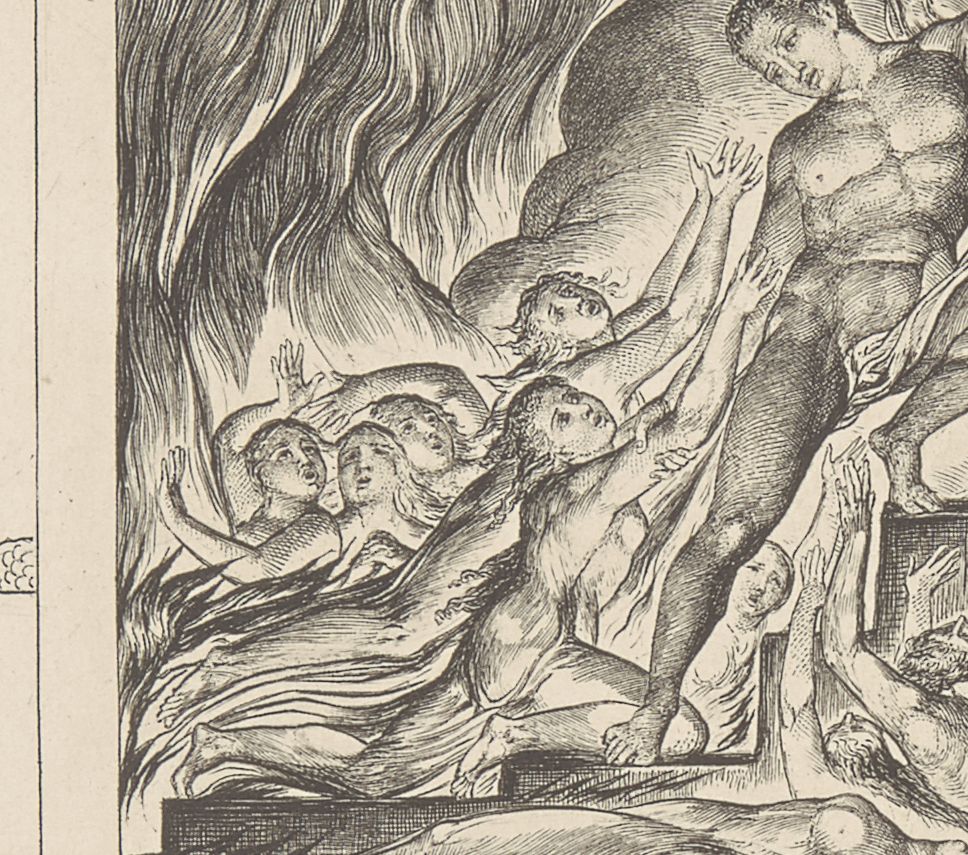
Hands carry much of the action. On the left, faces turn towards the descending weight and open palms rise at different angles. Their repetition makes a broken, ascending rhythm beneath Satan’s extended arms. Lower down, another figure stretches both hands upwards from a much tighter space. These gestures allow us to register individual responses without assigning names or a precise sequence of movements to people caught in a single compressed instant. [2]
On the right, a figure is overturned beneath a diagonal fragment, the head close to the lower edge and the limbs turned back into the wreckage. Across the front, the reclining woman introduces a different kind of horror. Her long horizontal body interrupts the upward-reaching arms and falling diagonals. The drapery follows the length of her legs; hair spreads beside her head. The image asks us to move between threatened life and the stillness that the inscription below will name as death. [2]
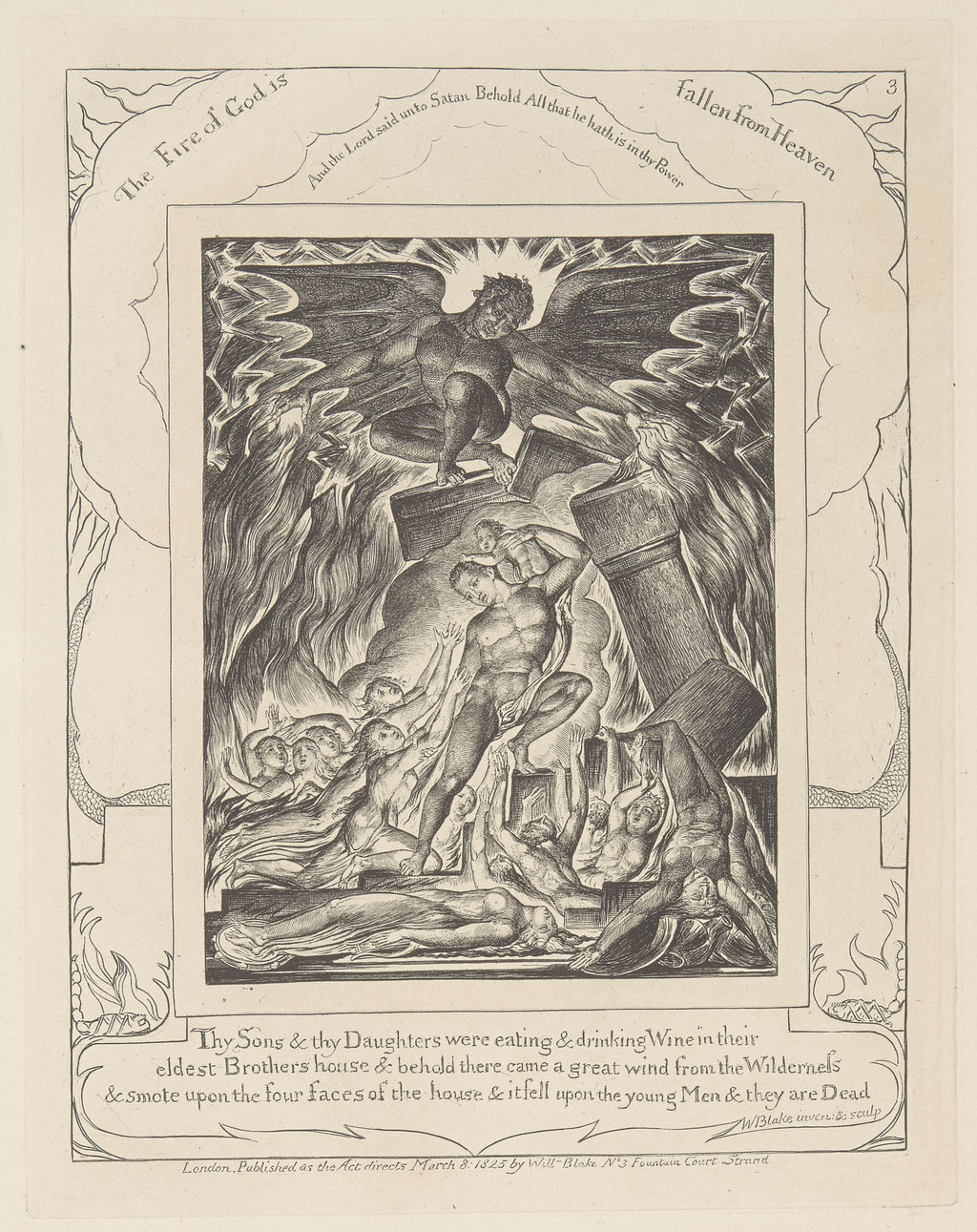
Job’s Sons and Daughters Overwhelmed by Satan. Yale Center for British Art, B1978.43.1505, identified impression dated 1826. The engraved 1825 publication line is a separate date.
Familiar gestures made terrible
Martin Butlin’s Tate catalogue connects the central man’s pose with an inherited language of bodily anguish. Reporting Bo Lindberg’s comparison, it points to the ancient Laocoön group, which Blake also studied and engraved. The comparison helps explain the force of the twisting torso and lifted arm: this is a body made eloquent through strain. It does not supply an identity for the figure or turn Job’s household into an illustration of the ancient story. [1]
Penelope Minney’s study places Blake’s destructive Satan within a longer pictorial tradition. She compares the design with the medieval Job paintings formerly in St Stephen’s Chapel, Westminster, where a crouching Satan pushed down the house above the family’s meal. Her account also connects the direct attack with the apocryphal Testament of Job. Minney’s proposed parallels show how giving Satan a physical role had precedents beyond the wording of the biblical messenger’s report. They do not establish exactly which earlier images or texts Blake consulted. [14]
Minney’s main concern is the earlier Butts watercolour series. Her description of red fire illuminating the bodies belongs to that coloured version and cannot describe the monochrome engraving. Her distinction between celebration and wrongdoing nevertheless matters here: she reads the destroyed feast as an abrupt overturning of prosperity, not proof of debauchery. In the engraving, the family’s visible gestures strengthen that humane caution. We see alarm, exposed bodies and failed protection; no pictured action establishes their guilt. [14] [2]
Butlin’s catalogue also proposes that the overturned figure on the right may allude to Blake’s remark about the modern church crucifying Christ head downwards. In A Vision of the Last Judgment, the phrase follows an attack on those who control other people’s passions through poverty and cruelty. That context gives the proposed allusion force beyond a resemblance of pose: it would connect helpless suffering with Blake’s hostility to oppressive religious power. The identification remains a suggestion in the catalogue. [1] [15]
Annotated Details from Job’s Sons and Daughters: Falling Bodies and Broken Stone
These details show the Yale Center for British Art’s 1826 impression, B1978.43.1505. Follow the wings, broken masonry and contrasting gestures through the collapsing scene.
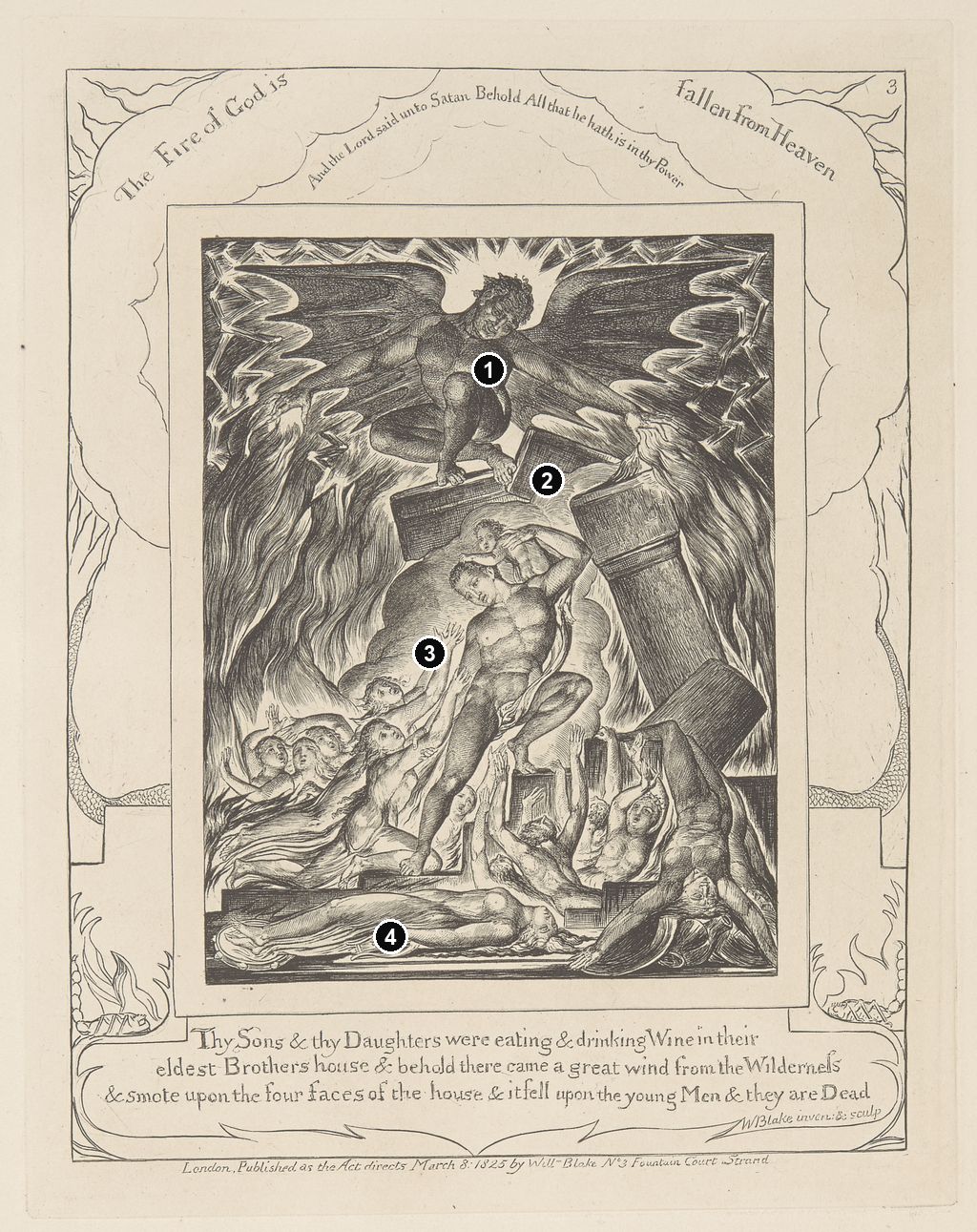
Details from JOB’S SONS AND DAUGHTERS: FALLING BODIES AND BROKEN STONE
The details retain this impression’s engraved lines and paper tone.
Wings across the upper scene
Dark wings spread across the upper scene behind a crouching figure. Pale jagged bands cut through the dense engraved lines on either side.
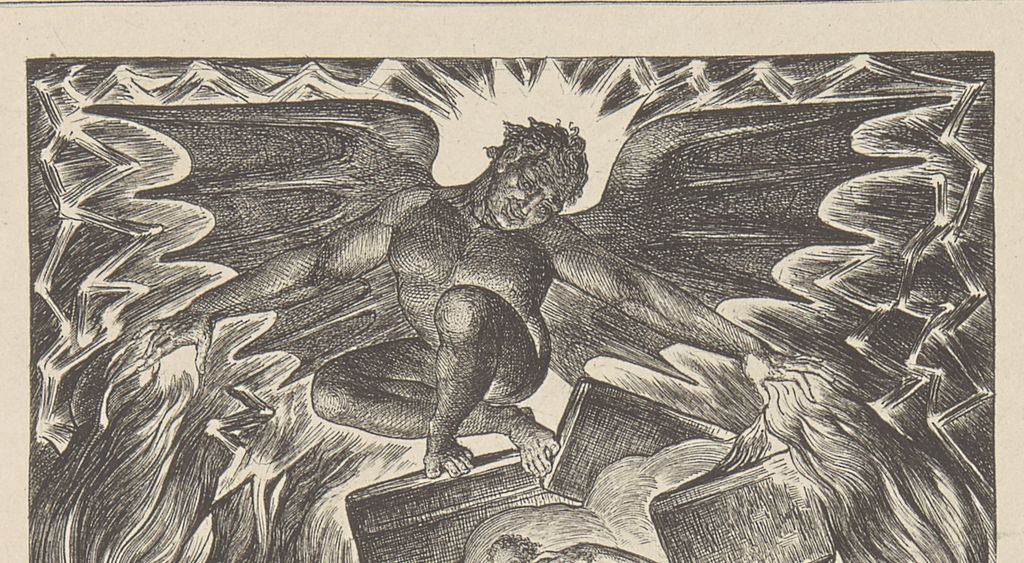
A crouching body and broken masonry
The crouching figure balances on broken slabs and extends his arms among jagged and flowing forms. Straight edges and tilted stones give the falling structure a hard geometry.
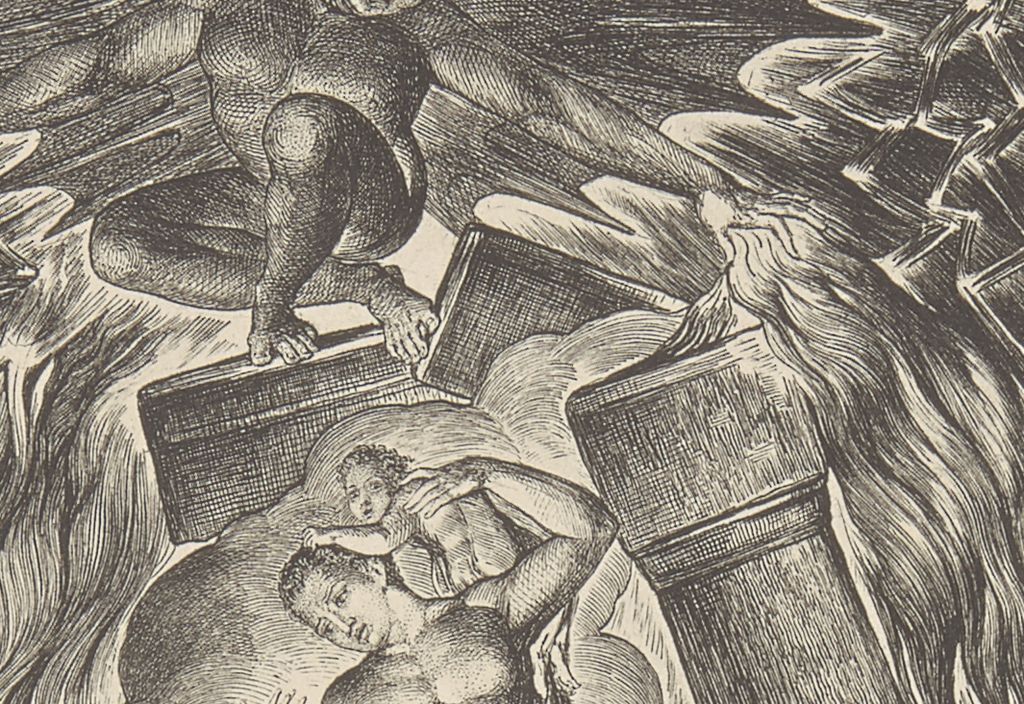
Raised hands amid the fall
At the left, figures raise open hands into the space above them. Their reaching arms interrupt the long curves of flame and cloth.
A body along the foreground
A reclining figure lies along the lower edge, with the head tilted back and arms resting beside the body. The low horizontal pose contrasts with the falling and twisting figures above.
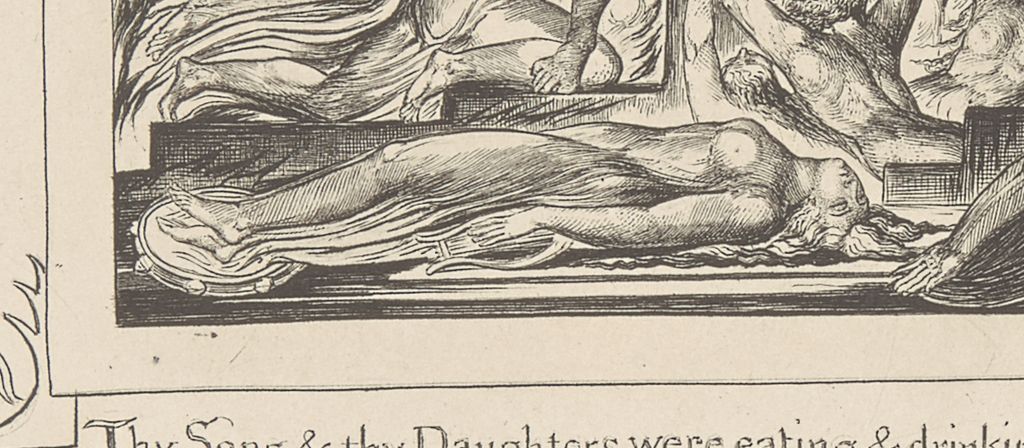
Image: Yale Center for British Art, B1978.43.1505. Numbered overview and detail crops from the collection’s original image. Collection record · CC0 1.0
Watch: William Blake’s world and working methods
Choose an introduction to Blake, a printing demonstration, or a discussion of his radical ideas.
William Blake: Poet, Artist & Visionary - a genius of early Romanticism in England
An introduction to Blake’s art, poetry and imaginative world.
Watch on YouTubeThe words surrounding the catastrophe
Across the upper margin, Blake places the report that the fire of God has fallen from heaven. Its words come from the second messenger in Job 1:16, describing the destruction of sheep and servants. Their appearance above the falling house brings a separate disaster into the page. The phrase names the fire as the messenger describes it; the figure in the central image makes Satan’s involvement visible. Reading the words together with the picture keeps the question of destructive agency active. [1] [3]
Inside that broad upper arch is a second inscription: God gives Satan power over all Job has. In the biblical verse, this permission is immediately limited by the command to leave Job himself untouched. Blake’s selected wording concentrates on the power granted. Remembering the rest of the verse gives the page a disturbing human scale. Job is protected from direct bodily assault at this stage, while the people who belong to his household remain exposed. The engraving makes us look at the human cost of that distinction. [1] [3]
Below the scene, the long inscription recounts the meal, wind, falling house and deaths. Blake changes the King James wording about the building’s four corners to its four faces, and joins the report into a continuous account. The lettering follows the breadth of the page, giving the reader time to return through the event after the eye has encountered its concentrated violence. What appears below as reported speech has already become an image above. [1] [2] [3]
The margin also enlarges the image through differences of touch. The central scene is dark and densely worked. Beyond it, expansive cloud contours and flames are carried by relatively open lines. Lightly indicated human forms and small rising shapes occupy the sides. They can be easy to miss beside the sharp wings and heavy stones, yet they belong to the designed page’s movement between bodily catastrophe and a larger spiritual setting. [2]
Minney interprets the marginal figures as angels watching over something like a phoenix’s rebirth. Her deliberately suggestive comparison allows the flames to carry an implication beyond destruction. It should remain a reading of those elusive forms. The print supplies no explicit statement that these particular victims are shown rising again, and its small marginal figures cannot make the deaths in the central scene inconsequential. The possibility of renewal exists around an image that continues to insist on loss. [14] [2]
The parents outside the picture
The heavenly encounter precedes the catastrophe in Satan Before the Throne of God. The family’s living presence has already been established in Job and His Family. Those neighbouring scenes give the catastrophe a remembered human setting: the victims belong to a household Blake has allowed us to encounter before it is broken. This plate’s concentration on their bodies interrupts the sequence’s movement between Job and heaven. [16]
In the Bible, Job tears his mantle, shaves his head and falls to the ground after the news. His worship occurs alongside these outward acts of mourning. Chapter 2 brings his bodily affliction and the arrival of friends who weep when they scarcely recognise him. Their first response is to sit beside him in silence for seven days because of his great grief. The suffering extends beyond the instant of collapse into a damaged life that other people must attempt to approach. [3]
The later renewal of the household needs equal care. Chapter 42 records relatives coming to eat with Job and comfort him, followed by his renewed prosperity and another seven sons and three daughters. This concluding family belongs to a later passage of his life. Its presence does not establish that the people killed in the first chapter have simply returned, or that new children cancel the loss of the earlier ones. Blake’s image gives that loss a particular bodily form which a summary of the ending can too easily overlook. [3]
The complete engraved series carries the story onwards. Here there is value in allowing the eye to stay with the raised palms and fallen woman. These figures are more than a preliminary obstacle in Job’s spiritual progress. Blake devotes an entire design to the disaster that deprives them of their lives. [1] [2]
A design printed at different dates
The publication line cut beneath the engraving gives 8 March 1825. Tate’s shared series catalogue distinguishes that engraved date from the completion and issue of the suite in 1826. The compositions also have a history before the copperplates, in Blake’s watercolour sets. A date on the printed border therefore describes one part of the work’s history; it cannot by itself date every drawing or every sheet taken from the plate. [1]
Tate’s own impression, accession A00014, is currently catalogued as 1825, reprinted 1874. Its image measures 197 by 153 millimetres. The historical catalogue associates the Tate set with the later printing made for John Linnell and records its acquisition in 1919. Those details describe the museum’s object. They cannot be transferred to a cropped reproduction merely because it shows the same composition. [1]
Yale’s B1978.43.1505 is a separately identified impression dated 1826 in the institution’s official image record. Its complete page is especially useful for moving between the family’s catastrophe and the words above and below it. The two collection records make a valuable distinction visible: a composition can persist across successive printings while each sheet has its own date and material history. Across those differences, the confrontation remains exacting—an assured destructive body above, and people below whose strength, shelter and gestures of appeal cannot save them. [2] [1]
Works and designs directory
Browse separate works, impressions and book components. Dates distinguish versions; six Tate copies after Blake are labelled. These records are not a complete catalogue of unique designs.
| Name | Date | Medium |
|---|---|---|
| A Figure Standing in a Gothic Apse, perhaps the Empress Maud. Verso: Detailed Drawings for ‘The Empress Maud in Bed’ | c.1819 | Pencil drawing |
| A Rolling Stone Is Ever Bare of Moss, from Thornton's "Pastorals of Virgil" | 1821 | Wood engraving |
| A Title Page for The Grave | 1806 | Watercolour |
| A Vision of the Last Judgment | 1808 | Watercolour |
| A Vision: The Inspiration of the Poet (Elisha in the Chamber on the Wall) | c.1819–20? | Watercolour |
| Adam and the Beasts, Frontispiece to Hayley's "Ballads" | June 1, 1802 | Engraving |
| Age Teaching Youth | c.1785–90 | Watercolour |
| Alfred and the Neat-Herd’s Wife (after Henry Fuseli) | 1797, published 1798 | Etching and engraving |
| An Allegory of the Bible. Verso: The Shins of an Écorché Male Figure | c.1780–5, ?c.1780 | Watercolour |
| Angel of the Divine Presence Bringing Eve to Adam (The Creation of Eve: "And She Shall be Called Woman) (recto); Sketch for the same (verso) | ca. 1803 | Watercolour |
| Angel of the Revelation (Book of Revelation, chapter 10) | ca. 1803–5 | Watercolour |
| Antaeus setting down Dante and Virgil in the Last Circle of Hell | 1824–1827 | Watercolour |
| Bathsheba at the Bath | c.1799–1800 | Tempera |
| Beatrice Addressing Dante from the Car | 1824–7 | Watercolour |
| Behemoth and Leviathan | 1825–26 | Engraving |
| Behemoth and Leviathan | 1825, reprinted 1874 | Engraving |
| Behemoth and Leviathan | 1826 | Engraving |
| Blasted Trees and Flattened Crops, from Thornton's "Pastorals of Virgil" | 1821 | Wood engraving |
| Boy Returning Joyfully, with Plough and Oxen, from Thornton's "Pastorals of Virgil" | 1821 | Wood engraving |
| Boy Returning Joyfully, with Plough and Oxen, from Thornton's "Pastorals of Virgil" | 1821 | Wood engraving |
| Catherine Blake. Verso: A Man’s Head and Other Drawings | c.1805 | Pencil drawing |
| Cerberus | 1824–7 | Watercolour |
| Cerberus (second version) | 1824–1827 | Watercolour |
| Chaucer’s Canterbury Pilgrims | 1810, reprinted before 1881 | Engraving |
| Christ Appearing to His Disciples After the Resurrection | c.1795 | Colour print |
| Christ Appearing to the Apostles after the Resurrection | c.1795 | Watercolour |
| Christ Blessing the Little Children | 1799 | Tempera |
| Christ in the Carpenter’s Shop: The Humility of the Saviour (after William Blake) | Date not stated | Watercolour |
| Ciampolo the Barrator Tormented by the Devils | 1826–7, reprinted 1892 | Engraving |
| Ciampolo the Barrator Tormented by the Devils | 1826–7, reprinted 1968 | Engraving |
| Circle of Theives: Agnello Brunelleschi Attacked By a Six-Footed Serpent | ca. 1825–27 | Engraving |
| Clarence's Dream (Shakespeare, Richard III, Act 1, Scene 4) | 1774 | Etching and engraving |
| Colinet Mocked by Two Boys, from Thornton's "Pastorals of Virgil" | 1821 | Wood engraving |
| Colinet Rests by a Stream at Night | c.1821, printed 1830 | Wood engraving |
| Colinet Rests by a Stream at Night | 1821, reprinted 1977 | Wood engraving |
| Colinet with his Shepherd’s Pipe, Mocked by Two Boys | c.1821, printed 1830 | Wood engraving |
| Colinet with his Shepherd’s Pipe, Mocked by Two Boys | 1821, reprinted 1977 | Wood engraving |
| Colinet's Journey, Milestone Marked 'LXII Miles to London', from Thornton's "Pastorals of Virgil" | 1821 | Wood engraving |
| Colinet's Journey: Milestone Marked 'LXII Miles to London', from Thornton's "Pastorals of Virgil" | 1821 | Wood engraving |
| Colinet’s Fond Desire Strange Lands to Know | 1821, reprinted 1977 | Wood engraving |
| Colinet’s ‘Fond Desire Strange Lands to Know’ | c.1821, printed 1830 | Wood engraving |
| Composition Sketch for ‘The Fall of the Rebel Angels’? Verso: Standing Figure with Flaming Hair | ?c.1805–10 | Pencil drawing |
| Composition Sketch, Possibly a Subject from Dante. Verso: A Man Standing over a Figure Reclining on a Bed | ?1824–7, ?c.1800–10 | Pencil drawing |
| Composition Sketch. Verso: Standing Figure Holding a Spear | ?c.1805–10 | Pencil drawing |
| Dante and Virgil Approaching the Angel Who Guards the Entrance of Purgatory | 1824–7 | Watercolour |
| Dante and Virgil Penetrating the Forest | 1824–7 | Watercolour |
| Dante in the Empyrean, Drinking at the River of Light | 1824–7 | Watercolour |
| Dante running from the Three Beasts | 1824–1827 | Watercolour |
| Dante Striking against Bocca Degli Abati | 1826–7, reprinted 1892 | Engraving |
| Dante Striking Against Bocca degli Abati | 1826–7, reprinted 1968 | Engraving |
| David Delivered out of Many Waters | c.1805 | Watercolour |
| David Delivered out of Many Waters (after William Blake) | Date not stated | Watercolour |
| Detailed Drawings for ‘A Figure Standing in a Gothic Apse’ | 1819 | Pencil drawing |
| Elohim Creating Adam | 1795–c.1805 | Colour print |
| Enoch | 1806–7 | Lithograph |
| Epitome of James Hervey’s ‘Meditations among the Tombs’ | c.1820–5 | Watercolour |
| Europe. A Prophecy; Frontispiece | ca. 1820 | Relief etching |
| Evening | c.1820/1825 | Watercolour |
| Every Man also Gave him a Piece of Money | 1825, reprinted 1874 | Engraving |
| Every Man also Gave him a Piece of Money. Verso: God the Father with Attendant Angels | c.1821–3 | Watercolour |
| Every One also Gave Him a Piece of Money | 1826 | Engraving |
| Fertilization of Egypt, from Erasmus Darwin's "The Botanic Garden" | 1791 | Engraving |
| First Book of Urizen pl. 10 | 1796, c.1818 | Etching |
| First Book of Urizen pl. 11 | 1796, c.1818 | Etching |
| First Book of Urizen pl. 15 | 1796, c.1818 | Etching |
| First Book of Urizen pl. 17 | 1796, c.1818 | Etching |
| First Book of Urizen pl. 21 | 1796, c.1818 | Etching |
| First Book of Urizen pl. 6 | 1796, c.1818 | Etching |
| Frontispiece to Jerusalem, the Emanation of the Great Albion | [ca. 1804–20] (?) | Engraving |
| Frontispiece to ‘Visions of the Daughters of Albion’ | c.1795 | Relief etching |
| Frontispiece: Thenot and Colinet | c.1821, printed 1830 | Wood engraving |
| George Cumberland's Message Card | 1827 | Engraving |
| God Judging Adam | ca. 1795 | Relief etching |
| God Judging Adam | 1795 | Relief etching |
| Hiding of Moses, from "Remember Me!, or a Pocket Companion" | 1825 | Engraving |
| Homer and the Ancient Poets | 1824–7 | Watercolour |
| Illustration 1 to Milton’s On the Morning of Christ’s Nativity: The Descent of Peace | c.1814–1816 | Watercolour |
| Illustration 1 to Milton’s Paradise Lost: Satan Calling Up His Legions | 1807 | Watercolour |
| Job accepting Charity | 1825–26 | Engraving |
| Job and his Daughters | 1825–26 | Engraving |
| Job and his Daughters | 1825, reprinted 1874 | Engraving |
| Job and His Daughters | 1826 | Engraving |
| Job and His Family | 1825–26 | Engraving |
| Job and his Family | Reprinted 1874; engraved 1828 date is an error | Engraving |
| Job and His Family | 1826 | Engraving |
| Job and his Family Restored to Prosperity | 1825, reprinted 1874 | Engraving |
| Job and his Wife restored to Prosperity | 1825–26 | Engraving |
| Job rebuked by his Friends | 1825–26 | Engraving |
| Job Rebuked by his Friends | 1825, reprinted 1874 | Engraving |
| Job Rebuked by His Friends | 1826 | Engraving |
| Job's Comforters | 1825–26 | Engraving |
| Job's Comforters | 1826 | Engraving |
| Job's Despair | 1825–26 | Engraving |
| Job's Evil Dreams | 1825–26 | Engraving |
| Job's Evil Dreams | 1826 | Engraving |
| Job's Sacrifice | 1825–26 | Engraving |
| Job's Sons and Daughters Overwhelmed by Satan | 1826 | Engraving |
| Job, his Wife and his Friends: The Complaint of Job. Verso: Job’s Wife and Eight Other Sketches | c.1785 | Watercolour |
| Job’s Comforters | 1825, reprinted 1874 | Engraving |
| Job’s Despair | 1825, reprinted 1874 | Engraving |
| Job’s Evil Dreams | 1825, reprinted 1874 | Engraving |
| Job’s Sacrifice | 1825, reprinted 1874 | Engraving |
| Job’s Sons and Daughters Overwhelmed by Satan | 1825, reprinted 1874 | Engraving |
| John Linnell | 1825 | Pencil drawing |
| Joseph of Arimathea Preaching to the Britons | c.1794/1796 | Relief etching |
| Judas Betrays Him | c.1803–5 | Watercolour |
| King John Absolved by Pandulph (after Henry Fuseli) | 1797, published 1798 | Etching and engraving |
| Lamech and his Two Wives | 1795 | Colour print |
| Landscape near Felpham | c.1800 | Watercolour |
| Lear and Cordelia in Prison | c.1779 | Watercolour |
| Los and Orc | c.1792–3 | Watercolour |
| Lower Half of a Woman Playing a Harp. Verso: Seraphim and Other Drawings | c.1785, c.?1807 | Pencil drawing |
| Menalcus Watching Women Dance, from Thornton's "Pastorals of Virgil" | 1821 | Wood engraving |
| Menalcus Watching Women Dance, from Thornton's "Pastorals of Virgil" | 1821 | Wood engraving |
| Moses Indignant at the Golden Calf | c.1799–1800 | Tempera |
| Nebuchadnezzar | 1795–c.1805 | Colour print |
| Newton | 1795–c.1805 | Colour print |
| Oberon, Titania and Puck with Fairies Dancing | c.1786 | Watercolour |
| Pity | ca. 1795 | Relief etching |
| Pity | c.1795 | Colour print |
| Plate 2 of ‘Urizen’: ‘Teach these Souls to Fly’ | ?1796 | Relief etching |
| Plate 3 of ‘Urizen’: Oh! Flames of Furious Desires’ (after William Blake) | Date not stated | Watercolour |
| Plate 4 of ‘Visions of the Daughters of Albion’ | c.1795 | Relief etching |
| Plutus | 1824–7 | Watercolour |
| Preliminary Sketch for ‘Christ Girding Himself with Strength’. Verso: Standing Figure with One Arm Raised | c.1805, c.1805–10 | Pencil drawing |
| Preludium. "The shadowy daughter of Urthona stood before red Orc..." (Plate 3) | 1793 | Relief etching |
| Queen Elizabeth and Essex (after Henry Fuseli) | 1797, published 1798 | Engraving |
| Sabrina's Silvery Flood, from Thornton's "Pastorals of Virgil" | 1821 | Wood engraving |
| Sabrina's Silvery Flood, from Thornton's "Pastorals of Virgil" | 1821 | Wood engraving |
| Sabrina’s Silvery Flood | c.1821, printed 1830 | Wood engraving |
| Sabrina’s Silvery Flood | 1821, reprinted 1977 | Wood engraving |
| Satan Before the Throne of God | 1825–26 | Engraving |
| Satan before the Throne of God | 1825, reprinted 1874 | Engraving |
| Satan before the Throne of God | 1826 | Engraving |
| Satan calling up his Legions | c.1800–05 | Tempera |
| Satan Exulting over Eve | c.1795 | Colour print |
| Satan Going Forth from the Presence of the Lord, and Job’s Charity | 1825, reprinted 1874 | Engraving |
| Satan Going Forth fron the Presence of the Lord | 1825–26 | Engraving |
| Satan in his Original Glory: ‘Thou wast Perfect till Iniquity was Found in Thee’ | c.1805 | Watercolour |
| Satan Smiting Job with Boils | 1825–26 | Engraving |
| Satan Smiting Job with Sore Boils | 1825, reprinted 1874 | Engraving |
| Satan Smiting Job with Sore Boils | c.1826 | Tempera |
| Satan Smiting Job with Sore Boils | 1826 | Engraving |
| Shepherd Chases Away a Wolf, from Thornton's "Pastorals of Virgil" | 1821 | Wood engraving |
| Shepherd Chases Away a Wolf, from Thornton's "Pastorals of Virgil" | 1821 | Wood engraving |
| Sketch for the Title-Page of the Engraved Illustrations to the Book of Job | c.1823/1826 | Pencil drawing |
| Sketch for ‘The Four and Twenty Elders Casting their Crowns before the Divine Throne’. Verso: Standing Figure with Arms at his Side | c.1803, c.1805–10 | Pencil drawing |
| Sketch for ‘Tiriel Supporting the Dying Myratana’. Verso: Sketch for ‘Tiriel Supporting the Dying Myratana’ | c.1786–9 | Pencil drawing |
| Songs of Experience: A Little Boy Lost | [1794] printed ca. 1825 | Relief etching |
| Songs of Experience: A Little Girl Lost | [1794] printed ca. 1825 | Relief etching |
| Songs of Experience: A Poison Tree | [1794] printed ca. 1825 | Relief etching |
| Songs of Experience: Earth's Answer | [1794] printed ca. 1825 | Relief etching |
| Songs of Experience: Frontispiece | [1794] printed ca. 1825 | Relief etching |
| Songs of Experience: Holy Thursday | [1794] printed ca. 1825 | Relief etching |
| Songs of Experience: Infant Sorrow | [1794] printed ca. 1825 | Relief etching |
| Songs of Experience: Introduction | [1794] printed ca. 1825 | Relief etching |
| Songs of Experience: London | [1794] printed ca. 1825 | Relief etching |
| Songs of Experience: My Pretty Rose Tree, Ah! Sun-Flower, The Lilly | [1794] printed ca. 1825 | Relief etching |
| Songs of Experience: Nurses Song | [1794] printed ca. 1825 | Relief etching |
| Songs of Experience: The Angel | [1794] printed ca. 1825 | Relief etching |
| Songs of Experience: The Chimney Sweeper | [1794] printed ca. 1825 | Relief etching |
| Songs of Experience: The Clod & the Pebble | [1794] printed ca. 1825 | Relief etching |
| Songs of Experience: The Fly | [1794] printed ca. 1825 | Relief etching |
| Songs of Experience: The Garden of Love | [1794] printed ca. 1825 | Relief etching |
| Songs of Experience: The Human Abstract | [1794] printed ca. 1825 | Relief etching |
| Songs of Experience: The Little Girl Found (second plate) | [1789] printed ca. 1825 | Relief etching |
| Songs of Experience: The Little Girl Lost | [1789] printed ca. 1825 | Relief etching |
| Songs of Experience: The Little Girl Lost (second plate); The Little Girl Found | [1789] printed ca. 1825 | Relief etching |
| Songs of Experience: The Little Vagabond | [1794] printed ca. 1825 | Relief etching |
| Songs of Experience: The School Boy | [1789] printed ca. 1825 | Relief etching |
| Songs of Experience: The Sick Rose | [1794] printed ca. 1825 | Relief etching |
| Songs of Experience: The Tyger | [1794] printed ca. 1825 | Relief etching |
| Songs of Experience: The Voice of the Ancient Bard | [1789] printed ca. 1825 | Relief etching |
| Songs of Experience: Title-page | [1794] printed ca. 1825 | Relief etching |
| Songs of Experience: To Tirzah | [1794] printed ca. 1825 | Relief etching |
| Songs of Innocence and of Experience, Shewing the Two Contrary States of the Human Soul: Combined Title-page | [1789–94] printed ca. 1825 | Relief etching |
| Songs of Innocence and of Experience: Infant Sorrow | 1794, reprinted 1831 or later | Relief etching |
| Songs of Innocence: A Cradle Song | [1789] printed ca. 1825 | Relief etching |
| Songs of Innocence: A Cradle Song (second plate) | [1789] printed ca. 1825 | Relief etching |
| Songs of Innocence: A Dream | [1794] printed ca. 1825 | Relief etching |
| Songs of Innocence: Frontispiece | [1789] printed ca. 1825 | Relief etching |
| Songs of Innocence: Holy Thursday | [1789] printed ca. 1825 | Relief etching |
| Songs of Innocence: Infant Joy | [1789] printed ca. 1825 | Relief etching |
| Songs of Innocence: Introduction | [1789] printed ca. 1825 | Relief etching |
| Songs of Innocence: Laughing Song | [1789] printed ca. 1825 | Relief etching |
| Songs of Innocence: Little Boy Lost | [1789] printed ca. 1825 | Relief etching |
| Songs of Innocence: Night | [1789] printed ca. 1825 | Relief etching |
| Songs of Innocence: Night (second plate) | [1789] printed ca. 1825 | Relief etching |
| Songs of Innocence: Nurse's Song | [1789] printed ca. 1825 | Relief etching |
| Songs of Innocence: On Anothers Sorrow | [1789] printed ca. 1825 | Relief etching |
| Songs of Innocence: Spring | [1789] printed ca. 1825 | Relief etching |
| Songs of Innocence: Spring (second plate) | [1789] printed ca. 1825 | Relief etching |
| Songs of Innocence: The Blossom | [1789] printed ca. 1825 | Relief etching |
| Songs of Innocence: The Chimney Sweeper | [1789] printed ca. 1825 | Relief etching |
| Songs of Innocence: The Divine Image | [1789] printed ca. 1825 | Relief etching |
| Songs of Innocence: The Ecchoing Green | [1789] printed ca. 1825 | Relief etching |
| Songs of Innocence: The Ecchoing Green (second plate) | [1789] printed ca. 1825 | Relief etching |
| Songs of Innocence: The Lamb | [1789] printed ca. 1825 | Relief etching |
| Songs of Innocence: The Little Black Boy | [1789] printed ca. 1825 | Relief etching |
| Songs of Innocence: The Little Black Boy (second plate) | [1789] printed ca. 1825 | Relief etching |
| Songs of Innocence: The Little Boy Found | [1789] printed ca. 1825 | Relief etching |
| Songs of Innocence: The Shepherd | [1789] printed ca. 1825 | Relief etching |
| Songs of Innocence: Title Page | [1789] printed ca. 1825 | Relief etching |
| St Christopher, Copy from an Engraving? Verso:Part of a Face: Copy from a Plaster Cast: a Daughter of Niobe? | ?c.1779–80 | Pencil drawing |
| The Agony in the Garden | c.1799–1800 | Tempera |
| The Angel Appearing to Zacharias | 1799–1800 | Tempera |
| The Ascent of the Mountain of Purgatory | 1824–7 | Watercolour |
| The Baffled Devils Fighting | 1826–7, reprinted 1892 | Engraving |
| The Baffled Devils Fighting | 1826–7, reprinted 1968 | Engraving |
| The Bard, from Gray | ?1809 | Tempera |
| The Beggar's Opera, Act III | July 1, 1790 | Etching and engraving |
| The Beggar's Opera, Act III | July 1, 1790 | Engraving |
| The Beggar's Opera, Act III | 1790 | Engraving |
| The Blasphemer | c.1800 | Watercolour |
| The Blighted Corn | c.1821, printed 1830 | Wood engraving |
| The Blighted Corn | 1821, reprinted 1977 | Wood engraving |
| The Body of Abel Found by Adam and Eve | c.1826 | Tempera |
| The Body of Christ Borne to the Tomb | c.1799–1800 | Tempera |
| The Book of Job: Title Page | 1825 | Engraving |
| The Book of Thel pl. 6 | 1796, c.1818 | Etching |
| The Circle of Corrupt Officials: The Devils Mauling Each Other | ca. 1825–27 | Engraving |
| The Circle of Corrupt Officials: The Devils Tormenting Ciampolo | ca. 1825–27 | Engraving |
| The Circle of the Lustful: Francesca da Rimini (‘The Whirlwind of Lovers’) | 1826–7, reprinted 1892 | Engraving |
| The Circle of the Lustful: Francesca da Rimini (‘The Whirlwind of Lovers’) | 1826–7, reprinted 1968 | Engraving |
| The Circle of the Lustful: Paolo and Francesca | ca. 1825–27 | Engraving |
| The Circle of the Thieves; Buoso Donati Attacked by the Serpent | ca. 1825–27 | Engraving |
| The Circle of Traitors: Dante's Foot Striking Bocca degli Abbate | ca. 1825–27 | Engraving |
| The Complaint and the Consolation; or, Night Thoughts | 1797 | Etching and engraving |
| The Creation | 1825–26 | Engraving |
| The Crucifixion | c.1825–7 | Pencil drawing |
| The Crucifixion: ‘Behold Thy Mother’ | c.1805 | Watercolour |
| The Dance of Albion (Glad Day) | c.1803/1810 | Engraving |
| The Death of Lucretia, from Allen's "New and Impartial Roman History" | 1797 | Engraving |
| The Death of Saint Joseph | 1803 | Watercolour |
| The Death of the Virgin | 1803 | Watercolour |
| The Descent of Peace [recto] | c.1815 | Pencil drawing |
| The Destruction of Job's Sons | 1825–26 | Engraving |
| The Devils, with Dante and Virgil by the Side of the Pool | 1824–7 | Watercolour |
| The Entombment | c.1805 | Watercolour |
| The Fall of Rosamond (after Thomas Stothard) | 1783 | Etching and engraving |
| The Fall of Satan | 1825–26 | Engraving |
| The Fall of Satan | 1825, reprinted 1874 | Engraving |
| The Fall of Satan | 1826 | Engraving |
| The Four and Twenty Elders Casting their Crowns before the Divine Throne | c.1803–5 | Watercolour |
| The Ghost of a Flea | c.1819–20 | Tempera |
| The Good and Evil Angels | 1795–?c.1805 | Colour print |
| The Good Farmer, Probably the Parable of the Wheat and the Tares. Verso: Rough Sketch of Two or Three Figures in a Landscape | c.1780–5 | Watercolour |
| The Great Red Dragon and the Beast from the Sea | c.1805 | Watercolour |
| The Great Red Dragon and the Woman Clothed with the Sun | c.1805 | Watercolour |
| The Head of the Ghost of a Flea. Verso: A Profile and a Reduced Drawing of Milton’s First Wife | c.1819 | Pencil drawing |
| The Hermit’s Dog, from William Hayley’s "Ballads" | 1805 | Etching and engraving |
| The Hiding of Moses | 1824 | Engraving |
| The House of Death | 1795–c.1805 | Colour print |
| The House of Death | c.1790 | Watercolour |
| The Hypocrites with Caiaphas. Verso: Sketch of a Stooping Figure | 1824–7 | Watercolour |
| The Inscription over the Gate | 1824–7 | Watercolour |
| The Laborious Passage along the Rocks | 1824–7 | Watercolour |
| The Last Trumpet (recto); Two studies of a right eye, a profile of an open-mouthed young man, the head of an eagle, and the head of a lion (verso) | 1780–85 | Pencil drawing |
| The Lord Answering Job out of the Whirlwind | 1825–26 | Engraving |
| The Lord Answering Job out of the Whirlwind | 1825, reprinted 1874 | Engraving |
| The Man Who Taught Blake Painting in his Dreams (counterproof) (after William Blake) | after c.1819–20 | Pencil drawing |
| The Marriage of Heaven and Hell pl. 16 | 1796, c.1818 | Etching |
| The Messengers tell Job of his Misfortunes | 1825–26 | Engraving |
| The Messengers tell Job of his Misfortunes | 1825, reprinted 1874 | Engraving |
| The Night of Enitharmon’s Joy (formerly called ‘Hecate’) | c.1795 | Colour print |
| The Parable of the Wise and Foolish Virgins | ca. 1799–1800 | Watercolour |
| The Parable of the Wise and Foolish Virgins (after William Blake) | Date not stated | Watercolour |
| The Pastorals of Virgil, with a Course of English Reading, Adapted for Schools, Vol. I | 1821 | Wood engraving |
| The Penance of Jane Shore in St Paul’s Church | c.1793 | Watercolour |
| The Pit of Disease: The Falsifiers | 1826–7, reprinted 1892 | Engraving |
| The Pit of Disease: The Falsifiers | 1824–7 | Watercolour |
| The Pit of Disease: The Falsifiers | 1826–7, reprinted 1968 | Engraving |
| The Primaeval Giants Sunk in the Soil | 1824–7 | Watercolour |
| The Punishment of the Thieves | 1824–7 | Watercolour |
| The Raising of Lazarus (after William Blake) | Date not stated | Watercolour |
| The Rest on the Flight into Egypt (The Repose of the Holy Family in Egypt) | 1806 | Watercolour |
| The River of Life | c.1805 | Watercolour |
| The Rock Sculptured with the Recovery of the Ark and the Annunciation | 1824–7 | Watercolour |
| The Serpent Attacking Buoso Donati | 1826–7, reprinted 1892 | Engraving |
| The Serpent Attacking Buoso Donati | 1826–7, reprinted 1968 | Engraving |
| The Serpent Attacking Buoso Donati. Verso: A Man with a Transparent Hood (?) over his Head | 1824–7 | Watercolour |
| The Simoniac Pope | 1824–7 | Watercolour |
| The Six-Footed Serpent Attacking Agnolo Brunelleschi | 1826–7, reprinted 1892 | Engraving |
| The Six-Footed Serpent Attacking Agnolo Brunelleschi | 1826–7, reprinted 1968 | Engraving |
| The Soul Hovering over the Body Reluctantly Parting with Life | c.1805 | Pencil drawing |
| The Spiritual Form of Nelson Guiding Leviathan | c.1805–9 | Tempera |
| The Spiritual Form of Pitt Guiding Behemoth | ?1805 | Tempera |
| The Sun at His Eastern Gate | c.1816–1820 | Watercolour |
| The Temple of Mirth, after Thomas Stothard | 1784 | Engraving |
| The Temptation and Fall of Eve | 1807 | Watercolour |
| The Temptation and Fall of Eve (Illustration to Milton’s Paradise Lost) | 1808 | Watercolour |
| The Thieves and Serpents | 1824–1827 | Watercolour |
| The Vision of Christ | 1825, reprinted 1874 | Engraving |
| The Vision of Eliphaz | 1825–26 | Engraving |
| The Vision of Eliphaz | 1825, reprinted 1874 | Engraving |
| The Vision of God | 1825–26 | Engraving |
| The Wood of the Self-Murderers: The Harpies and the Suicides | 1824–7 | Watercolour |
| The Wrath of Elihu | 1825–26 | Engraving |
| The Wrath of Elihu | 1825, reprinted 1874 | Engraving |
| Thenot and Colinet | 1821, reprinted 1977 | Wood engraving |
| Thenot and Colinet at Supper | c.1821, printed 1830 | Wood engraving |
| Thenot and Colinet at Supper | 1821, reprinted 1977 | Wood engraving |
| Thenot and Colinet Converse Seated between Two Trees | c.1821, printed 1830 | Wood engraving |
| Thenot and Colinet Converse Seated between Two Trees | 1821, reprinted 1977 | Wood engraving |
| Thenot and Colinet Eat Their Evening Meal, from Thornton's "Pastorals of Virgil" | 1821 | Wood engraving |
| Thenot and Colinet Folding their Flocks together at Sunset | c.1821, printed 1830 | Wood engraving |
| Thenot and Colinet Folding their Flocks together at Sunset | 1821, reprinted 1977 | Wood engraving |
| Thenot and Colinet Lead Their Flocks Together, from Thornton's "Pastorals of Virgil" | 1821 | Wood engraving |
| Thenot and Colinet Lead Their Flocks Together, from Thornton's "Pastorals of Virgil" | 1821 | Wood engraving |
| Thenot Remonstrates with Colinet | c.1821, printed 1830 | Wood engraving |
| Thenot Remonstrates with Colinet | 1821, reprinted 1977 | Wood engraving |
| Thenot Remonstrates With Colinet, from Thornton's "Pastorals of Virgil" | 1821 | Wood engraving |
| Thenot Remonstrates With Colinet, from Thornton's "Pastorals of Virgil" | 1821 | Wood engraving |
| Thenot Remonstrates with Colinet, Lightfoot in the Background, from Thornton's "Pastorals of Virgil" | 1821 | Wood engraving |
| Thenot Remonstrates with Colinet: Lightfoot in the Distance | 1821, reprinted 1977 | Wood engraving |
| Thenot Remonstrates with Colinet; Lightfoot in the Distance | c.1821, printed 1830 | Wood engraving |
| Thenot Under a Fruit Tree, from Thornton's "Pastorals of Virgil" | 1821 | Wood engraving |
| Thenot, with Colinet Waving his Arms in Sorrow | c.1821, printed 1830 | Wood engraving |
| Thenot, with Colinet Waving his Arms in Sorrow | 1821, reprinted 1977 | Wood engraving |
| Title Page: Illustrations of the Book of Job | 1825–26 | Engraving |
| Title-Page of ‘The Book of Job’ | 1825, reprinted 1874 | Engraving |
| Tornado–Zeus Battling Typhon, from Erasmus Darwin's "Botanic Garden" | August 1, 1795 | Engraving |
| Tornado–Zeus Battling Typhon, from Erasmus Darwin's "The Botanic Garden" | August 1, 1795 | Engraving |
| Two Figures in a Decorative Border | c.1790 | Pencil drawing |
| Unyok'd Heifers, Loitering Homeward (Return of the Shepherd), from Thornton's "Pastorals of Virgil" | 1821 | Wood engraving |
| Virgil Girding Dante’s Brow with a Rush | 1824–7 | Watercolour |
| Wat Tyler and the Tax-Gatherer (after Henry Fuseli) | 1797, published 1798 | Etching and engraving |
| When the Morning Stars Sang Together | 1825, reprinted 1874 | Engraving |
| When the Morning Stars Sang Together | 1826 | Engraving |
| Winged Figure Flying Through Clouds, from Bell's "Poets" | 1790 | Etching and engraving |
| Winter | c.1820–5 | Tempera |
| ‘A Rolling Stone is ever Bare of Moss’ | c.1821, printed 1830 | Wood engraving |
| ‘A Rolling Stone is ever Bare of Moss’ | 1821, reprinted 1977 | Wood engraving |
| ‘And Unyok’d Heifers, Loitering Homeward, Low’ | c.1821, printed 1830 | Wood engraving |
| ‘And Unyok’d Heifers, Loitering Homewards, Low’ | 1821, reprinted 1977 | Wood engraving |
| ‘Europe’: Fragment of Pages 3 and 4 | 1794–c.1830–5 | Relief etching |
| ‘For him Our Yearly Wakes and Feasts We Hold’ | c.1821, printed 1830 | Wood engraving |
| ‘For him Our Yearly Wakes and Feasts We Hold’ | 1821, reprinted 1977 | Wood engraving |
| ‘Nor Fox, nor Wolf, nor Rat among our Sheep’ | c.1821, printed 1830 | Wood engraving |
| ‘Nor Fox, nor Wolf, nor Rat among our Sheep’ | 1821, reprinted 1977 | Wood engraving |
| ‘Songs of Innocence and of Experience’: ‘Infant Sorrow’ | 1794, reprinted 1831 or later | Relief etching |
| ‘Songs of Innocence and of Experience’: ‘Spring’ | 1794, reprinted 1831 or later | Relief etching |
| ‘Songs of Innocence’: Title-Page | 1789, reprinted 1831 or later | Relief etching |
| ‘Songs of Innocence’: Title-Page | 1789, reprinted 1831 or later | Relief etching |
| ‘With Songs the Jovial Hinds Return from Plow’ | c.1821, printed 1830 | Wood engraving |
| ‘With Songs the Jovial Hinds Return from Plow’ | 1821, reprinted 1977 | Wood engraving |
Frequently Asked Questions
Job’s worry is a possibility rather than a confirmed discovery. The opening describes him as upright and places the attack within Satan’s test. [3]
Discussion
Look again at the images and ideas explored in Job’s Sons and Daughters Overwhelmed by Satan. These editorial prompts invite your observations.
Reader Insights
Satan occupies the place of the roof. The sheltering structure has become the source of bodily destruction.
Job fears the possibility of inward sin; the story does not confirm it. The opening instead insists on his integrity.
The fire report concerns sheep and servants, while the centre shows the falling house. Distinct disasters meet on the engraved page.
Join the Conversation
Share a detail, comparison or question about Job’s Sons and Daughters Overwhelmed by Satan below.
References
- Tate / Martin Butlin. William Blake, Job’s Sons and Daughters Overwhelmed by Satan, A00014. Complete current object fields and catalogue resource; individual illustration 3 entry and shared Illustrations to the Book of Job series account in William Blake 1757–1827, Tate Gallery Collections V (London, 1990). Current date, medium and dimensions distinguished from historical interpretation. Laocoön comparison and proposed inverted-crucifixion allusion are reported through this entry. View the object record. View source.
- Yale Center for British Art. William Blake, Job’s Sons and Daughters Overwhelmed by Satan, B1978.43.1505, tms:2435. Complete official IIIF manifest, metadata and digital image, dated 1826. Separately identified comparison impression; full page and details of wings, masonry, raised hands and foreground figure. View the official image record. View source.
- The Bible, King James Version. Job 1–2 and 42, complete. Household gatherings, heavenly permission, distinct messenger reports, mourning, suffering without cause and later family; actual contexts for all three engraved inscriptions. Project Gutenberg, ebook 10. Read the source edition. View source.
- Society of Antiquaries of London. “William Blake's drawings of Westminster Abbey,” collection highlight, apprenticeship and antiquarian drawings. View source.
- The Morgan Library & Museum. “175. Poetical Sketches,” 1783, copy X, PML 61487, William Blake's World. View source.
- William Blake. Songs of Innocence and of Experience , title pages; “Introduction,” “The Lamb,” both “The Chimney Sweeper” poems, “The Tyger” and “London,” Erdman digital transcription, Arizona State University. View source.
- William Blake. To the Public , prospectus dated 10 October 1793, E692–693. David V. Erdman edition, electronic transcription. View source.
- Tate; Martin Butlin. Newton , 1795/c.1805, N05058, collection record and catalogue entry in William Blake 1757–1827 , Tate Gallery Collections V (London: Tate Gallery, 1990). View source.
- Sir John Soane's Museum. Edward Young, The Complaint, and the Consolation; or, Night Thoughts (London: R. Noble for R. Edwards, 1797), library reference 3653, collection catalogue. View source.
- William Blake. Exhibition advertisements, conditions of sale and A Descriptive Catalogue , 1809, especially preface and nos. I–V, IX and XI–XVI, E527–550. David V. Erdman edition, electronic transcription. View source.
- Tate; Martin Butlin. The Ghost of a Flea , c.1819–20, N05889, collection record and catalogue entry in William Blake 1757–1827 , Tate Gallery Collections V (1990), including discussion of Varley and Cunningham's testimony. View source.
- Tate; Martin Butlin. Job and his Family , A00012, catalogue introduction to Illustrations to the Book of Job: Engravings , in William Blake 1757–1827 , Tate Gallery Collections V (1990), agreement, publication and textual borders. View source.
- Tate; Martin Butlin. Dante and Virgil Penetrating the Forest , 1824–27, N03351, collection record, 2023 display caption and catalogue entry in William Blake 1757–1827 , Tate Gallery Collections V (1990). View source.
- Penelope Minney. Job’s Gethsemane: Tradition and Imagination in William Blake’s Illustrations for the Book of Job, M.Litt. thesis, Durham University, 1997. Printed pp.35–43 on St Stephen’s Chapel and Testament of Job traditions; pp.86–88 and 95–96 on Satan and gesture in the Butts designs; pp.139–141 on marginal figures; pp.163–166 on designs 2–5, especially pp.164–165 on the third watercolour and engraving. Earlier watercolour colour descriptions distinguished from engraved imagery. Read the thesis record. View source.
- William Blake. A Vision of the Last Judgment, notebook pp.86–87, with the surrounding passage into p.92; David V. Erdman, ed., The Complete Poetry and Prose of William Blake, E563–564, ASU digital transcription. Accusation, oppressive cruelty and the head-downward crucifixion remark cited by Tate; the remark is not an inscription on Job plate 3. Read the primary text. View source.
- Tate / Martin Butlin. William Blake, Job and his Family, A00012, and Satan before the Throne of God, A00013. Complete catalogue resources in William Blake 1757–1827 (1990), A00012 display caption and both official images. Family and heavenly encounter used only to establish the immediate preceding sequence. View the opening family scene; view the heavenly encounter. View source 1. View source 2.


