 by Tom Gurney
Tom Gurney BSc (Hons) is an art history expert with over 20 years experience
Published on June 19, 2020 / Updated on November 3, 2026
Email: tomgurney1@gmail.com / Phone: +44 7429 011000
William Blake’s Visionary Heads: Drawings and Witnesses: Introduction
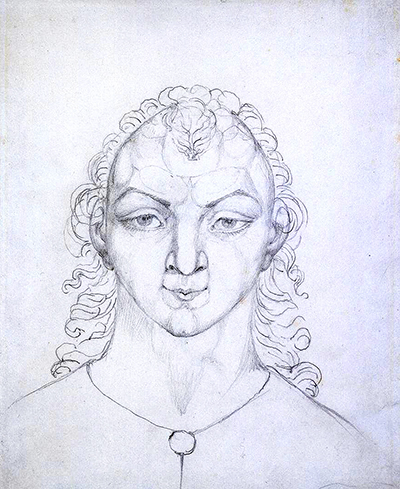
A face looks out from beneath a high forehead, its eyes wide and its mouth almost smiling. Curls fall to either shoulder, a small clasp closes the garment, and a branching shape rises above the brow. The image is familiar as The Man Who Taught Blake Painting in his Dreams. Yet the sheet at Tate is catalogued as a counterproof after William Blake. Its history begins with an imagined teacher and continues through the work of people who copied, inscribed and preserved the head. That combination of invention and transmission runs through the Visionary Heads. [1]
The project developed around Blake’s friendship with the watercolour painter and astrologer John Varley, whom John Linnell introduced to him in 1818. From 1819, Blake drew historical, biblical and imaginary people for Varley. The surviving works range from isolated profiles to complete bodies; some belonged to sketchbooks, while others acquired independent lives as drawings and copies. Selected heads eventually entered Varley’s printed book. Together they form an intimate gallery of people encountered through imagination, conversation and the attentive movement of a pencil. [2]
At a Glance
- Social settingBlake, John Varley and John Linnell [2][3]
- Tate dream instructorCatalogued as a counterproof after Blake [1]
- RangeThe group includes a full-length Old Parr [4]
Contents
- The dream instructor and his copies
- A company gathered around drawing
- Three witnesses, three emphases
- Queen Eleanor: a face before a secure name
- Old Parr and the reach of a whole body
- Leaves from working books
- From the drawing table to Varley’s book
- Encounters that continue on paper
The dream instructor and his copies
The frontal dream instructor offers a good place to begin because his presence is so direct. The neck rises firmly from the shoulders, and the hair widens the outline without overwhelming the face. The eyebrows slope towards the nose, while the slightly uneven eyes resist the symmetry of a mask. Around the lips, small changes of contour hold an expression between composure and animation. Almost everything that gives the head its particular character occupies a very small area of paper. [1]
The branching form on the forehead makes that character harder to place. It appears to grow out of the head, with a central stem and curling projections. It can be approached as an image of inspiration without deciding exactly what object it represents. In the surrounding curls, repeated loops organise the hair into an intricate frame. Against them, the central feature seems more deliberate and emblematic, a sign that this apparently available face retains something the viewer cannot fully explain. [1]
Tate’s sheet, N05187, measures 29.6 by 23.5 centimetres and is dated after about 1819–20. Its current attribution is after Blake. The Fitzwilliam Museum holds the drawing identified in Tate’s catalogue as the probable original, now PD.166-1985. A third version, Tate N05186, is a replica attributed to Linnell and dated about 1825. The family resemblance between the three works is itself part of the subject: a visionary image could become something worth reproducing with considerable care. [1][5][6]
A counterproof transfers a drawing’s marks onto another surface and reverses their direction. Reversal helps explain why related versions can look subtly unfamiliar even when their features are almost identical. In discussing the instructor, Tate’s catalogue also separates image size from paper size: the heads are much closer in scale than differently cropped reproductions might suggest. The large sheet around a small head, or a tightly cropped photograph, changes our first impression of the drawing without changing the face itself. [1]
The near agreement of the two Tate versions raises another question about copying. Their lines fail to coincide exactly, so Butlin suggests an optical aid such as Cornelius Varley’s Graphic Telescope. That is an explanation proposed from comparison, rather than a documented instrument used for this particular head. It helps distinguish two possibilities that can easily be confused: a direct transfer from a drawing and a new drawing made with assistance in following an existing image. [6]
Linnell’s inscriptions identify the subject through his relationship with Blake. They preserve a story of instruction received in dreams, rather than the ordinary identifying details of a commissioned portrait. On N05186, the title takes two slightly different forms along the bottom. Those handwritten explanations make the pictured person available to someone who was absent from the original conversation. They are a bridge between the private encounter and the later viewer. [6]
Geoffrey Keynes proposed that the instructor might be a visionary self-portrait. Tate’s catalogue records that suggestion and a debate over the forehead emblem, which Keynes associated with a menorah and the catalogue instead compared with flames of inspiration. These are interpretations, rather than a recovered name for the sitter. The head can remain compelling without being resolved into Blake himself or an identifiable ancient painter. Its title gives us a relationship; the drawing supplies a face. [1]
A company gathered around drawing
Varley’s presence gives the heads a distinctive social setting. An artist interested in faces and an astrologer interested in character could ask Blake for subjects, watch him draw and preserve the results. Linnell’s involvement added another skilled observer and, eventually, an engraver. The project brought together different kinds of attention: Blake’s pictorial invention, Varley’s wish to understand visionary experience, and the practical demands of making images available to others. [2][3]
The most memorable account of the evenings is Allan Cunningham’s, published in 1830. He describes a friend of Blake showing him a book of heads and recounting nocturnal sittings. The friend, identified by Martin Butlin as Varley, said that he sometimes slept and sometimes woke while Blake continued drawing. The alternating alertness of the watcher is an unusually domestic detail. It puts the extraordinary claims beside the ordinary realities of companionship, fatigue, paper and a long evening. [2][7]
Cunningham also retells an episode in which Blake was drawing William Wallace when Edward I supposedly intervened. The artist turned to a second sheet, drew the king, and then returned to Wallace. The anecdote makes imagined figures behave like impatient visitors, while the activity remains recognisable as portrait work interrupted by another demand. Its drama depends on the listener accepting that the sitters possess their own timing. Cunningham’s account preserves the story as told around the drawings; it does not make its narrator an eyewitness to that sitting. [7]
His book-viewing scene has a similar rhythm. A face is presented, the visitor guesses its moral character, and the host reveals a name which appears to vindicate the guess. Pindar, Corinna, a biblical taskmaster and the Devil belong to the sequence. The story turns the album into a succession of discoveries, allowing the company to move between ancient poetry, Scripture and contemporary personal resemblance. Looking becomes conversation, and conversation supplies the faces with histories. [7]
Three witnesses, three emphases
Varley’s own account appeared in A Treatise on Zodiacal Physiognomy in 1828. Its discussion of the flea begins by relating the creature to Gemini. He then describes supplying Blake with paper and a pencil and watching him interrupt a profile to draw the mouth separately. Varley regarded that change as evidence that Blake had an image before him which altered as he worked. The passage shows an observer explaining how he became convinced. His conclusion belongs to his account of the event. [3]
John Thomas Smith, also writing in 1828, approaches Blake through the pleasures of his art and conversation. In Nollekens and his Times, the flea is an entertaining personification whose verbal description can exceed the strangeness of the picture. Smith moves from the creature’s appetite and imagined strength to Blake’s industry, then to his colouring. The sequence matters: extraordinary talk stands beside persistent artistic labour. Smith’s writing gives the anecdote a different purpose from Varley’s attempted investigation. [8]
Cunningham, in turn, describes his own response to drawings and a small painted panel while placing accounts of their making in other people’s mouths. His judgements move between admiration and ridicule. Those changes of tone reveal something about the audience the heads encountered, as well as the works themselves. The three writers offer different kinds of evidence: a participant’s explanation, a biographer’s recollection of talk and art, and a visitor’s narrated encounter with a collection. Their shared subject does not turn them into one continuous transcript. [3][7][8]
For the drawings, this distinction is useful. We can ask how a head is constructed, how it was labelled and how it was shown without deciding that the surviving paper demonstrates an external apparition. We can also recognise Blake’s seriousness about visionary experience without assigning him a retrospective diagnosis. The accounts establish the language and convictions with which people approached the works. The objects give us another, more enduring form of encounter: marks that remain available for close looking. [1][3][7][8]
Queen Eleanor: a face before a secure name
At the Huntington, Queen Eleanor, dated about 1819–20, turns her eyes upwards. The face is broad and calm, with a small mouth and a strong, rounded chin. Long hair descends in waves on either side of the neck. Near the top, three raised, curled forms make a crown-like silhouette. The movement of the eyes is slight, but it prevents the frontal arrangement from becoming wholly still. We seem to have arrived while her attention is directed somewhere above us. [9]
The hair gives the drawing much of its movement. Its repeated strands bend outwards at the temples and turn back towards the shoulders. In places, several pencil lines gather closely enough to create a dark passage; elsewhere a single contour is left to carry the shape. Against these streaming edges, the face has a quieter surface. Light shading beneath the chin establishes the neck without turning the sheet into a fully modelled bust. The drawing gives different degrees of finish to the features that hold our attention. [9]
The title leaves an unresolved historical question. The Huntington discusses both Eleanor of Aquitaine and Eleanor of Castile, each of whom appears elsewhere in Blake’s artistic world. It finds no decisive identification in this face. The museum follows the title through nineteenth-century descriptions and the Linnell sale of 1918, while keeping the choice between the two queens open. A plausible association with a monument or another image is therefore an invitation to compare, rather than sufficient grounds to settle the sitter’s identity. [9]
That uncertainty does little to diminish the portrait’s visual individuality. The upward eyes, rounded mouth and long waves of hair make it different from the dream instructor’s sharper, more insistent frontality. Both heads address a viewer, but they do so through different arrangements of attention. With Eleanor, the gaze leads out of the encounter; with the instructor, the eyes seem to hold us within it. Their interest lies in these particular differences before it lies in a successful act of naming. [1][9]
Watch: William Blake’s world and working methods
Choose an introduction to Blake, a printing demonstration, or a discussion of his radical ideas.
William Blake: Poet, Artist & Visionary - a genius of early Romanticism in England
An introduction to Blake’s art, poetry and imaginative world.
Watch on YouTubeOld Parr and the reach of a whole body
Old Parr When Young, at the Huntington, makes the term Visionary Heads unexpectedly expansive. The work, dated 1820, shows a complete nude male figure standing upright on a narrow ground. His arms extend slightly from his body, their unfinished hands opening towards the edges. Long curls frame a relatively small head above a heavily articulated chest and abdomen. The drawing grants the body far more space than the face. [4]
Thomas Parr was famous for allegedly living to the age of 152 before his death in 1635. The age is a claim attached to a legend of longevity, rather than a securely established lifespan. Blake presents the celebrated old man as young. The Huntington interprets his heroic musculature in relation to vitality. That choice shifts the portrait away from the physical signs by which a viewer would normally recognise an exceptionally old person. The pictured body gives the legend a new form. [4]
Look at the relation between the legs. One supports the figure more firmly, while the other bends and crosses towards it. The feet approach each other at the bottom, gathering the weight of the broad torso into a small area. Above them, the shoulders spread and the forearms reach down and out. The posture combines a commanding upper body with an almost delicate arrangement of the lower limbs. Its balance has to be followed through the whole figure. [4]
The shading reinforces that experience. Rounded patches establish the chest, abdominal divisions and thighs; the contours of the arms become lighter as they reach the hands. An unfinished area can make an adjacent passage feel more substantial. The head is carefully available, but it cannot dominate the sheet in the way a large isolated profile would. Looking travels between face, muscular trunk, lightly indicated extremities and the writing below. [4]
Beside Eleanor, Parr shows how elastic this portrait project could be. A face lifted in quiet attention and a body displaying strength offer very different ways of making a past person present. The category embraces them because of their association with Blake’s visionary sittings, rather than a rule that every sheet must contain one head at one scale. That freedom is among the project’s pleasures: a viewer cannot predict the next work merely from the general title. [9][4]
Leaves from working books
The surviving objects also carry traces of less theatrical activity. Tate’s flea head, N05184, is a leaf from the Small Blake–Varley Sketchbook. The book had already been used by Varley for landscapes before Blake used it for the heads. The independent sheet once occupied a place among other drawings, with neighbours before and after it. The collection’s record of that setting brings the famous profile back into the activity of a working book. [10]
On the other side of the flea leaf, a reduced drawing of Milton’s first wife shares space with a profile and colour notes. This side originally preceded the flea. The change from book to independent artwork has therefore altered how the object is normally encountered: the celebrated subject comes first, while the related activities behind it require a deliberate turn of the sheet. [10]
Tate attributes the colour notes to Varley. Butlin suggests that the reduced image gave him somewhere to record observations while leaving the larger portrait on the facing page untouched. Likewise, a written name, an added number and a later mount can each belong to a different moment in a sheet’s history. Reading them together requires attention to whose hand wrote what. The heads became objects through which several people organised, remembered and transmitted an encounter. [1][6][10]
The Small Sketchbook was rediscovered in 1967 and subsequently dispersed; its leaves were sold separately in 1971. A larger Blake–Varley sketchbook reappeared in 1989. These discoveries helped scholars reconnect sheets and distinguish groups whose earlier histories had been confused. Butlin also discusses Bentley’s reconstruction of a further folio book. The last is a scholarly reconstruction from scattered evidence, with a different status from a book whose binding and pages can be examined together. [2][10]
The changing evidence makes a single unqualified total of the heads less helpful than it first appears. One must decide whether to count subjects, surviving autograph drawings, transferred impressions, replicas or several studies on one leaf. For a reader, the more revealing questions are often smaller: which object is this, how does it relate to another version, and what did its owner or copyist add? Those questions recover differences that a headline number would conceal. [1][2][6][10]
From the drawing table to Varley’s book
The journey into print can be followed in a particularly revealing pair of images. Butlin reproduces Varley’s preparation for a three-head plate alongside Linnell’s finished engraving for the Treatise. The preparation places a large human profile at the left, a smaller one below the centre and the flea at the right. In the engraving, those positions are retained, while the lines become firmer and the subjects receive printed labels. A gathering on paper becomes an arrangement made for readers. [2]
The change is visible most clearly in the flea. In Varley’s preparation, its projecting tongue has a long, almost absurd prominence. In the engraved head, the open mouth and teeth are more sharply articulated. Above them, the great curved forehead and small eye become an emphatic silhouette. The print gives the creature a cleaner edge against the blank background, making its difference from the two human profiles immediately legible. [2]
This is a composed plate containing several heads, with several makers involved in its preparation and execution. It should be distinguished from an individual autograph drawing by Blake, and from a modern arrangement of photographs of separate sheets. The captioned engraving has its own purpose. The labels Gemini and Cancer place the human profiles within Varley’s astrological system, while the flea’s connection with Blake is explicitly announced. The page asks its reader to move between comparison, classification and a reported vision. [2]
Other preparations reproduced by Butlin show eyes isolated above rows of heads, and separate pieces of paper assembled on a larger sheet. These are especially useful companions to the more celebrated portraits. A face can be broken into features, tried beside another profile or moved into a new arrangement. Varley’s printed argument required such practical decisions. Its illustrations emerged through selection and adjustment, even when their subjects were introduced as records of extraordinary experiences. [2]
The Treatise appeared in 1828, after Blake’s death. The projected continuation was never completed, and Tate’s catalogue suggests that the dream-instructor versions may have been trials for an engraving intended for an unpublished part. The suggestion remains a proposal about their purpose. What survives makes clear, however, that copying was an active part of the heads’ history. A transferred drawing or replica could carry a face towards another reader even when the larger publishing ambition remained unrealised. [2][6]
Encounters that continue on paper
The most famous inhabitant of this company, the Ghost of a Flea, acquired a separate painted body and setting. The heads as a group ask for a wider kind of attention. Eleanor’s upward gaze, Parr’s expansive physique, the dream instructor’s emblematic brow and the flea’s detached mouth show how many different pictorial problems the project could contain. They offer no single formula for a visionary portrait. [1][9][4][10]
Nor does their intimacy depend on accepting every story told about them. Their histories bring us close to artists sitting together, asking for an image, offering paper, adding an inscription and deciding what might be copied. The broader range of Blake’s drawings helps place that activity within his work. Here, the special fascination lies in watching an imagined encounter acquire a shareable form. Each surviving sheet preserves something particular, while the differences between the sheets keep the company unexpectedly alive. [1][2][6][10]
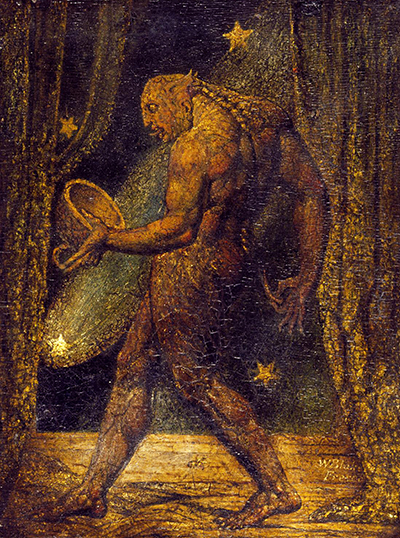
The Ghost of a Flea. The painted composition associated with the visionary-head circle.
Works and designs directory
Browse separate works, impressions and book components. Dates distinguish versions; six Tate copies after Blake are labelled. These records are not a complete catalogue of unique designs.
| Name | Date | Medium |
|---|---|---|
| A Figure Standing in a Gothic Apse, perhaps the Empress Maud. Verso: Detailed Drawings for ‘The Empress Maud in Bed’ | c.1819 | Pencil drawing |
| A Rolling Stone Is Ever Bare of Moss, from Thornton's "Pastorals of Virgil" | 1821 | Wood engraving |
| A Title Page for The Grave | 1806 | Watercolour |
| A Vision of the Last Judgment | 1808 | Watercolour |
| A Vision: The Inspiration of the Poet (Elisha in the Chamber on the Wall) | c.1819–20? | Watercolour |
| Adam and the Beasts, Frontispiece to Hayley's "Ballads" | June 1, 1802 | Engraving |
| Age Teaching Youth | c.1785–90 | Watercolour |
| Alfred and the Neat-Herd’s Wife (after Henry Fuseli) | 1797, published 1798 | Etching and engraving |
| An Allegory of the Bible. Verso: The Shins of an Écorché Male Figure | c.1780–5, ?c.1780 | Watercolour |
| Angel of the Divine Presence Bringing Eve to Adam (The Creation of Eve: "And She Shall be Called Woman) (recto); Sketch for the same (verso) | ca. 1803 | Watercolour |
| Angel of the Revelation (Book of Revelation, chapter 10) | ca. 1803–5 | Watercolour |
| Antaeus setting down Dante and Virgil in the Last Circle of Hell | 1824–1827 | Watercolour |
| Bathsheba at the Bath | c.1799–1800 | Tempera |
| Beatrice Addressing Dante from the Car | 1824–7 | Watercolour |
| Behemoth and Leviathan | 1825–26 | Engraving |
| Behemoth and Leviathan | 1825, reprinted 1874 | Engraving |
| Behemoth and Leviathan | 1826 | Engraving |
| Blasted Trees and Flattened Crops, from Thornton's "Pastorals of Virgil" | 1821 | Wood engraving |
| Boy Returning Joyfully, with Plough and Oxen, from Thornton's "Pastorals of Virgil" | 1821 | Wood engraving |
| Boy Returning Joyfully, with Plough and Oxen, from Thornton's "Pastorals of Virgil" | 1821 | Wood engraving |
| Catherine Blake. Verso: A Man’s Head and Other Drawings | c.1805 | Pencil drawing |
| Cerberus | 1824–7 | Watercolour |
| Cerberus (second version) | 1824–1827 | Watercolour |
| Chaucer’s Canterbury Pilgrims | 1810, reprinted before 1881 | Engraving |
| Christ Appearing to His Disciples After the Resurrection | c.1795 | Colour print |
| Christ Appearing to the Apostles after the Resurrection | c.1795 | Watercolour |
| Christ Blessing the Little Children | 1799 | Tempera |
| Christ in the Carpenter’s Shop: The Humility of the Saviour (after William Blake) | Date not stated | Watercolour |
| Ciampolo the Barrator Tormented by the Devils | 1826–7, reprinted 1892 | Engraving |
| Ciampolo the Barrator Tormented by the Devils | 1826–7, reprinted 1968 | Engraving |
| Circle of Theives: Agnello Brunelleschi Attacked By a Six-Footed Serpent | ca. 1825–27 | Engraving |
| Clarence's Dream (Shakespeare, Richard III, Act 1, Scene 4) | 1774 | Etching and engraving |
| Colinet Mocked by Two Boys, from Thornton's "Pastorals of Virgil" | 1821 | Wood engraving |
| Colinet Rests by a Stream at Night | c.1821, printed 1830 | Wood engraving |
| Colinet Rests by a Stream at Night | 1821, reprinted 1977 | Wood engraving |
| Colinet with his Shepherd’s Pipe, Mocked by Two Boys | c.1821, printed 1830 | Wood engraving |
| Colinet with his Shepherd’s Pipe, Mocked by Two Boys | 1821, reprinted 1977 | Wood engraving |
| Colinet's Journey, Milestone Marked 'LXII Miles to London', from Thornton's "Pastorals of Virgil" | 1821 | Wood engraving |
| Colinet's Journey: Milestone Marked 'LXII Miles to London', from Thornton's "Pastorals of Virgil" | 1821 | Wood engraving |
| Colinet’s Fond Desire Strange Lands to Know | 1821, reprinted 1977 | Wood engraving |
| Colinet’s ‘Fond Desire Strange Lands to Know’ | c.1821, printed 1830 | Wood engraving |
| Composition Sketch for ‘The Fall of the Rebel Angels’? Verso: Standing Figure with Flaming Hair | ?c.1805–10 | Pencil drawing |
| Composition Sketch, Possibly a Subject from Dante. Verso: A Man Standing over a Figure Reclining on a Bed | ?1824–7, ?c.1800–10 | Pencil drawing |
| Composition Sketch. Verso: Standing Figure Holding a Spear | ?c.1805–10 | Pencil drawing |
| Dante and Virgil Approaching the Angel Who Guards the Entrance of Purgatory | 1824–7 | Watercolour |
| Dante and Virgil Penetrating the Forest | 1824–7 | Watercolour |
| Dante in the Empyrean, Drinking at the River of Light | 1824–7 | Watercolour |
| Dante running from the Three Beasts | 1824–1827 | Watercolour |
| Dante Striking against Bocca Degli Abati | 1826–7, reprinted 1892 | Engraving |
| Dante Striking Against Bocca degli Abati | 1826–7, reprinted 1968 | Engraving |
| David Delivered out of Many Waters | c.1805 | Watercolour |
| David Delivered out of Many Waters (after William Blake) | Date not stated | Watercolour |
| Detailed Drawings for ‘A Figure Standing in a Gothic Apse’ | 1819 | Pencil drawing |
| Elohim Creating Adam | 1795–c.1805 | Colour print |
| Enoch | 1806–7 | Lithograph |
| Epitome of James Hervey’s ‘Meditations among the Tombs’ | c.1820–5 | Watercolour |
| Europe. A Prophecy; Frontispiece | ca. 1820 | Relief etching |
| Evening | c.1820/1825 | Watercolour |
| Every Man also Gave him a Piece of Money | 1825, reprinted 1874 | Engraving |
| Every Man also Gave him a Piece of Money. Verso: God the Father with Attendant Angels | c.1821–3 | Watercolour |
| Every One also Gave Him a Piece of Money | 1826 | Engraving |
| Fertilization of Egypt, from Erasmus Darwin's "The Botanic Garden" | 1791 | Engraving |
| First Book of Urizen pl. 10 | 1796, c.1818 | Etching |
| First Book of Urizen pl. 11 | 1796, c.1818 | Etching |
| First Book of Urizen pl. 15 | 1796, c.1818 | Etching |
| First Book of Urizen pl. 17 | 1796, c.1818 | Etching |
| First Book of Urizen pl. 21 | 1796, c.1818 | Etching |
| First Book of Urizen pl. 6 | 1796, c.1818 | Etching |
| Frontispiece to Jerusalem, the Emanation of the Great Albion | [ca. 1804–20] (?) | Engraving |
| Frontispiece to ‘Visions of the Daughters of Albion’ | c.1795 | Relief etching |
| Frontispiece: Thenot and Colinet | c.1821, printed 1830 | Wood engraving |
| George Cumberland's Message Card | 1827 | Engraving |
| God Judging Adam | ca. 1795 | Relief etching |
| God Judging Adam | 1795 | Relief etching |
| Hiding of Moses, from "Remember Me!, or a Pocket Companion" | 1825 | Engraving |
| Homer and the Ancient Poets | 1824–7 | Watercolour |
| Illustration 1 to Milton’s On the Morning of Christ’s Nativity: The Descent of Peace | c.1814–1816 | Watercolour |
| Illustration 1 to Milton’s Paradise Lost: Satan Calling Up His Legions | 1807 | Watercolour |
| Job accepting Charity | 1825–26 | Engraving |
| Job and his Daughters | 1825–26 | Engraving |
| Job and his Daughters | 1825, reprinted 1874 | Engraving |
| Job and His Daughters | 1826 | Engraving |
| Job and His Family | 1825–26 | Engraving |
| Job and his Family | Reprinted 1874; engraved 1828 date is an error | Engraving |
| Job and His Family | 1826 | Engraving |
| Job and his Family Restored to Prosperity | 1825, reprinted 1874 | Engraving |
| Job and his Wife restored to Prosperity | 1825–26 | Engraving |
| Job rebuked by his Friends | 1825–26 | Engraving |
| Job Rebuked by his Friends | 1825, reprinted 1874 | Engraving |
| Job Rebuked by His Friends | 1826 | Engraving |
| Job's Comforters | 1825–26 | Engraving |
| Job's Comforters | 1826 | Engraving |
| Job's Despair | 1825–26 | Engraving |
| Job's Evil Dreams | 1825–26 | Engraving |
| Job's Evil Dreams | 1826 | Engraving |
| Job's Sacrifice | 1825–26 | Engraving |
| Job's Sons and Daughters Overwhelmed by Satan | 1826 | Engraving |
| Job, his Wife and his Friends: The Complaint of Job. Verso: Job’s Wife and Eight Other Sketches | c.1785 | Watercolour |
| Job’s Comforters | 1825, reprinted 1874 | Engraving |
| Job’s Despair | 1825, reprinted 1874 | Engraving |
| Job’s Evil Dreams | 1825, reprinted 1874 | Engraving |
| Job’s Sacrifice | 1825, reprinted 1874 | Engraving |
| Job’s Sons and Daughters Overwhelmed by Satan | 1825, reprinted 1874 | Engraving |
| John Linnell | 1825 | Pencil drawing |
| Joseph of Arimathea Preaching to the Britons | c.1794/1796 | Relief etching |
| Judas Betrays Him | c.1803–5 | Watercolour |
| King John Absolved by Pandulph (after Henry Fuseli) | 1797, published 1798 | Etching and engraving |
| Lamech and his Two Wives | 1795 | Colour print |
| Landscape near Felpham | c.1800 | Watercolour |
| Lear and Cordelia in Prison | c.1779 | Watercolour |
| Los and Orc | c.1792–3 | Watercolour |
| Lower Half of a Woman Playing a Harp. Verso: Seraphim and Other Drawings | c.1785, c.?1807 | Pencil drawing |
| Menalcus Watching Women Dance, from Thornton's "Pastorals of Virgil" | 1821 | Wood engraving |
| Menalcus Watching Women Dance, from Thornton's "Pastorals of Virgil" | 1821 | Wood engraving |
| Moses Indignant at the Golden Calf | c.1799–1800 | Tempera |
| Nebuchadnezzar | 1795–c.1805 | Colour print |
| Newton | 1795–c.1805 | Colour print |
| Oberon, Titania and Puck with Fairies Dancing | c.1786 | Watercolour |
| Pity | ca. 1795 | Relief etching |
| Pity | c.1795 | Colour print |
| Plate 2 of ‘Urizen’: ‘Teach these Souls to Fly’ | ?1796 | Relief etching |
| Plate 3 of ‘Urizen’: Oh! Flames of Furious Desires’ (after William Blake) | Date not stated | Watercolour |
| Plate 4 of ‘Visions of the Daughters of Albion’ | c.1795 | Relief etching |
| Plutus | 1824–7 | Watercolour |
| Preliminary Sketch for ‘Christ Girding Himself with Strength’. Verso: Standing Figure with One Arm Raised | c.1805, c.1805–10 | Pencil drawing |
| Preludium. "The shadowy daughter of Urthona stood before red Orc..." (Plate 3) | 1793 | Relief etching |
| Queen Elizabeth and Essex (after Henry Fuseli) | 1797, published 1798 | Engraving |
| Sabrina's Silvery Flood, from Thornton's "Pastorals of Virgil" | 1821 | Wood engraving |
| Sabrina's Silvery Flood, from Thornton's "Pastorals of Virgil" | 1821 | Wood engraving |
| Sabrina’s Silvery Flood | c.1821, printed 1830 | Wood engraving |
| Sabrina’s Silvery Flood | 1821, reprinted 1977 | Wood engraving |
| Satan Before the Throne of God | 1825–26 | Engraving |
| Satan before the Throne of God | 1825, reprinted 1874 | Engraving |
| Satan before the Throne of God | 1826 | Engraving |
| Satan calling up his Legions | c.1800–05 | Tempera |
| Satan Exulting over Eve | c.1795 | Colour print |
| Satan Going Forth from the Presence of the Lord, and Job’s Charity | 1825, reprinted 1874 | Engraving |
| Satan Going Forth fron the Presence of the Lord | 1825–26 | Engraving |
| Satan in his Original Glory: ‘Thou wast Perfect till Iniquity was Found in Thee’ | c.1805 | Watercolour |
| Satan Smiting Job with Boils | 1825–26 | Engraving |
| Satan Smiting Job with Sore Boils | 1825, reprinted 1874 | Engraving |
| Satan Smiting Job with Sore Boils | c.1826 | Tempera |
| Satan Smiting Job with Sore Boils | 1826 | Engraving |
| Shepherd Chases Away a Wolf, from Thornton's "Pastorals of Virgil" | 1821 | Wood engraving |
| Shepherd Chases Away a Wolf, from Thornton's "Pastorals of Virgil" | 1821 | Wood engraving |
| Sketch for the Title-Page of the Engraved Illustrations to the Book of Job | c.1823/1826 | Pencil drawing |
| Sketch for ‘The Four and Twenty Elders Casting their Crowns before the Divine Throne’. Verso: Standing Figure with Arms at his Side | c.1803, c.1805–10 | Pencil drawing |
| Sketch for ‘Tiriel Supporting the Dying Myratana’. Verso: Sketch for ‘Tiriel Supporting the Dying Myratana’ | c.1786–9 | Pencil drawing |
| Songs of Experience: A Little Boy Lost | [1794] printed ca. 1825 | Relief etching |
| Songs of Experience: A Little Girl Lost | [1794] printed ca. 1825 | Relief etching |
| Songs of Experience: A Poison Tree | [1794] printed ca. 1825 | Relief etching |
| Songs of Experience: Earth's Answer | [1794] printed ca. 1825 | Relief etching |
| Songs of Experience: Frontispiece | [1794] printed ca. 1825 | Relief etching |
| Songs of Experience: Holy Thursday | [1794] printed ca. 1825 | Relief etching |
| Songs of Experience: Infant Sorrow | [1794] printed ca. 1825 | Relief etching |
| Songs of Experience: Introduction | [1794] printed ca. 1825 | Relief etching |
| Songs of Experience: London | [1794] printed ca. 1825 | Relief etching |
| Songs of Experience: My Pretty Rose Tree, Ah! Sun-Flower, The Lilly | [1794] printed ca. 1825 | Relief etching |
| Songs of Experience: Nurses Song | [1794] printed ca. 1825 | Relief etching |
| Songs of Experience: The Angel | [1794] printed ca. 1825 | Relief etching |
| Songs of Experience: The Chimney Sweeper | [1794] printed ca. 1825 | Relief etching |
| Songs of Experience: The Clod & the Pebble | [1794] printed ca. 1825 | Relief etching |
| Songs of Experience: The Fly | [1794] printed ca. 1825 | Relief etching |
| Songs of Experience: The Garden of Love | [1794] printed ca. 1825 | Relief etching |
| Songs of Experience: The Human Abstract | [1794] printed ca. 1825 | Relief etching |
| Songs of Experience: The Little Girl Found (second plate) | [1789] printed ca. 1825 | Relief etching |
| Songs of Experience: The Little Girl Lost | [1789] printed ca. 1825 | Relief etching |
| Songs of Experience: The Little Girl Lost (second plate); The Little Girl Found | [1789] printed ca. 1825 | Relief etching |
| Songs of Experience: The Little Vagabond | [1794] printed ca. 1825 | Relief etching |
| Songs of Experience: The School Boy | [1789] printed ca. 1825 | Relief etching |
| Songs of Experience: The Sick Rose | [1794] printed ca. 1825 | Relief etching |
| Songs of Experience: The Tyger | [1794] printed ca. 1825 | Relief etching |
| Songs of Experience: The Voice of the Ancient Bard | [1789] printed ca. 1825 | Relief etching |
| Songs of Experience: Title-page | [1794] printed ca. 1825 | Relief etching |
| Songs of Experience: To Tirzah | [1794] printed ca. 1825 | Relief etching |
| Songs of Innocence and of Experience, Shewing the Two Contrary States of the Human Soul: Combined Title-page | [1789–94] printed ca. 1825 | Relief etching |
| Songs of Innocence and of Experience: Infant Sorrow | 1794, reprinted 1831 or later | Relief etching |
| Songs of Innocence: A Cradle Song | [1789] printed ca. 1825 | Relief etching |
| Songs of Innocence: A Cradle Song (second plate) | [1789] printed ca. 1825 | Relief etching |
| Songs of Innocence: A Dream | [1794] printed ca. 1825 | Relief etching |
| Songs of Innocence: Frontispiece | [1789] printed ca. 1825 | Relief etching |
| Songs of Innocence: Holy Thursday | [1789] printed ca. 1825 | Relief etching |
| Songs of Innocence: Infant Joy | [1789] printed ca. 1825 | Relief etching |
| Songs of Innocence: Introduction | [1789] printed ca. 1825 | Relief etching |
| Songs of Innocence: Laughing Song | [1789] printed ca. 1825 | Relief etching |
| Songs of Innocence: Little Boy Lost | [1789] printed ca. 1825 | Relief etching |
| Songs of Innocence: Night | [1789] printed ca. 1825 | Relief etching |
| Songs of Innocence: Night (second plate) | [1789] printed ca. 1825 | Relief etching |
| Songs of Innocence: Nurse's Song | [1789] printed ca. 1825 | Relief etching |
| Songs of Innocence: On Anothers Sorrow | [1789] printed ca. 1825 | Relief etching |
| Songs of Innocence: Spring | [1789] printed ca. 1825 | Relief etching |
| Songs of Innocence: Spring (second plate) | [1789] printed ca. 1825 | Relief etching |
| Songs of Innocence: The Blossom | [1789] printed ca. 1825 | Relief etching |
| Songs of Innocence: The Chimney Sweeper | [1789] printed ca. 1825 | Relief etching |
| Songs of Innocence: The Divine Image | [1789] printed ca. 1825 | Relief etching |
| Songs of Innocence: The Ecchoing Green | [1789] printed ca. 1825 | Relief etching |
| Songs of Innocence: The Ecchoing Green (second plate) | [1789] printed ca. 1825 | Relief etching |
| Songs of Innocence: The Lamb | [1789] printed ca. 1825 | Relief etching |
| Songs of Innocence: The Little Black Boy | [1789] printed ca. 1825 | Relief etching |
| Songs of Innocence: The Little Black Boy (second plate) | [1789] printed ca. 1825 | Relief etching |
| Songs of Innocence: The Little Boy Found | [1789] printed ca. 1825 | Relief etching |
| Songs of Innocence: The Shepherd | [1789] printed ca. 1825 | Relief etching |
| Songs of Innocence: Title Page | [1789] printed ca. 1825 | Relief etching |
| St Christopher, Copy from an Engraving? Verso:Part of a Face: Copy from a Plaster Cast: a Daughter of Niobe? | ?c.1779–80 | Pencil drawing |
| The Agony in the Garden | c.1799–1800 | Tempera |
| The Angel Appearing to Zacharias | 1799–1800 | Tempera |
| The Ascent of the Mountain of Purgatory | 1824–7 | Watercolour |
| The Baffled Devils Fighting | 1826–7, reprinted 1892 | Engraving |
| The Baffled Devils Fighting | 1826–7, reprinted 1968 | Engraving |
| The Bard, from Gray | ?1809 | Tempera |
| The Beggar's Opera, Act III | July 1, 1790 | Etching and engraving |
| The Beggar's Opera, Act III | July 1, 1790 | Engraving |
| The Beggar's Opera, Act III | 1790 | Engraving |
| The Blasphemer | c.1800 | Watercolour |
| The Blighted Corn | c.1821, printed 1830 | Wood engraving |
| The Blighted Corn | 1821, reprinted 1977 | Wood engraving |
| The Body of Abel Found by Adam and Eve | c.1826 | Tempera |
| The Body of Christ Borne to the Tomb | c.1799–1800 | Tempera |
| The Book of Job: Title Page | 1825 | Engraving |
| The Book of Thel pl. 6 | 1796, c.1818 | Etching |
| The Circle of Corrupt Officials: The Devils Mauling Each Other | ca. 1825–27 | Engraving |
| The Circle of Corrupt Officials: The Devils Tormenting Ciampolo | ca. 1825–27 | Engraving |
| The Circle of the Lustful: Francesca da Rimini (‘The Whirlwind of Lovers’) | 1826–7, reprinted 1892 | Engraving |
| The Circle of the Lustful: Francesca da Rimini (‘The Whirlwind of Lovers’) | 1826–7, reprinted 1968 | Engraving |
| The Circle of the Lustful: Paolo and Francesca | ca. 1825–27 | Engraving |
| The Circle of the Thieves; Buoso Donati Attacked by the Serpent | ca. 1825–27 | Engraving |
| The Circle of Traitors: Dante's Foot Striking Bocca degli Abbate | ca. 1825–27 | Engraving |
| The Complaint and the Consolation; or, Night Thoughts | 1797 | Etching and engraving |
| The Creation | 1825–26 | Engraving |
| The Crucifixion | c.1825–7 | Pencil drawing |
| The Crucifixion: ‘Behold Thy Mother’ | c.1805 | Watercolour |
| The Dance of Albion (Glad Day) | c.1803/1810 | Engraving |
| The Death of Lucretia, from Allen's "New and Impartial Roman History" | 1797 | Engraving |
| The Death of Saint Joseph | 1803 | Watercolour |
| The Death of the Virgin | 1803 | Watercolour |
| The Descent of Peace [recto] | c.1815 | Pencil drawing |
| The Destruction of Job's Sons | 1825–26 | Engraving |
| The Devils, with Dante and Virgil by the Side of the Pool | 1824–7 | Watercolour |
| The Entombment | c.1805 | Watercolour |
| The Fall of Rosamond (after Thomas Stothard) | 1783 | Etching and engraving |
| The Fall of Satan | 1825–26 | Engraving |
| The Fall of Satan | 1825, reprinted 1874 | Engraving |
| The Fall of Satan | 1826 | Engraving |
| The Four and Twenty Elders Casting their Crowns before the Divine Throne | c.1803–5 | Watercolour |
| The Ghost of a Flea | c.1819–20 | Tempera |
| The Good and Evil Angels | 1795–?c.1805 | Colour print |
| The Good Farmer, Probably the Parable of the Wheat and the Tares. Verso: Rough Sketch of Two or Three Figures in a Landscape | c.1780–5 | Watercolour |
| The Great Red Dragon and the Beast from the Sea | c.1805 | Watercolour |
| The Great Red Dragon and the Woman Clothed with the Sun | c.1805 | Watercolour |
| The Head of the Ghost of a Flea. Verso: A Profile and a Reduced Drawing of Milton’s First Wife | c.1819 | Pencil drawing |
| The Hermit’s Dog, from William Hayley’s "Ballads" | 1805 | Etching and engraving |
| The Hiding of Moses | 1824 | Engraving |
| The House of Death | 1795–c.1805 | Colour print |
| The House of Death | c.1790 | Watercolour |
| The Hypocrites with Caiaphas. Verso: Sketch of a Stooping Figure | 1824–7 | Watercolour |
| The Inscription over the Gate | 1824–7 | Watercolour |
| The Laborious Passage along the Rocks | 1824–7 | Watercolour |
| The Last Trumpet (recto); Two studies of a right eye, a profile of an open-mouthed young man, the head of an eagle, and the head of a lion (verso) | 1780–85 | Pencil drawing |
| The Lord Answering Job out of the Whirlwind | 1825–26 | Engraving |
| The Lord Answering Job out of the Whirlwind | 1825, reprinted 1874 | Engraving |
| The Man Who Taught Blake Painting in his Dreams (counterproof) (after William Blake) | after c.1819–20 | Pencil drawing |
| The Marriage of Heaven and Hell pl. 16 | 1796, c.1818 | Etching |
| The Messengers tell Job of his Misfortunes | 1825–26 | Engraving |
| The Messengers tell Job of his Misfortunes | 1825, reprinted 1874 | Engraving |
| The Night of Enitharmon’s Joy (formerly called ‘Hecate’) | c.1795 | Colour print |
| The Parable of the Wise and Foolish Virgins | ca. 1799–1800 | Watercolour |
| The Parable of the Wise and Foolish Virgins (after William Blake) | Date not stated | Watercolour |
| The Pastorals of Virgil, with a Course of English Reading, Adapted for Schools, Vol. I | 1821 | Wood engraving |
| The Penance of Jane Shore in St Paul’s Church | c.1793 | Watercolour |
| The Pit of Disease: The Falsifiers | 1826–7, reprinted 1892 | Engraving |
| The Pit of Disease: The Falsifiers | 1824–7 | Watercolour |
| The Pit of Disease: The Falsifiers | 1826–7, reprinted 1968 | Engraving |
| The Primaeval Giants Sunk in the Soil | 1824–7 | Watercolour |
| The Punishment of the Thieves | 1824–7 | Watercolour |
| The Raising of Lazarus (after William Blake) | Date not stated | Watercolour |
| The Rest on the Flight into Egypt (The Repose of the Holy Family in Egypt) | 1806 | Watercolour |
| The River of Life | c.1805 | Watercolour |
| The Rock Sculptured with the Recovery of the Ark and the Annunciation | 1824–7 | Watercolour |
| The Serpent Attacking Buoso Donati | 1826–7, reprinted 1892 | Engraving |
| The Serpent Attacking Buoso Donati | 1826–7, reprinted 1968 | Engraving |
| The Serpent Attacking Buoso Donati. Verso: A Man with a Transparent Hood (?) over his Head | 1824–7 | Watercolour |
| The Simoniac Pope | 1824–7 | Watercolour |
| The Six-Footed Serpent Attacking Agnolo Brunelleschi | 1826–7, reprinted 1892 | Engraving |
| The Six-Footed Serpent Attacking Agnolo Brunelleschi | 1826–7, reprinted 1968 | Engraving |
| The Soul Hovering over the Body Reluctantly Parting with Life | c.1805 | Pencil drawing |
| The Spiritual Form of Nelson Guiding Leviathan | c.1805–9 | Tempera |
| The Spiritual Form of Pitt Guiding Behemoth | ?1805 | Tempera |
| The Sun at His Eastern Gate | c.1816–1820 | Watercolour |
| The Temple of Mirth, after Thomas Stothard | 1784 | Engraving |
| The Temptation and Fall of Eve | 1807 | Watercolour |
| The Temptation and Fall of Eve (Illustration to Milton’s Paradise Lost) | 1808 | Watercolour |
| The Thieves and Serpents | 1824–1827 | Watercolour |
| The Vision of Christ | 1825, reprinted 1874 | Engraving |
| The Vision of Eliphaz | 1825–26 | Engraving |
| The Vision of Eliphaz | 1825, reprinted 1874 | Engraving |
| The Vision of God | 1825–26 | Engraving |
| The Wood of the Self-Murderers: The Harpies and the Suicides | 1824–7 | Watercolour |
| The Wrath of Elihu | 1825–26 | Engraving |
| The Wrath of Elihu | 1825, reprinted 1874 | Engraving |
| Thenot and Colinet | 1821, reprinted 1977 | Wood engraving |
| Thenot and Colinet at Supper | c.1821, printed 1830 | Wood engraving |
| Thenot and Colinet at Supper | 1821, reprinted 1977 | Wood engraving |
| Thenot and Colinet Converse Seated between Two Trees | c.1821, printed 1830 | Wood engraving |
| Thenot and Colinet Converse Seated between Two Trees | 1821, reprinted 1977 | Wood engraving |
| Thenot and Colinet Eat Their Evening Meal, from Thornton's "Pastorals of Virgil" | 1821 | Wood engraving |
| Thenot and Colinet Folding their Flocks together at Sunset | c.1821, printed 1830 | Wood engraving |
| Thenot and Colinet Folding their Flocks together at Sunset | 1821, reprinted 1977 | Wood engraving |
| Thenot and Colinet Lead Their Flocks Together, from Thornton's "Pastorals of Virgil" | 1821 | Wood engraving |
| Thenot and Colinet Lead Their Flocks Together, from Thornton's "Pastorals of Virgil" | 1821 | Wood engraving |
| Thenot Remonstrates with Colinet | c.1821, printed 1830 | Wood engraving |
| Thenot Remonstrates with Colinet | 1821, reprinted 1977 | Wood engraving |
| Thenot Remonstrates With Colinet, from Thornton's "Pastorals of Virgil" | 1821 | Wood engraving |
| Thenot Remonstrates With Colinet, from Thornton's "Pastorals of Virgil" | 1821 | Wood engraving |
| Thenot Remonstrates with Colinet, Lightfoot in the Background, from Thornton's "Pastorals of Virgil" | 1821 | Wood engraving |
| Thenot Remonstrates with Colinet: Lightfoot in the Distance | 1821, reprinted 1977 | Wood engraving |
| Thenot Remonstrates with Colinet; Lightfoot in the Distance | c.1821, printed 1830 | Wood engraving |
| Thenot Under a Fruit Tree, from Thornton's "Pastorals of Virgil" | 1821 | Wood engraving |
| Thenot, with Colinet Waving his Arms in Sorrow | c.1821, printed 1830 | Wood engraving |
| Thenot, with Colinet Waving his Arms in Sorrow | 1821, reprinted 1977 | Wood engraving |
| Title Page: Illustrations of the Book of Job | 1825–26 | Engraving |
| Title-Page of ‘The Book of Job’ | 1825, reprinted 1874 | Engraving |
| Tornado–Zeus Battling Typhon, from Erasmus Darwin's "Botanic Garden" | August 1, 1795 | Engraving |
| Tornado–Zeus Battling Typhon, from Erasmus Darwin's "The Botanic Garden" | August 1, 1795 | Engraving |
| Two Figures in a Decorative Border | c.1790 | Pencil drawing |
| Unyok'd Heifers, Loitering Homeward (Return of the Shepherd), from Thornton's "Pastorals of Virgil" | 1821 | Wood engraving |
| Virgil Girding Dante’s Brow with a Rush | 1824–7 | Watercolour |
| Wat Tyler and the Tax-Gatherer (after Henry Fuseli) | 1797, published 1798 | Etching and engraving |
| When the Morning Stars Sang Together | 1825, reprinted 1874 | Engraving |
| When the Morning Stars Sang Together | 1826 | Engraving |
| Winged Figure Flying Through Clouds, from Bell's "Poets" | 1790 | Etching and engraving |
| Winter | c.1820–5 | Tempera |
| ‘A Rolling Stone is ever Bare of Moss’ | c.1821, printed 1830 | Wood engraving |
| ‘A Rolling Stone is ever Bare of Moss’ | 1821, reprinted 1977 | Wood engraving |
| ‘And Unyok’d Heifers, Loitering Homeward, Low’ | c.1821, printed 1830 | Wood engraving |
| ‘And Unyok’d Heifers, Loitering Homewards, Low’ | 1821, reprinted 1977 | Wood engraving |
| ‘Europe’: Fragment of Pages 3 and 4 | 1794–c.1830–5 | Relief etching |
| ‘For him Our Yearly Wakes and Feasts We Hold’ | c.1821, printed 1830 | Wood engraving |
| ‘For him Our Yearly Wakes and Feasts We Hold’ | 1821, reprinted 1977 | Wood engraving |
| ‘Nor Fox, nor Wolf, nor Rat among our Sheep’ | c.1821, printed 1830 | Wood engraving |
| ‘Nor Fox, nor Wolf, nor Rat among our Sheep’ | 1821, reprinted 1977 | Wood engraving |
| ‘Songs of Innocence and of Experience’: ‘Infant Sorrow’ | 1794, reprinted 1831 or later | Relief etching |
| ‘Songs of Innocence and of Experience’: ‘Spring’ | 1794, reprinted 1831 or later | Relief etching |
| ‘Songs of Innocence’: Title-Page | 1789, reprinted 1831 or later | Relief etching |
| ‘Songs of Innocence’: Title-Page | 1789, reprinted 1831 or later | Relief etching |
| ‘With Songs the Jovial Hinds Return from Plow’ | c.1821, printed 1830 | Wood engraving |
| ‘With Songs the Jovial Hinds Return from Plow’ | 1821, reprinted 1977 | Wood engraving |
Frequently Asked Questions
No. The Huntington’s Old Parr When Young is a complete nude figure, dated 1820, with extensive attention to torso and limbs. [4]
Tate records it as a leaf from the Small Blake–Varley Sketchbook, previously used by Varley for landscapes. [10]
Discussion
Look again at the images and ideas explored in William Blake’s Visionary Heads: Drawings and Witnesses. These editorial prompts invite your observations.
Reader Insights
The dream instructor survives through copying and inscription. Its direct-looking face does not erase the counterproof’s material history.
Varley explains how the changing mouth convinced him. His conclusion belongs to his testimony as a witness.
Old Parr gives the whole body more space than the face. The group offers no single formula for a visionary portrait.
Join the Conversation
Share a detail, comparison or question about William Blake’s Visionary Heads: Drawings and Witnesses below.
References
- Tate, The Man Who Taught Blake Painting in his Dreams (counterproof), N05187, current object fields and Martin Butlin’s catalogue entry, published in William Blake 1757–1827, 1990. Collection record. View source.
- Martin Butlin, “Blake, Linnell and Varley and A Treatise on Zodiacal Physiognomy,” in Diana Dethloff, Tessa Murdoch and Kim Sloan, with Caroline Elam, eds., Burning Bright: Essays in Honour of David Bindman (UCL Press, 2015), pp. 126–135, especially figures 13.1–4. Open-access book. View source.
- John Varley, A Treatise on Zodiacal Physiognomy (1828), pp. 54–55, reprinted in Arthur Symons, William Blake (1907), section VI. Primary passage. View source.
- The Huntington, Old Parr When Young, 000.48, current collection fields, catalogue description and label. Collection record. View source.
- Fitzwilliam Museum, The Man who taught Blake painting in his dreams, PD.166-1985. Collection record. View source.
- Tate, The Man Who Taught Blake Painting in his Dreams (after William Blake), attributed to John Linnell, N05186, current fields and Butlin’s 1990 catalogue. Collection record. View source.
- Allan Cunningham, “William Blake,” Lives of the Most Eminent British Painters, Sculptors, and Architects, vol. II (1830), visionary-head sequence, reprinted in Symons, section VIII. Primary account. View source.
- John Thomas Smith, Nollekens and his Times, vol. II (1828), pp. 471–472 and surrounding discussion, reprinted in Symons, section VII. Primary account. View source.
- The Huntington, Queen Eleanor, 000.46, current collection fields and catalogue description. Collection record. View source.
- Tate, The Head of the Ghost of a Flea. Verso: A Profile and a Reduced Drawing of Milton’s First Wife, N05184, current fields and complete sketchbook/catalogue entry. Collection record. View source.