William Blake.jpg)
 by Tom Gurney
Tom Gurney BSc (Hons) is an art history expert with over 20 years experience
Published on June 19, 2020 / Updated on November 5, 2026
Email: tomgurney1@gmail.com / Phone: +44 7429 011000
Enitharmon’s Joy
A woman sits with her knees drawn up, one hand resting on an open book. Behind her, two naked figures turn their faces away; before her, a donkey lowers its head towards the ground. An owl stares out from the rocks, while a creature with enormous wings hovers overhead. William Blake brings these presences so close together that the darkness feels inhabited rather than empty. Yet their relationships remain troublingly unclear. Are the figures seeking shelter, submitting to a spell, or sharing a nightmare?
The work usually called The Night of Enitharmon’s Joy, formerly Hecate, belongs to Blake’s extraordinary experiments in printing coloured pictures. The impression illustrated here is Tate’s, dated around 1795, made with colour printing, ink, tempera and watercolour on paper. It measures 439 by 581 millimetres and entered the collection as a gift from W. Graham Robertson in 1939. Those details identify a particular sheet: two other surviving impressions have their own colouring and finish. [1] [2] [3]
At a Glance
Designs and later printing
Contents
A circle of uneasy attention
Begin with the woman’s feet. They project from the dark drapery towards the lower edge, making her bodily presence unusually immediate. The folds rise into two rounded knees and then fall away to expose her shoulders. Against the surrounding mottled surface, the cloth makes a relatively solid, almost shieldlike shape. She seems enclosed even before we try to decide whether she is enclosing the other figures.
Her face turns sharply towards the left. Its profile is alert, with a compressed mouth and a crease above the eye; the long black hair follows her shoulder. The pale body behind her on the left leans inward, but its head disappears from view. The figure on the right also faces away. Although the three bodies touch or overlap, their attention never becomes a shared exchange of looks. The front woman sees something that we cannot confidently identify, while her companions withhold their expressions altogether. These are details of the Tate impression, visible in the National Gallery of Ireland’s reproduction. [2]
The book supplies a second centre of interest. Spread beside her, it is close enough for her fingers to touch the pages. Its pale leaves echo the flesh of the figures, but the marks across them do not yield an ordinary, readable message. The gesture can look authoritative: she appears to possess knowledge that the others lack. It can equally suggest dependence, as though her position requires the book’s support. Nothing legible on the open pages settles which kind of knowledge Blake means.
The animals sharpen this uncertainty. The donkey’s long ears and lowered muzzle make a strong downward movement on the left. Above it, the owl’s circular eyes interrupt the rocky surface with a direct stare. Between animal and woman, a small amphibian-like head pushes out of a crevice. Tate’s subject indexing calls this creature a toad. Overhead, the largest flying creature spreads its wings almost across the picture, while a smaller dark silhouette occupies the space behind the figures. [1]
At first, the bright eyes and winged monster may dominate our memory. Look again, however, and the human arrangement becomes more disturbing than any single creature. The woman’s exposed shoulders seem vulnerable; the firm curve of the covered knees seems defensive; the turned bodies deny us the reassurance of companionship. Blake makes these effects coexist. The image’s emotional force begins in that visible tension, before any symbolic explanation is applied.
Why Hecate became Enitharmon
The older title Hecate directs us towards witchcraft. The Huntington’s collection label explains that the subject has traditionally been identified with the Greek goddess of magic and witchcraft. That association fits the nocturnal creatures and mysterious book, but an evocative title does not establish a complete account of the scene. [5]
The National Galleries of Scotland records a wider history of proposed identities, including Hecate, Jealousy, Medea and Enitharmon. Its curatorial text favours Enitharmon, a character in Blake’s mythological writings, while acknowledging the continuing debate. This is a useful way to approach the modern title: it presents a persuasive interpretation, rather than removing every uncertainty. The Edinburgh collection also preserves the former name The Triple Hecate within its title. [3]
The two titles change what we notice. With Hecate in mind, the book and creatures seem to belong to a witch’s domain. With Enitharmon in mind, the positioning of the human bodies becomes central. The woman between the two younger figures can appear to divide them as much as to shelter them. These readings need not make every visible detail serve one fixed meaning. We can recognise the picture’s atmosphere of enchantment without assuming that Blake intended an illustration of a particular classical episode.
The disturbing joy of Blake’s poem
The strongest starting point for understanding Enitharmon is Blake’s own Europe a Prophecy, first issued in 1794. The relevant passage begins, “Now comes the night of Enitharmons joy!” Enitharmon calls on her children to establish a world in which sexual love is condemned and happiness deferred to an imagined afterlife. Her instructions include the blunt command, “Forbid all joy”. The wording comes from plate 5, lines 1–10, in David V. Erdman’s edition, page 62. [4]
This makes the title deliberately uncomfortable. Enitharmon’s joy is bound up with the denial of joy to others. Read beside the print, the poem offers a framework for seeing separation and prohibition in the tight group of bodies. The central figure’s book may then appear connected with imposed belief or law. That is an interpretation prompted by the poem and the composition; the pages do not carry a readable label naming their author or doctrine.
Later in Europe, Enitharmon sleeps for eighteen hundred years. The poem expands her night into a vast period of human experience, linking dream, domination and the troubled history of Europe. Its subsequent images include Urizen’s book and the young people of England hiding in gloom. These passages make the poem a richer context than a dictionary definition of Enitharmon could provide. They also caution against treating her as simply another name for a classical goddess. [4]
The print remains a separate work. Blake has not placed the poem’s speech across its surface or given each visible figure an identifying caption. The correspondence helps us ask why intimacy looks obstructed and why knowledge takes the form of a darkly marked book. It does not compel us to identify every animal as a precise abstract quality. Much of the image’s strength lies in the distance between the compelling poetic context and the unresolved encounter before our eyes.
A picture made through printing
The surface deserves as much attention as the subject. Along the rocky slope and lower ground, colour breaks into irregular patches; fine contours establish bodies, hair and wings within that uneven field. The effect combines the freedom of transferred paint with the precision of subsequent drawing. Blake’s creatures belong to the same textured darkness as the rocks, yet their eyes, mouths and outlines pull them into sharp focus. [2]
Joseph Viscomi explains the process as painting onto a flat support, transferring the colours to damp paper through a rolling press, and then finishing the impression by hand. His description brings together actions that we often separate into painting, printing and drawing. The resulting picture could be extensively developed after the transfer. Its patterned surface was therefore a starting point for further invention, rather than a finished image mechanically reproduced. [7]
The Huntington’s record identifies its impression as a planographic colour print with pen, ink and watercolour. Its label draws attention to a particularly revealing passage along the lower edge, where Blake developed the netlike texture produced by separating paper from the printing surface into vegetation. Here a physical effect of the process becomes part of the imagined world. The record also cautions that printing and hand finishing need not have happened at the same time. [5]
The terminology matters. Viscomi distinguishes Blake’s monoprints, whose underlying designs could be repeated, from purely improvised monotypes without fixed forms. Individual impressions nevertheless remained different because painting the support and finishing the paper required renewed decisions. Calling this work simply a watercolour misses the transferred colour beneath it; calling it an ordinary reproduction misses the making that continued on the sheet. [6]
Three impressions, three encounters
The surviving impressions are in Tate, the Huntington and the National Galleries of Scotland. The latter institution dates the composition to about 1795, noting that none of the three carries a date and that the Tate paper bears a 1794 watermark. A paper date provides a boundary for when a sheet could have been used; it does not by itself give the year when Blake finished the image. [3]
Viscomi’s 2017 reconstruction identifies the Huntington impression as a first pull and Edinburgh’s as the second, both from 1795. He places Tate’s in a separate printing around 1795–96. These are scholarly conclusions about production, distinguished from Tate’s broader catalogue date of around 1795. His analysis of the incised surname on the Tate sheet also contributes to his argument that Blake signed certain works when selling them. [6]
Comparison rewards the eye even without following the full technical argument. The official Edinburgh reproduction shows a warmer, yellower field and lighter hair and clothing than the Tate image reproduced by the National Gallery of Ireland. In Tate’s sheet, blue-green passages of rock and the dark mass of drapery make the pale bodies stand forward with particular clarity. These differences are visible in the reproductions, although photographs cannot establish the exact appearance of either original under identical conditions. [2] [3]
The Huntington further notes that its sheet is trimmed, especially below, and that the front woman’s eyes are more downcast. It records smaller differences in the hair and hands, too. We are therefore looking at related objects with distinct expressive details. The angle of an eye or the shape of a hand can change how withdrawn, commanding or apprehensive a figure appears. [5]
Beside Blake’s Newton
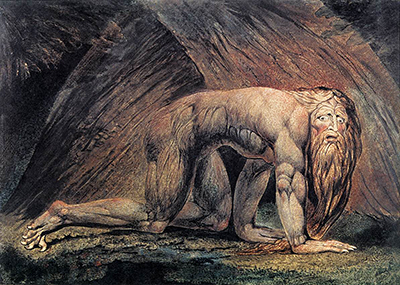
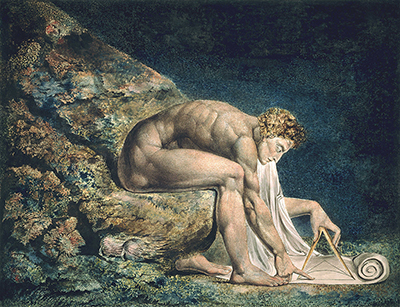
Newton belongs to the same group of large colour prints and offers a useful comparison in the relationship between design and individual sheet. Viscomi identifies an 1804 watermark in Tate’s Newton and places that impression’s printing around 1805, although the design belongs to the earlier project. The comparison shows why “1795” should not make us imagine every sheet emerging finished in a single campaign. Blake could return to a design and make a new object from it years later. [6]
In Enitharmon’s Joy, this material individuality supports the experience of looking. The woman’s dark clothes, the harsh brightness of the creatures’ eyes and the broken colour of the rocks belong to this particular encounter with the design. Its famous titles offer entrances into the scene, but neither replaces the work of attending to those details. The book remains open, the companions remain turned away, and the woman keeps watch across a darkness whose meaning is still contested.
Artworks directory
The three Enitharmon impressions have separate entries because their colouring, finishing and object histories differ. Dates and titles follow the cited collection records; printing dates proposed in the article remain attributed interpretations. Additional entries labelled “Tate” come from the museum’s October 2014 catalogue. They retain its historical titles, dates and attributions; newer collection records are used where available. The list brings together selected records from these sources. [9]
| Name | Date | Medium |
|---|---|---|
| The Night of Enitharmon’s Joy (Tate impression) | about 1795 | Colour print |
| The Night of Enitharmon’s Joy (Edinburgh impression) | about 1795 | Colour print |
| The Night of Enitharmon’s Joy (Huntington impression) | 1795 | Colour print |
| The Circle of the Lustful: Francesca da Rimini (‘The Whirlwind of Lovers’) (Tate A00005) | 1826–7, reprinted 1892 | |
| Ciampolo the Barrator Tormented by the Devils (Tate A00006) | 1826–7, reprinted 1892 | |
| The Baffled Devils Fighting (Tate A00007) | 1826–7, reprinted 1892 | |
| The Six-Footed Serpent Attacking Agnolo Brunelleschi (Tate A00008) | 1826–7, reprinted 1892 | |
| The Serpent Attacking Buoso Donati (Tate A00009) | 1826–7, reprinted 1892 | |
| The Pit of Disease: The Falsifiers (Tate A00010) | 1826–7, reprinted 1892 | |
| Dante Striking against Bocca Degli Abati (Tate A00011) | 1826–7, reprinted 1892 | |
| Job and his Family (Tate A00012) | 1828, reprinted 1874 | |
| Satan before the Throne of God (Tate A00013) | 1825, reprinted 1874 | |
| Job’s Sons and Daughters Overwhelmed by Satan (Tate A00014) | 1825, reprinted 1874 | |
| The Messengers tell Job of his Misfortunes (Tate A00015) | 1825, reprinted 1874 | |
| Satan Going Forth from the Presence of the Lord, and Job’s Charity (Tate A00016) | 1825, reprinted 1874 | |
| Satan Smiting Job with Sore Boils (Tate A00017) | 1825, reprinted 1874 | |
| Job’s Comforters (Tate A00018) | 1825, reprinted 1874 | |
| Job’s Despair (Tate A00019) | 1825, reprinted 1874 | |
| The Vision of Eliphaz (Tate A00020) | 1825, reprinted 1874 | |
| Job Rebuked by his Friends (Tate A00021) | 1825, reprinted 1874 | |
| Job’s Evil Dreams (Tate A00022) | 1825, reprinted 1874 | |
| The Wrath of Elihu (Tate A00023) | 1825, reprinted 1874 | |
| The Lord Answering Job out of the Whirlwind (Tate A00024) | 1825, reprinted 1874 | |
| When the Morning Stars Sang Together (Tate A00025) | 1825, reprinted 1874 | |
| Behemoth and Leviathan (Tate A00026) | 1825, reprinted 1874 | |
| The Fall of Satan (Tate A00027) | 1825, reprinted 1874 | |
| The Vision of Christ (Tate A00028) | 1825, reprinted 1874 | |
| Job’s Sacrifice (Tate A00029) | 1825, reprinted 1874 | |
| Every Man also Gave him a Piece of Money (Tate A00030) | 1825, reprinted 1874 | |
| Job and his Daughters (Tate A00031) | 1825, reprinted 1874 | |
| Job and his Family Restored to Prosperity (Tate A00032) | 1825, reprinted 1874 | |
| Sketch for ‘The Four and Twenty Elders Casting their Crowns before the Divine Throne’. Verso: Standing Figure with Arms at his Side (Tate A00033) | c.1803, c.1805–10 | Drawing |
| ‘Europe’: Fragment of Pages 3 and 4 (Tate A00034) | 1794–c.1830–5 | |
| Songs of Innocence and of Experience: Infant Sorrow (Tate A00035) | 1794, reprinted 1831 or later | |
| ‘Songs of Innocence and of Experience’: ‘Infant Sorrow’ (Tate A00036) | 1794, reprinted 1831 or later | |
| ‘Songs of Innocence and of Experience’: ‘Spring’ (Tate A00037) | 1794, reprinted 1831 or later | |
| ‘Songs of Innocence’: Title-Page (Tate A00038) | 1789, reprinted 1831 or later | |
| ‘Songs of Innocence’: Title-Page (Tate A00039) | 1789, reprinted 1831 or later | |
| Sketch for ‘Tiriel Supporting the Dying Myratana’. Verso: Sketch for ‘Tiriel Supporting the Dying Myratana’ (Tate A00040) | c.1786–9 | Drawing |
| Landscape near Felpham (Tate A00041) | c.1800 | Drawing |
| Two Figures in a Decorative Border (Tate A00042) | c.1790 | Drawing |
| Preliminary Sketch for ‘Christ Girding Himself with Strength’. Verso: Standing Figure with One Arm Raised (Tate A00043) | c.1805, c.1805–10 | Drawing |
| Lower Half of a Woman Playing a Harp. Verso: Seraphim and Other Drawings (Tate A00044) | c.1785, c.?1807 | Drawing |
| St Christopher, Copy from an Engraving? Verso:Part of a Face: Copy from a Plaster Cast: a Daughter of Niobe? (Tate A00045) | ?c.1779–80 | Drawing |
| The Crucifixion (Tate A00046) | c.1825–7 | Drawing |
| Composition Sketch, Possibly a Subject from Dante. Verso: A Man Standing over a Figure Reclining on a Bed (Tate A00047) | ?1824–7, ?c.1800–10 | Drawing |
| Composition Sketch. Verso: Standing Figure Holding a Spear (Tate A00048) | ?c.1805–10 | Drawing |
| Composition Sketch for ‘The Fall of the Rebel Angels’? Verso: Standing Figure with Flaming Hair (Tate A00049) | ?c.1805–10 | Drawing |
| Frontispiece: Thenot and Colinet (Tate A00111) | c.1821, printed 1830 | |
| Thenot Remonstrates with Colinet (Tate A00112) | c. 1821, printed 1830 | |
| Thenot and Colinet Converse Seated between Two Trees (Tate A00113) | c. 1821, printed 1830 | |
| Thenot Remonstrates with Colinet; Lightfoot in the Distance (Tate A00114) | c. 1821, printed 1830 | |
| Thenot, with Colinet Waving his Arms in Sorrow (Tate A00115) | c. 1821, printed 1830 | |
| The Blighted Corn (Tate A00116) | c. 1821, printed 1830 | |
| ‘Nor Fox, nor Wolf, nor Rat among our Sheep’ (Tate A00117) | c. 1821, printed 1830 | |
| Sabrina’s Silvery Flood (Tate A00118) | c. 1821, printed 1830 | |
| Colinet’s ‘Fond Desire Strange Lands to Know’ (Tate A00119) | c. 1821, printed 1830 | |
| ‘A Rolling Stone is ever Bare of Moss’ (Tate A00120) | c. 1821, printed 1830 | |
| Colinet Rests by a Stream at Night (Tate A00121) | c. 1821, printed 1830 | |
| Colinet with his Shepherd’s Pipe, Mocked by Two Boys (Tate A00122) | c. 1821, printed 1830 | |
| ‘For him Our Yearly Wakes and Feasts We Hold’ (Tate A00123) | c. 1821, printed 1830 | |
| Thenot and Colinet Folding their Flocks together at Sunset (Tate A00124) | c. 1821, printed 1830 | |
| Thenot and Colinet at Supper (Tate A00125) | c. 1821, printed 1830 | |
| ‘With Songs the Jovial Hinds Return from Plow’ (Tate A00126) | c. 1821, printed 1830 | |
| ‘And Unyok’d Heifers, Loitering Homeward, Low’ (Tate A00127) | c. 1821, printed 1830 | |
| The Spiritual Form of Pitt Guiding Behemoth (Tate N01110) | ?1805 | Painting |
| The Body of Christ Borne to the Tomb (Tate N01164) | c.1799–1800 | Painting |
| David Delivered out of Many Waters (Tate N02230) | c.1805 | Drawing |
| Epitome of James Hervey’s ‘Meditations among the Tombs’ (Tate N02231) | c.1820–5 | Drawing |
| Oberon, Titania and Puck with Fairies Dancing (Tate N02686) | c.1786 | Drawing |
| The Spiritual Form of Nelson Guiding Leviathan (Tate N03006) | c.1805–9 | Painting |
| Bathsheba at the Bath (Tate N03007) | c.1799–1800 | Painting |
| Satan Smiting Job with Sore Boils (Tate N03340) | c.1826 | Painting |
| Dante and Virgil Penetrating the Forest (Tate N03351) | 1824–7 | Drawing |
| The Inscription over the Gate (Tate N03352) | 1824–7 | Drawing |
| Homer and the Ancient Poets (Tate N03353) | 1824–7 | Drawing |
| Cerberus (Tate N03354) | 1824–7 | Drawing |
| Plutus (Tate N03355) | 1824–7 | Drawing |
| The Wood of the Self-Murderers: The Harpies and the Suicides (Tate N03356) | 1824–7 | Drawing |
| The Simoniac Pope (Tate N03357) | 1824–7 | Drawing |
| The Devils, with Dante and Virgil by the Side of the Pool (Tate N03358) | 1824–7 | Drawing |
| The Hypocrites with Caiaphas. Verso: Sketch of a Stooping Figure (Tate N03359) | 1824–7 | Drawing |
| The Laborious Passage along the Rocks (Tate N03360) | 1824–7 | Drawing |
| The Serpent Attacking Buoso Donati. Verso: A Man with a Transparent Hood (?) over his Head (Tate N03361) | 1824–7 | Drawing |
| The Pit of Disease: The Falsifiers (Tate N03362) | 1824–7 | Drawing |
| The Primaeval Giants Sunk in the Soil (Tate N03363) | 1824–7 | Drawing |
| The Punishment of the Thieves (Tate N03364) | 1824–7 | Drawing |
| Virgil Girding Dante’s Brow with a Rush (Tate N03365) | 1824–7 | Drawing |
| The Ascent of the Mountain of Purgatory (Tate N03366) | 1824–7 | Drawing |
| Dante and Virgil Approaching the Angel Who Guards the Entrance of Purgatory (Tate N03367) | 1824–7 | Drawing |
| The Rock Sculptured with the Recovery of the Ark and the Annunciation (Tate N03368) | 1824–7 | Drawing |
| Beatrice Addressing Dante from the Car (Tate N03369) | 1824–7 | Drawing |
| Dante in the Empyrean, Drinking at the River of Light (Tate N03370) | 1824–7 | Drawing |
| Frontispiece to ‘Visions of the Daughters of Albion’ (Tate N03373) | c.1795 | |
| Plate 4 of ‘Visions of the Daughters of Albion’ (Tate N03374) | c.1795 | |
| The Bard, from Gray (Tate N03551) | ?1809 | Painting |
| Plate 2 of ‘Urizen’: ‘Teach these Souls to Fly’ (Tate N03696) | ?1796 | |
| Elohim Creating Adam (Tate N05055) | 1795–c. 1805 | |
| The Good and Evil Angels (Tate N05057) | 1795–?c. 1805 | |
| Newton (Tate N05058) | 1795–c. 1805 | |
| Nebuchadnezzar (Tate N05059) | 1795–c. 1805 | |
| The House of Death (Tate N05060) | 1795–c. 1805 | |
| Lamech and his Two Wives (Tate N05061) | 1795 | |
| Pity (Tate N05062) | c.1795 | |
| God Judging Adam (Tate N05063) | 1795 | |
| Age Teaching Youth (Tate N05183) | c.1785–90 | Drawing |
| The Head of the Ghost of a Flea. Verso: A Profile and a Reduced Drawing of Milton’s First Wife (Tate N05184) | c.1819 | Drawing |
| Catherine Blake. Verso: A Man’s Head and Other Drawings (Tate N05188) | c.1805 | Drawing |
| Lear and Cordelia in Prison (Tate N05189) | c.1779 | Drawing |
| The House of Death (Tate N05192) | c.1790 | Drawing |
| The Blasphemer (Tate N05195) | c.1800 | Drawing |
| The Good Farmer, Probably the Parable of the Wheat and the Tares. Verso: Rough Sketch of Two or Three Figures in a Landscape (Tate N05198) | c.1780–5 | Drawing |
| Job, his Wife and his Friends: The Complaint of Job. Verso: Job’s Wife and Eight Other Sketches (Tate N05200) | c.1785 | Drawing |
| The Soul Hovering over the Body Reluctantly Parting with Life (Tate N05300) | c.1805 | Drawing |
| Christ Appearing to the Apostles after the Resurrection (Tate N05875) | c.1795 | Drawing |
| The River of Life (Tate N05887) | c.1805 | Drawing |
| The Body of Abel Found by Adam and Eve (Tate N05888) | c.1826 | Painting |
| The Ghost of a Flea (Tate N05889) | c.1819–20 | Painting |
| Satan in his Original Glory: ‘Thou wast Perfect till Iniquity was Found in Thee’ (Tate N05892) | c.1805 | Drawing |
| Christ Blessing the Little Children (Tate N05893) | 1799 | Painting |
| The Agony in the Garden (Tate N05894) | c.1799–1800 | Painting |
| The Crucifixion: ‘Behold Thy Mother’ (Tate N05895) | c.1805 | Drawing |
| The Entombment (Tate N05896) | c.1805 | Drawing |
| The Four and Twenty Elders Casting their Crowns before the Divine Throne (Tate N05897) | c.1803–5 | Drawing |
| The Penance of Jane Shore in St Paul’s Church (Tate N05898) | c.1793 | Drawing |
| The Death of the Virgin (Tate N05899) | 1803 | Drawing |
| Los and Orc (Tate T00547) | c.1792–3 | Drawing |
| An Allegory of the Bible. Verso: The Shins of an Écorché Male Figure (Tate T01128) | c.1780–5, ?c.1780 | Drawing |
| A Figure Standing in a Gothic Apse, perhaps the Empress Maud. Verso: Detailed Drawings for ‘The Empress Maud in Bed’ (Tate T01334) | c.1819 | Drawing |
| Detailed Drawings for ‘A Figure Standing in a Gothic Apse’ (Tate T01335) | 1819 | Drawing |
| The Circle of the Lustful: Francesca da Rimini (‘The Whirlwind of Lovers’) (Tate T01950) | 1826–7, reprinted 1968 | |
| Ciampolo the Barrator Tormented by the Devils (Tate T01951) | 1826–7, reprinted 1968 | |
| The Baffled Devils Fighting (Tate T01952) | 1826–7, reprinted 1968 | |
| The Six-Footed Serpent Attacking Agnolo Brunelleschi (Tate T01953) | 1826–7, reprinted 1968 | |
| The Serpent Attacking Buoso Donati (Tate T01954) | 1826–7, reprinted 1968 | |
| The Pit of Disease: The Falsifiers (Tate T01955) | 1826–7, reprinted 1968 | |
| Dante Striking Against Bocca degli Abati (Tate T01956) | 1826–7, reprinted 1968 | |
| Thenot and Colinet (Tate T02115) | 1821, reprinted 1977 | |
| Thenot Remonstrates with Colinet (Tate T02116) | 1821, reprinted 1977 | |
| Thenot and Colinet Converse Seated between Two Trees (Tate T02117) | 1821, reprinted 1977 | |
| Thenot Remonstrates with Colinet: Lightfoot in the Distance (Tate T02118) | 1821, reprinted 1977 | |
| Thenot, with Colinet Waving his Arms in Sorrow (Tate T02119) | 1821, reprinted 1977 | |
| The Blighted Corn (Tate T02120) | 1821, reprinted 1977 | |
| ‘Nor Fox, nor Wolf, nor Rat among our Sheep’ (Tate T02121) | 1821, reprinted 1977 | |
| Sabrina’s Silvery Flood (Tate T02122) | 1821, reprinted 1977 | |
| Colinet’s Fond Desire Strange Lands to Know (Tate T02123) | 1821, reprinted 1977 | |
| ‘A Rolling Stone is ever Bare of Moss’ (Tate T02124) | 1821, reprinted 1977 | |
| Colinet Rests by a Stream at Night (Tate T02125) | 1821, reprinted 1977 | |
| Colinet with his Shepherd’s Pipe, Mocked by Two Boys (Tate T02126) | 1821, reprinted 1977 | |
| ‘For him Our Yearly Wakes and Feasts We Hold’ (Tate T02127) | 1821, reprinted 1977 | |
| Thenot and Colinet Folding their Flocks together at Sunset (Tate T02128) | 1821, reprinted 1977 | |
| Thenot and Colinet at Supper (Tate T02129) | 1821, reprinted 1977 | |
| ‘With Songs the Jovial Hinds Return from Plow’ (Tate T02130) | 1821, reprinted 1977 | |
| ‘And Unyok’d Heifers, Loitering Homewards, Low’ (Tate T02131) | 1821, reprinted 1977 | |
| Winter (Tate T02387) | c.1820–5 | Painting |
| Every Man also Gave him a Piece of Money. Verso: God the Father with Attendant Angels (Tate T03233) | c.1821–3 | Drawing |
| Moses Indignant at the Golden Calf (Tate T04134) | c.1799–1800 | Painting |
| A Vision: The Inspiration of the Poet (Elisha in the Chamber on the Wall) (Tate T05716) | c.1819–20? | Drawing |
| Title-Page of ‘The Book of Job’ (Tate T05845) | 1825, reprinted 1874 | |
| The Hiding of Moses (Tate T06585) | 1824 | |
| Alfred and the Neat-Herd’s Wife (after Henry Fuseli) (Tate T06586) | 1797, published 1798 | |
| King John Absolved by Pandulph (after Henry Fuseli) (Tate T06587) | 1797, published 1798 | |
| Wat Tyler and the Tax-Gatherer (after Henry Fuseli) (Tate T06588) | 1797, published 1798 | |
| Queen Elizabeth and Essex (after Henry Fuseli) (Tate T06589) | 1797, published 1798 | |
| Judas Betrays Him (Tate T06606) | c.1803–5 | Drawing |
| The Fall of Rosamond (after Thomas Stothard) (Tate T06671) | 1783 | |
| The Temple of Mirth, after Thomas Stothard (Tate T07048) | 1784 | |
| Satan Exulting over Eve (Tate T07213) | c.1795 | |
| First Book of Urizen pl. 15 (Tate T12997) | 1796, c.1818 | |
| First Book of Urizen pl. 17 (Tate T12998) | 1796, c.1818 | |
| First Book of Urizen pl. 21 (Tate T12999) | 1796, c.1818 | |
| The Book of Thel pl. 6 (Tate T13000) | 1796, c.1818 | |
| The Marriage of Heaven and Hell pl. 16 (Tate T13001) | 1796, c.1818 | |
| First Book of Urizen pl. 6 (Tate T13002) | 1796, c.1818 | |
| First Book of Urizen pl. 10 (Tate T13003) | 1796, c.1818 | |
| First Book of Urizen pl. 11 (Tate T13004) | 1796, c.1818 |
Frequently Asked Questions
Tate catalogues its impression as colour print, ink, tempera and watercolour on paper. Printing and hand finishing both contributed to the result. [1]
The identification is disputed. Hecate is the traditional name; the Enitharmon interpretation connects the image with Blake’s own mythology and is favoured by the National Galleries of Scotland. [3]
Discussion
Look at the open book and the creatures around the woman while keeping the proposed identities open.
Reader Insights
Does the book make the woman seem powerful, protective or trapped?
Which creature first unsettles the scene?
What changes when each impression is treated as an individual object?
Join the Conversation
Share a detail, comparison or question about Enitharmon’s Joy below.
References
- Tate, collection data for The Night of Enitharmon’s Joy (formerly called ‘Hecate’), N05056. Institutional catalogue dataset: title, medium, support dimensions, date, credit and subject indexing. View source.
- National Gallery of Ireland, William Blake: The Age of Romantic Fantasy. Official reproduction and caption identifying the Tate impression, around 1795, presented by W. Graham Robertson in 1939. View source.
- National Galleries of Scotland, The Night of Enitharmon’s Joy (formerly called ‘The Triple Hecate’), P 7851. Collection record, interpretation, dating and reproduction. View source.
- William Blake, Europe a Prophecy, in The Complete Poetry and Prose of William Blake, edited by David V. Erdman, electronic text hosted by Arizona State University. Especially plates 5, 9, 11–12; Erdman pages 62–64. View source.
- The Huntington, The Night of Enitharmon’s Joy, accession 000.126. Collection record and 2022 label: medium, process and differences between impressions. View source.
- Joseph Viscomi, “Signing Large Color Prints: The Significance of Blake’s Signatures”, Huntington Library Quarterly 80, no. 3 (2017), pp. 365–402. Especially pp. 368–69 on terminology; pp. 376–79, tables 1–3, on printing dates and sequence; pp. 383–84 on signatures. View source.
- Joseph Viscomi, “William Blake’s 1818 Letter to Dawson Turner and Later Career as Graphic Artist”, BRANCH: Britain, Representation and Nineteenth-Century History, edited by Dino Franco Felluga. Introduction, paragraphs on transferring and finishing the large monoprints. View source.
- Tate, Newton, N05058, collection data: title, date 1795–c.1805, medium and official photograph. Accessed 28 October 2026. View source.
- Tate, Tate Collection metadata, artwork_data.csv, October 2014 snapshot, released under CC0. Repository readme states that this dataset is no longer maintained. Downloaded and artist rows inspected 28 October 2026. View source.