

 John William Waterhouse.jpg)
 by Tom Gurney
Tom Gurney BSc (Hons) is an art history expert with over 20 years experience
Published on August 14, 2026 / Updated on August 14, 2026
Email: tomgurney1@gmail.com / Phone: +44 7429 011000
Study for The Magic Circle: Introduction
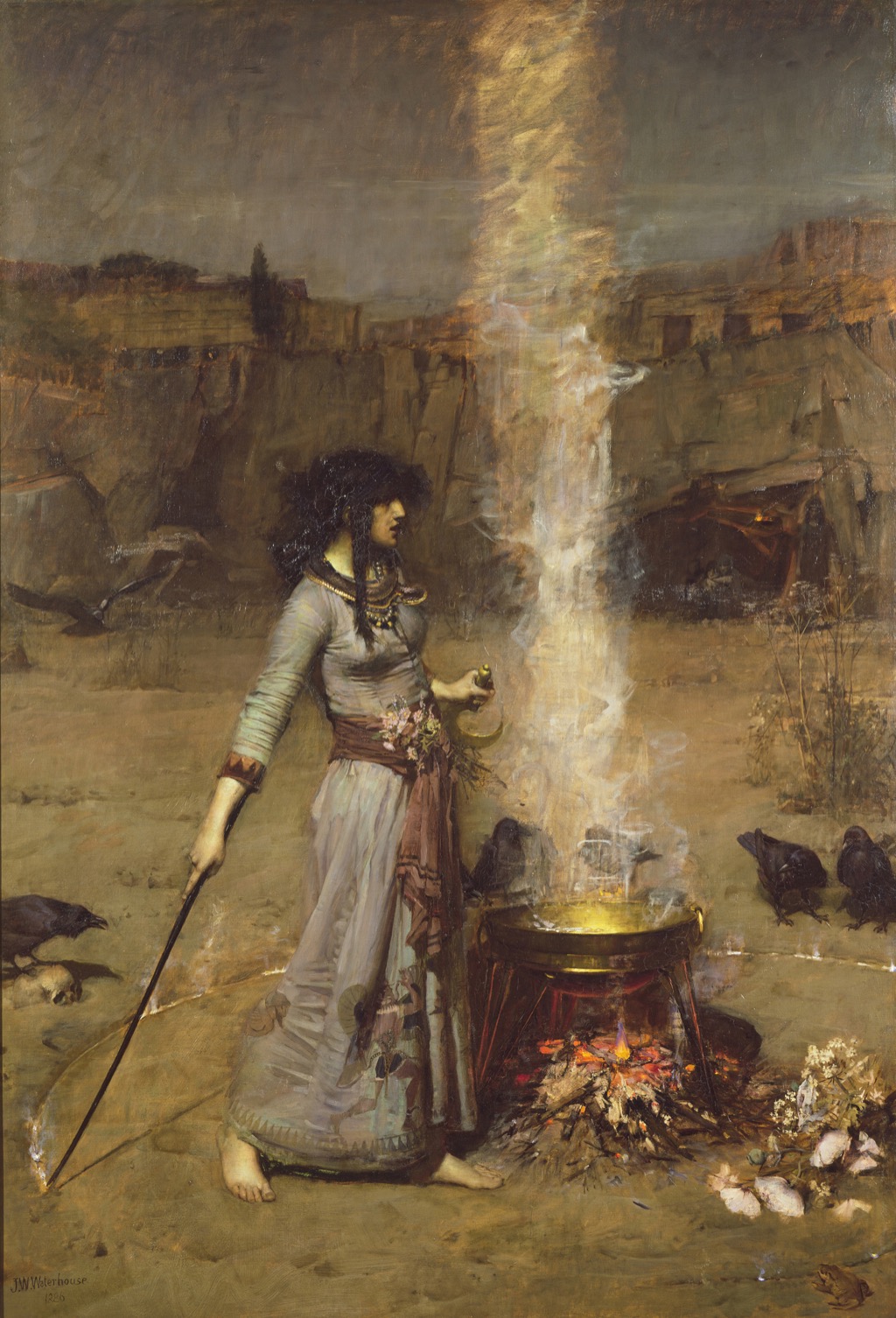
John William Waterhouse's oil Study for The Magic Circle establishes nearly the entire drama of his celebrated 1886 Tate painting. A dark-haired sorceress uses her wand to draw a cold blue-yellow circle around a blazing cauldron while ravens, poppies, serpent, toad and distant watchers gather in a moonlit rocky landscape. [1]
The study measures 61.5 × 41.2 cm and is privately owned. [1] It is distinct from both Tate's monumental finished canvas and a smaller, highly finished version measuring about 88 × 60 cm. Its dusky palette, visible revisions and varied paint handling make it the best page for explaining how Waterhouse built the composition. [1] [2]
At a Glance
- ArtistJohn William Waterhouse
- TitleStudy for The Magic Circle [1]
- DateAbout 1886 [1]
- MediumOil on canvas [1]
- Dimensions61.5 × 41.2 cm [1]
- CollectionPrivate collection [1]
- PurposePreparatory compositional study for Tate's The Magic Circle [1]
- Final work1886, oil on canvas, 183 × 127 cm, Tate, N01572 [3]
- Earlier developmentWaterhouse exhibited a related sepia drawing at the Dudley Gallery in 1881 [1]
- Version controlNot the separate 88 × 60 cm small finished version [2]
Contents
- Introduction
- What the study shows
- Circle, cauldron and magical boundary
- The sorceress and her tools
- Birds, plants and ambiguous power
- Distant watchers and imagined setting
- From dusky study to Academy painting
- Paint handling and modern naturalism
- Possible literary and occult contexts
- Three versions, one composition
What the study shows
A standing woman dominates a tall rocky landscape. Her body is upright while one arm and wand extend diagonally towards the ground.
The wand traces a luminous circle around her and a central brazier or cauldron.
Flames rise in orange, violet and green, contrasting with the colder blue-yellow marks of the circle. [1]
She holds a curved knife in the other hand. Herbs and pale poppies appear near the fire and at her waist.
A snake coils around her neck or body. Ravens gather beyond the protected boundary; one perches on a human skull. [1]
A toad occupies the foreground. Smoke rises into irregular, almost bodiless patterns.
Behind the sorceress, cliffs support structures that Christie's describes as Egyptian-looking, probably tombs. [1]
Three people watch from a safer distance near a lamp-lit cave, adding witnesses to an otherwise solitary rite. [1]
The scene is nocturnal or dusky. Dark ground makes flame, skin and magic line flicker.
Although called a study, it is highly developed. The entire narrative arrangement is present.
Circle, cauldron and magical boundary
The magic circle is both title and organising form. It separates the sorceress's working space from the creatures outside.
Circles in ritual magic can define protection, concentration and controlled sacred ground.
Waterhouse makes the boundary visible through cold dabs of light rather than a simple drawn line. [1]
The cauldron's hotter fire occupies the interior, creating two kinds of energy: contained flame and enclosing magic.
Her body and wand form a triangle anchored within the circle. [1]
Triangle and circle stabilise an otherwise agitated landscape of smoke, birds and rough rock.
The sorceress appears protected from the ravens because they remain beyond the boundary. Whether she summons or wards them off is unresolved.
That uncertainty changes the moral reading. She may practise dangerous magic, protective healing or a mixture of both.
The circle is incomplete in action. We see her making it, so safety is being constructed rather than assumed.
This temporal choice creates suspense. A closed circle would be static; a line under formation can still fail.
The title does not explain the spell's desired outcome. Visible ritual takes precedence over result.
The sorceress and her tools
The woman holds wand and curved knife, combining command with practical preparation.
Christie's calls the knife a boline, a tool associated in later occult traditions with cutting herbs. [1]
Its crescent shape echoes the curve of her hand and the moonlike circle.
Plants gathered at her waist and beside the fire make cutting a plausible function.
Her dress is richly patterned. Christie's sees an Archaic Greek warrior encountering a serpent, perhaps Jason overcoming the dragon with Medea's potion. [1]
Recent research has proposed that the central garment image is Medusa, showing that iconographic identification remains contested. [4]
The page should present such readings as proposals, not settled labels.
Her flushed face and open mouth suggest chanting, effort or trance.
Waterhouse gives her agency. She directs the rite rather than receiving supernatural knowledge passively.
Victorian associations between women and mediumship could make such power both fascinating and socially unsettling. [1]
The woman's identity is not securely named. “Sorceress” or “witch” describes her role; Medea and Simaetha remain possible contexts.
Her tools bring intellect and labour into the occult image. Magic is shown as organised practice, not spontaneous glamour.
Birds, plants and ambiguous power
Seven ravens or crows form a rough semicircle beyond the sorceress. [1]
The number seven and repeated curve echo the magical boundary and other Waterhouse groupings.
One bird stands on a skull, strengthening associations with death and omen.
Yet the birds' position outside the circle can make them threats held at bay rather than servants summoned by the woman.
The toad carries a long visual history of witchcraft, poison and earthbound transformation.
Poppies suggest sleep, dream, narcotic effect and death. Their swollen white forms glow near the ritual centre. [1]
Angelica, however, has protective and healing associations. Christie's notes its presence as evidence against reading every plant as poisonous. [1]
The serpent around the sorceress may evoke danger, knowledge, renewal or the ouroboros cycle of life and death. [1]
Rose Sketchley's 1909 interpretation, published with Waterhouse's approval, connects the painting with will acting upon forces of destruction and renewal. [1]
The iconography therefore resists a simple “evil witch” caption.
Death signs and healing plants coexist. The rite may direct, balance or counter destructive energy.
The study's darker palette increases menace, but colour mood does not settle magical purpose.
Distant watchers and imagined setting
Three figures gather near a lit cave behind the sorceress. [1]
They are observers rather than participants within the circle.
Their distance helps scale the landscape and makes the woman's isolation more dramatic.
The cave can suggest an entrance to the underworld, a ritual refuge or simply shelter in the rocks. [1]
Structures on the cliffs look Egyptian to Christie's and may be tombs. [1]
These elements combine several cultural vocabularies: Greek dress imagery, Celtic-associated knife, Egyptian-looking architecture and modern occult signs.
Waterhouse does not reconstruct one historically coherent rite.
His eclecticism was part of Victorian occult imagery, which freely combined archaeological, literary and esoteric sources.
The wasteland keeps ordinary society away. Magic occurs at a boundary of civilisation, night and death.
Yet the witnesses remind us that it is also performance. Someone watches from within the painted world, just as Academy visitors would later watch outside it.
Lamp, fire and magic line create separate centres of illumination. Each belongs to a different degree of access.
The watchers have ordinary lamp-light; the sorceress occupies transformative flame.
From dusky study to Academy painting
Christie's describes the study as noticeably duskier than the finished Tate version. [1]
Waterhouse probably lightened the final palette so that the scene could be read in the crowded and unevenly lit Royal Academy exhibition. [1]
This practical consideration demonstrates that revision responded to display conditions as well as artistic preference.
The study's darker atmosphere makes fire and circle especially vivid but can obscure secondary objects.
The final canvas enlarges the composition to roughly three times the study's height. [3]
At Academy scale, the sorceress approaches life size and the rocky setting becomes theatrical.
Major compositional relationships change little. Christie's calls the study evidence of how seriously Waterhouse viewed the final canvas. [1]
Persistence of design does not make the study redundant. It preserves the palette and handling before public clarity became dominant.
The final work was the first Waterhouse exhibited after election as an Associate of the Royal Academy in 1885. [1]
Its success and national purchase gave the composition unusual career importance.
The study therefore sits at the intersection of private invention and institutional ambition.
Paint handling and modern naturalism
Christie's draws attention to striking variation in the application of paint. [1]
The sorceress's forearm and feet are thickly modelled, almost photographic in presence.
Kindling is rendered with scratch-like marks. Grey and umber landscape is brushed thinly and freely.
Foreground and background dissolve differently, concentrating attention on the body. [1]
This approach reflects the influence of French naturalism, especially Jules Bastien-Lepage, as absorbed by British painters. [1]
It complicates the label of Waterhouse as simply traditional or Pre-Raphaelite.
His subject is an archaic magical rite, but his handling responds to current experiments in texture, recession and selective focus.
The New English Art Club formed in 1886 around artists with French experience, the same year Waterhouse exhibited the finished work at the more conservative Academy. [1]
Waterhouse could therefore place modern technique inside a conventionally legible history painting.
The study makes this process easier to see because not every passage is smoothed into exhibition finish.
Paint consistency becomes part of meaning: solid body acts against dissolving occult atmosphere.
Possible literary and occult contexts
For many years the rite was treated as generically magical. More recent research has recovered a possible connection with Theocritus's second Idyll. [4]
In that poem, Simaetha performs a love spell at night, using fire, herbs and repeated incantation to draw an absent lover back. [5]
An 1881 notice concerning Waterhouse's earlier Magic Circle drawing connected the subject with Theocritus, strengthening the proposal. [4]
This evidence makes Simaetha a persuasive context but does not prove that every painted detail comes from the poem.
Christie's also explores late-Victorian spiritualism, theosophy and fascination with female mediums. [1]
Helena Blavatsky's promotion of occult symbols provides context for an ouroboros reading of the serpent. [1]
Frederick Sandys's Medea, Burne-Jones's own Magic Circle and Rossetti's Astarte Syriaca offer visual precedents for the powerful female occultist. [1]
Waterhouse combines rather than copies these sources.
The most secure facts remain visible action and title: a woman draws a magical circle around a fire.
Literary identification should deepen, not close, the image.
Three versions, one composition
The study is one of three painted forms commonly associated with the subject.
First is this 61.5 × 41.2 cm compositional sketch in private ownership. [1]
Second is a smaller, highly finished version around 88 × 60 cm, also privately owned. [2]
Third is Tate's monumental 183 × 127 cm signed canvas of 1886. [3]
The study and small version are often confused online because both are privately held.
Dimensions provide the most reliable control.
The 88 × 60 cm work is too large and resolved to be identified with Christie's 61.5 × 41.2 cm study.
Tate's accession N01572, Chantrey purchase and monumental size belong only to the final work. [3]
Earlier still, a related sepia drawing was exhibited at the Dudley Gallery in 1881. [1]
The subject therefore developed over at least five years.
Calling every smaller image “the study” erases stages of invention, elaboration and replication.
This manuscript is exclusively for the 61.5 × 41.2 cm oil sold by Christie's in 2009. [1]
Exhibition significance and interpretation
The finished Magic Circle appeared at the Royal Academy in 1886 and was purchased for the nation through the Chantrey Bequest. [1] [3]
That success confirmed Waterhouse's status soon after his election as an Associate.
Contemporary reaction recognised the scene's theatrical drama; Punch even parodied it with Sarah Bernhardt stirring a cauldron. [1]
The study helps explain that theatricality. Body, triangle, circle, flames and watchers already form a stage.
But its varied surface adds a second value: direct evidence of how Waterhouse made the spectacle.
Interpretation should avoid equating female power automatically with evil. Healing plants and protected boundary leave motive open.
It should also avoid treating eclectic props as a real historical ritual.
The sorceress's authority is undeniable even when her spell is not.
She occupies a rare visual position for a Victorian woman: alone, technically skilled and commanding dangerous natural forces.
That agency helped make the subject compelling and threatening.
The study preserves the conception before institutional scale made it a national spectacle.
Fire, colour and temperature
Christie's distinction between the cold magic line and hot central fire is more than a palette observation. [1]
Orange, violet and green flame belongs to material combustion. Blue and yellow dabs on the ground make an invisible boundary temporarily perceptible.
The two fires create concentric systems. One consumes herbs and fuel; the other controls space.
The sorceress stands between them as the agent who converts practical preparation into ritual force.
Smoke joins the systems vertically. It rises from the cauldron and dissolves into forms Christie's compares with the ectoplasmic imagery of spiritualism. [1]
Viewers need not accept literal spirits to see how irregular paint makes smoke a carrier of suggestion.
Temperature also organises danger. The woman is close to physical flame but protected from ominous creatures beyond the cooler circle.
This inversion prevents the centre from being simply the most threatening zone.
Waterhouse's dusky study makes every light source compete: cauldron, magic line, cave lamp and pale poppies.
The later Academy lightening improves readability but changes the balance between secrecy and spectacle.
Female expertise and Victorian occultism
The sorceress is not passive, possessed or surprised. She controls tools, ingredients, boundary and voice.
Such technical authority distinguished her from conventional religious roles available to Victorian women.
Christie's notes the period belief that women were especially suited to mediumship, a claim that could grant influence while also presenting female power as irrational or abnormal. [1]
Waterhouse exploits that cultural tension. His figure is visibly competent, yet her competence belongs to a feared and exoticised practice.
The open mouth suggests incantation, making speech an instrument rather than a plea.
Her posture is physically stable despite the circling birds and uneven ground.
The wand extends her reach, and the knife shows control of materials before they enter the fire.
This is why a simple “witch casting an evil spell” caption is inadequate. Evil is not demonstrated; expertise is.
The possible Simaetha source adds emotional complexity. Theocritus's speaker performs magic in response to abandonment and erotic distress, combining agency with vulnerability. [5]
If that context informs Waterhouse, the rite is neither abstract occult theatre nor uncomplicated domination.
The study as evidence of exhibition strategy
The study preserves choices made before the Royal Academy wall became a practical problem.
Waterhouse knew that a crowded exhibition could be dim, irregularly hung and viewed from a distance.
Lightening the final scene would separate body, objects and narrative action for that environment. [1]
This is a useful correction to romantic ideas of creation. Composition develops in relation to institutions, architecture and audience.
The change did not betray the original mood; it translated it for public visibility.
Scale required other adjustments in emphasis even where object placement stayed similar. A dab on the study becomes a legible bird or flower in the final canvas.
The sorceress's near-life-size presence at Tate transforms an intimate experiment into confrontation.
Studying both works reveals how Waterhouse balanced atmosphere against information.
The smaller oil is consequently not only a preliminary image. It is evidence of the decision before exhibition pressure reshaped tone.
Close-looking questions the study can answer
First, where does Waterhouse spend his thickest paint? Christie's identifies the forearm and feet as highly modelled against freer scenery. [1]
That concentration secures the body as the rite's reality while landscape and smoke remain uncertain.
Second, how are curves repeated? Circle, crescent knife, snake, bird grouping and cauldron rim create related arcs.
Third, where do triangles appear? Body and wand form the principal one, giving directional authority inside circular protection.
Fourth, how is looking controlled? Ravens face inward, distant people watch from the cave and the spectator observes from outside every painted boundary.
The image contains nested audiences but grants active knowledge only to the woman at its centre.
Finally, what remains ambiguous after close inspection? The spell's purpose, the watchers' identities and the exact cultural source do not resolve.
Good close looking therefore increases both evidence and uncertainty. It makes the study richer without pretending it is a fully decoded occult manual.
Why the preparatory oil matters
The study changes the way Tate's famous image is understood. It proves that theatrical clarity emerged from an earlier, darker experiment rather than appearing fully formed at monumental scale.
It also keeps technique tied to interpretation. Thin grey-brown landscape does not merely save time; it lets the world dissolve around a densely painted body. Scratch-like firewood and heavy flesh create different degrees of reality within the same rite. [1]
Because the canvas is privately owned, the Christie's record remains the principal public object source. Its handled dimensions and close catalogue analysis are more reliable than captions that merge it with the 88 × 60 cm version.
For Waterhouse's development, the study joins institutional ambition with experimental surface. A newly elected Associate prepared a conservative Academy subject through techniques responsive to French naturalism. The combination explains why The Magic Circle could look ancient, spectacular and contemporary at once.
Related Pages
- The Lady of Shalott: Compare Waterhouse's best-known literary composition.
- Hylas and the Nymphs: Compare another major mythological scene.
- The Magic Circle: Compare Waterhouse's treatment of ritual and symbolism.
Frequently Asked Questions
It measures 61.5 × 41.2 cm. [1]
It is privately owned. [1]
No. Tate owns the much larger final canvas, 183 × 127 cm, accession N01572. [3]
She uses a wand to draw a magical boundary around herself and a burning cauldron.
Neither identity is certain. Recent research makes Theocritus's Simaetha a persuasive source, while Medea imagery may inform her dress and visual type. [1] [4]
Waterhouse likely lightened the finished canvas so its details would read more clearly in the crowded Royal Academy. [1]
Discussion
The study shows that preparation can contain nearly complete meaning. Circle, triangle, fire, birds and watchers are already coordinated before the final scale is fixed.
Its dusky palette makes magic appear more secret, while the later lightening acknowledges the public conditions of exhibition. Occult privacy had to become Academy legibility.
Reader Insights
Which visible detail most changes the way you read this page?
Which source or comparison helps the work feel less familiar and more specific?
What question would you bring back to the painting after reading?
Join the Conversation
Share your reading of this page below.
References
- Christie's, “John William Waterhouse: Study for The Magic Circle,” lot record and Peter Trippi catalogue essay, 4 June 2009. View source.
- “The Magic Circle (study),” object summary for the separate 88 × 60 cm private version. View source.
- Tate, “John William Waterhouse: The Magic Circle,” collection record, N01572. View source.
- Mark Williams and Jennifer Williams, “The Inspiration behind The Magic Circle,” summary of research connecting the subject with Theocritus and discussing the gown image. View source.
- Theocritus, Idylls, Idyll II, “The Sorceress,” translated by J. M. Edmonds, Perseus Digital Library. View source.