

 by Tom Gurney
Tom Gurney BSc (Hons) is an art history expert with over 20 years experience
Published on August 14, 2026 / Updated on August 14, 2026
Email: tomgurney1@gmail.com / Phone: +44 7429 011000
Isabella and the Pot of Basil: Introduction
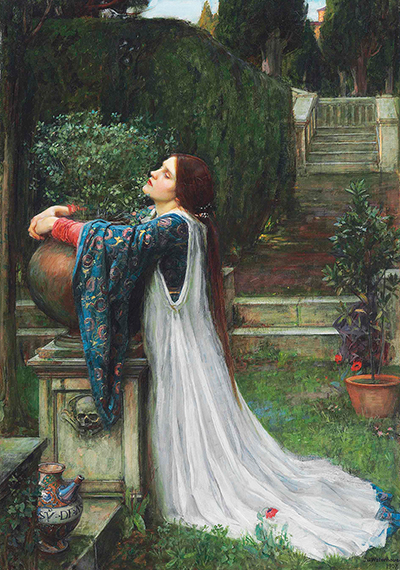
Isabella kneels in a garden and folds herself around a great copper planter. Basil grows above her; beneath the leaves lies the severed head of her murdered lover, Lorenzo. John William Waterhouse does not reveal that hidden object. He paints the care that surrounds it: swollen eyes, streaming hair, trailing fabric and a body bent into grief.
Completed in 1907, Isabella and the Pot of Basil brings together Giovanni Boccaccio's medieval tale, John Keats's Romantic poem and a long Pre-Raphaelite tradition of painting the story. Waterhouse chooses a scene without murder, ghost or discovery. Love has already become mourning, and mourning has become a daily ritual through which a plant is fed by tears. The picture's luxuriant beauty grows from knowledge of death.
At a Glance
- ArtistJohn William Waterhouse (1849–1917)
- TitleIsabella and the Pot of Basil
- Date1907
- MediumOil on canvas
- Dimensions104.8 × 74 cm
- SignatureSigned and dated “J.W. Waterhouse / 1907” at lower right [1]
- Current statusPrivate collection
- First exhibitedRoyal Academy, London, 1907, no. 78, under the shorter title Isabella [1]
- Principal literary sourceJohn Keats, Isabella; or, The Pot of Basil: A Story from Boccaccio, written in 1818 and published in 1820 [2]
- Earlier sourceGiovanni Boccaccio, Decameron, Day 4, Story 5, the tale of Lisabetta and Lorenzo [3]
- Documented early ownerH. W. Henderson
- Later documented ownerSir Rod Stewart by 1981 [1]
- Related Waterhouse worksLa Belle Dame sans Merci (1893), Lamia (1905 and 1909), Phyllis and Demophoön (1907), and Apollo and Daphne (1908)
Contents
- Introduction
- Grief Organised Around a Living Plant
- Boccaccio's Lisabetta and Lorenzo
- Keats's Isabella; or, The Pot of Basil
- The Hidden Head and the Visible Skull
- Isabella's Kneeling Body
- Copper, Water and the Work of Mourning
- The Garden as Sanctuary and Tomb
- Beauty Growing from Decay
- Waterhouse, Millais and Holman Hunt
Grief Organised Around a Living Plant
Waterhouse begins after the secret burial. Lorenzo has been murdered, appeared in a dream and guided Isabella to his body. She has recovered his head and placed it beneath the basil. The painted action is the sustained devotion that follows.
This timing removes conventional narrative excitement. No murderer enters and no ghost speaks. Isabella's brothers have not yet stolen the planter. Waterhouse makes repetition—the daily bending, watering and mourning—the centre of the tragedy.
The planter is physically immense. Its swelling copper form occupies much of the upper right side and stands above Isabella's kneeling body. She does not hold a small keepsake; she submits herself to an altar-like object that contains love, death and living roots.
Her posture joins embrace and collapse. One arm reaches around or towards the vessel while her upper body leans against its support. The plant requires care, but the act of caring appears to consume the carer.
The basin or watering vessel nearby establishes the practical side of grief. Basil survives through water, and both Boccaccio and Keats insist that Isabella waters it with tears as well as scented water. [2] [3] Waterhouse translates poetic moisture into a network of forms: flowing hair, loose sleeves, cascading overdress and hanging foliage.
The picture is not only an emblem of memory. The hidden head makes memory materially present in a disturbing way. Isabella has refused ordinary burial and converted Lorenzo's remains into the foundation of a private, living memorial.
That memorial offers intimacy but no healing. The basil grows vigorously while Isabella wastes. Plant and woman move in opposite directions, one fed by what the other loses.
Waterhouse makes this exchange beautiful enough to attract the eye, then embeds signs that beauty cannot remove: reddened eyes, dark enclosure and a skull on the pedestal. The viewer enters through colour and remains because the garden has become a tomb.
Boccaccio's Lisabetta and Lorenzo
The story first appears in the fifth tale of the fourth day of Boccaccio's Decameron. Its heroine is Lisabetta of Messina, the sister of three wealthy merchant brothers. Lorenzo is a young Pisan who manages their business affairs. The two become lovers in secret. [3]
When the eldest brother discovers the relationship, the brothers decide to prevent perceived shame. They lure Lorenzo outside the city, kill him and bury his body in a remote place. On returning, they pretend he has been sent away on business. [3]
Lisabetta repeatedly asks where he is. After long grief, Lorenzo appears to her in a dream, tells her that her brothers killed him and shows where he lies. With a trusted companion, she finds the body, cuts off the head and carries it home hidden in a cloth. [3]
She places the head in a large pot, covers it with earth and plants fine Salerno basil above it. Boccaccio says she waters the plant only with her tears or with rose or orange-flower water. Her constant attendance makes the basil flourish while grief exhausts her. [3]
Neighbours report her behaviour to the brothers. They take the pot away. When they discover the head and fear exposure, they leave Messina. Lisabetta continues to demand her basil and dies soon afterwards. [3]
Boccaccio's story is compact and unsentimental in structure. Private desire is destroyed by family honour and mercantile control; evidence of murder survives through a domestic object; the bereaved woman's repeated action becomes publicly visible despite secrecy.
Waterhouse retains the story's key container but removes the brothers, neighbours and business world. Their violence is present through consequence. Isabella's garden appears private, yet viewers know that privacy will fail.
The shift from Lisabetta to Isabella comes through English transmission, especially Keats. Waterhouse's title uses the name by which the tale had become familiar to nineteenth-century readers and artists.
Keats's Isabella; or, The Pot of Basil
John Keats wrote his narrative poem in 1818 and published it in the 1820 volume Lamia, Isabella, The Eve of St Agnes, and Other Poems. Its subtitle openly calls the work “A Story from Boccaccio.” [2]
Keats expands the lovers' emotional life and intensifies the opposition between love and mercantile calculation. Isabella's brothers imagine an advantageous marriage while Lorenzo belongs to their commercial household. Their crime protects class interest as well as family control.
The poem lingers over anticipation, murder, bodily decay, the dream and the recovery of Lorenzo's head. It also gives sensuous force to the basil ritual. Isabella bends over the plant continually and moistens it with tears; the basil grows rich and fragrant from the hidden matter beneath. [2]
Keats makes growth inseparable from decomposition. Beauty does not cover death in the weak sense of hiding it. It physically depends upon death. Roots draw nourishment from the place where Lorenzo's head has been buried.
This transformation gave Waterhouse a subject suited to his mature art. Around 1907 he was painting myths in which bodies, plants and passionate loss intersect. Phyllis and Demophoön and the later Apollo and Daphne treat metamorphosis explicitly, while Isabella's basil offers a darker, indirect conversion of flesh into foliage. [1]
Keats's poem also makes water intensely personal. Tears enter soil “unto the core,” turning emotion into cultivation. [2] Waterhouse's garden is lush because grief has become labour.
The painting does not illustrate one line with documentary literalness. Isabella is not necessarily shown at a precisely numbered stanza. Waterhouse gathers the poem's repeated actions into an emblematic moment.
Reading Keats changes the foliage. Basil can no longer be merely decorative greenery. Its vigour measures duration, devotion and the concealed violence that sustains it.
The Hidden Head and the Visible Skull
Lorenzo's head is the fact the painting refuses to display. It lies under earth inside the planter, inaccessible to the eye. Waterhouse trusts the title and literary story to make absence active.
Showing the remains would convert mourning into horror. Hiding them preserves the intimacy of Isabella's secret while making the planter psychologically dense. Viewers know more about the vessel than its surface reveals.
Waterhouse does provide a visible skull, but not on the pot itself. An ominous skull decorates the pedestal or support beneath it. [1] The motif tells the truth that foliage and copper conceal.
This displacement is elegant and severe. Death has moved downward—from Lorenzo's invisible head inside the pot to a carved or decorative skull below. Isabella leans where that sign can be discovered by the spectator, even if she does not look at it.
The skull is not subtle because its meaning is obscure; it is subtle because it belongs to architecture rather than apparition. It can initially pass as ornament. Only sustained looking turns decoration into warning.
William Holman Hunt's famous earlier treatment also used skull imagery on an elaborate pot. Waterhouse knew a visual tradition in which the container announced its contents through death's-head ornament. [1] [4] He transfers the warning to the garden pedestal and enlarges the metal planter into a more elemental form.
The hidden head and carved skull create two kinds of presence. Lorenzo remains materially present but unseen; mortality becomes visibly represented but unreal. Isabella's secret sits between body and sign.
No ghost enters the garden because the basil has taken over the work of haunting. It grows, requires care and keeps Isabella attached to the dead. The plant is not Lorenzo resurrected, but it occupies the place where continued relationship has become possible.
Isabella's Kneeling Body
Isabella kneels in profile, allowing Waterhouse to make the curve of her body answer the rounded planter. Her vertical independence has given way to an L-shaped or cascading arrangement that moves from leaves through hair, torso, sleeves and hem. [1]
The pose is devotional without being conventionally religious. She approaches the vessel as shrine, reliquary and beloved body. A lover's embrace has been redirected towards metal, earth and roots.
Kneeling can express agency as well as collapse. Isabella actively tends the plant and guards the secret her brothers tried to erase. Yet the posture also shows how grief has narrowed her world. She cannot rise out of the ritual.
Her long reddish hair descends in a thick stream. Christie's catalogue essay relates this cascade to the flow of tears and fabric, a convincing formal observation rather than a claim that the hair literally represents water. [1]
The face receives particular emotional emphasis. Pink or flushed skin and swollen, reddened eyes suggest prolonged crying. [1] Waterhouse does not need an open mouth or theatrical gesture. Repetition has altered Isabella's appearance.
Her costume combines patterned sleeves with a pale, loose overdress. The fabric expands around the body and spills towards the grass. It can look bridal, nocturnal or ritual without securely belonging to one category.
The semi-transparency and flowing fit preserve Waterhouse's characteristic sensuousness. Grief does not exempt the heroine from being presented as a beautiful young woman. That aesthetic choice connects the work to a wider Victorian tradition and raises familiar questions about female suffering made visually desirable.
Yet Isabella is not simply passive. Her brothers killed Lorenzo and attempted to control her future. Recovering the head, creating the planter and sustaining the basil are acts of defiance, however destructive they become. Her body bends, but it remains engaged in preserving what male authority sought to remove.
Copper, Water and the Work of Mourning
The copper planter is the painting's material centre. Its size, rounded volume and multi-coloured surface give it almost bodily presence. Waterhouse's varied brushwork makes metal appear warm, aged and responsive to garden light. [1]
Copper differs from the ceramic majolica pot prominent in Holman Hunt's version. It is less densely narrative on its own surface and more monumental in shape. The skull below carries explicit mortality, leaving the vessel to hold reflection and colour.
Waterhouse includes a water container near Isabella. Its practical role prevents the image from becoming pure trance. The basil must be maintained through repeated physical care.
Boccaccio names tears, rose water and orange-flower water; Keats gives tears poetic emphasis. [2] [3] The painted vessel does not allow us to identify exactly which liquid it holds. Calling it rose water as fact would go beyond what can be seen.
Water links the heroine to her own depletion. Every act that nourishes the plant also records loss. The plant's strength becomes evidence of time spent grieving.
The relation of water and copper may also heighten sensory imagination: cool liquid, hard metal, damp earth and aromatic basil. Waterhouse invites viewers to reconstruct a world of touch and scent, even though painting directly supplies only sight.
One modern interpretation proposes that the apothecary-like jar near Isabella could recall Keats's medical training. [5] This is an interesting association, not established evidence of Waterhouse's intention. The vessel's secure function remains care of the plant.
The objects create a labour of mourning. Isabella does not only remember Lorenzo inwardly; she lifts water, tends soil, bends, watches and returns. Grief becomes an occupation that gives her days structure while carrying her towards death.
The Garden as Sanctuary and Tomb
Unlike Holman Hunt, who placed Isabella in an opulent interior, Waterhouse stages the scene in a formal Renaissance garden. [1] Steps, walls or balustrades organise depth while dense foliage surrounds the heroine.
The outdoor setting makes the basil part of a larger living world. Its leaves echo surrounding growth, so the secret plant can hide in plain sight. Nature shelters what the house and family would expose.
Yet the garden is not open freedom. Architecture contains it, shade closes around it and the skull turns cultivation into memorial. The space behaves like a secluded cemetery without a conventional grave.
Light flickers across grass and fabric rather than arriving as a single dramatic beam. [1] This broken illumination suits an image in which beauty and decay cannot be separated into bright and dark halves.
The steps suggest a world continuing beyond Isabella, but no other person enters. Her isolation is created within a designed social landscape. A garden made for movement, pleasure and display has become the site of repetitive private mourning.
Flowers and foliage occupy much of the surface, answering Keats's attention to growth and fragrance. It would be unsafe to assign precise symbolic meanings to every species without botanical and documentary evidence. Basil is narratively certain; the rest establishes abundance and season.
The formal garden also allows Waterhouse to combine medieval or Renaissance romance with contemporary garden aesthetics. Christie's notes an affinity with the formal yet luxuriant gardens promoted by British designer Harold Peto. [1] This locates the image in Waterhouse's own period rather than treating it as a transparent window onto Boccaccio's Italy.
The sanctuary is temporary. Readers know that neighbours will observe Isabella's behaviour and her brothers will remove the pot. The garden's apparent privacy is shadowed by future discovery.
Beauty Growing from Decay
The basil is vigorous because Lorenzo's remains lie beneath it. This is not merely a symbolic opposition between life and death; within the story, decay materially nourishes growth.
Waterhouse makes the foliage visually rewarding. Leaves crown the vessel, spreading outward above Isabella. Their abundance explains why her care appears both successful and fatal.
The transformation is different from Ovidian metamorphosis. Lorenzo is not described as consciously becoming basil, and Isabella does not receive him back as a speaking plant. Matter circulates while identity remains lost.
That distinction preserves tragedy. If the basil were simply Lorenzo reborn, Isabella's devotion could be understood as reunion. Instead, the plant is a medium of attachment that cannot answer her.
The painting asks whether beauty redeems suffering or depends upon it. Waterhouse makes a compelling object from murder and obsessive grief; the basil makes fragrant life from buried flesh. Aesthetic and botanical creation mirror one another uneasily.
The skull prevents viewers from enjoying the exchange innocently. It anchors luxuriance to mortality. At the same time, the skull is itself beautifully integrated ornament, showing how completely art can absorb warning into design.
Isabella's own beauty is wasting according to the texts. Boccaccio says neighbours notice her changed appearance; Keats describes a decline towards death. [2] [3] Waterhouse paints the process before completion, when colour still glows but the eyes record exhaustion.
The image therefore contains three times: Lorenzo is already dead, the basil is presently flourishing, and Isabella will die after it is taken. Waterhouse compresses them into one garden encounter.
Waterhouse, Millais and Holman Hunt
The Isabella story had exceptional importance for Pre-Raphaelite art. John Everett Millais's Isabella of 1849 illustrated an earlier meal at which the brothers become aware of the lovers. It was one of the first paintings exhibited with the initials “PRB.”
William Holman Hunt later chose the mourning ritual. His large Isabella and the Pot of Basil, completed in 1868, places the sleepless heroine in a richly furnished chamber, embracing a majolica vessel decorated with skulls. [4]
Waterhouse's 1907 painting belongs to this lineage while refusing to copy it. He moves the scene outdoors, reverses or reorganises the figure's orientation, substitutes a huge copper planter and lets garden growth surround the basil. [1]
Hunt's interior intensifies private sensuality through nightdress, bed, textiles and devotional furniture. Waterhouse's garden turns grief into cultivation and gives flowing light, grass and foliage a larger part.
Both painters make the container an alternative body for Lorenzo. Both use skull ornament to tell viewers what cannot be seen. Both present Isabella's intimacy with the pot in ways that join mourning and sensuality.
Waterhouse came to Pre-Raphaelite subjects from a later generation. He was not a member of the original Brotherhood founded in 1848. Calling him “Pre-Raphaelite” describes the subjects, colour, detail and poetic revival in his mature work, not membership in that historical group.
The comparison also reveals changing narrative choices. Millais paints social discovery, Hunt paints a nocturnal embrace, and Waterhouse paints sustained garden ritual. One poem generates distinct images because each artist selects a different relation between love, family and remembrance.
Waterhouse's version is quieter than the banquet and more open than Hunt's chamber. Yet its quiet is not gentler. The skull is already built into the place where Isabella rests her grief.
Royal Academy Exhibition and Provenance
Waterhouse signed and dated the canvas in 1907 and exhibited it at the Royal Academy that year as no. 78, under the title Isabella. [1] The shorter exhibition title assumed that viewers could recognise the Keatsian heroine and her pot.
The painting appeared in a mature period of Waterhouse's career. He was already a Royal Academician and widely associated with literary and mythological women. Two years earlier he had exhibited Lamia, another Keats subject; in 1907 he also showed Phyllis and Demophoön, drawn from classical myth. [1]
H. W. Henderson became the documented early owner and lent the painting to the Royal Academy's 1922 memorial exhibition. It later passed through sales and collections connected with Mrs Wigan and Viscount Lambton, then a private collection in Beverly Hills. Sir Rod Stewart owned it by 1981. [1]
Christie's offered the painting in London in 2017 after decades away from broad public view. The catalogue assembled exhibition, literature and ownership records and reproduced a detailed scholarly essay prepared with assistance from Waterhouse specialist Peter Trippi. [1]
The work remains in private ownership. That means current public access may depend on loans or sales rather than permanent museum display. “Private collection” is more accurate than assigning it to the location of a former owner.
Its documented dimensions are 104.8 × 74 cm. [1] This vertical format is large enough for a nearly life-sized kneeling figure but more intimate than Waterhouse's broad multi-figure Academy histories of the 1880s.
No collection-based technical study cited here establishes a pigment list, infrared examination or hidden compositional revisions. Interpretations of paint handling should remain grounded in visible surface and the auction record's material facts.
The provenance also reminds us that fame and accessibility differ. The image has circulated widely in reproduction even when the original was seldom seen. Digital familiarity cannot substitute for its scale, copper surface and layered brushwork.
Secrecy, Family Control and Isabella's Defiance
The story's violence begins before Lorenzo's murder. Isabella's brothers assume authority over whom she may love and how her marriage should serve family status. The secret relationship forms because ordinary recognition is unavailable.
Boccaccio's merchants act to prevent shame to themselves and their sister; Keats expands their commercial coldness. [2] [3] In both versions, men who control work and household also attempt to control female desire. Lorenzo is vulnerable as their employee, Isabella as their unmarried sister.
The brothers make Lorenzo disappear administratively as well as physically. They claim he has gone away on business. Their lie uses the routines of commerce to erase a person whose labour already belonged to them.
Isabella's recovery of the head reverses that erasure. She finds what they hid and brings it into the domestic or garden world they expected to govern. The pot becomes a counter-archive: material evidence preserved through private care.
Her method is necessarily secret, and secrecy grants agency while increasing isolation. No public court hears an accusation. No community helps her mourn. The only durable witness is the plant growing above Lorenzo.
When neighbours report her behaviour, surveillance crosses the garden boundary. The brothers take the planter, discover the head and flee. Control depends not only on direct force but on the observation of a woman whose grief has become socially abnormal. [3]
Waterhouse omits every watching figure. This lets the garden appear protected, but literary knowledge places surveillance just beyond the frame. Isabella's solitude is both chosen intimacy and imposed vulnerability.
Calling her merely mad would reproduce the brothers' power to define her behaviour without acknowledging its cause. Her attachment is destructive, but it is also a rational response to murder, concealment and the denial of ordinary mourning.
The painting honours her defiance without pretending it can save her. Tending basil gives form to love and keeps Lorenzo present, yet it cannot expose the crime safely or restore a future. Resistance and self-erasure occupy the same kneeling body.
Keatsian Women in Waterhouse's Art
Waterhouse returned repeatedly to John Keats. La Belle Dame sans Merci (1893) shows a knight caught by an enigmatic woman; Lamia (1905 and again in 1909) explores desire directed towards a supernatural beloved; Isabella turns from enchantment to bereavement.
These women should not be merged into a single femme-fatale type. La Belle Dame and Lamia possess dangerous or ambiguous power within their poems. Isabella is a human victim of family violence who creates a private ritual after loss.
Their common ground lies in Keats's combination of sensuous presence and unstable reality. Beauty offers intense experience without secure future. Lovers meet across class, species, dream or death, and the meeting cannot hold.
Waterhouse translates that instability into close bodily encounters. The knight bends towards La Belle Dame; Lycius and Lamia exchange concentrated gazes; Isabella presses against a vessel whose contents can never answer. Distance collapses just as permanence fails.
Natural settings also carry emotional action. Dark woodland encloses enchantment, flowers surround Lamia, and the garden grows from Lorenzo's remains. Nature is not a neutral backdrop; it stores the consequence of desire.
The Isabella picture is distinctive because the beloved is absent as visible figure. Waterhouse relies on an object to sustain relationship. This places the canvas closer to still life and memorial art than his face-to-face romantic scenes.
It also changes the role of the viewer. We do not stand between lovers' gazes. We know the planter's secret while Isabella remains absorbed in it. Our knowledge comes from literature, not from a second painted body.
Waterhouse's Keatsian paintings demonstrate why literary source matters. Without the poems, they can seem like generic scenes of beautiful historical women. With Keats, each gesture acquires a precise structure of desire, danger, transformation or grief.
How to Look at Isabella and the Pot of Basil
Begin with the basil leaves, then follow the composition downward. Growth leads to copper, copper to Isabella's arms and hair, and hair to the pale stream of clothing on the grass.
Find the skull on the pedestal. Notice how death has been made into garden ornament. Ask how long it took you to see it.
Look at Isabella's face rather than only her flowing costume. The reddened eyes turn an elegant pose into evidence of duration. [1]
Compare her body with the planter. Both are rounded and weighted, but only one is flourishing. The basil rises as Isabella sinks.
Notice the watering vessel and imagine the repeated task it represents. The painting's story is not one embrace; it is a routine.
Finally, remember what is hidden. The picture never shows Lorenzo's head, yet every major form is organised around it. Waterhouse demonstrates that an absent object can govern a visible world.
Related Pages
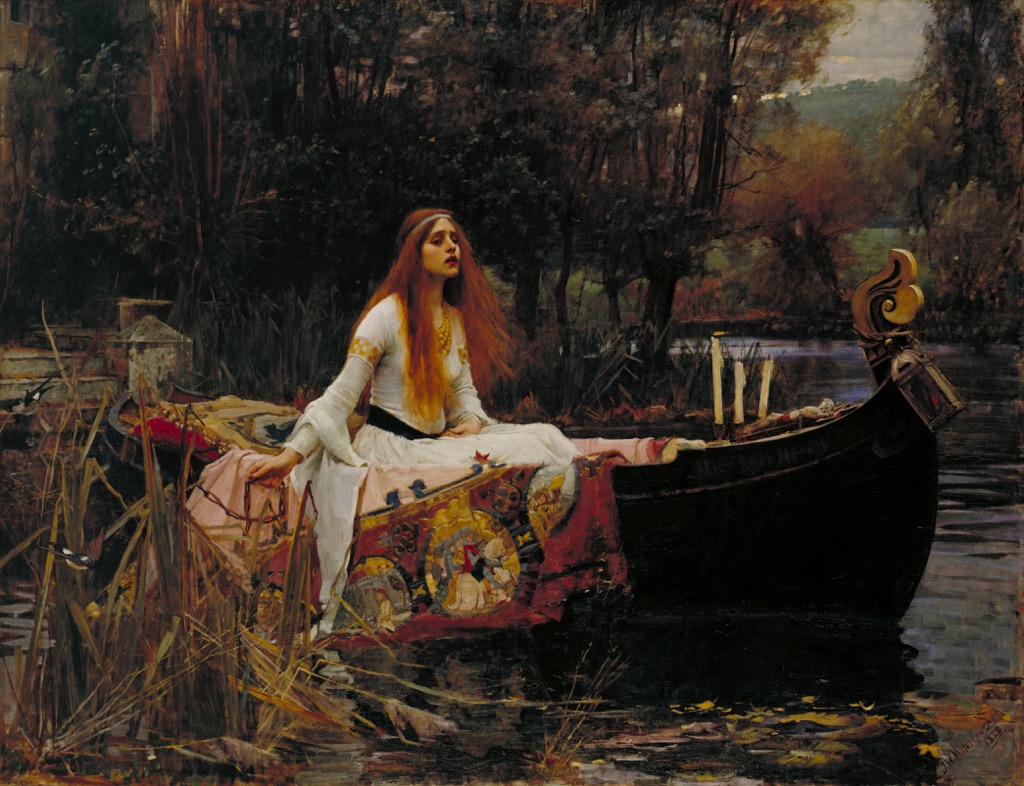
- The Lady of Shalott: Compare Waterhouse's best-known literary composition.
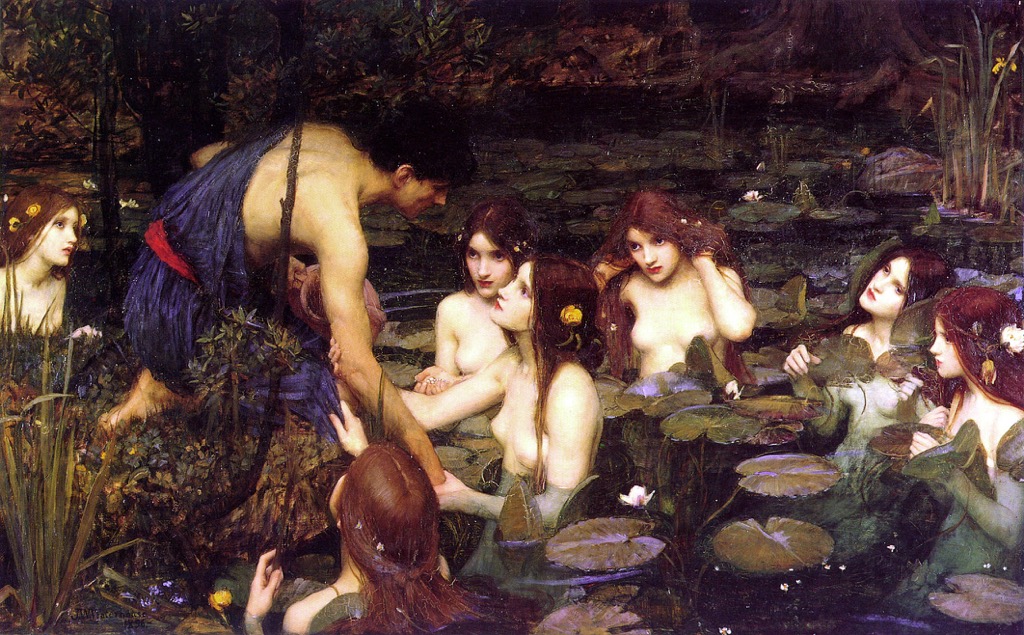
- Hylas and the Nymphs: Compare another major mythological scene.
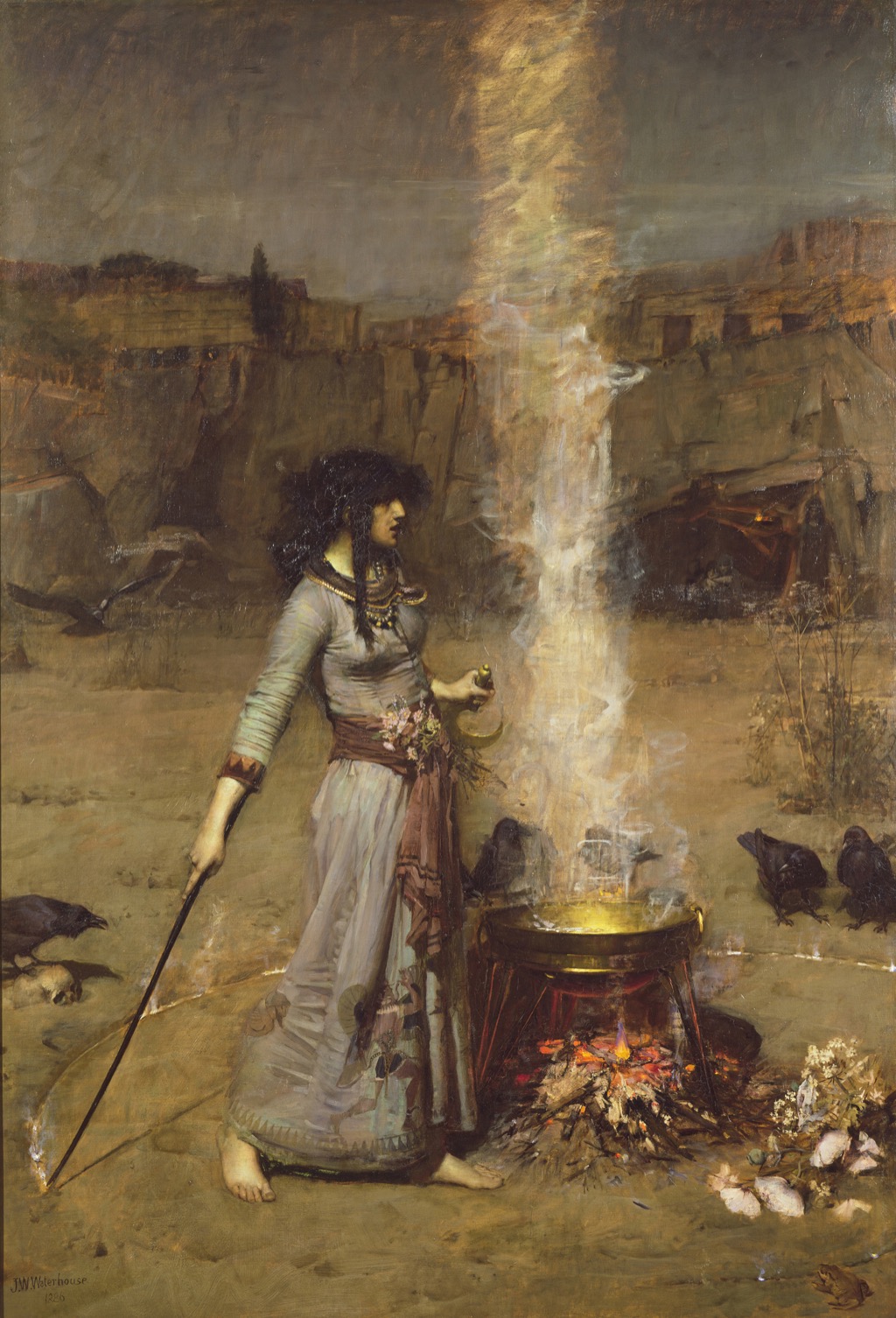
- The Magic Circle: Compare Waterhouse's treatment of ritual and symbolism.
Frequently Asked Questions
In Boccaccio's tale and Keats's poem, Isabella places the severed head of her murdered lover Lorenzo beneath the basil. [2] [3]
Her brothers killed Lorenzo and concealed the body. After his ghost revealed the burial place, she recovered the head and created a private memorial that allowed her to remain close to him.
Boccaccio says Isabella planted the head under fine basil and watered it with tears and scented water. The concealed organic matter and her continual care make the plant flourish. [3]
The skull on the pedestal reveals the mortality hidden inside the beautiful garden arrangement. It also recalls earlier painted versions of the story, especially Holman Hunt's pot decorated with death's heads. [1] [4]
It belongs to both traditions, but its title and late nineteenth-century context point especially to Keats's Isabella; or, The Pot of Basil, which openly adapts Boccaccio. [2] [3]
It is privately owned. It was offered at Christie's in London in 2017 after a documented history that included H. W. Henderson, Viscount Lambton and Sir Rod Stewart. [1]
No. The Pre-Raphaelite Brotherhood was founded in 1848, when Waterhouse was an infant. His mature poetry-derived subjects and visual style led later writers to associate him with a later Pre-Raphaelite revival.
Discussion
Isabella preserves love by creating a form of care that destroys her. The basil offers purpose, privacy and resistance to her brothers' attempt at erasure. It also prevents grief from changing into another life. Waterhouse does not judge that contradiction from outside; he gives it a garden in which devotion and decay become materially inseparable.
The painting's beauty is therefore not a consolation placed over the story. Beauty is the problem the story explores. Basil grows from death, Waterhouse's colour grows from grief, and the skull becomes ornament. The work asks whether art can reveal suffering without also making it desirable to behold. Its answer remains as divided as Isabella's plant: alive above the soil, founded upon loss below.
Reader Insights
Which visible detail most changes the way you read this page?
Which source or comparison helps the work feel less familiar and more specific?
What question would you bring back to the painting after reading?
Join the Conversation
Share your reading of this page below.
References
- Christie's. “John William Waterhouse, R.A., Isabella and the Pot of Basil,” 2017 lot record and scholarly catalogue essay, with object details, provenance, exhibition history and literature. View source
- John Keats. “Isabella; or, The Pot of Basil,” full text, first written in 1818 and published in 1820. View source
- Giovanni Boccaccio. The Decameron, Day 4, Story 5, English translation by John Payne, Project Gutenberg. View source
- Smarthistory. “William Holman Hunt, Isabella or the Pot of Basil,” discussion of Hunt's 1868 treatment and its relation to Keats. View source
- Wordsworth Grasmere. “Isabella after Keats—a potted history,” discussion of the story's botanical and medical contexts and Waterhouse's painting. View source