

 by Tom Gurney
Tom Gurney BSc (Hons) is an art history expert with over 20 years experience
Published on August 14, 2026 / Updated on August 14, 2026
Email: tomgurney1@gmail.com / Phone: +44 7429 011000
In the Peristyle: Introduction
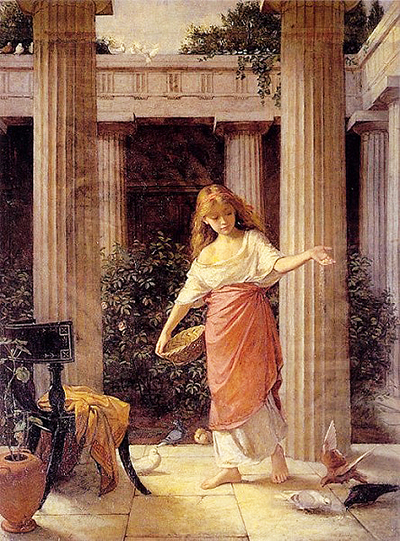
John William Waterhouse's In the Peristyle turns a quiet act of feeding birds into an absorbing study of movement, architecture and light. A barefoot girl steps across a tiled courtyard, scattering grain from a shallow basket as pigeons gather around her. Columns rise on either side, but the picture never feels static: one arm extends, cloth swings from her body, and startled wings disturb the measured order of the Roman setting.
Painted about 1874, this is an early Waterhouse, made before the Arthurian and mythological heroines that later defined his reputation. It already reveals several enduring interests: a single female figure absorbed in an action, a carefully imagined past, and a threshold between enclosed architecture and living nature. The painting belongs to Touchstones Rochdale, where it has formed part of the public collection since Robert Taylor Heape gave it in 1908. [1] [2]
At a Glance
- ArtistJohn William Waterhouse
- TitleIn the Peristyle
- DateAbout 1874 [1] [2]
- MediumOil on canvas [1] [2]
- Dimensions67.3 × 52.1 cm [1]
- CollectionTouchstones Rochdale / Rochdale Art Gallery [1] [2]
- Accession number122 [1]
- AcquisitionGift of Robert Taylor Heape, 1908 [1]
- SubjectA girl feeding pigeons in a Roman-style colonnaded courtyard
- Career contextAn early classical genre painting, created during Waterhouse's formative 1870s
Contents
- Introduction
- What the painting shows
- What is a peristyle?
- The girl and the pigeons
- Architecture as a frame
- Costume, furniture and domestic detail
- Colour, light and surface
- An early Waterhouse
- Victorian visions of Rome
- Meaning without a written story
What the painting shows
A young woman occupies the lower centre of a tall, narrow composition. Her head bends towards the birds, her left hand carries a shallow basket, and her other arm opens towards a pigeon in flight. She is caught between walking and pausing.
Her white undergarment and warm rose-red wrap stand out against buff stone. Bare feet make direct contact with the pale paving slabs, giving the carefully reconstructed scene a light, informal rhythm.
The surrounding court is densely observed. Two great foreground columns establish depth; further columns and shadowed openings continue behind them. Shrubs grow within the enclosure, foliage rises above the wall, and pigeons perch along the upper ledge.
At lower left, a large terracotta pot, a decorated chair and draped yellow cloth form a domestic still life. At lower right, birds cluster, lift or turn. The human figure links those two zones.
The picture contains no obvious crisis. Waterhouse creates attention through small changes of balance: the tipped head, open fingers, advancing foot and beating wing.
The moment could recur every day. That ordinariness is central to the painting's charm, but it does not make the design casual. Architecture, costume, plants, furniture and animal movement have been orchestrated to make the ordinary act legible.
What is a peristyle?
The title identifies the architecture. In a Roman house, a peristyle was an open-air court, commonly laid out as a garden and surrounded by a colonnade. The Getty Art & Architecture Thesaurus describes it as a court towards the rear of a Roman house, usually with a small garden enclosed by columns. [3]
Peristyles joined movement, display and retreat. The Metropolitan Museum of Art notes that Roman houses could contain a peristyle of varying size, normally gardened in the western empire and sometimes paved with marble in the East. [4]
The Getty Villa explains that such gardens admitted light and air, offered relief from heat, and supported conversation, contemplation and the cultivation of plants. [5] Waterhouse uses precisely this mixture of functions. His court is architectural yet open to sky, formal yet inhabited by shrubs and birds.
The painting should not be read as an archaeological diagram of a particular excavated house. No secure identification of an exact ancient site is attached to the collection record.
Instead, the peristyle is a believable composite. Repeated columns, panelled entablature, garden growth and tiled floor supply enough historical vocabulary to transport a Victorian viewer.
The title matters because it makes place, rather than biography or myth, the first interpretive key. The girl is unnamed; the architectural environment is named.
The girl and the pigeons
The girl's task is simple: she distributes feed from the basket. Waterhouse avoids a symmetrical pose, allowing her body to describe a soft diagonal from lowered hand to extended arm.
Her gaze falls towards the ground rather than meeting the spectator. That absorption anticipates later Waterhouse figures who read, weave, gather flowers or stare into water. Action gives the figure privacy even in full view.
The pigeons register successive stages of response. Some approach across the paving; another takes flight close to her fingers; others wait on the upper ledge. The scene therefore contains a small sequence within one image.
Birds also soften the architecture. Their irregular bodies and sudden motion interrupt straight shafts, horizontal cornices and rectangular slabs.
It is tempting to assign symbolic meanings—peace, love, Venus or the soul—to every dove. Classical and Christian traditions do give doves many associations, but the painting supplies no inscription or narrative attribute that selects one conclusively.
Calling them pigeons or doves does not materially change the scene. English art writing often uses “doves” for their poetic resonance, while the visible birds behave like familiar domestic pigeons.
Their strongest role is experiential. They turn the court from a reconstruction into a lived place, and they transform the girl's gesture into the centre of a responsive world.
Scale intensifies that response. The nearest pigeons are large enough to register individual turns of head and spread feathers, whereas the perched flock above becomes a row of pale marks. Waterhouse uses the same species to measure depth from paving to roofline.
The airborne bird near the girl's right hand is especially effective. Its diagonal wingbeat continues her open palm and makes the empty air between hand and column active. Nothing is exchanged except grain, yet a momentary relationship has been made visible.
Architecture as a frame
The two foreground columns act almost like the sides of an internal frame. They narrow the view and locate the spectator just inside the colonnade, looking across rather than surveying the whole house.
Waterhouse places the girl's head and upper body against the darker central opening. That contrast preserves her profile amid complex foliage and masonry.
Verticals dominate, but they are not mechanically regular. The near columns are cropped, the rear colonnade recedes, and climbing vegetation breaks the upper edge.
The floor supplies a second system. Its joints lead inward and clarify where bare feet and birds touch the ground. Perspective becomes part of the narrative because it distributes the flock around the moving figure.
At the top, the exterior sky is only a slim band. This limited opening gives light without dissolving enclosure. The viewer feels within a house that has been opened at its centre.
Waterhouse's father was an artist, and the young painter trained at the Royal Academy Schools. His early work repeatedly demonstrates an appetite for architecture, costume and constructed historical space. [6]
Yet technical accuracy serves atmosphere. The columns do not overwhelm the girl; they make her relaxed, curving movement more visible.
Costume, furniture and domestic detail
The costume is classicising rather than a documented copy of one named garment. A pale loose dress is crossed by a red-pink wrap, its folds gathered to leave the feet free.
Colour separates the body into readable layers. Cream catches light, rose defines the middle, and shadowed folds connect the figure to the court.
Her bare feet are important. They avoid the hard visual punctuation of shoes and make the step feel quiet against sun-warmed stone.
The chair at left has an ornamental back and curving legs. A yellow textile hangs over it, creating a complementary note beside the reddish dress. The object implies recent human use without adding another figure.
The terracotta vessel brings a large rounded mass into the corner. Its earthy colour connects furniture and pavement while distinguishing domestic equipment from carved stone.
These objects prevent “ancient Rome” from becoming only monument and column. A home needs movable things, fabric, containers, plants and routine.
They also reward slow viewing. The feeding action can be understood immediately, while the chair, cloth, pot and perched birds extend attention outwards.
No surviving preparatory account tells us whether individual props came from Waterhouse's studio collection. Their historical plausibility should not be converted into unsupported provenance.
Colour, light and surface
Warm ochres and creams organise the stone, while dark green foliage creates depth. The girl's rose wrap becomes the principal chromatic accent.
Light enters from above and falls most clearly across the paving and pale dress. The central recess remains dark enough to make the figure advance.
This is not the hard, uniform illumination of an archaeological illustration. Edges soften, vegetation merges with shadow, and distant masonry loses definition.
The small canvas—67.3 by 52.1 centimetres—invites intimate rather than panoramic viewing. [1] Its upright shape suits the standing body and tall columns.
Waterhouse balances descriptive finish with selective abbreviation. Architectural lines establish structure; paint becomes looser in leaves, feathers and drapery.
That variation makes different materials believable. Stone appears firm, cloth mobile and foliage porous, even though all are pigment on canvas.
Reproductions can shift the work towards brown or over-bright pink. Interpretation should therefore avoid exact colour claims based on a single digital file. The stable relationship matters more: warm figure and floor are held within darker vegetation and architectural shade.
An early Waterhouse
In the Peristyle dates from about 1874, when Waterhouse was in his mid-twenties and still establishing an exhibition identity. [1] [6]
His earliest public works favoured ancient settings and episodes of everyday or historical life. They belong to the broad Victorian taste for scenes of Greece and Rome developed by painters such as Lawrence Alma-Tadema and Frederic Leighton.
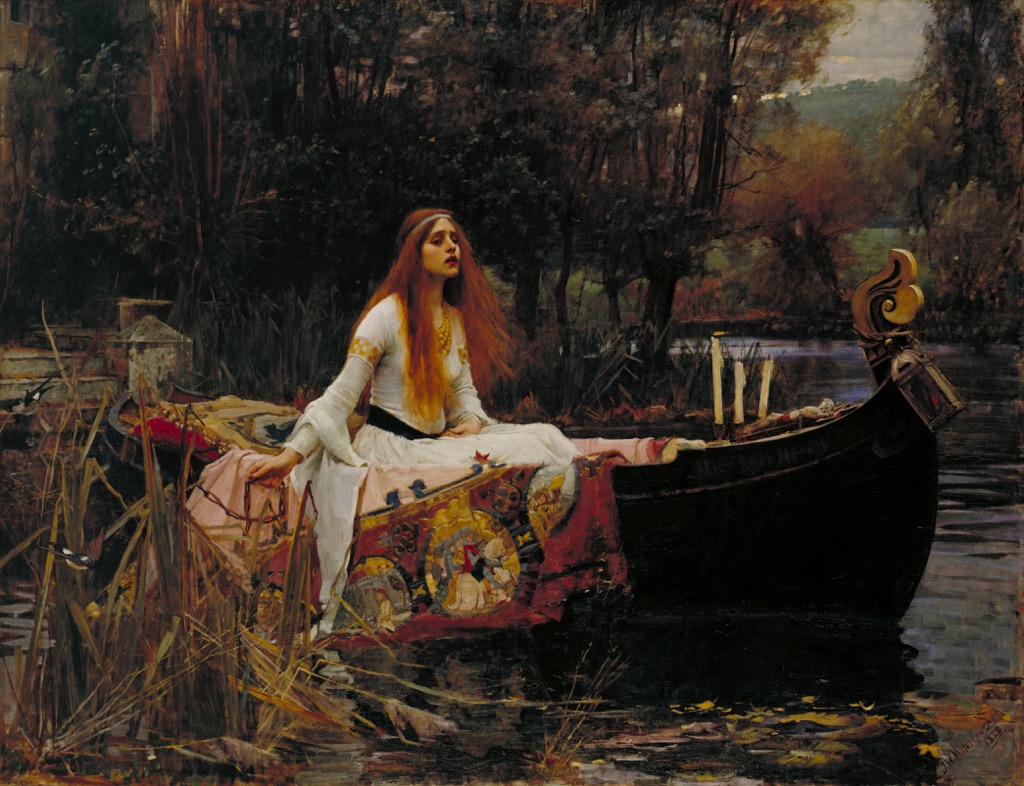
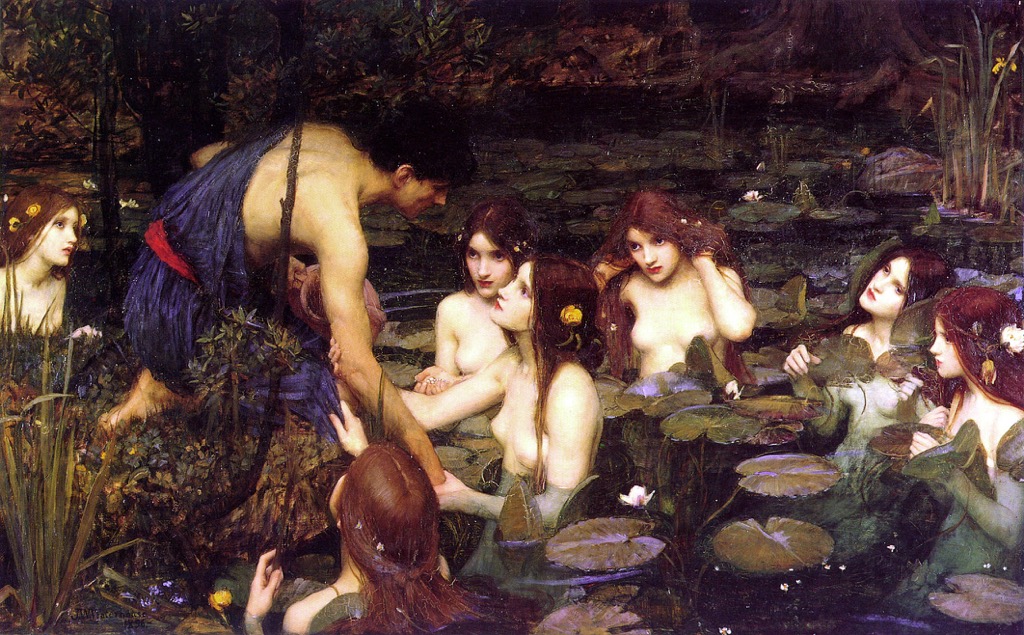
The painting is not yet the Waterhouse of The Lady of Shalott or Hylas and the Nymphs. There is no fatal literary heroine, supernatural encounter or threatening water.
Nevertheless, continuities are striking. One young woman occupies a carefully bounded environment; she is unaware of the viewer; costume and gesture carry meaning; plant life mediates between body and architecture.
The birds also anticipate Waterhouse's ability to arrest a transition. Later narratives often concentrate on the instant before a choice or catastrophe. Here the stakes are modest, but the extended hand and lifting wings create the same temporal sharpness.
It is better to describe the work as formative than “immature.” The composition is controlled, the public collection history substantial, and the subject deliberately quieter than later masterpieces.
Early does not mean irrelevant. This canvas shows Waterhouse discovering how a solitary female action could organise a whole invented world.
Comparison with the later paintings also reveals what Waterhouse chose not to retain. The architecture of his mature work is often less insistently displayed, submerged beneath vegetation, water or close psychological focus. In In the Peristyle, by contrast, the colonnade is nearly a co-protagonist. Its knowledge is placed on view.
The figure nevertheless prevents the exercise from becoming a showcase of perspective. Her bare foot crosses a paving joint, her arm overlaps a column, and her hair breaks against the dark recess. Each contact turns constructed depth into bodily experience.
The picture also shows that his interest in women “doing” something was present from the beginning. This girl is not posed solely for admiration. Feeding, walking and watching occupy her attention, creating a modest form of narrative agency that will become more complicated in later works.
Victorian visions of Rome
Nineteenth-century British audiences encountered antiquity through classical education, museum collections, excavations, architecture, theatre and popular illustration. Painters converted that material into convincing scenes of human life.
Waterhouse was born in Rome to English artist parents, though he grew up and trained principally in London. [6] His birthplace encourages interest in his classical subjects, but it does not prove direct memory for every architectural detail.
The peristyle offered Victorian painters a particularly useful setting. It joined interior and exterior, allowed brilliant Mediterranean light, and provided columns without requiring a public temple scene.
It could also domesticate antiquity. Feeding birds is recognisable across periods; costume and architecture move the activity into the imagined past.
Such pictures should be read critically. They are nineteenth-century constructions, shaped by contemporary scholarship, available props and ideals of beauty. They do not provide transparent evidence of how every Roman household looked or who performed its labour.
The girl's social position is not identified. She might be imagined as daughter, attendant or household member, but the picture does not settle her status.
That uncertainty is revealing. Waterhouse sought an emotionally accessible antiquity, not a sociological inventory. Modern viewers can enjoy the scene while distinguishing atmosphere from archaeological proof.
Victorian classical painting is sometimes judged only by whether every object is archaeologically correct. That test is too narrow. Historical credibility was assembled from research, but the picture's success also depended on composition, contemporary ideas of beauty and the expectations of exhibition audiences.
Here antiquity functions as both distance and familiarity. The columns declare another time; feeding birds collapses that distance at once. Waterhouse lets viewers recognise an action before asking them to examine the setting.
The unequal visibility of labour remains important. We see a pleasant household routine but not the people who built, cleaned or sustained the luxurious court. That absence is part of the nineteenth-century idealisation and should be acknowledged without demanding that one small painting become a complete social history of Rome.
Meaning without a written story
Many famous Waterhouse paintings begin with a literary text. In the Peristyle does not require one. Its title names the setting rather than a source or character.
The absence of a fixed story increases attention to mood. Is the girl playful, dutiful, lonely or simply occupied? Her downward face and gentle movement allow several tones without demanding a dramatic verdict.
Feeding establishes care without sentimentality. The birds remain animals responding to grain, not actors in an allegory.
The courtyard suggests sheltered freedom. It is enclosed by architecture but open to air and vegetation; birds can arrive or depart, while the human figure moves within household boundaries.
Modern interpretations may see gender in that enclosure, especially when comparing Waterhouse's later women confined by towers, pools or gardens. Such comparison can be productive, provided it is framed as interpretation rather than documented intention.
The most secure meaning comes from formal relationships. Order meets spontaneity, stone meets growth, and a repetitive routine becomes a fleeting visual event.
This modest narrative scale is one reason the work remains approachable. Nothing needs to be decoded before the viewer can feel the pleasure of movement through a sunlit court.
Rochdale and the painting's public life
The work belongs to Rochdale Art Gallery, now associated with Touchstones Rochdale. The catalogue records accession number 122 and a 1908 gift from Robert Taylor Heape. [1]
That provenance matters. Rather than disappearing into a private collection, an early Waterhouse entered a municipal collection and became part of civic cultural life.
The gift date also shows that the picture was valued before the twentieth-century revival of intense popular interest in Waterhouse's Pre-Raphaelite-associated works.
Collection names and display arrangements can change, so the most accurate lasting formulation is that the painting is held by the Rochdale collection. A visit should be checked with the museum before travel.
Public ownership supports comparison. Viewers can place this quiet 1870s canvas beside later images and see development that reproductions flatten.
The accession record preserves information that the scene itself cannot: physical dimensions, support, donor and date of entry. Those facts anchor interpretation in an object with a history.
In the Peristyle now occupies two times at once. It is a Victorian imagining of Roman domestic life and a long-standing part of a northern English public collection.
Related Pages
- The Lady of Shalott: Compare Waterhouse's best-known literary composition.
- Hylas and the Nymphs: Compare another major mythological scene.
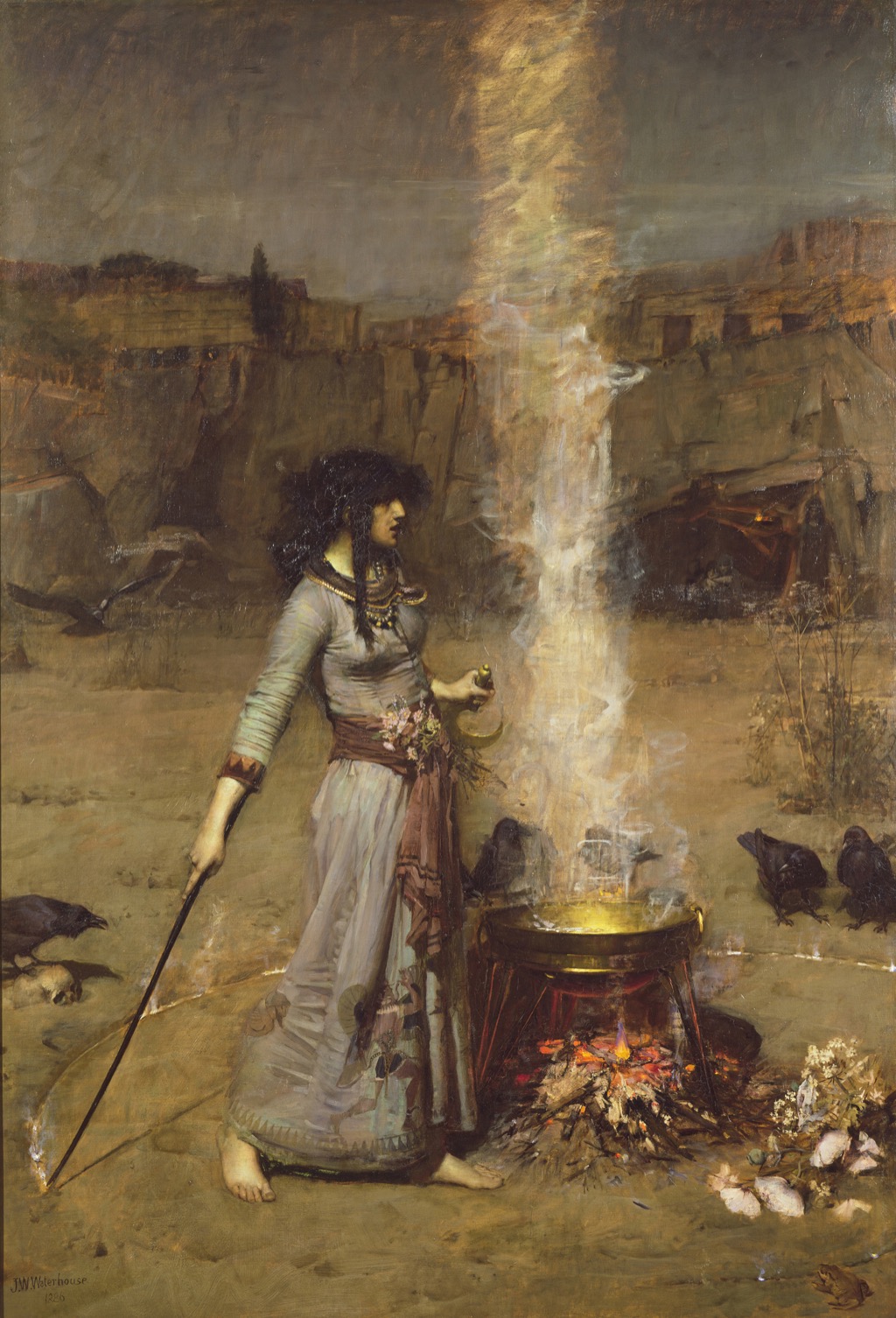
- The Magic Circle: Compare Waterhouse's treatment of ritual and symbolism.
Frequently Asked Questions
She carries a shallow basket and scatters food for pigeons or doves gathered on the paving.
No secure literary or mythological identity is established by the title or collection record.
It measures 67.3 by 52.1 centimetres. [1]
Robert Taylor Heape gave it in 1908. [1]
Waterhouse is often associated with later Pre-Raphaelitism, but this early work is more precisely described as a Victorian classical genre scene.
Discussion
In the Peristyle proves that Waterhouse did not need a famous poem or violent myth to create sustained attention. Its drama consists of a step, a handful of grain and a flicker of wings.
Architecture supplies order, but the picture lives through departures from that order: cloth slips over a chair, foliage crosses stone, and pigeons scatter across the grid of paving. The girl belongs to both systems. Her upright body echoes the columns while her tilted head and open arms follow the birds.
Reader Insights
Which visible detail most changes the way you read this page?
Which source or comparison helps the work feel less familiar and more specific?
What question would you bring back to the painting after reading?
Join the Conversation
Share your reading of this page below.
References
- Wikimedia Commons / Art UK object data, John William Waterhouse, In the Peristyle, date, medium, dimensions, accession, collection and acquisition. View source
- Art UK, “In the Peristyle,” Touchstones Rochdale collection record. View source
- Getty Research Institute, Art & Architecture Thesaurus, “peristyles (Roman courtyards),” definition and architectural context. View source
- The Metropolitan Museum of Art, “Roman Housing,” the structure and use of the peristyle in Roman domestic architecture. View source
- J. Paul Getty Museum, “Gardens,” uses and character of Roman peristyle gardens. View source
- Royal Academy of Arts, “John William Waterhouse RA,” training, career chronology and artistic context. View source