

 Buy Art Prints Now
from Amazon
* As an Amazon Associate I earn from qualifying purchases.
Image reference [image]
 by Tom Gurney
Tom Gurney BSc (Hons) is an art history expert with over 20 years experience
Published on August 14, 2026 / Updated on August 14, 2026
Email: tomgurney1@gmail.com / Phone: +44 7429 011000
Gone, But Not Forgotten: Introduction
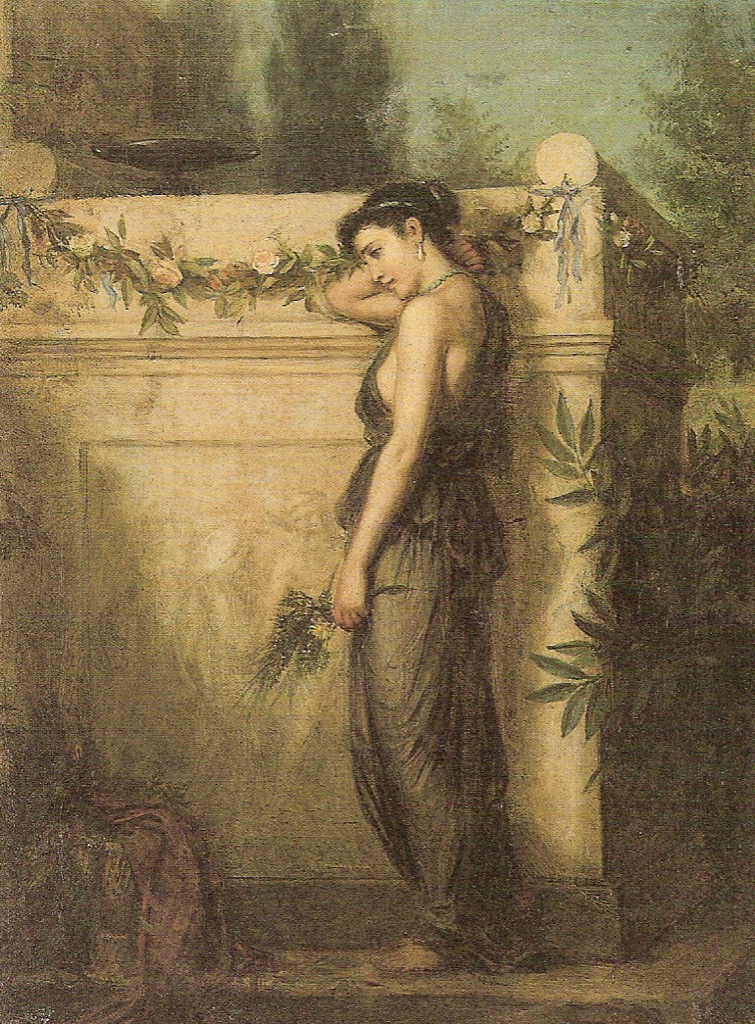
John William Waterhouse's Gone, But Not Forgotten is a small painting of remembrance without a named dead person or a fully explained ritual. A young woman in classically styled dress leans against a wall or architectural support. Flowers hang from one hand; a basket and folded fabric occupy the foreground. Her face turns away in subdued concentration.
Painted in 1873 while Waterhouse was still a student at the Royal Academy Schools, the picture was exhibited at the Dudley Gallery that winter. Christie's describes it as an essay in early Aestheticism, made before the influence of Lawrence Alma-Tadema became pronounced in Waterhouse's classical art. Its title directs the scene towards loss, but the painting does not tell us who is gone. That refusal is central to its effect. [1] [2] [3]
At a Glance
- ArtistJohn William Waterhouse
- Date1873 [1] [2]
- MediumOil on canvas [1]
- Dimensions31.8 × 24 cm (12 1/2 × 10 in.) [1] [2]
- SignatureSigned “J.W. Waterhouse” [1]
- CollectionPrivate collection [2]
- ExhibitionDudley Gallery, London, Winter 1873, no. 301 [1] [4]
- Catalogue price£20 including frame [1] [4]
- SubjectAn unnamed woman holding flowers in a mood of remembrance
- Interpretive limitNo secure literary story, deceased person or grave is identified by the exhibition catalogue [4]
Contents
- Introduction
- What the painting shows
- What the title establishes
- Flowers, basket and the work of memory
- Gesture, face and emotional restraint
- Classical dress without a named story
- Early Aestheticism and the Dudley Gallery
- Small scale and cabinet-picture intimacy
- Waterhouse as a student artist
- Rediscovery and private ownership
What the painting shows
One young woman fills most of a small upright canvas. Her body rests against a wall, pier or similar architectural surface, creating a posture of pause rather than forward movement.
She wears a light classical garment that slips or folds away from one shoulder. A band holds her hair, and jewellery adds restrained ornament.
In her left hand she carries small flowers or a floral sprig. They hang down rather than rise in presentation. This orientation makes them feel retained after an event rather than freshly offered.
A basket stands near the foreground, filled or partly covered by reddish-brown fabric. Its practical purpose is not explained.
The woman's head turns sideways and slightly down. She does not meet the spectator's gaze. Her face communicates absorption, but the exact emotion—grief, longing, recollection or fatigue—remains open.
Architecture encloses one side of the composition while the rest suggests outdoor air. The setting is neither a clearly identified tomb nor a fully developed domestic courtyard.
There is no second person. The title makes absence active: what matters most is not painted.
What the title establishes
“Gone, but not forgotten” is a formula of remembrance. It marks the separation between physical absence and continuing mental or emotional presence.
Waterhouse's exhibition title appears in the 1873 Dudley Gallery catalogue, confirming that it is not merely a later dealer's invention. [4] The punctuation and quotation marks vary across records, but the wording is stable.
The phrase does not identify death with certainty. Someone can be gone through departure, separation or loss as well as burial. The woman's flowers and solemnity make mourning plausible, but the painting lacks a named memorial inscription.
Nor does the title identify the relationship between the woman and absent person. Lover, family member and friend are all possible; none is documented.
This openness allowed a Victorian viewer to bring personal experience to the picture. A title broad enough for many forms of loss could attach private memory to an unnamed classical figure.
The second half of the phrase is as important as the first. “Not forgotten” describes mental action. The woman's stillness is not emptiness; she remembers.
Waterhouse therefore builds a narrative around an invisible object. We see the person who remains and infer the person who has left.
The grammar also resists a simple ending. “Gone” states a completed separation; “not forgotten” makes its consequences continuous. The painting occupies that continuing present. Nothing visible can reverse the first condition, yet posture, flower and title perform the second.
This is why a named anecdote may weaken the composition. If the absent person were securely identified, viewers could organise every detail around one biography. By leaving the relationship open, Waterhouse makes remembrance structurally important. The woman is not only illustrating a story; she models what it means for thought to remain attached to someone unavailable.
The phrase was common enough to sound familiar without requiring one literary citation. That familiarity carries an epitaph-like cadence without proving a tomb. Waterhouse can draw upon memorial language while placing his figure in an indeterminate outdoor setting.
Flowers, basket and the work of memory
Flowers are the painting's clearest material link to remembrance. They can be carried to a grave, retained from an exchange or used as tokens of affection.
Their perishability suits the title's tension. Cut blossoms disappear physically, while memory claims to persist.
The flowers hang from the woman's hand instead of forming a triumphant bouquet. Their lowered position corresponds with her averted face and supported body.
It would be tempting to identify exact species and assign them meanings from Victorian flower dictionaries. Reproduction quality and the absence of catalogue evidence make that unsafe. “Flowers” is enough.
The basket introduces ordinary labour into an emotional picture. It may have held flowers, cloth or personal belongings. Because it rests rather than being carried, it reinforces interruption.
The reddish fabric spills or folds across it, adding warmth to the subdued palette. Material richness keeps mourning from becoming visually austere.
Flowers and cloth also support an Aesthetic reading. They provide colour, texture and line independent of narrative function. The objects can carry feeling while remaining beautiful arrangements.
This double role is typical of the painting. Every motif seems potentially symbolic, yet none closes interpretation.
Gesture, face and emotional restraint
The woman's lean is the central gesture. Architecture bears part of her weight, suggesting that attention to the absent person has interrupted upright activity.
Her body is not collapsed in theatrical grief. Arms and hands remain controlled; there are no tears enlarged for the viewer.
The turned face preserves privacy. We observe emotion without being invited into direct exchange.
This restraint allows the painting to avoid one fixed emotional climax. Memory can be recurrent and quiet rather than newly catastrophic.
The exposed shoulder softens the figure's outline and introduces vulnerability. It should not automatically be eroticised; within the classical costume, drapery helps place the scene outside modern everyday dress.
Her hairband and jewellery give coherence to the head, the zone where remembering occurs. Ornament frames thought without explaining it.
The wall is more than background. It provides the physical resistance against which the body rests. Solid architecture contrasts with fragile flower and absent person.
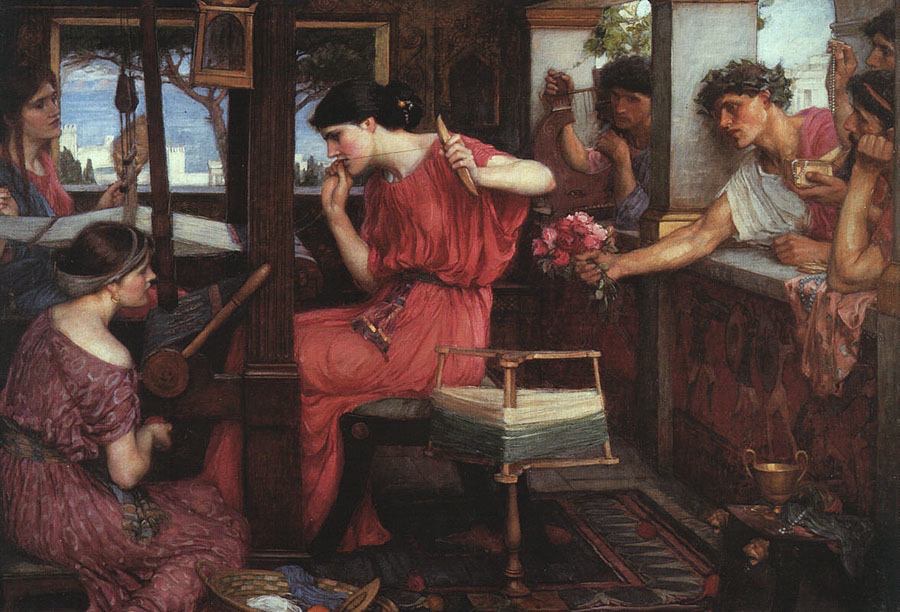
Waterhouse later became highly skilled at turning small gestures—hands on a loom, fingers around a cup, a face near a rose—into narrative. This early picture shows that interest before the mature technique.
The supported pose also divides the body into active and inactive parts. One hand retains the flowers, the head continues to think, but forward motion has stopped. Memory appears as an interruption of ordinary purpose.
Her averted face protects that interruption from spectacle. Victorian mourning imagery could make grief publicly legible through dramatic collapse, black dress or graveyard setting. Waterhouse instead gives a pale classical figure whose sorrow must be inferred. Restraint becomes a way of preserving dignity.
Because the reproduction enlarges the face, modern viewers may overstate one fixed expression. At the canvas's actual cabinet scale, head, flowers, basket and wall work together. Emotion belongs to the arrangement rather than to a theatrical facial close-up alone.
Classical dress without a named story
The garment and architectural setting evoke antiquity, but the 1873 exhibition catalogue supplies no mythological or historical name. [4]
The woman should therefore not be labelled Penelope, Ariadne, Electra or a Roman widow without documentary support. Many classical heroines wait or mourn; resemblance of condition is not identity.
Waterhouse's title is contemporary English rather than the name of an ancient text. It converts classical appearance into a general emotional language.
Antiquity gives distance from specific modern bereavement. The spectator can recognise grief without asking whose Victorian clothing or household is represented.
At this point in Waterhouse's career, the classical setting was still developing. Christie's notes that the pronounced influence of Alma-Tadema visible in later works had not yet arrived. [1]
The result is less archaeologically elaborate than Diogenes or The Favourites of the Emperor Honorius. Architecture and costume establish mood with economical means.
Calling the work “Ancient Roman” may be reasonable as a broad visual category, but no object in the accessible record fixes exact place or century.
The safest description is an unnamed classically dressed woman remembering an absent person.
Early Aestheticism and the Dudley Gallery
Christie's calls the painting an essay in early Aestheticism and connects that character with its exhibition at the Dudley Gallery. [1]
The Aesthetic Movement in Britain valued beauty, artistic sensation and formal harmony rather than insisting that art deliver a moral lesson. The Victoria and Albert Museum describes its aim as making art beautiful in resistance to industrial ugliness and materialism, often summarised as “art for art's sake.” [3]
Gone, But Not Forgotten still has emotional content. Aestheticism does not make its title meaningless. Instead, mood is carried through colour, pose, dress and objects rather than through a fully narrated moral anecdote.
The Dudley Gallery, held at the Egyptian Hall in Piccadilly, provided an important venue for such work before the Grosvenor Gallery opened. Christie's describes it as advancing aesthetic values during the 1860s and early 1870s. [1]
The surviving winter catalogue places Waterhouse's picture at no. 301 and gives a price of £20 including frame. [4] That primary record grounds the painting in a crowded commercial exhibition rather than an imagined private debut.
Nearby entries ranged across landscape, figure subjects and still life. Viewers would have encountered Waterhouse's small canvas among many competing objects.
Its concentrated female figure, suggestive title and restrained colour offered a way to attract attention without large scale or spectacular narrative.
Small scale and cabinet-picture intimacy
At 31.8 by 24 centimetres, the painting is physically intimate. [1] [2] It could be approached closely and accommodated within a domestic collection.
The Dudley event was explicitly a winter exhibition of cabinet pictures in oil. [4] “Cabinet picture” indicates a small work suited to close viewing and private rooms, not a piece of furniture.
Scale shapes the emotional register. A monumental mourner might become a public allegory. This figure remains personal, almost withheld.
The narrow format keeps body, wall, flowers and basket close together. There is little environmental distraction.
Small size also explains why image enlargement must be handled carefully. Online reproduction can make brushwork appear monumental and hide the object's actual delicacy.
The £20 catalogue price situates it as an offered artwork, not merely a student study kept in the studio. [1] [4] Frame was included, making presentation part of the commodity.
The painting's later private history suits the cabinet format, though present ownership should not be romanticised. It is private because of collection history, not because the subject demands secrecy.
Waterhouse as a student artist
Christie's states that Waterhouse was still a student at the Royal Academy Schools when he painted the picture. [1] He had begun exhibiting at the Society of British Artists in 1872 but would not make his Royal Academy exhibition debut until 1874. [5]
The 1873 canvas therefore sits between training and public formation. It shows ambition in theme and presentation without the scale of his later Academy works.
Its early date also corrects the habit of calling every Waterhouse woman “Pre-Raphaelite.” The original Brotherhood belonged to an earlier generation, and Waterhouse's stronger engagement with its literary and visual legacy developed later.
In this painting, Aestheticism is the more precise immediate context. [1] [3] Classical dress and melancholy overlap with Pre-Raphaelite interests, but institutional and stylistic labels should not be used as synonyms.
The young artist was already learning how titles shape viewing. Without the phrase Gone, But Not Forgotten, the figure might appear merely tired or thoughtful. With it, every object becomes a potential token.
He was also learning the value of incompleteness. The absent person never needs to enter for the canvas to imply relationship.
These strategies would endure through changes in technique and scale. Many mature works depend on a known text or title to activate an otherwise suspended figure.
Rediscovery and private ownership
Anthony Hobson's 1980 catalogue listed the painting without a known location. Christie's later presented it as a recent discovery and supplied the object details and exhibition record. [1]
“Rediscovered” should not be confused with newly authenticated from nothing. The title and early exhibition were documented; the physical canvas had become unavailable to scholarship.
Its reappearance allowed signature, dimensions and surface to be connected with the catalogue entry. Christie's records the signature “J.W. Waterhouse” and size of 12 1/2 by 10 inches. [1]
The current broad location remains a private collection. [2] Sale history should not be treated as proof of a present named owner.
Public-domain photography makes the image accessible, but colour and detail depend on the quality of the scan. [2] Claims about individual flowers or subtle pigment should therefore remain cautious.
The rediscovery also expanded understanding of Waterhouse's student years. A mature artist's career can look artificially sudden when early private works disappear.
Gone, But Not Forgotten is ironically suited to that history: physically absent from scholarly view for years, yet retained in catalogues and memory until object and record met again.
What should remain uncertain
No secure source identifies the woman or her model. Facial comparison alone cannot supply a name.
No literary text is cited in the Dudley catalogue. [4] The title may echo common memorial language, but it should not be assigned to one poem without evidence.
The architectural surface is not securely identified as a tomb. Describing it as a wall preserves what is visible.
The flowers do not prove that she has visited a grave. They support remembrance, dedication or retained affection without deciding among them.
The basket's contents and purpose are likewise unknown. It should not become a funeral offering chest through invention.
The exact ancient culture is open. “Classically styled” is more reliable than a precise Greek or Roman date.
These uncertainties strengthen rather than diminish the work. The title defines the emotional structure while leaving the personal story available to viewers.
They also shape how reproduction changes the work. The whole basket and supporting architecture remain important, since cropping the image to the woman's head converts an arranged cabinet picture into a portrait. The signed 1873 date, Dudley Gallery exhibition and private ownership anchor interpretation before thematic readings are added.
Within a broader Waterhouse sequence, the strongest comparisons are Sleep and His Half-Brother Death, The Lady Clare, Windflowers and The Soul of the Rose. These works handle loss, memory, flowers and suspended female attention differently. Comparison should illuminate motifs rather than claim that the unnamed 1873 woman is an early state of any later heroine.
The painting's title may encourage contemporary viewers to attach personal bereavement to it. That response is consistent with the work's openness, provided it remains distinct from historical fact. Waterhouse supplies a form for remembrance; each viewer may supply a memory, but that memory does not become the painted woman's biography.
The same discipline applies to emotional language. “Melancholy,” “sorrowful” and “reflective” are reasonable descriptions of the overall arrangement, while medicalised claims about depression or biographical claims about trauma are not. A painting can stage grief without diagnosing its fictional subject.
Finally, the work belongs within the history of young artists learning to address a market. The exhibition title had to be memorable, the figure attractive and the cabinet scale collectable. Those commercial conditions do not make the feeling false. They explain why feeling is made available through a broadly applicable phrase and beautiful surface. Waterhouse found a way to join private-seeming remembrance to public display, a contradiction that remains visible whenever a stranger looks closely at the woman's withdrawn face.
Its achievement is therefore double. The canvas is a market object carefully designed for a wall, and an image of thought turning away from the social world. Frame and catalogue invite possession; pose and gaze preserve distance.
That unresolved opposition gives the little picture a seriousness out of proportion to its scale. It offers remembrance publicly while allowing its imagined mourner to keep the remembered person entirely to herself.
Related Pages
- The Lady Clare: Compare another compact Waterhouse literary figure built around withheld identity.
- Windflowers: Compare a later Waterhouse figure where flowers and mood carry suspended feeling.
- The Shrine: Compare another classically framed early subject with public-facing source cautions.
Frequently Asked Questions
The 1873 catalogue lists £20 including the frame. [4]
The painting does not identify the absent person or the woman's relationship to them.
That is possible, but no clear grave marker or catalogue description confirms it.
They support themes of memory, affection and impermanence, but their exact purpose and species are not documented.
It is in a private collection. [2]
Discussion
Gone, But Not Forgotten turns absence into the most active presence in the picture. The unnamed woman, lowered flowers and interrupted basket all point towards a relationship that cannot be seen.
Its Aestheticism lies not in abandoning feeling but in refusing to explain feeling through busy anecdote. Colour, texture and posture carry remembrance.
Reader Insights
Which visible detail most changes the way you read this page?
Which source or comparison helps the work feel less familiar and more specific?
What question would you bring back to the painting after reading?
Join the Conversation
Share your reading of this page below.
References
- Image reference
- Christie's, “John William Waterhouse, Gone, but not Forgotten,” object record, exhibition details and catalogue essay. View source
- Wikimedia Commons, “John William Waterhouse — Gone, But Not Forgotten,” public-domain image record, date, medium, dimensions and private-collection status. View source
- Victoria and Albert Museum, “An introduction to the Aesthetic Movement,” overview of British Aestheticism and art for art's sake. View source
- Dudley Gallery, Winter Exhibition of Cabinet Pictures in Oil (1873), digitised primary catalogue listing Waterhouse's work as no. 301 at £20 including frame. View source
- Stephen Ongpin Fine Art, “John William Waterhouse,” professional biography documenting his training and early exhibition chronology. View source