

 by Tom Gurney
Tom Gurney BSc (Hons) is an art history expert with over 20 years experience
Published on August 14, 2026 / Updated on August 14, 2026
Email: tomgurney1@gmail.com / Phone: +44 7429 011000
Fair Rosamund: Introduction
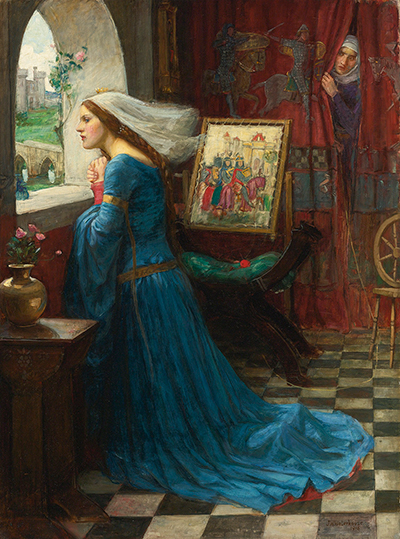
John William Waterhouse's Fair Rosamund turns a medieval legend into a scene of devastating dramatic irony. Rosamund kneels at an open window, watching for King Henry II beyond a bridge. Behind her, Queen Eleanor parts a red curtain and enters unseen. Between them stand an embroidery frame, red thread and images of armed riders: the room itself tells the story Rosamund has not yet understood.
Signed in 1916 and exhibited posthumously at the Royal Academy in 1917, Fair Rosamund was among Waterhouse's final narrative paintings. [1] It illustrates legend, not a verified murder. Rosamund Clifford was Henry II's mistress, but the maze, silken clue and death at Eleanor's hands developed long after the twelfth century. [2] Waterhouse paints the famous fiction with precision while leaving its history open to correction.
At a Glance
- ArtistJohn William Waterhouse
- TitleFair Rosamund
- Date1916, signed and dated lower right [1]
- MediumOil on canvas [1]
- Dimensions96.5 × 72.3 cm [1]
- CollectionPrivate collection, United States [1]
- ExhibitionRoyal Academy, London, 1917, no. 63, posthumously [1]
- SubjectRosamund Clifford waiting for Henry II as Queen Eleanor enters
- Historical basisRosamund was Henry II's mistress and died about 1176 [2]
- Legendary elementsThe maze or bower, silken clue and murder by Eleanor [2] [3]
Contents
- Introduction
- What the painting shows
- The historical Rosamund Clifford
- How the murder legend developed
- Rosamund at the window
- Eleanor behind the curtain
- Thread, embroidery and the maze
- Tapestry, roses and medieval setting
- Colour, geometry and suspense
- A last Royal Academy narrative
What the painting shows
Rosamund kneels at a tall arched window on the left. Her blue dress spreads across the chequered floor, and a white veil streams behind her head.
Her hands clasp near her chest as she looks into the bright exterior. A small figure in blue approaches along a path beyond a stone bridge, plausibly the expected King Henry.
The interior behind Rosamund is deep red and brown. Queen Eleanor appears at the upper right, drawing aside a heavy curtain and watching the unaware woman.
An embroidery frame stands between them. Its colourful design shows riders before a fortified building; behind it, a larger wall hanging also depicts mounted and armed figures.
A ball of red yarn rests on green cloth near the frame. At the far right, part of a wooden spinning wheel or textile apparatus is visible.
Pink roses rise by the window and sit in a metal or ceramic vessel on a small table. They connect the legendary “Fair Rosamund” with beauty and cultivated enclosure.
Nothing violent has yet occurred. There is no poison cup or dagger in clear view. Waterhouse constructs danger from unequal knowledge: the spectator sees Eleanor; Rosamund does not.
The historical Rosamund Clifford
The secure historical core is narrow. Rosamund Clifford was a mistress of Henry II and died around 1176. She was buried at Godstow Abbey near Oxford. [2]
Her relationship with the king became unusually famous, but contemporary evidence about her life is sparse. Many familiar details belong to later storytelling.
Oxford historian Emilie Amt notes that Rosamund was buried at Godstow, probably because her mother was there, and that Henry later showed favour to the abbey. [2]
The prominent tomb attracted controversy. About fifteen years after Rosamund's death, Bishop Hugh of Lincoln ordered its removal from inside the church because he considered that location inappropriate. [2]
Those facts helped keep her memory alive. Burial, royal association and moral condemnation created fertile conditions for romance.
The title “Fair Rosamund” foregrounds beauty rather than political circumstance. It transforms an elusive historical woman into an archetype of desired and endangered femininity.
Waterhouse does not attempt a portrait likeness. No reliable contemporary image of Rosamund underlies the idealised red-haired figure.
The painting should therefore be introduced as a visualisation of her legend, with the documented biography supplied separately.
How the murder legend developed
Later stories place Rosamund in a secret house or bower at Woodstock, protected by a labyrinth built so that Henry alone could reach her.
Eleanor discovers a silken thread and follows it through the maze. She confronts her rival and, in the best-known version, forces her to choose between dagger and poison.
This narrative is not contemporary history. Amt explains that the maze is a later embellishment and that the earliest version of Eleanor murdering Rosamund appears only in the fourteenth century. [2]
Renaissance versions develop the choice between stabbing and poison. The familiar story is therefore a layered cultural construction, not one stable medieval report. [2]
The older Dictionary of National Biography traces the queen's vengeance to a fourteenth-century chronicle and the clue of thread to a later chronicle, while noting that the poison cup arrives still later. [3]
Eleanor had been imprisoned by Henry after supporting their sons' rebellion, which makes the legendary confrontation historically implausible.
By the nineteenth century, poems, ballads, opera and Pre-Raphaelite-related art had made the fiction culturally real. Rosamund became innocent victim; Eleanor became jealous murderess.
Each added object made the story easier to picture. A hidden bower supplies a setting, a labyrinth creates suspense, thread permits discovery, and poison or dagger offers a climax. The accumulation resembles the construction of a dramatic script more than the recovery of an archive.
Waterhouse inherits these additions at the end of a long chain. He does not show the maze literally, because the room can preserve it through thread and concealment. Nor does he show the legendary killing, because anticipation lets viewers bring the familiar ending themselves.
This economy is historically revealing. By 1916, the legend could be activated through a few attributes; its audience did not need every episode narrated. Modern viewers may need the legend explained, but they should also be told how late its decisive elements are.
Waterhouse inherits that mature legend. His responsibility as a painter was narrative force; a modern manuscript's responsibility is to distinguish that force from fact.
Rosamund at the window
Rosamund's body is oriented entirely towards the exterior. Her profile, clasped hands and forward lean indicate expectation.
The small approaching figure beyond the bridge gives her gaze an object. He is reasonably read as Henry II, though distance prevents portrait identification.
Waterhouse lets exterior light model Rosamund's face and dress. She belongs visually to the open view even while her body remains within the room.
The arched window creates an internal picture of landscape: castle-like building, bridge, water or meadow, and approaching person.
Her white veil sweeps horizontally into the dark interior. It bridges the compositional divide but does not alert her to the presence behind it.
Clasped hands can suggest prayer, longing or anxious anticipation. The National Museum Wales describes a related sketch as Rosamund kneeling in prayer while waiting for Henry. [4]
She is neither asleep nor distracted by vanity. Her error is limited vision: concentration on one desired arrival prevents recognition of another.
That pattern is characteristically Waterhouse. Looking drives action, and what remains outside a figure's field of vision becomes the source of danger.
Eleanor behind the curtain
Eleanor appears at the top right, her face and hand emerging between folds of red fabric. A white coif frames her features; dark blue clothing separates her from the curtain.
She is not a spectral figure. The hand physically grips the textile, showing deliberate entry and concealment.
The curtain performs the work that a maze might have done. It divides the secret interior into visible and hidden zones.
Waterhouse places Eleanor above and behind Rosamund, giving her informational advantage without making her physically larger.
Her face is controlled rather than wildly furious. Suspense comes from stillness and proximity.
No weapon is displayed clearly. The spectator knows the legendary outcome, but the painting arrests the action before confrontation.
That absence separates Waterhouse from versions centred on the forced choice between poison and dagger. His subject is discovery rather than execution. Eleanor's first visible action is to look.
Looking creates a chain of possession. Henry, though distant, commands Rosamund's attention; Rosamund occupies Eleanor's; both women command ours. The arrangement makes emotional power circulate without a spoken exchange.
Anthony Hobson's account likewise stresses the composition's anticipation of the legend's sad culmination and the narrative work performed by its medieval furnishings. [5] The tragedy is legible before any fatal object appears.
This timing creates moral unease. We are given Eleanor's privileged view while Rosamund remains unaware.
Modern interpretation should also recognise how legend vilified Eleanor. A powerful queen and wronged wife was recast over centuries as a secret murderess, despite lack of historical evidence. [2]
Waterhouse's sympathy rests visibly with Rosamund, but the page need not repeat the legend's gender politics as biography.
Thread, embroidery and the maze
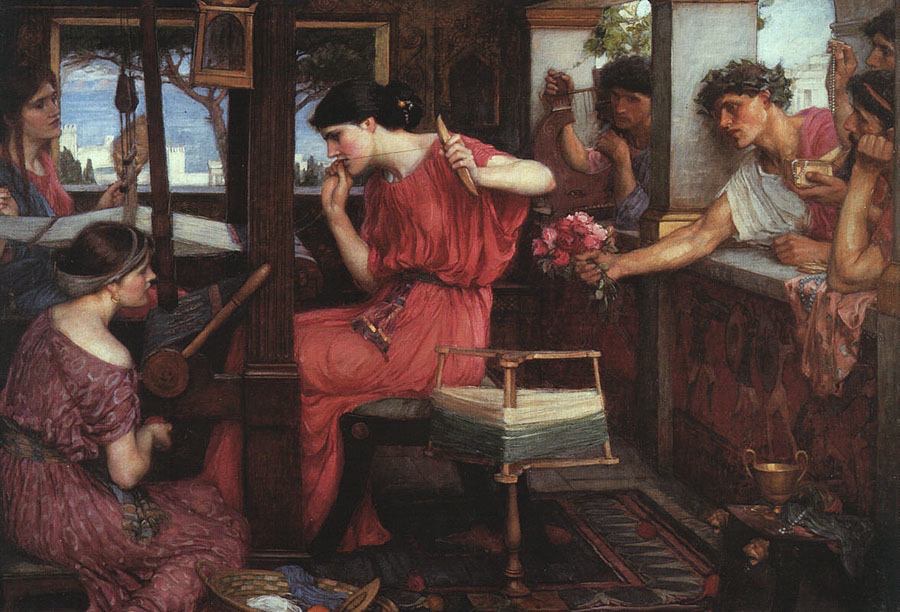
Textile imagery occupies the centre and right of the room. An embroidery frame, hanging, loose yarn and wheel turn the legendary “clue of thread” into a network of visual evidence.
The red ball rests conspicuously on green cloth. A strand may be difficult to follow in reproduction, but its colour makes it an obvious narrative prompt.
In the legend, thread guides Eleanor through the labyrinth. Waterhouse does not need to paint an outdoor hedge maze because textile materials carry its memory into the chamber.
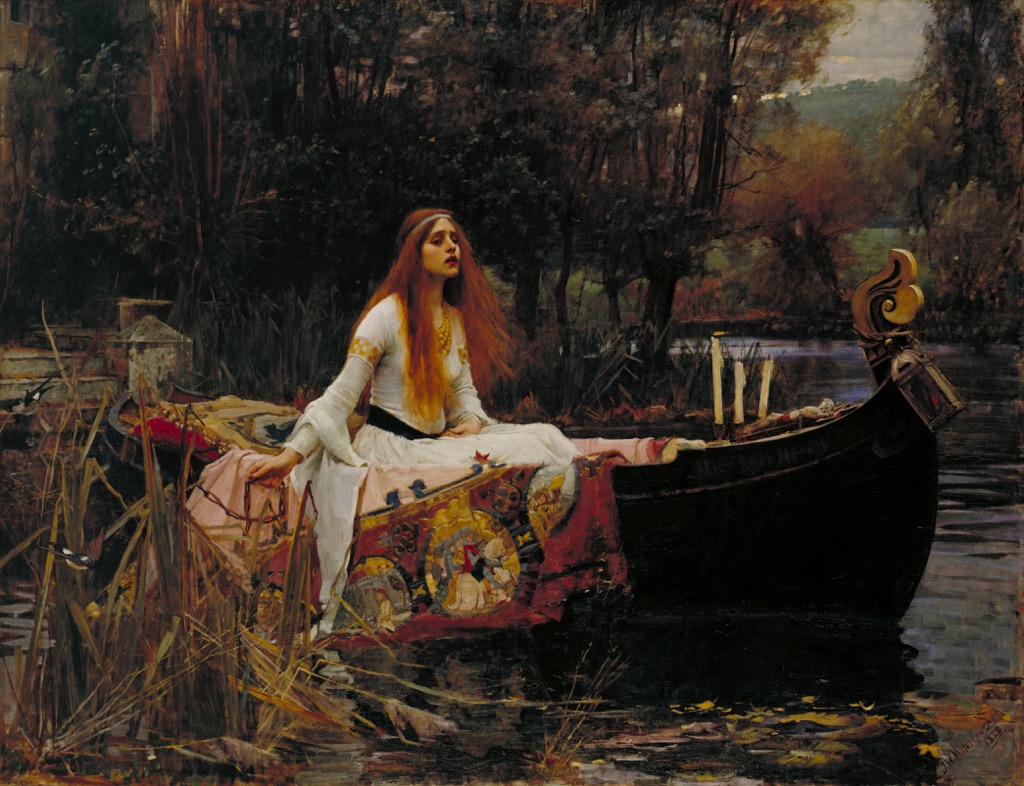
The embroidery frame also duplicates Rosamund's position. Like the Lady of Shalott, she inhabits a room where textile making and an outside world intersect.
The riders stitched in the central frame appear before a building, turning the handiwork into a miniature narrative of arrival.
Behind it, the larger tapestry shows armoured horsemen in action. Domestic art is saturated with the martial and courtly world outside.
Thread therefore has a double role. It is a medium of Rosamund's work and, in legend, the means by which privacy fails.
The choice is particularly sharp because a “clue” originally names a ball of thread. In the legend it becomes both material guide and narrative information—the thing that allows a hidden structure to be solved.
Waterhouse distributes that idea across the room. The visible ball is small, but textile imagery occupies a large part of the composition. Rosamund sits within the medium associated with Eleanor's discovery, apparently unaware that her domestic world contains the sign of its own penetration.
Embroidery also complicates passivity. Rosamund may wait, but the frame records skilled, time-consuming work. Like other Waterhouse women associated with textiles, she is given an activity even when narrative tradition defines her chiefly through love and victimhood.
Waterhouse's late paintings repeatedly use weaving to organise time. Here the danger is not a curse attached to the loom; it is the discovery made possible by a clue.
Tapestry, roses and medieval setting
Costume and interior do not reconstruct one securely documented room at Woodstock. They create a persuasive late medieval atmosphere for a twelfth-century legend.
Rosamund's fitted blue gown, white veil and jewelled details identify an ideal courtly woman more readily than an exact archaeological date.
The black-and-white or grey chequered floor supplies strong perspective. Heavy curtains, carved furniture and textiles fill the interior with wealth.
The embroideries depict castles, riders and armour, compressing an external political order into decorative objects.
Roses appear beside the window and in a vessel below. Their name association is suggestive, although Amt cautions against many later “rosa mundi” legends surrounding Rosamund. [2]
The flower's most secure pictorial function is visual and poetic. Pink blossoms soften stone and repeat the flush of Rosamund's face.
The building visible outside may evoke a castle or royal residence, but it should not be captioned as a precise view of Woodstock Palace.
Waterhouse's historicism is selective. Material abundance creates credibility while emotional geometry carries the tale.
Colour, geometry and suspense
Blue and red divide the canvas. Rosamund's brilliant dress dominates the lower left and centre; Eleanor is embedded within red curtains at upper right.
The colours mark opposing states. Blue advances into window light, while red encloses the concealed watcher.
The large embroidery frame tilts between them, acting as both barrier and hinge. Its pale square interrupts the dark interior and repeats the window's function as a picture within the picture.
Verticals from window, curtain and furniture stabilise the narrow canvas. Rosamund's long train supplies a diagonal that leads towards the signed lower edge.
Her veil creates the most dramatic horizontal, flowing from bright opening towards Eleanor's zone without reaching her.
The chequered floor measures depth and guides the eye to the hidden entrance. Pattern becomes suspenseful because it maps how close the two women are.
Outside, pale greens and blues contrast with the saturated room. Rosamund's desire is directed towards spatial openness; danger is already inside.
Waterhouse makes no single object shout the outcome. Suspense emerges from the alignment of gaze, curtain, thread and unseen proximity.
Scale reinforces the imbalance. Rosamund's blue body and train fill much of the lower canvas, while Eleanor occupies only a small opening. Visual area belongs to the unaware woman; decisive knowledge belongs to the smaller figure.
The exterior figure is smaller still. Henry's physical distance contrasts with his narrative importance: anticipation of his arrival has organised Rosamund's posture and left the room behind her unexamined.
These three scales—dominant Rosamund, concealed Eleanor, remote Henry—allow the whole triangle to remain present without crowding the interior. Waterhouse converts a complicated legend into an immediately readable system of distances.
A last Royal Academy narrative
Waterhouse signed and dated the painting in 1916. [1] He died in February 1917, before it appeared at the Royal Academy that year as catalogue number 63. [1]
The distinction between execution and exhibition matters. Calling it a “1917 painting” follows its public debut but obscures the date written by the artist.
The canvas belonged to William Hesketh Lever, later Viscount Leverhulme, and was sold at Christie's in 1988 before entering a private collection in the United States. [1]
Its Royal Academy showing was posthumous, one of several works through which audiences encountered Waterhouse after his death.
A preparatory oil sketch survives in the collection of Amgueddfa Cymru – Museum Wales. [4] Its existence shows that Waterhouse developed the composition through studies rather than improvising directly on the final canvas.
The finished work's dense object choreography feels appropriate to a final statement. Window, tapestry, textile frame, curtain and floor all contribute to narrative timing.
Hobson's discussion draws attention to this collaborative storytelling by setting and costume. [5] The detail is not antiquarian surplus. Every richly treated surface either establishes courtly enclosure or directs attention towards approach, secrecy and discovery.
The preparatory study is therefore especially valuable. It confirms that the kneeling figure and expectation at the window were developed deliberately, while the final canvas intensifies the counter-presence behind her. [4] Study and finished work together reveal narrative construction, not just a repeated pose.
It also returns to medieval literary-historical territory associated with his career's most famous works, but chooses a legend of sexual politics and concealed approach rather than Arthurian poetry.
History, gender and interpretation
The traditional narrative invites automatic sympathy for Rosamund. Waterhouse strengthens it by showing her young, expectant and unaware.
Eleanor receives less interiority. She enters as the visible mechanism of a fate the audience already knows.
Historical correction complicates this division. Eleanor was a ruler, patron and political actor whose later reputation absorbed accusations unsupported by contemporary evidence.
Rosamund too was simplified. The historical mistress becomes a pure victim defined by beauty, secrecy and death.
A responsible account can hold both truths: Waterhouse painted the legend exceptionally well, and the legend is not reliable biography.
The painting's own moment helps. Because no murder occurs, viewers can examine expectation, jealousy, secrecy and surveillance without accepting the subsequent death as fact.
The loom and embroidery also keep female activity central. Both women are framed by a domestic interior whose textiles preserve masculine warfare and royal movement.
The broader subject is knowledge. Henry outside, Rosamund waiting, Eleanor watching and the spectator knowing form four unequal positions within one carefully partitioned room.
Related Pages
- The Lady of Shalott: Compare Waterhouse's best-known literary composition.
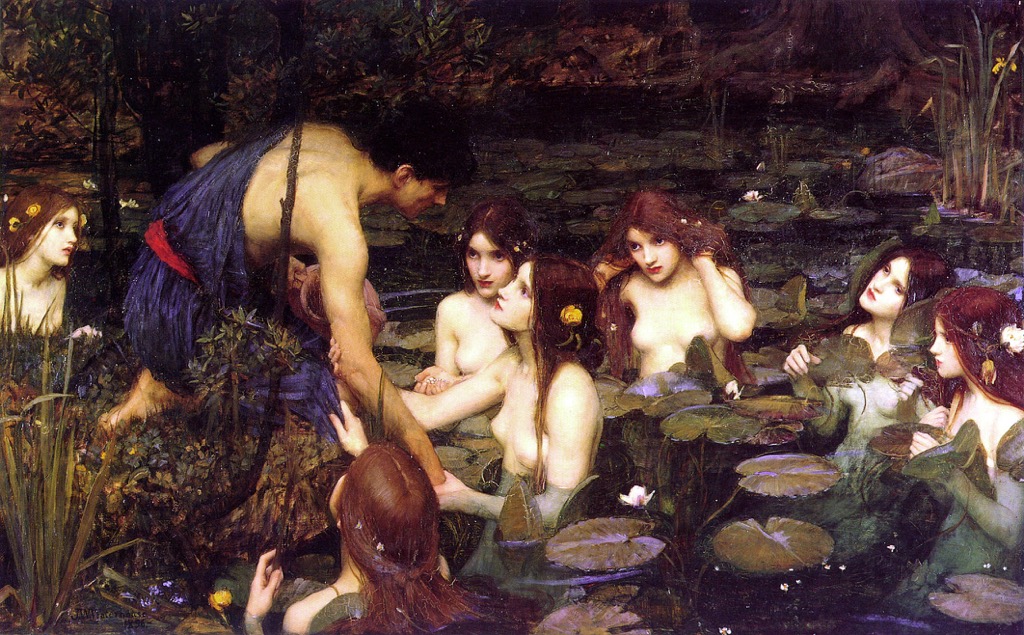
- Hylas and the Nymphs: Compare another major mythological scene.
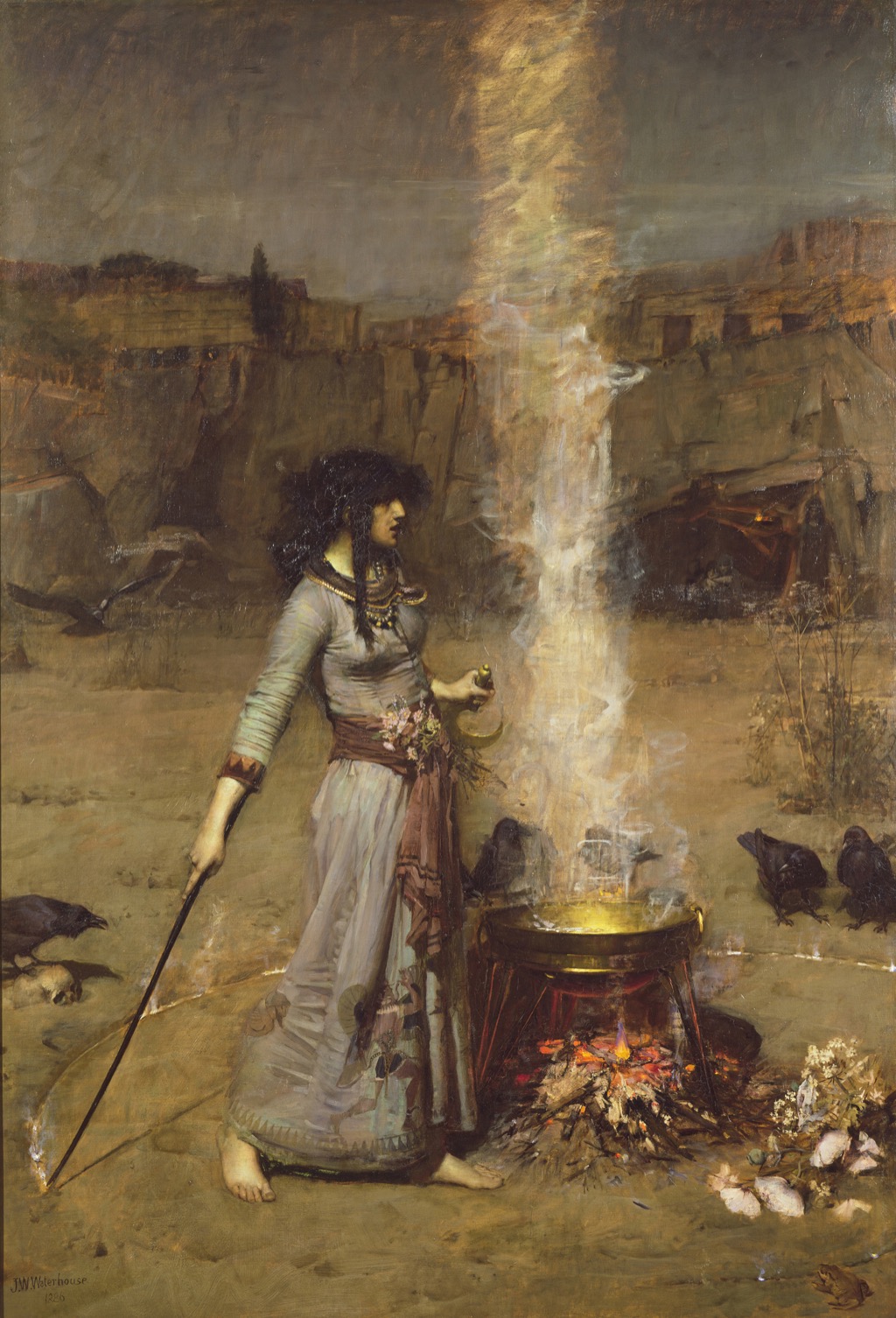
- The Magic Circle: Compare Waterhouse's treatment of ritual and symbolism.
Frequently Asked Questions
Rosamund Clifford was a twelfth-century noblewoman and mistress of King Henry II who died around 1176. [2]
There is no reliable contemporary evidence for murder. The story appeared centuries later and developed through chronicle, ballad and romance. [2] [3]
Rosamund waits at a window for Henry while Eleanor enters behind a curtain without being seen.
It recalls the legendary silken clue by which Eleanor found her way through the maze to Rosamund's bower. [2] [3]
It is signed and dated 1916. [1]
It was exhibited posthumously at the Royal Academy in 1917, but the artist's written date is 1916. [1]
96.5 by 72.3 centimetres. [1]
It is recorded in a private collection in the United States. [1]
Discussion
Fair Rosamund is among Waterhouse's most accomplished scenes of unequal sight. Rosamund sees the hoped-for figure outside; Eleanor sees Rosamund; the spectator sees both. No one shares the same knowledge.
Every object reinforces that structure. The window frames desire, the curtain frames intrusion, embroidery converts courtly history into domestic image, and red thread recalls the legendary route through concealment. Blue and red divide emotional space before any word is spoken.
Reader Insights
Which visible detail most changes the way you read this page?
Which source or comparison helps the work feel less familiar and more specific?
What question would you bring back to the painting after reading?
Join the Conversation
Share your reading of this page below.
References
- Wikimedia Commons / Sotheby's object data, John William Waterhouse, Fair Rosamund, signature and date, medium, dimensions, provenance, 1917 Royal Academy exhibition and collection. View source
- Oxford University Press, Emilie Amt, “Eight myths about Fair Rosamund,” documentary history, burial, maze, thread and murder legends. View source
- Dictionary of National Biography, “Clifford, Rosamond,” early documentary synthesis and chronology of the vengeance, maze, thread and poison traditions. View source
- Amgueddfa Cymru – Museum Wales, Waterhouse's preparatory sketch for Fair Rosamund, subject and relationship to the 1917 Royal Academy canvas. View source
- The Victorian Web, “Fair Rosamund,” Anthony Hobson's account of Waterhouse's visual treatment and the legend's narrative clue. View source