

 by Tom Gurney
Tom Gurney BSc (Hons) is an art history expert with over 20 years experience
Published on June 19, 2020June 19, 2020 / Updated on July 6, 2026
Email: tomgurney1@gmail.com / Phone: +44 7429 011000
The Menaced Assassin by Rene Magritte
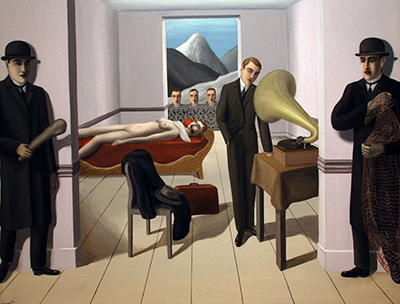
The Menaced Assassin is one of Rene Magritte's most theatrical early Surrealist paintings. Made in Brussels in 1927, it shows a crime scene staged with an almost cinematic calm: a murdered nude woman lies on a couch, a well-dressed man listens to a gramophone, two figures wait by the doorway with a club and a net, and three more men watch from beyond the window. [1]
MoMA records the painting as oil on canvas, measuring 59 1/4 x 6 ft. 4 7/8 in. (150.4 x 195.2 cm). It belongs to the Museum of Modern Art, New York, where it was purchased in 1966 with the Kay Sage Tanguy Fund and is listed as object number 247.1966. [1]
The painting matters because it feels like a mystery scene but refuses to become a solvable story. MoMA's gallery label calls it an "unsolvable narrative," which is exactly right. Magritte gives the viewer clues, witnesses, a victim, a possible murderer and two waiting pursuers, but no clear order of cause and consequence. [1]
At a Glance
- Artist: Rene Magritte [3]
- Title: The Menaced Assassin [1]
- Place and date: Brussels, 1927 [1]
- Medium: oil on canvas [1]
- Dimensions: 59 1/4 x 6 ft. 4 7/8 in. (150.4 x 195.2 cm) [1]
- Collection: Museum of Modern Art, New York [1]
- Object number: 247.1966 [1]
- Status: on view at MoMA, Floor 5, Gallery 517, at the time the page was accessed [1]
Contents
- Why this painting matters
- Museum perspective
- Historical background
- Visual description
- Looking carefully
- Meaning and interpretation
- Fantomas and film
- Comparison works
Why This Painting Matters
The Menaced Assassin matters because it shows Magritte becoming fully himself. The picture still uses traditional perspective, legible figures and a stage-like room, but the narrative has been made impossible. Everything looks arranged for explanation, yet explanation keeps slipping away. [5]
It is also one of Magritte's major early statements after the emergence of Surrealism in the 1920s. Instead of using abstract distortion, he uses ordinary-looking objects, figures and interiors to produce irrational suspense. [4]
Museum Perspective
MoMA describes The Menaced Assassin as one of Magritte's "largest and most theatrical compositions." That word theatrical is important. The room feels like a stage set, the figures feel placed, and the viewer is positioned like another witness. [1]
MoMA also gives the crucial Fantomas connection. Magritte was an avid fan of the pre-World War I crime-fiction series, and the museum states that he borrowed the placement of the two detectives flanking the doorway from Le Mort Qui Tue, a Fantomas film first released in 1913. [1]
Video Guide
This selected video from The Museum of Modern Art offers useful visual context before the detailed analysis continues.
Historical Background
Magritte made the painting in Brussels in 1927, the year of his first solo exhibition and the moment just before his move to Paris. This was the period in which his work shifted decisively into the startling, lucid Surrealism for which he became known. [6]
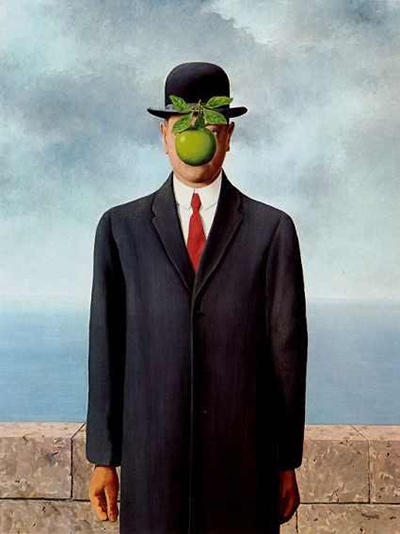
MoMA's artist record places Magritte among the central figures of Surrealism and notes that the artist's recognisable motifs include clouds, pipes, bowler hats and green apples. The Menaced Assassin predates many of those later icons, but it already shows the method: make the familiar clear, then make its meaning unstable. [3]
Visual Description
The painting is large and horizontal. A bare room opens toward the viewer. At the centre, a man in a dark suit stands near a gramophone, absorbed in listening. A coat, hat and case sit nearby, suggesting that he may be preparing to leave. [1]
Behind him, a nude woman lies dead on a couch. The scene is violent, but Magritte paints it with a strangely cool precision. There is no expressionistic chaos, no cinematic blur. The room is organised, almost quiet. [5]
At the front edge of the scene, two men wait just outside the doorway. One holds a club; the other holds a net. They are close to the viewer but hidden from the central man. In the background, through the window or balcony opening, three more men look in from outside. Beyond them is a mountainous landscape. [1]
Looking Carefully
Start with the gramophone. The central man does not appear to flee, mourn or panic. He listens. That pause changes the whole painting. The crime scene becomes a scene of attention. [7]
Then look at the doorway. The two waiting men are not simply policemen in ordinary pursuit. Their club and net make them seem closer to hunters or stage props than detectives. MoMA's Fantomas source helps explain the cinematic quality, but the painting still refuses a straightforward detective-story ending. [1]
Finally, look at the three men at the back. They repeat the logic of spectatorship. The viewer watches the room; the three men watch the room; the two men at the door wait to enter it; the central man listens inside it. The painting is full of observers who do not resolve what they see. [5]
Things You Might Miss
- The assassin is menaced, but the painting never confirms how much he knows. His calmness is part of the unease. [5]
- The gramophone may be the strangest object in the room because it interrupts action with listening. [7]
- The two figures at the door come from a film source, but Magritte transforms cinematic suspense into a frozen painted scene. [1]
- The mountain landscape at the back opens the room into another world, making the stage feel deeper and stranger. [6]
Technique and Composition
Magritte's handling is deliberately clear. The architecture of the room, the couch, the doorway, the window and the figures are easy to read. That readability makes the irrational structure stronger. [6]
The composition is layered like theatre or cinema: foreground pursuers, central interior, rear witnesses and distant landscape. Each layer adds information, but the information never becomes a coherent plot. [5]
This is one reason the painting works so well at large scale. At 150.4 x 195.2 cm, it is almost bodily. The viewer is not just looking at a small mystery; the viewer is standing before a staged event large enough to enter. [1]
Meaning and Interpretation
The best interpretation begins with narrative failure. The painting looks like a crime scene, but a crime scene usually promises reconstruction. Who acted? What happened first? Who knows what? The Menaced Assassin withholds those answers. [5]
MoMA's phrase "unsolvable narrative" should guide the reading. The painting is not merely an illustration of Fantomas, and it is not a puzzle with a hidden answer. It is an image of suspense without release. [1]
That also means the older habit of forcing the picture into a childhood-trauma explanation should be avoided here. Nothing in the MoMA record requires that reading. The painting is stronger when treated as a staged collision of violence, listening, pursuit and spectatorship. [6]
Fantomas and Film
The Fantomas connection gives the painting its clearest source story. Fantomas was a popular crime-fiction and film phenomenon before World War I, and MoMA states that Magritte borrowed the two doorway figures from Le Mort Qui Tue, first released in 1913. [1]
That source does not make the painting a film still. It shows Magritte taking a cinematic device and making it stranger by freezing it in paint. The viewer receives the charged arrangement of crime cinema without the narrative movement that cinema would normally provide. [5]
Museum Moment
MoMA's object page gives the painting a strong institutional life. It is in the Department of Painting and Sculpture, was acquired in 1966 with the Kay Sage Tanguy Fund, and was listed as on view in Gallery 517 when the page was accessed. [1]
The provenance also matters. MoMA traces the work from Paul Gustave Van Hecke and Galerie L'Epoque to Galerie Le Centaure, Galerie Walter Schwarzenberg, E.L.T. Mesens and finally MoMA. The Mesens link is especially important because Mesens was a major figure in Belgian Surrealist networks. [2]
Comparison Works
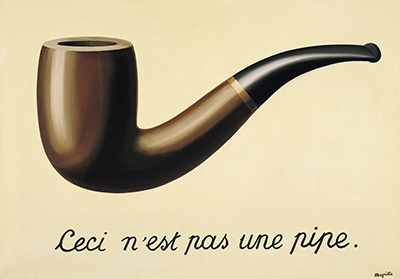
The Treachery of Images is the best comparison for Magritte's early attack on common sense. That painting turns the relation between word and image into a problem; The Menaced Assassin turns narrative causality into a problem. [6]
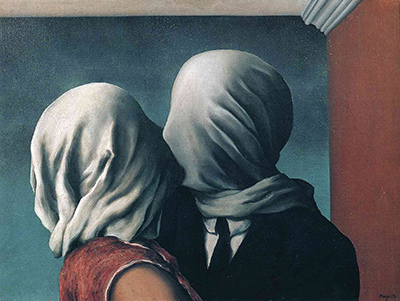
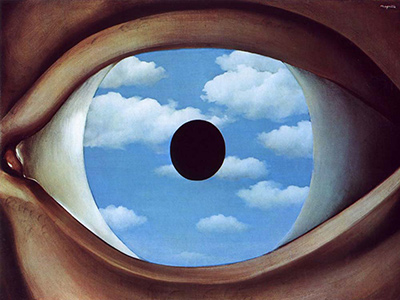
Les Amants and The False Mirror belong close by because they show Magritte using a simple, memorable device to unsettle seeing. The Menaced Assassin is busier, but it shares the same cool clarity. [5]
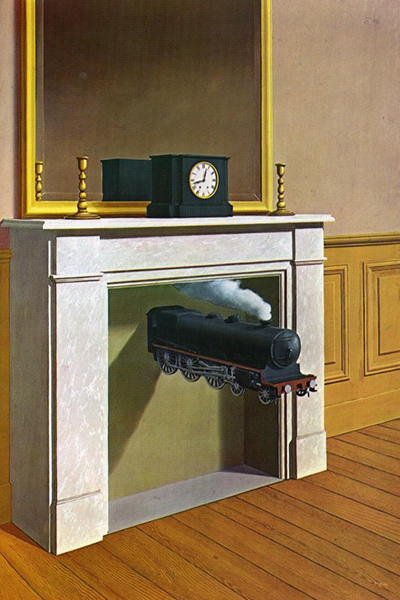
Time Transfixed is a later comparison for theatrical interior space. The locomotive in a fireplace is as impossible as the crime narrative here, but the later painting is more condensed. The Menaced Assassin lets the strangeness unfold across a whole stage. [7]
Reception and Exhibition History
The painting has had a long MoMA life. It appeared in the 1965-1966 Rene Magritte exhibition, in Recent Acquisitions: Five European Painters shortly after the museum purchased it, and in later permanent collection displays. [1]
It also appeared in Magritte: The Mystery of the Ordinary, 1926-1938, the 2013-2014 exhibition that focused on the years when Magritte's mature Surrealist language emerged. That context is useful because The Menaced Assassin is not a side work; it is one of the paintings that helped define the breakthrough. [5]
Timeline
- 1913 - Le Mort Qui Tue, the Fantomas film source cited by MoMA, is first released. [1]
- 1927 - Magritte paints The Menaced Assassin in Brussels. [1]
- 1927-1929 - Paul Gustave Van Hecke of Galerie L'Epoque is recorded in the early provenance. [2]
- Early 1930s-1966 - E.L.T. Mesens owns the painting. [2]
- 1962-1965 - The painting is loaned to Casino de Knokke, Belgium. [2]
- 1965-1966 - The work appears in MoMA's Rene Magritte exhibition. [1]
- 1966 - MoMA purchases the painting from Mesens with the Kay Sage Tanguy Fund. [2]
- 2013-2014 - It appears in Magritte: The Mystery of the Ordinary, 1926-1938. [5]
FAQs
The Menaced Assassin is in the collection of the Museum of Modern Art, New York. MoMA listed it as on view in Gallery 517 when the object page was accessed. [1]
MoMA dates the painting to Brussels, 1927. [1]
It shows a staged crime scene with a dead woman, a man listening to a gramophone, two waiting pursuers at the doorway and three witnesses watching from the back. [1]
Yes. MoMA states that Magritte was an avid fan of Fantomas and borrowed the placement of the two doorway figures from the 1913 film Le Mort Qui Tue. [1]
The strongest reading is that the painting creates an unsolvable narrative. It gives the viewer the elements of a crime story but prevents them from forming a stable explanation. [1]
References
- Museum of Modern Art, "Rene Magritte, The Menaced Assassin, Brussels 1927," accessed July 4, 2026, https://www.moma.org/collection/works/79267.
- Museum of Modern Art, Provenance Research Project entry on the object page for The Menaced Assassin, accessed July 4, 2026, https://www.moma.org/collection/works/79267.
- Museum of Modern Art, "Rene Magritte," artist record, accessed July 4, 2026, https://www.moma.org/artists/3692-rene-magritte.
- Museum of Modern Art, "Surrealism," art term linked from the MoMA object page for The Menaced Assassin, accessed July 4, 2026.
- Anne Umland, ed., Magritte: The Mystery of the Ordinary, 1926-1938, New York: Museum of Modern Art, 2013.
- David Sylvester and Sarah Whitfield, eds., Rene Magritte: Catalogue Raisonne, Houston and London: Menil Foundation / Philip Wilson, 1993.
- Harry Torczyner, Magritte: Ideas and Images, New York: Harry N. Abrams, 1977.