by Tom Gurney
Tom Gurney BSc (Hons) is an art history expert with over 20 years experience
Published on June 19, 2020 / Updated on November 2, 2026
Email: tomgurney1@gmail.com / Phone: +44 7429 011000
Young Mother Sewing by Mary Cassatt: Introduction
The woman keeps her eyes on the work between her raised hands. Beside her, a child in white leans close and looks towards us, one hand near her mouth. Their bodies belong to the same intimate grouping, but their attention moves in different directions. Mary Cassatt’s Young Mother Sewing depends on that small separation as much as on the figures’ closeness.
Painted in 1900, the oil on canvas belongs to the Metropolitan Museum of Art, accession 29.100.48. It entered the museum through the 1929 bequest of Mrs. H. O. Havemeyer. The museum identifies the sitters as two unrelated models, an important distinction between the family relationship suggested by the title and the circumstances in which the picture was made. [1]
The scene rewards looking before storytelling. The sewing is held near the adult’s chest, above the child’s head; the flowers and window open the grouping into a larger room; the child’s outward gaze connects that room with the spectator. Nothing requires us to invent an interruption or a conversation to recognise how carefully these relationships work.
At a Glance
- ArtistMary Cassatt [1]
- Date1900 [1]
- MediumOil on canvas [1]
- Dimensions92.4 × 73.7 cm [1]
- CollectionMetropolitan Museum of Art, New York [1]
- Accession29.100.48 [1]
- CreditH. O. Havemeyer Collection, bequest of Mrs. H. O. Havemeyer, 1929 [1]
This work across Mary Cassatt’s career
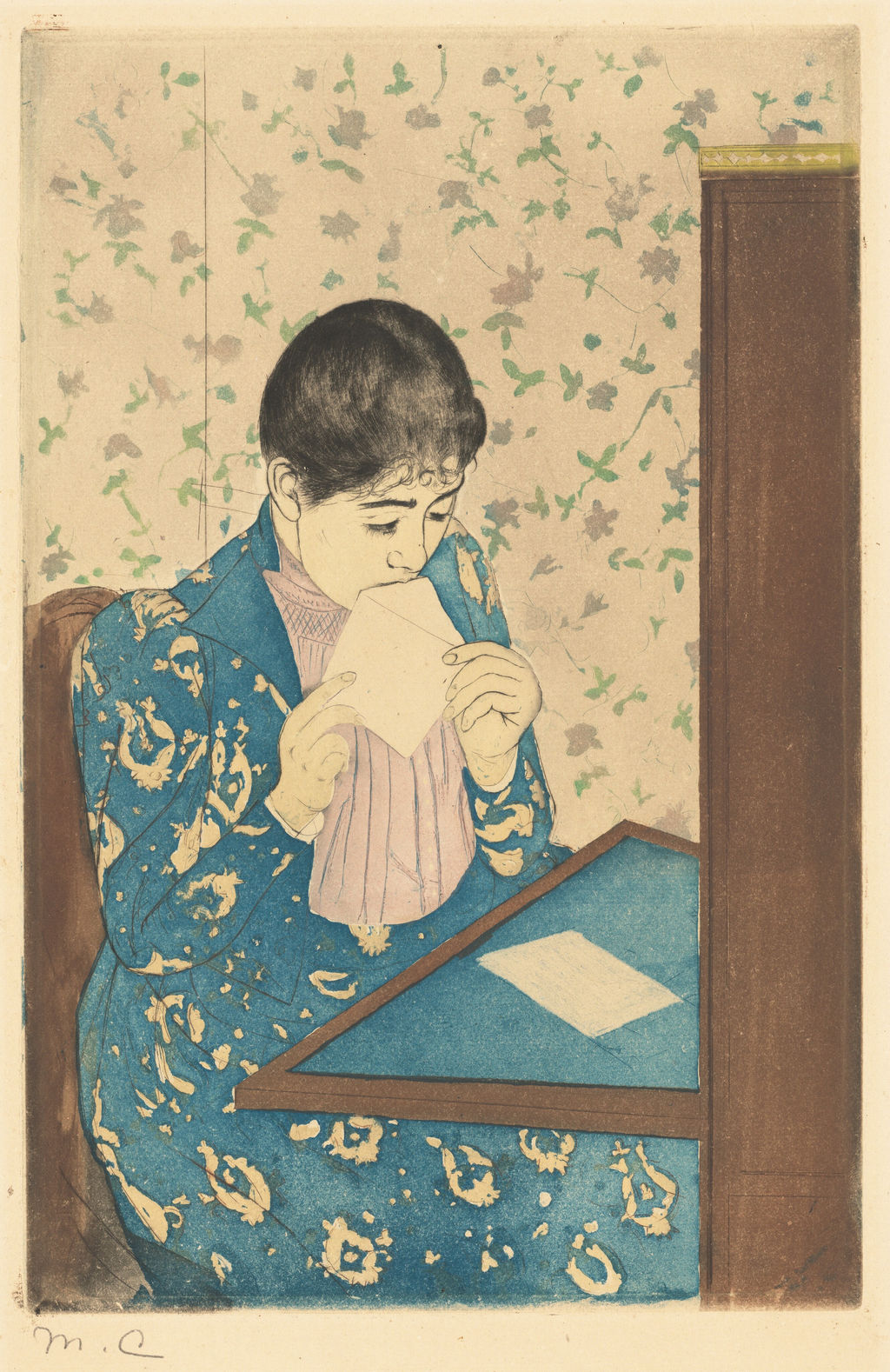
The Letter
1890–91 [6]Modern Woman
1892–93; displayed in 1893 [7] [8] [9]The Boating Party
1893–94 [10]The Child's Bath
1893 [11]Woman with a Sunflower
About 1905 [12]Young Woman in Green Outdoors in the Sun
About 1914 [13]Contents
- Two directions of attention
- Clothing, flowers and the window
- Models and the appearance of informality
- Related works and material decisions
- Painting, sale and collecting
- The 1915 title and a collector’s reading
- Comparing shared and divided attention
- Care and the work within the picture
Two directions of attention
The adult’s lowered eyes follow the small area between her hands. The hands are held above the child rather than resting together in the lap. Her bent arms create an open enclosure around the task. The sewing remains visually small, but the direction of the face and the placement of the fingers give it a precise focus.
The child’s head occupies a lower position and turns out towards the viewer. One hand rises beside the mouth, while the other lies lower, near the adult’s lap. These different hand positions keep the child from becoming a simple vertical shape beside the larger figure. The leaning body also crosses the adult’s seated form at a different angle.
The two faces consequently perform different roles. One remains absorbed in work; the other addresses the space in which we stand. The adult does not need to stop sewing for the child to become visible to us. Cassatt holds simultaneous activities within one composition instead of making every figure respond to the same event.
This is why the picture can feel informal without documenting a spontaneous interruption. A glance outwards may suggest that a child has noticed someone, but it does not establish who entered the room or what happened next. The visible arrangement is enough: closeness and separate attention coexist in the same small area.
The pale clothing strengthens that relationship. The child’s white dress overlaps the adult’s broad, cool-coloured garment, joining the figures through related light values. Yet the different outlines of shoulder, sleeve and head preserve their distinct positions. Physical contact does not dissolve the two bodies into one continuous silhouette.
Looking closely at the heads also changes the emotional reading. The adult’s face is inclined towards a task, not turned away in a gesture that can be confidently called rejection. The child’s outward gaze need not be interpreted as a plea. Cassatt gives both figures a legible direction of attention while leaving their private thoughts unrecorded.
Clothing, flowers and the window
The adult’s pale green and blue clothing forms a large area across the lower and central picture. Dark stripes run over the shoulders and sleeves, while lighter folds spread around the seated body. The clothing helps establish her scale even where the chair and lower limbs are only partly visible.
The child’s smaller white figure cuts across this broad area. Light clothing might have disappeared into another pale garment, but changes of edge, direction and tone keep the forms separate. The diagonal lean is especially important: it gives the child a position within the adult’s space rather than simply placing two upright figures beside one another.
At left, orange flowers rise from a blue-and-white vase. Their warmer colour provides a distinct accent against the cool clothing and green view beyond the window. The vase also introduces a compact, rounded form beside the broad planes of fabric. The still-life passage contributes to the composition instead of functioning only as a pleasant furnishing.
Window divisions provide a framework behind the figures. Their vertical lines contrast with the sloping shoulders and bent arms. Through them we see green outdoor space and darker tree forms. The view extends the room without offering a detailed panorama or identifying a particular garden through its appearance alone.
The flowers, heads and sewing create several possible points of attention at different heights. The colour of the flowers can attract the eye first; the adult’s face then directs attention down towards her hands; the child’s gaze returns attention outwards. Looking moves through the painting without settling permanently on a single isolated detail.
The Metropolitan Museum’s historical catalogue associates the setting, probably, with Beaufresne’s conservatory through a later recollection. That qualification matters. The window and greenery are visible; the exact room is a proposed identification. We can understand the interior’s pictorial role without treating every furnishing as documentary evidence of an address. [14]
Models and the appearance of informality
The museum’s explanation that unrelated models posed for the picture changes the questions we ask. A convincing impression of domestic intimacy was something Cassatt constructed through bodies, costumes, setting and paint. The work does not need to be a family snapshot to convey ease or familiarity. [1]
The museum’s audio discussion uses a snapshot analogy for the image’s effect. Such an analogy describes how the picture can feel to a spectator; it does not prove that a photograph supplied its composition. Nor does the child’s apparently casual lean establish an unposed encounter. Visual informality and the circumstances of making are different questions. [1]
This distinction makes the composition more impressive rather than less intimate. A posed figure can be arranged so that a shoulder seems to yield, an elbow finds support and a glance escapes the shared activity. The image’s persuasive naturalness grows from those relationships. It does not depend on the painter arriving unnoticed at an actual family moment.
Historical names and ages proposed for the models are also less secure than the present title might suggest. The older catalogue’s modelling chronology does not align neatly with the current 1900 date. The current museum’s unrelated-model identification gives a firmer basis for discussing the image without assigning an independently verified personal history to each face. [1] [14]
Related works and material decisions
The 1985 Metropolitan Museum catalogue describes related pencil drawings, an oil sketch, a pastel and a drypoint. These works suggest that the motif interested Cassatt across more than one material. The catalogue also states that their sequence has not been established. They cannot be arranged confidently into a simple progression from first idea to final painting. [14]
The catalogue reports an oil sketch in which the child appears full length and the flowers are absent. It also describes a similarly cropped pastel and a related drypoint with changes of gaze and cropping. These are specific alternatives within the recorded group, rather than a sequence that can be reconstructed from the finished oil alone. The finished oil is one solution within a group of related treatments of the motif. [14]
The differences help identify what is at stake in the final arrangement. Showing a whole child gives the lower body a larger descriptive role. Cropping can bring the head, shoulder and leaning action into a more concentrated relationship with the seated adult. Likewise, flowers introduce a separate warm accent at the side of the grouping. Without them, that area would participate differently in the balance between the figures and their surroundings.
Direction of looking is another independent choice. If a child’s gaze changes, the spectator’s relationship with the grouping changes even where the two bodies remain close. These possibilities make the related works relevant to the painting’s central problem of attention. They need not be assigned an invented order to illuminate the kinds of decision Cassatt could reconsider across media.
The oil painting’s present surface should also be considered on its own terms. Broad light areas of clothing coexist with darker stripes and smaller marks around faces and hands. Describing those differences is part of looking. It does not identify an exact pigment, establish how long a sitting lasted or reconstruct the order of painted layers.
The contrast between a concentrated face and more openly handled clothing is particularly useful. It directs attention while allowing fabric to remain visibly made from paint. The adult’s sewing is a small activity within a large field of pale material, so a few carefully placed hands and facial features can carry substantial descriptive weight.
The style and technique of Cassatt’s art can be explored through such observations. Scientific findings, where available, belong to individual examined objects. A technical account of another painting or a change in the support of a pastel cannot be transferred to this oil simply because both represent a caregiver and child.
Painting, sale and collecting
The current museum dates Young Mother Sewing to 1900. An older 1902 date survives in historical cataloguing, but it is not the preferred date for the Metropolitan Museum’s oil today. Dates for selling and paying for the work describe later events rather than alternative moments of creation. [1] [14]
The museum’s catalogue records Cassatt’s sale to Durand-Ruel on 3 January 1901. Susan Alyson Stein’s chronology of the Havemeyer collection records the collectors’ purchase on 23 April 1901, followed by payment on 12 July. These are three stages in the picture’s circulation: artist to dealer, dealer to collectors and payment. They do not need to be reconciled into one date. [14] [15]
The sequence shows how a painting could move from a studio through a commercial network into a private collection. The Havemeyers’ later bequest gave it another public setting. Its present museum identity belongs to that longer history, while the arrangement of adult and child continues to offer a much more immediate encounter to each viewer. [1]
The catalogue also records exhibition at St Botolph’s in 1909. Public display supplied contexts beyond the private collection, allowing different audiences to encounter Cassatt’s work. Such an exhibition date documents a stage in reception, not a new date for painting the canvas. [14]
Watch: Mary Cassatt
Choose a film to explore the artist’s work, its interpretation and its wider setting.
Demonstrating Mary Cassatt's Color Printmaking Techniques
The Philadelphia Museum of Art demonstrates techniques used to make Cassatt’s colour prints.
Watch on YouTubeThe 1915 title and a collector’s reading
The original catalogue for the 1915 Knoedler suffrage benefit lists the work as no.47, Little Girl Leaning Upon Her Mother’s Knee, 1900. This historical title emphasises the child’s position and describes a family relationship within the image. Its wording is evidence of how the painting was presented, not independent documentation of the models’ genealogy. [16]
In her published remarks associated with the exhibition, Louisine W. Havemeyer described the scene in explicitly familial terms:
“Mamma simply draws back a bit and continues to sew, while little daughter rests her elbows upon mamma’s knee.” [17]
Those are Havemeyer’s words, not a statement by Cassatt. Read beside the museum’s current explanation of unrelated models, they show how convincingly the picture could suggest a mother-and-daughter encounter to an early collector. Historical interpretation and present sitter information answer different questions.
The passage also reveals what Havemeyer valued in the image: the continuation of a small task amid bodily closeness. Her account gives the scene a narrative rhythm. Looking at the painting itself allows us to notice an additional distinction, the child’s outward attention alongside the adult’s downward gaze, without treating the collector’s description as a literal transcript of an event.
This history makes the title more interesting rather than simply incorrect. A title can describe the relationship represented by models even when it does not name their actual connection. The painting’s persuasive intimacy belongs to its artistic achievement. Its meaning is not exhausted by either the older family reading or the modern clarification of who posed.
Comparing shared and divided attention
Nurse Reading to a Little Girl
In Nurse Reading to a Little Girl, an 1895 pastel at the Metropolitan Museum, both heads incline towards an open book. The red-haired child stands close within the adult’s arms, and the book occupies a small but central area between them. Their gazes converge rather than separating towards work and spectator. [18]
The contrast makes attention visible as a compositional choice. Reading brings two faces into relation with the same object. Sewing leaves the adult absorbed in a task above the child, while the child looks out. Neither arrangement is a universal formula for closeness. Cassatt gives each activity its own distribution of heads, hands and support.
The material difference also matters. Nurse Reading is pastel on wove paper mounted on canvas, while Young Mother Sewing is oil on canvas. The museum’s discussion of the pastel distinguishes discoloration of its paper from the brilliance of the pastel colour. That support history belongs to that particular sheet; it does not explain the colours of this oil painting. [18] [19]
Their settings provide another useful distinction. The broad green field around the reading pair contrasts with the window framework behind the sewing figures. Greenery enters both images, but it occupies a different relationship to the bodies. One comparison can therefore clarify attention, setting and medium without assuming a shared room or shared models.
Mother and Child (The Oval Mirror)
The Metropolitan Museum’s Mother and Child (The Oval Mirror) offers a further contrast. Its upright nude child is supported by an adult, while a mirror repeats the child’s head behind the figures. The grouping creates additional views within the image rather than bringing a child’s outward gaze into relation with an adult’s occupied sewing hands. [20]
The mirror painting gives support a different physical role. An upright body must be steadied, while the clothed child in Young Mother Sewing leans into a seated figure. Reflections, clothing and hand positions generate different pictorial structures. The connection between the works lies in those observable relationships, not in an assumed identity of sitters or a single recorded family episode.

Nurse Reading to a Little Girl.

Mother and Child (The Oval Mirror).
Care and the work within the picture
Sewing is central to the image because it gives the adult something specific to do. The title does not tell us which stitch she is making or which garment she is repairing, and the reproduction does not supply that information reliably. The small task nevertheless organises the hands, head and upper body.
The Philadelphia Museum of Art’s 2024 exhibition Mary Cassatt at Work placed renewed emphasis on the relationship between Cassatt’s professional labour and the care represented in her pictures. This curatorial perspective encourages attention to tasks and concentration alongside affection. It need not turn every woman into a documented paid caregiver or every familiar interior into the same social statement. [21]
In this painting, the adult’s task continues while the child occupies a separate field of attention. The result gives closeness room for difference. The figures can share space without performing identical gestures or returning the same gaze. Mothers and Modern Life explores this range of actions across Cassatt’s work.
The image finally asks us to look at how little is needed to make such a relationship persuasive: a leaning shoulder, hands raised above a head, a sideways edge of white clothing and a face turned towards us. Cassatt makes these choices cohere within a room of flowers, window divisions and green light. Their apparent ease is the achievement of the painting.
Cassatt artworks and studies
A source-bounded directory of documented works and studies, including the works in the National Gallery’s 2026 checklist and one clearly marked former attribution. Different print impressions are grouped by design and remain searchable by their recorded accessions. This is not a complete catalogue raisonné. Unlinked titles have no individual article here.
| Name | Date | Medium |
|---|---|---|
| A Child’s Bath — LACMA oil | 1880 | Oil on canvas |
| A Goodnight Hug | 1880 | Pastel |
| After the Bullfight | 1873 | Oil on canvas |
| Afternoon Tea Party | 1890–91 | Colour print |
| At the Theatre (Lydia Cassatt Leaning on Her Arms, Seated in a Loge) | About 1879 | Pastel |
| Automne, portrait de Lydia Cassatt | 1880 | Oil on canvas |
| Breakfast in Bed | 1897 | Oil on canvas |
| Bust of Ellen with Bows in Her Hair | 1898 | Pastel |
| By the Pond | About 1896 in Met and Terra records; about 1898 at MoMA | Not established |
| Child Drinking Milk from a Bowl; provisionally identified composition (qualified identification) | About 1890, following inventory and catalogue text | Pastel |
| Child in a Straw Hat | About 1886 | Oil on canvas |
| Child Picking a Fruit | 1893 | Oil on canvas |
| Children Playing on the Beach | 1884 | Oil on canvas |
| Clarissa, Turned Left, with Her Hand to Her Ear | About 1890–93 in Sotheby’s 2012 entry; about 1893 in GCMA notice | Pastel |
| Denise at her Dressing Table | About 1908–09 | Oil on canvas |
| Driving | 1881 | Oil on canvas |
| Eddy Cassatt (Edward Buchanan Cassatt) | 1875 | Oil on canvas |
| Ellen Mary Cassatt in a White Coat | About 1896 | Oil on canvas |
| Emmie and her Child | About 1890 | Oil on canvas |
| Gathering Fruit | About 1893 | Not established |
| Girl Arranging her Hair | 1886 | Oil on canvas |
| Head of a Child with a Red Hat | 1903, signed and dated | Pastel |
| Head of a Woman in a Large Hat | About 1909 | Pastel |
| Head of Simone in a Green Bonnet with Wavy Brim | About 1904 | Pastel |
| In the Garden | 1903 or 1904 | Oil on canvas |
| In the Loge | 1878 | Oil on canvas |
| In the Omnibus | 1890–91 | Colour print |
| In the Omnibus [recto] — preparatory drawing | c. 1891 | Chalk and graphite |
| In the Opera Box (No. 3) [recto] — preparatory drawing | 1880 | Graphite |
| In the Opera Box (No. 3) — print | c. 1880 | Intaglio print |
| Jeune fille au jardin (Young Woman Sewing in a Garden) | 1880–82 | Oil on canvas |
| Jules Dried by His Mother; provisionally identified composition (qualified identification) | 1901, following catalogue text | Oil on canvas |
| Lady in Black, in a Loge, Facing Right | c. 1880 | Etching |
| Lilacs in a Window | About 1880–83 | Oil on canvas |
| Little Girl in a Blue Armchair | 1878 | Oil on canvas |
| Louise Nursing her Child | 1899 in Luxembourg caption; 1898–99 in loan and Arp records | Pastel |
| Madame Gaillard and Her Daughter Marie-Thérèse | 1897, Reynolda collection listing | Pastel |
| Maternal Caress | 1890–91 | Not established |
| Maternal Caress — preparatory drawing | About 1891 | Charcoal and graphite |
| Mathilde Holding a Baby Who Reaches out to the Right | About 1889, Christie’s catalogue | Pastel |
| Mimi as a Brunette | c. 1889 | Drypoint |
| Mimi Holding a Japanese Fan | c. 1889 | Drypoint |
| Modern Woman | 1892–93; displayed in 1893 | Not established |
| Mother about to Wash her Sleepy Child | 1880 | Oil on canvas |
| Mother and Child (Maternal Kiss) | 1896 | Pastel |
| Mother and Child (Nude Dark-Eyed Little Girl with Mother in Patterned Wrapper) | About 1898–99, Sotheby’s catalogue | Pastel |
| Mother and Child (The Oval Mirror) | About 1899 | Oil on canvas |
| Mother Berthe Holding Her Nude Baby | 1898–99 | Pastel |
| Mother in Purple Holding her Child | About 1914, Christie’s catalogue | Pastel |
| Mother Playing with Child | About 1897 | Pastel |
| Mother’s Kiss | 1890–91 | Colour print |
| Nurse Reading to a Little Girl | 1895 | Pastel |
| Poppies in a Field (formerly Cassatt; attributed to Victor Gabriel Gilbert) | About 1880, current museum record | Oil on panel |
| Portrait of an Elderly Lady | c. 1887 | Oil on canvas |
| Portrait of Madame AF Aude and her Two Daughters | 1899, Breeskin 1970 exhibition catalogue | Pastel |
| Portrait of the Artist | 1878 | Watercolour and gouache |
| Reading Le Figaro | 1878, NGA 2026 checklist; about 1877–78 in SAAM’s 2015 caption | Oil on canvas |
| Reflection — drypoint | c. 1890 | Drypoint |
| Sara Holding a Cat | About 1907–08 | Oil on canvas |
| Sara in a Green Bonnet | About 1901 | Oil on canvas |
| Sara with Her Dog, in an Armchair, Wearing a Bonnet with a Plum Ornament | 1901 | Pastel |
| Self Portrait | About 1880 | Watercolour and gouache |
| Simone in Blue Plumed Hat | About 1903 | Pastel |
| Simone Seated on the Grass next to her Mother | 1901–02 | Pastel |
| Sketch of Master St. Pierre | Date not established | Pastel |
| Sleepy Baby | About 1910 | Pastel |
| Smiling Mother with Sober Faced Child | Date not established | Pastel |
| Spanish Dancer Wearing a Lace Mantilla | 1873 | Oil on canvas |
| Summertime, horizontal painting | 1894–95, current Sotheby’s catalogue | Oil on canvas |
| Tea — print | c. 1890 | Drypoint |
| The Bath | 1890–91 | Not established |
| The Boating Party | 1893–94 | Oil on canvas |
| The Caress | 1902 | Oil on canvas |
| The Child's Bath | 1893 | Oil on canvas |
| The Coiffure | 1890–91 | Colour print |
| The Cup of Tea | About 1880–81 | Oil on canvas |
| The Fitting | 1890–91 | Colour print |
| The Lamp | 1890–91 | Colour print |
| The Letter | 1890–91 | Colour print |
| The Loge | About 1878–1880 | Oil on canvas |
| The Mandolin Player | 1868 | Oil on canvas |
| The Manicure (Les Ongles; The Nails) | About 1908 | Intaglio print |
| The Tea; Le Thé | About 1880 | Oil on canvas |
| The Visitor | c. 1880 | Intaglio print |
| Two Sisters | 1896 | Pastel |
| Two Women Seated by a Woodland Stream | About 1869 | Oil on canvas |
| Two Women Throwing Flowers During Carnival | 1872 | Oil on canvas |
| Under the Horse-Chestnut Tree | 1896–97, National Gallery and MoMA records | Not established |
| Woman Bathing (La Toilette) | 1890–91 | Colour print |
| Woman in a Loge (Woman with a Pearl Necklace) | 1879 | Oil on canvas |
| Woman Reading | 1878–79 | Oil on canvas |
| Woman Standing, Holding a Fan | 1878–79 | Distemper |
| Woman with a Fan | c. 1878–1879 | Oil on canvas |
| Woman with a Red Zinnia | 1891 | Oil on canvas |
| Woman with a Sunflower | About 1905 | Oil on canvas |
| Young Girl at a Window | c. 1883–1884 | Oil on canvas |
| Young Girl with Brown Hair, Looking Left | About 1913 (1997 summary catalogue) | Pastel |
| Young Mother Sewing | 1900 | Oil on canvas |
| Young Woman in Green, Outdoors in the Sun | About 1914 | Oil on canvas |
Questions about Young Mother Sewing
The museum explains that models posed. Its informal effect and the snapshot analogy used in the museum’s discussion do not establish an actual unposed encounter or a photographic source. [1]
It belongs to the Metropolitan Museum of Art, H. O. Havemeyer Collection, bequest of Mrs. H. O. Havemeyer, 1929, accession 29.100.48. [1]
Discussion
Look again at the images and ideas explored in Young Mother Sewing by Mary Cassatt. These editorial prompts invite your observations.
Reader Insights
The woman keeps her eyes on the work between her raised hands. What does this first detail make you notice?
The adult’s lowered eyes follow the small area between her hands. How does it affect your reading of the whole work?
How does the child’s outward gaze change a scene in which the adult remains absorbed in sewing?
Join the Conversation
Share a detail, comparison or question about Young Mother Sewing by Mary Cassatt below.
References
- Metropolitan Museum of Art, Young Mother Sewing, 1900, 29.100.48, current object text and audio transcript. View source.
- Denver Art Museum, Whistler to Cassatt Access Guide, The Salon, stop 104. View source.
- Denver Art Museum, Whistler to Cassatt:American Painters in France, bilingual exhibition livret,The Salon,no2. View source.
- National Gallery of Art, Little Girl in a Blue Armchair, 1983.1.18. View source.
- Philadelphia Museum of Art, Driving, 1881. View source.
- National Gallery of Art, The Letter,1943.3.2763. View source.
- Art Institute of Chicago, Ryerson and Burnham Archives, Bertha Honoré Palmer Correspondence Collection finding aid, selected Mary Cassatt entries, Box1Folder3. View source.
- Museum of Modern Art, Mary Cassatt artist essay and print records. View source.
- MaudHoweElliott(ed.) / UniversityofIllinoisUrbanaChampaign scan, Art and Handicraft in the Woman’s Building of the World’s Columbian Exposition,Chicago,1893,Chicago:RandMcNally,1894. View source.
- National Gallery of Art, The Boating Party, 1963.10.94. View source.
- Art Institute of Chicago, The Child’s Bath,1910.2,current expanded collection entry. View source.
- National Gallery of Art, Woman with a Sunflower, 1963.10.98. View source.
- Sotheby’s, Young Woman in Green Outdoors in the Sun, Modern Day. View source.
- Natalie Spassky and others, American Paintings in the Metropolitan Museum of Art, vol.II, 1985, pp.648–651, especially p.650. View source.
- Susan Alyson Stein, assisted by Rebecca A. Rabinow, Chronology, in Splendid Legacy: The Havemeyer Collection, 1993, p.230. View source.
- M. Knoedler & Co., Loan Exhibition of Masterpieces by Old and Modern Painters, 6–24 April 1915, p.21, no.47. View source.
- Louisine W. Havemeyer, Remarks on Edgar Degas and Mary Cassatt, 6 April 1915, scan p.8. View source.
- Metropolitan Museum of Art, Nurse Reading to a Little Girl, 1895, 62.72. View source.
- Doreen Bolger, ed., American Pastels in the Metropolitan Museum of Art, 1989, checklist p.156. View source.
- Metropolitan Museum of Art, Mother and Child (The Oval Mirror), c.1899, 29.100.47. View source.
- Philadelphia Museum of Art, Mary Cassatt at Work, 2024 exhibition press release. View source.
- Art Gallery of Ontario, Cassatt–McNicoll:ImpressionistsBetweenWorlds. View source.
- Metropolitan Museum of Art, The Bath, 16.2.7. View source.
- National Gallery of Art, Children Playing on the Beach, 1970.17.19. View source.
- Colby College Museum of Art, Explore Inside Out: The Prints of Mary Cassatt; Mother Berthe Holding Her Nude Baby,2013.549. View source.
- Sotheby’s, syndicated auction catalogue hosted by Invaluable, Simone in Blue Plumed Hat, Watson collection, 18 May 2005, lot 20. View source.
- The Huntington, Breakfast in Bed, 83.8.6. View source.
- Adelyn Dohme Breeskin / Smithsonian Institution Press; University of California scan indexed by Google Books, Mary Cassatt:A Catalogue Raisonné of the Oils,Pastels,Watercolors,and Drawings,1970,322pp; selected public search snippets pp91–92,143–144,316,318. View source.
- Metropolitan Museum of Art, The Private Collection of Edgar Degas: A Summary Catalogue, Cassatt entries, printed p.7, no.48. View source.
- Art Institute of Chicago, After the Bullfight, 1969.332. View source.
- Smithsonian American Art Museum, Art Inventories, After the Bullfight, siris_ari_180619. View source.
- Smithsonian American Art Museum, The Caress, 1911.2.1. View source.
- Museum of Modern Art, Under the Horse-Chestnut Tree,671.1940. View source.
- National Gallery of Art, Under the Horse-Chestnut Tree,1959.12.4. View source.
- Virginia Museum of Fine Arts, Board of Trustees minutes,17September2020,loan recommendation7:ChildPickingaFruit75.18. View source.
- Cincinnati Art Museum, Les Ongles(The Nails;The Manicure),ca1908,1940.155,secondstate. View source.
- Sotheby’s, Clarissa Turned Left with Her Hand to Her Ear, 2012 lot 51. View source.
- Greenville County Museum of Art, Recent Acquisitions Funded by Sale of Alma Thomas Painting, 2021. View source.
- Metropolitan Museum of Art, The Coiffure,16.2.3. View source.
- Metropolitan Museum of Art, The Cup of Tea, 22.16.17. View source.
- Sotheby’s, Mother and Child (Nude Dark-Eyed Little Girl with Mother in Patterned Wrapper), 19 May 2010, lot 31. View source.
- Metropolitan Museum of Art, Denise at Her Dressing Table, 2005.129. View source.
- Denver Art Museum, Whistler to Cassatt exhibition guide, stop 112: Bust of Ellen with Bows in Her Hair. View source.
- Museum of Fine Arts, Boston, Ellen Mary in a White Coat, 1982.630. View source.
- Amon Carter Museum of American Art, Woman Standing Holding a Fan, 2011.20. View source.
- Smithsonian American Art Museum, Special Installation of Nineteen American Masterworks, 2015. View source.
- Metropolitan Museum of Art, The Fitting, 16.2.8 final state. View source.
- Reynolda House Museum of American Art, Mary Cassatt collection listing: Madame Gaillard and Her Daughter Marie-Thérèse, 1897. View source.
- Wake Forest University, Wake Women 2023 schedule, Highlighting the Art of Women at Reynolda, captioned Cassatt image. View source.
- Detroit Institute of Arts, In the Garden, 36629. View source.
- National Gallery of Art, Gathering Fruit,1943.3.2757. View source.
- Sotheby’s, A Goodnight Hug,N09860lot11,14May2018. View source.
- Sotheby’s, syndicated auction catalogue hosted by Invaluable, Head of Simone in a Green Bonnet with Wavy Brim, Watson collection,18May2005,lot39. View source.
- National Gallery of Art, Girl Arranging Her Hair, 1963.10.97. View source.
- Joslyn Art Museum, Art Break:Woman Reading,1943.38,program object caption. View source.
- Los Angeles County Museum of Art, A Child’s Bath, M.62.8.14. View source.
- National Gallery of Art, The Lamp, 5937. View source.
- Sotheby’s, Tête de Femme au Grand Chapeau, 2008 N08449 lot135. View source.
- Metropolitan Museum of Art, Lilacs in a Window, 1997.207. View source.
- National Gallery of Art, The Loge,1963.10.96. View source.
- Arp Museum Bahnhof Rolandseck, Maestras: Malerinnen1500–1900,25February–16June2024,official five-page flyer. View source.
- Spanish official gazette / exhibition insurance schedule, BOE-A-2023-19808,21September2023,Maestras loan schedule. View source.
- Nationalmusée um Fëschmaart / ArpMuseum CollectionRauforUNICEF, Louise,NursingHerChild,1899,GR1.949;FromRenoirtoMonet2026–27. View source.
- Petit Palais / Paris Musées, Automne, portrait de Lydia Cassatt, PPP706; IIIF manifest 160008392. View source. (in French).
- Metropolitan Museum of Art, Maternal Caress, 16.2.5. View source.
- Philadelphia Museum of Art, Mother and Child Maternal Kiss, object 54049. View source.
- Metropolitan Museum of Art, Maternal Caress, preparatory drawing64.123.3, c1891. View source.
- Christie’s, Mathilde Holding Baby who Reaches out to Right, lot 5459369. View source.
- National Portrait Gallery / Catalog of American Portraits, Madame Meerson and her Daughter, SSSA2282. View source.
- Museum of Fine Arts Boston, In the Loge, 10.35. View source.
- Smithsonian art inventories, Child Drinking Milk from a Bowl, siris_ari_197517. View source.
- MutualArt public auction index; original auctioneer undisclosed without subscription, Child Drinking Milk from a Bowl, public listing dated 2 June 2024. View source.
- National Gallery of Art, Mother's Kiss,1963.10.254. View source.
- National Gallery of Art, Mary Cassatt the Daring Printmaker, 23 January 2026. View source.
- National Gallery of Art, Mary Cassatt An American in Paris checklist, updated 24 February 2026. View source.
- Adelyn D. Breeskin / National Gallery of Art, Mary Cassatt 1844–1926, 1970 exhibition catalogue. View source.
- National Gallery of Art, In the Omnibus, 46725. View source.
- Philadelphia Museum of Art, Woman in a Loge, 1978-1-5, object72182. View source.
- Metropolitan Museum of Art, Mother Playing with Child, 22.16.23. View source.
- Metropolitan Museum of Art, By the Pond,60.732bis. View source.
- Museum of Modern Art, By the Pond,673.1940. View source.
- Terra Foundation for American Art, By the Pond,1999.25. View source.
- Philadelphia Museum of Art, Poppies in a Field, attributed to Victor Gabriel Gilbert; formerly attributed to Mary Stevenson Cassatt, 1978-1-6. View source.
- Christie’s, Mother in Purple Holding Her Child, lot 5369421. View source.
- Sotheby’s, Tête d’enfant au chapeau rouge, American Art N09229, 20 November 2014, lot 39. View source.
- Christie’s, Sara Holding a Cat, lot 5561267. View source.
- Smithsonian American Art Museum, Art Inventories Catalog, Sara with Her Dog, in an Armchair, Wearing a Bonnet with a Plum Ornament; IAP 80170363 / siris_ari_180925. View source.
- Smithsonian American Art Museum, Sara in a Green Bonnet, 1929.6.11. View source.
- Mary Cassatt Catalogue Raisonné project, with Adelson Galleries, presented on Artnet, Sara with Her Dog, in an Armchair, Wearing a Bonnet with a Plum Ornament, work 424155733. View source.
- Metropolitan Museum of Art, Portrait of the Artist, 1975.319.1. View source.
- National Portrait Gallery, Mary Cassatt Self-Portrait, NPG.76.33. View source.
- Musée d’Orsay, Jeune fille au jardin,RF193720. View source. (in French).
- Sotheby’s, Simone Seated on the Grass Next to Her Mother, 30 September 2020, lot 33. View source.
- Dallas Museum of Art, Sleepy Baby,1952.38.M. View source.
- Sotheby’s, Smiling Mother with Sober Faced Child, 2022. View source.
- Smithsonian American Art Museum, Spanish Dancer Wearing a Lace Mantilla, 1967.40. View source.
- Spencer Museum of Art,University of Kansas, The Manicure,c1908,1991.0266. View source.
- Christie’s, Sketch of Master St Pierre, 2017 online lot. View source.
- National Gallery of Art, Child in a Straw Hat, 1983.1.17. View source.
- Sotheby’s, Summertime, Armand Hammer: The Private Collection, Modern Evening Auction 2026. View source.
- National Gallery of Art, Afternoon Tea Party, 46731. View source.
- Museum of Fine Arts, Boston / Erica E. Hirshler, The Tea, 42.178. View source.
- The Nelson-Atkins Museum of Art, At the Theater,F77-33;French Paintings and Pastels appendixII. View source.
- Metropolitan Museum of Art, Woman Bathing La Toilette, 16.2.2. View source.
- Sotheby’s, Two Sisters, 2005 American Paintings sale N08134, lot 44. View source.
- Wichita Art Museum, Mother and Child, M109.53. View source.
- Smithsonian American Art Museum, Art Inventories, Two Women Seated by a Woodland Stream / Duex femmes assises aupres de l’eau, IAP 80170008. View source.
- Tacoma Art Museum / David Setford, Impressionist Painting: From Pleasure Gardens to the Palais Garnier, 22 October 2019. View source.
- Tacoma Art Museum, French Impressionism and the Northwest, Works of Art Adoption Program, 2019–2020, no. 10 / PDF p. 12. View source.