by Tom Gurney
Tom Gurney BSc (Hons) is an art history expert with over 20 years experience
Published on June 19, 2020 / Updated on November 2, 2026
Email: tomgurney1@gmail.com / Phone: +44 7429 011000
Mary Cassatt Drawings and Pastels: Introduction
A face can emerge from softly joined colours while the sleeve beside it remains a network of visible strokes. In Mary Cassatt’s works on paper, that difference is often central to how a picture works. Drawing can define an edge, build a coloured surface, suggest weight or help move a composition towards a printing plate. A pastel can be an independent finished work, while a more sparsely marked sheet can preserve a particular stage of preparation.
The useful starting point is to ask what material is on which support, then examine what the marks do. Marjorie Shelley’s technical essay in American Pastels in the Metropolitan Museum of Art explains the range between blended colour and open, linear handling. It also shows why the same material can produce quite different effects within a single picture. [1]
Cassatt’s Mother Playing with Her Child and Portrait of the Artist make that range concrete. The former is a pastel of about 1897; the latter is a watercolour and gouache self-portrait dated 1878. Both use paper, but that common support does not make them the same kind of object. [2] [3]
At a Glance
- ScopeDrawings, pastels and selected works on paper [1] [3] [4] [5]
- Materials examinedPastel, chalk, graphite, watercolour and gouache; printed transfers distinguished [1] [3] [4] [5]
- Key questionsLine, support, colour, mounting, preparation and reversal [1] [6] [7]
Contents
- Drawing and colour belong together
- What pastel makes possible
- Contour, hatching and open ground
- Mother Playing with Her Child: two kinds of handling
- Paper colour can change
- Mounts are part of the object description
- A self-portrait in watercolour and gouache
- Berthe: a pastel beside a print discussion
- A drawing that helped make a print
- Counterproof is a different kind of transfer
Drawing and colour belong together
The word drawing can describe an activity as well as a category of artwork. A line may follow the boundary of a cheek, indicate a fold or establish the position of a chair. Coloured marks can perform those jobs too. A pastel therefore need not choose between being a picture made from colour and one organised through drawing.
It is more revealing to examine how particular marks function than to place every work on a scale from sketch to painting. A broad coloured passage may establish the size of a shoulder, while a few narrow strokes describe fingers. Both can be necessary to the same composition. The difference in detail does not automatically establish which area was completed first or which the artist considered unfinished.
Nor does paper make an object merely preparatory. A drawing can be made for its own presentation; another can help prepare a print; a pastel can later be related to a different composition. Those purposes must be established individually. The status of a work follows its evidence and history, rather than a general assumption that canvas represents the final destination of every artistic idea.
For a wider view of those relationships, Cassatt’s paintings and prints provide complementary comparisons. The point is not to rank one medium above another, but to see how each can organise a figure and a surface. Her biography supplies the professional chronology behind those changes without turning every loose mark into a milestone in a predetermined evolution.

Mother Playing with Child.

Portrait of the Artist.
Browse drawings and pastels


 Mary Cassatt.jpg)


 Mary Cassatt.jpg)
What pastel makes possible
Pastel deposits dry coloured particles on a surface. Its small amount of binder and the texture of its support affect how those particles adhere. Shelley explains that a pastelist can build effects through closely placed strokes, broader applications and degrees of blending. Heavy rubbing or overworking can change the appearance of the particles and dull colour. These are general properties of the medium, not a recipe established for every Cassatt sheet. [1]
A useful visual distinction is between a colour formed by a broad continuous passage and one perceived through several neighbouring marks. In the second case, spaces between strokes can remain active. A viewer may recognise a cheek or sleeve at a distance and then discover that its apparent continuity depends on small interruptions when looking more closely.
Pressure and direction can also change the role of a mark. A narrow stroke may describe a contour; a wider passage may establish an area of tone. Several lines running in a similar direction can connect separate parts of a garment, while a sudden turn can suggest a fold. These are things to look for in the image before inferring the exact tool or movement that produced them.
Pastel’s apparent softness should not obscure its capacity for sharp description. Eyes, fingertips and edges can be rendered with compact, definite marks. A successful picture may combine those moments of precision with much more open areas. The material permits variation rather than imposing a single uniformly blurred appearance.
Contour, hatching and open ground
A contour identifies an edge; hatching builds an area through repeated strokes. The two can meet within one figure. A line around a forearm may make its shape clear, while angled coloured strokes inside a sleeve establish its volume and surface. Looking at where a mark begins and ends helps distinguish those jobs.
Open ground adds another relationship. Where the support remains visible between strokes, it participates in the appearance of the surrounding colour. It may separate marks, provide a middle tone or make a pale accent more conspicuous. Shelley discusses this growing interest in the visible stroke and support as part of nineteenth-century pastel practice. [1]
The effect should be evaluated locally. A small gap beside a cheek may help keep a boundary light; a larger opening in a garment may allow several quick changes of direction to remain legible. Neither gap automatically tells us that the artist stopped work accidentally. Visible paper is a feature to describe before it becomes an argument about intention.
Tête de Femme au Grand Chapeau offers one such comparison. Sotheby’s identifies the matched work as pastel on tan paper, dated about 1909. The face is more fully developed than the broad surrounding costume and hat. No exact dimensions are given here because the sale record’s inch and centimetre figures conflict. [8]
The contrast directs attention towards the head while leaving other areas visibly composed of marks. It does not prove a measured execution time, a medical cause or a universal late style in which every garment was treated alike. The useful question is what the unequal concentration of detail does within this particular image.
Mother Playing with Her Child: two kinds of handling
The Metropolitan Museum’s Mother Playing with Child, accession 22.16.23, is pastel on wove paper mounted on cardboard. The adult bends towards a small child, and their hands meet near the lower centre. Blue clothing, pale fabric and a marked green background give the grouping several different textures. [2]
Shelley uses this exact composition to explain a combination of handling: blended colour in faces and hands, more open hatching and short strokes elsewhere. That is an object-specific published observation, distinct from a general claim about what all pastels must look like. [1]
Following the adult’s sleeve makes the difference especially clear. Repeated marks travel across the fabric, while smaller changes of tone help articulate the hand near the child. The two areas remain connected anatomically even though their surfaces are described differently. Drawing and modelling support one another rather than representing incompatible methods.
The background also matters. Its marks surround and partly echo the figures without becoming a complete botanical inventory. The human contact remains the strongest focus because hands and faces carry more concentrated description. An openly handled setting can therefore strengthen, rather than weaken, the specificity of a gesture.
The museum identifies this pastel as a basis for the unfinished print Picking Daisies. That relationship is documented in its account, rather than inferred merely from similar titles. It does not establish every intermediate step or a complete sequence of print states, and it does not make the pastel itself an unfinished print. [2]
Paper colour can change
Support colour is part of the appearance we see, but its present state and its original state are different questions. The 1989 Metropolitan Museum checklist identifies discoloured paper for Mother Playing with Her Child. It does not establish the original hue of that sheet. The neighbouring checklist entry has its own paper description and should not supply a missing fact for this object. [1]
Nurse Reading to a Little Girl, the museum’s 1895 pastel accession 62.72, provides a second specific example. Its medium is pastel on wove paper mounted on canvas, and the historical checklist also records discolouration. The originally blue support discussed for a different Nurse and Child, accession 60.181, should not be assigned to this reading picture. [9] [1]
These distinctions change how a reproduction is interpreted. A warm or brownish area may be important to the work’s appearance today without proving that Cassatt selected exactly that hue. Likewise, two photographs with different saturation do not by themselves document a conservation change. Lighting, reproduction and the physical history of the sheet are separate possible factors.
The practical habit is to keep observation and historical claim together but distinct. We can describe the contrast between pale marks and the ground as it appears. Establishing what the artist originally saw requires evidence about that particular support. Recognising the limit makes the visible effect more interesting, because the artwork has a material history as well as a depicted subject.
Mounts are part of the object description
Paper can be supported by another material without ceasing to be the surface on which the artist worked. A catalogue may describe paper mounted on canvas, laid onto another paper, or attached to cardboard. Those layers need to be read in sequence. The word canvas in a mounting description does not automatically turn a pastel into an oil painting.
The two Metropolitan Museum pastels illustrate this clearly. Mother Playing with Her Child has a cardboard mount; Nurse Reading to a Little Girl has a canvas mount. Their recorded combinations belong to separate objects and should remain attached to the appropriate accession numbers. [2] [9]
Mounting can also be a question of history. A current object description may identify the layers present without explaining precisely when every layer was attached. Unless that timing is documented, it should not be converted into a claim that Cassatt personally chose and assembled the entire surviving structure. Material vocabulary can be precise without pretending to know an unrecorded workshop procedure.
Watch: Mary Cassatt
Choose a film to explore the artist’s work, its interpretation and its wider setting.
Demonstrating Mary Cassatt's Color Printmaking Techniques
The Philadelphia Museum of Art demonstrates techniques used to make Cassatt’s colour prints.
Watch on YouTubeA self-portrait in watercolour and gouache
The 1878 Portrait of the Artist at the Metropolitan Museum offers an important contrast with pastel. Its current record identifies watercolour and gouache on wove paper laid down to buff wood-pulp paper. It entered the museum through Edith Proskauer’s 1975 bequest; that donor should be distinguished from earlier collectors. [3]
The white costume spreads diagonally across the seated figure, with coloured marks describing folds and darker ribbons near the neck. A decorated bonnet adds small concentrated accents above the face. The pale clothing occupies a large proportion of the picture, yet changes in edge and tone keep it from becoming a uniform white shape.
Comparing it with Mother Playing with Her Child shows why a visual resemblance is not a medium identification. Both include pale clothing, a more concentrated face and visibly varied marks. The underlying materials differ. The word gouache identifies an opaque watercolour medium; it should not be silently replaced by pastel because parts of the surface appear soft or chalk-like. [7]
Nor is there a need to invent a progression in which one sitting led directly from a watercolour to a pastel. The works have separate dates, subjects and records. Their comparison teaches a more useful lesson: related visual effects can be produced through different materials, so an exact object description remains necessary even when looking feels familiar.
Berthe: a pastel beside a print discussion
Colby College Museum of Art identifies Mother Berthe Holding Her Nude Baby as a pastel of 1898–99, accession 2013.549. The child’s pale back occupies a broad central shape, while a turned head appears above a bent arm and the adult’s supporting hand is visible below. The two bodies overlap within a close vertical arrangement. [10]
The more continuously described flesh contrasts with the open marks in the adult’s pale clothing and the surrounding ground. Here again, an area can feel fully legible without every part receiving equal descriptive density. The child’s back, the adult’s face and the supporting hand do different work within the composition.
Colby’s exhibition page also discusses the print Emmie and Her Child, including its unusual impression history. That neighbouring discussion belongs to the print, not the Berthe pastel. The distinction matters when a museum page presents several objects in succession: a nearby paragraph cannot establish a pastel’s print state, mounting or status as a learning exercise. [10]
The image itself can then be read on its own terms. The child turns outward while resting against the adult, and the overlapping bodies make support visible from more than one direction. There is ample material for examining contour, colour and weight without transferring a historical claim from another object.
A drawing that helped make a print
In the Omnibus provides unusually concrete evidence of drawing used in preparation. The National Gallery of Art records black chalk and graphite on the front of a wove-paper sheet, accession 1948.11.51.a. The reverse, 1948.11.51.b, preserves transferred softground material. These are two sides of one physical sheet. [4] [5]
The Gallery’s process account explains how the drawing was wrapped around a prepared plate and selected contours transferred. It also identifies additional passengers visible in the drawing who were omitted from the simplified printed composition. The source supplies a material connection between stages, beyond a general resemblance of subject. [6]
Looking between the sides reveals different degrees of selection. The front contains a more extensive arrangement of figures and interior. The transferred image concentrates on the seated women and child. A preparatory sheet can therefore record possibilities that a later stage does not retain. It is evidence of decisions, not merely a less polished version of an inevitable result.
Reversal is another useful distinction. Comparing a drawing with an impression requires attention to left and right, because the transfer and printing operations affect orientation. A figure changing sides in related images is not automatically a different sitter or an error in reproduction. The exact objects and the documented process must be identified before explaining the difference.
The Gallery presents six physical works in its Omnibus group, with seven views when both sides of the drawing sheet are counted. Treating every view as a separate artwork would inflate the evidence. The sequence includes a sheet, proofs and a final impression with different physical roles. A line in the resulting print is printed ink, even where its appearance resembles a freely drawn contour. [6]
Counterproof is a different kind of transfer
A pastel counterproof is made by pressing another sheet against a pastel so that some material transfers and produces a reversed image. The Smithsonian Associates teaching handout describes the use of damp paper and a press for this process. [7]
That operation differs from tracing a drawing onto a softground-coated copper plate. The pastel counterproof receives material from the pastel surface; the Omnibus transfer helps prepare lines on a plate from which impressions can then be printed. Both involve contact and reversal, but the receiving material and purpose differ. Similar vocabulary should not make them interchangeable.
It follows that a counterproof is a separate physical object from its source pastel. Its colour, orientation and later additions need their own identification. A title shared across two records does not establish that a photograph shows the original pastel, the counterproof or a subsequently reworked sheet. The medium line is often the first useful clue.
Reading a work on paper closely
Begin with one definite feature, such as a face, and follow how its edges connect to clothing or background. Then compare a more open area. Does the support show between marks? Do repeated strokes describe a fold, or simply establish a field of tone? These questions make differences of handling visible without presuming a hidden sequence of actions.
Next, check the object’s recorded materials and physical identity. Pastel, chalk, graphite, watercolour, gouache and printed ink are not interchangeable, even when reproduced at the same size on a screen. A sheet’s front and back, or a print’s separate impressions, also require distinct descriptions.
Finally, ask which conclusions come from looking and which come from documentation. Visible marks can explain how a composition directs attention. A changed support colour, a preparatory relationship or a transfer process needs evidence attached to the exact work. Holding those forms of understanding together gives Cassatt’s drawings and pastels the full attention they deserve as objects, images and records of artistic decisions.
Cassatt artworks and studies
A source-bounded directory of documented works and studies, including the works in the National Gallery’s 2026 checklist and one clearly marked former attribution. Different print impressions are grouped by design and remain searchable by their recorded accessions. This is not a complete catalogue raisonné. Unlinked titles have no individual article here.
| Name | Date | Medium |
|---|---|---|
| A Child’s Bath — LACMA oil | 1880 | Oil on canvas |
| A Goodnight Hug | 1880 | Pastel |
| After the Bullfight | 1873 | Oil on canvas |
| Afternoon Tea Party | 1890–91 | Colour print |
| At the Theatre (Lydia Cassatt Leaning on Her Arms, Seated in a Loge) | About 1879 | Pastel |
| Automne, portrait de Lydia Cassatt | 1880 | Oil on canvas |
| Breakfast in Bed | 1897 | Oil on canvas |
| Bust of Ellen with Bows in Her Hair | 1898 | Pastel |
| By the Pond | About 1896 in Met and Terra records; about 1898 at MoMA | Not established |
| Child Drinking Milk from a Bowl; provisionally identified composition (qualified identification) | About 1890, following inventory and catalogue text | Pastel |
| Child in a Straw Hat | About 1886 | Oil on canvas |
| Child Picking a Fruit | 1893 | Oil on canvas |
| Children Playing on the Beach | 1884 | Oil on canvas |
| Clarissa, Turned Left, with Her Hand to Her Ear | About 1890–93 in Sotheby’s 2012 entry; about 1893 in GCMA notice | Pastel |
| Denise at her Dressing Table | About 1908–09 | Oil on canvas |
| Driving | 1881 | Oil on canvas |
| Eddy Cassatt (Edward Buchanan Cassatt) | 1875 | Oil on canvas |
| Ellen Mary Cassatt in a White Coat | About 1896 | Oil on canvas |
| Emmie and her Child | About 1890 | Oil on canvas |
| Gathering Fruit | About 1893 | Not established |
| Girl Arranging her Hair | 1886 | Oil on canvas |
| Head of a Child with a Red Hat | 1903, signed and dated | Pastel |
| Head of a Woman in a Large Hat | About 1909 | Pastel |
| Head of Simone in a Green Bonnet with Wavy Brim | About 1904 | Pastel |
| In the Garden | 1903 or 1904 | Oil on canvas |
| In the Loge | 1878 | Oil on canvas |
| In the Omnibus | 1890–91 | Colour print |
| In the Omnibus [recto] — preparatory drawing | c. 1891 | Chalk and graphite |
| In the Opera Box (No. 3) [recto] — preparatory drawing | 1880 | Graphite |
| In the Opera Box (No. 3) — print | c. 1880 | Intaglio print |
| Jeune fille au jardin (Young Woman Sewing in a Garden) | 1880–82 | Oil on canvas |
| Jules Dried by His Mother; provisionally identified composition (qualified identification) | 1901, following catalogue text | Oil on canvas |
| Lady in Black, in a Loge, Facing Right | c. 1880 | Etching |
| Lilacs in a Window | About 1880–83 | Oil on canvas |
| Little Girl in a Blue Armchair | 1878 | Oil on canvas |
| Louise Nursing her Child | 1899 in Luxembourg caption; 1898–99 in loan and Arp records | Pastel |
| Madame Gaillard and Her Daughter Marie-Thérèse | 1897, Reynolda collection listing | Pastel |
| Maternal Caress | 1890–91 | Not established |
| Maternal Caress — preparatory drawing | About 1891 | Charcoal and graphite |
| Mathilde Holding a Baby Who Reaches out to the Right | About 1889, Christie’s catalogue | Pastel |
| Mimi as a Brunette | c. 1889 | Drypoint |
| Mimi Holding a Japanese Fan | c. 1889 | Drypoint |
| Modern Woman | 1892–93; displayed in 1893 | Not established |
| Mother about to Wash her Sleepy Child | 1880 | Oil on canvas |
| Mother and Child (Maternal Kiss) | 1896 | Pastel |
| Mother and Child (Nude Dark-Eyed Little Girl with Mother in Patterned Wrapper) | About 1898–99, Sotheby’s catalogue | Pastel |
| Mother and Child (The Oval Mirror) | About 1899 | Oil on canvas |
| Mother Berthe Holding Her Nude Baby | 1898–99 | Pastel |
| Mother in Purple Holding her Child | About 1914, Christie’s catalogue | Pastel |
| Mother Playing with Child | About 1897 | Pastel |
| Mother’s Kiss | 1890–91 | Colour print |
| Nurse Reading to a Little Girl | 1895 | Pastel |
| Poppies in a Field (formerly Cassatt; attributed to Victor Gabriel Gilbert) | About 1880, current museum record | Oil on panel |
| Portrait of an Elderly Lady | c. 1887 | Oil on canvas |
| Portrait of Madame AF Aude and her Two Daughters | 1899, Breeskin 1970 exhibition catalogue | Pastel |
| Portrait of the Artist | 1878 | Watercolour and gouache |
| Reading Le Figaro | 1878, NGA 2026 checklist; about 1877–78 in SAAM’s 2015 caption | Oil on canvas |
| Reflection — drypoint | c. 1890 | Drypoint |
| Sara Holding a Cat | About 1907–08 | Oil on canvas |
| Sara in a Green Bonnet | About 1901 | Oil on canvas |
| Sara with Her Dog, in an Armchair, Wearing a Bonnet with a Plum Ornament | 1901 | Pastel |
| Self Portrait | About 1880 | Watercolour and gouache |
| Simone in Blue Plumed Hat | About 1903 | Pastel |
| Simone Seated on the Grass next to her Mother | 1901–02 | Pastel |
| Sketch of Master St. Pierre | Date not established | Pastel |
| Sleepy Baby | About 1910 | Pastel |
| Smiling Mother with Sober Faced Child | Date not established | Pastel |
| Spanish Dancer Wearing a Lace Mantilla | 1873 | Oil on canvas |
| Summertime, horizontal painting | 1894–95, current Sotheby’s catalogue | Oil on canvas |
| Tea — print | c. 1890 | Drypoint |
| The Bath | 1890–91 | Not established |
| The Boating Party | 1893–94 | Oil on canvas |
| The Caress | 1902 | Oil on canvas |
| The Child's Bath | 1893 | Oil on canvas |
| The Coiffure | 1890–91 | Colour print |
| The Cup of Tea | About 1880–81 | Oil on canvas |
| The Fitting | 1890–91 | Colour print |
| The Lamp | 1890–91 | Colour print |
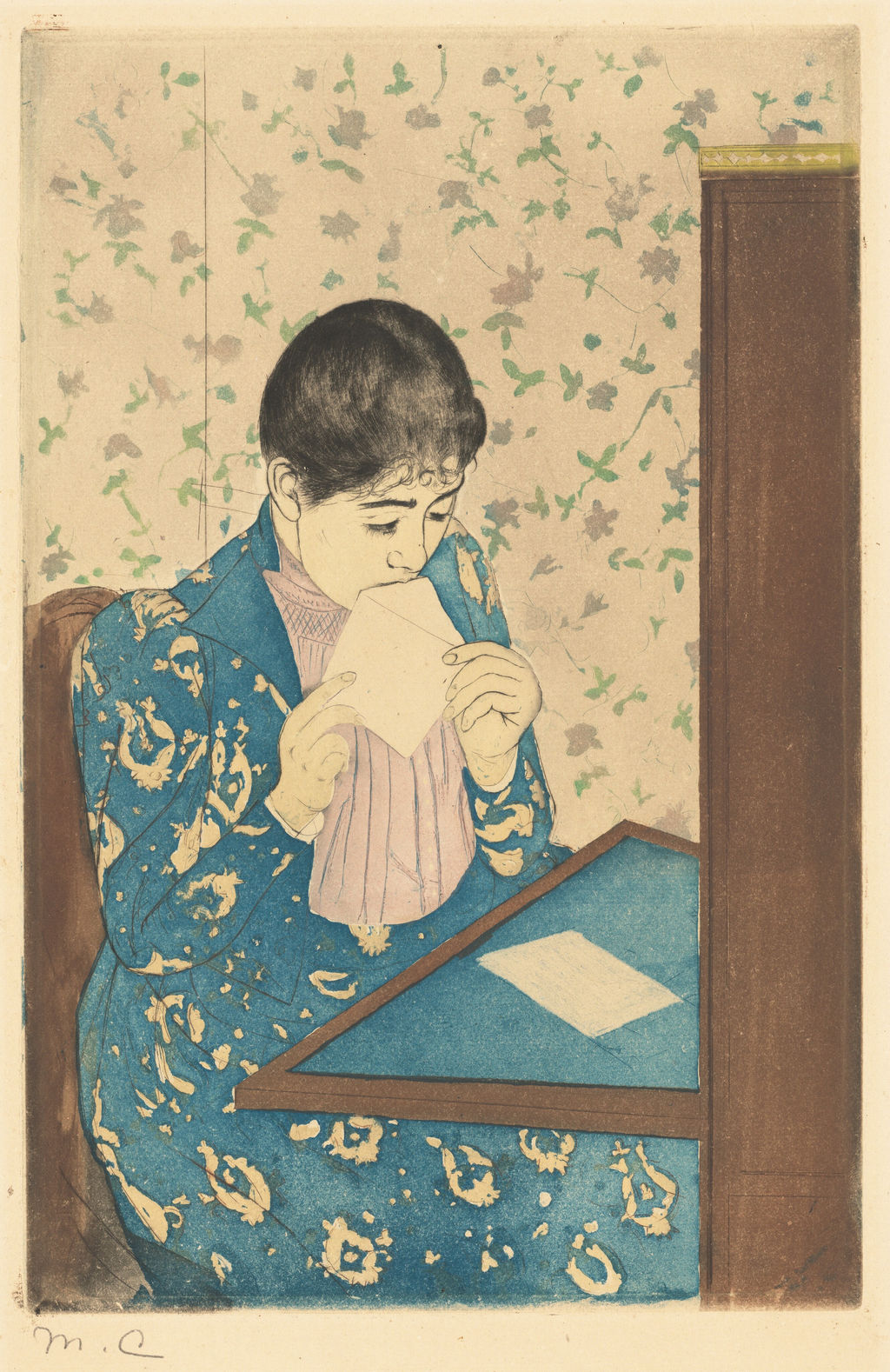
| The Letter | 1890–91 | Colour print |
| The Loge | About 1878–1880 | Oil on canvas |
| The Mandolin Player | 1868 | Oil on canvas |
| The Manicure (Les Ongles; The Nails) | About 1908 | Intaglio print |
| The Tea; Le Thé | About 1880 | Oil on canvas |
| The Visitor | c. 1880 | Intaglio print |
| Two Sisters | 1896 | Pastel |
| Two Women Seated by a Woodland Stream | About 1869 | Oil on canvas |
| Two Women Throwing Flowers During Carnival | 1872 | Oil on canvas |
| Under the Horse-Chestnut Tree | 1896–97, National Gallery and MoMA records | Not established |
| Woman Bathing (La Toilette) | 1890–91 | Colour print |
| Woman in a Loge (Woman with a Pearl Necklace) | 1879 | Oil on canvas |
| Woman Reading | 1878–79 | Oil on canvas |
| Woman Standing, Holding a Fan | 1878–79 | Distemper |
| Woman with a Fan | c. 1878–1879 | Oil on canvas |
| Woman with a Red Zinnia | 1891 | Oil on canvas |
| Woman with a Sunflower | About 1905 | Oil on canvas |
| Young Girl at a Window | c. 1883–1884 | Oil on canvas |
| Young Girl with Brown Hair, Looking Left | About 1913 (1997 summary catalogue) | Pastel |
| Young Mother Sewing | 1900 | Oil on canvas |
| Young Woman in Green, Outdoors in the Sun | About 1914 | Oil on canvas |
Discussion
Look again at the images and ideas explored in Mary Cassatt Drawings and Pastels. These editorial prompts invite your observations.
Reader Insights
A face can emerge from softly joined colours while the sleeve beside it remains a network of visible strokes. What does this first detail make you notice?
The word drawing can describe an activity as well as a category of artwork. Which connection would you explore further?
When does visible paper make a figure clearer rather than less complete?
Join the Conversation
Share a detail, comparison or question about Mary Cassatt Drawings and Pastels below.
References
- Marjorie Shelley and selected Cassatt catalogue/checklist entries, American Pastels in the Metropolitan Museum of Art, 1989, technical essay printed pages 33–45, especially 39–41; checklist pages 152 and 156. View source.
- Metropolitan Museum of Art, Mother Playing with Child, 22.16.23. View source.
- Metropolitan Museum of Art, Portrait of the Artist, 1975.319.1. View source.
- National Gallery of Art, In the Omnibus (recto), 1948.11.51.a. View source.
- National Gallery of Art, In the Omnibus (verso), 1948.11.51.b. View source.
- National Gallery of Art, Mary Cassatt, the Daring Printmaker, 23 January 2026; Omnibus process and object group. View source.
- Bonita Billman, Smithsonian Associates, Mary Cassatt: An American Among the Impressionists, teaching handout, 21 August 2025, page 2, glossary; counterproof and gouache definitions only. View source.
- Sotheby’s, Tête de Femme au Grand Chapeau, lot 135, 2008; measurements excluded for conflicting units. View source.
- Metropolitan Museum of Art, Nurse Reading to a Little Girl, 62.72. View source.
- Colby College Museum of Art, Explore Inside Out: The Prints of Mary Cassatt, exact caption for Mother Berthe Holding Her Nude Baby, 2013.549, and separate Emmie and Her Child discussion. View source.
- Art Gallery of Ontario, Cassatt–McNicoll:ImpressionistsBetweenWorlds. View source.
- Metropolitan Museum of Art, The Bath, 16.2.7. View source.
- National Gallery of Art, Children Playing on the Beach, 1970.17.19. View source.
- National Gallery of Art, Little Girl in a Blue Armchair, 1983.1.18. View source.
- Sotheby’s, syndicated auction catalogue hosted by Invaluable, Simone in Blue Plumed Hat, Watson collection, 18 May 2005, lot 20. View source.
- National Gallery of Art, The Boating Party, 1963.10.94. View source.
- The Huntington, Breakfast in Bed, 83.8.6. View source.
- Adelyn Dohme Breeskin / Smithsonian Institution Press; University of California scan indexed by Google Books, Mary Cassatt:A Catalogue Raisonné of the Oils,Pastels,Watercolors,and Drawings,1970,322pp; selected public search snippets pp91–92,143–144,316,318. View source.
- Metropolitan Museum of Art, The Private Collection of Edgar Degas: A Summary Catalogue, Cassatt entries, printed p.7, no.48. View source.
- Art Institute of Chicago, After the Bullfight, 1969.332. View source.
- Smithsonian American Art Museum, Art Inventories, After the Bullfight, siris_ari_180619. View source.
- Smithsonian American Art Museum, The Caress, 1911.2.1. View source.
- Museum of Modern Art, Under the Horse-Chestnut Tree,671.1940. View source.
- National Gallery of Art, Under the Horse-Chestnut Tree,1959.12.4. View source.
- Art Institute of Chicago, The Child’s Bath,1910.2,current expanded collection entry. View source.
- Virginia Museum of Fine Arts, Board of Trustees minutes,17September2020,loan recommendation7:ChildPickingaFruit75.18. View source.
- Cincinnati Art Museum, Les Ongles(The Nails;The Manicure),ca1908,1940.155,secondstate. View source.
- Sotheby’s, Clarissa Turned Left with Her Hand to Her Ear, 2012 lot 51. View source.
- Greenville County Museum of Art, Recent Acquisitions Funded by Sale of Alma Thomas Painting, 2021. View source.
- Metropolitan Museum of Art, The Coiffure,16.2.3. View source.
- Metropolitan Museum of Art, The Cup of Tea, 22.16.17. View source.
- Sotheby’s, Mother and Child (Nude Dark-Eyed Little Girl with Mother in Patterned Wrapper), 19 May 2010, lot 31. View source.
- Metropolitan Museum of Art, Denise at Her Dressing Table, 2005.129. View source.
- Denver Art Museum, Whistler to Cassatt:American Painters in France, bilingual exhibition livret,The Salon,no2. View source.
- Philadelphia Museum of Art, Driving, 1881. View source.
- Denver Art Museum, Whistler to Cassatt exhibition guide, stop 112: Bust of Ellen with Bows in Her Hair. View source.
- Museum of Fine Arts, Boston, Ellen Mary in a White Coat, 1982.630. View source.
- MaudHoweElliott(ed.) / UniversityofIllinoisUrbanaChampaign scan, Art and Handicraft in the Woman’s Building of the World’s Columbian Exposition,Chicago,1893,Chicago:RandMcNally,1894. View source.
- Amon Carter Museum of American Art, Woman Standing Holding a Fan, 2011.20. View source.
- Smithsonian American Art Museum, Special Installation of Nineteen American Masterworks, 2015. View source.
- Metropolitan Museum of Art, The Fitting, 16.2.8 final state. View source.
- Reynolda House Museum of American Art, Mary Cassatt collection listing: Madame Gaillard and Her Daughter Marie-Thérèse, 1897. View source.
- Wake Forest University, Wake Women 2023 schedule, Highlighting the Art of Women at Reynolda, captioned Cassatt image. View source.
- Detroit Institute of Arts, In the Garden, 36629. View source.
- National Gallery of Art, Gathering Fruit,1943.3.2757. View source.
- Sotheby’s, A Goodnight Hug,N09860lot11,14May2018. View source.
- Sotheby’s, Young Woman in Green Outdoors in the Sun, Modern Day. View source.
- Sotheby’s, syndicated auction catalogue hosted by Invaluable, Head of Simone in a Green Bonnet with Wavy Brim, Watson collection,18May2005,lot39. View source.
- National Gallery of Art, Girl Arranging Her Hair, 1963.10.97. View source.
- Joslyn Art Museum, Art Break:Woman Reading,1943.38,program object caption. View source.
- Los Angeles County Museum of Art, A Child’s Bath, M.62.8.14. View source.
- National Gallery of Art, The Lamp, 5937. View source.
- National Gallery of Art, The Letter,1943.3.2763. View source.
- Metropolitan Museum of Art, Lilacs in a Window, 1997.207. View source.
- National Gallery of Art, The Loge,1963.10.96. View source.
- Arp Museum Bahnhof Rolandseck, Maestras: Malerinnen1500–1900,25February–16June2024,official five-page flyer. View source.
- Spanish official gazette / exhibition insurance schedule, BOE-A-2023-19808,21September2023,Maestras loan schedule. View source.
- Nationalmusée um Fëschmaart / ArpMuseum CollectionRauforUNICEF, Louise,NursingHerChild,1899,GR1.949;FromRenoirtoMonet2026–27. View source.
- Petit Palais / Paris Musées, Automne, portrait de Lydia Cassatt, PPP706; IIIF manifest 160008392. View source. (in French).
- Denver Art Museum, Whistler to Cassatt Access Guide, The Salon, stop 104. View source.
- Metropolitan Museum of Art, Maternal Caress, 16.2.5. View source.
- Philadelphia Museum of Art, Mother and Child Maternal Kiss, object 54049. View source.
- Metropolitan Museum of Art, Maternal Caress, preparatory drawing64.123.3, c1891. View source.
- Christie’s, Mathilde Holding Baby who Reaches out to Right, lot 5459369. View source.
- National Portrait Gallery / Catalog of American Portraits, Madame Meerson and her Daughter, SSSA2282. View source.
- Museum of Fine Arts Boston, In the Loge, 10.35. View source.
- Smithsonian art inventories, Child Drinking Milk from a Bowl, siris_ari_197517. View source.
- MutualArt public auction index; original auctioneer undisclosed without subscription, Child Drinking Milk from a Bowl, public listing dated 2 June 2024. View source.
- Museum of Modern Art, Mary Cassatt artist essay and print records. View source.
- National Gallery of Art, Mother's Kiss,1963.10.254. View source.
- National Gallery of Art, Mary Cassatt An American in Paris checklist, updated 24 February 2026. View source.
- Adelyn D. Breeskin / National Gallery of Art, Mary Cassatt 1844–1926, 1970 exhibition catalogue. View source.
- National Gallery of Art, In the Omnibus, 46725. View source.
- Metropolitan Museum of Art, Mother and Child (The Oval Mirror), 29.100.47. View source.
- Art Institute of Chicago, Ryerson and Burnham Archives, Bertha Honoré Palmer Correspondence Collection finding aid, selected Mary Cassatt entries, Box1Folder3. View source.
- Philadelphia Museum of Art, Woman in a Loge, 1978-1-5, object72182. View source.
- Metropolitan Museum of Art, By the Pond,60.732bis. View source.
- Museum of Modern Art, By the Pond,673.1940. View source.
- Terra Foundation for American Art, By the Pond,1999.25. View source.
- Philadelphia Museum of Art, Poppies in a Field, attributed to Victor Gabriel Gilbert; formerly attributed to Mary Stevenson Cassatt, 1978-1-6. View source.
- Christie’s, Mother in Purple Holding Her Child, lot 5369421. View source.
- Sotheby’s, Tête d’enfant au chapeau rouge, American Art N09229, 20 November 2014, lot 39. View source.
- Christie’s, Sara Holding a Cat, lot 5561267. View source.
- Smithsonian American Art Museum, Art Inventories Catalog, Sara with Her Dog, in an Armchair, Wearing a Bonnet with a Plum Ornament; IAP 80170363 / siris_ari_180925. View source.
- Smithsonian American Art Museum, Sara in a Green Bonnet, 1929.6.11. View source.
- Mary Cassatt Catalogue Raisonné project, with Adelson Galleries, presented on Artnet, Sara with Her Dog, in an Armchair, Wearing a Bonnet with a Plum Ornament, work 424155733. View source.
- National Portrait Gallery, Mary Cassatt Self-Portrait, NPG.76.33. View source.
- Musée d’Orsay, Jeune fille au jardin,RF193720. View source. (in French).
- Sotheby’s, Simone Seated on the Grass Next to Her Mother, 30 September 2020, lot 33. View source.
- Dallas Museum of Art, Sleepy Baby,1952.38.M. View source.
- Sotheby’s, Smiling Mother with Sober Faced Child, 2022. View source.
- Smithsonian American Art Museum, Spanish Dancer Wearing a Lace Mantilla, 1967.40. View source.
- Spencer Museum of Art,University of Kansas, The Manicure,c1908,1991.0266. View source.
- Christie’s, Sketch of Master St Pierre, 2017 online lot. View source.
- National Gallery of Art, Child in a Straw Hat, 1983.1.17. View source.
- Sotheby’s, Summertime, Armand Hammer: The Private Collection, Modern Evening Auction 2026. View source.
- National Gallery of Art, Woman with a Sunflower, 1963.10.98. View source.
- National Gallery of Art, Afternoon Tea Party, 46731. View source.
- Museum of Fine Arts, Boston / Erica E. Hirshler, The Tea, 42.178. View source.
- The Nelson-Atkins Museum of Art, At the Theater,F77-33;French Paintings and Pastels appendixII. View source.
- Metropolitan Museum of Art, Woman Bathing La Toilette, 16.2.2. View source.
- Sotheby’s, Two Sisters, 2005 American Paintings sale N08134, lot 44. View source.
- Wichita Art Museum, Mother and Child, M109.53. View source.
- Smithsonian American Art Museum, Art Inventories, Two Women Seated by a Woodland Stream / Duex femmes assises aupres de l’eau, IAP 80170008. View source.
- Tacoma Art Museum / David Setford, Impressionist Painting: From Pleasure Gardens to the Palais Garnier, 22 October 2019. View source.
- Tacoma Art Museum, French Impressionism and the Northwest, Works of Art Adoption Program, 2019–2020, no. 10 / PDF p. 12. View source.
- Metropolitan Museum of Art, Young Mother Sewing, 29.100.48. View source.