by Tom Gurney
Tom Gurney BSc (Hons) is an art history expert with over 20 years experience
Published on June 19, 2020 / Updated on November 2, 2026
Email: tomgurney1@gmail.com / Phone: +44 7429 011000
The Bath by Mary Cassatt: Introduction
The woman reaches into a blue tub with one hand while the other arm supports a turning child against her knee. A large yellow dress gathers both actions into one broad shape. Around the figures, the setting remains spare. Mary Cassatt’s The Bath makes care visible through two simultaneous tasks: testing the water and keeping the child secure.
The colour-print design dates to 1890–91. A final-state example at the Metropolitan Museum of Art, accession 16.2.7, combines drypoint, softground etching and aquatint printed from two plates. The museum catalogues that sheet as the seventeenth state of seventeen in Mathews and Shapiro’s system. Other impressions share the composition; their paper, state and ownership histories must be identified separately. [1]
This distinction matters throughout the article. The figures and their arrangement can be examined as a composition; paper, state, measurements and ownership must belong to a particular identified sheet. The Bath is also separate from Cassatt’s later oil The Child’s Bath and the colour print Woman Bathing, which show different actions and settings.
At a Glance
- ArtistMary Cassatt [1]
- Design date1890–91 [1]
- Selected exampleMetropolitan Museum of Art, 16.2.7 [1]
- Medium of selected exampleDrypoint, softground etching and aquatint, printed in colour from two plates [1]
- State of selected exampleSeventeenth of seventeen, Mathews and Shapiro [1]
- Selected example dimensionsImage 29.5 × 24.8 cm; sheet 43.2 × 30 cm [1]
- Selected example creditGift of Paul J. Sachs, 1916 [1]
- Legacy imageDesign matched; physical impression unidentified [1] [2]
This work across Mary Cassatt’s career
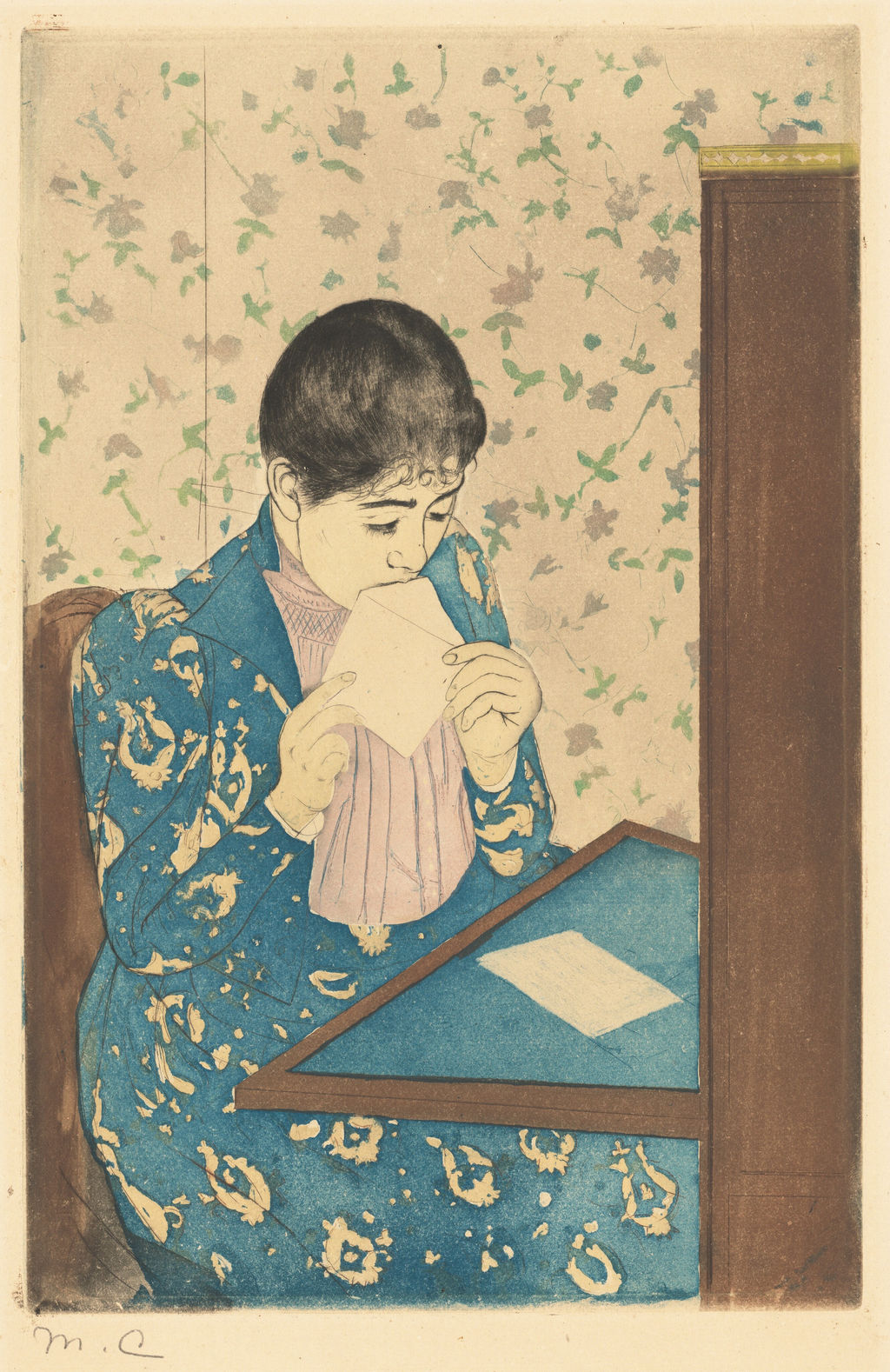
The Letter
1890–91 [7]The Bath (current article)
1890–91 [1]Modern Woman
1892–93; displayed in 1893 [8] [9] [10]The Boating Party
1893–94 [11]The Child's Bath
1893 [12]Woman with a Sunflower
About 1905 [14]Young Woman in Green Outdoors in the Sun
About 1914 [15]Contents
- One body coordinates two tasks
- The tub is a colour shape and a working object
- A patterned dress around a less patterned body
- A spare setting gives the gesture room
- Making colour with two plates
- Seventeen states do not mean seventeen copies
- The full sheet and its dimensions
- Japanese prints and Cassatt’s colour project
- A museum gift after the original project
- The later oil The Child’s Bath
One body coordinates two tasks
The adult’s head inclines towards the left, in the direction of the hand reaching into the tub. Her extended arm creates a long diagonal from shoulder to water. The other arm remains close to the child, holding the smaller body within the space formed by her knee and dress.
Those actions require different positions. The testing hand enters another object, while the supporting arm helps contain a body. The viewer can follow both within one compact arrangement, without finding the adult’s attention represented by a single straight line from face to hand.
The child adds another direction. Its head and torso turn away from the testing hand rather than repeating the woman’s movement towards the tub. Legs and arms bend across the larger yellow area. The difference makes the child an active shape within the grouping, rather than a smaller copy of the adult’s pose.
Support is crucial to the effect. The child appears positioned against the woman’s knee, with the adult’s arm supplying another contact. A small body turning at that angle needs a visible place to rest. The picture’s convincing care depends on the legibility of those relationships as much as on any expression in a face.
The title gives the activity a familiar name, but the image presents a moment before immersion rather than a child already seated in the water. The tub and reaching hand make preparation part of the subject. Cassatt can establish an everyday action through relatively few objects when their positions explain how they are being used.
The tub is a colour shape and a working object
The blue tub occupies the left side and is partly cropped by the image boundary. Its curved upper edge describes an opening, while a darker blue side gives it height. The water is distinguished within that opening, close to the adult’s lowered hand.
The form has a practical role: it is where the hand reaches. It also has a pictorial role, creating a substantial cool area beside the warmer yellow garment. The picture joins those functions. The viewer recognises the action partly because the tub is clearly shaped and separated from the dress.
The rim’s curve differs from the longer downward folds of clothing. Looking between them makes clear that a rounded container and a clothed body occupy adjacent areas. Their boundaries supply information that a heavily detailed background is not needed to provide.
The testing gesture does not reveal the water’s actual temperature. Nor does the surface identify a precise household routine or a named interior. Its importance is visible and specific: the woman directs one hand into the tub while keeping another body near her. An invented domestic story would add little to that coordination.
A patterned dress around a less patterned body
The yellow garment supplies the largest continuous colour area. It extends from the collar and shoulders, down the testing sleeve, across the bent knee and around the lower grouping. Small dark motifs repeat over it, while longer lines describe folds and the opening of the dress.
The pattern makes the material conspicuous without preventing us from understanding the pose beneath it. At the knee, changes in direction help articulate the bend. Along the reaching arm, the sleeve leads towards the hand. The same broad colour can therefore join several body parts while lines preserve their different positions.
The child is less densely patterned. Pale flesh and sparse contours stand against the busier yellow field, so its rounded torso and bent limbs remain easy to follow. The contrast between a marked garment and a more open body does much of the descriptive work that deep shadow might perform in another medium.
Dark hair gives both heads a compact accent. The adult’s larger hair shape sits above the extended arm, while the child’s smaller head lies farther to the right. These separated dark forms help prevent the pale skin and light surrounding field from merging into one indefinite area.
The yellow dress also functions as an immediate setting for the child. Instead of placing the smaller figure against a distant wall, Cassatt surrounds much of it with material that belongs to the adult. That overlap makes the relationship physical: the child occupies the space of another body and its clothing.
A spare setting gives the gesture room
Only a little environmental information surrounds the pair. A horizontal division behind them and the tub establish an interior, but there is no extensive inventory of furniture. The figures remain the principal structures within the image.
This spareness should not be confused with an assertion that every light area is untouched paper. A printed tonal field and the sheet’s outer margin are different things. What matters in the composition is the relative absence of represented objects around the figures, leaving their outlines and gestures conspicuous.
The open surrounding area also affects the balance of the yellow mass. The dress can expand broadly without competing with a dense floor or wallpaper pattern. The tub becomes its strongest neighbouring form. The viewer moves between those large areas and the smaller points where hand, water and child meet.
Cropping contributes to that concentration. Part of the tub continues beyond the left boundary, while the adult and child remain held within the main field. The container’s incomplete outline suggests its continuation without requiring the whole object to be displayed. The image can feel close while retaining substantial space around the figures.
Making colour with two plates
The Metropolitan Museum explains that Cassatt made an early impression from a single plate but used two for its later example. One contributed tonal areas; the other carried drypoint lines and the tone of the dress. The final plate count therefore does not describe every earlier trial. [1]
This is an important difference between a printed result and a coloured drawing. The final visible marks are ink transferred from worked plates, even where an outline resembles a line drawn directly onto paper. Separate inked surfaces must also register in relation to one another if their contributions are to form the intended image.
The National Gallery’s process account explains the roles of drypoint, softground etching and aquatint in Cassatt’s colour work. They offer different means of making line and tone within an intaglio practice. Their combination enabled a print to retain definite contours while giving clothing, water and surrounding areas a larger coloured presence. [16]
The published process explanation is not a complete reconstruction of every press operation for every impression. The museum also credits the printing of its sheet jointly to Cassatt and Monsieur LeRoy. That credit adds a collaborator to the object’s making without specifying every division of labour. It is a reminder that designing and working plates, preparing ink and producing an impression are related but distinguishable activities. [1]
Seventeen states do not mean seventeen copies
A state records an identified stage of work on a print design or matrix. An impression is a physical sheet produced through printing. Several impressions can belong to one state, and one design can survive through several states. These terms answer different questions about the object and its making.
The Met’s final example is one identified sheet within Mathews and Shapiro’s seventeen-state sequence. Its catalogue description does not mean that only seventeen sheets were ever printed. Nor does citing the number establish that every intermediate state has been visually compared here. [1]
The National Gallery’s The Bath, accession 1943.3.2760, is a different impression, catalogued as the sixteenth state of seventeen. Its current record identifies Japanese paper and the Rosenwald Collection. The same record also cites Breeskin’s tenth-of-eleven classification, a different catalogue system. The two sets of numbering should not be combined into one arithmetic sequence. [2]
A sheet’s appearance can vary for more than one reason. Differences of state, inking, paper and reproduction all need to be considered before a changed colour is treated as evidence of a newly worked plate. A yellow dress appearing warmer in one photograph does not by itself identify a later state.
Recognising the composition is consequently only a first step in identifying a print. A photograph of the design does not automatically establish a final state or a particular paper. The museum accession number is valuable because it ties a catalogue description to one physical object.
Watch: Mary Cassatt
Choose a film to explore the artist’s work, its interpretation and its wider setting.
Demonstrating Mary Cassatt's Color Printmaking Techniques
The Philadelphia Museum of Art demonstrates techniques used to make Cassatt’s colour prints.
Watch on YouTubeThe full sheet and its dimensions
The Met records an image area of 29.5 × 24.8 cm within a sheet measuring 43.2 × 30 cm. The image measurement describes the printed area; it is not labelled as a measurement of the plate. The margin and the printed field have different roles when describing the physical object. [1]
The National Gallery gives separate plate and sheet measurements for its own impression. Those figures describe that sheet, not an alternative size for the Met object. Differences between museum records can arise because different physical impressions and measurement areas are being described. [2]
A full-sheet view also preserves information below and beside the image. Signatures, annotations and the proportion of the margin can disappear when a reproduction is cropped tightly around the figures. A detail may be useful for studying the testing hand, but it cannot replace the whole impression when the question concerns its material identity.
Japanese prints and Cassatt’s colour project
The Bath belongs to the group of ten colour designs Cassatt exhibited in Paris in 1891. Museum accounts connect the project with her response to the Japanese-print exhibition of 1890. The influence concerned possibilities of line, broad colour and composition, while her own prints used intaglio methods rather than Japanese woodblock matrices. [1] [16]
In this design, those questions can be examined through the large dress, the definite contours of the bodies and the spare setting. Pattern remains active across a broad area without requiring every fold to be modelled through continuous shadow. The water provides another kind of surface within the same composition.
The relationship does not identify a single copied Japanese prototype for the pose. The successive states and the different methods brought together in the plates show Cassatt developing a particular colour-print solution through successive work, rather than borrowing one unaltered formula.
A museum gift after the original project
Paul J. Sachs gave the Met’s colour impression in 1916. The museum distinguishes those colour states from the black-ink examples given by his brother Arthur. That collecting history belongs to the museum’s formation of its print holdings, decades after the design’s creation. [1]
The gift should not be projected backwards into the print’s original market or assigned to every surviving impression. Likewise, the National Gallery’s Rosenwald credit concerns its own sheet. The common design links the objects visually, while their separate ownership histories explain how they reached different institutions. [2]
The later oil The Child’s Bath
The Child’s Bath, the Art Institute of Chicago’s oil of 1893, presents a different action. A seated child’s foot is washed in a basin, with the adult’s other hand supporting the body. Its higher viewpoint and denser patterned setting give the figures another relationship to the surrounding space. [12]
The comparison begins with the hands. In the print, one tests the water while the other arm braces the turning child. In the oil, washing is already taking place at a foot. The distinction changes the child’s position, the adult’s reach and the object around which attention gathers.
The surroundings differ too. The oil’s patterns extend through more of the interior, whereas the print leaves the dress and tub as the main adjacent colour forms. A shared bathing theme consequently produces different spatial and material solutions. The oil’s dimensions and technical findings cannot describe the earlier print.

The Child’s Bath, 1893. Art Institute of Chicago. Image source. Public domain. Resized only; whole composition retained.
Woman Bathing: an adult before a mirror
The Toilette, also called Woman Bathing, offers another comparison from 1890–91. The Met’s example, accession 16.2.2, is a three-plate colour print in its fourth and final state. A standing adult bends over a basin, with a striped cloth around the lower body and a mirror providing another view. [17]
The absence of a child changes the distribution of support. The body bends towards furniture rather than being coordinated with another person’s weight. A washstand, reflection and patterned floor define a more enclosed interior, contrasting with The Bath’s kneeling figure and spare surrounding field.
The striped cloth and yellow patterned dress also perform different jobs. One hangs from an adult’s waist towards the floor; the other curves around a knee and a supported child. Comparing them shows how costume can help explain action, rather than simply decorate a bathing subject.
These distinctions make the titles useful only when joined to images and exact records. A print of preparing a child’s bath, a later oil of foot washing and a print of an adult at a basin are three separate compositions. Their differences reveal how varied Cassatt’s repeated attention to bodily care could be.

Woman Bathing (La Toilette) — print design; the illustrated legacy impression is unidentified.
Cassatt artworks and studies
A source-bounded directory of documented works and studies, including the works in the National Gallery’s 2026 checklist and one clearly marked former attribution. Different print impressions are grouped by design and remain searchable by their recorded accessions. This is not a complete catalogue raisonné. Unlinked titles have no individual article here.
| Name | Date | Medium |
|---|---|---|
| A Child’s Bath — LACMA oil | 1880 | Oil on canvas |
| A Goodnight Hug | 1880 | Pastel |
| After the Bullfight | 1873 | Oil on canvas |
| Afternoon Tea Party | 1890–91 | Colour print |
| At the Theatre (Lydia Cassatt Leaning on Her Arms, Seated in a Loge) | About 1879 | Pastel |
| Automne, portrait de Lydia Cassatt | 1880 | Oil on canvas |
| Breakfast in Bed | 1897 | Oil on canvas |
| Bust of Ellen with Bows in Her Hair | 1898 | Pastel |
| By the Pond | About 1896 in Met and Terra records; about 1898 at MoMA | Not established |
| Child Drinking Milk from a Bowl; provisionally identified composition (qualified identification) | About 1890, following inventory and catalogue text | Pastel |
| Child in a Straw Hat | About 1886 | Oil on canvas |
| Child Picking a Fruit | 1893 | Oil on canvas |
| Children Playing on the Beach | 1884 | Oil on canvas |
| Clarissa, Turned Left, with Her Hand to Her Ear | About 1890–93 in Sotheby’s 2012 entry; about 1893 in GCMA notice | Pastel |
| Denise at her Dressing Table | About 1908–09 | Oil on canvas |
| Driving | 1881 | Oil on canvas |
| Eddy Cassatt (Edward Buchanan Cassatt) | 1875 | Oil on canvas |
| Ellen Mary Cassatt in a White Coat | About 1896 | Oil on canvas |
| Emmie and her Child | About 1890 | Oil on canvas |
| Gathering Fruit | About 1893 | Not established |
| Girl Arranging her Hair | 1886 | Oil on canvas |
| Head of a Child with a Red Hat | 1903, signed and dated | Pastel |
| Head of a Woman in a Large Hat | About 1909 | Pastel |
| Head of Simone in a Green Bonnet with Wavy Brim | About 1904 | Pastel |
| In the Garden | 1903 or 1904 | Oil on canvas |
| In the Loge | 1878 | Oil on canvas |
| In the Omnibus | 1890–91 | Colour print |
| In the Omnibus [recto] — preparatory drawing | c. 1891 | Chalk and graphite |
| In the Opera Box (No. 3) [recto] — preparatory drawing | 1880 | Graphite |
| In the Opera Box (No. 3) — print | c. 1880 | Intaglio print |
| Jeune fille au jardin (Young Woman Sewing in a Garden) | 1880–82 | Oil on canvas |
| Jules Dried by His Mother; provisionally identified composition (qualified identification) | 1901, following catalogue text | Oil on canvas |
| Lady in Black, in a Loge, Facing Right | c. 1880 | Etching |
| Lilacs in a Window | About 1880–83 | Oil on canvas |
| Little Girl in a Blue Armchair | 1878 | Oil on canvas |
| Louise Nursing her Child | 1899 in Luxembourg caption; 1898–99 in loan and Arp records | Pastel |
| Madame Gaillard and Her Daughter Marie-Thérèse | 1897, Reynolda collection listing | Pastel |
| Maternal Caress | 1890–91 | Not established |
| Maternal Caress — preparatory drawing | About 1891 | Charcoal and graphite |
| Mathilde Holding a Baby Who Reaches out to the Right | About 1889, Christie’s catalogue | Pastel |
| Mimi as a Brunette | c. 1889 | Drypoint |
| Mimi Holding a Japanese Fan | c. 1889 | Drypoint |
| Modern Woman | 1892–93; displayed in 1893 | Not established |
| Mother about to Wash her Sleepy Child | 1880 | Oil on canvas |
| Mother and Child (Maternal Kiss) | 1896 | Pastel |
| Mother and Child (Nude Dark-Eyed Little Girl with Mother in Patterned Wrapper) | About 1898–99, Sotheby’s catalogue | Pastel |
| Mother and Child (The Oval Mirror) | About 1899 | Oil on canvas |
| Mother Berthe Holding Her Nude Baby | 1898–99 | Pastel |
| Mother in Purple Holding her Child | About 1914, Christie’s catalogue | Pastel |
| Mother Playing with Child | About 1897 | Pastel |
| Mother’s Kiss | 1890–91 | Colour print |
| Nurse Reading to a Little Girl | 1895 | Pastel |
| Poppies in a Field (formerly Cassatt; attributed to Victor Gabriel Gilbert) | About 1880, current museum record | Oil on panel |
| Portrait of an Elderly Lady | c. 1887 | Oil on canvas |
| Portrait of Madame AF Aude and her Two Daughters | 1899, Breeskin 1970 exhibition catalogue | Pastel |
| Portrait of the Artist | 1878 | Watercolour and gouache |
| Reading Le Figaro | 1878, NGA 2026 checklist; about 1877–78 in SAAM’s 2015 caption | Oil on canvas |
| Reflection — drypoint | c. 1890 | Drypoint |
| Sara Holding a Cat | About 1907–08 | Oil on canvas |
| Sara in a Green Bonnet | About 1901 | Oil on canvas |
| Sara with Her Dog, in an Armchair, Wearing a Bonnet with a Plum Ornament | 1901 | Pastel |
| Self Portrait | About 1880 | Watercolour and gouache |
| Simone in Blue Plumed Hat | About 1903 | Pastel |
| Simone Seated on the Grass next to her Mother | 1901–02 | Pastel |
| Sketch of Master St. Pierre | Date not established | Pastel |
| Sleepy Baby | About 1910 | Pastel |
| Smiling Mother with Sober Faced Child | Date not established | Pastel |
| Spanish Dancer Wearing a Lace Mantilla | 1873 | Oil on canvas |
| Summertime, horizontal painting | 1894–95, current Sotheby’s catalogue | Oil on canvas |
| Tea — print | c. 1890 | Drypoint |
| The Bath | 1890–91 | Not established |
| The Boating Party | 1893–94 | Oil on canvas |
| The Caress | 1902 | Oil on canvas |
| The Child's Bath | 1893 | Oil on canvas |
| The Coiffure | 1890–91 | Colour print |
| The Cup of Tea | About 1880–81 | Oil on canvas |
| The Fitting | 1890–91 | Colour print |
| The Lamp | 1890–91 | Colour print |
| The Letter | 1890–91 | Colour print |
| The Loge | About 1878–1880 | Oil on canvas |
| The Mandolin Player | 1868 | Oil on canvas |
| The Manicure (Les Ongles; The Nails) | About 1908 | Intaglio print |
| The Tea; Le Thé | About 1880 | Oil on canvas |
| The Visitor | c. 1880 | Intaglio print |
| Two Sisters | 1896 | Pastel |
| Two Women Seated by a Woodland Stream | About 1869 | Oil on canvas |
| Two Women Throwing Flowers During Carnival | 1872 | Oil on canvas |
| Under the Horse-Chestnut Tree | 1896–97, National Gallery and MoMA records | Not established |
| Woman Bathing (La Toilette) | 1890–91 | Colour print |
| Woman in a Loge (Woman with a Pearl Necklace) | 1879 | Oil on canvas |
| Woman Reading | 1878–79 | Oil on canvas |
| Woman Standing, Holding a Fan | 1878–79 | Distemper |
| Woman with a Fan | c. 1878–1879 | Oil on canvas |
| Woman with a Red Zinnia | 1891 | Oil on canvas |
| Woman with a Sunflower | About 1905 | Oil on canvas |
| Young Girl at a Window | c. 1883–1884 | Oil on canvas |
| Young Girl with Brown Hair, Looking Left | About 1913 (1997 summary catalogue) | Pastel |
| Young Mother Sewing | 1900 | Oil on canvas |
| Young Woman in Green, Outdoors in the Sun | About 1914 | Oil on canvas |
Discussion
Look again at the images and ideas explored in The Bath by Mary Cassatt. These editorial prompts invite your observations.
Reader Insights
The woman reaches into a blue tub with one hand while the other arm supports a turning child against her knee. What does this first detail make you notice?
The adult’s head inclines towards the left, in the direction of the hand reaching into the tub. How does it affect your reading of the whole work?
Which makes the care most legible: the hand testing water or the arm supporting the child?
Join the Conversation
Share a detail, comparison or question about The Bath by Mary Cassatt below.
References
- Metropolitan Museum of Art, The Bath, 16.2.7, final-state two-plate example, process explanation, image/sheet measurements and Sachs gift history. View source.
- National Gallery of Art, The Bath, 1943.3.2760, Japanese-paper impression, Mathews and Shapiro sixteenth of seventeen, and separately cited Breeskin catalogue system. View source.
- Denver Art Museum, Whistler to Cassatt Access Guide, The Salon, stop 104. View source.
- Denver Art Museum, Whistler to Cassatt:American Painters in France, bilingual exhibition livret,The Salon,no2. View source.
- National Gallery of Art, Little Girl in a Blue Armchair, 1983.1.18. View source.
- Philadelphia Museum of Art, Driving, 1881. View source.
- National Gallery of Art, The Letter,1943.3.2763. View source.
- Art Institute of Chicago, Ryerson and Burnham Archives, Bertha Honoré Palmer Correspondence Collection finding aid, selected Mary Cassatt entries, Box1Folder3. View source.
- Museum of Modern Art, Mary Cassatt artist essay and print records. View source.
- MaudHoweElliott(ed.) / UniversityofIllinoisUrbanaChampaign scan, Art and Handicraft in the Woman’s Building of the World’s Columbian Exposition,Chicago,1893,Chicago:RandMcNally,1894. View source.
- National Gallery of Art, The Boating Party, 1963.10.94. View source.
- Art Institute of Chicago, The Child’s Bath, 1910.2, current expanded object record. View source.
- Metropolitan Museum of Art, Young Mother Sewing, 29.100.48. View source.
- National Gallery of Art, Woman with a Sunflower, 1963.10.98. View source.
- Sotheby’s, Young Woman in Green Outdoors in the Sun, Modern Day. View source.
- National Gallery of Art, Mary Cassatt, the Daring Printmaker, 23 January 2026; colour-project and intaglio process account. View source.
- Metropolitan Museum of Art, Woman Bathing (La Toilette), 16.2.2, separate three-plate, fourth/final-state impression. View source.
- Art Gallery of Ontario, Cassatt–McNicoll:ImpressionistsBetweenWorlds. View source.
- National Gallery of Art, Children Playing on the Beach, 1970.17.19. View source.
- Colby College Museum of Art, Explore Inside Out: The Prints of Mary Cassatt; Mother Berthe Holding Her Nude Baby,2013.549. View source.
- Sotheby’s, syndicated auction catalogue hosted by Invaluable, Simone in Blue Plumed Hat, Watson collection, 18 May 2005, lot 20. View source.
- The Huntington, Breakfast in Bed, 83.8.6. View source.
- Adelyn Dohme Breeskin / Smithsonian Institution Press; University of California scan indexed by Google Books, Mary Cassatt:A Catalogue Raisonné of the Oils,Pastels,Watercolors,and Drawings,1970,322pp; selected public search snippets pp91–92,143–144,316,318. View source.
- Metropolitan Museum of Art, The Private Collection of Edgar Degas: A Summary Catalogue, Cassatt entries, printed p.7, no.48. View source.
- Art Institute of Chicago, After the Bullfight, 1969.332. View source.
- Smithsonian American Art Museum, Art Inventories, After the Bullfight, siris_ari_180619. View source.
- Smithsonian American Art Museum, The Caress, 1911.2.1. View source.
- Museum of Modern Art, Under the Horse-Chestnut Tree,671.1940. View source.
- National Gallery of Art, Under the Horse-Chestnut Tree,1959.12.4. View source.
- Virginia Museum of Fine Arts, Board of Trustees minutes,17September2020,loan recommendation7:ChildPickingaFruit75.18. View source.
- Cincinnati Art Museum, Les Ongles(The Nails;The Manicure),ca1908,1940.155,secondstate. View source.
- Sotheby’s, Clarissa Turned Left with Her Hand to Her Ear, 2012 lot 51. View source.
- Greenville County Museum of Art, Recent Acquisitions Funded by Sale of Alma Thomas Painting, 2021. View source.
- Metropolitan Museum of Art, The Coiffure,16.2.3. View source.
- Metropolitan Museum of Art, The Cup of Tea, 22.16.17. View source.
- Sotheby’s, Mother and Child (Nude Dark-Eyed Little Girl with Mother in Patterned Wrapper), 19 May 2010, lot 31. View source.
- Metropolitan Museum of Art, Denise at Her Dressing Table, 2005.129. View source.
- Denver Art Museum, Whistler to Cassatt exhibition guide, stop 112: Bust of Ellen with Bows in Her Hair. View source.
- Museum of Fine Arts, Boston, Ellen Mary in a White Coat, 1982.630. View source.
- Amon Carter Museum of American Art, Woman Standing Holding a Fan, 2011.20. View source.
- Smithsonian American Art Museum, Special Installation of Nineteen American Masterworks, 2015. View source.
- Metropolitan Museum of Art, The Fitting, 16.2.8 final state. View source.
- Reynolda House Museum of American Art, Mary Cassatt collection listing: Madame Gaillard and Her Daughter Marie-Thérèse, 1897. View source.
- Wake Forest University, Wake Women 2023 schedule, Highlighting the Art of Women at Reynolda, captioned Cassatt image. View source.
- Detroit Institute of Arts, In the Garden, 36629. View source.
- National Gallery of Art, Gathering Fruit,1943.3.2757. View source.
- Sotheby’s, A Goodnight Hug,N09860lot11,14May2018. View source.
- Sotheby’s, syndicated auction catalogue hosted by Invaluable, Head of Simone in a Green Bonnet with Wavy Brim, Watson collection,18May2005,lot39. View source.
- National Gallery of Art, Girl Arranging Her Hair, 1963.10.97. View source.
- Joslyn Art Museum, Art Break:Woman Reading,1943.38,program object caption. View source.
- Los Angeles County Museum of Art, A Child’s Bath, M.62.8.14. View source.
- National Gallery of Art, The Lamp, 5937. View source.
- Sotheby’s, Tête de Femme au Grand Chapeau, 2008 N08449 lot135. View source.
- Metropolitan Museum of Art, Lilacs in a Window, 1997.207. View source.
- National Gallery of Art, The Loge,1963.10.96. View source.
- Arp Museum Bahnhof Rolandseck, Maestras: Malerinnen1500–1900,25February–16June2024,official five-page flyer. View source.
- Spanish official gazette / exhibition insurance schedule, BOE-A-2023-19808,21September2023,Maestras loan schedule. View source.
- Nationalmusée um Fëschmaart / ArpMuseum CollectionRauforUNICEF, Louise,NursingHerChild,1899,GR1.949;FromRenoirtoMonet2026–27. View source.
- Petit Palais / Paris Musées, Automne, portrait de Lydia Cassatt, PPP706; IIIF manifest 160008392. View source. (in French).
- Metropolitan Museum of Art, Maternal Caress, 16.2.5. View source.
- Philadelphia Museum of Art, Mother and Child Maternal Kiss, object 54049. View source.
- Metropolitan Museum of Art, Maternal Caress, preparatory drawing64.123.3, c1891. View source.
- Christie’s, Mathilde Holding Baby who Reaches out to Right, lot 5459369. View source.
- National Portrait Gallery / Catalog of American Portraits, Madame Meerson and her Daughter, SSSA2282. View source.
- Museum of Fine Arts Boston, In the Loge, 10.35. View source.
- Smithsonian art inventories, Child Drinking Milk from a Bowl, siris_ari_197517. View source.
- MutualArt public auction index; original auctioneer undisclosed without subscription, Child Drinking Milk from a Bowl, public listing dated 2 June 2024. View source.
- National Gallery of Art, Mother's Kiss,1963.10.254. View source.
- National Gallery of Art, Mary Cassatt An American in Paris checklist, updated 24 February 2026. View source.
- Adelyn D. Breeskin / National Gallery of Art, Mary Cassatt 1844–1926, 1970 exhibition catalogue. View source.
- Metropolitan Museum of Art, Nurse Reading to a Little Girl, 62.72. View source.
- National Gallery of Art, In the Omnibus, 46725. View source.
- Metropolitan Museum of Art, Mother and Child (The Oval Mirror), 29.100.47. View source.
- Philadelphia Museum of Art, Woman in a Loge, 1978-1-5, object72182. View source.
- Metropolitan Museum of Art, Mother Playing with Child, 22.16.23. View source.
- Metropolitan Museum of Art, By the Pond,60.732bis. View source.
- Museum of Modern Art, By the Pond,673.1940. View source.
- Terra Foundation for American Art, By the Pond,1999.25. View source.
- Philadelphia Museum of Art, Poppies in a Field, attributed to Victor Gabriel Gilbert; formerly attributed to Mary Stevenson Cassatt, 1978-1-6. View source.
- Christie’s, Mother in Purple Holding Her Child, lot 5369421. View source.
- Sotheby’s, Tête d’enfant au chapeau rouge, American Art N09229, 20 November 2014, lot 39. View source.
- Christie’s, Sara Holding a Cat, lot 5561267. View source.
- Smithsonian American Art Museum, Art Inventories Catalog, Sara with Her Dog, in an Armchair, Wearing a Bonnet with a Plum Ornament; IAP 80170363 / siris_ari_180925. View source.
- Smithsonian American Art Museum, Sara in a Green Bonnet, 1929.6.11. View source.
- Mary Cassatt Catalogue Raisonné project, with Adelson Galleries, presented on Artnet, Sara with Her Dog, in an Armchair, Wearing a Bonnet with a Plum Ornament, work 424155733. View source.
- Metropolitan Museum of Art, Portrait of the Artist, 1975.319.1. View source.
- National Portrait Gallery, Mary Cassatt Self-Portrait, NPG.76.33. View source.
- Musée d’Orsay, Jeune fille au jardin,RF193720. View source. (in French).
- Sotheby’s, Simone Seated on the Grass Next to Her Mother, 30 September 2020, lot 33. View source.
- Dallas Museum of Art, Sleepy Baby,1952.38.M. View source.
- Sotheby’s, Smiling Mother with Sober Faced Child, 2022. View source.
- Smithsonian American Art Museum, Spanish Dancer Wearing a Lace Mantilla, 1967.40. View source.
- Spencer Museum of Art,University of Kansas, The Manicure,c1908,1991.0266. View source.
- Christie’s, Sketch of Master St Pierre, 2017 online lot. View source.
- National Gallery of Art, Child in a Straw Hat, 1983.1.17. View source.
- Sotheby’s, Summertime, Armand Hammer: The Private Collection, Modern Evening Auction 2026. View source.
- National Gallery of Art, Afternoon Tea Party, 46731. View source.
- Museum of Fine Arts, Boston / Erica E. Hirshler, The Tea, 42.178. View source.
- The Nelson-Atkins Museum of Art, At the Theater,F77-33;French Paintings and Pastels appendixII. View source.
- Sotheby’s, Two Sisters, 2005 American Paintings sale N08134, lot 44. View source.
- Wichita Art Museum, Mother and Child, M109.53. View source.
- Smithsonian American Art Museum, Art Inventories, Two Women Seated by a Woodland Stream / Duex femmes assises aupres de l’eau, IAP 80170008. View source.
- Tacoma Art Museum / David Setford, Impressionist Painting: From Pleasure Gardens to the Palais Garnier, 22 October 2019. View source.
- Tacoma Art Museum, French Impressionism and the Northwest, Works of Art Adoption Program, 2019–2020, no. 10 / PDF p. 12. View source.