by Tom Gurney
Tom Gurney BSc (Hons) is an art history expert with over 20 years experience
Published on June 19, 2020 / Updated on November 2, 2026
Email: tomgurney1@gmail.com / Phone: +44 7429 011000
Mary Cassatt Prints: Introduction
Mary Cassatt’s prints reveal an artist testing how an image can change. A drawing becomes a guide for a worked plate; a proof makes a decision visible; colour alters the relationship between clothing, skin, furniture and open paper. The finished print is one outcome of that process, while surviving alternatives allow us to follow choices that a single final image would conceal.
Printmaking also changes the meaning of a title. The Lamp or In the Omnibus can name a recognisable design, but several museums may hold different physical sheets of it. Those sheets can differ in state, colour, paper, inscriptions and collecting history. Looking at Cassatt’s prints therefore involves both the image and the particular impression before us.
The celebrated colour series of 1890–91 is central to this work, but it is not the whole story. Earlier experiments, later designs and the continuing circulation of impressions belong to a longer practice. The biography places it within Cassatt’s career; the prints themselves show how material decisions could generate new pictorial possibilities.
At a Glance
- ArtistMary Cassatt [1]
- Major colour projectSet of Ten, 1890–91 [2]
- TechniquesDrypoint, softground etching and aquatint [2] [3] [4]
- Printing collaboratorModeste Leroy [2]
- Later printmakingIncluding The Manicure, c.1908 [5] [6]
Contents
- Early experiments and an unrealised journal
- The colour series of 1890–91
- Line, tone, plates and alignment
- Design, state, impression and edition
- In the Omnibus: a drawing and its reverse
- Four proofs and a final colour impression
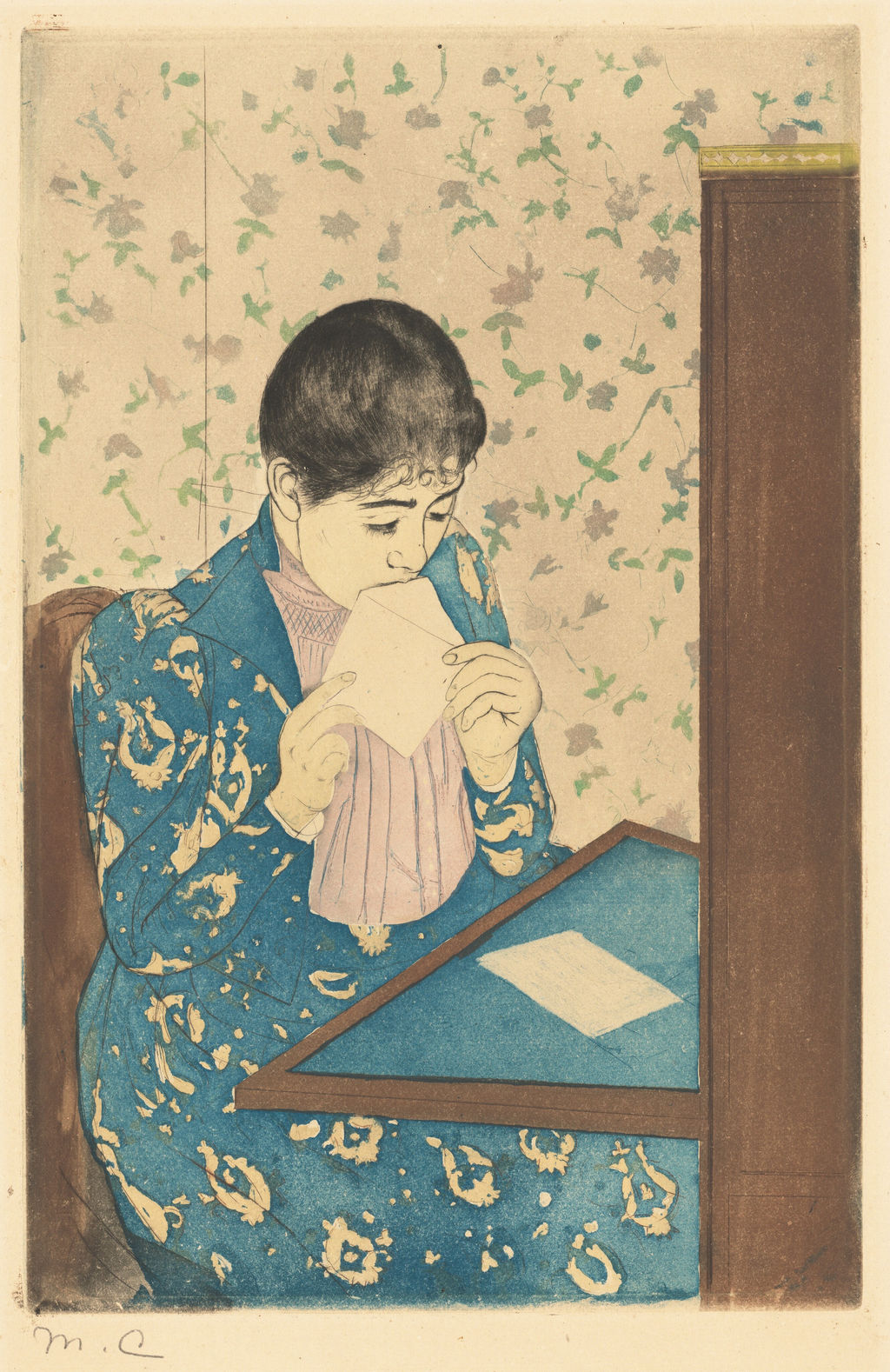
- The Letter: an early image already has structure
- The Lamp: colour does not mean final state
- Paper, margins and the whole sheet
- Collections contain individual impressions
Early experiments and an unrealised journal
During 1879–80, Cassatt worked with Degas and other artists towards the proposed print journal Le Jour et la nuit. It was never published, but the collaboration provided a setting for practical experimentation. The National Gallery’s 2014 Degas/Cassatt brochure discusses the combination of techniques in her In the Opera Box (No.3), including changes in the visibility of the face between states. [1]
The project’s unrealised publication should be distinguished from the existence of the work made for it. A print could be developed, tested and shown even if the intended journal did not appear. The history concerns both a collaborative ambition and individual objects that survived beyond its failure.
Theatre subjects connected the experiments with themes Cassatt explored in paintings and pastels, but the new material posed different problems. A dark passage could be reconsidered across proofs; a figure’s visibility could change as line and tone were reworked. The print was an active field of invention rather than a small duplicate of an already completed painting. [1]
This early history also gives the later colour prints a longer preparation. Cassatt did not encounter plate work for the first time in 1890. The colour project brought new challenges into a practice in which she had already investigated combinations of line, tone and revision.
Browse print reproductions and printmaking articles


The colour series of 1890–91
The major Paris exhibition of Japanese prints in 1890 was an important stimulus for the group commonly called the Set of Ten. Cassatt worked with printer Modeste Leroy to develop the colour impressions. The project brought patterned surfaces and distinctive viewpoints into images made through copper-plate processes, rather than through Japanese woodblock printing. [2]
The ten designs include bathing and grooming scenes, an envelope being sealed, a clothing fitting, tea, an omnibus journey and embraces. Familiar actions offered different relationships between hands, faces, garments and furnishings. The group belongs together historically, but its images do not repeat one arrangement of figures or one balance of pattern and open space.
In The Bath, a patterned dress surrounds a supported child and a hand extended towards a tub. The Coiffure places raised arms and a curved back before a mirror. Each directs attention through a different bodily action, even where both involve a private interior. Their titles should not be confused with separate bathing oil paintings. [3] [4]
The other designs extend that range: The Letter, The Fitting, In the Omnibus, The Lamp, Woman Bathing, Mother’s Kiss, Maternal Caress and Afternoon Tea Party. They bring solitary tasks, public travel and bodily closeness into the same colour-print project. [2]
Look across them for different uses of pattern. Ornament can fill a dress, continue across wallpaper or meet a comparatively unmarked body. It does not always occupy the background. Sometimes a pattern competes with a figure; sometimes its repetition makes the figure’s pale outline more insistent. The relationship changes with the particular action and setting.

The Bath — print design; the illustrated legacy impression is unidentified.

The Coiffure — print design; the illustrated legacy impression is unidentified.
Line, tone, plates and alignment
Cassatt combined intaglio techniques, in which recessed lines and areas of a plate hold the ink transferred to paper. Drypoint scratches the plate directly; etching uses a resistant ground and acid to form exposed lines; aquatint provides tonal areas. Softground can carry the character of a drawing into the worked surface. These processes can operate together within one image. [2]
The Metropolitan Museum’s discussion of the first-state Letter explains another material effect. A needle scratching copper raises a burr, contributing to the rich, rough quality of its drypoint lines. A line can therefore carry texture as well as describe an edge. This helps explain why a black impression is more than a colour image with its colour removed: the character of the worked mark can become a central part of the experience. The museum’s explanation concerns the print’s making, not a claim that every detail can be examined microscopically in an online photograph. [7]
Colour introduced another set of decisions. Different plates could carry different parts of the image, and their impressions had to align. This alignment is called registration. A patterned garment and a field of colour might look immediate in the finished sheet while depending on carefully coordinated printing. Leroy’s contribution belongs within that practical history. [2]
The individual records keep the process specific. The Metropolitan Museum describes its final-state Bath through a two-plate solution, after earlier one-plate experiments. Its final Coiffure uses three plates. A general statement that every Cassatt print required the same number of plates would erase those differences. [3] [4]
The visible effect also depends on how much a line is asked to do. A small contour can define a cheek or the edge of an arm without extensive modelling. A patterned passage can remain dense beside a pale area where the paper plays a larger part. Simplicity at one point does not mean that the image as a whole was technically simple to make.
Design, state, impression and edition
A design is the image we recognise under a title. A state records a change to its worked printing surface. An impression is an individual sheet printed from that surface. An edition concerns a planned group of impressions. These terms describe different aspects of a print and should not be used as substitutes for one another.
Consider what happens when a museum owns an early state. Its sheet may preserve a stage before later colour or surrounding detail developed. Another museum’s final-state sheet belongs to the same design, but it is not the same object. Its measurements, paper, marginal writing and provenance belong to that impression.
Colour is not, by itself, a certificate of finality. A coloured impression can preserve an intermediate state. Conversely, a catalogue’s state count depends on the system in which it is described. Roman numerals such as III/IV mean a third state within a four-state account; they should be read with the catalogue named by the record.
These distinctions become useful when comparing photographs. Differences between reproduced sheets may involve a changed plate, colour choices, paper, printing or photography. A warmer face in one image does not establish a reworked plate on its own. Identifying the physical impressions comes before explaining every visible difference as a change in the design.
In the Omnibus: a drawing and its reverse
The National Gallery’s preparatory material for In the Omnibus offers an unusually clear encounter with process. The front of a sheet, accession 1948.11.51.a, carries a black-chalk-and-graphite drawing. Its reverse, 1948.11.51.b, preserves the transferred softground image. They are two sides of one physical object, not two independent drawings. [8] [9]
The drawing includes peripheral figures beyond the central group. The transferred selection simplifies the arrangement towards two women and a child. This is a significant pictorial decision: reducing the number of passengers changes the relationship between the central bodies and the rectangular window structure behind them.
The transferred image also changes orientation relative to the front drawing. Thinking about front and reverse helps make the move between drawing and print tangible. A line can begin as part of a freely handled sheet and become a guide within a process that produces another object. The visual relationship does not make the drawing and the final impression interchangeable.
The vehicle’s windows create a second kind of organisation. They divide the upper area into a grid, while the figures and broad garments fill the foreground. Their relationship carries the scene between bodily closeness and an exterior view. A transport subject becomes a problem of enclosure, selection and different scales of space.
Four proofs and a final colour impression
A drypoint proof with graphite, 1946.21.93, is catalogued as the second state of seven in the Mathews–Shapiro system. A separate colour proof, 1943.3.2753, preserves an early colour solution. Its position in an illustrated sequence cannot, by itself, establish an ordinal state number. [10] [11]
The early colour proof leaves much of the exterior undeveloped. A grey proof, 1943.3.2752, catalogued as the fourth state, establishes the river view more fully. A later colour proof, 1943.3.2764, is the sixth state; the final NGA impression 1963.10.250 is the seventh. Each accession identifies a different sheet with its own material history. [12] [13] [14]
The comparisons reveal more than the gradual addition of detail. The exterior changes how the windows function: an open area of paper becomes a view beyond the seated group. Colour changes the relative emphasis of clothes and faces. The figures can remain in broadly similar positions while the picture’s balance shifts through tone and surrounding space.
The late colour proof and final impression also offer different facial colouring in the reproduced examples. This can be observed without turning it into a universal statement about every surviving impression. The relationship between coloured passages and the paper’s own tone is one of the decisions made visible by comparing particular sheets.
Together, the double-sided drawing, four proofs and final print are six objects represented through seven views. That count helps keep the evidence clear. The drawing’s front and back belong to one sheet; the printed proofs are separate objects. Their survival allows us to follow selected alternatives without pretending that every stage or every impression is present.
The Letter: an early image already has structure
The Metropolitan Museum’s 16.3.2 is a first-state black drypoint of The Letter. The National Gallery’s 1943.3.2763 is a final colour impression, fourth of four in the Mathews–Shapiro catalogue. They share the action of a woman lowering her face towards an envelope, but their materials and surrounding effects differ. [7] [15]
The early impression is not an empty outline waiting for every decorative decision. Pattern in the garment and lines defining the desk and upright furniture are already present. The final colour image adds strongly differentiated fields and floral wallpaper, changing how the figure occupies the interior. A before-and-after comparison is more useful when it identifies both continuity and change.
The envelope remains a small pale focus within that setting. Fingers, face and desktop direct attention towards an activity whose contents we cannot read. Patterned clothing and wallpaper can spread through the image without displacing the hand’s task. Colour alters the relationships around the action rather than supplying a wholly different subject.
The Met describes its sheet as the only known impression of the first state. That claim belongs to that catalogued early object. It does not mean the final design exists in only one example or that a different museum’s colour sheet carries the same rarity. Keeping state and impression separate protects the particular meaning of such a collection statement. [7]
Watch: Mary Cassatt
Choose a film to explore the artist’s work, its interpretation and its wider setting.
Demonstrating Mary Cassatt's Color Printmaking Techniques
The Philadelphia Museum of Art demonstrates techniques used to make Cassatt’s colour prints.
Watch on YouTubeThe Lamp: colour does not mean final state
Two National Gallery impressions of The Lamp demonstrate the point especially clearly. Rosenwald 1943.3.2762 is already coloured, but the Mathews–Shapiro record identifies it as the third state of four. The Dale impression 1963.10.249 is the fourth and final state. The shared title therefore does not supply an identical caption for both sheets. [16] [17]
The broad lampshade, seated figure, open fan and mirror organise both images. The shade’s curved edge occupies a large part of the upper composition, while the figure’s turned head introduces a separate directional emphasis. The mirror repeats objects rather than simply returning the woman’s face. A familiar interior becomes a sequence of overlapping shapes and repeated views.
In the reproduced impressions, the garment and fan differ in colour. Those differences can be compared without asserting that every colour change required a new engraved or etched contour. The physical state information comes from the accessioned records; the visual comparison concerns these particular printed examples.
Inscriptions also differ. The final Dale sheet carries artist-and-Leroy wording that does not belong automatically to the intermediate Rosenwald impression. Margins form part of the object’s evidence. Cropping them out can make two related sheets look more interchangeable than their full records allow. [16] [17]
The Rosenwald record also cites Breeskin’s third state of three. This is a different cataloguing system from Mathews–Shapiro’s third of four. The final numeral in one system cannot simply replace the identification supplied by another. A clear caption names the system rather than making the numbers appear to contradict the object. [16]
Paper, margins and the whole sheet
Paper is more than a neutral backing for the image. Its visible tone can participate in a face or garment, while its texture and margins belong to the physical impression. The Omnibus records, for example, distinguish wove-paper proofs from laid-paper colour sheets. Those descriptions should remain attached to the named objects rather than being generalised across every example of the design. [10] [12] [13] [14]
Different measurements answer different questions too. A plate measurement describes something other than the full sheet, and a museum’s label of “image” should not silently become a plate dimension. The paper can extend substantially beyond the worked area. Looking only at the central figures may conceal how much of the object lies around them.
Mother’s Kiss makes that surrounding space especially important. The National Gallery’s 1963.10.254 preserves a large open field above a compact grouping of faces, supporting hands and bent legs. Floral pattern fills the adult’s dress below, while a green chair edge anchors the left. The image has a different balance when the open upper area is allowed to remain visible. [18]
The open field is not evidence, by itself, that the design is unfinished or damaged. It contrasts with the density of the low grouping and the repeated small motifs in the dress. Cropping closely around the embrace can make the image look fuller and more conventional, but it removes a relationship that belongs to the composition.
The complete sheet also shows plate boundaries and marginal writing. These features help distinguish the pictured image from the object carrying it. A detail can teach us about a hand or face, but the full view establishes where that detail sits within the design and the paper. Both scales of looking are useful when their roles remain clear.
An impression’s medium can include work beyond the printed passages. The Metropolitan Museum records brush-applied gold on its Afternoon Tea Party, 16.2.1. This is a fact about a particular sheet, not a reason to describe every impression of the design or every Cassatt colour print as identically finished. The material description preserves a distinction that a general title alone cannot convey. [19]
Collections contain individual impressions
Museum ownership should be understood at the level of the sheet. Two institutions can hold The Letter without holding duplicate objects in every respect. The designs may match while the papers, states, colours, inscriptions and acquisition histories differ. This is one reason a general title search can produce images that look similar but carry different information.
The Van Gogh Museum’s 2021 annual report records acquisitions of four Cassatt sheets: The Letter, Woman Bathing, The Fitting and The Loge. Each has a distinct collection number. The report documents acquisitions of those physical works, not ownership of every impression of those designs or a transfer of the National Gallery’s sheets. [20]
Collecting also preserves the history of revision. An early proof may be especially informative because it differs from a later image, not because it approximates that image more closely. Keeping several states allows a museum to show an artist choosing between alternatives. An apparently incomplete surrounding field can be valuable evidence within that comparison.
The same care applies to exhibition histories. A named impression may have travelled to a particular venue while another example remained elsewhere. A general exhibition title does not prove that every sheet of a design appeared at every stop. The object’s individual record supplies the relevant history.
Printmaking after the 1891 series
The Set of Ten was a concentrated achievement, but later printmaking continued. Museum records for The Manicure, dated around 1908, establish work beyond the often repeated 1901 stopping point. The Spencer Museum of Art’s 1991.0266 and Cincinnati Art Museum’s 1940.155 are separately accessioned impressions, with distinct descriptions of technique and state. [5] [6]
Those records support a bounded chronological conclusion: Cassatt’s printmaking extended into the early twentieth century. They do not identify the exact date of her last design or establish when every surviving impression was printed. A design date and the printing date of a particular sheet can be different kinds of information.
Later dealings in existing plates and prints also belong to the history of circulation. Stein’s chronology records activity involving old plates after regular artmaking had ceased. A later pull is consequently not automatic evidence that Cassatt was inventing a new composition at that moment. Production, printing and collecting have related but distinct chronologies. [21]
The distinction keeps the prints connected with the rest of the career without making them dependent on a simplified final date. Their significance lies in the continuing experiments visible across objects, as well as in the moments when particular designs were first made.
How to look at a Cassatt print
Begin with the whole sheet. Notice whether the image fills its field or leaves a large open area, where the plate boundary falls, and whether marginal writing is visible. Then follow a contour through the image. A small line can give a face its orientation or define the edge of a hand without extensive tonal modelling.
Next, compare line with colour. Does a patterned passage describe clothing, furniture or wallpaper? Does an unprinted-looking area participate in skin or fabric? A pale body can be held between denser patterns, while a broad colour field can make a small gesture more apparent. These are pictorial relationships as well as material effects.
If another impression is available, compare one feature at a time. Identify the sheets before deciding what a difference means. A changed contour is not the same observation as a different colour balance, and a different photograph does not supply a complete explanation of printing. The most informative comparison begins with a precise, visible question.
Cassatt’s prints reward this patient approach because their apparent economy contains so much decision-making. The same artist who organised bodies and furniture in her paintings could investigate their relations through transfer, plates, proofs and paper. The result is a body of original images whose processes remain part of their visual interest.
Further reading from museums
These publications offer different routes into the works and their histories.
Mary Cassatt 1844–1926. Adelyn D. Breeskin; National Gallery of Art, 1970 exhibition catalogue.
A historical catalogue for comparing titles and reproductions; later object records can supply revised dates and attributions. Open the museum publication.
Degas/Cassatt. National Gallery of Art, 2014 exhibition brochure.
A concise introduction to artistic exchange across painting and printmaking. Read the free brochure.
Cassatt artworks and studies
A source-bounded directory of documented works and studies, including the works in the National Gallery’s 2026 checklist and one clearly marked former attribution. Different print impressions are grouped by design and remain searchable by their recorded accessions. This is not a complete catalogue raisonné. Unlinked titles have no individual article here.
| Name | Date | Medium |
|---|---|---|
| A Child’s Bath — LACMA oil | 1880 | Oil on canvas |
| A Goodnight Hug | 1880 | Pastel |
| After the Bullfight | 1873 | Oil on canvas |
| Afternoon Tea Party | 1890–91 | Colour print |
| At the Theatre (Lydia Cassatt Leaning on Her Arms, Seated in a Loge) | About 1879 | Pastel |
| Automne, portrait de Lydia Cassatt | 1880 | Oil on canvas |
| Breakfast in Bed | 1897 | Oil on canvas |
| Bust of Ellen with Bows in Her Hair | 1898 | Pastel |
| By the Pond | About 1896 in Met and Terra records; about 1898 at MoMA | Not established |
| Child Drinking Milk from a Bowl; provisionally identified composition (qualified identification) | About 1890, following inventory and catalogue text | Pastel |
| Child in a Straw Hat | About 1886 | Oil on canvas |
| Child Picking a Fruit | 1893 | Oil on canvas |
| Children Playing on the Beach | 1884 | Oil on canvas |
| Clarissa, Turned Left, with Her Hand to Her Ear | About 1890–93 in Sotheby’s 2012 entry; about 1893 in GCMA notice | Pastel |
| Denise at her Dressing Table | About 1908–09 | Oil on canvas |
| Driving | 1881 | Oil on canvas |
| Eddy Cassatt (Edward Buchanan Cassatt) | 1875 | Oil on canvas |
| Ellen Mary Cassatt in a White Coat | About 1896 | Oil on canvas |
| Emmie and her Child | About 1890 | Oil on canvas |
| Gathering Fruit | About 1893 | Not established |
| Girl Arranging her Hair | 1886 | Oil on canvas |
| Head of a Child with a Red Hat | 1903, signed and dated | Pastel |
| Head of a Woman in a Large Hat | About 1909 | Pastel |
| Head of Simone in a Green Bonnet with Wavy Brim | About 1904 | Pastel |
| In the Garden | 1903 or 1904 | Oil on canvas |
| In the Loge | 1878 | Oil on canvas |
| In the Omnibus | 1890–91 | Colour print |
| In the Omnibus [recto] — preparatory drawing | c. 1891 | Chalk and graphite |
| In the Opera Box (No. 3) [recto] — preparatory drawing | 1880 | Graphite |
| In the Opera Box (No. 3) — print | c. 1880 | Intaglio print |
| Jeune fille au jardin (Young Woman Sewing in a Garden) | 1880–82 | Oil on canvas |
| Jules Dried by His Mother; provisionally identified composition (qualified identification) | 1901, following catalogue text | Oil on canvas |
| Lady in Black, in a Loge, Facing Right | c. 1880 | Etching |
| Lilacs in a Window | About 1880–83 | Oil on canvas |
| Little Girl in a Blue Armchair | 1878 | Oil on canvas |
| Louise Nursing her Child | 1899 in Luxembourg caption; 1898–99 in loan and Arp records | Pastel |
| Madame Gaillard and Her Daughter Marie-Thérèse | 1897, Reynolda collection listing | Pastel |
| Maternal Caress | 1890–91 | Not established |
| Maternal Caress — preparatory drawing | About 1891 | Charcoal and graphite |
| Mathilde Holding a Baby Who Reaches out to the Right | About 1889, Christie’s catalogue | Pastel |
| Mimi as a Brunette | c. 1889 | Drypoint |
| Mimi Holding a Japanese Fan | c. 1889 | Drypoint |
| Modern Woman | 1892–93; displayed in 1893 | Not established |
| Mother about to Wash her Sleepy Child | 1880 | Oil on canvas |
| Mother and Child (Maternal Kiss) | 1896 | Pastel |
| Mother and Child (Nude Dark-Eyed Little Girl with Mother in Patterned Wrapper) | About 1898–99, Sotheby’s catalogue | Pastel |
| Mother and Child (The Oval Mirror) | About 1899 | Oil on canvas |
| Mother Berthe Holding Her Nude Baby | 1898–99 | Pastel |
| Mother in Purple Holding her Child | About 1914, Christie’s catalogue | Pastel |
| Mother Playing with Child | About 1897 | Pastel |
| Mother’s Kiss | 1890–91 | Colour print |
| Nurse Reading to a Little Girl | 1895 | Pastel |
| Poppies in a Field (formerly Cassatt; attributed to Victor Gabriel Gilbert) | About 1880, current museum record | Oil on panel |
| Portrait of an Elderly Lady | c. 1887 | Oil on canvas |
| Portrait of Madame AF Aude and her Two Daughters | 1899, Breeskin 1970 exhibition catalogue | Pastel |
| Portrait of the Artist | 1878 | Watercolour and gouache |
| Reading Le Figaro | 1878, NGA 2026 checklist; about 1877–78 in SAAM’s 2015 caption | Oil on canvas |
| Reflection — drypoint | c. 1890 | Drypoint |
| Sara Holding a Cat | About 1907–08 | Oil on canvas |
| Sara in a Green Bonnet | About 1901 | Oil on canvas |
| Sara with Her Dog, in an Armchair, Wearing a Bonnet with a Plum Ornament | 1901 | Pastel |
| Self Portrait | About 1880 | Watercolour and gouache |
| Simone in Blue Plumed Hat | About 1903 | Pastel |
| Simone Seated on the Grass next to her Mother | 1901–02 | Pastel |
| Sketch of Master St. Pierre | Date not established | Pastel |
| Sleepy Baby | About 1910 | Pastel |
| Smiling Mother with Sober Faced Child | Date not established | Pastel |
| Spanish Dancer Wearing a Lace Mantilla | 1873 | Oil on canvas |
| Summertime, horizontal painting | 1894–95, current Sotheby’s catalogue | Oil on canvas |
| Tea — print | c. 1890 | Drypoint |
| The Bath | 1890–91 | Not established |
| The Boating Party | 1893–94 | Oil on canvas |
| The Caress | 1902 | Oil on canvas |
| The Child's Bath | 1893 | Oil on canvas |
| The Coiffure | 1890–91 | Colour print |
| The Cup of Tea | About 1880–81 | Oil on canvas |
| The Fitting | 1890–91 | Colour print |
| The Lamp | 1890–91 | Colour print |
| The Letter | 1890–91 | Colour print |
| The Loge | About 1878–1880 | Oil on canvas |
| The Mandolin Player | 1868 | Oil on canvas |
| The Manicure (Les Ongles; The Nails) | About 1908 | Intaglio print |
| The Tea; Le Thé | About 1880 | Oil on canvas |
| The Visitor | c. 1880 | Intaglio print |
| Two Sisters | 1896 | Pastel |
| Two Women Seated by a Woodland Stream | About 1869 | Oil on canvas |
| Two Women Throwing Flowers During Carnival | 1872 | Oil on canvas |
| Under the Horse-Chestnut Tree | 1896–97, National Gallery and MoMA records | Not established |
| Woman Bathing (La Toilette) | 1890–91 | Colour print |
| Woman in a Loge (Woman with a Pearl Necklace) | 1879 | Oil on canvas |
| Woman Reading | 1878–79 | Oil on canvas |
| Woman Standing, Holding a Fan | 1878–79 | Distemper |
| Woman with a Fan | c. 1878–1879 | Oil on canvas |
| Woman with a Red Zinnia | 1891 | Oil on canvas |
| Woman with a Sunflower | About 1905 | Oil on canvas |
| Young Girl at a Window | c. 1883–1884 | Oil on canvas |
| Young Girl with Brown Hair, Looking Left | About 1913 (1997 summary catalogue) | Pastel |
| Young Mother Sewing | 1900 | Oil on canvas |
| Young Woman in Green, Outdoors in the Sun | About 1914 | Oil on canvas |
Questions about Cassatt’s prints
Discussion
Look again at the images and ideas explored in Mary Cassatt Prints. These editorial prompts invite your observations.
Reader Insights
Mary Cassatt’s prints reveal an artist testing how an image can change. What does this first detail make you notice?
During 1879–80, Cassatt worked with Degas and other artists towards the proposed print journal Le Jour et la nuit . Which connection would you explore further?
Which comparison best shows artistic decision-making: a drawing and transfer, an early and final Letter, or two coloured Lamp impressions?
Join the Conversation
Share a detail, comparison or question about Mary Cassatt Prints below.
References
- Kimberly A. Jones / National Gallery of Art, Degas/Cassatt exhibition brochure, 2014. View source.
- National Gallery of Art, Mary Cassatt the Daring Printmaker, 23 January 2026. View source.
- Metropolitan Museum of Art, The Bath, 16.2.7, final-state impression. View source.
- Metropolitan Museum of Art, The Coiffure, 16.2.3, final-state impression. View source.
- Spencer Museum of Art, University of Kansas, The Manicure, c.1908, 1991.0266. View source.
- Cincinnati Art Museum, Les Ongles (The Nails; The Manicure), c.1908, 1940.155. View source.
- Metropolitan Museum of Art, The Letter, 16.3.2, first state. View source.
- National Gallery of Art, In the Omnibus (recto), 1948.11.51.a. View source.
- National Gallery of Art, In the Omnibus (verso), 1948.11.51.b. View source.
- National Gallery of Art, In the Omnibus, 1946.21.93, Mathews–Shapiro II/VII. View source.
- National Gallery of Art, In the Omnibus, 1943.3.2753, colour proof. View source.
- National Gallery of Art, In the Omnibus, 1943.3.2752, Mathews–Shapiro IV/VII. View source.
- National Gallery of Art, In the Omnibus, 1943.3.2764, Mathews–Shapiro VI/VII. View source.
- National Gallery of Art, In the Omnibus, 1963.10.250, Mathews–Shapiro VII/VII. View source.
- National Gallery of Art, The Letter, 1943.3.2763, final state. View source.
- National Gallery of Art, The Lamp, 1943.3.2762, Mathews–Shapiro III/IV. View source.
- National Gallery of Art, The Lamp, 1963.10.249, Mathews–Shapiro IV/IV. View source.
- National Gallery of Art, Mother’s Kiss, 1963.10.254, full-sheet record. View source.
- Metropolitan Museum of Art, Afternoon Tea Party, 1890–91, 16.2.1, medium and final-state record. View source.
- Van Gogh Museum, Annual Report 2021, acquisitions pp.72–73. View source.
- Susan Alyson Stein, assisted by Rebecca A. Rabinow, Chronology, in Splendid Legacy: The Havemeyer Collection, 1993, pp.201–287. View source.
- Art Gallery of Ontario, Cassatt–McNicoll:ImpressionistsBetweenWorlds. View source.
- National Gallery of Art, Children Playing on the Beach, 1970.17.19. View source.
- Colby College Museum of Art, Explore Inside Out: The Prints of Mary Cassatt; Mother Berthe Holding Her Nude Baby,2013.549. View source.
- National Gallery of Art, Little Girl in a Blue Armchair, 1983.1.18. View source.
- Sotheby’s, syndicated auction catalogue hosted by Invaluable, Simone in Blue Plumed Hat, Watson collection, 18 May 2005, lot 20. View source.
- National Gallery of Art, The Boating Party, 1963.10.94. View source.
- The Huntington, Breakfast in Bed, 83.8.6. View source.
- Adelyn Dohme Breeskin / Smithsonian Institution Press; University of California scan indexed by Google Books, Mary Cassatt:A Catalogue Raisonné of the Oils,Pastels,Watercolors,and Drawings,1970,322pp; selected public search snippets pp91–92,143–144,316,318. View source.
- Metropolitan Museum of Art, The Private Collection of Edgar Degas: A Summary Catalogue, Cassatt entries, printed p.7, no.48. View source.
- Art Institute of Chicago, After the Bullfight, 1969.332. View source.
- Smithsonian American Art Museum, Art Inventories, After the Bullfight, siris_ari_180619. View source.
- Smithsonian American Art Museum, The Caress, 1911.2.1. View source.
- Museum of Modern Art, Under the Horse-Chestnut Tree,671.1940. View source.
- National Gallery of Art, Under the Horse-Chestnut Tree,1959.12.4. View source.
- Art Institute of Chicago, The Child’s Bath,1910.2,current expanded collection entry. View source.
- Virginia Museum of Fine Arts, Board of Trustees minutes,17September2020,loan recommendation7:ChildPickingaFruit75.18. View source.
- Sotheby’s, Clarissa Turned Left with Her Hand to Her Ear, 2012 lot 51. View source.
- Greenville County Museum of Art, Recent Acquisitions Funded by Sale of Alma Thomas Painting, 2021. View source.
- Metropolitan Museum of Art, The Cup of Tea, 22.16.17. View source.
- Sotheby’s, Mother and Child (Nude Dark-Eyed Little Girl with Mother in Patterned Wrapper), 19 May 2010, lot 31. View source.
- Metropolitan Museum of Art, Denise at Her Dressing Table, 2005.129. View source.
- Denver Art Museum, Whistler to Cassatt:American Painters in France, bilingual exhibition livret,The Salon,no2. View source.
- Philadelphia Museum of Art, Driving, 1881. View source.
- Denver Art Museum, Whistler to Cassatt exhibition guide, stop 112: Bust of Ellen with Bows in Her Hair. View source.
- Museum of Fine Arts, Boston, Ellen Mary in a White Coat, 1982.630. View source.
- MaudHoweElliott(ed.) / UniversityofIllinoisUrbanaChampaign scan, Art and Handicraft in the Woman’s Building of the World’s Columbian Exposition,Chicago,1893,Chicago:RandMcNally,1894. View source.
- Amon Carter Museum of American Art, Woman Standing Holding a Fan, 2011.20. View source.
- Smithsonian American Art Museum, Special Installation of Nineteen American Masterworks, 2015. View source.
- Metropolitan Museum of Art, The Fitting, 16.2.8 final state. View source.
- Reynolda House Museum of American Art, Mary Cassatt collection listing: Madame Gaillard and Her Daughter Marie-Thérèse, 1897. View source.
- Wake Forest University, Wake Women 2023 schedule, Highlighting the Art of Women at Reynolda, captioned Cassatt image. View source.
- Detroit Institute of Arts, In the Garden, 36629. View source.
- National Gallery of Art, Gathering Fruit,1943.3.2757. View source.
- Sotheby’s, A Goodnight Hug,N09860lot11,14May2018. View source.
- Sotheby’s, Young Woman in Green Outdoors in the Sun, Modern Day. View source.
- Sotheby’s, syndicated auction catalogue hosted by Invaluable, Head of Simone in a Green Bonnet with Wavy Brim, Watson collection,18May2005,lot39. View source.
- National Gallery of Art, Girl Arranging Her Hair, 1963.10.97. View source.
- Joslyn Art Museum, Art Break:Woman Reading,1943.38,program object caption. View source.
- Los Angeles County Museum of Art, A Child’s Bath, M.62.8.14. View source.
- Sotheby’s, Tête de Femme au Grand Chapeau, 2008 N08449 lot135. View source.
- Metropolitan Museum of Art, Lilacs in a Window, 1997.207. View source.
- National Gallery of Art, The Loge,1963.10.96. View source.
- Arp Museum Bahnhof Rolandseck, Maestras: Malerinnen1500–1900,25February–16June2024,official five-page flyer. View source.
- Spanish official gazette / exhibition insurance schedule, BOE-A-2023-19808,21September2023,Maestras loan schedule. View source.
- Nationalmusée um Fëschmaart / ArpMuseum CollectionRauforUNICEF, Louise,NursingHerChild,1899,GR1.949;FromRenoirtoMonet2026–27. View source.
- Petit Palais / Paris Musées, Automne, portrait de Lydia Cassatt, PPP706; IIIF manifest 160008392. View source. (in French).
- Denver Art Museum, Whistler to Cassatt Access Guide, The Salon, stop 104. View source.
- Metropolitan Museum of Art, Maternal Caress, 16.2.5. View source.
- Philadelphia Museum of Art, Mother and Child Maternal Kiss, object 54049. View source.
- Metropolitan Museum of Art, Maternal Caress, preparatory drawing64.123.3, c1891. View source.
- Christie’s, Mathilde Holding Baby who Reaches out to Right, lot 5459369. View source.
- National Portrait Gallery / Catalog of American Portraits, Madame Meerson and her Daughter, SSSA2282. View source.
- Museum of Fine Arts Boston, In the Loge, 10.35. View source.
- Smithsonian art inventories, Child Drinking Milk from a Bowl, siris_ari_197517. View source.
- MutualArt public auction index; original auctioneer undisclosed without subscription, Child Drinking Milk from a Bowl, public listing dated 2 June 2024. View source.
- Museum of Modern Art, Mary Cassatt artist essay and print records. View source.
- National Gallery of Art, Mary Cassatt An American in Paris checklist, updated 24 February 2026. View source.
- Adelyn D. Breeskin / National Gallery of Art, Mary Cassatt 1844–1926, 1970 exhibition catalogue. View source.
- Metropolitan Museum of Art, Nurse Reading to a Little Girl, 62.72. View source.
- Metropolitan Museum of Art, Mother and Child (The Oval Mirror), 29.100.47. View source.
- Art Institute of Chicago, Ryerson and Burnham Archives, Bertha Honoré Palmer Correspondence Collection finding aid, selected Mary Cassatt entries, Box1Folder3. View source.
- Philadelphia Museum of Art, Woman in a Loge, 1978-1-5, object72182. View source.
- Metropolitan Museum of Art, Mother Playing with Child, 22.16.23. View source.
- Metropolitan Museum of Art, By the Pond,60.732bis. View source.
- Museum of Modern Art, By the Pond,673.1940. View source.
- Terra Foundation for American Art, By the Pond,1999.25. View source.
- Philadelphia Museum of Art, Poppies in a Field, attributed to Victor Gabriel Gilbert; formerly attributed to Mary Stevenson Cassatt, 1978-1-6. View source.
- Christie’s, Mother in Purple Holding Her Child, lot 5369421. View source.
- Sotheby’s, Tête d’enfant au chapeau rouge, American Art N09229, 20 November 2014, lot 39. View source.
- Christie’s, Sara Holding a Cat, lot 5561267. View source.
- Smithsonian American Art Museum, Art Inventories Catalog, Sara with Her Dog, in an Armchair, Wearing a Bonnet with a Plum Ornament; IAP 80170363 / siris_ari_180925. View source.
- Smithsonian American Art Museum, Sara in a Green Bonnet, 1929.6.11. View source.
- Mary Cassatt Catalogue Raisonné project, with Adelson Galleries, presented on Artnet, Sara with Her Dog, in an Armchair, Wearing a Bonnet with a Plum Ornament, work 424155733. View source.
- Metropolitan Museum of Art, Portrait of the Artist, 1975.319.1. View source.
- National Portrait Gallery, Mary Cassatt Self-Portrait, NPG.76.33. View source.
- Musée d’Orsay, Jeune fille au jardin,RF193720. View source. (in French).
- Sotheby’s, Simone Seated on the Grass Next to Her Mother, 30 September 2020, lot 33. View source.
- Dallas Museum of Art, Sleepy Baby,1952.38.M. View source.
- Sotheby’s, Smiling Mother with Sober Faced Child, 2022. View source.
- Smithsonian American Art Museum, Spanish Dancer Wearing a Lace Mantilla, 1967.40. View source.
- Christie’s, Sketch of Master St Pierre, 2017 online lot. View source.
- National Gallery of Art, Child in a Straw Hat, 1983.1.17. View source.
- Sotheby’s, Summertime, Armand Hammer: The Private Collection, Modern Evening Auction 2026. View source.
- National Gallery of Art, Woman with a Sunflower, 1963.10.98. View source.
- National Gallery of Art, Afternoon Tea Party, 46731. View source.
- Museum of Fine Arts, Boston / Erica E. Hirshler, The Tea, 42.178. View source.
- The Nelson-Atkins Museum of Art, At the Theater,F77-33;French Paintings and Pastels appendixII. View source.
- Metropolitan Museum of Art, Woman Bathing La Toilette, 16.2.2. View source.
- Sotheby’s, Two Sisters, 2005 American Paintings sale N08134, lot 44. View source.
- Wichita Art Museum, Mother and Child, M109.53. View source.
- Smithsonian American Art Museum, Art Inventories, Two Women Seated by a Woodland Stream / Duex femmes assises aupres de l’eau, IAP 80170008. View source.
- Tacoma Art Museum / David Setford, Impressionist Painting: From Pleasure Gardens to the Palais Garnier, 22 October 2019. View source.
- Tacoma Art Museum, French Impressionism and the Northwest, Works of Art Adoption Program, 2019–2020, no. 10 / PDF p. 12. View source.
- Metropolitan Museum of Art, Young Mother Sewing, 29.100.48. View source.