by Tom Gurney
Tom Gurney BSc (Hons) is an art history expert with over 20 years experience
Published on June 19, 2020 / Updated on November 2, 2026
Email: tomgurney1@gmail.com / Phone: +44 7429 011000
Summertime by Mary Cassatt: The Horizontal Boating Painting: Introduction
A long green boat enters from the right, carrying two pale-clothed figures among ducks. One bends over its curved end; the other sits more upright beneath a light hat. Around them, blue-green water breaks into short reflections, while a distant bank closes the top of the picture. The people form a compact group within a much larger field of moving colour.
This is Cassatt’s horizontal Summertime, catalogued by Sotheby’s in 2026 as an oil on canvas executed in 1894–95 and signed at the lower right. It is distinct from the upright painting of the same name in the Terra Foundation collection. The difference is visible in the format, scale of the figures within the image and extent of the surrounding pond. [1]
The horizontal canvas does not make the boat the whole scene. Ducks occupy the foreground and middle distance, ripples continue around the hull, and the shore remains visible beyond. Its particular character comes from the balance between a closely observed human group and a surface that continually draws attention away from them.
At a Glance
- ArtistMary Cassatt [1]
- TitleSummertime, horizontal painting [1]
- Date1894–95, current Sotheby’s catalogue [1]
- MediumOil on canvas [1]
- Historical catalogueBreeskin 240; National Gallery exhibition 1970, no. 55 [2]
- Dated collection contextArmand Hammer: The Private Collection, Sotheby’s preliminary 2026 listing [1]
This work across Mary Cassatt’s career
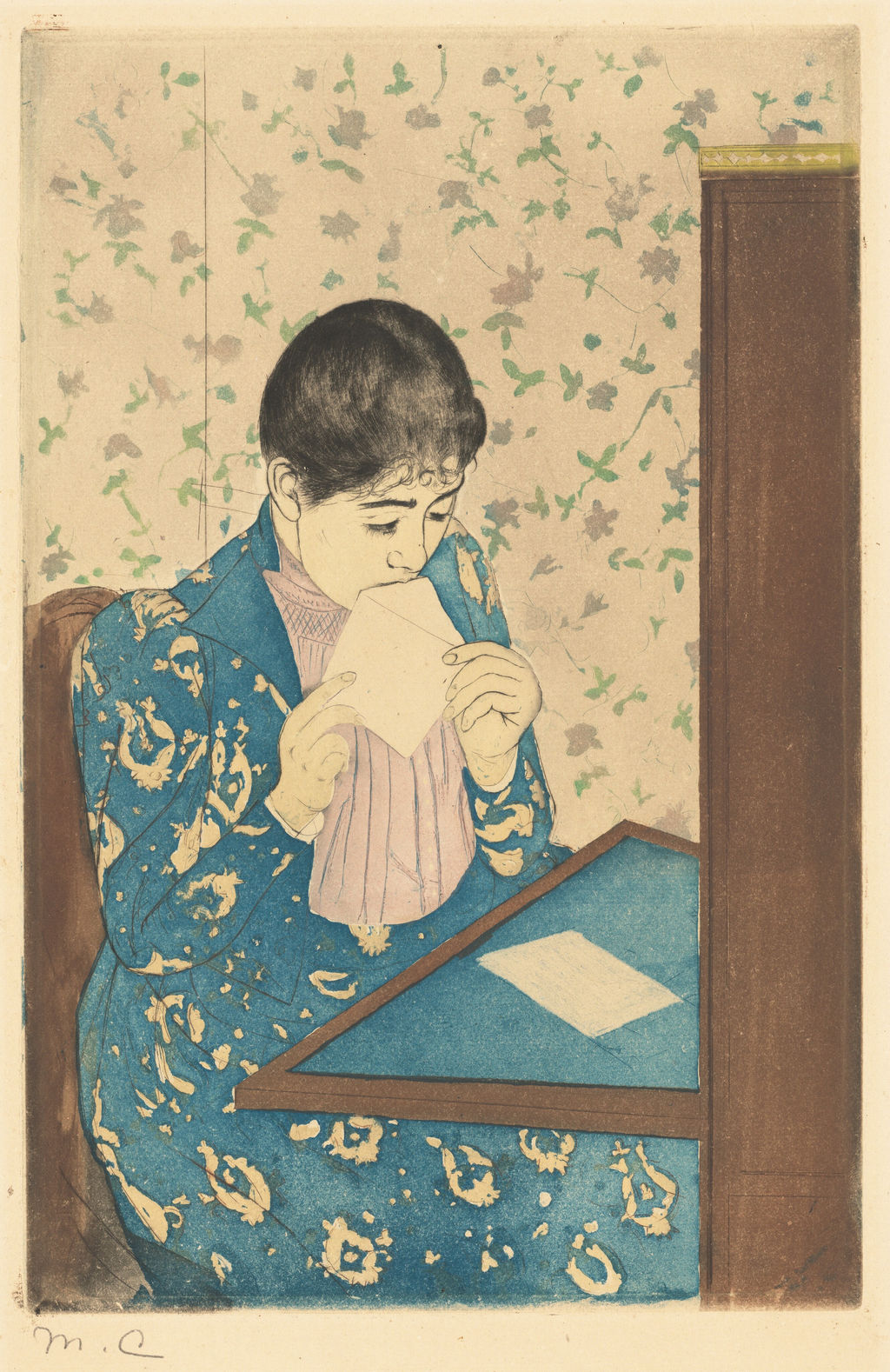
The Letter
1890–91 [7]Modern Woman
1892–93; displayed in 1893 [8] [9] [10]The Boating Party
1893–94 [11]The Child's Bath
1893 [12]Summertime (current article)
1894–95, current Sotheby’s catalogue [1]Woman with a Sunflower
About 1905 [14]Young Woman in Green Outdoors in the Sun
About 1914 [15]Contents
- A boat crossing the right edge
- One figure bending, one more upright
- Pale clothing above dark water
- Ducks at several distances
- The diagonal oar
- Water made from broken marks
- The bank across the top
- An upright Summertime at Terra
- Cropping and the Japanese comparison
- The Boating Party
A boat crossing the right edge
The boat’s green side forms a long curved boundary beneath the figures. A pale strip follows the outer edge, making it distinct from the darker water below. The contrast is especially strong where the hull curves around the figure leaning towards the left.
At the right, the boat continues beyond the canvas. This cut-off prevents it from appearing as a complete object set neatly within a surrounding border. The scene seems to extend sideways, even though the visible figures remain gathered within the portion we can see.
The vessel’s low horizontal shape differs from the more scattered directions of the water marks. Its side provides a stable route across the middle-lower area. Following that curve gives the eye a temporary rest from the changing colour and broken strokes around it.
Inside the boat, green surfaces and darker divisions help locate the figures. The arrangement is readable without a detailed account of every plank or fitting. The hull’s main curve and pale edge give sufficient structure for bodies and fabric to occupy it convincingly.
One figure bending, one more upright
The figure at the left leans over the boat’s curved end. A reddish-brown hat inclines with the head, and a pale flower-like accent interrupts its darker colour. Bent arms and hands gather near the rim, directing attention downward towards the adjacent water.
The other figure sits farther right and more upright, wearing a broad pale hat. A bare arm descends towards the side of the boat, while pale lilac-blue fabric spreads across the seated body. The pose gives that side a more vertical accent within the long vessel.
Their heads occupy different heights and turn at different angles. The leaning figure brings attention close to the rim; the upright sitter makes a taller silhouette above it. The contrast keeps the pair from repeating one pose, despite their shared pale clothing.
The bodies also overlap through fabric. Pink and lilac passages gather across the centre of the boat, connecting the figures while leaving their upper outlines distinct. The grouping is intimate in scale within the vessel, yet relatively small beside the total area of water.
Neither the poses nor the apparent difference between the figures establishes a documented mother-and-daughter relationship. The image supplies two people sharing a boat and directing attention towards the pond. A precise family narrative would require information beyond their appearance.
Pale clothing above dark water
The clothing creates the largest light area in the painting. Pink, white, lavender and cooler blue notes remain visibly separate within it. Their changes help distinguish folds and adjoining bodies without making the garments into one uniform pale patch.
This light group stands out against the darker reflection behind the boat. The hats provide additional contrasts: one warmer and darker, the other lighter and broader. Small differences within the figure group remain legible because the larger surround is so varied in depth of colour.
The clothes also spread horizontally through the seated arrangement. The pale middle passage joins a bending torso to a more upright one, answering the vessel’s length. The figures therefore belong to the boat’s broad direction even where individual heads and arms introduce diagonals.
Warm pink touches appear again among the lower reflections. They create a visual relation between the garments and the water without requiring every mark to be assigned to a single reflected source. The scene is connected through recurring colours as well as through recognisable objects.
Ducks at several distances
White ducks provide conspicuous accents around the boat. Their pale bodies remain distinct against blue and green water, while warmer beaks and darker touches make them more than empty white silhouettes. Different orientations give the group a changing rhythm.
A dark-headed duck in the foreground adds another kind of contrast. Its body includes light, violet-grey and dark areas, making it more internally varied than the brightest white birds. It draws attention towards the lower left, away from the seated figures.
Farther back, smaller birds appear near the upper water. Their reduced size helps extend the pond beyond the main group. The viewer moves through foreground ducks, the boat and more distant accents before reaching the bank.
The birds are not arranged as identical repeated motifs. Some turn across the surface, another tips its head down, and the spaces between them vary. Their separate directions make the water feel occupied by activity that does not simply mirror the two figures’ poses.
They also help prevent a single centre from dominating. A viewer may first notice the pale clothes, then follow a white body to the foreground and another into the distance. The picture’s attention is distributed among people, animals and reflections.
The diagonal oar
An oar enters from the right and angles towards the lower centre. Its comparatively straight shaft interrupts the broad horizontal route of the boat and the shorter, shifting directions of the water marks. This makes it one of the clearest diagonals in the scene.
The lower end meets the dark water close to the foreground reflections. The line connects an area near the boat’s right-hand continuation with a point much lower in the image. It gives the eye a route across space without requiring the entire vessel or a rower to be shown.
Its warm brown colour remains distinct from the surrounding blues and greens. At the same time, pale and warmer water marks cross nearby, so the oar does not become detached from the surface around it. A firm direction is set within a field of less regular marks.
The visible segment does not identify who was using it or establish the boat’s exact speed. Its immediate importance is compositional: it cuts across the lower-right area and strengthens the impression that the scene continues beyond the painted edge.
Water made from broken marks
Much of the pond is built through short horizontal and curved strokes. Dark blue-green passages alternate with lighter blue, pale cream and warmer accents. From a distance these become reflections and ripples; closer inspection reveals a dense arrangement of separate applications of paint.
The marks are not spread uniformly. Some areas gather into broader dark reflections, especially towards the upper centre. Others fragment into small contrasting touches around the ducks and below the boat. The water changes character from one region to another.
This variety makes the surface active without requiring large waves. The pale clothing can seem relatively settled while neighbouring strokes continually redirect the eye. The contrast is between a recognisable seated group and the changing description around it, rather than between absolute stillness and violent movement.
The water also carries much of the colour range. It includes cool depths, pale highlights and scattered warm passages. These changes connect the scene’s different parts while allowing the pond to remain a substantial subject in its own right.
The bank across the top
A narrow strip of shore appears along the upper edge. Green and yellow areas, dark vertical accents and broader shadowed shapes suggest vegetation beyond the water. There is no large open sky above it.
This high boundary gives the pond most of the available space. The viewer looks across and somewhat down into the scene, with the bank establishing a distant limit rather than an expansive horizon. The composition remains concentrated on the water’s surface.
The dark reflection below the shore helps connect upper land and pond. It makes a substantial passage behind the boat, where the light hats and clothing become particularly clear. The distant setting therefore participates in the foreground colour balance.
The bank does not securely identify one exact pond or vantage point. It supplies the landscape information visible in this canvas: water continuing towards a vegetated edge. The title’s summer association and the light effects can be considered without reconstructing a particular afternoon.
Watch: Mary Cassatt
Choose a film to explore the artist’s work, its interpretation and its wider setting.
Demonstrating Mary Cassatt's Color Printmaking Techniques
The Philadelphia Museum of Art demonstrates techniques used to make Cassatt’s colour prints.
Watch on YouTubeAn upright Summertime at Terra
The Terra Foundation owns a separate Summertime, dated 1894, accession 1988.25. Its oil painting has an upright format and brings the figures much closer to the viewer. It should not inherit the horizontal canvas’s collection history or be used as its replacement image. [16]
In the Terra work, the two seated figures occupy a much greater proportion of the composition. The leaning figure’s hat and pale pink clothing fill the upper left and centre, while the other sitter’s pale hat and lilac garment spread down the right. The boat is more severely cut by the surrounding edges.
Water continues around them, but there is no equivalent distant shore. The view is directed more sharply down towards figures, vessel and birds. A foreground duck is much larger in relation to the canvas than the distant birds of the horizontal picture.
These differences change the experience of proximity. The upright painting brings the viewer into the immediate grouping and its adjacent reflections. The horizontal canvas leaves more room to move through the wider pond, from foreground birds to small upper accents and the bank beyond.
The two works show why a shared title is insufficient identification. Format, placement of the shore, the relation of boat to edge and the scale of the figures within the image distinguish them before any ownership record is consulted.
Cropping and the Japanese comparison
In her Terra essay, Hideko Numata relates the upright painting’s elevated viewpoint and cropped boat to Japanese print composition. Her discussion concerns that specific canvas and its format, rather than establishing a documented prototype for every boating scene Cassatt painted. [16]
The horizontal Summertime can be examined in terms of its own edges. The boat runs out through the right boundary, the oar enters at an angle, and the top bank leaves little room for sky. These are visible choices governing how much of a larger scene appears.
Cropping has more than one effect here. It enlarges the sense of space outside the image while keeping the people grouped within the boat. It also permits the water to occupy the foreground without showing a complete vessel from end to end.
A compositional comparison does not require a claim that Cassatt copied one particular Japanese print. Nor does it establish an exact sequence from a print to this oil. The stronger observation is that abrupt edges and an elevated view help organise the relation between figures, surface and the space imagined beyond the canvas.
The Boating Party
The Boating Party, dated 1893/1894 by the National Gallery of Art, is another oil on canvas. Its large foreground rower makes a markedly different point of entry into a boating subject. [11]
The man’s dark back fills much of the right-hand foreground. Across from him, an adult holds a small child, and the boat’s strong yellow-green divisions create broad wedges and arcs. The vessel and rower occupy far more of the image than the two figures do in the horizontal Summertime.
The pond canvas distributes attention more widely. Its boat sits among ducks and changing reflections, while the bank and smaller birds extend the distance. No comparably large foreground person blocks or anchors the view.
Both works use a high horizon and forceful boat edges, but their balance differs. One emphasises the bodily presence of a rower and the geometry of a close vessel; the other allows the surrounding water to compete more continuously with its human group. Neither comparison identifies the same boat or named sitters.

The Boating Party, 1893–94. National Gallery of Art, Washington. Image source. CC0 / Public domain. Resized only; whole composition retained.
By the Pond
By the Pond brings figures close to the front of a waterside image through a different medium. The Met dates its impression to about 1896 and records drypoint and aquatint printed in colour from three plates, fourth state of four. [17]
The adult and child occupy much of the foreground, with the adult’s yellow garment providing a strong coloured area. Green water and reflected forms remain behind them. Their placement gives the faces and supporting hand greater immediate prominence than the small heads in the horizontal oil.
The difference is also material. The print organises broad coloured areas and fine drawn lines through an intaglio process; the painting presents a field of visibly varied brushstrokes. Similar waterside themes do not make the objects interchangeable or turn the oil’s handling into evidence about printmaking stages.
The Met’s technical description belongs to its identified impression, 60.732bis. It does not identify the physical sheet behind every reproduction of the design. The comparison is strongest when it keeps medium and object separate while following the different balance between people and reflected water.

By the Pond — print design; the illustrated legacy impression is unidentified.
Historical lenders, loans and collection labels
Breeskin’s 1970 National Gallery exhibition catalogue included the horizontal painting as number 55, with a Huntington Hartford Collection loan and catalogue reference 240. It used the single date 1894; the current Sotheby’s entry gives the broader range 1894–95. The historical lender is not a present collection statement. [2] [1]
A museum-authored release in January 2023 described Summertime as a loan to the Santa Barbara Museum of Art from the Hammer collection context. A loan and a permanent museum acquisition are different relationships. That dated announcement does not establish continuing display several years later. [18]
As of 27 October 2026, Sotheby’s publicly lists the horizontal work under Armand Hammer: The Private Collection. This is a dated catalogue context, with no sale outcome or subsequent owner established here. It should not be converted into a claim of permanent Hammer Museum ownership or a promise of present viewing. [1]
Keeping those records distinct makes the composition easier to identify across time. The long green boat, distant bank, ducks and diagonal oar remain the particular image discussed here. Its later collection labels do not turn it into the upright Terra painting, nor do they reduce the pond to a background for the figures alone.
Cassatt artworks and studies
A source-bounded directory of documented works and studies, including the works in the National Gallery’s 2026 checklist and one clearly marked former attribution. Different print impressions are grouped by design and remain searchable by their recorded accessions. This is not a complete catalogue raisonné. Unlinked titles have no individual article here.
| Name | Date | Medium |
|---|---|---|
| A Child’s Bath — LACMA oil | 1880 | Oil on canvas |
| A Goodnight Hug | 1880 | Pastel |
| After the Bullfight | 1873 | Oil on canvas |
| Afternoon Tea Party | 1890–91 | Colour print |
| At the Theatre (Lydia Cassatt Leaning on Her Arms, Seated in a Loge) | About 1879 | Pastel |
| Automne, portrait de Lydia Cassatt | 1880 | Oil on canvas |
| Breakfast in Bed | 1897 | Oil on canvas |
| Bust of Ellen with Bows in Her Hair | 1898 | Pastel |
| By the Pond | About 1896 in Met and Terra records; about 1898 at MoMA | Not established |
| Child Drinking Milk from a Bowl; provisionally identified composition (qualified identification) | About 1890, following inventory and catalogue text | Pastel |
| Child in a Straw Hat | About 1886 | Oil on canvas |
| Child Picking a Fruit | 1893 | Oil on canvas |
| Children Playing on the Beach | 1884 | Oil on canvas |
| Clarissa, Turned Left, with Her Hand to Her Ear | About 1890–93 in Sotheby’s 2012 entry; about 1893 in GCMA notice | Pastel |
| Denise at her Dressing Table | About 1908–09 | Oil on canvas |
| Driving | 1881 | Oil on canvas |
| Eddy Cassatt (Edward Buchanan Cassatt) | 1875 | Oil on canvas |
| Ellen Mary Cassatt in a White Coat | About 1896 | Oil on canvas |
| Emmie and her Child | About 1890 | Oil on canvas |
| Gathering Fruit | About 1893 | Not established |
| Girl Arranging her Hair | 1886 | Oil on canvas |
| Head of a Child with a Red Hat | 1903, signed and dated | Pastel |
| Head of a Woman in a Large Hat | About 1909 | Pastel |
| Head of Simone in a Green Bonnet with Wavy Brim | About 1904 | Pastel |
| In the Garden | 1903 or 1904 | Oil on canvas |
| In the Loge | 1878 | Oil on canvas |
| In the Omnibus | 1890–91 | Colour print |
| In the Omnibus [recto] — preparatory drawing | c. 1891 | Chalk and graphite |
| In the Opera Box (No. 3) [recto] — preparatory drawing | 1880 | Graphite |
| In the Opera Box (No. 3) — print | c. 1880 | Intaglio print |
| Jeune fille au jardin (Young Woman Sewing in a Garden) | 1880–82 | Oil on canvas |
| Jules Dried by His Mother; provisionally identified composition (qualified identification) | 1901, following catalogue text | Oil on canvas |
| Lady in Black, in a Loge, Facing Right | c. 1880 | Etching |
| Lilacs in a Window | About 1880–83 | Oil on canvas |
| Little Girl in a Blue Armchair | 1878 | Oil on canvas |
| Louise Nursing her Child | 1899 in Luxembourg caption; 1898–99 in loan and Arp records | Pastel |
| Madame Gaillard and Her Daughter Marie-Thérèse | 1897, Reynolda collection listing | Pastel |
| Maternal Caress | 1890–91 | Not established |
| Maternal Caress — preparatory drawing | About 1891 | Charcoal and graphite |
| Mathilde Holding a Baby Who Reaches out to the Right | About 1889, Christie’s catalogue | Pastel |
| Mimi as a Brunette | c. 1889 | Drypoint |
| Mimi Holding a Japanese Fan | c. 1889 | Drypoint |
| Modern Woman | 1892–93; displayed in 1893 | Not established |
| Mother about to Wash her Sleepy Child | 1880 | Oil on canvas |
| Mother and Child (Maternal Kiss) | 1896 | Pastel |
| Mother and Child (Nude Dark-Eyed Little Girl with Mother in Patterned Wrapper) | About 1898–99, Sotheby’s catalogue | Pastel |
| Mother and Child (The Oval Mirror) | About 1899 | Oil on canvas |
| Mother Berthe Holding Her Nude Baby | 1898–99 | Pastel |
| Mother in Purple Holding her Child | About 1914, Christie’s catalogue | Pastel |
| Mother Playing with Child | About 1897 | Pastel |
| Mother’s Kiss | 1890–91 | Colour print |
| Nurse Reading to a Little Girl | 1895 | Pastel |
| Poppies in a Field (formerly Cassatt; attributed to Victor Gabriel Gilbert) | About 1880, current museum record | Oil on panel |
| Portrait of an Elderly Lady | c. 1887 | Oil on canvas |
| Portrait of Madame AF Aude and her Two Daughters | 1899, Breeskin 1970 exhibition catalogue | Pastel |
| Portrait of the Artist | 1878 | Watercolour and gouache |
| Reading Le Figaro | 1878, NGA 2026 checklist; about 1877–78 in SAAM’s 2015 caption | Oil on canvas |
| Reflection — drypoint | c. 1890 | Drypoint |
| Sara Holding a Cat | About 1907–08 | Oil on canvas |
| Sara in a Green Bonnet | About 1901 | Oil on canvas |
| Sara with Her Dog, in an Armchair, Wearing a Bonnet with a Plum Ornament | 1901 | Pastel |
| Self Portrait | About 1880 | Watercolour and gouache |
| Simone in Blue Plumed Hat | About 1903 | Pastel |
| Simone Seated on the Grass next to her Mother | 1901–02 | Pastel |
| Sketch of Master St. Pierre | Date not established | Pastel |
| Sleepy Baby | About 1910 | Pastel |
| Smiling Mother with Sober Faced Child | Date not established | Pastel |
| Spanish Dancer Wearing a Lace Mantilla | 1873 | Oil on canvas |
| Summertime, horizontal painting | 1894–95, current Sotheby’s catalogue | Oil on canvas |
| Tea — print | c. 1890 | Drypoint |
| The Bath | 1890–91 | Not established |
| The Boating Party | 1893–94 | Oil on canvas |
| The Caress | 1902 | Oil on canvas |
| The Child's Bath | 1893 | Oil on canvas |
| The Coiffure | 1890–91 | Colour print |
| The Cup of Tea | About 1880–81 | Oil on canvas |
| The Fitting | 1890–91 | Colour print |
| The Lamp | 1890–91 | Colour print |
| The Letter | 1890–91 | Colour print |
| The Loge | About 1878–1880 | Oil on canvas |
| The Mandolin Player | 1868 | Oil on canvas |
| The Manicure (Les Ongles; The Nails) | About 1908 | Intaglio print |
| The Tea; Le Thé | About 1880 | Oil on canvas |
| The Visitor | c. 1880 | Intaglio print |
| Two Sisters | 1896 | Pastel |
| Two Women Seated by a Woodland Stream | About 1869 | Oil on canvas |
| Two Women Throwing Flowers During Carnival | 1872 | Oil on canvas |
| Under the Horse-Chestnut Tree | 1896–97, National Gallery and MoMA records | Not established |
| Woman Bathing (La Toilette) | 1890–91 | Colour print |
| Woman in a Loge (Woman with a Pearl Necklace) | 1879 | Oil on canvas |
| Woman Reading | 1878–79 | Oil on canvas |
| Woman Standing, Holding a Fan | 1878–79 | Distemper |
| Woman with a Fan | c. 1878–1879 | Oil on canvas |
| Woman with a Red Zinnia | 1891 | Oil on canvas |
| Woman with a Sunflower | About 1905 | Oil on canvas |
| Young Girl at a Window | c. 1883–1884 | Oil on canvas |
| Young Girl with Brown Hair, Looking Left | About 1913 (1997 summary catalogue) | Pastel |
| Young Mother Sewing | 1900 | Oil on canvas |
| Young Woman in Green, Outdoors in the Sun | About 1914 | Oil on canvas |
Discussion
Look again at the images and ideas explored in Summertime by Mary Cassatt: The Horizontal Boating Painting. These editorial prompts invite your observations.
Reader Insights
A long green boat enters from the right, carrying two pale-clothed figures among ducks. What does this first detail make you notice?
The boat’s green side forms a long curved boundary beneath the figures. How does it affect your reading of the whole work?
Does your eye return more often to the people in the boat or to the ducks and shifting reflections around them?
Join the Conversation
Share a detail, comparison or question about Summertime by Mary Cassatt: The Horizontal Boating Painting below.
References
- Sotheby’s, Summertime, Modern Evening Auction 2026, Armand Hammer: The Private Collection; preliminary public catalogue as of 27 October 2026, exact horizontal oil and 1894–95 dating. View source.
- Adelyn D. Breeskin, National Gallery of Art, Mary Cassatt 1844–1926, 1970, entry 55; historical horizontal painting, date and lender. View source.
- Denver Art Museum, Whistler to Cassatt Access Guide, The Salon, stop 104. View source.
- Denver Art Museum, Whistler to Cassatt:American Painters in France, bilingual exhibition livret,The Salon,no2. View source.
- National Gallery of Art, Little Girl in a Blue Armchair, 1983.1.18. View source.
- Philadelphia Museum of Art, Driving, 1881. View source.
- National Gallery of Art, The Letter,1943.3.2763. View source.
- Art Institute of Chicago, Ryerson and Burnham Archives, Bertha Honoré Palmer Correspondence Collection finding aid, selected Mary Cassatt entries, Box1Folder3. View source.
- Museum of Modern Art, Mary Cassatt artist essay and print records. View source.
- MaudHoweElliott(ed.) / UniversityofIllinoisUrbanaChampaign scan, Art and Handicraft in the Woman’s Building of the World’s Columbian Exposition,Chicago,1893,Chicago:RandMcNally,1894. View source.
- National Gallery of Art, The Boating Party, 1893/1894, accession 1963.10.94; separate oil painting. View source.
- Art Institute of Chicago, The Child’s Bath,1910.2,current expanded collection entry. View source.
- Metropolitan Museum of Art, Young Mother Sewing, 29.100.48. View source.
- National Gallery of Art, Woman with a Sunflower, 1963.10.98. View source.
- Sotheby’s, Young Woman in Green Outdoors in the Sun, Modern Day. View source.
- Terra Foundation for American Art, Hideko Numata, Summertime: Conversations with the Collection; separate upright oil, 1894, accession 1988.25, and attributed compositional interpretation. View source.
- Metropolitan Museum of Art, By the Pond, about 1896, accession 60.732bis; identified impression and medium. View source.
- Katrina Carl for the Santa Barbara Museum of Art, Santa Barbara Museum of Art Pays Tribute to Michael Armand Hammer, 24 January 2023; museum-authored release hosted by Noozhawk, historical loan. View source.
- Art Gallery of Ontario, Cassatt–McNicoll:ImpressionistsBetweenWorlds. View source.
- Metropolitan Museum of Art, The Bath, 16.2.7. View source.
- National Gallery of Art, Children Playing on the Beach, 1970.17.19. View source.
- Colby College Museum of Art, Explore Inside Out: The Prints of Mary Cassatt; Mother Berthe Holding Her Nude Baby,2013.549. View source.
- Sotheby’s, syndicated auction catalogue hosted by Invaluable, Simone in Blue Plumed Hat, Watson collection, 18 May 2005, lot 20. View source.
- The Huntington, Breakfast in Bed, 83.8.6. View source.
- Adelyn Dohme Breeskin / Smithsonian Institution Press; University of California scan indexed by Google Books, Mary Cassatt:A Catalogue Raisonné of the Oils,Pastels,Watercolors,and Drawings,1970,322pp; selected public search snippets pp91–92,143–144,316,318. View source.
- Metropolitan Museum of Art, The Private Collection of Edgar Degas: A Summary Catalogue, Cassatt entries, printed p.7, no.48. View source.
- Art Institute of Chicago, After the Bullfight, 1969.332. View source.
- Smithsonian American Art Museum, Art Inventories, After the Bullfight, siris_ari_180619. View source.
- Smithsonian American Art Museum, The Caress, 1911.2.1. View source.
- Museum of Modern Art, Under the Horse-Chestnut Tree,671.1940. View source.
- National Gallery of Art, Under the Horse-Chestnut Tree,1959.12.4. View source.
- Virginia Museum of Fine Arts, Board of Trustees minutes,17September2020,loan recommendation7:ChildPickingaFruit75.18. View source.
- Cincinnati Art Museum, Les Ongles(The Nails;The Manicure),ca1908,1940.155,secondstate. View source.
- Sotheby’s, Clarissa Turned Left with Her Hand to Her Ear, 2012 lot 51. View source.
- Greenville County Museum of Art, Recent Acquisitions Funded by Sale of Alma Thomas Painting, 2021. View source.
- Metropolitan Museum of Art, The Coiffure,16.2.3. View source.
- Metropolitan Museum of Art, The Cup of Tea, 22.16.17. View source.
- Sotheby’s, Mother and Child (Nude Dark-Eyed Little Girl with Mother in Patterned Wrapper), 19 May 2010, lot 31. View source.
- Metropolitan Museum of Art, Denise at Her Dressing Table, 2005.129. View source.
- Denver Art Museum, Whistler to Cassatt exhibition guide, stop 112: Bust of Ellen with Bows in Her Hair. View source.
- Museum of Fine Arts, Boston, Ellen Mary in a White Coat, 1982.630. View source.
- Amon Carter Museum of American Art, Woman Standing Holding a Fan, 2011.20. View source.
- Smithsonian American Art Museum, Special Installation of Nineteen American Masterworks, 2015. View source.
- Metropolitan Museum of Art, The Fitting, 16.2.8 final state. View source.
- Reynolda House Museum of American Art, Mary Cassatt collection listing: Madame Gaillard and Her Daughter Marie-Thérèse, 1897. View source.
- Wake Forest University, Wake Women 2023 schedule, Highlighting the Art of Women at Reynolda, captioned Cassatt image. View source.
- Detroit Institute of Arts, In the Garden, 36629. View source.
- National Gallery of Art, Gathering Fruit,1943.3.2757. View source.
- Sotheby’s, A Goodnight Hug,N09860lot11,14May2018. View source.
- Sotheby’s, syndicated auction catalogue hosted by Invaluable, Head of Simone in a Green Bonnet with Wavy Brim, Watson collection,18May2005,lot39. View source.
- National Gallery of Art, Girl Arranging Her Hair, 1963.10.97. View source.
- Joslyn Art Museum, Art Break:Woman Reading,1943.38,program object caption. View source.
- Los Angeles County Museum of Art, A Child’s Bath, M.62.8.14. View source.
- National Gallery of Art, The Lamp, 5937. View source.
- Sotheby’s, Tête de Femme au Grand Chapeau, 2008 N08449 lot135. View source.
- Metropolitan Museum of Art, Lilacs in a Window, 1997.207. View source.
- National Gallery of Art, The Loge,1963.10.96. View source.
- Arp Museum Bahnhof Rolandseck, Maestras: Malerinnen1500–1900,25February–16June2024,official five-page flyer. View source.
- Spanish official gazette / exhibition insurance schedule, BOE-A-2023-19808,21September2023,Maestras loan schedule. View source.
- Nationalmusée um Fëschmaart / ArpMuseum CollectionRauforUNICEF, Louise,NursingHerChild,1899,GR1.949;FromRenoirtoMonet2026–27. View source.
- Petit Palais / Paris Musées, Automne, portrait de Lydia Cassatt, PPP706; IIIF manifest 160008392. View source. (in French).
- Metropolitan Museum of Art, Maternal Caress, 16.2.5. View source.
- Philadelphia Museum of Art, Mother and Child Maternal Kiss, object 54049. View source.
- Metropolitan Museum of Art, Maternal Caress, preparatory drawing64.123.3, c1891. View source.
- Christie’s, Mathilde Holding Baby who Reaches out to Right, lot 5459369. View source.
- National Portrait Gallery / Catalog of American Portraits, Madame Meerson and her Daughter, SSSA2282. View source.
- Museum of Fine Arts Boston, In the Loge, 10.35. View source.
- Smithsonian art inventories, Child Drinking Milk from a Bowl, siris_ari_197517. View source.
- MutualArt public auction index; original auctioneer undisclosed without subscription, Child Drinking Milk from a Bowl, public listing dated 2 June 2024. View source.
- National Gallery of Art, Mother's Kiss,1963.10.254. View source.
- National Gallery of Art, Mary Cassatt the Daring Printmaker, 23 January 2026. View source.
- National Gallery of Art, Mary Cassatt An American in Paris checklist, updated 24 February 2026. View source.
- Adelyn D. Breeskin / National Gallery of Art, Mary Cassatt 1844–1926, 1970 exhibition catalogue. View source.
- Metropolitan Museum of Art, Nurse Reading to a Little Girl, 62.72. View source.
- National Gallery of Art, In the Omnibus, 46725. View source.
- Metropolitan Museum of Art, Mother and Child (The Oval Mirror), 29.100.47. View source.
- Philadelphia Museum of Art, Woman in a Loge, 1978-1-5, object72182. View source.
- Metropolitan Museum of Art, Mother Playing with Child, 22.16.23. View source.
- Museum of Modern Art, By the Pond,673.1940. View source.
- Terra Foundation for American Art, By the Pond,1999.25. View source.
- Philadelphia Museum of Art, Poppies in a Field, attributed to Victor Gabriel Gilbert; formerly attributed to Mary Stevenson Cassatt, 1978-1-6. View source.
- Christie’s, Mother in Purple Holding Her Child, lot 5369421. View source.
- Sotheby’s, Tête d’enfant au chapeau rouge, American Art N09229, 20 November 2014, lot 39. View source.
- Christie’s, Sara Holding a Cat, lot 5561267. View source.
- Smithsonian American Art Museum, Art Inventories Catalog, Sara with Her Dog, in an Armchair, Wearing a Bonnet with a Plum Ornament; IAP 80170363 / siris_ari_180925. View source.
- Smithsonian American Art Museum, Sara in a Green Bonnet, 1929.6.11. View source.
- Mary Cassatt Catalogue Raisonné project, with Adelson Galleries, presented on Artnet, Sara with Her Dog, in an Armchair, Wearing a Bonnet with a Plum Ornament, work 424155733. View source.
- Metropolitan Museum of Art, Portrait of the Artist, 1975.319.1. View source.
- National Portrait Gallery, Mary Cassatt Self-Portrait, NPG.76.33. View source.
- Musée d’Orsay, Jeune fille au jardin,RF193720. View source. (in French).
- Sotheby’s, Simone Seated on the Grass Next to Her Mother, 30 September 2020, lot 33. View source.
- Dallas Museum of Art, Sleepy Baby,1952.38.M. View source.
- Sotheby’s, Smiling Mother with Sober Faced Child, 2022. View source.
- Smithsonian American Art Museum, Spanish Dancer Wearing a Lace Mantilla, 1967.40. View source.
- Spencer Museum of Art,University of Kansas, The Manicure,c1908,1991.0266. View source.
- Christie’s, Sketch of Master St Pierre, 2017 online lot. View source.
- National Gallery of Art, Child in a Straw Hat, 1983.1.17. View source.
- National Gallery of Art, Afternoon Tea Party, 46731. View source.
- Museum of Fine Arts, Boston / Erica E. Hirshler, The Tea, 42.178. View source.
- The Nelson-Atkins Museum of Art, At the Theater,F77-33;French Paintings and Pastels appendixII. View source.
- Metropolitan Museum of Art, Woman Bathing La Toilette, 16.2.2. View source.
- Sotheby’s, Two Sisters, 2005 American Paintings sale N08134, lot 44. View source.
- Wichita Art Museum, Mother and Child, M109.53. View source.
- Smithsonian American Art Museum, Art Inventories, Two Women Seated by a Woodland Stream / Duex femmes assises aupres de l’eau, IAP 80170008. View source.
- Tacoma Art Museum / David Setford, Impressionist Painting: From Pleasure Gardens to the Palais Garnier, 22 October 2019. View source.
- Tacoma Art Museum, French Impressionism and the Northwest, Works of Art Adoption Program, 2019–2020, no. 10 / PDF p. 12. View source.