by Tom Gurney
Tom Gurney BSc (Hons) is an art history expert with over 20 years experience
Published on June 19, 2020 / Updated on November 2, 2026
Email: tomgurney1@gmail.com / Phone: +44 7429 011000
Mary Cassatt Quotes in Context: Introduction
Cassatt’s words become more interesting when their occasions remain visible. A recollection about independent exhibiting, advice for hanging paintings and a comment about an owned Degas concern different decisions. Detached from those circumstances, they can look like interchangeable declarations about artistic freedom or taste. Read in context, they reveal a professional life of comparison, judgement and negotiation.
The five excerpts below also survive through different kinds of source. Achille Ségard published a recollection in French; Louisine Havemeyer reported conversations in an English speech; Susan Alyson Stein transcribed passages from letters in a scholarly chronology. These distinctions do not make every statement equally immediate, and they should remain part of how the words are read.
At a Glance
- SelectionFive artist-attributed excerpts [1] [2] [3]
- Source typesReported recollection, reported conversations and scholarly letter transcriptions [1] [2] [3]
- LanguagesFrench translated into English; published English [1] [2] [3]
- SubjectsExhibiting, comparison, reception and collecting [1] [2] [3]
Contents
- Independence from a jury
- Asking the public to compare Vermeer and Degas
- A family’s response to Lady at the Tea Table
- Bequest advice: Poussin and the nineteenth century
- A Degas nude for painters and connoisseurs
- Words by Cassatt and words about her
- Reading quotations through their sources
Independence from a jury
In Ségard’s 1913 account, Cassatt recalls accepting Degas’s invitation to exhibit with the independent artists. Translated from French:
“I accepted with joy. At last I could work with complete independence, without worrying about a jury’s possible opinion.” [1]
The words concern an exhibition choice. They describe a release from the authority of a selection jury, rather than a claim that Cassatt no longer needed colleagues, audiences or buyers. Her professional independence existed within an active network of artistic exchange.
The chronology also matters. Degas’s invitation came in 1877, while her first participation in the Impressionist exhibitions followed in 1879. Ségard’s later recollection should not make those separate events collapse into one date. The National Gallery’s account of the relationship distinguishes invitation and debut. [4]
The passage is reported speech published decades after the invitation, not a surviving 1877 transcript. Its value lies partly in what Cassatt later emphasised about the decision: the conditions under which she could work and exhibit. The statement is therefore more precise than a general instruction to disregard everyone else’s judgement.
Reading the recollection beside the biography also prevents independence from becoming a story of isolation. Cassatt’s career continued through exhibitions, printmaking collaboration, dealers and collecting relationships. Freedom from a jury was a particular professional change within that larger life.
Asking the public to compare Vermeer and Degas
Louisine Havemeyer’s published 1915 remarks report advice from Cassatt to place a Vermeer near a Degas. The purpose was to encourage viewers to:
“look first at the one and then at the other.” [2]
The surrounding reported conversation concerns the arrangement of art for public looking. Cassatt was asking a display to create an encounter between older and more recent painting. The statement is not a universal ranking of two artists or a reason to treat their works as identical.
The occasion was connected with the 1915 Knoedler exhibition in New York, whose original catalogue documents the assembled display. The benefit context and Havemeyer’s advocacy gave looking a public purpose: paintings could be placed in relation so that visitors had something concrete to compare. [5]
The advice also gives a practical role to the spectator. It does not ask the public simply to accept an expert’s verdict. Looking from one work to another can reveal a relationship through differences as well as similarities. A hanging arrangement becomes a means of thinking rather than a neutral row of separate masterpieces.
The exact paintings need to be established before illustrating the reported 1915 comparison. A famous Vermeer and a convenient Degas chosen at random would not document that display. The verbal point remains clear without supplying an unverified pair of images.
Havemeyer reports a conversation; the printed speech is the source for the wording. It should not be introduced as a sentence found in an autograph letter from Cassatt. Keeping the source chain visible preserves both the usefulness of the advice and the kind of evidence through which it survives.
A family’s response to Lady at the Tea Table
Havemeyer also recalls Cassatt speaking about an initially unwelcome portrait:
“The family did not like it, and I was so disappointed.” [2]
The comment concerns Lady at the Tea Table, not Little Girl in a Blue Armchair. The Metropolitan Museum identifies the portrait’s sitter as Mary Dickinson Riddle and dates the painting 1883–85. Its current account includes the family’s initial rejection and Cassatt’s 1923 gift of the work to the museum. [6]
The specificity changes the quotation’s meaning. It is a response to the reception of a particular portrait within a family setting. It does not describe an audience’s reaction to every unconventional picture Cassatt made, and it cannot supply a general measure of her confidence or emotional state across the career.
Havemeyer’s account also belongs to a later moment of advocacy and renewed attention. The painting’s early reception and eventual museum destination are different stages in its history. A work can fail to please an initial audience while acquiring another public life through collecting, display and interpretation.
The short statement makes that history human, but it should not replace it. The current museum record establishes the object; the 1915 speech supplies the reported words. The two sources illuminate different aspects of the case. No formal commissioning document or independent testimony from every family member follows from the quotation alone.
Bequest advice: Poussin and the nineteenth century
In a letter to Havemeyer dated 24 May 1919, as transcribed by Stein, Cassatt proposed a starting point for a museum bequest:
“I would begin with Poussin & then skip to the 19th Century” [3]
The excerpt preserves the spelling, capitalisation and ampersand of the published transcription. It is part of advice about a particular collection, rather than a complete list of the artists Cassatt considered important. The passage continues into recommendations whose context is the formation of a bequest.
Its breadth is significant. Cassatt’s interests were not restricted to her own pictures or to a single contemporary group. The recommendation places older European art and nineteenth-century painting within one collecting discussion. Her collecting advice depended on judgement across works, periods and opportunities.
The following recommendations include Courbet, Ingres, Corot, Degas, Manet and Monet. They make the excerpt part of a particular collecting discussion, rather than a declaration of one favourite painter. Stein also records differences between the advice and Havemeyer’s decisions, including Cézanne’s inclusion and Monet’s initial omission from the bequest. [3]
Advice nevertheless remained different from a final decision. Stein’s chronology distinguishes Cassatt’s recommendations from Havemeyer’s codicils and later choices by family members and the museum. A bequest can emerge through several people’s agency even where one adviser has a substantial role. [3]
That distinction prevents the excerpt from becoming an exaggerated claim that Cassatt personally selected every object eventually given. It also keeps the quotation from being turned into a universal rule for what a museum ought to collect. The statement answered a specific request within a longstanding professional relationship.
These words are quoted from Stein’s published transcription of a cited letter. The reference identifies the source of the wording and its date, while keeping a scholarly transcription distinct from the physical autograph.
Watch: Mary Cassatt
Choose a film to explore the artist’s work, its interpretation and its wider setting.
Demonstrating Mary Cassatt's Color Printmaking Techniques
The Philadelphia Museum of Art demonstrates techniques used to make Cassatt’s colour prints.
Watch on YouTubeA Degas nude for painters and connoisseurs
Another letter to Havemeyer, undated but assigned to April 1913 in Stein’s chronology, contains the sentence:
“Those things are for painters and connoisseurs.” [3]
The subject is a Degas nude owned by Cassatt, Woman Bathing in a Shallow Tub. It is not a remark about all of Cassatt’s bathing scenes or a general statement that ordinary viewers should be excluded from art. The surrounding letter concerns her judgement of a particular work and the audience likely to appreciate it.
The Metropolitan Museum’s record for Degas’s 1885 pastel connects it with an exchange involving Cassatt’s Girl Arranging Her Hair. The independently catalogued works help make the relationship concrete. The remark concerns the Degas, even though the exchange also forms part of the history of Cassatt’s own painting. [7] [8]
The sentence points towards the distinction between an immediate subject and the kinds of artistic decision a practised viewer might value. That is a useful way to approach Cassatt’s taste, but it does not prove that a particular modern public dislikes the work. A comment about expected appreciation is not a survey of audiences across time.
The approximate date should remain approximate. A year appearing as the heading of a later chronology entry does not necessarily date every letter cited within it. Here the source assigns the undated letter to April 1913. Preserving that editorial dating keeps the collecting history distinct from later wartime transfers and sales. [3]

Girl Arranging her Hair.
Words by Cassatt and words about her
The speaker matters as much as the subject. Havemeyer’s 1915 description of Young Mother Sewing presents a mother-and-daughter encounter. Those are the collector’s words about a painting, not Cassatt’s statement about the models. The Met’s current record identifies them as unrelated people who posed. [2] [9]
Read together, the accounts reveal a persuasive image and an early viewer’s response to it. They do not need to be forced into agreement about genealogy. The painting could suggest a family relationship while having been made with models whose biological connection was different.
The distinction applies to critics and fellow artists too. Praise spoken about Cassatt is not one of her own quotations, even when it appears close to her name in a book or on a quotation page. A recollection can preserve a voice while still requiring the reporting speaker to be named.

Young Mother Sewing.
Reading quotations through their sources
Each excerpt becomes stronger when four things remain attached: speaker, occasion, wording and transmission. A translated recollection needs a language label. A reported conversation needs the person who recorded it. A letter excerpt needs its date, any uncertainty in that date and the publication through which it is quoted.
This approach leaves room for interpretation without turning a sentence into a detached maxim. Cassatt’s comments can illuminate exhibition independence, comparative looking, a portrait’s reception and collecting decisions. They do not supply one explanation for every painting or print she made.
Familiarity alone is weaker evidence. A sentence repeated widely with an artist’s name can still lack an identifiable publication or page. Conversely, a short, clearly sourced fragment can offer more historical value than a longer saying detached from the circumstances in which it was written or remembered.
Cassatt artworks and studies
A source-bounded directory of documented works and studies, including the works in the National Gallery’s 2026 checklist and one clearly marked former attribution. Different print impressions are grouped by design and remain searchable by their recorded accessions. This is not a complete catalogue raisonné. Unlinked titles have no individual article here.
| Name | Date | Medium |
|---|---|---|
| A Child’s Bath — LACMA oil | 1880 | Oil on canvas |
| A Goodnight Hug | 1880 | Pastel |
| After the Bullfight | 1873 | Oil on canvas |
| Afternoon Tea Party | 1890–91 | Colour print |
| At the Theatre (Lydia Cassatt Leaning on Her Arms, Seated in a Loge) | About 1879 | Pastel |
| Automne, portrait de Lydia Cassatt | 1880 | Oil on canvas |
| Breakfast in Bed | 1897 | Oil on canvas |
| Bust of Ellen with Bows in Her Hair | 1898 | Pastel |
| By the Pond | About 1896 in Met and Terra records; about 1898 at MoMA | Not established |
| Child Drinking Milk from a Bowl; provisionally identified composition (qualified identification) | About 1890, following inventory and catalogue text | Pastel |
| Child in a Straw Hat | About 1886 | Oil on canvas |
| Child Picking a Fruit | 1893 | Oil on canvas |
| Children Playing on the Beach | 1884 | Oil on canvas |
| Clarissa, Turned Left, with Her Hand to Her Ear | About 1890–93 in Sotheby’s 2012 entry; about 1893 in GCMA notice | Pastel |
| Denise at her Dressing Table | About 1908–09 | Oil on canvas |
| Driving | 1881 | Oil on canvas |
| Eddy Cassatt (Edward Buchanan Cassatt) | 1875 | Oil on canvas |
| Ellen Mary Cassatt in a White Coat | About 1896 | Oil on canvas |
| Emmie and her Child | About 1890 | Oil on canvas |
| Gathering Fruit | About 1893 | Not established |
| Girl Arranging her Hair | 1886 | Oil on canvas |
| Head of a Child with a Red Hat | 1903, signed and dated | Pastel |
| Head of a Woman in a Large Hat | About 1909 | Pastel |
| Head of Simone in a Green Bonnet with Wavy Brim | About 1904 | Pastel |
| In the Garden | 1903 or 1904 | Oil on canvas |
| In the Loge | 1878 | Oil on canvas |
| In the Omnibus | 1890–91 | Colour print |
| In the Omnibus [recto] — preparatory drawing | c. 1891 | Chalk and graphite |
| In the Opera Box (No. 3) [recto] — preparatory drawing | 1880 | Graphite |
| In the Opera Box (No. 3) — print | c. 1880 | Intaglio print |
| Jeune fille au jardin (Young Woman Sewing in a Garden) | 1880–82 | Oil on canvas |
| Jules Dried by His Mother; provisionally identified composition (qualified identification) | 1901, following catalogue text | Oil on canvas |
| Lady in Black, in a Loge, Facing Right | c. 1880 | Etching |
| Lilacs in a Window | About 1880–83 | Oil on canvas |
| Little Girl in a Blue Armchair | 1878 | Oil on canvas |
| Louise Nursing her Child | 1899 in Luxembourg caption; 1898–99 in loan and Arp records | Pastel |
| Madame Gaillard and Her Daughter Marie-Thérèse | 1897, Reynolda collection listing | Pastel |
| Maternal Caress | 1890–91 | Not established |
| Maternal Caress — preparatory drawing | About 1891 | Charcoal and graphite |
| Mathilde Holding a Baby Who Reaches out to the Right | About 1889, Christie’s catalogue | Pastel |
| Mimi as a Brunette | c. 1889 | Drypoint |
| Mimi Holding a Japanese Fan | c. 1889 | Drypoint |
| Modern Woman | 1892–93; displayed in 1893 | Not established |
| Mother about to Wash her Sleepy Child | 1880 | Oil on canvas |
| Mother and Child (Maternal Kiss) | 1896 | Pastel |
| Mother and Child (Nude Dark-Eyed Little Girl with Mother in Patterned Wrapper) | About 1898–99, Sotheby’s catalogue | Pastel |
| Mother and Child (The Oval Mirror) | About 1899 | Oil on canvas |
| Mother Berthe Holding Her Nude Baby | 1898–99 | Pastel |
| Mother in Purple Holding her Child | About 1914, Christie’s catalogue | Pastel |
| Mother Playing with Child | About 1897 | Pastel |
| Mother’s Kiss | 1890–91 | Colour print |
| Nurse Reading to a Little Girl | 1895 | Pastel |
| Poppies in a Field (formerly Cassatt; attributed to Victor Gabriel Gilbert) | About 1880, current museum record | Oil on panel |
| Portrait of an Elderly Lady | c. 1887 | Oil on canvas |
| Portrait of Madame AF Aude and her Two Daughters | 1899, Breeskin 1970 exhibition catalogue | Pastel |
| Portrait of the Artist | 1878 | Watercolour and gouache |
| Reading Le Figaro | 1878, NGA 2026 checklist; about 1877–78 in SAAM’s 2015 caption | Oil on canvas |
| Reflection — drypoint | c. 1890 | Drypoint |
| Sara Holding a Cat | About 1907–08 | Oil on canvas |
| Sara in a Green Bonnet | About 1901 | Oil on canvas |
| Sara with Her Dog, in an Armchair, Wearing a Bonnet with a Plum Ornament | 1901 | Pastel |
| Self Portrait | About 1880 | Watercolour and gouache |
| Simone in Blue Plumed Hat | About 1903 | Pastel |
| Simone Seated on the Grass next to her Mother | 1901–02 | Pastel |
| Sketch of Master St. Pierre | Date not established | Pastel |
| Sleepy Baby | About 1910 | Pastel |
| Smiling Mother with Sober Faced Child | Date not established | Pastel |
| Spanish Dancer Wearing a Lace Mantilla | 1873 | Oil on canvas |
| Summertime, horizontal painting | 1894–95, current Sotheby’s catalogue | Oil on canvas |
| Tea — print | c. 1890 | Drypoint |
| The Bath | 1890–91 | Not established |
| The Boating Party | 1893–94 | Oil on canvas |
| The Caress | 1902 | Oil on canvas |
| The Child's Bath | 1893 | Oil on canvas |
| The Coiffure | 1890–91 | Colour print |
| The Cup of Tea | About 1880–81 | Oil on canvas |
| The Fitting | 1890–91 | Colour print |
| The Lamp | 1890–91 | Colour print |
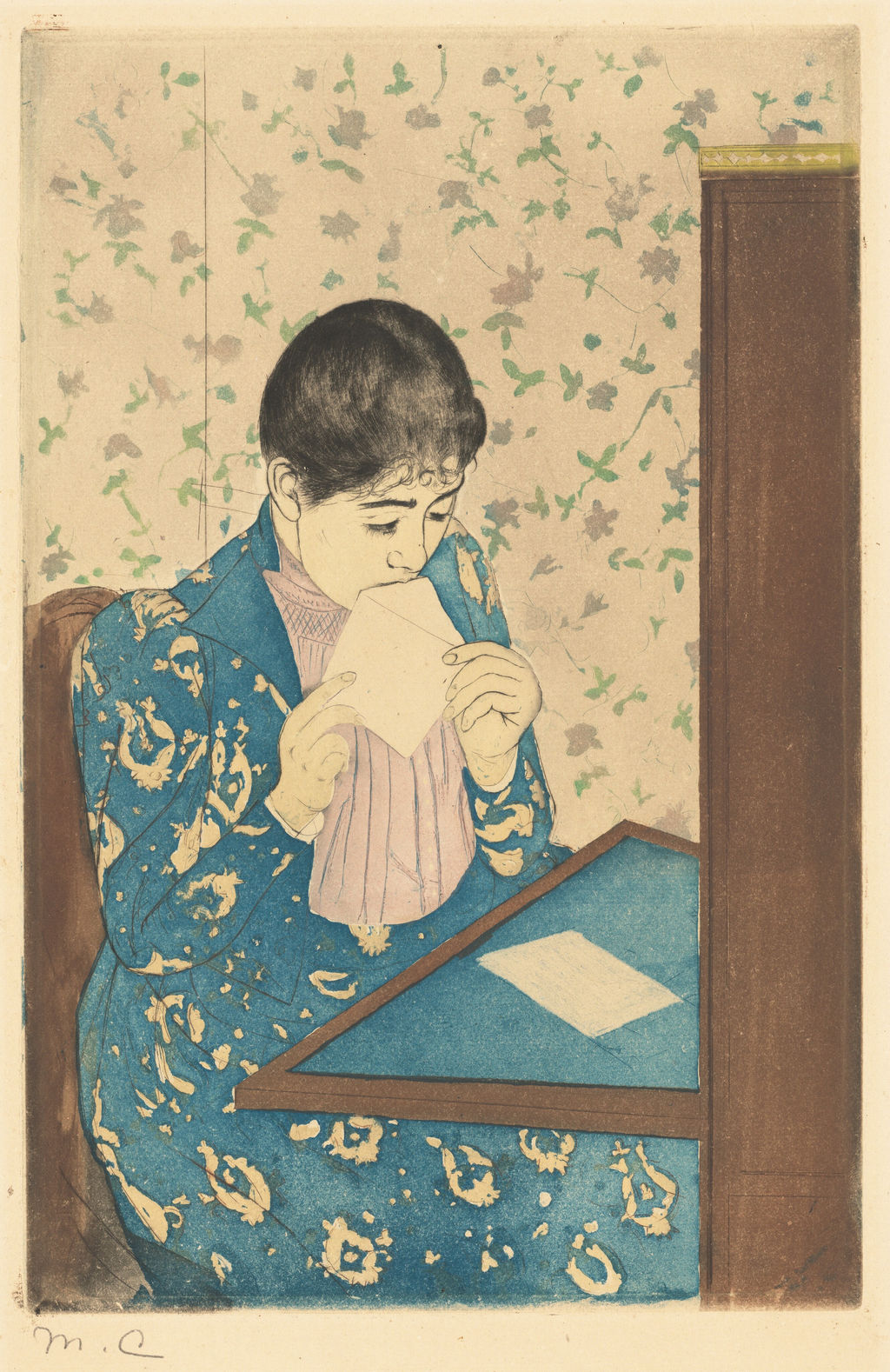
| The Letter | 1890–91 | Colour print |
| The Loge | About 1878–1880 | Oil on canvas |
| The Mandolin Player | 1868 | Oil on canvas |
| The Manicure (Les Ongles; The Nails) | About 1908 | Intaglio print |
| The Tea; Le Thé | About 1880 | Oil on canvas |
| The Visitor | c. 1880 | Intaglio print |
| Two Sisters | 1896 | Pastel |
| Two Women Seated by a Woodland Stream | About 1869 | Oil on canvas |
| Two Women Throwing Flowers During Carnival | 1872 | Oil on canvas |
| Under the Horse-Chestnut Tree | 1896–97, National Gallery and MoMA records | Not established |
| Woman Bathing (La Toilette) | 1890–91 | Colour print |
| Woman in a Loge (Woman with a Pearl Necklace) | 1879 | Oil on canvas |
| Woman Reading | 1878–79 | Oil on canvas |
| Woman Standing, Holding a Fan | 1878–79 | Distemper |
| Woman with a Fan | c. 1878–1879 | Oil on canvas |
| Woman with a Red Zinnia | 1891 | Oil on canvas |
| Woman with a Sunflower | About 1905 | Oil on canvas |
| Young Girl at a Window | c. 1883–1884 | Oil on canvas |
| Young Girl with Brown Hair, Looking Left | About 1913 (1997 summary catalogue) | Pastel |
| Young Mother Sewing | 1900 | Oil on canvas |
| Young Woman in Green, Outdoors in the Sun | About 1914 | Oil on canvas |
Questions about these quotations
No. Havemeyer’s printed recollections preserve attributed speech. They should be cited as that source, rather than introduced as words read in a surviving Cassatt letter. [2]
Discussion
Look again at the images and ideas explored in Mary Cassatt Quotes in Context. These editorial prompts invite your observations.
Reader Insights
Cassatt’s words become more interesting when their occasions remain visible. What does this first detail make you notice?
In Ségard’s 1913 account, Cassatt recalls accepting Degas’s invitation to exhibit with the independent artists. Which connection would you explore further?
Which source context most changes how you read an excerpt: the later recollection, the person reporting a conversation, or the particular artwork under discussion?
Join the Conversation
Share a detail, comparison or question about Mary Cassatt Quotes in Context below.
References
- Achille Ségard, Un peintre des enfants et des mères: Mary Cassatt, 1913, p.8, in French; reported recollection, English translation here. View source. (in French).
- Louisine W. Havemeyer, Remarks on Edgar Degas and Mary Cassatt, 6 April 1915, scan pp.6 and 10; reported conversations. View source.
- Susan Alyson Stein, assisted by Rebecca A. Rabinow, Chronology, in Splendid Legacy: The Havemeyer Collection, 1993, pp.274 and 276; scholarly letter transcriptions. View source.
- Kimberly A. Jones / National Gallery of Art, Degas/Cassatt exhibition brochure, 2014. View source.
- M. Knoedler & Co., Loan Exhibition of Masterpieces by Old and Modern Painters, 6–24 April 1915. View source.
- Metropolitan Museum of Art, Lady at the Tea Table, 1883–85, 23.101. View source.
- Metropolitan Museum of Art, Edgar Degas, Woman Bathing in a Shallow Tub, 1885, 29.100.41. View source.
- National Gallery of Art, Girl Arranging Her Hair, 1886, 1963.10.97. View source.
- Metropolitan Museum of Art, Young Mother Sewing, 1900, 29.100.48. View source.
- Art Gallery of Ontario, Cassatt–McNicoll:ImpressionistsBetweenWorlds. View source.
- Metropolitan Museum of Art, The Bath, 16.2.7. View source.
- National Gallery of Art, Children Playing on the Beach, 1970.17.19. View source.
- Colby College Museum of Art, Explore Inside Out: The Prints of Mary Cassatt; Mother Berthe Holding Her Nude Baby,2013.549. View source.
- National Gallery of Art, Little Girl in a Blue Armchair, 1983.1.18. View source.
- Sotheby’s, syndicated auction catalogue hosted by Invaluable, Simone in Blue Plumed Hat, Watson collection, 18 May 2005, lot 20. View source.
- National Gallery of Art, The Boating Party, 1963.10.94. View source.
- The Huntington, Breakfast in Bed, 83.8.6. View source.
- Adelyn Dohme Breeskin / Smithsonian Institution Press; University of California scan indexed by Google Books, Mary Cassatt:A Catalogue Raisonné of the Oils,Pastels,Watercolors,and Drawings,1970,322pp; selected public search snippets pp91–92,143–144,316,318. View source.
- Metropolitan Museum of Art, The Private Collection of Edgar Degas: A Summary Catalogue, Cassatt entries, printed p.7, no.48. View source.
- Art Institute of Chicago, After the Bullfight, 1969.332. View source.
- Smithsonian American Art Museum, Art Inventories, After the Bullfight, siris_ari_180619. View source.
- Smithsonian American Art Museum, The Caress, 1911.2.1. View source.
- Museum of Modern Art, Under the Horse-Chestnut Tree,671.1940. View source.
- National Gallery of Art, Under the Horse-Chestnut Tree,1959.12.4. View source.
- Art Institute of Chicago, The Child’s Bath,1910.2,current expanded collection entry. View source.
- Virginia Museum of Fine Arts, Board of Trustees minutes,17September2020,loan recommendation7:ChildPickingaFruit75.18. View source.
- Cincinnati Art Museum, Les Ongles(The Nails;The Manicure),ca1908,1940.155,secondstate. View source.
- Sotheby’s, Clarissa Turned Left with Her Hand to Her Ear, 2012 lot 51. View source.
- Greenville County Museum of Art, Recent Acquisitions Funded by Sale of Alma Thomas Painting, 2021. View source.
- Metropolitan Museum of Art, The Coiffure,16.2.3. View source.
- Metropolitan Museum of Art, The Cup of Tea, 22.16.17. View source.
- Sotheby’s, Mother and Child (Nude Dark-Eyed Little Girl with Mother in Patterned Wrapper), 19 May 2010, lot 31. View source.
- Metropolitan Museum of Art, Denise at Her Dressing Table, 2005.129. View source.
- Denver Art Museum, Whistler to Cassatt:American Painters in France, bilingual exhibition livret,The Salon,no2. View source.
- Philadelphia Museum of Art, Driving, 1881. View source.
- Denver Art Museum, Whistler to Cassatt exhibition guide, stop 112: Bust of Ellen with Bows in Her Hair. View source.
- Museum of Fine Arts, Boston, Ellen Mary in a White Coat, 1982.630. View source.
- MaudHoweElliott(ed.) / UniversityofIllinoisUrbanaChampaign scan, Art and Handicraft in the Woman’s Building of the World’s Columbian Exposition,Chicago,1893,Chicago:RandMcNally,1894. View source.
- Amon Carter Museum of American Art, Woman Standing Holding a Fan, 2011.20. View source.
- Smithsonian American Art Museum, Special Installation of Nineteen American Masterworks, 2015. View source.
- Metropolitan Museum of Art, The Fitting, 16.2.8 final state. View source.
- Reynolda House Museum of American Art, Mary Cassatt collection listing: Madame Gaillard and Her Daughter Marie-Thérèse, 1897. View source.
- Wake Forest University, Wake Women 2023 schedule, Highlighting the Art of Women at Reynolda, captioned Cassatt image. View source.
- Detroit Institute of Arts, In the Garden, 36629. View source.
- National Gallery of Art, Gathering Fruit,1943.3.2757. View source.
- Sotheby’s, A Goodnight Hug,N09860lot11,14May2018. View source.
- Sotheby’s, Young Woman in Green Outdoors in the Sun, Modern Day. View source.
- Sotheby’s, syndicated auction catalogue hosted by Invaluable, Head of Simone in a Green Bonnet with Wavy Brim, Watson collection,18May2005,lot39. View source.
- Joslyn Art Museum, Art Break:Woman Reading,1943.38,program object caption. View source.
- Los Angeles County Museum of Art, A Child’s Bath, M.62.8.14. View source.
- National Gallery of Art, The Lamp, 5937. View source.
- Sotheby’s, Tête de Femme au Grand Chapeau, 2008 N08449 lot135. View source.
- National Gallery of Art, The Letter,1943.3.2763. View source.
- Metropolitan Museum of Art, Lilacs in a Window, 1997.207. View source.
- National Gallery of Art, The Loge,1963.10.96. View source.
- Arp Museum Bahnhof Rolandseck, Maestras: Malerinnen1500–1900,25February–16June2024,official five-page flyer. View source.
- Spanish official gazette / exhibition insurance schedule, BOE-A-2023-19808,21September2023,Maestras loan schedule. View source.
- Nationalmusée um Fëschmaart / ArpMuseum CollectionRauforUNICEF, Louise,NursingHerChild,1899,GR1.949;FromRenoirtoMonet2026–27. View source.
- Petit Palais / Paris Musées, Automne, portrait de Lydia Cassatt, PPP706; IIIF manifest 160008392. View source. (in French).
- Denver Art Museum, Whistler to Cassatt Access Guide, The Salon, stop 104. View source.
- Metropolitan Museum of Art, Maternal Caress, 16.2.5. View source.
- Philadelphia Museum of Art, Mother and Child Maternal Kiss, object 54049. View source.
- Metropolitan Museum of Art, Maternal Caress, preparatory drawing64.123.3, c1891. View source.
- Christie’s, Mathilde Holding Baby who Reaches out to Right, lot 5459369. View source.
- National Portrait Gallery / Catalog of American Portraits, Madame Meerson and her Daughter, SSSA2282. View source.
- Museum of Fine Arts Boston, In the Loge, 10.35. View source.
- Smithsonian art inventories, Child Drinking Milk from a Bowl, siris_ari_197517. View source.
- MutualArt public auction index; original auctioneer undisclosed without subscription, Child Drinking Milk from a Bowl, public listing dated 2 June 2024. View source.
- Museum of Modern Art, Mary Cassatt artist essay and print records. View source.
- National Gallery of Art, Mother's Kiss,1963.10.254. View source.
- National Gallery of Art, Mary Cassatt the Daring Printmaker, 23 January 2026. View source.
- National Gallery of Art, Mary Cassatt An American in Paris checklist, updated 24 February 2026. View source.
- Adelyn D. Breeskin / National Gallery of Art, Mary Cassatt 1844–1926, 1970 exhibition catalogue. View source.
- Metropolitan Museum of Art, Nurse Reading to a Little Girl, 62.72. View source.
- National Gallery of Art, In the Omnibus, 46725. View source.
- Metropolitan Museum of Art, Mother and Child (The Oval Mirror), 29.100.47. View source.
- Art Institute of Chicago, Ryerson and Burnham Archives, Bertha Honoré Palmer Correspondence Collection finding aid, selected Mary Cassatt entries, Box1Folder3. View source.
- Philadelphia Museum of Art, Woman in a Loge, 1978-1-5, object72182. View source.
- Metropolitan Museum of Art, Mother Playing with Child, 22.16.23. View source.
- Metropolitan Museum of Art, By the Pond,60.732bis. View source.
- Museum of Modern Art, By the Pond,673.1940. View source.
- Terra Foundation for American Art, By the Pond,1999.25. View source.
- Philadelphia Museum of Art, Poppies in a Field, attributed to Victor Gabriel Gilbert; formerly attributed to Mary Stevenson Cassatt, 1978-1-6. View source.
- Christie’s, Mother in Purple Holding Her Child, lot 5369421. View source.
- Sotheby’s, Tête d’enfant au chapeau rouge, American Art N09229, 20 November 2014, lot 39. View source.
- Christie’s, Sara Holding a Cat, lot 5561267. View source.
- Smithsonian American Art Museum, Art Inventories Catalog, Sara with Her Dog, in an Armchair, Wearing a Bonnet with a Plum Ornament; IAP 80170363 / siris_ari_180925. View source.
- Smithsonian American Art Museum, Sara in a Green Bonnet, 1929.6.11. View source.
- Mary Cassatt Catalogue Raisonné project, with Adelson Galleries, presented on Artnet, Sara with Her Dog, in an Armchair, Wearing a Bonnet with a Plum Ornament, work 424155733. View source.
- Metropolitan Museum of Art, Portrait of the Artist, 1975.319.1. View source.
- National Portrait Gallery, Mary Cassatt Self-Portrait, NPG.76.33. View source.
- Musée d’Orsay, Jeune fille au jardin,RF193720. View source. (in French).
- Sotheby’s, Simone Seated on the Grass Next to Her Mother, 30 September 2020, lot 33. View source.
- Dallas Museum of Art, Sleepy Baby,1952.38.M. View source.
- Sotheby’s, Smiling Mother with Sober Faced Child, 2022. View source.
- Smithsonian American Art Museum, Spanish Dancer Wearing a Lace Mantilla, 1967.40. View source.
- Spencer Museum of Art,University of Kansas, The Manicure,c1908,1991.0266. View source.
- Christie’s, Sketch of Master St Pierre, 2017 online lot. View source.
- National Gallery of Art, Child in a Straw Hat, 1983.1.17. View source.
- Sotheby’s, Summertime, Armand Hammer: The Private Collection, Modern Evening Auction 2026. View source.
- National Gallery of Art, Woman with a Sunflower, 1963.10.98. View source.
- National Gallery of Art, Afternoon Tea Party, 46731. View source.
- Museum of Fine Arts, Boston / Erica E. Hirshler, The Tea, 42.178. View source.
- The Nelson-Atkins Museum of Art, At the Theater,F77-33;French Paintings and Pastels appendixII. View source.
- Metropolitan Museum of Art, Woman Bathing La Toilette, 16.2.2. View source.
- Sotheby’s, Two Sisters, 2005 American Paintings sale N08134, lot 44. View source.
- Wichita Art Museum, Mother and Child, M109.53. View source.
- Smithsonian American Art Museum, Art Inventories, Two Women Seated by a Woodland Stream / Duex femmes assises aupres de l’eau, IAP 80170008. View source.
- Tacoma Art Museum / David Setford, Impressionist Painting: From Pleasure Gardens to the Palais Garnier, 22 October 2019. View source.
- Tacoma Art Museum, French Impressionism and the Northwest, Works of Art Adoption Program, 2019–2020, no. 10 / PDF p. 12. View source.