by Tom Gurney
Tom Gurney BSc (Hons) is an art history expert with over 20 years experience
Published on June 19, 2020 / Updated on November 2, 2026
Email: tomgurney1@gmail.com / Phone: +44 7429 011000
Woman and Child Driving by Mary Cassatt: Introduction
The horse disappears through the left edge, and a large wheel is cut by the right. Between them, a woman holds the reins beside a pale-clad child. A third person sits behind, facing the other way. Mary Cassatt’s Driving brings a carriage close enough for its passengers, rails and fittings to fill most of the picture.
The Philadelphia Museum of Art dates the oil on canvas to 1881. Its dimensions are 88.8 × 129.8 centimetres, and its accession number is W1921-1-1. The museum credits a purchase with the W. P. Wilstach Fund in 1921. The work is also known as Woman and Child Driving and A Woman and a Girl Driving. [1]
At a Glance
- ArtistMary Cassatt [1]
- Museum titleDriving [1]
- Date1881 [1]
- MediumOil on canvas [1]
- Dimensions88.8 × 129.8 cm (canvas; frame measured separately) [1]
- CollectionPhiladelphia Museum of Art [1]
- AccessionW1921-1-1 [1]
- CreditPurchased with the W. P. Wilstach Fund, 1921 [1]
This work across Mary Cassatt’s career
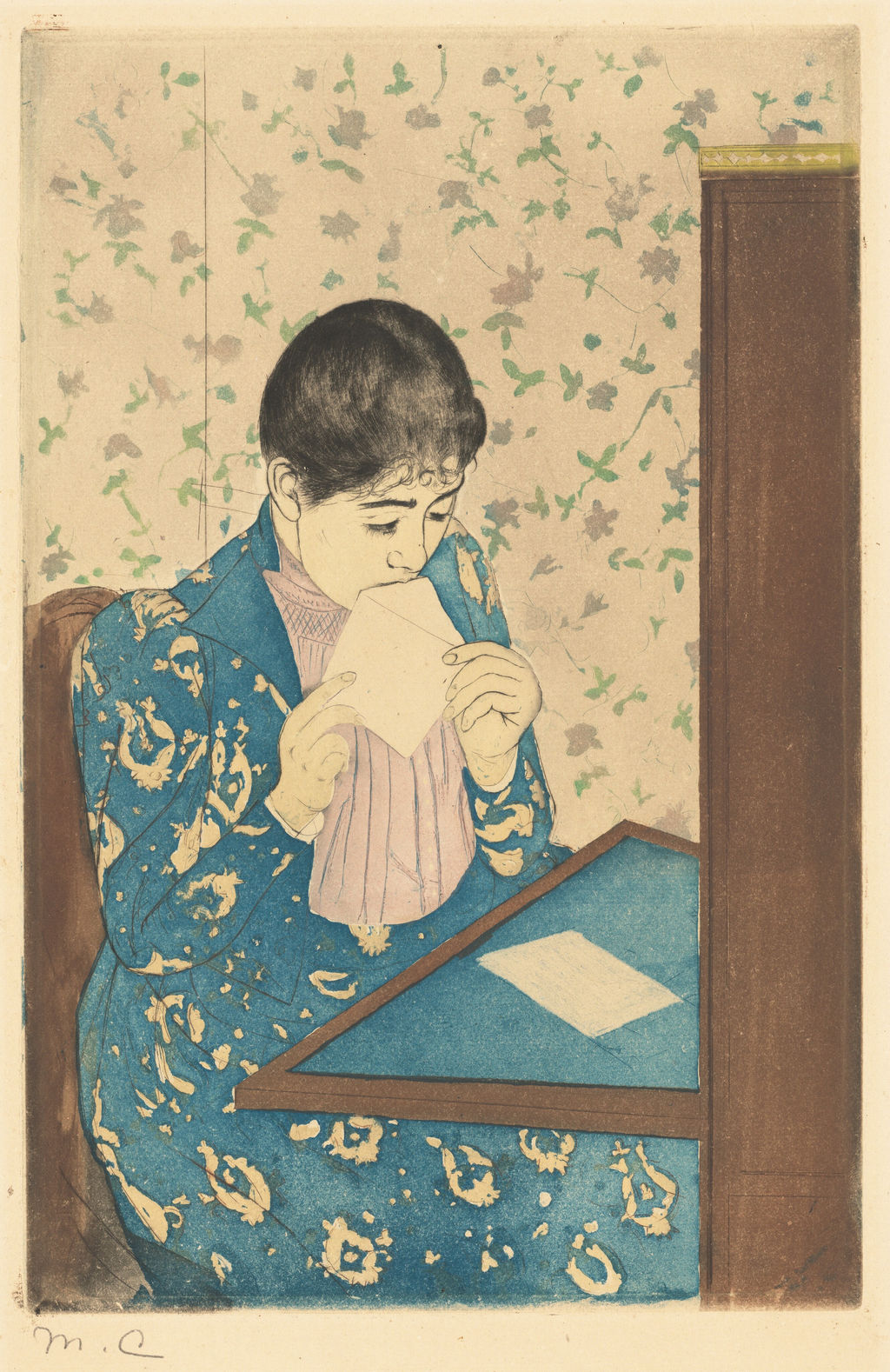
The Letter
1890–91 [5]Modern Woman
1892–93; displayed in 1893 [6] [7] [8]The Boating Party
1893–94 [9]The Child's Bath
1893 [10]Woman with a Sunflower
About 1905 [12]Young Woman in Green Outdoors in the Sun
About 1914 [13]Contents
- A carriage extending beyond the frame
- Hands, reins and the driver’s task
- The child beside the rail
- The third passenger
- The lamp and the carriage’s crossing lines
- Foliage around the vehicle
- Whom the museum identifies
- Why the date is 1881
- Mobility and its social limits
- From the Cassatt family to Philadelphia
A carriage extending beyond the frame
The wide format suits a vehicle travelling across the image, but Cassatt does not fit the whole carriage and horse neatly inside it. At the left, we see the horse’s dark hindquarters and harness rather than its head. At the lower right, only part of the wheel remains visible. These large cut forms make the group feel close to the viewer.
The cropping also changes what receives attention. A complete horse could have become a second major figure, with a face and direction of looking to rival the passengers. Here its broad dark body contributes weight at the left while leaving the three human heads as the clearest centres of attention.
The wheel has a different role. Its curved rim enters from below and continues out of sight, making the lower boundary seem to pass through a larger working object. Straight spokes divide the visible portion. The combination of arc and radiating lines contrasts with the more upright bodies above.
The vehicle cannot be understood from one outline. A shaft passes towards the horse; the carriage body rises behind it; rails surround the passengers; and the wheel projects below. Following those connected parts gives the picture depth even though the large forms are pressed close together.
The result feels like a view taken from beside the carriage. We are not given a remote prospect of a road with a small vehicle moving across it. The landscape becomes a surrounding field, while the carriage occupies the immediate space. That emphasis makes the passengers’ differing postures unusually easy to compare.
Hands, reins and the driver’s task
The driver sits higher than the child, with an upright torso and face turned towards the left. Her hands extend in front of her above the carriage body. Fine dark lines run from this area towards the horse, giving the pose a practical purpose rather than leaving the raised hands as an unexplained gesture.
The reins establish a connection across the picture. They link the compact area around the hands with the large cropped animal, passing over the intervening space. This relationship matters even though the horse’s face is outside the frame: the driver’s activity remains visible through what she holds.
Dark vertical and diagonal lines rise above the hand area into the foliage. They belong to a wider network of narrow shapes crossing the broad green background. The difference in scale is useful. A small line can mark an implement or connection, while the larger dark mass behind it remains readable as woodland.
The driver’s pale scarf or neck covering expands below the face, separating her profile from the darker clothing and background. Her hat supplies another compact, relatively dark shape above. Face, neck covering and hands consequently form a sequence of lighter accents within the more substantial central figure.
The hands also locate responsibility within the group. The child can sit facing outward while the driver remains connected to the horse. The rear figure occupies a different position again. Cassatt makes these roles visible through placement and action, without requiring the viewer to imagine a spoken instruction.
The child beside the rail
The child sits lower and nearer the front edge of the vehicle. Pale pink and white clothing spreads across the lap and rises towards the small head. Against the darker carriage and foliage, this light area is one of the picture’s strongest contrasts.
The face is turned more towards the viewer than the driver’s profile. This does not produce a straightforward portrait addressed directly to us: the eyes and head still have their own direction. It does, however, let the child’s features remain visible beside the more sharply sideward adult face.
One arm reaches along the curved rail at the right. The rail makes a dark boundary beside the light clothing, while the small hand provides a point where body and vehicle visibly meet. The child occupies a seat with a surrounding structure rather than floating against the background.
Below the pink skirt, pale lower legs and dark footwear appear close to the lower middle. Their small scale helps establish the difference between the child and the driver. The carriage’s much larger forms continue around them, making the vehicle feel substantial in relation to its youngest passenger.
The dress also gives the composition a broad light passage across its lower half. The driver’s neck covering is brighter and higher; the child’s garment extends more horizontally. These two areas are related through pale colour while retaining different shapes and positions.
The third passenger
Behind the child, a dark-clad man in a tall hat turns towards the right. His face points away from the driver’s. The pale side of his head appears against the greenery, while his dark coat joins the shadowed forms around the rear seat.
This opposing direction prevents the three figures from becoming a single repeated profile. The driver looks left, the child is more nearly frontal, and the rear figure looks right. Their bodies share one vehicle while their attention appears distributed across different parts of the surrounding space.
The third figure also changes the social structure of the scene. The museum identifies him by his role as a groom, but does not supply a personal name. His presence belongs to the represented carriage outing even though the two figures in the familiar title receive more explicit attention. [1]
His dark clothing makes the child’s pale head and dress more distinct. At the same time, the hat introduces a strong upright accent near the right side of the group. The figure is therefore structurally important as well as part of the subject.
The separate faces do not prove estrangement, boredom or a shared private mood. Such responses are interpretations of posture and expression. What can be followed directly is the arrangement: adjacent bodies, different head turns and no obvious exchange of looks between all three passengers.
The lamp and the carriage’s crossing lines
A carriage lamp stands near the left of the driver’s hands. Its pale, patterned face creates a small bright shape against the brown vehicle and dark horse. The fitting helps articulate the carriage as an object assembled from distinct parts.
Around it, rails, shafts and edges run at different angles. Some narrow lines continue across larger forms; others stop where a body or panel overlaps them. Their crossings help the eye distinguish near and far parts without needing a fully exposed side view of the vehicle.
The lamp is particularly effective because it interrupts this network. Its more concentrated shape gives the viewer a place to pause among long narrow lines. From it, the eye can move towards the driver’s hands, the horizontal rail and then the curved wheel below.
Brown and warm yellow passages connect the carriage’s parts, but changes of direction keep them from becoming one solid block. A shaft leads left, a rail encloses a seat and a wheel curves down. Similar colour supports their relationship while their shapes explain their different functions.
The picture’s energy consequently comes from more than the possibility of forward movement. Even where the passengers sit relatively still, the vehicle offers a dense arrangement of diagonals, arcs and intersections. Cassatt places quieter faces within this more active structure.
Foliage around the vehicle
Dark greens occupy much of the upper and left background. Upright trunks and irregular patches of foliage establish a wooded setting, but they do not open into a broad distant panorama. The trees enclose the carriage more than they draw attention away from it.
The green field helps the pale faces remain legible. Around the driver’s profile and the groom’s head, darker passages make small areas of skin stand out. Behind the child, the background is interrupted by the rear figure and the seat, creating another kind of contrast.
The handling varies across the canvas. Broad, broken marks describe foliage and carriage surfaces, while smaller changes clarify a face or hand. The overall image remains connected through colour without giving every leaf, garment and fitting the same degree of definition.
The horse’s dark body also meets the surrounding green without disappearing into it. Harness lines and warmer adjoining parts of the carriage help establish the animal’s boundary. Its large mass anchors the left side while the passengers gather towards the right.
These are observations about the visible painted arrangement. They do not measure how quickly Cassatt worked or identify pigments and underlying layers. The documented medium, oil on canvas, establishes the basic object type; the surface alone cannot supply a complete account of its making. [1]
Watch: Mary Cassatt
Choose a film to explore the artist’s work, its interpretation and its wider setting.
Demonstrating Mary Cassatt's Color Printmaking Techniques
The Philadelphia Museum of Art demonstrates techniques used to make Cassatt’s colour prints.
Watch on YouTubeWhom the museum identifies
Philadelphia identifies the driver as Cassatt’s sister Lydia and the child as Odile Fèvre, a niece of Edgar Degas. It names the partly shown horse Bichette and locates the outing in the Bois de Boulogne, the wooded park at the western side of Paris. These are the museum’s identifications of the scene. [1]
The names bring two family circles into the painting: Cassatt’s own sister and a child related to Degas. They help explain why the image is discussed alongside Cassatt’s family portraits and professional relationships. The biography provides the wider context for those connections.
A museum identification still differs from a transcript of a particular sitting or journey. It does not establish the exact day represented, the party’s destination or what anyone said. The painting contains enough specific activity to be examined without supplying those missing details.
The role of the unnamed groom is another useful limit. Naming two passengers does not make every person in a group equally documented. Retaining his occupational description preserves what the museum supplies while leaving his individual biography open.
The title, meanwhile, simplifies a more populated image. Woman and Child Driving points to the two most prominent figures, whereas Driving names the central activity. Neither requires us to overlook the third passenger or the horse that makes the outing possible.
Why the date is 1881
The museum’s current date is 1881. An earlier source, the National Gallery of Art’s 1970 exhibition catalogue, listed Woman and Child Driving as 1879. The matching entry is number 16, associated with Breeskin catalogue number 69. The older date is part of the picture’s publication history rather than the date preferred by the current owning museum. [1] [14]
The year 1879 has another, separate relevance. Philadelphia states that the Cassatt family acquired a small carriage and Bichette in that year, and connects the purchase with the sisters’ enjoyment of driving. Buying the vehicle and painting this canvas are distinct events. [1]
This distinction matters because a date attached to the represented object can easily be mistaken for the date of the artwork. The carriage could be available before the composition was made. Its acquisition supplies context for the subject without requiring the canvas itself to have been executed immediately.
The older catalogue also discussed the bold cropping and asymmetrical composition in relation to Degas. That is a historical critical interpretation. The visible cut horse and wheel can be examined directly, while the catalogue’s account shows how those features were explained to viewers in 1970. [14]
Mobility and its social limits
Philadelphia interprets the outing in relation to a degree of independence available to upper-class women. The driver visibly controls the reins rather than appearing only as a passenger. This gives the social reading a concrete point of contact with the composition. [1]
The vehicle and accompanying groom are part of the same scene. They keep the question of movement connected to material resources and assistance. The freedom represented here is situated within a particular kind of outing, with a particular arrangement of people and equipment.
It would therefore be misleading to make the painting stand for equal access to Parisian public life among all women. The museum’s class qualification is central to its interpretation. The image can present a woman directing a carriage without demonstrating that every woman enjoyed comparable opportunities.
The child’s position adds another distinction. She shares the journey, but does not perform the driver’s task. Sitting beside the reins and controlling them are different relationships to the same vehicle. Cassatt’s arrangement makes both visible within one compact group.
From the Cassatt family to Philadelphia
The museum’s provenance begins with Alexander Johnston Cassatt. It records inheritance by his wife, Lois Buchanan Cassatt, followed by descent to their son Edward Buchanan Cassatt. In 1921 the City of Philadelphia purchased the work with the W. P. Wilstach Fund on behalf of the museum. [1]
This sequence places the painting within family ownership before its public acquisition. It does not establish that the later museum purchase was an original commission. Nor does a provenance list by itself explain every circumstance of the first transfer from the artist.
The year 1921 belongs to the collection history, separate from the current execution date of 1881 and the family’s carriage purchase in 1879. Each date answers a different question: when the painting was made, when its represented equipment became available and when the work entered the museum’s care.
A different view of Lydia at the theatre
At the Theater, a Nelson-Atkins pastel dated about 1879, presents a seated woman in yellow with a red chair, chandelier and reflected head. Its traditional Lydia identification remains qualified. Resemblance to the driver cannot independently prove the sitter’s identity in that separate work. [15]
The contrast concerns what the figures do within their settings. The theatre sitter’s hands rest low, while the turned face suggests attention to something beyond the image. In Driving, raised hands connect directly to the reins and horse. The surrounding objects make different kinds of activity legible.
The reflection in the pastel adds another view of one person. The carriage oil contains three actual passengers facing in different directions. A repeated head in a mirror and another person occupying a rear seat create different spatial relationships, despite the shared emphasis on seated figures.
The works also differ in format and medium. The vertical pastel concentrates on a single body within a close interior; the wide oil extends through a vehicle and its wooded surroundings. Together they show how Cassatt could make posture, hands and surrounding structures carry a scene without displaying the precise object of every person’s attention.
 Mary Cassatt.jpg)
At the Theatre (Lydia Cassatt Leaning on Her Arms, Seated in a Loge).
Cassatt artworks and studies
A source-bounded directory of documented works and studies, including the works in the National Gallery’s 2026 checklist and one clearly marked former attribution. Different print impressions are grouped by design and remain searchable by their recorded accessions. This is not a complete catalogue raisonné. Unlinked titles have no individual article here.
| Name | Date | Medium |
|---|---|---|
| A Child’s Bath — LACMA oil | 1880 | Oil on canvas |
| A Goodnight Hug | 1880 | Pastel |
| After the Bullfight | 1873 | Oil on canvas |
| Afternoon Tea Party | 1890–91 | Colour print |
| At the Theatre (Lydia Cassatt Leaning on Her Arms, Seated in a Loge) | About 1879 | Pastel |
| Automne, portrait de Lydia Cassatt | 1880 | Oil on canvas |
| Breakfast in Bed | 1897 | Oil on canvas |
| Bust of Ellen with Bows in Her Hair | 1898 | Pastel |
| By the Pond | About 1896 in Met and Terra records; about 1898 at MoMA | Not established |
| Child Drinking Milk from a Bowl; provisionally identified composition (qualified identification) | About 1890, following inventory and catalogue text | Pastel |
| Child in a Straw Hat | About 1886 | Oil on canvas |
| Child Picking a Fruit | 1893 | Oil on canvas |
| Children Playing on the Beach | 1884 | Oil on canvas |
| Clarissa, Turned Left, with Her Hand to Her Ear | About 1890–93 in Sotheby’s 2012 entry; about 1893 in GCMA notice | Pastel |
| Denise at her Dressing Table | About 1908–09 | Oil on canvas |
| Driving | 1881 | Oil on canvas |
| Eddy Cassatt (Edward Buchanan Cassatt) | 1875 | Oil on canvas |
| Ellen Mary Cassatt in a White Coat | About 1896 | Oil on canvas |
| Emmie and her Child | About 1890 | Oil on canvas |
| Gathering Fruit | About 1893 | Not established |
| Girl Arranging her Hair | 1886 | Oil on canvas |
| Head of a Child with a Red Hat | 1903, signed and dated | Pastel |
| Head of a Woman in a Large Hat | About 1909 | Pastel |
| Head of Simone in a Green Bonnet with Wavy Brim | About 1904 | Pastel |
| In the Garden | 1903 or 1904 | Oil on canvas |
| In the Loge | 1878 | Oil on canvas |
| In the Omnibus | 1890–91 | Colour print |
| In the Omnibus [recto] — preparatory drawing | c. 1891 | Chalk and graphite |
| In the Opera Box (No. 3) [recto] — preparatory drawing | 1880 | Graphite |
| In the Opera Box (No. 3) — print | c. 1880 | Intaglio print |
| Jeune fille au jardin (Young Woman Sewing in a Garden) | 1880–82 | Oil on canvas |
| Jules Dried by His Mother; provisionally identified composition (qualified identification) | 1901, following catalogue text | Oil on canvas |
| Lady in Black, in a Loge, Facing Right | c. 1880 | Etching |
| Lilacs in a Window | About 1880–83 | Oil on canvas |
| Little Girl in a Blue Armchair | 1878 | Oil on canvas |
| Louise Nursing her Child | 1899 in Luxembourg caption; 1898–99 in loan and Arp records | Pastel |
| Madame Gaillard and Her Daughter Marie-Thérèse | 1897, Reynolda collection listing | Pastel |
| Maternal Caress | 1890–91 | Not established |
| Maternal Caress — preparatory drawing | About 1891 | Charcoal and graphite |
| Mathilde Holding a Baby Who Reaches out to the Right | About 1889, Christie’s catalogue | Pastel |
| Mimi as a Brunette | c. 1889 | Drypoint |
| Mimi Holding a Japanese Fan | c. 1889 | Drypoint |
| Modern Woman | 1892–93; displayed in 1893 | Not established |
| Mother about to Wash her Sleepy Child | 1880 | Oil on canvas |
| Mother and Child (Maternal Kiss) | 1896 | Pastel |
| Mother and Child (Nude Dark-Eyed Little Girl with Mother in Patterned Wrapper) | About 1898–99, Sotheby’s catalogue | Pastel |
| Mother and Child (The Oval Mirror) | About 1899 | Oil on canvas |
| Mother Berthe Holding Her Nude Baby | 1898–99 | Pastel |
| Mother in Purple Holding her Child | About 1914, Christie’s catalogue | Pastel |
| Mother Playing with Child | About 1897 | Pastel |
| Mother’s Kiss | 1890–91 | Colour print |
| Nurse Reading to a Little Girl | 1895 | Pastel |
| Poppies in a Field (formerly Cassatt; attributed to Victor Gabriel Gilbert) | About 1880, current museum record | Oil on panel |
| Portrait of an Elderly Lady | c. 1887 | Oil on canvas |
| Portrait of Madame AF Aude and her Two Daughters | 1899, Breeskin 1970 exhibition catalogue | Pastel |
| Portrait of the Artist | 1878 | Watercolour and gouache |
| Reading Le Figaro | 1878, NGA 2026 checklist; about 1877–78 in SAAM’s 2015 caption | Oil on canvas |
| Reflection — drypoint | c. 1890 | Drypoint |
| Sara Holding a Cat | About 1907–08 | Oil on canvas |
| Sara in a Green Bonnet | About 1901 | Oil on canvas |
| Sara with Her Dog, in an Armchair, Wearing a Bonnet with a Plum Ornament | 1901 | Pastel |
| Self Portrait | About 1880 | Watercolour and gouache |
| Simone in Blue Plumed Hat | About 1903 | Pastel |
| Simone Seated on the Grass next to her Mother | 1901–02 | Pastel |
| Sketch of Master St. Pierre | Date not established | Pastel |
| Sleepy Baby | About 1910 | Pastel |
| Smiling Mother with Sober Faced Child | Date not established | Pastel |
| Spanish Dancer Wearing a Lace Mantilla | 1873 | Oil on canvas |
| Summertime, horizontal painting | 1894–95, current Sotheby’s catalogue | Oil on canvas |
| Tea — print | c. 1890 | Drypoint |
| The Bath | 1890–91 | Not established |
| The Boating Party | 1893–94 | Oil on canvas |
| The Caress | 1902 | Oil on canvas |
| The Child's Bath | 1893 | Oil on canvas |
| The Coiffure | 1890–91 | Colour print |
| The Cup of Tea | About 1880–81 | Oil on canvas |
| The Fitting | 1890–91 | Colour print |
| The Lamp | 1890–91 | Colour print |
| The Letter | 1890–91 | Colour print |
| The Loge | About 1878–1880 | Oil on canvas |
| The Mandolin Player | 1868 | Oil on canvas |
| The Manicure (Les Ongles; The Nails) | About 1908 | Intaglio print |
| The Tea; Le Thé | About 1880 | Oil on canvas |
| The Visitor | c. 1880 | Intaglio print |
| Two Sisters | 1896 | Pastel |
| Two Women Seated by a Woodland Stream | About 1869 | Oil on canvas |
| Two Women Throwing Flowers During Carnival | 1872 | Oil on canvas |
| Under the Horse-Chestnut Tree | 1896–97, National Gallery and MoMA records | Not established |
| Woman Bathing (La Toilette) | 1890–91 | Colour print |
| Woman in a Loge (Woman with a Pearl Necklace) | 1879 | Oil on canvas |
| Woman Reading | 1878–79 | Oil on canvas |
| Woman Standing, Holding a Fan | 1878–79 | Distemper |
| Woman with a Fan | c. 1878–1879 | Oil on canvas |
| Woman with a Red Zinnia | 1891 | Oil on canvas |
| Woman with a Sunflower | About 1905 | Oil on canvas |
| Young Girl at a Window | c. 1883–1884 | Oil on canvas |
| Young Girl with Brown Hair, Looking Left | About 1913 (1997 summary catalogue) | Pastel |
| Young Mother Sewing | 1900 | Oil on canvas |
| Young Woman in Green, Outdoors in the Sun | About 1914 | Oil on canvas |
Discussion
Look again at the images and ideas explored in Woman and Child Driving by Mary Cassatt. These editorial prompts invite your observations.
Reader Insights
The horse disappears through the left edge, and a large wheel is cut by the right. What does this first detail make you notice?
The wide format suits a vehicle travelling across the image, but Cassatt does not fit the whole carriage and horse neatly inside it. How does it affect your reading of the whole work?
Which part of the carriage leads your eye most strongly: the reins, the lamp, or the cut wheel?
Join the Conversation
Share a detail, comparison or question about Woman and Child Driving by Mary Cassatt below.
References
- Philadelphia Museum of Art, Driving, 1881, accession W1921-1-1; current object record, label, publicly embedded dimensions, credit and provenance. Sitter, horse and location identifications and the class-qualified mobility interpretation are attributed to the museum. View source.
- Denver Art Museum, Whistler to Cassatt Access Guide, The Salon, stop 104. View source.
- Denver Art Museum, Whistler to Cassatt:American Painters in France, bilingual exhibition livret,The Salon,no2. View source.
- National Gallery of Art, Little Girl in a Blue Armchair, 1983.1.18. View source.
- National Gallery of Art, The Letter,1943.3.2763. View source.
- Art Institute of Chicago, Ryerson and Burnham Archives, Bertha Honoré Palmer Correspondence Collection finding aid, selected Mary Cassatt entries, Box1Folder3. View source.
- Museum of Modern Art, Mary Cassatt artist essay and print records. View source.
- MaudHoweElliott(ed.) / UniversityofIllinoisUrbanaChampaign scan, Art and Handicraft in the Woman’s Building of the World’s Columbian Exposition,Chicago,1893,Chicago:RandMcNally,1894. View source.
- National Gallery of Art, The Boating Party, 1963.10.94. View source.
- Art Institute of Chicago, The Child’s Bath,1910.2,current expanded collection entry. View source.
- Metropolitan Museum of Art, Young Mother Sewing, 29.100.48. View source.
- National Gallery of Art, Woman with a Sunflower, 1963.10.98. View source.
- Sotheby’s, Young Woman in Green Outdoors in the Sun, Modern Day. View source.
- Adelyn D. Breeskin, National Gallery of Art, Mary Cassatt 1844–1926, 1970, printed p. 22, entry 16 and corresponding plate; historical 1879 dating and interpretation of cropping, distinct from the current museum date. View source.
- The Nelson-Atkins Museum of Art, At the Theater, about 1879, accession F77-33; separate pastel on paper and qualified traditional sitter identification. View source.
- Art Gallery of Ontario, Cassatt–McNicoll:ImpressionistsBetweenWorlds. View source.
- Metropolitan Museum of Art, The Bath, 16.2.7. View source.
- National Gallery of Art, Children Playing on the Beach, 1970.17.19. View source.
- Colby College Museum of Art, Explore Inside Out: The Prints of Mary Cassatt; Mother Berthe Holding Her Nude Baby,2013.549. View source.
- Sotheby’s, syndicated auction catalogue hosted by Invaluable, Simone in Blue Plumed Hat, Watson collection, 18 May 2005, lot 20. View source.
- The Huntington, Breakfast in Bed, 83.8.6. View source.
- Adelyn Dohme Breeskin / Smithsonian Institution Press; University of California scan indexed by Google Books, Mary Cassatt:A Catalogue Raisonné of the Oils,Pastels,Watercolors,and Drawings,1970,322pp; selected public search snippets pp91–92,143–144,316,318. View source.
- Metropolitan Museum of Art, The Private Collection of Edgar Degas: A Summary Catalogue, Cassatt entries, printed p.7, no.48. View source.
- Art Institute of Chicago, After the Bullfight, 1969.332. View source.
- Smithsonian American Art Museum, Art Inventories, After the Bullfight, siris_ari_180619. View source.
- Smithsonian American Art Museum, The Caress, 1911.2.1. View source.
- Museum of Modern Art, Under the Horse-Chestnut Tree,671.1940. View source.
- National Gallery of Art, Under the Horse-Chestnut Tree,1959.12.4. View source.
- Virginia Museum of Fine Arts, Board of Trustees minutes,17September2020,loan recommendation7:ChildPickingaFruit75.18. View source.
- Cincinnati Art Museum, Les Ongles(The Nails;The Manicure),ca1908,1940.155,secondstate. View source.
- Sotheby’s, Clarissa Turned Left with Her Hand to Her Ear, 2012 lot 51. View source.
- Greenville County Museum of Art, Recent Acquisitions Funded by Sale of Alma Thomas Painting, 2021. View source.
- Metropolitan Museum of Art, The Coiffure,16.2.3. View source.
- Metropolitan Museum of Art, The Cup of Tea, 22.16.17. View source.
- Sotheby’s, Mother and Child (Nude Dark-Eyed Little Girl with Mother in Patterned Wrapper), 19 May 2010, lot 31. View source.
- Metropolitan Museum of Art, Denise at Her Dressing Table, 2005.129. View source.
- Denver Art Museum, Whistler to Cassatt exhibition guide, stop 112: Bust of Ellen with Bows in Her Hair. View source.
- Museum of Fine Arts, Boston, Ellen Mary in a White Coat, 1982.630. View source.
- Amon Carter Museum of American Art, Woman Standing Holding a Fan, 2011.20. View source.
- Smithsonian American Art Museum, Special Installation of Nineteen American Masterworks, 2015. View source.
- Metropolitan Museum of Art, The Fitting, 16.2.8 final state. View source.
- Reynolda House Museum of American Art, Mary Cassatt collection listing: Madame Gaillard and Her Daughter Marie-Thérèse, 1897. View source.
- Wake Forest University, Wake Women 2023 schedule, Highlighting the Art of Women at Reynolda, captioned Cassatt image. View source.
- Detroit Institute of Arts, In the Garden, 36629. View source.
- National Gallery of Art, Gathering Fruit,1943.3.2757. View source.
- Sotheby’s, A Goodnight Hug,N09860lot11,14May2018. View source.
- Sotheby’s, syndicated auction catalogue hosted by Invaluable, Head of Simone in a Green Bonnet with Wavy Brim, Watson collection,18May2005,lot39. View source.
- National Gallery of Art, Girl Arranging Her Hair, 1963.10.97. View source.
- Joslyn Art Museum, Art Break:Woman Reading,1943.38,program object caption. View source.
- Los Angeles County Museum of Art, A Child’s Bath, M.62.8.14. View source.
- National Gallery of Art, The Lamp, 5937. View source.
- Sotheby’s, Tête de Femme au Grand Chapeau, 2008 N08449 lot135. View source.
- Metropolitan Museum of Art, Lilacs in a Window, 1997.207. View source.
- National Gallery of Art, The Loge,1963.10.96. View source.
- Arp Museum Bahnhof Rolandseck, Maestras: Malerinnen1500–1900,25February–16June2024,official five-page flyer. View source.
- Spanish official gazette / exhibition insurance schedule, BOE-A-2023-19808,21September2023,Maestras loan schedule. View source.
- Nationalmusée um Fëschmaart / ArpMuseum CollectionRauforUNICEF, Louise,NursingHerChild,1899,GR1.949;FromRenoirtoMonet2026–27. View source.
- Petit Palais / Paris Musées, Automne, portrait de Lydia Cassatt, PPP706; IIIF manifest 160008392. View source. (in French).
- Metropolitan Museum of Art, Maternal Caress, 16.2.5. View source.
- Philadelphia Museum of Art, Mother and Child Maternal Kiss, object 54049. View source.
- Metropolitan Museum of Art, Maternal Caress, preparatory drawing64.123.3, c1891. View source.
- Christie’s, Mathilde Holding Baby who Reaches out to Right, lot 5459369. View source.
- National Portrait Gallery / Catalog of American Portraits, Madame Meerson and her Daughter, SSSA2282. View source.
- Museum of Fine Arts Boston, In the Loge, 10.35. View source.
- Smithsonian art inventories, Child Drinking Milk from a Bowl, siris_ari_197517. View source.
- MutualArt public auction index; original auctioneer undisclosed without subscription, Child Drinking Milk from a Bowl, public listing dated 2 June 2024. View source.
- National Gallery of Art, Mother's Kiss,1963.10.254. View source.
- National Gallery of Art, Mary Cassatt the Daring Printmaker, 23 January 2026. View source.
- National Gallery of Art, Mary Cassatt An American in Paris checklist, updated 24 February 2026. View source.
- Adelyn D. Breeskin / National Gallery of Art, Mary Cassatt 1844–1926, 1970 exhibition catalogue. View source.
- Metropolitan Museum of Art, Nurse Reading to a Little Girl, 62.72. View source.
- National Gallery of Art, In the Omnibus, 46725. View source.
- Metropolitan Museum of Art, Mother and Child (The Oval Mirror), 29.100.47. View source.
- Philadelphia Museum of Art, Woman in a Loge, 1978-1-5, object72182. View source.
- Metropolitan Museum of Art, Mother Playing with Child, 22.16.23. View source.
- Metropolitan Museum of Art, By the Pond,60.732bis. View source.
- Museum of Modern Art, By the Pond,673.1940. View source.
- Terra Foundation for American Art, By the Pond,1999.25. View source.
- Philadelphia Museum of Art, Poppies in a Field, attributed to Victor Gabriel Gilbert; formerly attributed to Mary Stevenson Cassatt, 1978-1-6. View source.
- Christie’s, Mother in Purple Holding Her Child, lot 5369421. View source.
- Sotheby’s, Tête d’enfant au chapeau rouge, American Art N09229, 20 November 2014, lot 39. View source.
- Christie’s, Sara Holding a Cat, lot 5561267. View source.
- Smithsonian American Art Museum, Art Inventories Catalog, Sara with Her Dog, in an Armchair, Wearing a Bonnet with a Plum Ornament; IAP 80170363 / siris_ari_180925. View source.
- Smithsonian American Art Museum, Sara in a Green Bonnet, 1929.6.11. View source.
- Mary Cassatt Catalogue Raisonné project, with Adelson Galleries, presented on Artnet, Sara with Her Dog, in an Armchair, Wearing a Bonnet with a Plum Ornament, work 424155733. View source.
- Metropolitan Museum of Art, Portrait of the Artist, 1975.319.1. View source.
- National Portrait Gallery, Mary Cassatt Self-Portrait, NPG.76.33. View source.
- Musée d’Orsay, Jeune fille au jardin,RF193720. View source. (in French).
- Sotheby’s, Simone Seated on the Grass Next to Her Mother, 30 September 2020, lot 33. View source.
- Dallas Museum of Art, Sleepy Baby,1952.38.M. View source.
- Sotheby’s, Smiling Mother with Sober Faced Child, 2022. View source.
- Smithsonian American Art Museum, Spanish Dancer Wearing a Lace Mantilla, 1967.40. View source.
- Spencer Museum of Art,University of Kansas, The Manicure,c1908,1991.0266. View source.
- Christie’s, Sketch of Master St Pierre, 2017 online lot. View source.
- National Gallery of Art, Child in a Straw Hat, 1983.1.17. View source.
- Sotheby’s, Summertime, Armand Hammer: The Private Collection, Modern Evening Auction 2026. View source.
- National Gallery of Art, Afternoon Tea Party, 46731. View source.
- Museum of Fine Arts, Boston / Erica E. Hirshler, The Tea, 42.178. View source.
- Metropolitan Museum of Art, Woman Bathing La Toilette, 16.2.2. View source.
- Sotheby’s, Two Sisters, 2005 American Paintings sale N08134, lot 44. View source.
- Wichita Art Museum, Mother and Child, M109.53. View source.
- Smithsonian American Art Museum, Art Inventories, Two Women Seated by a Woodland Stream / Duex femmes assises aupres de l’eau, IAP 80170008. View source.
- Tacoma Art Museum / David Setford, Impressionist Painting: From Pleasure Gardens to the Palais Garnier, 22 October 2019. View source.
- Tacoma Art Museum, French Impressionism and the Northwest, Works of Art Adoption Program, 2019–2020, no. 10 / PDF p. 12. View source.