



 by Tom Gurney
Tom Gurney BSc (Hons) is an art history expert with over 20 years experience
Published on June 19, 2020 / Updated on August 21, 2026
Email: tomgurney1@gmail.com / Phone: +44 7429 011000
Jean-Léon Gérôme painted as though every surface could be made legible. Stone records age and weather; silk catches light differently from skin; bronze, dust, fur and marble each receive their own visual texture. This precision gives his pictures an extraordinary authority. It can also mislead. Gérôme's finished worlds were constructed from drawings, photographs, collected objects, studio models, literary sources and imaginative reconstruction. Their detail makes them convincing, but conviction is not the same as documentary truth.
His paintings range from intimate visions of ancient Greece to enormous state commissions, from violent Roman spectacles to Parisian studio allegories, and from travel-derived scenes in Cairo to closely observed animals. This guide groups those works by subject and method. It is a route through a large and varied career, not a complete catalogue raisonné.
At a Glance
- ArtistJean-Léon Gérôme
- Main mediaOil painting, drawing and sculpture
- Key subjectsClassical history, Orientalist interiors, religious scenes, portraiture and animal studies
- Major worksPygmalion and Galatea, Snake Charmer, The Death of Caesar and Pollice Verso
- Related readingGérôme drawings and biography
The Surface as Persuasion
Gérôme's paint handling is often called “smooth” because individual strokes seldom compete with the represented object. The surface directs attention through tonal contrasts, sharply controlled edges and carefully distributed colour. Paint appears to disappear into metal, cloth, architecture or flesh.
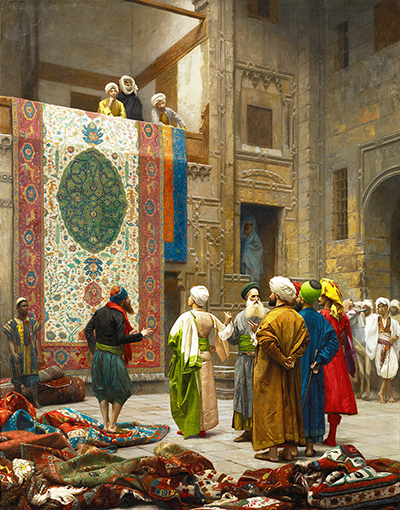
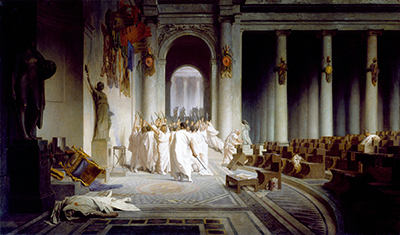
That finish has a narrative function. In The Death of Caesar, a broad expanse of pavement separates the corpse from the departing conspirators. In The Carpet Merchant, stone and textile provide competing systems of pattern and texture. In Tiger and Cubs, fur, rock and vegetation produce a different kind of looking: the viewer searches a natural setting rather than an archaeological one.
Gérôme could make complicated spaces unusually easy to read. Architecture often channels the eye towards an incident; a foreground figure may place the audience close to danger; empty ground may delay entry into the action. His viewpoint is therefore never a passive container. It decides who sees clearly, whose body is available for inspection and how near the viewer stands to violence or desire.
The polished result conceals much of the work that preceded it. Surviving drawings show changes of pose and composition. Oil studies may test atmosphere, colour or landscape. Photographs and collected objects could supply specific information. Gérôme then brought these materials together into a coherent fiction. His method rewards close looking, but it also requires readers to ask where the evidence ends and invention begins.[1][2]
Selected Gérôme Paintings
Use this visual list as a quick route into the main Gérôme painting pages.
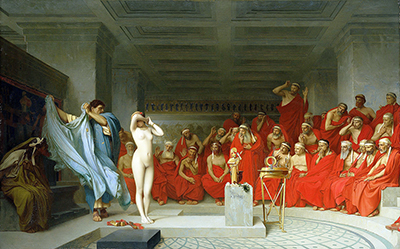
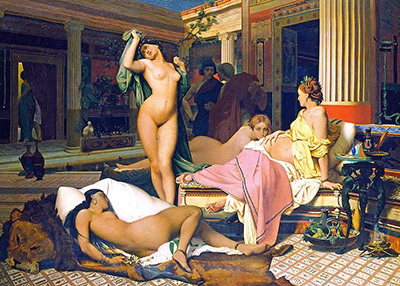
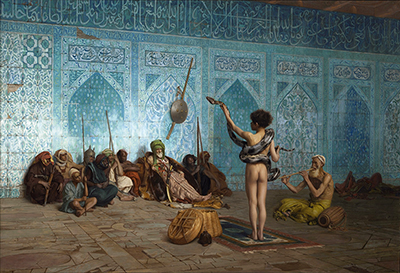
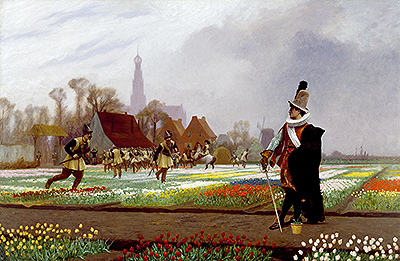
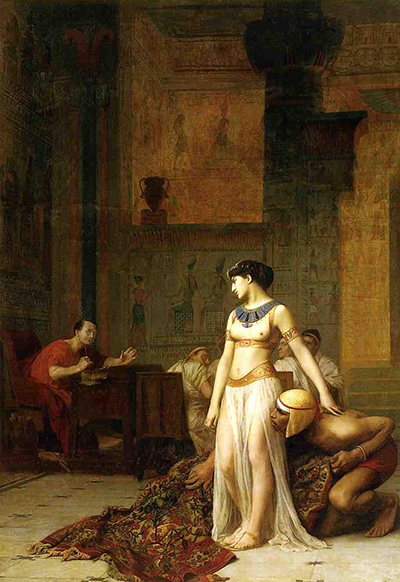
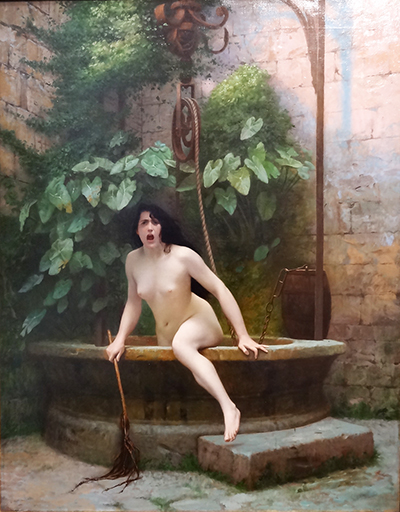




 Jean-Leon Gerome.jpg)


Early Néo-Grec Painting
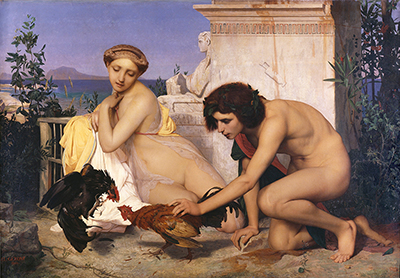
Gérôme's first major success came with Young Greeks Attending a Cock Fight, painted in 1846 and exhibited at the Salon the following year. The picture became closely associated with the Néo-Grec tendency. Instead of treating antiquity only as a source of heroic moral examples, Néo-Grec artists imagined its intimate spaces, entertainments and sensuous daily life.[1]
The young figures and fighting birds create a provocative contrast between human stillness and animal aggression. Archaeological and Mediterranean references make the setting plausible, but the work is a nineteenth-century fantasy about ancient beauty. Its appeal depends on historical distance: antiquity offers Gérôme a stage on which nudity, spectatorship and violence can appear both refined and immediate.
Other early works complicate the label. Greek Interior (The Gynaeceum) turns an imagined domestic interior into a scene of female display, while The Virgin, the Infant Jesus and Saint John brings a classicising visual language to Christian subject matter. La Bacchante, a tondo showing a woman with ram's horns, compresses classical allusion into a strange, concentrated head. The Néo-Grec was less a single formula than an early field in which Gérôme tested the attractions and dangers of making antiquity familiar.
Rome, the Arena and Archaeological Theatre
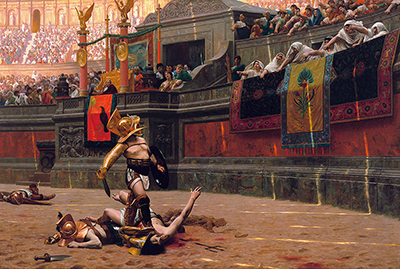
Gérôme's Roman paintings enlarge those concerns into public spectacle. Ave Caesar! Morituri te salutant presents gladiators saluting before combat. Pollice Verso shifts to the end of a contest, when the crowd demands the defeated fighter's death. The Christian Martyrs' Last Prayer places a threatened group within a vast arena assembled from different archaeological sources.
These pictures are often described as cinematic because their scale, staging and decisive moments resemble later screen spectacle. That resemblance should not replace historical analysis. Gérôme worked before cinema, but his images circulated widely through photography and reproduction, and scholars have examined how their legible action and framed viewpoints contributed to a modern culture of spectacle.[3]
His archaeological ambition did not guarantee accuracy. The meaning of the thumb gesture in Pollice Verso remains disputed, while the famous gladiators' salute in Ave Caesar rests on a fragile ancient textual foundation. Architecture and equipment could be selected from serious research yet rearranged to serve drama. The paintings reveal what Gérôme and his century wanted the ancient world to look like as much as they recover what it was.
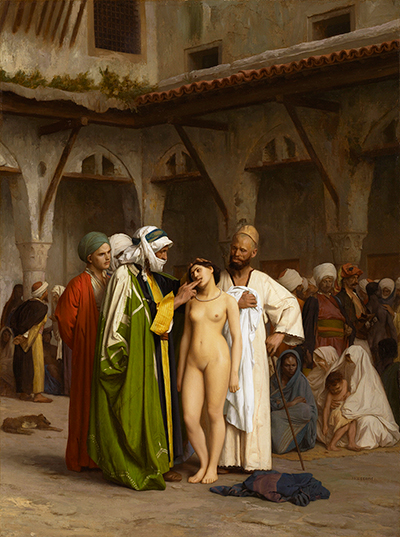
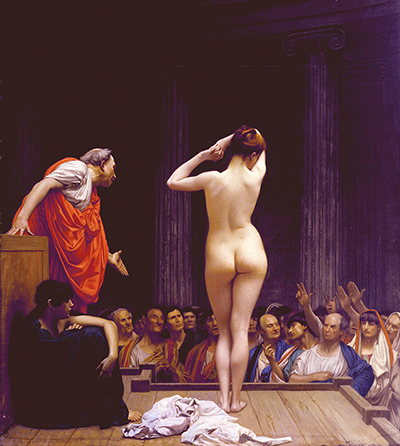
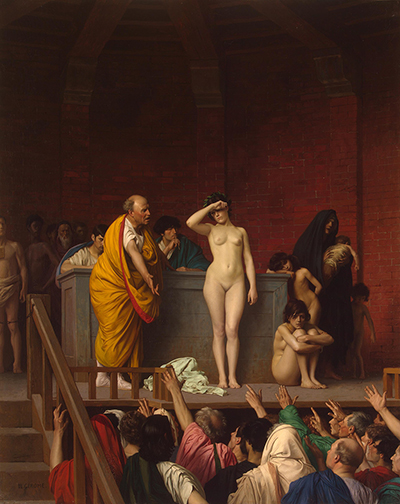
The Roman slave-market compositions make that theatre ethically acute. Gérôme painted three distinct markets: an Orientalist scene dated 1866 and two later works set in ancient Rome. In each, the display and inspection of a human body structure the composition. Historical distance does not neutralise that violence. The pictures ask the modern viewer to occupy a privileged position within a system of sale, exposure and unequal power.
History after the Decisive Moment
Not all Gérôme's history paintings depend on crowded action. Some of his most forceful compositions are built around absence.
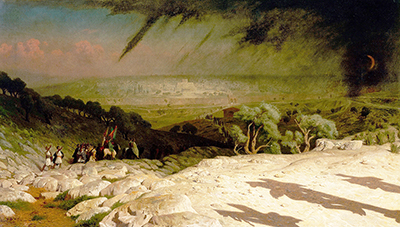
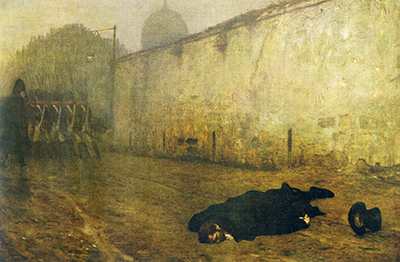
In The Death of Caesar, the assassination is over. The body lies on the floor while the killers exit beneath a raised statue. The Execution of Marshal Ney likewise shows an aftermath: Ney has fallen beside the wall against which he was shot, and the soldiers are already beyond the frame. Jerusalem, also known as Golgotha or Consummatum est, leaves the crucified figures unseen; their shadows reach across the foreground as spectators descend from the site.[4]
By withholding the event, Gérôme turns reconstruction into investigation. The viewer reads marks, bodies and spaces as evidence. Empty architecture acquires moral weight because it seems to retain what has happened there.
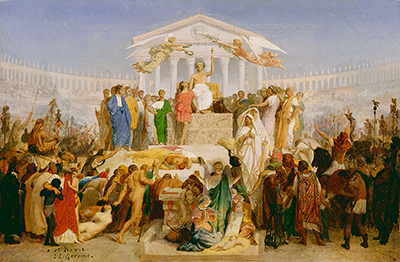
Other historical canvases operate through accumulation. The monumental Age of Augustus: The Birth of Christ gathers rulers, nations and allegorical figures around Augustus while the Nativity appears at the margin of the imperial vision. Reception of the Grand Condé by Louis XIV reconstructs a ceremony at Versailles through costumes, architecture and a carefully calibrated gesture of royal favour. Louis XIV and Molière gives visual life to a later court anecdote rather than a firmly documented event.
These paintings remind us that history painting transforms its evidence. Gérôme selected an account, assigned bodies and objects to it, and chose the instant through which later viewers would imagine the past.
Travel-Derived and Orientalist Paintings
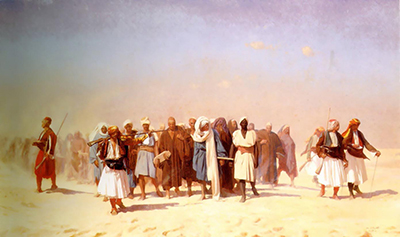
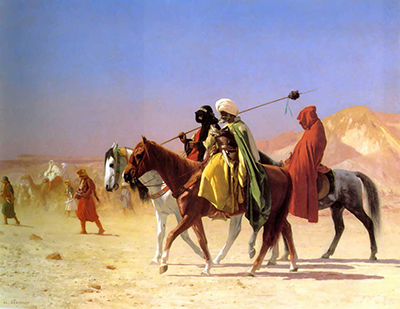
Gérôme travelled in Egypt and other parts of the Ottoman world, collecting visual material that supported decades of painting. Works such as Egyptian Recruits Crossing the Desert, Riders Crossing the Desert and The Two Majesties use open terrain, compressed horizons and intense light to organise bodies within landscape. Others move indoors: mosques, baths, markets and coffee houses offer dense architectural and material detail.[1][2]
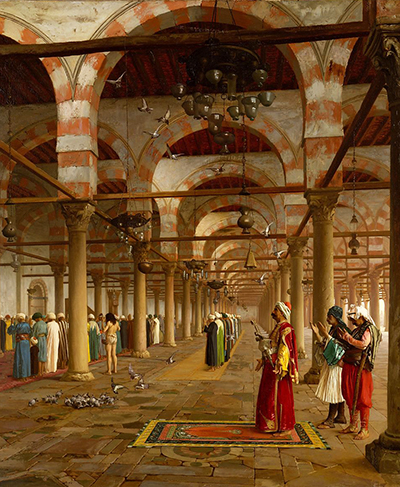
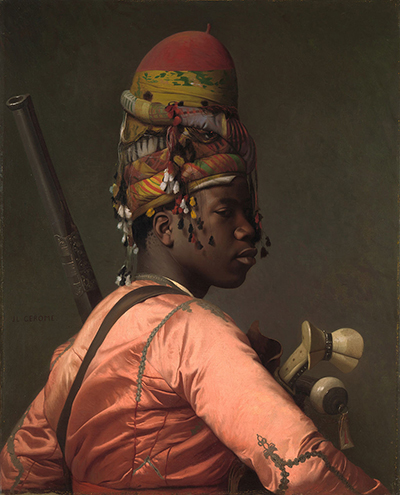
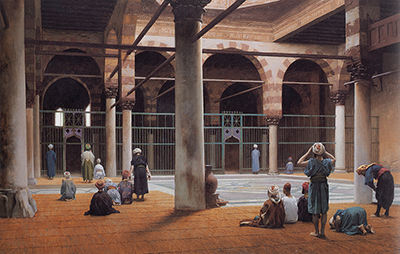
Travel is important evidence, but it cannot authenticate every scene. The Metropolitan Museum's Prayer in the Mosque incorporates architecture associated with the Mosque of Amr ibn al-As in Cairo, yet the group and service are composite. Cafe House, Cairo (Casting Bullets) received its activity title through a Goupil stock record; it should not be mistaken for witnessed political reporting. The studio portrait Bashi-Bazouk creates a military and cultural type from a model, clothing and weapons whose combination is itself an artistic construction.
This is the territory described by Orientalism. Nineteenth-century European and American audiences encountered North Africa, the Middle East and Ottoman societies through art produced within unequal imperial and commercial relations. Gérôme's images might contain closely studied architecture or objects while turning cultural difference into possession, fantasy or spectacle.[5]
Bath and harem paintings make that problem particularly visible. Pool in a Harem, Moorish Bath and The Great Bath at Bursa offer the presumed viewer access to spaces associated with women, privacy and bodily care. Such access was imagined for a predominantly male market. The erotic display of women—often differentiated through racialised roles—cannot be justified as neutral description merely because tiles, textiles or architecture look precise.
Mosque paintings require a related but distinct care. Prayer in the Mosque and the later Interior of a Mosque are separate works. Neither should turn Muslim worship into generic atmosphere. The task is to identify what can be tied to a place or practice, state what has been assembled, and recognise that a European painter and market determined the terms of visibility.
Paintings about Sculpture
Gérôme began exhibiting sculpture in the late 1870s, and the relationship between two and three dimensions became a major late-career subject. He did not stop painting in order to sculpt. Instead, each medium entered the imaginative world of the other.[1]
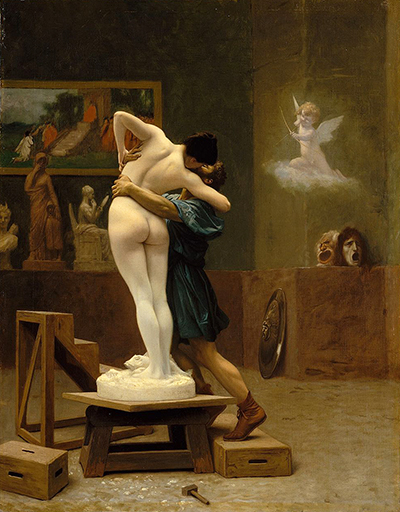
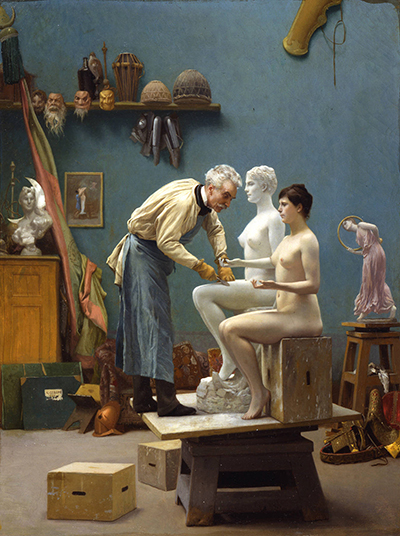
In Working in Marble, or The Artist Sculpting Tanagra, Gérôme depicts himself carving his large personification Tanagra. The workshop is recognisable yet highly staged, crowded with works that turn self-portraiture into a statement about artistic creation. The Antique Pottery Painter: Sculpturae vitam insufflat pictura shows colour being applied to sculptural figures. Its Latin subtitle declares that painting breathes life into sculpture.
The idea reaches its most spectacular form in Pygmalion and Galatea. A statue becomes flesh while embracing its maker. Gérôme made several painted versions from different viewpoints and a related polychrome marble. Seen together, they exploit a difference between media: sculpture can be walked around, while painting can show an impossible transformation from white material into coloured life.[6]
Colour carried an archaeological and narrative claim. Evidence that ancient sculpture had been painted challenged the later ideal of untouched white marble. Gérôme's experiments with pigmented wax joined archaeological curiosity to illusion and showmanship. They also returned him to a lifelong question: how does an artwork persuade us that inert material has become present?
Portraits, Types and Animals
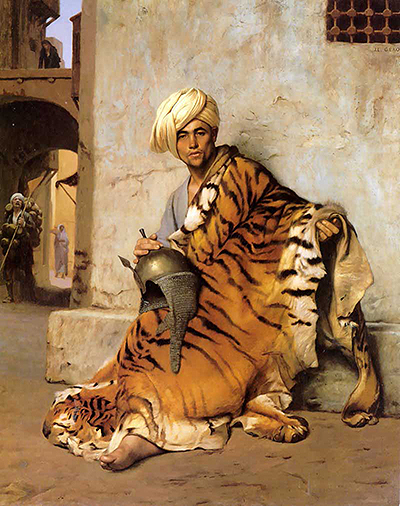
Some of Gérôme's paintings resist the broad narrative groups. Bashi-Bazouk is arranged like a portrait, but the sitter is unidentified and his elaborate costume creates a social type for the viewer. The Grief of the Pasha combines intimate emotion with a literary idea of rank, attachment and loss. The Pelt Merchant, Cairo exists in more than one autograph version, making title and date control essential before interpretation.
The animal paintings shift attention from human ceremony to watchfulness. Tiger on the Watch and Tiger and Cubs are distinct works, not interchangeable examples of an exotic wildlife theme. Their concentrated observation of posture, concealment and terrain shows Gérôme applying his controlled descriptive method outside the history painting for which he is best known.
Even here, apparent immediacy should not invite an invented story of firsthand encounter. A convincing tiger is evidence of pictorial study, not proof that Gérôme watched that exact animal in the wild. The same rule that governs architecture and costume governs nature: identify the object, distinguish evidence from inference and attend to how the composition manages the act of looking.
How to Read an Individual Painting
Begin with the museum facts: title, date, medium, dimensions, collection and accession number. Gérôme often revisited subjects, and similar English titles can conceal separate objects. His three slave markets, two Bashi-Bazouk paintings and several bath interiors must be identified before their details are compared.
Then ask what the composition makes visible. Where does it place the viewer? What has just happened, or is about to happen? Which textures and colours direct attention? Empty space can matter as much as crowded detail.
Finally, distinguish different kinds of evidence. A museum record establishes an object's identity. A surviving drawing can demonstrate preparation. A source text may explain a narrative tradition. A scholar's interpretation can illuminate ideology or spectatorship. None should be silently substituted for another.
Gérôme's paintings reward this layered approach. Their surfaces invite belief, while their construction teaches us to examine how belief is made.
Frequently Asked Questions
Discussion
Which detail in Jean-Léon Gérôme Paintings most changes how you read Gérôme's balance of spectacle, evidence and invention?
Reader Insights
Which detail in Paintings most changes how you read the scene's balance of evidence, staging and spectacle?
Set this page beside the Gérôme biography, paintings overview and related works to test how travel, studio practice and the Salon shaped the image.
What should a careful modern reading preserve, question or leave uncertain when looking at this work today?
Join the Conversation
Share a thoughtful observation about Paintings, Gérôme's method, or the wider context that would help another reader look more carefully.
References
- Musée d'Orsay. “The Spectacular Art of Jean-Léon Gérôme (1824–1904).” Exhibition presentation, 19 October 2010–23 January 2011 View source.
- J. Paul Getty Museum. “The Spectacular Art of Jean-Léon Gérôme.” Exhibition overview, 2010 View source.
- Marc Gotlieb. “Gérôme's Cinematic Imagination.” In Scott Allan and Mary Morton, eds., Reconsidering Gérôme, pp. 54–64. Los Angeles: J. Paul Getty Museum, 2010 View source.
- Musée d'Orsay. “Jerusalem.” Collection record, RF 1990 7 View source.
- Jennifer Meagher. “Orientalism in Nineteenth-Century Art.” Heilbrunn Timeline of Art History, The Metropolitan Museum of Art, October 2004 View source.
- The Metropolitan Museum of Art. “Pygmalion and Galatea.” Collection record, 27.200 View source.