

 by Tom Gurney
Tom Gurney BSc (Hons) is an art history expert with over 20 years experience
Published on June 19, 2020 / Updated on August 21, 2026
Email: tomgurney1@gmail.com / Phone: +44 7429 011000
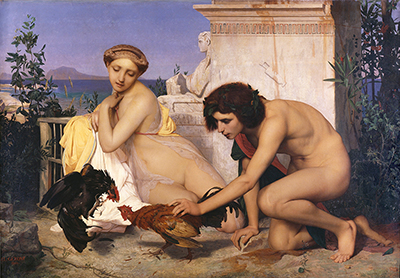
Two adolescents rest beside a fountain while fighting birds clash at their feet. Their bodies are poised and still; the cocks lunge with feathers raised. Behind them, the damaged profile of a sphinx looks towards a luminous sea. Jean-Léon Gérôme's Young Greeks Attending a Cock Fight sets youth, beauty and Mediterranean light against violence, age and death.
Painted in 1846 and exhibited at the Salon of 1847, the canvas made the young Gérôme famous. It became a defining work of the Néo-Grec tendency, which brought ancient life closer through intimate, archaeological and sometimes provocative subjects. Gérôme did not present a heroic event from Greek history. He imagined an ordinary entertainment with the finish and scale of an ambitious Salon painting.[1][2]
Its success was substantial but not unanimous. Théophile Gautier praised its drawing, animation and colour, while Charles Baudelaire attacked Gérôme as weak and artificial.[1] The disagreement began a long debate over whether Gérôme's precision revived history painting or reduced it to polished spectacle.
At a Glance
- ArtistJean-Léon Gérôme
- Institutional titleJeunes Grecs faisant battre des coqs
- English titleYoung Greeks Attending a Cock Fight
- Alternative titleUn combat de coqs / The Cock Fight
- Date1846
- MediumOil on canvas
- Dimensions143 × 204 cm (56 5/16 × 80 5/16 in.)
- CollectionMusée d'Orsay, Paris
- AccessionRF 88[1]
Youth and Violence
The human figures occupy the centre but do not generate the action. The young man kneels or leans towards the fight, while the young woman sits beside the fountain. Their poses create a stable, gently curving group.
The birds supply a different energy. They face one another low in the composition, their aggressive movement compressed against the calm bodies above. The fight may appear minor beside the adolescents, yet one bird's imminent injury or death gives the title its meaning.
Gérôme's contrast is not only between people and animals. It is between spectators and participants. The young Greeks can watch violence without receiving it, much as the Salon audience could admire the painted contest from a safe distance.
Their youth intensifies the theme. Smooth skin, balanced poses and clear light suggest vitality. The birds' struggle introduces mortality into the same space. Gérôme makes beauty more fragile by placing conflict at its feet.
The relationship need not be reduced to a moral allegory with one fixed answer. The cockfight can be a genre detail, a symbol of rivalry, an erotic counterpart or a reminder of death. Its pictorial job is certain: it disturbs the stillness of the idealised bodies.
The Sphinx and the Landscape
A damaged sphinx appears behind the young figures. Its chipped profile and weathered material contrast with living skin. The Musée d'Orsay also draws attention to the opposition between lush vegetation and dead branches on the ground.[1]
These details create a sequence of time: youthful bodies, a violent present and an ancient object already marked by decay. The scene's Mediterranean brightness does not remove mortality; it makes every surface visible.
The sea and sky open the background beyond the enclosed fountain. Light colours and clear atmosphere became associated with Néo-Grec painting. Rather than the dark gravity expected from traditional history painting, Gérôme offers an antiquity of sunlight, leisure and sensation.[1][2]
The setting looks archaeological without identifying one documented place. Fountain, sphinx, vegetation and coastline create an invented ancient environment. Their specificity supplies credibility, but the gathering remains a nineteenth-century reconstruction.
What Was Néo-Grec Painting?
The Néo-Grecs were an informal circle of young artists active around the late 1840s. They were interested in a newly intimate vision of classical antiquity informed by archaeology, decorative objects and the everyday rather than only heroic literature.[2]
Gérôme's painting became an emblem of the movement because it combines a minor subject with ambitious finish. Cockfighting is not a foundational myth or exemplary act of citizenship. It is an episode of private leisure elevated to a large canvas.
The approach challenged the hierarchy of genres. Traditional academic theory placed history painting above scenes of ordinary life. Néo-Grec art brought anecdote into the classical world and used antiquity to give genre scenes cultural status.
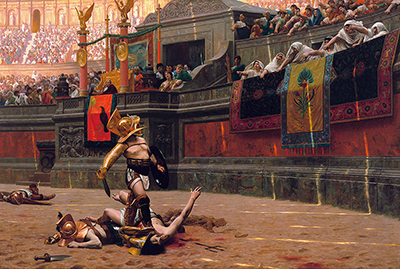
Critics could admire the freshness and skill or complain that accessories, colour and archaeological detail displaced moral seriousness. This tension followed Gérôme throughout his career. His later Roman spectacles and Orientalist interiors would also be praised for conviction and criticised for turning history or cultural difference into display.
The Néo-Grec episode itself was brief, but it helped loosen the visual language of antiquity. Ancient people could be shown as young, idle, sensuous, amused or cruel—not only as marble embodiments of civic virtue.
A Career Made at the Salon
Gérôme painted the work after failing to win the Prix de Rome, the competition that could have sent him to the French Academy in Rome. According to the Musée d'Orsay, he feared another rejection and hesitated to submit the canvas until his teacher Paul Delaroche encouraged him.[1]
The response at the 1847 Salon established him as a major new talent while he was still in his early twenties. Public exhibition mattered because the Salon gathered artists, critics, officials, collectors and large crowds. A single work could create a reputation.
Gautier saw remarkable skill in Gérôme's drawing, animation and colour. Baudelaire instead associated him with an artificial and overly sharp tendency he called the “school of the pointed.”[1] Their disagreement went beyond competence to what finish and archaeological elegance should accomplish.
The painting's subsequent provenance confirms its official standing. The French state acquired it in 1873 from Adolphe Goupil for the Musée du Luxembourg, the museum devoted to living artists, and it later entered the national collections now represented at the Musée d'Orsay.[1]
The route from uncertainty to national acquisition makes the canvas a genuine career threshold.
Looking at the Young Figures
Modern viewers should approach the figures' age and nudity carefully. The museum describes them as adolescents, and the painting idealises their largely uncovered bodies.[1] Gérôme uses classical distance to place youthful beauty before an adult Salon audience.
The young woman sits with a degree of composure; the young man leans towards the fight. Their positions create a contrast between bodily display and absorbed attention. Neither acknowledges the viewer.
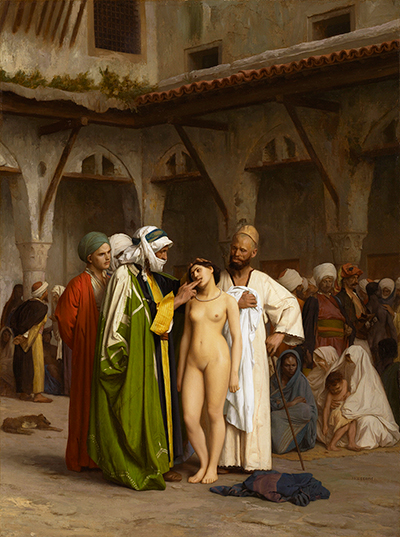
This lack of reciprocal gaze is characteristic of Gérôme's spectacles. The audience can examine bodies and action without being examined in return. Here the setting is quieter than a slave market or arena, but the privilege of looking remains.
It is possible to discuss sensuousness without sexualising the adolescents. Their bodies belong to the work's structure of youth, vulnerability and classical idealisation. The analysis should remain with what the painting makes visible and the audience for whom it did so.
Finish, Colour and Control
The painting already demonstrates qualities associated with Gérôme's mature art: smooth handling, carefully differentiated materials, sharp contours and a staged viewpoint.
Pale bodies stand against landscape and architecture without dissolving into them. Clear colour keeps the scene bright, while the birds concentrate darker movement below. Gérôme controls the eye across a large horizontal field.
The surface also conceals uncertainty. Nothing appears searched for or revised. Ancient setting, youthful bodies and fighting birds share one finished world.
This completeness helped make Gérôme's antiquity persuasive. It also generated criticism from viewers who preferred visible energy, emotional depth or less conspicuous archaeological arrangement. The very qualities that launched his career contained the terms of later resistance.
Artist Up Close
Begin with the birds. Their compressed aggression is easy to overlook beneath the larger human figures, but it supplies the scene's immediate danger.
Then move from the adolescents' unmarked skin to the damaged sphinx. Gérôme places living youth before an object already eroded by time.
Finally, compare the dead branches with the lush plants and clear sea. Small oppositions between growth and decline spread the cockfight's mortality through the whole landscape.
Frequently Asked Questions
Discussion
Which detail in Young Greeks Attending a Cock Fight most changes how you read Gérôme's balance of spectacle, evidence and invention?
Reader Insights
Which detail in Young Greeks Attending a Cock Fight most changes how you read the scene's balance of evidence, staging and spectacle?
Set this page beside the Gérôme biography, paintings overview and related works to test how travel, studio practice and the Salon shaped the image.
What should a careful modern reading preserve, question or leave uncertain when looking at this work today?
Join the Conversation
Share a thoughtful observation about Young Greeks Attending a Cock Fight, Gérôme's method, or the wider context that would help another reader look more carefully.
References
- Musée d'Orsay. “Jeunes Grecs faisant battre des coqs.” Collection record, RF 88 View source.
- Musée d'Orsay. “The Spectacular Art of Jean-Léon Gérôme (1824–1904).” Exhibition presentation, section “The Néo-Grec Episode.” View source.