

 by Tom Gurney
Tom Gurney BSc (Hons) is an art history expert with over 20 years experience
Published on June 19, 2020 / Updated on August 21, 2026
Email: tomgurney1@gmail.com / Phone: +44 7429 011000
Jean-Léon Gérôme lived long enough to become both a pillar of the French art establishment and an emblem of everything its challengers wished to overthrow. He emerged in the 1840s with intimate, provocative visions of antiquity; won state commissions and international honours; travelled through Egypt and Ottoman territories; taught at the École des Beaux-Arts for four decades; and built a late career in sculpture. His paintings reached an audience far larger than the people who saw them at the Salon because the firm of Goupil reproduced and sold his images across Europe and the United States. By the end of the nineteenth century, few French artists were more recognisable.
That success did not make Gérôme easy to admire, even during his lifetime. Critics attacked his polished finish, theatrical narratives and commercial reach. He opposed the institutional acceptance of Impressionism and came to represent an academic system from which the history of modern art would soon turn away. His Orientalist paintings created compelling visions of North Africa and the Ottoman world, but their persuasive detail often served scenes constructed for Western viewers—scenes shaped by fantasy, unequal access and the power relations of the colonial century.
Gérôme's biography is therefore not a simple rise, fall and recovery. It is the story of an artist who defended tradition while embracing photography and modern reproduction; who demanded disciplined observation yet assembled many of his most convincing worlds in a Paris studio; and whose art remains technically dazzling, culturally influential and ethically contested. Those tensions are not distractions from his life. They are the reason it continues to matter.[1][2][3]
At a Glance
- Born11 May 1824, Vesoul, Haute-Saône, France
- Died10 January 1904, Paris, France
- FieldsPainting, sculpture and teaching
- Principal early teacherPaul Delaroche
- Early breakthroughYoung Greeks Attending a Cock Fight, Salon of 1847
- Major subjectsClassical antiquity, French history, religious history, Orientalist scenes, studio allegory and animals
- Professor at the École des Beaux-ArtsFrom 1864
- Elected to the Académie des Beaux-Arts2 December 1865
- Major teaching publicationCharles Bargue and Jean-Léon Gérôme, Cours de dessin, 1867–70
- First exhibited sculptureThe Gladiators, 1878
- Late-career concernsPolychrome sculpture, artistic creation, photography and the exchange between painting and three-dimensional form[1][2][4]
Childhood in Vesoul and the Journey to Paris
Gérôme was born in Vesoul, a town in eastern France, into a prosperous merchant family. The surviving outlines of his childhood are more reliable than the colourful destiny stories that later fame can attract. He showed an aptitude for drawing, completed his baccalauréat and left for Paris while still a teenager. The Bibliothèque nationale de France places this move immediately after his schooling; modern sources variously date his arrival to around 1840 or 1841.[1]
Paris offered an aspiring painter a dense structure of ateliers, museums, competitions and personal alliances. Gérôme entered the studio of Paul Delaroche, one of the most prominent history painters of the day. Delaroche's importance went beyond instruction in drawing and composition. His paintings made the past emotionally immediate by selecting a charged incident, constructing a believable setting and bringing famous figures down to human scale. Rather than treating history only as an elevated moral example, he could make it unfold like theatre.
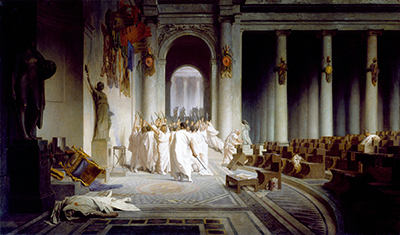
Gérôme absorbed that lesson deeply. Across his career, he repeatedly chose the instant before or after the expected climax: Caesar's body after the assassins have turned away, Marshal Ney after the firing squad has begun to leave, the shadows of the Crucifixion rather than Christ on the cross. The historical world is made tangible through objects, bodies and architecture, but its force often depends on the moment the artist withholds.
Delaroche's atelier was also a network. Gérôme met artists and photographers whose careers would follow very different paths. This matters because painting and the young medium of photography were not sealed worlds. The friendships, experiments and systems of reproduction developing around Delaroche helped form the visual culture in which Gérôme would later prosper.[2]
Italy, Gleyre and a Failed Prize
In 1843 Gérôme followed Delaroche to Italy. The journey gave him direct experience of Rome, Pompeii and the ancient sites farther south. A large drawing of Paestum now at the Metropolitan Museum of Art grew from studies made in this period and shows how long those encounters remained active in his imagination.[5]
The Italian journey did not provide the official prize that young French artists most coveted. Back in Paris, Gérôme worked in the teaching environment of Charles Gleyre, who had taken over Delaroche's atelier. Gleyre placed drawing, careful modelling and the preparation of each figure at the centre of his instruction. His pupils included artists as different as the Néo-Grecs, James McNeill Whistler and several future Impressionists. The range is a useful warning against assuming that one atelier produced one inevitable style.[6]
In 1846 Gérôme attempted the Prix de Rome and failed. The competition could fund years of study at the French Academy in Rome, and defeat was a serious disappointment. He began Young Greeks Attending a Cock Fight in the wake of that result. According to the Musée d'Orsay, he hesitated to expose himself to another public judgment, but Delaroche encouraged him to send the picture to the Salon of 1847.[7]
The result transformed his prospects. Two young people sit beside fighting cocks in a luminous Mediterranean setting. The human bodies are poised and still; the birds enact the violence from which the figures appear momentarily detached. Archaeological reference, sensuality and threat coexist within a picture that is intimate rather than monumental. Some critics admired its novelty, while others considered its mingling of genre painting, erotic suggestion and classical subject matter dangerous to the dignity of history painting.[2][7]
The picture made Gérôme a leading figure among the artists called the Néo-Grecs. This was a loose circle, not a school governed by a manifesto. Its members imagined the domestic, decorative and sensuous life of antiquity with an archaeological attention that could be learned and playful at once. Their work blurred the border between history painting and scenes of everyday life. Gérôme's early reputation was thus established through a kind of rule-breaking, even though he would later be remembered as a guardian of rules.
From Néo-Grec Intimacy to Official History Painting
The Néo-Grec label explains only the beginning of Gérôme's development. In the late 1840s and early 1850s he tested classical language across religious, mythological and domestic subjects. He also learned that archaeological detail could perform several jobs at once: locate a scene in time, reward an educated viewer and give imagined behaviour the authority of fact.
His ambitions soon increased in scale. In 1852 he received the state commission that became The Age of Augustus: The Birth of Christ, an enormous composition completed for the Exposition Universelle of 1855. The work gathers rulers, peoples and allegorical figures around Augustus, while the Nativity appears at the margin of the imperial assembly. It was a formidable problem of hierarchy and synthesis: many bodies, different costumes and distant historical claims had to become readable within a single painted world.[19]
The commission placed Gérôme securely within official culture, but official success never meant critical peace. His history paintings asked viewers to enjoy exactly what sceptics distrusted: polished reconstruction, learned detail and clear narrative. At the Salon of 1859, where he exhibited major Roman subjects, Charles Baudelaire attacked the use of erudition and the conversion of ordinary anecdote into ancient costume. Later, Émile Zola would treat Gérôme's art as cold calculation adapted to commercial reproduction.[2]
These objections identify real features but do not exhaust them. Gérôme's historical scenes can be surprisingly oblique. The Death of Caesar disperses attention across an emptied floor and a departing group. Jerusalem, or Golgotha, keeps the crosses outside the upper edge of the image and lets their shadows enter the viewer's space. The Execution of Marshal Ney turns a recent, politically charged death into a stark aftermath. The artist's clarity is often used to produce uncertainty: we can see the material setting, but we arrive too late to master the event.
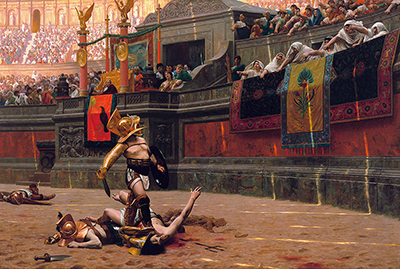
His Roman arena paintings approach history differently. Ave Caesar! Morituri te salutant, Pollice Verso and The Christian Martyrs' Last Prayer turn spectatorship itself into a subject. Crowds judge, demand and consume violence. The modern museum viewer is offered an extraordinarily privileged view, close enough to inspect the bodies and the machinery of spectacle. Gérôme's historical imagination was not only about what happened. It was about who was allowed to watch.
Constantinople, Egypt and the Desire to Travel
Gérôme made a short visit to Constantinople in 1853. In 1856 he undertook his first extended journey in Egypt, travelling in Cairo and along the Nile with companions who included the sculptor Auguste Bartholdi. Further journeys followed through Egypt, the Holy Land, Asia Minor and other parts of the Ottoman world. The itineraries supplied drawings, photographs, costumes, weapons, textiles and architectural observations that could remain useful for years.[1][2][18]
Travel changed Gérôme's career. Paintings derived from the 1856 journey helped establish the Orientalist subjects for which he became internationally famous. Open desert, intense light, Islamic architecture and carefully differentiated dress gave his art a new visual field. Yet the word “derived” is crucial. Gérôme did not simply transfer witnessed scenes to canvas.
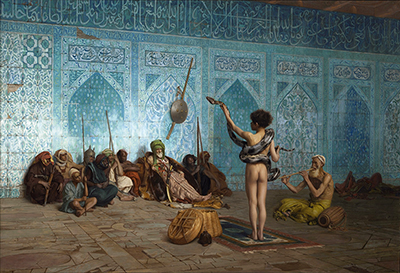
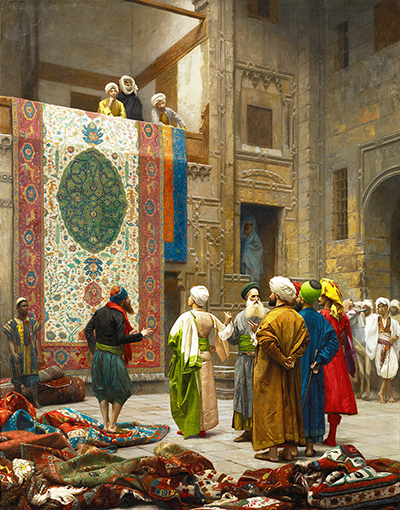
His paintings were normally composed in Paris. A finished interior could combine architecture remembered or photographed in one place, tiles associated with another, objects held in the studio and figures posed by models. The smooth surface united those pieces so completely that invention could look like observation. The Musée d'Orsay describes this as a balance between exact detail and an expected, imaginary “Orient.”[2]
Orientalism was a broad nineteenth-century field in which European and American artists represented North Africa, the Middle East and Ottoman societies. Some travelled extensively; others imagined those regions from afar. Their work could record objects, buildings and encounters with real precision. It also developed within imperial expansion, colonial rule, collecting and a market that expected sensuality, violence, timelessness and difference.
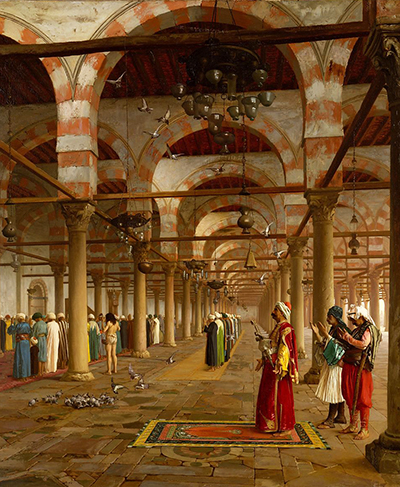
Gérôme's biography should therefore not present travel as a certificate of authenticity. A mosque painting may contain identifiable Cairene architecture while rearranging worshippers into a service the artist did not witness as shown. A bath or harem scene may describe tile, fabric and metal with astonishing care while imagining access to women's space for a predominantly male Western audience. Costumes may be studied closely while the unidentified sitter becomes a social or ethnic “type.”[9][15]
The Metropolitan Museum of Art's 2026 exhibition Orientalism: Between Fact and Fantasy expands this history by stressing movement across the Mediterranean and Atlantic worlds. Europeans and Americans did not act alone: Ottoman and other Middle Eastern artists, patrons, collectors and designers participated in the modern circulation of objects and styles. Recognising that agency makes the picture richer, but it does not remove the unequal power that shaped who represented whom, for which audience and under what political conditions.[9]
The 1868 Expedition and Photography
One of Gérôme's best-documented journeys began in 1868 and passed through Egypt, Sinai, Jordan and Palestine. His brother-in-law Albert Goupil assembled an album of seventy-seven albumen prints connected with the expedition. These photographs belong to a larger body of evidence through which travel, collecting and image-making became interdependent.[1]
Photography served Gérôme in more than one way. It could preserve architectural and topographical information, record people or objects, and widen the resources available in the studio. Photographs also reproduced his own finished work, turning paintings held in private collections into images that circulated internationally. By the end of his life, he was making photographs part of his thinking about artistic truth itself.
This interest complicates the familiar opposition between academic painting and modern technology. Gérôme's surfaces were unlike the broken brushwork of Impressionism, but his career was inseparable from new ways of making, storing and distributing images. Photography did not force him to abandon invention. It gave invention a growing archive of visible facts.
Adolphe Goupil, Marriage and the International Art Market
In 1859 Gérôme formed a close relationship with the dealer and publisher Adolphe Goupil. In 1863 he married Goupil's daughter Marie. The family connection was important, but it should not be used as a shortcut that makes every later achievement a product of marriage. Gérôme was already a successful Salon painter, and Goupil was not merely a relative arranging private sales. The firm connected original paintings, publishing, photographic reproduction and an expanding international market.[2][3]
This network changed what fame could mean. A canvas might appear briefly at the Salon and then disappear into a private collection, yet an engraving or photograph after it could continue to sell. Buyers who would never own the original could recognise the scene. American collectors became especially important to Gérôme's market, and many major paintings eventually entered museums in the United States.
The clarity of his compositions helped them survive changes of scale and medium. A raised thumb, a fallen body or the silhouette of Napoleon before the Sphinx could remain legible in reproduction. Their lives extended beyond the uniqueness of oil on canvas.
Critics noticed. Zola's complaint that Gérôme worked for Goupil and made pictures to be sold in thousands of copies attacked both the finish and the system around it. Commercial calculation is part of the story, but the relationship between market and form is more interesting than an accusation of selling out. Gérôme belonged to a moment when the Salon, the dealer, photography, engraving and the collector's home formed an interconnected visual economy. His career demonstrates how a nineteenth-century painting could become a modern mass image.[2][11]
Marriage also tied Gérôme's domestic life to an artistic and business dynasty. Jean-Léon and Marie Gérôme raised a family, and their household became linked through the next generation to artists and dealers. The Goupil connection brought family, friendship and professional circulation unusually close together, although the record does not license invented private motives.
Professor at the École des Beaux-Arts
Gérôme was appointed professor at the École des Beaux-Arts in 1864, as official ateliers were being established within the reorganised school. On 2 December 1865 he was elected to the Académie des Beaux-Arts, occupying Fauteuil III in the painting section. The two positions consolidated his authority: he was not only a successful practitioner but a participant in the institutions that trained artists and distributed honour.[1][4]
His atelier attracted French and international students for the rest of his life. H. Barbara Weinberg's study documents more than 150 Americans who enrolled under him. Thomas Eakins studied principally with Gérôme during nearly three years in Paris before returning to Philadelphia. George de Forest Brush spent years in the same academic environment. Edwin Lord Weeks, Kenyon Cox, Abbott Handerson Thayer and others carried aspects of French training into markedly different American careers.[10][13]
The international network was wider than the United States. Osman Hamdi Bey, who became a major Ottoman painter, museum director and archaeologist, trained in Paris with Gérôme and Gustave Boulanger.[17] Near the end of Gérôme's life, Fernand Léger attended as an unenrolled student after being rejected for formal admission to the École. Léger's later Cubist language was not an extension of Gérôme's, and his brief attendance should not be mistaken for profound influence. It does, however, disrupt the idea of two artistic generations that never touched.[14]
Academic instruction placed drawing at the foundation of the artist's work. Students progressed through casts, the construction of form and study from the living model. Criticism in the atelier could be exacting because an unclear contour or an unconvincing weight shift was understood as a structural failure, not a decorative blemish.
The system also embodied exclusions. Access to official training, especially study from nude models, was shaped by gender and institutional rules. The prestige of Gérôme's atelier should not be confused with equal opportunity. Nor should the later achievements of individual pupils be treated as evidence that the school determined every choice they made.
Gérôme's influence is best understood as a common technical language used for different ends. Eakins applied rigorous figure construction to contemporary American life. Orientalist painters developed travel-derived subjects of their own. Some pupils became teachers; some moved towards styles their master opposed. A studio can transmit habits of looking without producing a family of copies.
The Bargue–Gérôme Drawing Course
Between 1867 and 1870 Goupil published the three parts of the Cours de dessin under the names of the lithographer Charles Bargue and Gérôme. The plates move from isolated features and casts through master drawings towards exercises concerned with the living model. They break complex seeing into stages: proportion, contour, light, shade and the construction of volume.[8]
The course is often called the Bargue–Gérôme method, but it was not a stenographic record of everything Gérôme said in the atelier. Bargue played a substantial role in making the plates, Goupil provided the publishing system, and the sequence belonged to a wider academic culture of learning through copies. Its importance lies partly in its portability. A model of Parisian instruction could travel as lithographs, extending pedagogical authority beyond the school itself.
Copying in this context was not intended as the opposite of invention. It trained eye and hand before the student tackled a complex composition. Gérôme's own art repeatedly demonstrates that distinction. He could study an object or body closely and then place it within a scene that never existed. Observation supplied a vocabulary; composition made the argument.
Power, Spectacle and the Position of the Viewer
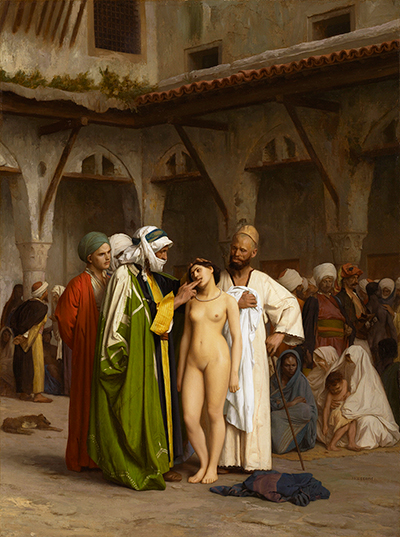
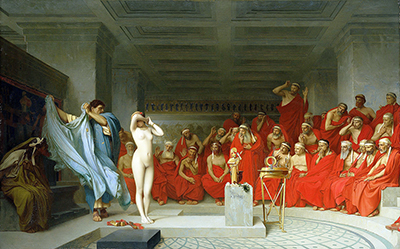
Gérôme's mature paintings often centre on public acts of judgment. An emperor watches gladiators. A court judges Phryne while her body is exposed before them. Buyers inspect enslaved people. Louis XIV measures favour through a gesture on a palace staircase. A crowd, tribunal or market converts looking into power.
The viewer's position is rarely innocent. Gérôme gives us a clear, carefully organised sightline, then uses that access to implicate us in the event. In Pollice Verso, the drama is not only the wounded gladiator; it is the appetite of the spectators above him. In Phryne before the Areopagus, the woman's nudity is staged through the reactions of a male assembly. In the slave-market paintings, the aesthetic display of the body cannot be separated from the fiction of inspection and sale.
This helps explain why Gérôme's art became so important to later studies of spectatorship, gender and Orientalism. The pictures do not merely contain troubling subjects. Their visual intelligence makes the privilege of looking pleasurable. Smooth finish, convincing objects and controlled viewpoints allow a viewer to feel present without being vulnerable.
The same mechanism operates in less overtly violent works. A mosque interior can offer Western audiences access to worship; a bath scene can open a gendered space; a studio painting can let admirers watch the artist create. Biography, market and form converge in a recurring pattern: travel gathers visual material, the studio reconstructs it, and reproduction distributes it.
Gérôme Becomes a Sculptor
In 1878 Gérôme exhibited The Gladiators, which the Musée d'Orsay identifies as his first sculpture. He was fifty-four and already famous. Sculpture was therefore neither youthful apprenticeship nor a quiet retirement. It became a second major public practice that changed the subjects of his painting.[2]
The earliest sculptural work extended a painted image into three dimensions: the victorious and defeated gladiators developed the central group of Pollice Verso. Soon the traffic ran both ways. Sculptures appeared within paintings; studio scenes represented Gérôme working on his own statues; painted versions of sculptural subjects offered viewpoints and transformations unavailable to an object in the round.
Around 1890 Tanagra brought these concerns together. The large personification referred to the small ancient terracotta figurines excavated in Greece. Gérôme represented himself sculpting it in Working in Marble, surrounding the act with other works and tools. The studio became both workplace and theatre of artistic identity.
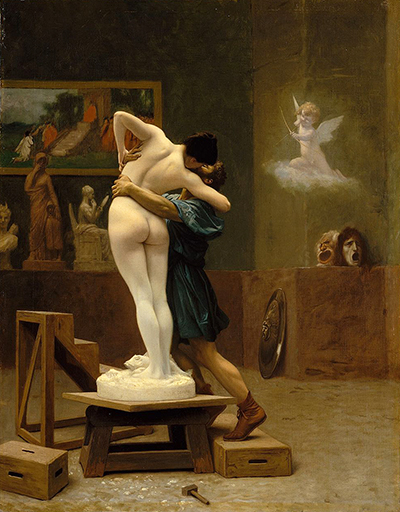
The myth of Pygmalion offered an even more direct subject. Gérôme made multiple paintings of the moment when a sculpted woman becomes flesh, as well as a related polychrome marble. In the Metropolitan Museum's version, the body shifts from pale material towards living colour as Galatea turns to embrace her maker. Paint can show the instant of transformation that sculpture, however lifelike, can only imply.[12]
Colour was central to Gérôme's later sculpture. Archaeological evidence had long challenged the fantasy that ancient Greek and Roman sculpture was always unpainted white marble. Gérôme used pigmented wax on marble and produced coloured versions and reductions. His results were imaginative modern works, not scientifically exact restorations of lost ancient appearances. Even so, polychromy allowed him to question where sculpture ended and living presence began.[2][3]
Critics could find these coloured marbles theatrical, erotic or vulgar. Collectors found them compelling. Their reproduction in different sizes and materials also continued the commercial logic familiar from his paintings. The late sculptor remained the maker of images who understood multiplication.
An Opponent of Impressionism Who Embraced Photography
From the 1870s onward, Gérôme publicly resisted the institutional recognition of Impressionism and other newer art. He believed in drawing, controlled form, finish and standards maintained through established institutions. As artists who challenged those values gained ground, his position hardened. He became a visible representative of official opposition.[1][3]
That stance had consequences for his reputation. Later histories of modern art often told a story moving from Manet and Impressionism towards the avant-garde. Within that story, Gérôme appeared as the losing side: anecdotal rather than formally radical, commercially popular rather than critically prophetic, polished rather than visibly experimental.
Yet his relation to modernity was more tangled than that opposition suggests. He used photographs as visual resources, benefited from photomechanical circulation and took a keen interest in the capacity of the camera to change sight. In a 1902 preface to Émile Bayard's Le Nu esthétique, he declared photography an art and argued that it had forced artists to abandon old routines and look at things previously unseen.[1]
This does not make Gérôme a secret avant-gardist or cancel his hostility to Impressionism. It reveals that “modern” can describe more than one history. Modernity included new paint handling, but also industrial reproduction, global markets, photographic archives and mass audiences. Gérôme resisted one modern art while participating brilliantly in another modern visual culture.
His late work makes that contradiction especially vivid. Polychrome sculpture looked back to antiquity through contemporary archaeology and modern fabrication. Studio allegories revived Pygmalion while turning artistic labour into a self-conscious spectacle. Photography was praised as truth while painting continued to manufacture impeccable fictions. Gérôme's conservatism was genuine, but it was not simple stasis.
Final Years and Death
Gérôme continued to paint, sculpt and teach into his final years. The elderly artist remained institutionally powerful even as the artistic world around him changed. Fernand Léger's brief presence as a free student is an apt final detail: the academic master and a future modernist occupied the same educational space without sharing a common destination.[1][14]
His increasing commitment to sculpture did not mean that painting ceased. The two practices had become interdependent. He continued to picture studios, statues, models and acts of animation, while authorising sculptural reductions and pursuing the difficult surfaces of polychrome marble.
Gérôme died in Paris on 10 January 1904. The Musée d'Orsay notes that he was still working on Corinth, an elaborate female personification that became his final sculptural testament.[2] Later accounts embellished the scene of his death with paintings and symbolic gestures. Such recollections belong to the making of his legend, not to the small group of facts that can be stated without qualification.
He left a body of work spread unusually widely across media and collections. Paintings that had entered American private collections later moved into museums; reproductions preserved compositions whose originals were inaccessible; pupils carried academic training into institutions far from Paris. His influence was a network of objects, images, people and teaching practices rather than a single line of style.
Reputation after 1904
Gérôme's critical standing declined through much of the twentieth century. Academic history painting lost prestige, and the polished narrative picture became an easy foil for the formal innovations of modernism. His popularity and relationship with Goupil could be cited as evidence that the art was merely commercial. Orientalist subjects were often admired for technique without sustained attention to the histories of empire and representation on which they depended.
The reassessment that began in earnest in the later twentieth century did not simply restore an old master to a pedestal. Gerald M. Ackerman's catalogue and biographical research established a foundation for identifying the works and reconstructing the career. Major exhibitions and publications then brought different questions to the material. Scholars examined the relation between painting and photography, the international market, the theatrical reconstruction of history, the politics of Orientalism, the erotic display of bodies and the persistence of Gérôme-like spectacles in later visual culture.[2][16]
This scholarship made the apparent truth of a Gérôme painting a subject of analysis. How does a smooth surface make a composite scene feel witnessed? Why is the viewer given this particular access? Which observed objects support a broader fantasy? How did reproduction turn a private painting into an internationally recognised image?
The questions also prevent “rehabilitation” from becoming a claim that earlier criticism was simply mistaken. Gérôme's Orientalist paintings remain bound to unequal systems of looking. His scenes of slavery and erotic exposure can make violence available as aesthetic pleasure. His institutional opposition to newer artists was not invented by later historians. Serious study does not require acquittal.
Nor does criticism require indifference to the art. Gérôme organised complex scenes with exceptional control. He understood the narrative force of an empty floor, a withheld event and a crowd's glance. He could make paint impersonate marble, skin, silk, dust and metal, then use coloured marble to imitate living flesh. He recognised that an image gains power not only from what it represents but from how widely and memorably it circulates.
That is why his work has returned so forcefully to discussions of the nineteenth century. Gérôme stands at the meeting point of the academy and mass culture, archaeology and fantasy, travel and studio invention, handmade object and mechanical reproduction. His pictures do not merely show spectacles. They reveal the systems that make spectacle persuasive.
A Concise Jean-Léon Gérôme Timeline
- 1824: Born in Vesoul on 11 May.
- ca. 1840–41: Moves to Paris and enters Paul Delaroche's studio.
- 1843: Travels to Italy with Delaroche.
- 1846: Fails in the Prix de Rome competition and begins Young Greeks Attending a Cock Fight.
- 1847: The painting succeeds at the Salon; Gérôme becomes closely associated with the Néo-Grecs.
- 1852–55: Works on the state-commissioned Age of Augustus for the 1855 Exposition Universelle.
- 1853: Makes a short visit to Constantinople.
- 1856: Undertakes his first extended Egyptian journey.
- 1859: Exhibits major Roman subjects and begins a close relationship with Adolphe Goupil.
- 1863: Marries Marie Goupil.
- 1864: Becomes a professor at the École des Beaux-Arts.
- 1865: Elected to the Académie des Beaux-Arts on 2 December.
- 1867–70: The three parts of the Bargue–Gérôme Cours de dessin are published.
- 1868: Leads a journey through Egypt, Sinai, Jordan and Palestine connected with Albert Goupil's photographic album.
- 1878: Exhibits The Gladiators, his first sculpture.
- ca. 1890: Develops Tanagra, Pygmalion and Galatea and sustained experiments with polychromy.
- 1902: Publishes his positive statement on photography in Bayard's Le Nu esthétique.
- 1903–04: Fernand Léger attends as an unenrolled student.
- 1904: Dies in Paris on 10 January while Corinth remains in progress.
Frequently Asked Questions
Discussion
Which detail in Jean-Léon Gérôme Biography: Artist, Teacher and Maker of Modern Spectacle most changes how you read Gérôme's balance of spectacle, evidence and invention?
Reader Insights
Which detail in Biography: Artist and Teacher most changes how you read the scene's balance of evidence, staging and spectacle?
Set this page beside the Gérôme biography, paintings overview and related works to test how travel, studio practice and the Salon shaped the image.
What should a careful modern reading preserve, question or leave uncertain when looking at this work today?
Join the Conversation
Share a thoughtful observation about Biography: Artist and Teacher, Gérôme's method, or the wider context that would help another reader look more carefully.
References
- Bibliothèque nationale de France. Jean-Léon Gérôme (1824–1904): bibliographie sélective. February 2025 View source.
- Musée d'Orsay. “The Spectacular Art of Jean-Léon Gérôme (1824–1904).” Detailed exhibition presentation, 2010 View source.
- J. Paul Getty Museum. “The Spectacular Art of Jean-Léon Gérôme.” Exhibition overview, 2010 View source.
- Académie des Beaux-Arts. “Jean-Léon Gérôme.” Authority record View source.
- The Metropolitan Museum of Art. “Paestum.” Collection record, 2021.15.1 View source.
- Musée d'Orsay. “Charles Gleyre (1806–1874): The Reformed Romantic.” Exhibition presentation, 2016 View source.
- Musée d'Orsay. “Young Greeks Attending a Cock Fight.” Collection record View source.
- Charles Bargue and Jean-Léon Gérôme. Cours de dessin. Three parts. Paris: Goupil, 1867–70. Gallica, Bibliothèque nationale de France: Part 1, Part 2, Part 3, View source 1 View source 2 View source 3.
- The Metropolitan Museum of Art. “Orientalism: Between Fact and Fantasy.” Exhibition and press material, 2026 View source.
- H. Barbara Weinberg. The American Pupils of Jean-Léon Gérôme. Fort Worth: Amon Carter Museum, 1984. Bibliographic record: View source.
- J. Paul Getty Trust. “The Goupil Stock Books Project.” Getty News, 2016 View source.
- The Metropolitan Museum of Art. “Pygmalion and Galatea.” Collection record, 27.200 View source.
- The Metropolitan Museum of Art. “Thomas Eakins (1844–1916): Painting.” Heilbrunn Timeline of Art History View source.
- The Metropolitan Museum of Art. “Fernand Léger (1881–1955).” Heilbrunn Timeline of Art History View source.
- Jennifer Meagher. “Orientalism in Nineteenth-Century Art.” Heilbrunn Timeline of Art History, The Metropolitan Museum of Art, 2004 View source.
- Scott Allan and Mary Morton, eds. Reconsidering Gérôme. Los Angeles: J. Paul Getty Museum, 2010 View source.
- Marjorie Shelley. “The Later Ottomans and the Impact of Europe.” Heilbrunn Timeline of Art History, The Metropolitan Museum of Art, 2004 View source.
- Sarah Lees, ed. “Jean-Léon Gérôme, Snake Charmer.” In Nineteenth-Century European Paintings at the Sterling and Francine Clark Art Institute, vol. 1, cat. 154. Williamstown, MA: Sterling and Francine Clark Art Institute, 2012 View source.
- Musée de Picardie, Amiens. “Jean-Léon Gérôme, The Age of Augustus: The Birth of Christ.” Collection dossier View source.