

 by Tom Gurney
Tom Gurney BSc (Hons) is an art history expert with over 20 years experience
Published on June 19, 2020 / Updated on August 21, 2026
Email: tomgurney1@gmail.com / Phone: +44 7429 011000
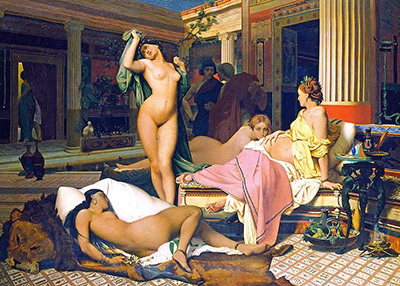
Women gather in an imagined ancient domestic room. Drapery, furniture and carefully posed bodies turn everyday interior life into a learned reconstruction of Greece. Jean-Léon Gérôme's Greek Interior, also known as The Gynaeceum, belongs to the intimate archaeological fantasies of the Néo-Grec movement.
The full painting was shown at the Paris Salon of 1850–51, measured 64 × 88 centimetres and is now of unknown location. The Musée d'Orsay owns a much smaller oil-on-wood study dated 1848. That study helps document the composition, but it is not the missing Salon canvas.[1][2]
This distinction governs the entire page. The route concerns the full work; the surviving Orsay object supplies evidence of preparation, not replacement metadata.
At a Glance
- ArtistJean-Léon Gérôme
- TitleGreek Interior
- Alternative titleThe Gynaeceum / Scene in a Gynaeceum
- Full paintingExhibited at the Salon of 1850–51, no. 1257
- MediumOil painting
- Dimensions64 × 88 cm
- Current locationUnknown
- CatalogueAckerman 29
- Related studyMusée d'Orsay RF 1981 46; 1848; oil on wood; 15.5 × 21 cm[1][2]
The Full Painting and the Orsay Study
Small studies can become better known than lost finished works because they remain accessible in museums. That reversal creates a metadata trap.
The Orsay panel is signed and dedicated in 1848. The museum labels it explicitly as a study for the painting exhibited in 1850–51.[2]
It measures only 15.5 by 21 centimetres. The Salon canvas was approximately four times larger in each linear dimension, with a surface vastly greater than the study.
The study establishes the early arrangement: a group of women, nude and draped bodies, a table and an antique-style interior.[2] It cannot tell us every colour, finish or adjustment in the full work.
For that reason, close description must use conditional language. Features visible in the study informed the composition; they are not automatically proof of the missing canvas's final state.
What Is a Gynaeceum?
The term gynaeceum derives from Greek words associated with women and the household. In later writing it commonly denotes women's quarters or the female area of an ancient Greek home.
The label can create the impression of one standard room universally separated from male space. Ancient houses varied across region, period, wealth and use, while literary ideals do not always map neatly onto surviving architecture.
Gérôme's title should therefore be understood as a nineteenth-century way of framing the scene. It tells viewers that they are entering a gendered domestic interior, but it does not supply an archaeological floor plan.
The room is organised to make private life visible to a public Salon audience. Its supposed seclusion becomes the condition of display.
That contradiction is essential: the painting invites viewers into a space defined as not ordinarily open to them.
The Néo-Grec Project
The Néo-Grecs were a loose circle of young French artists who emerged around the late 1840s. They sought a fresh image of antiquity through archaeological detail, refined colour and intimate anecdote.[3]
Instead of representing only gods, battles and civic virtue, they painted games, interiors, courtship and small incidents. The ancient world became domestic and sensuous.
The Musée d'Orsay describes their approach as an attempted archaeological break with vague Greco-Roman convention, while also noting contemporary criticism of its precious accessories and genre-like subjects.[3]
Greek Interior fits that experiment. Its title promises antiquity, but its attraction lies in bodies sharing a room.
History painting is brought to human scale. The viewer learns less about a named event than about how the nineteenth century imagined ancient daily life.
Archaeology and Invention
Furniture, vessels, textiles and costume could be informed by excavated objects, illustrated publications and museum collections. Each accurate accessory helped build credibility.
No surviving evidence can recover an entire ancient social encounter. Gérôme had to decide who occupied the room, how bodies related and which moment would appear meaningful.
The result combines knowledge with invention. Archaeology supplies fragments; composition makes them coexist.
This process is not unique to Gérôme. All historical reconstruction moves between evidence and interpretation. His smooth finish, however, can hide the join.
The better the room appears complete, the easier it is to forget that its completeness belongs to 1848–50 rather than ancient Greece.
Looking and the Gendered Interior
The grouping of clothed and unclothed women places the canvas within a history of images made for viewers assumed to be male. Domestic privacy becomes visual access.
The title helps naturalise that access. If this is “the gynaeceum,” nudity and seclusion can appear to be cultural information rather than choices made by the painter.
Modern interpretation should keep those choices visible. Gérôme arranged bodies, sightlines and furniture for the Salon.
The women may interact within the room, but they cannot control the outside audience. Their private space has been opened by art.
This does not prevent close attention to gesture or colour. It asks why an imagined female interior was attractive to nineteenth-century public culture.
From Study to Salon
The two-year interval between the dated study and the Salon provides evidence of development. Gérôme established the idea in 1848 and presented the full canvas in the 1850–51 Salon season.[1][2]
The Salon record gives the full work institutional visibility even though its present location is unknown. It also fixes a public date that should not be confused with the study's creation.
Exhibition altered scale and audience. A small working panel could be held close; the larger canvas addressed a crowded public display.
Its refined antique subject helped consolidate Gérôme's identity after the success of Young Greeks Attending a Cock Fight. Both works turn antiquity into a carefully staged encounter among youthful bodies.
The lost painting belongs to a decisive early phase, before Gérôme's major Orientalist and Roman spectacles.
What Can Be Said when an Artwork Is Missing?
An unknown current location does not mean a painting never existed. Salon catalogues, dimensions, catalogue-raisonné entries and preparatory works preserve its historical identity.
It does mean that condition, support, final colour and details cannot be checked directly today.
A responsible manuscript separates three levels: facts about the full canvas, observations from the study and broader interpretation of the composition.
That transparency gives the reader more, not less. The history of survival becomes part of the artwork's story.
Greek Interior now exists publicly through records and related objects. The absence of the final canvas should remain visible rather than being silently filled by a museum study.
Artist Up Close
When looking at the Orsay study, begin with the largest blocks of light, drapery and flesh. At this scale, relationships matter more than finish.
Then trace the table and room boundaries. They organise bodies into a domestic rather than monumental setting.
Finally, remember the size difference. Imagine how much more information the 64 × 88 cm Salon canvas could have carried, while resisting the urge to invent it.
Frequently Asked Questions
Discussion
Which detail in Greek Interior (The Gynaeceum) most changes how you read Gérôme's balance of spectacle, evidence and invention?
Reader Insights
Which detail in Greek Interior (The Gynaeceum) most changes how you read the scene's balance of evidence, staging and spectacle?
Set this page beside the Gérôme biography, paintings overview and related works to test how travel, studio practice and the Salon shaped the image.
What should a careful modern reading preserve, question or leave uncertain when looking at this work today?
Join the Conversation
Share a thoughtful observation about Greek Interior (The Gynaeceum), Gérôme's method, or the wider context that would help another reader look more carefully.
References
- French Ministry of Culture, POP/Joconde. “Intérieur grec.” Notice 000PE028369, cross-reference to Salon 1850–51 no. 1257 and the unlocated full painting View source.
- Musée d'Orsay. “Léon Gérôme, Intérieur grec.” Collection record for the 1848 study, RF 1981 46 View source.
- Musée d'Orsay. “Jean-Léon Gérôme (1824–1904): The Spectacular Art of Jean-Léon Gérôme,” section “The Neo-Greek Episode.” 2010 exhibition presentation View source.