


 by Tom Gurney
Tom Gurney BSc (Hons) is an art history expert with over 20 years experience
Published on June 19, 2020 / Updated on August 21, 2026
Email: tomgurney1@gmail.com / Phone: +44 7429 011000
The Grand Condé climbs the Ambassadors' Staircase at Versailles as Louis XIV waits above. Condé bows; the king reaches towards him; courtiers, guards, flags and marble architecture turn a meeting between cousins into a public ceremony of power.
Jean-Léon Gérôme painted Reception of the Grand Condé by Louis XIV (Versailles, 1674) in 1878. The title identifies Louis II de Bourbon, Prince of Condé, known as the Grand Condé—not an unspecified “Prince Condé.” He was a celebrated commander who had also rebelled against royal authority during the Fronde.[1]
The composition presents reconciliation as hierarchy. Louis XIV appears gracious, but he stands above. Condé returns in triumph after military victory, yet he must ascend towards the king who controls his restoration.
At a Glance
- ArtistJean-Léon Gérôme
- TitleReception of the Grand Condé by Louis XIV (Versailles, 1674)
- Date1878
- MediumOil on canvas
- Dimensions96.5 × 139.7 cm (38 × 55 in.)
- CollectionMusée d'Orsay, Paris
- AccessionRF 2004 15
- Depicted eventVersailles, 1674[1]
The Gesture on the Staircase
The scene is built around two movements. Condé advances upward while Louis extends an arm downward. Their gestures almost bridge the architectural and political distance between them.
The king's welcome appears generous. Gérôme shows him moving forward rather than remaining rigidly enthroned. Yet the staircase ensures that Condé approaches from below.
This vertical relation turns etiquette into image. Rank is not an abstract rule; it is built into the floor. Louis controls the landing, the assembled court and the moment at which exile becomes acceptance.
Condé's bow acknowledges that control. His military reputation may enter the palace with him, but royal favour determines his place within it.
Around the central pair, courtiers perform attention. Their clothing and positions create a frame of witnesses. Reconciliation is effective because it is seen.
Gérôme makes the event legible from a low viewpoint. We look up with Condé, though from outside his precise path. The angle enlarges the staircase and gives the king's landing ceremonial force.[1]
The Grand Condé and the Fronde
Louis II de Bourbon, Prince of Condé, earned fame as a military commander during the Thirty Years' War. During the Fronde, the series of civil conflicts that challenged royal government while Louis XIV was young, Condé turned against the crown.
He later fought for Spain and remained outside France before being formally reconciled with Louis XIV. The Musée d'Orsay describes the 1674 reception as ending an exile of nearly fifteen years.[1]
The immediate context was Condé's role at the Battle of Seneffe against forces led by William of Orange. The battle was costly and tactically disputed, but Condé returned with renewed prestige. Gérôme chooses the royal welcome rather than the battlefield.
This selection transforms complicated political history into one controlled gesture. Rebellion, exile, foreign service and military recovery arrive at the point where the king can absorb them.
The work therefore celebrates Condé while confirming Louis' supremacy. A great subject is made greater by being received; a great king demonstrates power by showing favour.
Versailles Reconstructed
The Ambassadors' Staircase was one of the grand ceremonial approaches to the royal apartments at Versailles. It was altered and eventually demolished in the eighteenth century, long before Gérôme painted the scene.[2]
According to the Musée d'Orsay, Gérôme used engraved views of Versailles and portraits of the people represented to make the event plausible.[1] The interior is a reconstruction built from images of a lost space.
This source-based method resembles archaeological history painting even though the subject is relatively recent. Gérôme treats seventeenth-century court architecture as a vanished world requiring recovery.
The polished marble, painted decoration, flags and costumes create a dense field of information. Their coherence can make the room appear witnessed. In fact, Gérôme selected and reorganised surviving visual evidence.
The low angle is unlikely to be a neutral copy of an engraving. It is a dramatic decision. Architecture becomes a machine for elevating royal authority.
The painting's historical truth is therefore layered: documented people and event, lost architecture reconstructed through sources, and a viewpoint invented to explain power.
Colour within Marble
Much of the staircase is pale and cool. Gérôme uses marble to give the court an atmosphere of permanence and control. Against it, uniforms, flags and court dress provide concentrated reds, blues and golds.
The colour makes people legible without dissolving the architecture's dominance. Condé and Louis can be found quickly, but the eye continues through guards, courtiers and decorative surfaces.
The cross-like diagonal structure identified by the Musée d'Orsay energises the scene.[1] One axis follows the staircase; another links the principal figures and surrounding movement.
Gérôme's finish serves etiquette. Every garment and gesture appears in its correct place. There is little visible disorder, despite the turbulent history preceding the encounter.
That transformation is political. The Fronde's challenge to monarchy has been converted into ceremony. The painting makes absolutism look like visual harmony.
From Intended Buyer to Vanderbilt
Gérôme hoped to sell the canvas to the duc d'Aumale, who was developing the Château de Chantilly, closely associated with the Condé family. The transaction did not take place.[1]
The work instead went through Goupil to the American millionaire William H. Vanderbilt in 1878. It was lent to the Metropolitan Museum of Art from 1886 to 1903, while engravings spread its reputation in France.[1]
This provenance gives the painting a second history of status. A French image of royal ceremony became a prestigious object for an American industrial fortune.
The transfer does not make Vanderbilt equivalent to Louis XIV, but it shows why the work appealed internationally. Its subject joins military fame, aristocratic reconciliation, lost architecture and concentrated luxury.
Reproduction widened the audience beyond the original owner. Gérôme's carefully legible staging allowed a canvas in New York to remain familiar in France.
The Musée d'Orsay acquired the work at auction in 2004, restoring a major example of Gérôme's French history painting to a national collection.[1]
History as a Decisive Moment
No photograph or transcript can recover the exact gestures of the 1674 meeting. Gérôme's king and prince embody the relationship history requires them to express.
Louis' extended hand combines forgiveness and command. Condé's approach combines triumph and submission. The court converts a personal encounter into public order.
The scene is therefore credible without being documentary. Gérôme uses an instant to explain a political structure.
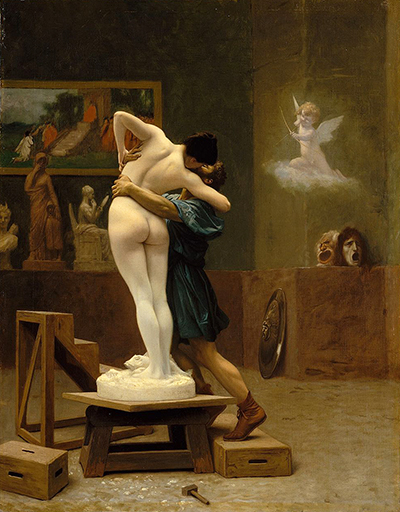
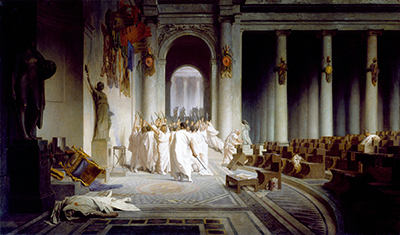
This method differs from his aftermath paintings. Ney and Caesar appear after power has acted violently. Condé appears at the moment power reintegrates a former opponent.
In each case, spatial arrangement makes history intelligible. The staircase is as important to reconciliation as the wall is to Ney's execution.
Artist Up Close
Begin with the gap between Louis' hand and Condé's bow. The unresolved space holds pardon, hierarchy and anticipation.
Then follow the stairs down. Notice how every step increases the king's physical and political elevation.
Finally, look away from the principals to the witnesses. Ceremony requires an audience, and Gérôme distributes rank through every posture.
Frequently Asked Questions
Discussion
Which detail in Reception of the Grand Condé by Louis XIV most changes how you read Gérôme's balance of spectacle, evidence and invention?
Reader Insights
Which detail in Reception of the Grand Condé by Louis XIV most changes how you read the scene's balance of evidence, staging and spectacle?
Set this page beside the Gérôme biography, paintings overview and related works to test how travel, studio practice and the Salon shaped the image.
What should a careful modern reading preserve, question or leave uncertain when looking at this work today?
Join the Conversation
Share a thoughtful observation about Reception of the Grand Condé by Louis XIV, Gérôme's method, or the wider context that would help another reader look more carefully.
References
- Musée d'Orsay. “Réception du Grand Condé par Louis XIV (Versailles, 1674).” Collection record, RF 2004 15 View source.
- Château de Versailles. “The Ambassadors' Staircase.” Historical account of the lost ceremonial staircase and its decoration View source.