

 by Tom Gurney
Tom Gurney BSc (Hons) is an art history expert with over 20 years experience
Published on June 19, 2020 / Updated on August 21, 2026
Email: tomgurney1@gmail.com / Phone: +44 7429 011000
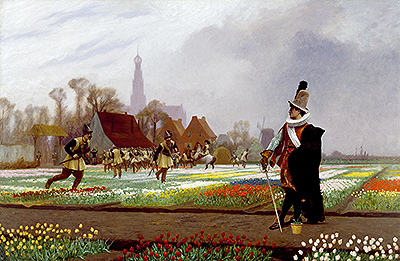
Soldiers trample a tulip bed while one swordsman stands between them and a single exceptional flower. Church architecture rises behind the confrontation. Jean-Léon Gérôme's The Tulip Folly turns market scarcity into physical action: destroy ordinary bulbs to protect value, or defend the rare bloom against organised force.
Painted in 1882, the scene evokes the Dutch tulip trade of the 1630s. Gérôme was looking back nearly two and a half centuries, and the episode behaves like a historical parable rather than a neutral record.[1]
The solitary defender may be brave, absurd or both. His sword gives him authority, but he is outnumbered. The flower he protects is precious precisely because value has become detached from everyday scale.
At a Glance
- ArtistJean-Léon Gérôme
- TitleThe Tulip Folly
- Date1882
- MediumOil on canvas
- Dimensions65.4 × 100 cm (25 3/4 × 39 3/8 in.)
- CollectionThe Walters Art Museum, Baltimore
- Accession37.2612
- Depicted settingHaarlem, with the Sint-Bavokerk identified by the museum[1]
One Flower against a Crowd
The composition depends on imbalance. A single man and bloom face a larger armed group.
Gérôme makes the flower visually small but narratively enormous. Once the title is known, every figure's action points back to it.
The swordsman forms a vertical barrier. His upright posture opposes the soldiers' forward movement and the flattened plants underfoot.
Weapons introduce the language of battle into horticulture. Steel is drawn over a flower, allowing economic conflict to masquerade as military history.
The Walters notes that the approaching clash remains unresolved.[1] Gérôme stops before violence determines whether conviction is courage or folly.
Destroying Supply to Defend Value
The museum interprets the soldiers as trampling beds in an attempt to limit supply and stabilise the market.[1] That explanation turns their apparent vandalism into economic policy.
If rarity sustains price, destroying common bulbs may protect valuable ones. Gérôme gives this abstract relation a brutal physical form.
The logic is deliberately paradoxical. Flowers are cultivated only to be crushed; value survives through waste.
The defender interrupts that calculation. He treats one bloom as something whose worth requires preservation, not managed scarcity.
Yet the painting does not tell us whether he loves the flower, owns it or hopes to profit from it. Moral motive remains as speculative as market value.
What Happened in the 1630s?
Tulips reached western Europe from the Ottoman world in the sixteenth century. In the Dutch Republic, unusual varieties—especially visually dramatic “broken” blooms—became prized among growers, connoisseurs and traders.[1][2]
During the winter of 1636–37, contracts for some bulbs changed hands at rapidly rising prices. The trade then faltered sharply, leaving disputes over promised purchases and payment.
Popular retellings made the episode a national madness in which people from every class ruined themselves. Modern archival scholarship led by Anne Goldgar offers a narrower, more complex picture: participation was concentrated in connected groups, knowledge and honour mattered alongside money, and the damage was not a general collapse of the Dutch economy.[2]
It is therefore unhelpful to call tulip trading simply the “first speculative bubble” and stop there. Prices, contracts, rarity, trust and later moral storytelling all belong to the history.
Gérôme painted one of those later moral stories. His title already tells us that the market was folly.
Haarlem Reconstructed
The Walters identifies the setting with Haarlem and the Sint-Bavokerk.[1] The recognisable church locates the parable within Dutch civic space.
Its permanence contrasts with the fragile flower and unstable price. Stone architecture belongs to generations; tulip value can rise and fall within a season.
The church also raises moral associations without requiring a specific religious event. The confrontation occurs under the visual presence of a major communal institution.
Gérôme's setting is a nineteenth-century reconstruction of a seventeenth-century moment. Architectural recognition makes the invented clash feel historically anchored.
That method resembles his French and Roman history paintings. A credible place supports a compressed episode designed to explain a larger system.
A Nineteenth-Century Financial Parable
The Walters suggests that Gérôme's original audience could find parallels with financial instability in its own time.[1]
By 1882, industrial capitalism, international markets and periodic crashes had made speculation a familiar modern anxiety. Dutch tulips provided a safely distant costume for the question.
The painting does not analyse financial institutions. It turns them into characters: armed authority, defiant owner and threatened commodity.
That simplification is why the image works as a parable. Viewers can recognise the absurdity of protecting value through destruction without understanding a seventeenth-century contract.
It is also why the canvas should not replace economic history. Gérôme supplies moral clarity where the archive supplies negotiation, social networks and uncertainty.
Hero, Fool or Speculator?
The defender's posture belongs to history painting. He stands as though guarding a city, sovereign or sacred object.
The tulip reduces and intensifies that heroism. If the flower represents beauty threatened by economic violence, he appears noble. If it represents an irrationally priced asset, he appears ridiculous.
Gérôme does not resolve the ambiguity. The title The Tulip Folly may condemn the entire market, the destructive authorities, the isolated defender or all three.
The man's sword cannot determine a price. It can only protect the physical object on which belief has settled.
This gap between force and confidence gives the scene lasting relevance. Markets depend on collective agreement, while the painting shows individuals trying to command that agreement with weapons.
Flowers, Soldiers and Gendered Power
The work stages a traditionally delicate subject—cultivated flowers—through masculine military action. That contrast drives much of its humour and tension.
Soldiers usually defend territory. Here they invade a garden. The swordsman usually guards people or honour. Here he guards a bloom.
The mismatch exposes the violence hidden in apparently abstract decisions about supply and value.
At the same time, Gérôme makes the flower passive. It cannot express beauty or worth; men project both upon it and fight over the projection.
The tulip becomes commodity, emblem and hostage in the same instant.
The Finished Canvas and Its Study
The Walters holds the 1882 finished painting as accession 37.2612. The museum also records a related study for the composition.[1]
A study documents preparation but is not a smaller duplicate of the finished object. Its support, dimensions and degree of resolution have their own record.
The distinction matters because Gérôme's apparent spontaneity was planned. Figures and movements developed before the final canvas fixed the confrontation.
The completed work later passed through prominent American collections and entered the Walters in 1983 through the gift of Mrs Cyril W. Keene.[1]
Its history shows how a Dutch financial parable became an American museum object a century after it was painted.
Artist Up Close
Begin with the protected flower and compare its size with the swords around it. Narrative value, not physical scale, makes it dominant.
Then follow the soldiers' movement across the damaged beds. Their direction turns economic control into an advancing force.
Finally, look up to the church. Architecture stabilises a scene about unstable belief.
Frequently Asked Questions
Discussion
Which detail in The Tulip Folly most changes how you read Gérôme's balance of spectacle, evidence and invention?
Reader Insights
Which detail in The Tulip Folly most changes how you read the scene's balance of evidence, staging and spectacle?
Set this page beside the Gérôme biography, paintings overview and related works to test how travel, studio practice and the Salon shaped the image.
What should a careful modern reading preserve, question or leave uncertain when looking at this work today?
Join the Conversation
Share a thoughtful observation about The Tulip Folly, Gérôme's method, or the wider context that would help another reader look more carefully.
References
- The Walters Art Museum. “Jean-Léon Gérôme, The Tulip Folly.” Collection record, 37.2612 View source.
- Anne Goldgar. Tulipmania: Money, Honor, and Knowledge in the Dutch Golden Age. Chicago: University of Chicago Press, 2007. Publisher overview: View source.