


 by Tom Gurney
Tom Gurney BSc (Hons) is an art history expert with over 20 years experience
Published on June 19, 2020 / Updated on August 21, 2026
Email: tomgurney1@gmail.com / Phone: +44 7429 011000
A small group kneels in prayer at the centre of an enormous arena. Lions and other beasts enter from the edges. Figures bound to crosses burn along the perimeter, while tiered seats rise towards an ancient cityscape. Jean-Léon Gérôme's The Christian Martyrs' Last Prayer suspends catastrophe at the moment before the central victims are attacked.
The painting occupied Gérôme for twenty years. William T. Walters commissioned it in 1863; the finished canvas was delivered in 1883. That long interval did not produce a single archaeologically consistent Rome. The Walters Art Museum shows that Gérôme combined the Circus Maximus, Colosseum-like seating, an Athenian-looking hill and forms of martyrdom not documented together in that place. Historical detail was subordinated to a larger drama of faith under spectacle.[1]
The result is not an eyewitness reconstruction of one persecution. It is a nineteenth-century Christian history painting built from ancient evidence, inherited martyr traditions and Gérôme's mastery of the arena.
At a Glance
- ArtistJean-Léon Gérôme
- TitleThe Christian Martyrs' Last Prayer
- Date1863–83
- MediumOil on canvas
- Dimensions87.9 × 150.1 cm (34 5/8 × 59 1/8 in.)
- CollectionWalters Art Museum, Baltimore
- AccessionAcquired by William T. Walters, 1883; 37.113
- Commission historyCommissioned in 1863 and delivered twenty years later[1]
The Still Centre and the Moving Threat
Gérôme places prayer at the compositional centre. The martyrs gather closely, their bodies lowered and attention directed inward or upward. They form a compact human island within a huge field of danger.
Around them, movement enters from several directions. Animals cross the sand; flames rise at the boundary; the architecture expands outward and upward. The central group does not run. Their stillness becomes the action by which faith is represented.
The arena floor creates a long delay between victims and threats. Gérôme gives the viewer time to measure distance and anticipate contact. Violence has begun around the perimeter, but its arrival at the centre remains suspended.
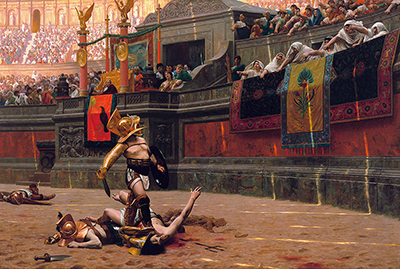
This spacing produces suspense without showing an attack. Like Pollice Verso, the painting concerns the instant before a death stroke. Unlike the gladiator scene, its central figures refuse the arena's logic. They do not perform for survival or appeal to the crowd; they pray.
Their small scale is crucial. Physical power belongs to animals, fire and imperial architecture. Spiritual resolve appears through collective vulnerability.
A Twenty-Year Commission
William T. Walters, the Baltimore collector whose family collection formed the Walters Art Museum, commissioned the painting in 1863 through the agent George A. Lucas. Gérôme did not deliver it until 1883.[1]
The two dates should always remain visible. “1863” records the beginning of the commission; “1883” records completion and acquisition. Reducing the work to either year erases its unusual production history.
The delay suggests the difficulty or changing priority of the project, but no single motive should be invented without documentary evidence. Gérôme's career altered substantially during those decades. He travelled, developed new historical and Orientalist subjects, deepened his relationship with Goupil and became a major teacher.
When the canvas finally reached Walters, it represented both an earlier conception and a mature control of spectacular composition.
The commission also shows the importance of American collecting to Gérôme's career. A French Salon artist produced a major vision of early Christian endurance for a Baltimore patron, and the work entered a collection shaped by international art markets.[1][2]
Gérôme's Circus Maximus
In a letter to Walters, Gérôme identified the setting as the Circus Maximus, Rome's great chariot-racing venue. He pointed to goalposts and tracks on the ground as evidence.[1]
The Walters' analysis reveals the limits of that identification. The rising seats resemble the Colosseum more closely than the Circus Maximus. The distant hill, crowned with a colossal statue and temple, looks nearer to the Athenian Acropolis than to Rome's Palatine Hill.[1]
The execution methods are also composited. The central victims face wild animals, while others burn on crosses around the arena. Tacitus' account of Nero's persecution describes Christians subjected to mockery, animal skins, dogs and fire, but Gérôme has converted ancient textual traditions into a single architecturally staged spectacle.[3]
The Walters notes that these forms of martyrdom did not occur together in the Circus Maximus as Gérôme presents them.[1] “Synthetic” describes the result more precisely than “inaccurate”: Gérôme uses recognisable evidence from different places and accounts to create an ideal arena of persecution.
That synthesis reveals Gérôme's historical method. Accuracy in individual detail could support dramatic clarity even when the whole environment was impossible.
Martyrdom, History and Tradition
Early Christians did face prosecution and execution under Roman authority, but persecution varied by period, location and political circumstance. The later Christian category of “the martyrs” brought diverse deaths into a shared history of witness and faith.
Gérôme does not identify one named group, emperor or year. This absence makes the martyrs representative. Men, women and children appear within the prayer group, allowing the scene to stand for a community rather than a single biography.
That generality serves religious meaning but limits historical precision. The painting cannot demonstrate how one documented execution occurred. It visualises a tradition: believers remain faithful as imperial spectacle prepares to destroy their bodies.
The title emphasises “last prayer,” not the coming attack. Gérôme locates heroism in spiritual preparation. Death matters because it is imminent; prayer matters because it is chosen.
Modern viewers should also recognise how nineteenth-century Christianity shaped the representation. Gérôme's martyrs embody family, innocence, solidarity and composure in ways intended to make ancient victims legible to his own audience.
The Crowd We Cannot Read
Tiered seating implies an audience, but individual spectators are subordinate to the architecture. Gérôme keeps the museum viewer closer to the martyrs than to the Roman crowd.
This differs from Pollice Verso, where spectators display their appetite through repeated thumbs. Here the ancient audience functions as a remote mass whose presence magnifies the martyrs' isolation.
The modern viewer receives a morally privileged position. We are invited to sympathise with the praying group and condemn the system surrounding them. Yet we still consume the arena as spectacle: animals, fire, architecture and suspense make threatened death visually compelling.
Gérôme's painting thus depends on the same attraction it criticises. The Christian message reverses the value of the spectacle, turning apparent victims into spiritual victors, but the arena remains the machinery through which the picture holds attention.
The tension does not invalidate the work. It reveals how martyr imagery transforms violence into testimony and how history painting transforms testimony into an event for an audience.
Fire, Animals and the Ring of Death
The threats around the martyrs form a near-complete ring. Burning figures establish one boundary, animals another, and architecture encloses them all. Escape appears impossible before any beast reaches the centre.
Fire supplies vertical movement and supernatural intensity. Its light punctuates the arena while echoing later Christian imagery of sacrifice and witness. Gérôme renders it as physical pain and symbolic illumination at once.
The animals are not allegorical abstractions. Their advancing bodies make the coming attack concrete. Yet Gérôme spaces them carefully so that no chaotic struggle obscures the prayer group.
This control distinguishes anticipation from horror. The painting avoids torn bodies at the centre. Viewers must imagine what follows, and imagination can prolong the scene beyond the fixed canvas.
The composition therefore operates through two times: present prayer and future violence. The twenty-year making of the work ends in a moment defined by waiting.
Archaeological Error or Dramatic Truth?
Calling the scene archaeologically accurate would be false. Gérôme's own Circus Maximus identification conflicts with architectural and historical evidence documented by the Walters.[1]
Calling the picture careless would also miss its method. Goalposts, chariot tracks, amphitheatre seating, monumental hill and execution traditions have been selected because each contributes a recognisable element of Roman spectacle.
Gérôme creates a Rome that works pictorially. The arena reads quickly, the victims appear isolated and several threats can be seen at once. Dramatic truth has been purchased through historical combination.
The painting is valuable precisely because the seams can now be examined. It shows how nineteenth-century viewers imagined Roman persecution and how apparent detail can make a composite past feel whole.
Artist Up Close
Begin with the praying group and note how little space it occupies. Gérôme makes spiritual focus visually small within overwhelming force.
Then travel around the perimeter: animals, flames, crosses, seats and distant monuments create a complete system of threat.
Finally, look at the empty sand between centre and edge. That space is time. It holds the martyrs in the last interval before violence arrives.
Frequently Asked Questions
Discussion
Which detail in The Christian Martyrs' Last Prayer most changes how you read Gérôme's balance of spectacle, evidence and invention?
Reader Insights
Which detail in The Christian Martyrs' Last Prayer most changes how you read the scene's balance of evidence, staging and spectacle?
Set this page beside the Gérôme biography, paintings overview and related works to test how travel, studio practice and the Salon shaped the image.
What should a careful modern reading preserve, question or leave uncertain when looking at this work today?
Join the Conversation
Share a thoughtful observation about The Christian Martyrs' Last Prayer, Gérôme's method, or the wider context that would help another reader look more carefully.
References
- Walters Art Museum. “The Christian Martyrs' Last Prayer.” Collection record, 37.113 View source.
- Musée d'Orsay. “The Spectacular Art of Jean-Léon Gérôme (1824–1904).” Exhibition presentation View source.
- Tacitus. Annals, Book 15, section 44. Perseus Digital Library, Tufts University View source.