 by
Tom Gurney
Tom Gurney BSc (Hons) is an art history expert with over 20 years experience
Email:
tomgurney1@gmail.com
/ Phone:
+44 7429 011000
Solothurn Madonna by Hans Holbein the Younger: Introduction
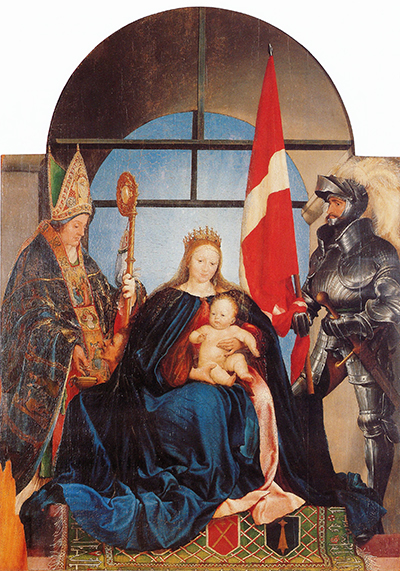
A naked child sits on his mother's lap between a richly vested bishop and a soldier in black armour. Above them, heavy bars cross a plain stone opening. Below, a patterned carpet carries two small coats of arms. Hans Holbein the Younger's Solothurn Madonna brings the sacred and the tangible close together: crown, crozier, polished metal, soft flesh and the weight of blue cloth all occupy the same narrow space.
Holbein painted the panel in 1522. It belongs to the Kunstmuseum Solothurn, whose current record identifies the medium as oil on limewood and gives the inventory number A I 134. Its modern name connects it with the city where it is preserved; the museum associates its commission with the Basel town clerk Johannes Gerster and his wife Barbara Guldinknopf. Its whereabouts went unrecorded for centuries before its rediscovery near Grenchen in 1864. [1] [2]
The family behind the commission is represented through heraldry; the Virgin's possible model remains disputed; and the wooden object has undergone substantial intervention. The painted gathering feels settled, while much about its journey remains open.
At a Glance
- Artist Hans Holbein the Younger.
- Title Solothurner Madonna , usually called the Solothurn Madonna in English.
- Date 1522.
- Medium Oil on limewood.
- Dimensions 143.5 × 102 × 3.7 cm, as recorded by the Kunstmuseum Solothurn.
- Collection Kunstmuseum Solothurn, Switzerland; inventory A I 134.
- Collection transfer Taken over from the Kunstverein Solothurn in 1879. [1]
- Subject Virgin and Child with St Martin, identified by the museum as the bishop, and St Ursus, the armoured saint. [3]
- Patronage The museum names Johannes Gerster and Barbara Guldinknopf; the precise original installation is less certain. [2]
This work across Hans Holbein the Younger’s career
Dead Christ in the Tomb
1521–22 [5]Sir Thomas More
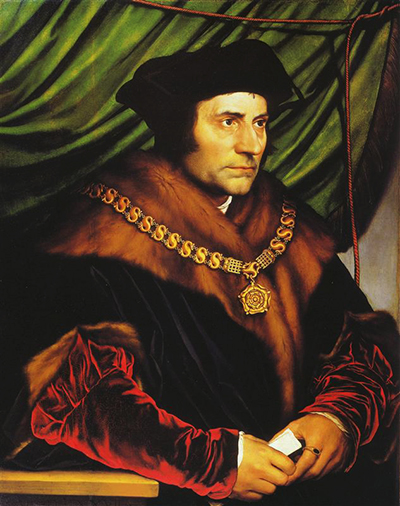
1527 [6]Georg Giese
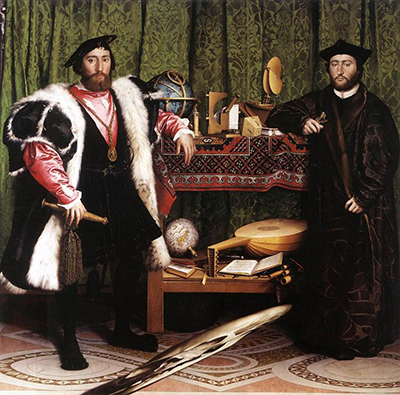
1532 [7]The Ambassadors
1533 [8]Contents
- A sacred gathering within reach
- St Martin and St Ursus
- Stone, cloth and the painted threshold
- The family behind the coats of arms
- A possible model in the Louvre
- Rediscovery, dispute and a public collection
- What happened to the wooden panel?
- Research continues around the painting
A sacred gathering within reach
The Virgin occupies the centre without filling the entire height of the painting. Her crowned head sits well below the highest point of the arch. The space above her is dark and almost empty, crossed by the straight lines of the bars. This interval gives the group room to breathe and makes the human figures seem more accessible than an uninterrupted tower of ornament would have done.
Mary's mantle spreads broadly across her knees and down towards the carpet. Its folds turn her seated body into the composition's stable base. The child sits above that mass of blue, his pale body clearly separated from the surrounding fabrics. His limbs bend and shift; Mary's hands steady him. The arrangement has the formality of a presentation, yet it retains the practical tenderness of holding a small child.
The two standing saints frame this central relationship. Their bodies are taller, their dress more elaborate and their bearing more upright. Neither overwhelms the Virgin. The bishop's crozier and the soldier's banner create narrow vertical accents on either side, while their heads turn towards the central part of the image. Looking from one figure to another produces a slow circular movement around mother and child.
The museum describes the painting as a sacra conversazione , or sacred conversation. The term refers to the gathering of the Virgin, Christ and saints within a shared pictorial setting. It need not mean that the figures are speaking. Here their presence together matters more than any visible exchange of words. [3] [10]
There is no crowd beyond them, no distant procession and no elaborate landscape to draw attention away. Small areas of blue sky appear through the opening, enough to establish an outside world. The saints and the Virgin nevertheless remain close to the surface, as if the arch has assembled them for a sustained encounter with the viewer.
St Martin and St Ursus
The saints are easiest to locate by the viewer's left and right. The bishop stands on the left; the armoured figure stands on the right. The Kunstmuseum Solothurn identifies them as St Martin and St Ursus, describing Ursus as the city's patron saint. [3]
Martin wears a tall mitre, patterned vestments and an ornamental clasp. His crozier rises beside Mary's shoulder. The garments gather into dense, coloured folds that make his body appear wrapped in layers. Near the lower left edge, a much smaller human head enters the scene beneath his arm. This detail is easy to overlook when the eye is first caught by the mitre or the golden staff. It introduces a second, humbler scale of human presence into the gathering.
Ursus has an entirely different surface. His armour is built from overlapping curved plates, with reflected light tracing the breast, shoulder, arm and leg. A pale plume rises behind the helmet. The red and white banner extends almost to the top of the arch, occupying the open space above him. His equipment gives him a strong silhouette even where the dark metal blends with the shadows.
The two saints balance one another through these different materials. Martin's outlines soften into fabric; Ursus's body is enclosed by hard, jointed forms. The bishop's staff curls; the soldier's banner pole runs straight upwards. Both stand beside the child with an authority expressed through clothing and equipment, while Christ's exposed body remains physically vulnerable.
Their presence also changes the way the Virgin's crown appears. It belongs to a group of honours and attributes, yet Mary's face is quieter and smaller than the surrounding display. Looking past the splendour brings the viewer back to the restrained centre: a lowered gaze, an infant's movement and hands giving support.
Stone, cloth and the painted threshold
The architecture is surprisingly plain. A broad arch curves above the figures, with little carved decoration to compete with them. Dark horizontal and vertical bars divide the opening into large areas. Their weight is suggested through blunt edges and deep colour. Holbein gives the setting a firm structure before filling its lower half with more flexible forms.
The arch also echoes the rounded top of the panel. Picture and painted architecture seem to belong together. The illusion is strongest at the edges, where the supporting stone rises beside the saints. The eye moves between a shaped wooden painting and an opening occupied by living figures.
At the base, the carpet offers another kind of order. Its repeated angular lines contrast with the broad, irregular folds above. The pattern crosses the foreground, then disappears under the Virgin's mantle and the surrounding forms. It helps establish a floor beneath the group without requiring a large stretch of empty pavement.
The two shields interrupt that pattern near the front. One has a red field; the other appears dark, with a pale upright emblem. Their placement makes them available to a close viewer while keeping them below the sacred figures. They belong to the painting's human history, embedded in the visual approach to Mary and Christ.
Colour helps the eye negotiate the compressed space. Blue holds the centre; warm red and pale pink appear around the child and within the mantle's lining; the banner repeats a stronger red above. The bright flesh is surrounded by deeper tones, so the child remains conspicuous even though he occupies a relatively small part of the panel.
The different textures reward a second look. Cloth has broad areas of light and shadow; armour breaks light into narrow streaks; the carpet carries small repeated marks. The differences make the gathering feel materially varied and give the eye several speeds at which to move.
Watch: Holbein’s portraits and working methods
Explore museum films on Holbein’s drawings, painted portraits and close-looking details.
Hans Holbein at the court of Henry VIII
A Royal Collection Trust film exploring Holbein’s work at Henry VIII’s court.
Watch on YouTubeThe family behind the coats of arms
The museum's 2025 collection leaflet names the commissioners as Johannes Gerster, a town clerk, and his wife Barbara Guldinknopf. It places the painting among the major works of Holbein's Basel period. [2] That connection gives the shields an immediate purpose for the modern viewer: they direct attention to the people for whom this religious image was made.
The family is not introduced through a pair of large kneeling portraits. Instead, the armorial signs occupy the foreground. Their position allows personal identity to enter the composition without adding another full-sized figure to the central gathering. The contrast is revealing. A viewer can respond to mother and child before noticing the household's presence at their feet.
Heraldry is evidence of connection, but it does not by itself explain every circumstance of a commission. The exact place where the panel originally stood and the prayers, commemorations or services associated with it cannot be reconstructed simply from the two shields. A religious painting could serve several overlapping purposes, and its later location does not settle its first destination.
It is therefore useful to distinguish the patronage named by the museum from a complete account of original function. The picture presents Mary and Christ with saints, and it carries signs of a particular family. Those features establish a devotional and personal framework. They leave room for questions about installation and use.
For a different arrangement of sacred figures and human patrons, Holbein's Darmstadt Madonna offers a useful comparison. The Solothurn painting has its own scale of intimacy: the donors' signs are small enough to be missed, yet deliberately placed where the viewer enters the image.
A possible model in the Louvre
A drawing in the Louvre brings the Virgin's face into a more complicated discussion. Catalogued as Portrait of a Young Woman in Bust, Smiling , INV 20737 recto, it carries the tentative date about 1520–1522. The Louvre records Alfred Woltmann's 1874 proposal that it was a study for the Virgin in the Solothurn Madonna . It also records that identifying the model as Holbein's wife, Elsbeth, has been widely challenged since 1954. [11]
The drawing and the painting should therefore be connected as a scholarly proposal, with the sitter's name left uncertain. The attraction of the relationship is understandable: the lowered gaze and restrained expression offer a way to think about a face observed from life becoming part of a sacred image. A resemblance, however, cannot supply a secure biography for the woman.
The Louvre also summarises Christian Müller's suggestion that some of the drawing's added washes, ink and white highlights could have helped transform a portrait into a model for further use. That is a proposal about the sheet's development, not proof of an uninterrupted sequence from a named sitting to the finished Madonna. [11]
The distinction matters when looking at Mary's face. A painted Virgin can retain individual features while serving a religious role. Recognising that possibility makes the image more human without requiring the viewer to identify every sacred figure with a member of the painter's household. The related Head of a Woman deserves attention as a drawing with its own history, not only as a key to this panel.
Rediscovery, dispute and a public collection
The modern story begins in 1864 at the Allerheiligenkapelle, the Chapel of All Saints, near Grenchen. The Kunstmuseum Solothurn's collection leaflet names Franz Anton Zetter and Frank Buchser in the painting's rediscovery and acquisition. It also acknowledges the long legal dispute with Grenchen before the panel remained in Solothurn. [2]
Recovery brought new obligations as well as prestige. In its 2019 history, the Kunstverein Solothurn explains that Zetter gave the restored painting to the association in 1869 on condition that its restoration costs be repaid. After his death, his heirs sought settlement of a debt of 12,000 francs. Unable to pay, the association transferred its collection to the municipality in 1879, which took over the debt. The collection then became public municipal property. [12]
This history gives the familiar museum credit line an unexpected depth. The statement that the painting was taken over from the Kunstverein in 1879 marks a change in ownership shaped by the costs of preserving it. [1] [12] Rediscovery was followed by negotiation, treatment and financial difficulty before the work acquired the institutional home associated with its modern name.
The museum also connects the panel's recovery with the eventual creation of a municipal museum. [3] Its importance in Solothurn consequently reaches beyond the position it occupies on a gallery wall. A religious commission from Holbein's Basel years became a reason for later viewers to organise, pay for and argue over public access to art.
What happened to the wooden panel?
The painting's restoration history concerns its physical structure as well as its appearance. Ulrich Schiessl's study in the Getty Conservation Institute's The Structural Conservation of Panel Paintings describes treatment by Andreas Eigner in Augsburg between 1865 and 1867. Eigner reported a complete transfer, but Schiessl states that approximately two to three millimetres of the original support remained. The treatment was therefore a partial transfer, reinforced with additional wood. [13]
Schiessl also records treatment by Thomas Brachert at the Swiss Institute for Art Research in 1971–1972. Eigner's added support was removed and replaced by a reinforcement of balsa blocks. [13] These details explain why a painting catalogued as oil on limewood is more than an untouched sixteenth-century board carrying an unchanged layer of paint.
A partial transfer preserves a thin portion of the old support while substantially changing what carries it. That is a major intervention in the object, even when it is invisible in an ordinary frontal photograph. The smooth continuity of the composition can conceal a much less continuous material history.
Such knowledge encourages patient looking. The child, mantle and armour remain legible as parts of Holbein's design, but the panel has also passed through the hands of people trying to keep it intact. Its survival includes those decisions. A reproduction can show the arrangement vividly while revealing little about the structure behind the painted face.
Research continues around the painting
The Solothurn Madonna received a detailed technical examination in spring 2024 in connection with the Frankfurt exhibition Holbein and the Renaissance in the North . The Kunstmuseum Solothurn subsequently announced a lecture by Jochen Sander for 26 June 2025, presenting recent research. The notice documents the examination and the planned presentation; it does not publish the individual technical findings. [14]
That distinction leaves several questions open without diminishing the encounter with the work. New evidence may sharpen understanding of its making or later treatment. Meanwhile, the visible relationships remain available to every attentive viewer: the child against the blue mantle, the saints' contrasting dress, the strong bars overhead and the small family emblems below. Each belongs to a painting whose calm arrangement has endured a decidedly unsettled history.
Artworks directory
Explore paintings, drawings, prints and designs, including works without a separate article. Related studies and versions have their own entries; workshop works and copies are labelled. Print designs and series are grouped rather than repeated for every impression.
Frequently Asked Questions
The Kunstmuseum Solothurn identifies the bishop on the viewer's left as St Martin and the armoured figure on the right as St Ursus, Solothurn's patron saint. [3]
That identification is disputed. The Louvre records both a proposed relationship between its Head of a Woman and the Madonna and the longstanding challenge to naming the model as Elsbeth. [11]
Schiessl describes Eigner's nineteenth-century intervention as a partial transfer: a thin layer of the original wood remained. Later structural treatment took place in 1971–1972. [13]
Discussion
Look again at the images and ideas explored in Solothurn Madonna by Hans Holbein the Younger. These editorial prompts invite your observations.
Reader Insights
Follow the child's limbs and Mary's supporting hands. How does their movement affect the stillness of the larger group?
Compare the bishop's patterned garments with the soldier's reflective armour. Which draws your attention first, and which holds it longer?
Look for the two shields near the carpet's front edge. How does noticing them change your sense of who the painting addresses?
Join the Conversation
What most shapes your response to the Solothurn Madonna : the closeness of mother and child, the saints' imposing presence or the knowledge of the panel's recovery and restoration? Share the detail that first made you look again.
References
- Kunstmuseum Solothurn , Solothurner Madonna , 1522, collection record A I 134 (in German). View source .
- Kunstmuseum Solothurn , We Care! , gallery leaflet, 21 September 2025–1 January 2026, section for room 13 (in German). View source .
- Kunstmuseum Solothurn , Altmeistersammlung , collection introduction, including the identification of St Martin and St Ursus (in German). View source .
- Kunstmuseum Basel, Bildnis des Bonifacius Amerbach, 1519, inventory 314 (in German) . View source .
- Kunstmuseum Basel, Der tote Christus im Grab, 1521–22, inventory 318 (in German) . View source .
- The Frick Collection, Sir Thomas More, 1527, accession 1912.1.77, collection record . View source .
- Gemäldegalerie Berlin, Georg Gisze . View source .
- Susan Foister, The Ambassadors, The German Paintings before 1800 (2024) . View source .
- Susan Foister, Christina of Denmark, Duchess of Milan (2024) . View source .
- Kunstmuseum Solothurn , Hörbilder , introduction to the Solothurner Madonna with narration by Klaus Merz (in German; introductory text, not an audio transcript). View source .
- Musée du Louvre , Portrait de jeune femme en buste, souriant , INV 20737 recto, collection record and catalogue commentary, updated 25 April 2025 (commentary in French). View source .
- Kunstverein Solothurn , Patricia Bieder and Anna Bürkli, Fortsetzung folgt: Geschichten zur Sammlung des Kunstvereins Solothurn , 2019, pp. 11–12 (in German). View source .
- Ulrich Schiessl / Getty Conservation Institute , “History of Panel Painting Conservation in Austria, Germany, and Switzerland”, in Kathleen Dardes and Andrea Rothe, eds., The Structural Conservation of Panel Paintings , 1998, p. 223 and fig. 19. View source .
- Kunstmuseum Solothurn , Die Solothurner Madonna unter der Lupe , announcement of Jochen Sander's lecture, 26 June 2025 (in German). View source .
- Würth Collection, Holbeins Schutzmantelmadonna, inventory 14910, current owner account (in German) . View source .
- Metropolitan Museum, Dance of Death series . View source .
- Kunstmuseum Basel, Bildnis der Frau des Künstlers mit den beiden ältesten Kindern, about 1528–29, inventory 325 (in German) . View source .
- Kunsthistorisches Museum Wien, Next Generation, Jane Seymour, about 1536–37, inventory 881 (in German) . View source .