by
Tom Gurney
Tom Gurney BSc (Hons) is an art history expert with over 20 years experience
Email:
tomgurney1@gmail.com
/ Phone:
+44 7429 011000
Portrait of Nicolaus Kratzer: Introduction
A bright, many-sided sundial rests in Nicolaus Kratzer’s hand. Against his expansive dark robe, its sharp edges and finely ruled faces catch the eye almost as quickly as his face. His other hand holds a small implement above the table. He has paused, but the objects around him keep the work in view: pointed tools, a straight rule, papers, a small circular dial and the larger instruments mounted behind his shoulder.
Holbein’s Portrait of Nicolaus Kratzer brings the making of instruments into the space normally occupied by a sitter’s attributes of rank. Painted in 1528, it shows Henry VIII’s astronomer as a practising maker, with a particular object under his fingers. The Louvre identifies the instrument as a ten-faced sundial and Kratzer’s age as forty-two. [1] The painting also records a meeting between two people whose work sometimes overlapped. Holbein and Kratzer collaborated on projects involving astronomical knowledge and visual design. [2]
At a Glance
- Artist Hans Holbein the Younger.
- Title Portrait of Nicolaus Kratzer ; the Louvre uses the French form Nicolas.
- Date 1528.
- Support Oak panel.
- Dimensions 83 × 67 cm, excluding the frame.
- Collection Musée du Louvre, Paris, Department of Paintings.
- Inventory number INV 1343; MR 751.
- Sitter Instrument maker and astronomer to Henry VIII.
- Age recorded Forty-two.
- Central object A polyhedral sundial with ten faces. [1]
This work across Hans Holbein the Younger’s career
Dead Christ in the Tomb
1521–22 [4]Sir Thomas More
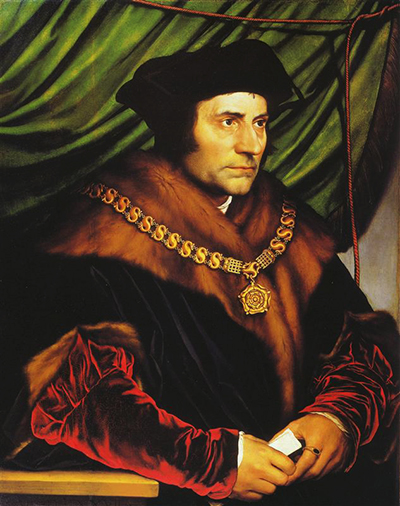
1527 [5]Georg Giese
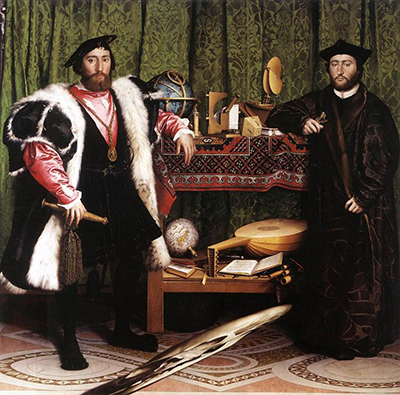
1532 [6]The Ambassadors
1533 [2]Contents
- A room arranged around the sitter
- The face and the direction of attention
- Hands that give the instrument scale
- Reading the tools without losing the painting
- The inscription on the table
- Holbein and Kratzer as collaborators
- Looking ahead to The Ambassadors
- A maker remembered through a portrait
A room arranged around the sitter
The figure occupies most of the narrow upright panel. Kratzer’s black cap spreads horizontally above his face, while the heavy robe widens into a broad base below. The outline is almost architectural: a firm upper edge, sloping shoulders and a mass of dark cloth that fills the foreground. Within that shape, the small white opening at his throat provides a sudden interval of light.
Behind him, the room divides into two unequal zones. A deep recess on the left holds instruments; the pale wall on the right carries a larger angular construction. The contrast gives the head a clear setting without isolating it against an empty backdrop. Objects enter the space at different depths, and the table slopes away beneath his hands.
The arrangement is busy at its edges but calm at its centre. The face has room to breathe. Holbein keeps its outline clear of the mounted instrument, even though the instrument’s long diagonals come close to the cap and shoulder. This is a carefully composed portrait rather than an indiscriminate inventory of a room.
The table also establishes our position. We can see down onto its surface, close enough to distinguish small implements and the sheets at the left. Yet Kratzer’s upper body rises almost level with us. The combination invites attention to his work while retaining the presence of a formal seated portrait. We encounter both a person and the working space that helps identify him.
The face and the direction of attention
Kratzer looks towards the right of the picture. His gaze passes beyond the table and outside the frame; he does not meet ours. His lips are together, and the mouth’s long, slightly uneven line supplies much of the face’s individuality. The broad cheek, prominent nose and light falling across the forehead are described with particularity rather than softened into an ideal head.
The cap helps us see those differences. Its broad, dark shape sets off the lighter skin, while the short fringe beneath it breaks the boundary between headwear and face. At the sides, the hair and ear add smaller irregularities to an otherwise strong silhouette. Holbein’s attention moves between large shape and minute distinction.
The gaze creates a quiet ambiguity. Kratzer might be listening or simply looking away from the object he holds; the image does not settle that question. What it does show is a separation between the direction of the eyes and the activity of the hands. His profession remains present even while his attention appears to move elsewhere.
This gives the portrait more duration than a straightforward demonstration would have. We can imagine the held object being turned again, or the tool returning to its surface, without being told the next action. The pause is visually persuasive because the hands retain their positions. It would be harder to recover a sense of work if the instrument had been set aside and both hands folded into the lap.
Hands that give the instrument scale
The two hands perform different tasks. One supports and steadies the sundial, with fingers curving around its upper edge. The other lies lower and farther forward, holding a small dark implement. The space between them opens the instrument towards the viewer. Its angled faces remain readable, while the touch of the fingers gives those faces a convincing physical size.
The supporting hand does more than identify ownership. It shows how an awkward, many-sided object can be held. The fingertips do not flatten into an emblematic gesture; they adjust to corners and edges. The instrument sits close to the body, sheltered by the robe, while the lower hand extends into the more crowded space of the tabletop.
Look at the relation between the broad sleeve and the exposed wrist. A large area of dark cloth narrows abruptly to the small zone where careful manipulation takes place. That shift in scale makes dexterity visible. The person occupies much of the panel, but the action depends on a few fingers and a fine point.
The two hands also give the eye a route through the lower picture. We move from the upper fingers onto the yellow faces, then down to the second hand and across the tools. The sundial becomes the hinge between figure and table. Its warm colour connects it to the tabletop, while its outline separates it sharply from the robe.
There is a sympathetic correspondence between this depiction of manual work and the act of painting it. Holbein translates tiny ruled marks, surfaces and finger joints into a coherent likeness. That correspondence is visible in the picture’s organisation; it need not imply that the painter left a coded statement about his own profession.
Watch: Holbein’s portraits and working methods
Explore museum films on Holbein’s drawings, painted portraits and close-looking details.
Hans Holbein at the court of Henry VIII
A Royal Collection Trust film exploring Holbein’s work at Henry VIII’s court.
Watch on YouTubeReading the tools without losing the painting
Several instruments can be identified more precisely than their outlines initially suggest. Susan Foister’s National Gallery catalogue recognises a cylindrical or shepherd’s dial, a quadrant and a semicircular dial behind Kratzer, as well as a small dial, rule and dividers on the table. [2] These names help distinguish the objects without requiring every viewer to reconstruct their operation.
The cylindrical dial stands upright in the shadowed recess at the upper left. Its compact vertical shape contrasts with the wide yellow curve beside it. Across the painting, the instrument mounted on the pale wall is more open: straight bars, projecting points and a curved scale leave the wall visible between their parts. Solid and skeletal forms balance one another across the head.
On the table, a small upright pointer rises from a low circular object. Nearby, long implements stretch sideways or cross at slight angles. Their spacing matters. They are sufficiently separated for us to recognise different shapes, yet close enough to suggest a shared working area. The papers introduce broad pale surfaces among the thin lines of the tools.
The held sundial rewards the closest attention. Its faces carry fine systems of lines, and the edges change direction as the form turns. Holbein makes the geometry clear through the junctions between surfaces. Colour alone would leave a flat yellow patch; changes of angle, shading and the placement of the hand turn that patch into a body.
It is useful to return from the instruments to the whole composition. Their straight lines and calibrated curves have a different rhythm from the folds of the robe. The tools give the surroundings a sense of exact division, while the cloth gathers into softer, less predictable forms. Kratzer’s body connects those two visual worlds. Precision belongs to a person who handles objects, rather than floating in the room as an abstract idea.
The inscription on the table
The Latin inscription identifies Kratzer as a Bavarian from Munich, describes a likeness made from life and dates it 1528. The Louvre confirms his age as forty-two, correcting an older reading of forty-one. [1]
The sheet is part of the painted room. It lies at an angle among other pieces of paper, close to the edge of the table. We approach its words as something within reach, while its function reaches beyond the moment represented. Face, name, origin, age and date are brought together in one object.
The statement that the likeness was made from life grounds the portrait in the living sitter. It does not tell us how many sittings took place, how quickly Holbein worked, or whether every instrument was painted with Kratzer present. None of those circumstances can be recovered merely by enlarging the inscription.
The paper also introduces a different kind of line from the scales on the instruments. Handwriting proceeds across the sheet in rows, while the sundial’s marks divide surfaces according to their changing orientation. Both invite reading, but in different ways. One identifies the man in words; the other makes his occupation tangible through a system of marks on an object.
Holbein and Kratzer as collaborators
The professional connection extended beyond this portrait. Foister records their work on a representation of the heavens for a temporary royal theatre at Greenwich in 1527, and on Kratzer’s Canones horoptri , instructions for an astronomical instrument, in 1528. [2] These projects help explain why a painter and an instrument maker might share practical concerns about how knowledge could be represented.
A surviving manuscript gives that relationship a material form. The Getty’s Holbein: Capturing Character exhibition checklist identifies Holbein as the illuminator of a title page with an initial E, dated 1528, from Kratzer’s Canones Horoptri . It records black and red ink, coloured pigment and gold on parchment, and locates the manuscript in the Bodleian Libraries, Oxford, as MS. Bodl. 504. [8]
That division of labour is revealing. Kratzer’s name belongs to the text, Holbein’s to the illuminated opening. Written explanation and visual elaboration could occupy the same manuscript without becoming interchangeable skills. The portrait similarly allows a viewer to recognise an expert through the appearance of the things he makes and handles.
The manuscript should also keep us from treating every object in the painting as a solitary invention. Expertise could involve books, drawn instructions, workshop practice and collaboration. The painting gathers one man’s identity into a compact scene, but the surviving title page opens a view onto work that passed between people and media. Kratzer appears here with his tools; elsewhere his instructions received a painter’s contribution.
Looking ahead to The Ambassadors
Five years later, instruments of related types appeared in The Ambassadors . Foister draws attention to the resemblance between the sundials in the two paintings and considers the possibility that Holbein reused studies associated with Kratzer. That remains a possibility, rather than proof of exactly how the later painting was planned. [2]
The comparison is most useful when we begin with the different place each picture gives its objects. Here, the sundial is held. Its size is measured against fingers, and its surfaces remain close to the maker’s body. The surrounding tools extend that relation into the room. We can read an occupation through an activity.
In the later double portrait, instruments occupy shelves between two standing men. Their relationship to the sitters is less immediately physical. They form a display that asks us to consider the objects together, along with books and musical instruments. A familiar shape can therefore do different work in a new composition.
Recognising the connection does not turn Kratzer into a universal explanation for the later picture. It gives us a more concrete starting point: Holbein had already painted someone engaged in making an astronomical instrument. Before searching for elaborate meanings in the apparatus of The Ambassadors , it helps to spend time with the hand, the edge and the ruled surface of this smaller portrait.
A maker remembered through a portrait
The portrait now belongs to the Louvre. [1] That museum setting changes the way we encounter the scene at the table. Its contents are close, modest in scale and spread out for handling. A museum encounter places the whole scene beyond our reach, behind the flat surface of a painting. We can inspect the tools visually, but the fingers remain the only parts of the image that touch them.
That distance increases the importance of the hands. They preserve the relation between an instrument and its user after the actual working occasion has disappeared. The bright sundial is not an isolated specimen floating on a neutral background. It belongs to the figure’s posture, the dark sleeve, the table edge and the direction of his attention.
Begin a second look with the face, then follow the downward movement to the instrument and out across the table. Finally, look back towards the two groups behind him. The portrait becomes richer through that movement between person and apparatus. Its exactness resides as much in those relationships as in the minute marks that first draw us close.
Artworks directory
Explore paintings, drawings, prints and designs, including works without a separate article. Related studies and versions have their own entries; workshop works and copies are labelled. Print designs and series are grouped rather than repeated for every impression.
Frequently Asked Questions
He was Henry VIII’s astronomer and an astronomical instrument maker. [1]
A ten-faced sundial, shown in the process of manufacture. [1]
Forty-two, according to the Louvre’s reading of the inscription. [1]
Their documented collaborations and the instruments shared by the two portraits make his involvement a serious question. Foister discusses possible access to Kratzer’s instruments or drawings, but the precise means by which Holbein prepared the later painting remain uncertain. [2]
In the Musée du Louvre, Paris, inventory number INV 1343. [1]
Discussion
Look again at the images and ideas explored in Portrait of Nicolaus Kratzer. These editorial prompts invite your observations.
Reader Insights
Kratzer’s eyes turn away while his hands retain the instrument and tool. How does that divided attention affect your sense of the moment?
Compare the sundial’s angular faces with the broad folds of the robe. Which makes you more aware of the other?
The identifying inscription lies on the table among the working objects. Consider how that placement differs from a label outside the painting.
Join the Conversation
Which detail first makes Kratzer’s profession clear to you: the instrument in his hand, the tools on the table, or the apparatus behind him? Share what you noticed and how it changed your reading of the portrait.
References
- Musée du Louvre , Portrait de Nicolas Kratzer (vers 1486-après 1550), astronome du roi d’Angleterre Henri VIII , 1528, INV 1343; collection record, description, inscription, dimensions and provenance (in French). View source .
- Susan Foister / The National Gallery , Jean de Dinteville and Georges de Selve (‘The Ambassadors’) , in The German Paintings before 1800 , 2024; sections on the setting, making and interpretation, including discussion of Kratzer’s portrait and collaborations. View source .
- Kunstmuseum Basel, Bildnis des Bonifacius Amerbach, 1519, inventory 314 (in German) . View source .
- Kunstmuseum Basel, Der tote Christus im Grab, 1521–22, inventory 318 (in German) . View source .
- The Frick Collection, Sir Thomas More, 1527, accession 1912.1.77, collection record . View source .
- Gemäldegalerie Berlin, Georg Gisze . View source .
- Susan Foister, Christina of Denmark, Duchess of Milan (2024) . View source .
- J. Paul Getty Museum , Holbein: Capturing Character in the Renaissance , exhibition checklist, 2021, entry 55, printed p. 11: Title Page with Illuminated Letter E , from Nikolaus Kratzer’s Canones Horoptri , Bodleian Libraries, MS. Bodl. 504. View source .
- Würth Collection, Holbeins Schutzmantelmadonna, inventory 14910, current owner account (in German) . View source .
- Metropolitan Museum, Dance of Death series . View source .
- Kunstmuseum Basel, Bildnis der Frau des Künstlers mit den beiden ältesten Kindern, about 1528–29, inventory 325 (in German) . View source .
- Kunsthistorisches Museum Wien, Next Generation, Jane Seymour, about 1536–37, inventory 881 (in German) . View source .