 by
Tom Gurney
Tom Gurney BSc (Hons) is an art history expert with over 20 years experience
Email:
tomgurney1@gmail.com
/ Phone:
+44 7429 011000
Sir Thomas More: the Portrait Drawings: Introduction
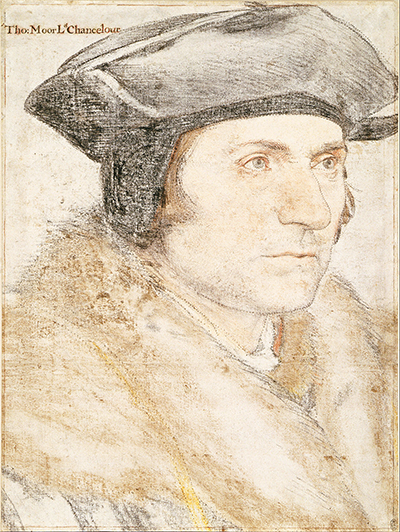
The cap is broad and dark; beneath it, Thomas More’s face appears almost weightless. Fine reddish lines hold the eyes, pale shadows turn the cheek, and the mouth closes with a slight unevenness. Around the neck, warm brown fur spreads into loosely worked clothing. Holbein’s 1527 drawing, Royal Collection RCIN 912268, has outlines pricked for transfer. A second sheet preserves the same sitter through a different handling of chalk and wash. [1] [2]
At a Glance
- Artist Hans Holbein the Younger.
- Principal drawing Sir Thomas More (1478–1535) , 1527.
- Medium Black and coloured chalks; outlines pricked for transfer.
- Dimensions 39.8 × 29.9 cm, sheet of paper.
- Collection Royal Collection, RCIN 912268. [1]
- Second drawing Sir Thomas More (1478–1535) , c.1526–27, black and coloured chalks with brown wash, 37.6 × 25.5 cm; Royal Collection, RCIN 912225. Its contours were traced with a stylus. [2]
- Related painting Holbein’s Sir Thomas More , 1527, oil on oak panel, Frick Collection, New York. [3]
This work across Hans Holbein the Younger’s career
Dead Christ in the Tomb
1521–22 [5]Sir Thomas More
1527 [6]Georg Giese
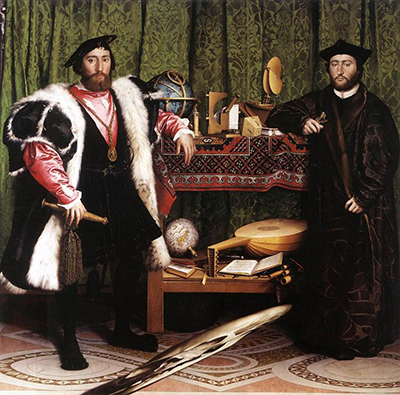
1532 [7]The Ambassadors
1533 [8]Contents
- Looking into the face
- Chalk, fur and unfinished spaces
- The second More drawing
- What the transfer marks reveal
- From the drawings to the painted portraits
- A drawing with a later history
Looking into the face
More turns towards the right of the sheet, and his gaze continues beyond its edge. The cap’s brim makes a firm horizontal over his forehead, while the broad crown rises and folds above it. Its darkness concentrates attention on the pale face. Look beneath the nearer eye: a small pocket of shadow helps establish the cheek without needing a heavy boundary around it.
The eyes are especially delicate. Reddish contours sit beside cooler touches in the irises, and the surrounding skin is described through slight variations of colour. The nose projects through an equally restrained combination of edge and shadow. Below, a short line of colour gives the mouth its shape; the chin meets the collar with scarcely more pressure than the cheeks.
Such details make the expression compelling without fixing it. The eyes can seem watchful, the mouth guarded, yet these are responses to a configuration of marks. A portrait cannot tell us exactly what a sitter was thinking. Here the small asymmetries between the eyes and the two sides of the mouth give us plenty to attend to before assigning an emotion.
Chalk, fur and unfinished spaces
The drawing changes pace as it moves away from the face. Wide strokes describe the cap, small restless marks suggest fur, and longer lines establish the lower garment. The collar’s broken edge is particularly effective: a few projecting hairs make its softness legible against the surrounding paper. The lightly indicated clothing leaves the likeness surrounded by an open, airy space.
Victoria Button’s technical study identifies the support as unprepared, creamy-white laid paper. She describes red and black chalk blended in the flesh, brown chalk in the hair and fur, and a yellow band indicating the chain. Untouched paper supplies light areas, including the whites of the eyes and the shirt collar. [10]
Compare the cap’s upper folds with the cheek. In the cap, dark strokes can remain conspicuous as strokes; the face needs much gentler transitions. Neither area has to imitate the smooth surface of an oil painting. The difference in handling lets cloth, skin and fur retain their own textures while belonging to the same head and shoulders. The untouched spaces are part of that effect: light paper can stand for a lit surface without being covered.
The second More drawing
The other sheet, RCIN 912225, repeats the turned head, hat and fur collar but has a noticeably lighter, more linear appearance. Its brown wash is part of the modelling, and its contours bear indentations from a stylus. The Royal Collection identifies it as a study for the More family portrait, while noting that its different appearance may reflect another stage in Holbein’s work. [2]
These distinctions are easy to lose when both images are reproduced under the same short title. The pricked drawing has the broader sheet and strongly worked cap; the second has traced contours and a narrower support. Their identifying inscriptions also differ. The upper-left inscription on the pricked sheet is eighteenth-century, whereas the second drawing carries a sixteenth-century identification near the top. [1] [2]
Having two versions invites comparison, but it does not establish which came first. The more lightly worked image need not be an earlier thought: a drawing made to carry outlines from one surface to another could require less description of texture.
Watch: Holbein’s portraits and working methods
Explore museum films on Holbein’s drawings, painted portraits and close-looking details.
Hans Holbein at the court of Henry VIII
A Royal Collection Trust film exploring Holbein’s work at Henry VIII’s court.
Watch on YouTubeWhat the transfer marks reveal
Pricking and tracing offer two ways of moving a design. In pouncing, powder passes through small holes along the outlines to leave a dotted pattern on another surface. A stylus can instead press along contours, producing a transferred line through an intervening sheet carrying chalk or charcoal. An intermediate paper could help protect the original drawing during either operation. [10]
The More sheets preserve evidence of these different actions: holes in RCIN 912268 and indented lines in RCIN 912225. Button cautions that the date of the pricking cannot be established with certainty. She also observes that the pricked sheet lacks the scattering of carbon powder expected from direct pouncing, and proposes the possible use of an intermediate sheet. [10]
The marks therefore tell us that the likeness was transferable, while leaving parts of its use unresolved. It would be too simple to imagine Holbein placing this exact sheet against a prepared panel and copying every feature in one operation. The connection has to be tested against the painted portrait itself.
From the drawings to the painted portraits
The Frick portrait of More dates from 1527. Its rich clothing and green curtain give the sitter a fuller setting than either drawing. [3] Comparing it with the pricked sheet, the familiar cap and turned face make the relationship immediately recognisable. Colour and finish change the experience: the drawing exposes separate marks and open paper, while the painting encloses the figure within a richly furnished rectangle.
Button’s comparison found that parts of the pricked drawing align with the painting, but the whole face does not match exactly. The second, traced drawing proved a closer fit. She suggests that it might have served as an intermediate pattern, or even have been traced from the painting. These remain proposals about the working sequence. They explain why resemblance alone cannot settle how a sheet was used. [10]
The More family portrait is lost, although Holbein’s composition drawing survives in Basel. [11] The Royal Collection’s account of the pricked drawing proposes that both larger More studies may initially have served the individual portrait, before the household commission. Its record for the traced sheet emphasises the family connection. [1] [2] Both drawings belong to the story of More’s portraits, but their precise roles overlap.
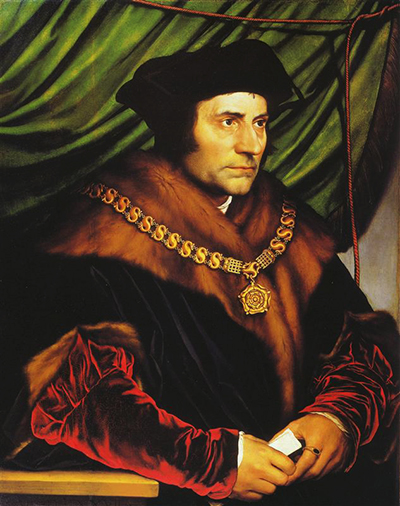
Hans Holbein the Younger, Sir Thomas More, 1527. Oil on oak panel, 74.9 × 60.3 cm. The Frick Collection, New York, Henry Clay Frick Bequest, 1912.1.77.
A drawing with a later history
The pricked sheet’s inscription calls More Lord Chancellor, an office he took in 1529, two years after its date. The lettering belongs to a later identification of the sitter. [1] It changes the way we first meet the portrait, bringing a later public title into an earlier likeness.
The drawings also have histories as collected objects. The main Holbein portrait group was documented in an album at Whitehall in 1547. It subsequently passed through several collections before Charles II acquired it. [11] The second More sheet may have joined that group later than most: its early inscription suggests a separate initial history. [2]
That distinction preserves a small but meaningful uncertainty. Two drawings now held together need not have travelled together throughout their lives. Their shared sitter connects them, while inscriptions, surfaces and transfer marks keep each sheet’s individual history in view.
Artworks directory
Explore paintings, drawings, prints and designs, including works without a separate article. Related studies and versions have their own entries; workshop works and copies are labelled. Print designs and series are grouped rather than repeated for every impression.
Frequently Asked Questions
The relationship is close, but direct transfer is uncertain. Button found differences between the pricked drawing and the painting’s underdrawing, and considered an intermediate pattern a possibility. [10]
Discussion
Look again at the images and ideas explored in Sir Thomas More: the Portrait Drawings. These editorial prompts invite your observations.
Reader Insights
Compare the broad strokes of the cap with the fine marks around the eyes. Where does the drawing become most convincing with the least material?
Look at the cap and nose in both sheets. How does the balance between contour and shading change your response to the face?
The same likeness could be studied, transferred and collected. Which surviving marks make you most aware of the drawing as a physical object?
Join the Conversation
Does the pricked drawing feel closer to an encounter with More than the finished painting does? Consider which details create that impression.
References
- Royal Collection Trust , Sir Thomas More (1478–1535) , 1527, RCIN 912268, collection record, including text adapted from Holbein to Hockney: Drawings from the Royal Collection . View source .
- Royal Collection Trust , Sir Thomas More (1478–1535) , c.1526–27, RCIN 912225, collection record. View source .
- Christopher Snow Hopkins, The Frick Collection , “Mapping Provenance: Holbein’s ‘Sir Thomas More’”, 15 October 2021. View source .
- Kunstmuseum Basel, Bildnis des Bonifacius Amerbach, 1519, inventory 314 (in German) . View source .
- Kunstmuseum Basel, Der tote Christus im Grab, 1521–22, inventory 318 (in German) . View source .
- The Frick Collection, Sir Thomas More, 1527, accession 1912.1.77, collection record . View source .
- Gemäldegalerie Berlin, Georg Gisze . View source .
- Susan Foister, The Ambassadors, The German Paintings before 1800 (2024) . View source .
- Susan Foister, Christina of Denmark, Duchess of Milan (2024) . View source .
- Victoria Button , The portrait drawings of Hans Holbein the Younger: function and use explored through materials and techniques , PhD thesis, Royal College of Art, 2013, pp.132, 142–143, 208–210 and 282–283. View source .
- Royal Collection Trust , Holbein at the Tudor Court , German exhibition text, “Holbeins Zeichnungen in der Königlichen Sammlung” and “Die Familie von Thomas More, 1526–27”, PDF pages 5 and 11 (in German). View source .
- Würth Collection, Holbeins Schutzmantelmadonna, inventory 14910, current owner account (in German) . View source .
- Metropolitan Museum, Dance of Death series . View source .
- Kunstmuseum Basel, Bildnis der Frau des Künstlers mit den beiden ältesten Kindern, about 1528–29, inventory 325 (in German) . View source .
- Kunsthistorisches Museum Wien, Next Generation, Jane Seymour, about 1536–37, inventory 881 (in German) . View source .