 by
Tom Gurney
Tom Gurney BSc (Hons) is an art history expert with over 20 years experience
Email:
tomgurney1@gmail.com
/ Phone:
+44 7429 011000
Sir Thomas Elyot: Introduction
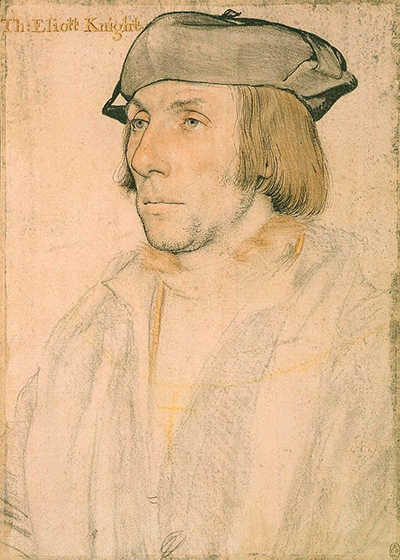
The face in Holbein’s drawing of Sir Thomas Elyot is held between two very different kinds of line. Above it, the cap has a firm, dark outline, its folded corners extending beyond the head. Below, the gown dissolves into pale strokes. Between them, small shifts of colour and shadow give the cheek, mouth and eyes their presence.
A slender chain descends over the chest to a crucifix. It is easy to overlook beside the strongly drawn head, yet it gives the lightly sketched body a point of focus. This portrait of a writer and diplomat, dated about 1535, is a companion to Holbein’s drawing of Margaret, Lady Elyot . [1] [2]
At a Glance
- Artist Hans Holbein the Younger.
- Title Sir Thomas Elyot (c.1490–1546) .
- Date About 1535.
- Medium Black and coloured chalks with black ink and white heightening on pink prepared paper.
- Dimensions 27.8 × 20.8 cm, sheet of paper.
- Collection Royal Collection, RCIN 912203.
- Format Bust-length portrait, turned three-quarters to the left.
- Companion Margaret, Lady Elyot , RCIN 912204. [1] [2]
This work across Hans Holbein the Younger’s career
Dead Christ in the Tomb
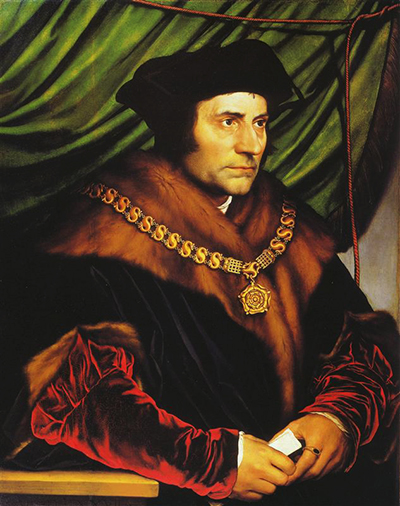
1521–22 [4]Sir Thomas More
1527 [5]Georg Giese
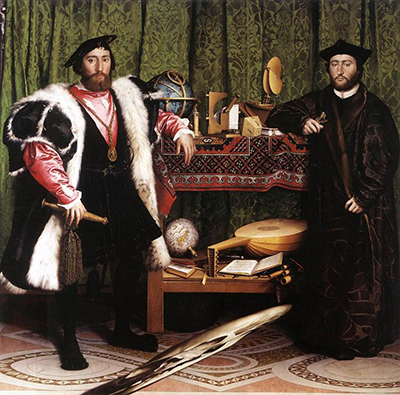
1532 [6]The Ambassadors
1533 [7]Sir Thomas Elyot (current article)
About 1535Contents
- The face beneath the cap
- Drawing with the colour of the paper
- A crucifix in the lightly sketched gown
- A learned man in royal service
- Facing Lady Elyot
The face beneath the cap
Elyot looks towards the left edge of the sheet. His eyes sit beneath softly indicated brows, with a darker accent at the nearer upper eyelid. The nose projects in a clear contour, while the mouth is almost horizontal. Short, scattered marks describe the beard beneath his lower lip and around his chin. These details give the face a particular texture without making every part equally sharp.
The hair offers a different rhythm. Long strokes descend beside the cheek, then turn under at the ends. Its broad shape is easy to grasp, but individual strands interrupt the smoothness. Beside the ear, darker lines gather into a small, curled passage. Across the face, by comparison, the transitions are quieter: warm colour spreads over the cheek and fades towards the jaw.
The cap supplies a strong upper boundary. Its wide crown seems flattened between the dark edge above and a curved line over the forehead. The projecting folds make the headwear appear broader than the face. This contrast gives the portrait weight at the top while leaving the lower body comparatively open.
Drawing with the colour of the paper
The pink surface belongs to the paper’s preparation. The Royal Collection identifies chalks, black ink and white heightening, with the additional ink and white used in the face. [1] These materials allow a range from powdery shading to more decisive accents.
Conservators Rachael Smith and Victoria Button explain that Holbein’s prepared pink papers provided a middle tone from which he could work towards both light and shadow. The drawings could gather information for potential paintings or miniatures, and their materials suited work carried out in front of a sitter. [9]
Here, the quieter areas remain as necessary as the dark ones. Around the throat and upper chest, a few curved and diagonal marks suggest clothing without enclosing it in a solid shape. Farther down, the pink ground becomes increasingly prominent. The passage from the closely observed features to the faint gown lets us watch the drawing change its degree of attention.
Watch: Holbein’s portraits and working methods
Explore museum films on Holbein’s drawings, painted portraits and close-looking details.
Hans Holbein at the court of Henry VIII
A Royal Collection Trust film exploring Holbein’s work at Henry VIII’s court.
Watch on YouTubeA crucifix in the lightly sketched gown
The chain follows the opening of the gown and extends down the chest. Its yellow colour catches the eye against the subdued clothing; the small crucifix gives the descending line a destination. The Royal Collection specifically identifies the ornament as a crucifix. [1]
Its handling differs from that of the face. The pendant is lightly indicated, while the head carries a much fuller account of volume and surface. Even so, the ornament helps organise the bust. It bridges the carefully developed upper portion and the sparse lower marks, keeping the eye moving down through the portrait.
The crucifix remains legible within an abbreviated costume. Its presence alone does not establish a precise religious or political position; the portrait leaves the circumstances of its inclusion unexplained.
A learned man in royal service
Elyot’s work brought classical learning into practical English prose. His The Boke named the Governour , first published in 1531, addressed political instruction through classical literature. He also produced a Latin–English dictionary and a medical handbook. As a diplomat he served as ambassador to Charles V. [1]
That combination of scholarship and public service gives useful context to the sitter. Holbein includes no open book, writing desk or papers. Elyot appears through his face, dress and ornament, with no surrounding scene to advertise his publications. Knowing about the books changes our recognition of the man while leaving his expression open to us.
Facing Lady Elyot
Margaret à Barrow married Thomas in 1520; the couple belonged to Thomas More’s learned circle. Her portrait matches this sheet in size and turns in the opposite direction. [2] Seen together, the two heads face inwards, giving each sitter’s outward gaze a counterpart.
This puts Margaret on the viewer’s left, reversing the more usual male placement. The Royal Collection reports Susan Foister’s suggestion that her drawing was made first and Thomas’s added afterwards to create the pair. This is a proposed sequence, not a documented order of sittings. [2]
The date is also approximate. Margaret’s paper, and possibly Thomas’s, matches that used for Holbein’s drawing of Sir Nicholas Poyntz, supporting a date around 1535. The inscription naming Thomas at the upper left was added in the eighteenth century, copying a mid-sixteenth-century original. [1] The written name and the drawn likeness therefore belong to different moments in the sheet’s history.
Artworks directory
Explore paintings, drawings, prints and designs, including works without a separate article. Related studies and versions have their own entries; workshop works and copies are labelled. Print designs and series are grouped rather than repeated for every impression.
Frequently Asked Questions
Elyot, who lived from about 1490 to 1546, was an English writer and diplomat. His best-known book is The Boke named the Governour , published in 1531. [1]
It is a drawing on pink prepared paper. Holbein combined black and coloured chalks with black ink and white heightening. [1]
The Royal Collection identifies it as a crucifix. Its pale yellow lines remain visible within the lightly sketched gown. [1]
The sheets form a pair, but simultaneous sittings are not established. Susan Foister has suggested that Margaret’s portrait preceded her husband’s; the Royal Collection reports this as a hypothesis. [2]
Discussion
Look again at the images and ideas explored in Sir Thomas Elyot. These editorial prompts invite your observations.
Reader Insights
Compare the dark outline of the cap with the scattered marks of Elyot’s beard. How does each kind of line suggest a different surface?
Follow the chain towards the crucifix. Does this small object change how you read the almost empty lower half of the sheet?
Place Thomas’s likeness beside Margaret’s in your mind. Which similarities connect the drawings, and which details keep the two sitters distinct?
Join the Conversation
Where does Elyot’s likeness feel most immediate to you: in the eyes, the uneven beard, the turned ends of the hair or the firmly folded cap?
References
- Royal Collection Trust , Sir Thomas Elyot (c.1490–1546) , c.1535, RCIN 912203, collection record. View source .
- Royal Collection Trust , Margaret, Lady Elyot (d. 1560) , c.1535, RCIN 912204, collection record; includes Susan Foister’s proposed sequence for the pair, from Holbein and England (2004), p.227. View source .
- Kunstmuseum Basel, Bildnis des Bonifacius Amerbach, 1519, inventory 314 (in German) . View source .
- Kunstmuseum Basel, Der tote Christus im Grab, 1521–22, inventory 318 (in German) . View source .
- The Frick Collection, Sir Thomas More, 1527, accession 1912.1.77, collection record . View source .
- Gemäldegalerie Berlin, Georg Gisze . View source .
- Susan Foister, The Ambassadors, The German Paintings before 1800 (2024) . View source .
- Susan Foister, Christina of Denmark, Duchess of Milan (2024) . View source .
- Rachael Smith and Victoria Button, Royal Collection Trust , Holbein’s portrait drawings , sections on the drawings’ purpose, prepared paper, chalk and costume. View source .
- Würth Collection, Holbeins Schutzmantelmadonna, inventory 14910, current owner account (in German) . View source .
- Metropolitan Museum, Dance of Death series . View source .
- Kunstmuseum Basel, Bildnis der Frau des Künstlers mit den beiden ältesten Kindern, about 1528–29, inventory 325 (in German) . View source .
- Kunsthistorisches Museum Wien, Next Generation, Jane Seymour, about 1536–37, inventory 881 (in German) . View source .